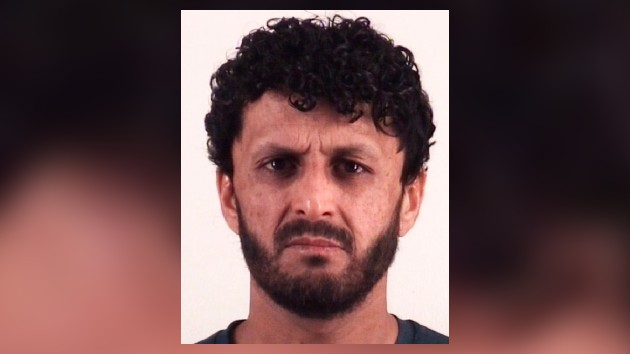
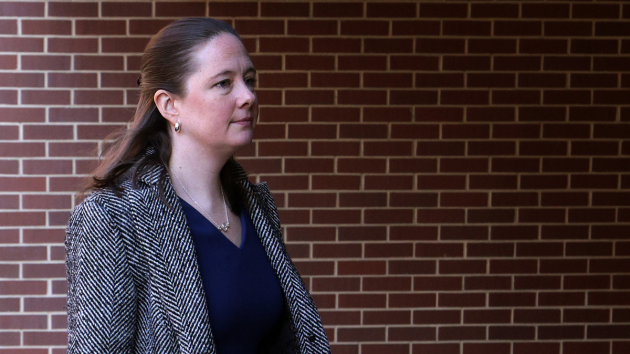
Mohammad Alokozay is shown in this Nov. 25 2025, booking photo. Tarrant County Corrections Center
(FORT WORTH, Texas) — Homeland Security said investigators arrested an Afghan national who allegedly made a social media post about “building a bomb” and threatened to blow up a building in Fort Worth, Texas.
Mohammad Dawood Alokozay’s arrest took place on Nov. 25, Tricia McLaughlin, an assistant secretary with DHS, said in a social media post Saturday.
Alokozay was arrested on state terror charges and is being held at a corrections center in Tarrant County, Texas, according to court records. He was hit with federal charges of transmitting a threatening communication in interstate commerce.
After his arrest one week ago, Alokozay confirmed to investigators that he made the statements in the video and that he deleted his TikTok account after being contacted by people who had seen his comments shared on social media, according to the criminal complaint unsealed Tuesday.
“He concluded that he was not afraid of deportation or getting killed,” prosecutors said in their criminal complaint. “When asked why Alokozay came to the United States, he responded that it was to kill the others on the call. Alokozay stated he wanted to conduct a suicide attack on Americans, too.”
It is not immediately clear when Alokozay will make his first appearance in federal court.
Alokozay’s arrest came just a day before two National Guard members were allegedly shot by another Afghan national — 29-year-old Rahmanullah Lakanwal– in Washington, D.C.
One of the Guard members, U.S. Army Specialist Sarah Beckstrom, later died from her injuries. Lakanwal is now facing a first-degree murder charge.
McLaughlin alleged in an X post that Alokozay “posted a video of himself on TikTok indicating he was building a bomb with an intended target of the Fort Worth area.”
“He was arrested on Tuesday by the Texas Department of Public Safety and FBI JTTF and charged with making Terroristic Threats,” she added.
Attorney information for Alokozay was not immediately available.
McLaughlin said Immigration and Customs Enforcement has lodged a retainer for Alokozay.
-ABC News’ Jenna Harrison contributed to this report.
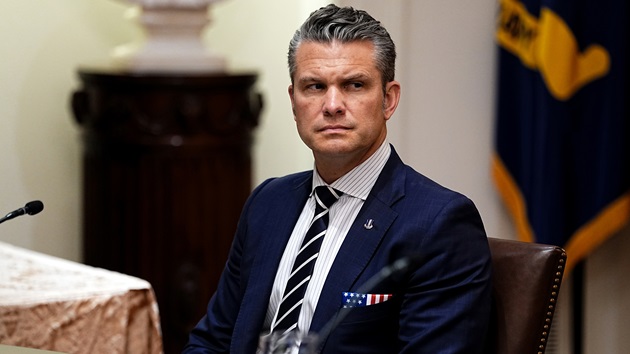
Pete Hegseth, US secretary of defense, during a meeting in the Cabinet Room of White House in Washington, DC, US, on Friday, Nov. 7, 2025.
(WASHINGTON) — Defense Secretary Pete Hegseth and a top military commander are facing serious questions about why the U.S. on Sept. 2 killed survivors of a military strike against a suspected drug boat, when the laws of war say survivors on the battlefield should be rescued.
The White House acknowledges that a second strike was ordered on a boat already hit by the military in the Caribbean Sea, and ABC News has confirmed that survivors from the initial strike were killed as a result.
Democrats say that alone could be enough to suggest a war crime occurred. The laws of war require either side in a conflict to provide care for wounded and shipwrecked troops.
Hegseth told Fox News the day after that he watched the operation unfold in real time and defended it as legal. He appears to be leaning on the same legal playbook carved out during the war on terror, in which the U.S. justified the killing of people transporting weapons that it said posed a threat to U.S. forces.
“We’re going to conduct oversight, and we’re going to try to get to the facts,” Sen. Roger Wicker, the Republican chairman of the Senate Armed Services Committee, told reporters on Monday. “And to the extent that we’re able to see videos and see what the orders were, we’ll have a lot more information other than just news reports.”
Here are three key questions about the orders to kill drug smugglers:
What did Hegseth order exactly?
A key question for lawmakers is what Hegseth’s initial “execute order” included and what intelligence was used to justify it.
According to The Washington Post, sources say Hegseth told the military to ensure that none of the 11 passengers aboard the boat should be allowed to survive. After the initial strike left two people clinging to the wreckage, the Post says, Adm. Mitch Bradley made the decision as head of the Joint Special Operations Command to launch a second strike to fulfill Hegseth’s initial order to kill everyone.
Hegseth called the report a “fabrication,” while his chief spokesman, Sean Parnell, said the allegations were a “fake news narrative that Secretary Hegseth gave some sort of ‘kill all survivors’ order.”
The Pentagon declined to answer questions though about what was included in Hegseth’s initial order.
On Monday, White House press secretary Karoline Leavitt would confirm only that a second strike occurred and didn’t address a question about survivors. When asked if Adm. Bradley had made the decision on his own, Leavitt suggested that was accurate, replying “And he was well within his authority to do so.”
Why did Adm. Bradley order subsequent strikes after seeing survivors?
Several sources described Bradley, a former Navy SEAL, as a deeply experienced and widely respected commander. At the time of the Sept. 2 strike, Bradley had already spent time overseeing special operations missions in the Middle East under U.S. Central Command and had taken over Joint Special Operations Command, a global command devoted to preparing and executing special operations missions in some of the most challenging and complex operating environments.
When President Donald Trump nominated Bradley to take over U.S. Special Operations Command this fall, the Senate overwhelmingly approved his nomination by voice vote.
Eric Oehlerich, an ABC News contributor and former Navy SEAL who worked under Bradley’s command during the war on terror, said he has never seen Bradley push the bounds of the law.
Oehlerich said that if Bradley ordered subsequent strikes on Sept. 2, as the White House suggested, the decision would have relied on Hegseth’s initial order as well as findings by the intelligence community about why the alleged smugglers on the boats were a threat to the U.S.
Bradley also would have sought counsel from a military lawyer in the room, he said.
“There isn’t a single commander that’s sitting in a position of authority that does not have a lawyer as the closest person to him sitting there watching the entire time,” Oehlerich said.
The attack also would have been directly overseen by Hegseth himself, as he told Fox News on Sept. 3, saying he had watched it “live.” In a post on X on Monday, Hegseth suggested only that the operation was Bradley’s call.
“I stand by him and the combat decisions he has made — on the September 2 mission and all others since,” Hegseth wrote.
Bradley declined to comment but was expected to brief lawmakers later this week.
Who was killed? And were they a threat to the US?
Hegseth’s rationale for killing drug smugglers appears to be the same one used after 9/11 when Congress authorized the military to use force against targets linked to al-Qaida. That authority enabled commanders in places like Iraq and Syria to kill people transporting improvised explosive devices, which it said were an immediate threat to U.S. forces stationed in the region.
Earlier this year, President Donald Trump argued that people smuggling illegal narcotics were just as dangerous to Americans as al-Qaida terrorists. He declared several drug cartels would be deemed “foreign terrorist organizations.”
Legal experts have pushed back on the comparison of drug smugglers and al-Qaida or ISIS fighters. They also note that Congress hasn’t provided any kind of authorization for using force.
A key question remains as to who exactly is onboard the boats and what threat they posed exactly — an assessment that would have been done by the intelligence community and signed off on by Hegseth.
Rep. Jim Himes, the top Democrat on the House Intelligence Committee, said he is still waiting for information on the role U.S. intelligence played in the strikes and whether the attacks are having a strategic impact. Bradley was expected to brief House lawmakers on Thursday.
“If it is substantiated, whoever made that order needs to get the hell out of Washington,” said Sen. Thom Tillis, R-N.C. “And if it is not substantiated, whoever the hell created the rage bate should be fired.”
Luigi Mangione appears for the second day of a suppression of evidence hearing in the killing of UnitedHealthcare CEO Brian Thompson on December 02, 2025 in New York City. (Michael M. Santiago/Getty Images)
(NEW YORK) — A police officer who responded last Dec. 9 to a McDonald’s where witnesses said they may have spotted the man accused of killing a health care CEO testified Tuesday that he knew right away it was the suspect.
“I knew it was him immediately,” Altoona, Pennsylvania, police officer Joseph Detwiler testified about Luigi Mangione, who is accused of killing United Healthcare CEO Brian Thompson in New York City last year.
Mangione, 27, is in court Tuesday for the second day of a high-stakes hearing in his state criminal case, where his lawyers are fighting to bar prosecutors from using key evidence against him — including the alleged murder weapon and writings that prosecutors say amount to a confession — by arguing it was unlawfully seized when his backpack was searched without a warrant.
The backpack was searched by law enforcement as they arrested Mangione in Pennsylvania, five days after the fatal shooting of Thompson on a sidewalk in midtown Manhattan. Mangione has pleaded not guilty to killing Thompson.
Defense attorneys have alleged that Detwiler violated Mangione’s rights by questioning him for nearly twenty minutes without reading him his Miranda rights. They argue that mistake should justify barring prosecutors from introducing any testimony about the statements Mangione made to police that morning.
Recollecting the events of Dec. 9, Detwiler testified that he responded sarcastically when he got the dispatch call that a local McDonald’s manager reported a “male who looks like the NYC shooter.” He said he didn’t even turn on his police sirens when he drove to the McDonald’s because he “did not think it was going to be him.”
“I did not think it was going to be the person they thought it was,” he testified, though he noted his supervisor promised to buy him a “hoagie” if he “got the NYC shooter.”
“I said consider it done,” Detwiler testified.
An avid watcher of Fox News, Detwiler testified he saw the images of the murder suspect “a lot” and was familiar with the ongoing coverage of the high-profile assassination. Prosecutor Joel Seidemann walked through each of the photos of the suspect that circulated after the shooting; each time, Detwiler responded in a monotone voice that said he saw the pictures in the same place — Fox News.
“I saw a lot of Fox News and saw a lot of video and articles on the shooter. I saw the person’s picture many, many times prior to those five days — many times,” he said.
During Detwiler’s testimony, prosecutors for the first time played his body-camera footage from the morning of Dec. 9. The footage showed Detwiler and his partner casually entering the McDonald’s before turning right to the rear of the restaurant, where they found Mangione sitting at a table.
“What’s your name?” Detwiler asked in the footage.
“Mark,” Mangione said.
“Mark what?” Detwiler asked.
“Mark Rosario,” Mangione said.
“Someone called and said you were suspicious,” Detwiler said in the video. “Thought you looked like someone.”
Prosecutors on the first day of the hearing on Monday played for the first time security camera footage from inside the McDonald’s where Mangione was arrested, the 911 call placed by the store manager who expressed alarm that he “looked like the CEO shooter in New York,” and the minute-to-minute dispatch audio leading to his arrest.
“There’s a male in the store that looks like the NYC shooter,” a dispatcher said in a recording played in court.
The crux of Mangione’s argument is that his constitutional rights were violated when Pennsylvania police interrogated him before reading him his rights and searching his backpack without a warrant.
Defense lawyers allege that officers waited nearly 20 minutes after first approaching Mangione, extensively questioning him about his whereabouts without informing him of his right to remain silent.
They also allege that officers searched through his backpack — which allegedly contained a handgun, magazine, and his journal — without having a warrant.
Citing police body camera footage, they argue that officers searched Mangione’s backpack as early as 9:58 a.m. but waited until after 5 p.m. to seek a warrant. They have asked the judge to limit prosecutors from using the evidence because it was the “fruit” of an illegal search.
Prosecutors argue the arrest and search were conducted lawfully, and that the evidence overwhelmingly proves Mangione’s guilt.
If defense attorneys succeed in limiting the evidence seized from Mangione’s backpack and statements made during his arrests, they could severely undercut the prosecution’s case against the alleged murderer.
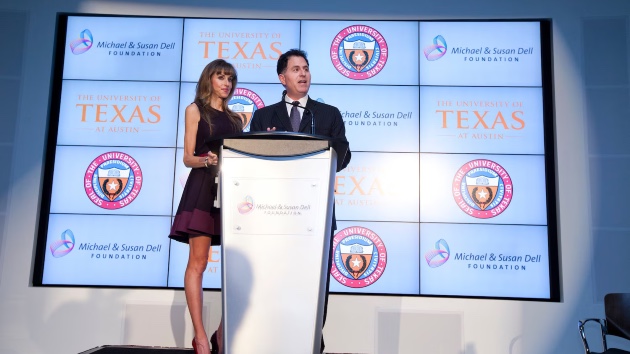
Michael Dell, CEO of Dell Computer, and wife Susan announce the donation of $50 million over 10 years to the University of Texas at Austin for the creation of a new Dell Medical School. (Robert Daemmrich/Corbis via Getty Images)
(NEW YORK) — In a major philanthropic move, billionaires Michael and Susan Dell are donating $6.25 billion dollars to deposit $250 into savings accounts for up to 25 million American children.
The announcement from the Dells, which was confirmed by a White House official, gives the funds to Invest America, which sets up a tax-advantaged investment account for American children starting at birth.
The so-called Trump Accounts are a key piece of President Trump’s signature tax and spending legislation, which passed earlier this year.
Under that law, the Treasury Department will give $1,000 to the accounts for children born between Jan. 1, 2025, and Dec. 31, 2028. Those accounts become the property of a child’s guardian and “will track a stock index and allow for additional private contributions of up to $5,000 per year,” according to the White House.
The donations from the Dells will supplement that federal funding, expanding the number of children who will qualify for accounts.
The more than $6 billion in funds from the Dells will go to “most children age 10 and under who were born prior to the qualifying date for the federal newborn contribution,” though Tuesday’s announcement adds that some children older than 10 may also be eligible if there is funding left over after the initial sign-ups.
There are still logistical questions about the donations, but the website for Invest America says sign-ups for the accounts are expected to open July 4, 2026.
“We’ve seen what happens when a child gets even a small financial head start – their world expands,” Michael Dell said in a video announcing the news.
Trump celebrated the move Tuesday morning, posting a link to a new article about the announcement and calling the Dells “TWO GREAT PEOPLE.”
“I LOVE DELL!!!,” Trump added in the social media post.
A White House official confirmed that Dell will join Trump at the White House Tuesday for the 2 p.m. announcement. White House spokesperson Kush Desai called the accounts “revolutionary investment by the federal government into the next generation of American children” in a statement about the donation.
“It’s also President Trump’s call to action for American businesses and philanthropists to do their part, too – Michael and Susan Dell’s $6 billion investment into America’s children is the first of many announcements to come for America’s children,” Desai added.
In June, Michael Dell attended a roundtable at the White House and spoke alongside Trump about how access to the savings accounts for American children will be a “simple yet powerful way to transform lives.”
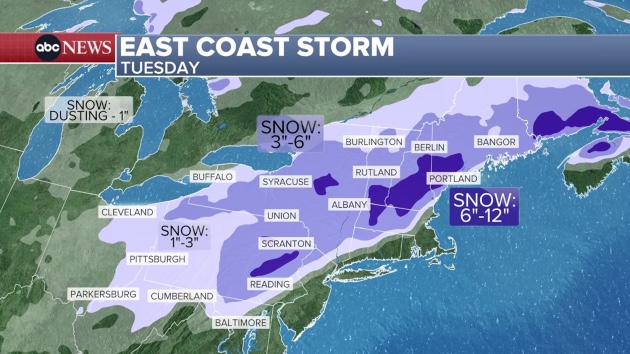
(NEW YORK) — A winter storm brought the first big batch of snow and ice to parts of the Midwest and South on Monday, and now that same storm is bringing ice to parts of Appalachia and heavy snow to the inland Northeast on Tuesday.
On Monday, the Kansas City area saw 3 to 5 inches of snow, while Louisville recorded around 3 inches of snow. St. Louis, Missouri, and Indianapolis both recorded about 2 to 4 inches of snow.
A glaze of ice wreaked havoc on roads in places like Oklahoma and Arkansas on Monday, and on Tuesday, that ice will be a major threat for cities including Boone, North Carolina, and Roanoke, Virginia.
On Tuesday, Ohio, West Virginia, Pennsylvania and western New York could see 2 to 4 inches of snow.
Winter weather advisories are in place in northern Pennsylvania and central New York, where 4 to 6 inches of snow is possible.
New Jersey Gov. Phil Murphy declared a state of emergency in several counties.
“With snow and rain in the forecast, we urge all New Jerseyans to be cautious of icy roads and walkways,” he warned on social media on Tuesday.
Cities directly along the East Coast will be warmer and will likely only get rain, but there is a brief chance for a morning wintry mix around Washington, D.C., that could cause disruption on roads.
A winter storm warning is in place from northeast Pennsylvania to central Maine, where more than 6 inches of snow is in the forecast. Some spots could even see snow totals of 9 to 12 inches.
By Tuesday night, the rain will be ending in New York City but ongoing in Boston, while snow will still falling from Albany, New York, through Maine.
(NEW YORK) — Children who have smartphones by age 12 are at higher risk of lack of sleep, obesity and depression, according to a new study published Monday in the journal Pediatrics.
What’s more, researchers found that the earlier a child received a smartphone, the greater their risk of developing these conditions.
Dr. Ran Barzilay, lead author of the study and a child and adolescent psychiatrist at Children’s Hospital of Philadelphia, told ABC News that many experts suggest parents should postpone the age at which children receive their first smartphone.
Barzilay said he and his colleagues wanted to examine whether not delaying smartphone use by children would lead to negative health outcomes. He also had a personal motivation behind the study.
“I have a nine-year-old who wants a phone, and I think [whether to get them a smartphone] is a question that is relevant for every parent of a kid going into adolescence, even before adolescence,” said Barzilay, who’s also an assistant professor at the University of Pennsylvania.
The study team – comprised of researchers from the University of Pennsylvania; University of California, Berkeley; and Columbia University – looked at data from more than 10,500 participants in the Adolescent Brain Cognitive Development Study, which is an ongoing study assessing brain development in children throughout adolescence.
Researchers analyzed data on children between ages 9 and 16, collected from 2016 to 2022, to test how smartphone ownership and the age at which a child or teen received their first smartphone affected their health outcomes.
The team found that compared to 12-year-olds who didn’t own a smartphone, those who did had a 1.3 times higher risk of depression, a 1.4 times higher risk of obesity, and a 1.6 times higher risk of insufficient sleep.
Additionally, the earlier the age at which a child received a smartphone, the greater the risk of developing the problems increased – by about 10% for each year earlier in age, starting as young as age 4 – compared to kids who received a device later or not at all.
The study also found that children aged 13 who did not have a smartphone at age 12 but acquired one within the last year also had worse mental health outcomes and poor sleep. This held true even when the researchers controlled for those factors.
“This was quite surprising, I must say,” Barzilay said. “I mean, we designed the study with a question in mind to try and test it, but to find it was quite compelling.”
Barzilay said that while the study only proves association, not causation, it adds to a growing body of evidence linking smartphone use among children to adverse health outcomes.
In a longitudinal review of studies by the American Psychological Association, the emphasis is not only to cut down on screentime – which is linked to socioemotional problems in children – but also to improve the quality and social interactions through screentime.
The team behind the new study, published in Pediatric,s recommended that parents, children and pediatricians have a thoughtful discussion to determine whether children are ready for a phone.
Barzilay said the study results aren’t meant to put blame on parents who gave their kids smartphones at age 12 or younger, noting that his older two children received smartphones prior to age 12.
He added that smartphones do have some benefits, such as increasing connectivity and access to information. However, Barzilay said parents can implement some rules to limit the potential harm smartphone use can cause. Those rules could include not allowing kids to use them in their bedroom at night, and making sure that their children participate in activities that do not require phone use.
As for Barzilay’s nine-year-old who wants a phone, he said they’re “not getting a phone anytime soon. Clear decision.”
(NEW YORK) — A social media commentator and blogger was found liable on Monday in a defamation lawsuit filed by hip-hop star Megan Thee Stallion in October 2024.
Milagro Cooper was found liable for defamation, intentional infliction of emotional distress and promotion of an altered sexual depiction, according to court documents obtained by ABC News.
Megan Thee Stallion, whose legal name is Megan Pete, testified that Cooper, who is known on social media as blogger Milagro Gramz, participated in a targeted and coordinated social media campaign to harass, intimidate and defame her.
Pete alleged Cooper was a “paid surrogate” for rapper Tory Lanez and spread lies on his behalf. Lanez was convicted of shooting and injuring Pete in a July 2020 incident.
“We’re thankful for the jury’s commitment to reinforcing the importance of truth, accountability and responsible commentary on social media,” Megan’s attorney, Mari Henderson, said in a statement. “This verdict sends a clear message that spreading dangerous misinformation carries significant consequences.”
Cooper is required to pay $75,000 in damages to Pete.
“I am not ecstatic, of course, you want things to go your way, but like I said, I respect the jury and what they decided, and I think I made out pretty good,” Cooper told reporters outside the courthouse on Monday, according to ABC affiliate WSVN.
“I am just happy to be moving forward; things will be handled. It wasn’t a multimillion-dollar verdict and I think that’s a blessing. God is good through and through,” Cooper added.
The lawsuit alleges that Cooper spread lies about Pete to punish her and attempt to discredit her after she publicly named Lanez as her shooter.
“She’s created a space for a lot of people to come speak negatively about me,” Pete said in trial testimony last month of Cooper, referencing social media posts where the blogger attacked Pete’s character, casting her as a liar and mentally unstable.
Cooper, who took the stand earlier in November, testified that as a blogger, she discussed the shooting on her social media accounts without the influence of Tory Lanez, whose legal name is Daystar Peterson.
But Cooper did acknowledge that she spoke with Peterson and was hoping to have him as a guest on her channel. She also testified that she received payments from Peterson’s father, Sonstar Peterson, but claimed they were for “personal” reasons like her children’s birthdays and “promotional” work.
The jury was shown social media posts in which Cooper claimed that Pete was not shot.
When asked if she believed that Pete was shot, Cooper said, “I can’t say she lied about that because I wasn’t there,” but then Cooper said that she believed that Pete was not shot and had stepped on glass — a claim that Pete made in her initial statement to police.
Peterson is not named as a defendant in Pete’s defamation lawsuit but was asked to give a deposition ahead of the trial. ABC News has reached out to his attorneys, but requests for comment were not immediately returned.
Peterson, who chose not to take the witness stand during the 2022 trial, pleaded not guilty and his defense attorneys argued during the trial that he was not the shooter.
Peterson was sentenced to 10 years in prison without the possibility of parole on Aug. 8, 2023, after he was convicted in December 2022 of felony assault for shooting and injuring Pete in both of her feet in an incident that occurred in the Hollywood Hills on July 12, 2020.
His legal team appealed his conviction, but it was upheld on Nov. 12 by a federal court in Los Angeles.
(NEW YORK) — Former federal prosecutor Maurene Comey and the Trump administration have not talked about settling her civil lawsuit and do not believe alternatives to a trial “would be useful at this time,” the parties told the judge in a letter on Monday.
Comey is suing over her firing, arguing she was “abruptly and wrongfully terminated” because her father is former FBI director James Comey, or because of her perceived political affiliation and beliefs.
In the letter, her lawyers and the U.S. Attorney’s office for the Northern District of New York, which is handling the case for the Justice Department, affirmed the need for a conference with the judge, which is currently scheduled for Thursday.
Comey wants the judge to order the government to begin producing evidence. Government lawyers are expected to ask the judge for time to file a motion to dismiss the case.
The defense said the proper place for Comey to argue is not in court, but before the Merit Systems Protection Board. Comey’s attorneys said her case presents “novel” issues about executive power that a judge must resolve.
“While there are cases that discuss a President’s authority under Article II to remove Principal Officers and Inferior Officers, we are unaware of any decision that discusses (let alone approves of) a President’s use of Article II authority to remove without cause a non-officer civil service employee such as a line-level Assistant United States Attorney, in direct violation of the CSRA and the Bill of Rights,” Comey’s attorneys, Nicole Gueron, Ellen Blain, Deepa Vanamali and Margaret Donovan wrote.
The defense characterized Comey’s case as routine.
“A federal employee’s claims that removal from federal service was arbitrary and capricious or conducted in a manner that did not provide the process to which they contend they were due is not a novel issue,” government attorneys said.
The letter said there are no meaningful settlement talks, and alternative dispute resolution mechanisms would be unhelpful at the moment.
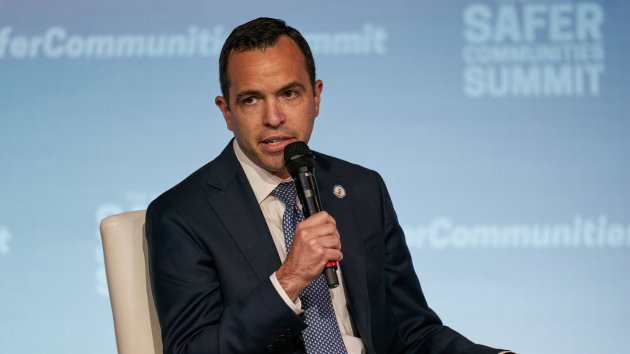
New Jersey Attorney General Matthew Platkin speaks at the National Safer Communities Summit in 2023. (Bing Guan/Bloomberg via Getty Images)
(NEW YORK) — A group of anti-abortion pregnancy centers in New Jersey is asking the Supreme Court on Tuesday to let it challenge an investigative subpoena from the state’s Democratic attorney general in federal court on grounds it violates the First Amendment.
First Choice Women’s Resource Centers, a faith-based organization that operates five locations across the state, claims the subpoena is part of a “hostile” campaign by Attorney General Matthew Platkin to harass the group and discourage people from supporting it.
The subpoena seeks thousands of pages of documents to determine whether the group “engaged in deceptive or otherwise unlawful conduct,” including the names and contact information of donors who may have wished to remain private.
“His demand for donor disclosure objectively chills First Choice’s associational and speech rights, causing its donors to think twice before supporting the faith-based non-profit,” the group’s attorneys argue in court filings.
Platikin insists he is pursuing a legitimate law enforcement inquiry and that First Choice has not yet been ordered by a state court to comply with the subpoena. (It is not self-executing, meaning there are no penalties for failure to comply in the meantime.)
“Non-profits, including crisis pregnancy centers, may not deceive or defraud residents in our State, and we may exercise our traditional investigative authority to ensure that they are not doing so — as we do to protect New Jerseyans from a range of harms,” Platkin said in a statement.
“The question before the U.S. Supreme Court focuses on whether First Choice sued prematurely, not whether our subpoena was valid,” he added. “I am optimistic that we will prevail.”
The case has potentially sweeping stakes for nonprofits and advocacy groups nationwide. If First Choice wins the ability to preemptively challenge the subpoena in federal court, it could make it easier for organizations to resist state investigations and strengthen the privacy of donors.
The dispute arose in the wake of the Supreme Court decision overruling Roe v. Wade and as states started drawing new battle lines over abortion.
Platkin pledged in 2022 to pursue enforcement actions aimed at promoting abortion access, which remains legal in New Jersey, and launched an investigation into First Choice on the belief that it may have engaged in false advertising and misled donors.
The attorney general issued a consumer alert in 2023 warning people with unplanned pregnancies that crisis pregnancy centers like First Choice don’t offer abortion as an option and may try to prevent a client from seeking medical information about ways to terminate a pregnancy.
“New Jersey’s attorney general is targeting First Choice — a ministry that provides parenting classes, free ultrasounds, baby clothes, and more to its community — simply because of its pro-life views,” said Erin Hawley, the attorney representing the group before the Supreme Court, in a statement.
“The Constitution protects First Choice and its donors from demands by a hostile state official to disclose their identities,” Hawley argued, “and First Choice is entitled to vindicate those rights in federal court.”
In a 2021 decision, the Supreme Court divided 6-3 along ideological lines to strike down a California law that required charities to privately disclose the identities of major donors to the state attorney general.
State officials had argued that the identities, which not-for-profit charities are allowed to keep secret from the public, would help enforce rules around tax-exempt status and catch potential fraud.
The New Jersey case, while similar, focuses primarily on where and when a targeted group can challenge an attorney general’s request in court.
After oral arguments Tuesday, the justices will draft an opinion in the case and release it sometime before the end of June 2026.
The logo for the Justice Department (Photographer: Eric Lee/Bloomberg via Getty Images)
(WASHINGTON) — An immigration judge who was fired by the Trump administration is suing the Department of Justice, alleging she is a victim of unlawful discrimination.
Tania Nemer, a former immigration judge in Ohio, filed a lawsuit Monday claiming she was dismissed based on her gender, her dual citizenship with the country of Lebanon, and her previous run for local office as a Democrat, in violation of civil rights law.
Nemer was “abruptly fired” in the middle of her probationary period despite receiving “the highest possible performance,” the lawsuit alleges.
“The lightning-fast, precipitous timing indicates that the incoming Administration’s decision was made — not as part of a careful evaluation of Ms. Nemer’s qualifications or fitness for office — but instead as part of a rushed attempt by the new Administration to target disfavored civil servants,” the complaint states.
The former Cleveland judge is among the more than 100 immigration judges who have been fired, resigned through the Department of Government Efficiency’s “Fork in the Road” offer, or transferred out of immigration adjudication, according to the union representing immigration judges.
Nemer’s attorneys said in the filing that she was escorted out of court at the time of her dismissal, and that Nemer’s supervisor and the acting chief immigration judge both said they did not know why she was being fired.
“And to this day, the government has failed to offer any coherent and legitimate nondiscriminatory rationale for her termination,” the lawyers wrote.
Shortly after she was fired, Nemer filed a formal discrimination complaint with an Equal Employment Opportunity office, which dismissed the case.
“The EEO office issued a final agency decision that dismissed Ms. Nemer’s complaint and asserted that Title VII does not constrain discriminatory dismissal against immigration judges because the statute purportedly conflicts with the Article II removal power,” according to the complaint.
“That is simply not true,” her attorneys said in the complaint. “Nothing in the Constitution gives the executive branch the right to discriminate.”
The lawyers called the DOJ’s position that it can fire federal employees without a reason — despite civil rights statutes — a “breathtaking assault on a landmark federal statute.”
According to the complaint, a DOJ official submitted an affidavit that detailed driving infractions involving Nemer, as well as two local tax cases from 2010 and 2011, which the former immigration judge alleged in the complaint that she had disclosed as part of a background check to become an immigration judge.
Nemer’s attorneys said in the complaint that the DOJ official “created the misleading impression that the prior infractions were somehow connected to Nemer’s termination.”
The former immigration judge is asking a court in D.C. for a “declaration that the government violated her rights; reinstatement; and compensatory damages.”