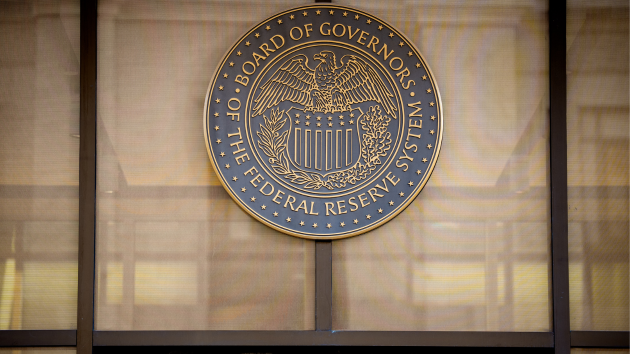
The Federal Reserve logo is visible on the William McChesney Martin Jr. Building on December 9, 2025 in Washington, DC. (Andrew Harnik/Getty Images)
(WASHINGTON) — The Federal Reserve is set to announce its latest adjustment of interest rates on Wednesday, potentially slashing borrowing costs for the third time this year in an effort to boost sluggish hiring.
Top officials at the Federal Reserve have displayed a rare degree of public disagreement over a possible interest rate cut. Inflation has picked up in recent months alongside the hiring slowdown, posing a risk of an economic double-whammy known as “stagflation.”
The Fed is stuck in a bind, since the central bank must balance a dual mandate to keep inflation under control and maximize employment. To address pressure on both of its goals, the Fed primarily holds a single tool: interest rates.
If the Fed holds interest rates steady as a means of protecting against tariff-induced inflation, it risks a deeper slowdown of the labor market. On the other hand, if the Fed lowers rates to stimulate the economy in the face of a hiring slowdown, it threatens to boost spending and worsen inflation.
“We have one tool,” Fed Chair Jerome Powell said at a press conference in Washington, D.C., in October. “You can’t address both of those at once.”
Lately, sentiment shifted in favor of a rate cut as some influential central bankers voiced openness toward the move, futures markets showed.
The chances of a quarter-point interest rate cut stand at about 87%, surging from a level as low as 30% last month, according to CME FedWatch Tool, a measure of market sentiment.
The prospects appeared to move in response to a murky jobs report and public statements from two allies of Powell on the committee charged with setting rates.
Last month, a jobs report for September sent mixed signals about the labor market. Employers added far more workers than expected in September, though hiring fell short of a breakneck clip. Meanwhile the unemployment rate ticked up to 4.4%, a low figure by historical standards but the highest recorded since October 2021.
New York Fed President John Williams, who is often in lockstep with Powell, days later voiced openness toward a rate cut, telling reporters he still saw “room for a further adjustment in the near term.”
Soon afterward, San Francisco Fed President Mary Daley took a similar position, telling reporters she sees room “for a further adjustment in the near term.” Daley, who isn’t voting on interest rates this year, is widely viewed as a supporter of Powell.
A quarter-point interest rate cut would reduce the Fed’s benchmark rate to a level between 3.5% and 3.75%.
That figure would mark a significant pullback from a peak in 2023. At the outset of the pandemic, interest rates stood at 0%.
Still, a reduction of interest rates could offer some relief for mortgage and credit card borrowers. Savers, however, stand to lose income as interest rates decline for accounts held at banks.
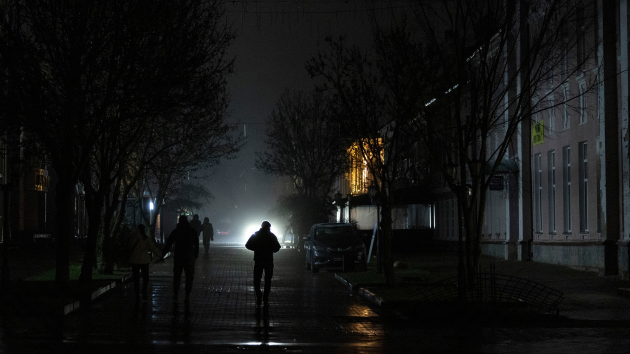
People walk through the streets of Sumy during emergency power cuts on December 9, 2025 in Sumy, Ukraine. (Maksym Kishka/Frontliner/Getty Images)
(LONDON) — Millions of Ukrainians have been plunged into frequent darkness and cold as Russian drones and missiles wage a systematic long-range campaign against the country’s energy grid for the fourth consecutive winter.
Even at the offices of Ukraine’s mammoth state-owned Naftogaz oil and gas conglomerate in Kyiv, emergency generators have been keeping the lights on.
“What I can see from my window — there is an absolutely dark city with only some lights,” CEO Sergii Koretskyi told ABC News during a video interview. “I’m sure people recognize this winter as the most difficult since the full-scale invasion started. We can see power cuts from four up to 10 hours a day.”
Russia’s nightly bombardments have increasingly targeted energy infrastructure in recent months, Ukrainian officials say, often involving hundreds of drones and dozens of missiles.
Ukrainian President Voloydmyr Zelenskyy has repeatedly appealed for more Western military aid to help blunt such strikes. “The Russians’ goal is to hurt millions of Ukrainians,” the president said in a social media post on Saturday.
Between October and December so far, Naftogaz recorded 11 “massive attacks on gas infrastructure across Ukraine,” Koretskyi said. “Our gas production infrastructure has suffered significant damage and destruction,” he added.
Naftogaz estimates the combined cost of covering its gas shortfall and repairing its production and storage infrastructure at more than $3 billion, Koretskyi said.
“We can see that the scale and intensity of strikes have changed dramatically,” Koretskyi added. This year’s bombardments have been even more punishing than those in the back end of last winter, he added, when Ukraine had 42% of its domestic gas production knocked out.
Throughout its full-scale invasion — which began in February 2022 following eight years of lower-intensity cross-border Russian aggression — Moscow has denied intentionally targeting civilians or civilian infrastructure.
The Russian Defense Ministry says it attacks Ukrainian fuel and energy targets that support the Ukrainian armed forces and Ukraine’s military-industrial enterprises.
Ukraine is also waging its own long-range strike campaign against Russian energy targets, particularly oil storage and refining facilities. Kyiv says the lucrative proceeds from Russian oil exports help fund Moscow’s ongoing invasion.
Koretskyi declined to say what proportion of the country’s gas production and storage capacities had been taken offline during this winter’s attacks, citing operational security and Moscow’s use of public statements and statistics to guide its strike campaign.
But virtually all of Ukraine’s regions now routinely face rolling blackouts, imposed to help protect the country’s grid while repairs are carried out, leaving millions with only hours of power.
Naftogaz says it supplies gas to 12.5 million households across Ukraine. Around 80% of the population using gas to heat their homes. Each night of Russian attacks threatens new blackouts for tens of thousands and sometimes hundreds of thousands of people.
“Their goal is clear — this is pure terrorism,” he said, “to put us into the darkness without heat during this winter season.”
Analysts have suggested that Western support could prove vital in helping Ukraine through this winter.
“Without substantial Western support — particularly air defense systems, transformers, and financial assistance for emergency repairs — blackouts are likely to be more regular, people will suffer in the cold, and economic activity may slow,” political consultant Kateryna Odarchenk wrote for the Center for European Policy Analysis this month.
Zelenskyy and his top officials have consistently pressed Western allies to provide more air defense systems and ammunition, to help Ukrainian defenders protect civilian centers, military sites and critical infrastructure.
Yuriy Boyechko, the CEO of the Hope For Ukraine charity, told ABC News that the current energy crisis is a result of inadequate air defenses in the face of “the relentless deluge of Russian missiles and drones.” He added, “The only viable solution is immediate, comprehensive air defense support from Western allies.”
The bombing has wrought holes in Ukraine’s energy network. As of December, Naftogaz estimated that Ukraine needed to import 4.4 billion cubic meters of gas through to the end of this heating season — which Ukraine’s government estimates will end by around March 31.
This is expected to cost some €1.9 billion — around $2.2 billion — Koretskyi said. Zelenskyy and his government have mobilized to secure the funding from foreign partners and financial institutions, but Naftogaz’s chief said a hole of around €600 million remains.
Kyiv is turning to private companies in gas-rich nations like the U.S. to help fill the gap. Companies require two permits to export natural gas — one from the Federal Energy Regulatory Commission and one from the Department of Energy.
This year already, more than 500 million cubic meters of American liquid natural gas (LNG) have been imported, with another 300 million cubic meters agreed for import earlier next year.
Through 2026, Koretskyi said, Ukraine would like to bring in another 1 billion cubic meters of American LNG. “We would like to build long-term relationships with U.S. LNG suppliers,” he said.
A recent agreement to import U.S. LNG through the Soviet-era Trans-Balkan pipeline running from Greece is also part of this drive, Ukrainian officials have said.
But as Russia’s attacks grow larger and more sophisticated, the cost and complexity of recovery grows. Naftogaz’s list of equipment needed for repairs is now 190 items strong, Koretskyi said. The estimated cost of this badly needed equipment is more than $900 million, he added.
“There are two lists of equipment — the first one for repairing or replacing those damaged or even destroyed, and the second is for a strategic reserve for upcoming potential attacks,” he explained. U.S. and European suppliers, Koretskyi said, could prove pivotal in filling the gaps.
“The lead time — of production time, delivery and installation — will take between eight and 18 months,” Koretskyi said. “So, we should be ready not just for this winter season, but for the next heating season.”
Meanwhile, the strikes and blackouts continue.
On Dec. 4, for example, the Kherson central heating plant in the southern frontline city was knocked offline after days of attacks by various Russian weapons systems. Kherson military administration head Oleksandr Prokudin said that disruption left more than 40,000 without heat.
“It’s like a nightmare,” Koretskyi said of life under rolling blackouts for many Ukrainians. “I do believe Ukrainians recognize the risk, the challenge, that Russia will continue bombing us.”
“Nobody can imagine what will happen in the coming months or weeks,” he added, suggesting that Ukrainians may have to summon reserves of resilience already tapped by almost four years of full-scale war.
“This is not a sprint, it’s a marathon,” Koretskyi said. “The war changes, upgrades and becomes different every day. The measures for survival, for protection, should be changed as well … That’s how we live.”
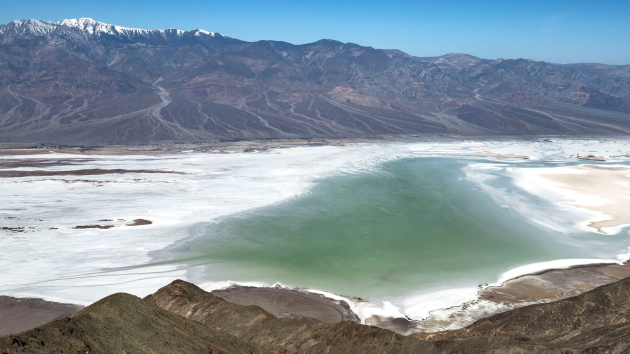
Badwater Basin, the site of Lake Manly, is viewed from Dante’s View showing the lake receding due to evaporation on April 21, 2024, near Furnace Creek, California. (George Rose/Getty)
(DEATH VALLEY NATIONAL PARK, Calif.) — An ancient lake that once existed at Death Valley National Park has reemerged after record rainfall in the region.
Several inches of water have formed in Badwater Basin, which lies at 282 feet below sea level, the lowest point in North America, according to a press release from the National Park Service.
During the Ice Ages, the basin — colloquially known as Lake Manly — was once a lake with depths of up to 700 feet.
Ice covered the Sierra Nevada between 128,000 and 186,000 years ago, allowing rivers to flow into a long valley that fed into Lake Manly, according to NASA. At the time, the lake measured nearly 100 miles long.
In modern times, the basin typically lies bare, without any significant moisture.
Death Valley just experienced its wettest fall on record, according to the National Weather Service. Between September and November, 2.41 inches of rain fell — more than what typically falls in the desert landscape in one year. November alone recorded 1.76 inches — breaking the record set in 1923 at 1.7 inches.
The lake is much more shallow than the one that formed in 2024 in the aftermath of Hurricane Hilary — an event that prompted the first tropical storm watch in California’s history.
On Aug. 20, 2024, alone, more than 2 inches of rain fell in Death Valley, according to the NPS.
This year’s rainfall will allow those who missed the last emergence of Lake Manly to see the rare phenomenon once again.
The water can’t drain out, since the basin is contained and at such a low elevation, said Andrew Heltzel, chief commercial officer of the Xanterra Travel Collection, an operator of lodges, restaurants and excursions at several of the most iconic national parks in the U.S., including Death Valley, Yellowstone and Grand Canyon.
“It’s almost impenetrable,” Heltzel told ABC News, describing the outskirts of the basin as “like a seal.”
The only way for the water to escape is through evaporation, which could take months.
When the water is present, it creates a stunning reflection of the surrounding mountain peaks.
“My advice would be to, if you are interested in seeing this, not to delay to get there,” Heltzel said. “It is getting smaller through evaporation every day.”
The “most exciting” aspect of the way the rain fell this time is that it could spark a superbloom of wildflowers in the spring, Heltzel said.
The pace and amount of rain that fell made for the “perfect ingredients” for a significant display of wildflowers to emerge, Heltzel said.
In 2024, too much rain fell too fast, and the soil was unable to absorb the moisture, Heltzel said.
“With the November rains, they came in gently enough that it was able to get into the ground and potentially give us those flowers as well as a second chance to see Lake Manly,” he said.
The last time a superbloom occurred was in 2016, according to the NPS.
The recent storms caused numerous road closures across the parks, with several paved roads covered in flood debris, according to the NPS. However, many of the park’s most popular sites remain open, including Zabriskie Point, Dantes View, Badwater Basin, and Mesquite Sand Dunes.
The National Park Service advised visitors to be aware that unpaved roads may be impassable due to storm damage and to be prepared for self-rescue when traveling on backcountry roads.
In February, Death Valley National Park will host the Dark Sky Festival, which can give visitors opportunities to sky gaze while also seeing Lake Manly, Heltzel said.
Death Valley has been designated as a Gold Tier Dark Sky Park, which signifies the highest rating of darkness, according to the NPS.
“The stargazing opportunities in Death Valley are second to none,” Heltzel said.
Al Azhar University in Gaza. (Diaa Ostaz/ABC News)
(GAZA STRIP) — After two consecutive years of war that upended nearly every aspect of life in the Gaza Strip, universities are slowly beginning to reopen, restoring a path to education despite extraordinary levels of destruction.
Before Oct. 7, 2023, Gaza had 17 higher-education institutions, comprising hundreds of buildings. Today, most of these facilities are in ruins, according to the Palestinian Ministry of Education and Higher Education.
More than 100 university buildings were destroyed during the war, while roughly 200 university employees were killed, the education ministry said. The devastation has raised doubts about whether higher education could resume at all. But at Al-Azhar University in Gaza, the administration and some students told ABC News they are determined not to let the war erase an entire generation’s future.
When ABC News visited the temporary campus where Al-Azhar has resumed in-person teaching, the damaged classrooms and improvised facilities reflected the depth of the crisis–yet they also highlighted the resilience of students returning with determination to continue their studies.
The university’s vice president, Dr. Muhammad Shubeir, said the decision to reopen was driven by necessity and by a sense of duty.
“During the difficult period of the war, we resumed the teaching,” online, Shubeir told ABC News. He said the staff worked from dangerous areas just to secure satellite internet. “We faced many risks, but thank God, we were able to continue until the war ended.”
As soon as conditions allowed, the administration said it moved toward restoring in-person learning, even though one of Al-Azhar’s largest campuses–its new facility in the Al Zahra area, which turned into the Netzarim corridor during the war — had been completely leveled.
“Despite losing everything at the university–especially the new campus that housed five colleges–we will begin anew with these buildings, gradually and voluntarily,” he told ABC News in an interview.
Shubeir said the university repeatedly stressed to all parties that it had no role in any conflict, and he recalled a phone call with an Israeli intelligence officer ordering the evacuation of the Zahra campus.
“Al-Azhar University is an academic institution that strives for a culture of peace, coexistence, and respect among all peoples,” Shubeir said. He said he reminded the officer that targeting educational institutions violates the Fourth Geneva Convention, though the warning did not stop the demolition.
The IDF told ABC News it found Hamas terrorist infrastructure in the university that was used for Hamas military activities.
IDF said soldiers on Oct. 30, 2024, identified armed terrorists and an anti-tank missile launching position in the Al-Azhar University area, and guided a fighter jet to strike.
“On Dec. 7, IDF soldiers destroyed enemy infrastructure disguised in buildings, that were used for Hamas’ military activities at Al-Azhar University in the Rimal neighborhood of the Gaza Strip,” IDF said in a statement.
“Terror infrastructures were located in the university campus, among them, an underground terror tunnel that leads from the university yard to a school about a kilometer away from it,” the IDF statement continued. “In addition, many weapons of explosive charges, rocket parts, launchers, explosives activation systems and a variety of technological means were found in the university.”
The financial damage to the school is immense, Shubeir said.
“The new university campus was erased from existence, resulting in a loss of $30 million,” he said. He estimated the total destruction of buildings, equipment, and movable assets at more than $40 million.
Still, he said the university’s message to the world remains unchanged. “In Gaza, there are people who want life. We want to live in peace and stability,” he said.
For some students, returning to campus has been both inspiring and overwhelming. Many have lost homes, academic materials, and years of normal schooling. Mira Al-Agha, a first-year pharmacy student, said her motivation to resume her studies came from her belief that education is the only sustainable path forward.
“Honestly, we have great faith in Al-Azhar University that it will definitely return,” she told ABC News. She said that despite limited facilities, university staff “are still working tirelessly, step by step.”
But she said the emotional toll remains heavy.
“We spent two years in places unsuitable for studying,” she said. “But the spirit of education makes you feel that you want to become something in this world. It gives you the motivation to continue.”
For Mira, transportation is one of the biggest obstacles–traveling from Khan Younis to Gaza City is expensive and unpredictable. She said students need better access to transportation, internet, and study spaces.
For dentistry students at Al-Azhar, the challenges are even greater. Much of their practical training relies on specialized labs and equipment — almost all of which were destroyed, the school said.
Dental student Abdul Rahman Amer, in the 5th level of the dentistry program, said the destruction initially shattered his hope.
“When I saw the building destroyed, I lost hope of ever completing our studies,” he told ABC News. But the university’s effort to secure temporary facilities revived his determination. “This gave us a glimmer of hope to resume our education,” he said.
Amer’s daily routine reflects the broader difficulties facing students. He leaves home before sunrise to catch transportation, which he says can cost around $50 per day.
“These aren’t luxuries,” he said, describing the difficulty of finding dental materials. “We help people and relieve their toothaches. But the tools are difficult to find, and the prices are exorbitant.” Still, he insists he will not give up. “Nothing will benefit me except finishing my studies,” he said.
The reopening of higher-education institutions–however limited–is a reminder that rebuilding Gaza begins with safeguarding its students’ futures, Shubeir said. For thousands of young people walking across damaged campuses each morning, education is not just learning; it is an act of resilience and a statement of survival, he added.
Shubeir said the world should understand that Gaza’s students are holding onto education as their last remaining path to a stable future.
“Our buildings were destroyed, but our will was not,” he said. He urged the international community to support efforts to rebuild academic life in Gaza, stressing that education is the foundation on which recovery must begin. “We want life, peace, and dignity,” he said. “Stand with us so we can protect this generation and give them the future they deserve.”
Keith Eli in police photo. St. Landry Parish Sheriff’s Office
(LOUISIANA) — Officials are raising concerns about the conditions in a Louisiana jail as investigators continue to search for a man who authorities said escaped the facility with two others last week by scaling down a wall.
St. Landry Parish Sheriff Bobby Guidroz released new photos and a video Monday of the Dec. 2 escape, when authorities said three detainees, Johnathan Jevon Joseph, Keith Eli and Joseph Allen Harrington, allegedly used sheets to scale the St. Landry Parish Jail’s outer wall, before dropping onto a first-floor roof and fleeing.
At a news conference, Guidroz criticized the conditions of the jail, located 130 miles northwest of New Orleans, and noted that there was ongoing construction he alleged that may have given the detainees a way to escape.
“[The] Parish government had a contracting crew out there fixing some of the water leaks of the roof, and they left extension cords, they left rope and they left any inmate an opportunity to just slide on out,” Guidroz said during the news conference Monday.
Two of the three escapees were found last week. One of the inmates, Harrington, took his own life Thursday after officers tracked him to a home and ordered him to surrender, police said.
Joseph surrendered to police the next day after authorities said they followed a tip and found him in another home.
Eli remains on the loose as of Tuesday and there is a reward for his capture.
Guidroz, meanwhile, has criticized St. Landry Parish President Jessie Bellard over the incident, claiming Guidroz has been asking for funding to repair the 43-year-old jail’s deficiencies.
Bellard said in a Facebook post that the claims of “crumbling walls and rusted out cell door locks were inaccurate.”
“The security incidents that have occurred are primarily due to a shortage of deputies and a lack of training for current staff,” he said.
“The Sheriff must take responsibility for improving deputy pay to ensure we are competitive with surrounding parishes, properly compensating those who risk their lives daily,” Bellard added.
Guidroz dismissed Bellard’s claim, contending that the pay was “competitive.”
“The pay for a non-post-certified corrections officer is $18 and some change [an hour]. If you get post-certified, it’s $19.15, and we’re fixing it to go up to $20,” the sheriff said.
Bellard told ABC affiliate KATC Monday that he disagreed with the sheriff’s characterization of the jail.
“The bricks and mortar are fine, and I have everything to back it up,” he told KATC.
“I have an architect coming from Baton Rouge tomorrow — a corrections specialist — to help design ways to fix the cinder block issues and prevent escapes. If I have to spend the money myself to protect the public, I will. But this only applies to the third floor — that’s where the mortar is weakening. The other floors have brick and mortar on the outside protecting them,” Bellard added.
(FRANKFORT, Ky.) — Multiple people were injured in a shooting Tuesday at Kentucky State University in Frankfort, according to the university and Kentucky Gov. Andy Beshear.
A suspect is in custody, according to Beshear and local police.
The Frankfort Police Department said it responded to an incident on the school’s campus Tuesday afternoon “regarding an active aggressor.”
“At this time, we are aware of some injuries,” Beshear said on X. “Let’s pray for all those affected.”
The campus is on lockdown until further notice, police said.
This is a developing story. Please check back for updates.
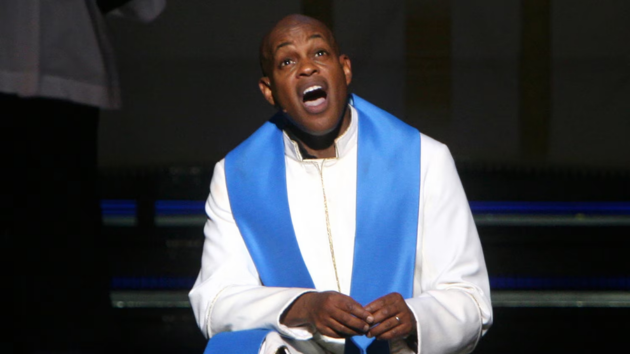
Jubilant Sykes sings with the Baltimore Symphony Orchestra in Leonard Bernstein’s “Mass” at Carnegie Hall, October 24, 2008. Hiroyuki Ito/Getty Images
(SANTA MONICA, Calif.) — A Grammy-nominated opera singer was stabbed to death inside a California residence, and the 71-year-old’s son has been arrested in connection with the killing, police said.
Jubilant Sykes was killed in a home in Santa Monica on Monday, police said. Officers responded to the residence after a 911 caller reported an assault in progress and found Sykes with “critical injuries consistent with a stabbing,” the Santa Monica Police Department said in a statement on Tuesday.
Sykes’ son, 31-year-old Micah Sykes, was found in the home and taken into custody without incident, police said. He will be booked for homicide, police said.
“The circumstances surrounding the incident remain under investigation,” police said.
Officers responded to the home around 9:20 p.m. on Monday and the 911 caller directed them inside, police said.
First responders with the Santa Monica Fire Department pronounced Sykes dead at the scene, police said.
Police said the weapon was recovered at the scene, though did not provide additional details.
The case will be presented to the Los Angeles County District Attorney’s Office.
“This appears to be an isolated incident occurring within a private residence, and there is no ongoing threat to the community,” police said.
Sykes performed on the Grammy-nominated 2009 recording of Leonard Bernstein’s “Mass,” with the Morgan State University Choir and Baltimore Symphony Orchestra.
Ghislaine Maxwell attends an unspecified event in New York, January 13, 2000. Patrick Mcmullan/Patrick McMullan via Getty Images
(WASHINGTON) — A federal judge on Tuesday granted the Justice Department’s motion to release grand jury materials and other nonpublic evidence from the criminal case of Jeffrey Epstein associate Ghislaine Maxwell in order to comply with Congress’ directive to publicly release materials from the government’s files on the wealthy financier and convicted sex offender who died by suicide in a New York jail in 2019.
U.S. District Judge Paul Engelmayer determined in his 24-page order that the Epstein Transparency Act, passed last month, “unambiguously applies” to the discovery materials provided by prosecutors to Maxwell’s defense team in connection with her criminal trial.
The ruling grants the Trump administration’s request to modify the protective order in the case to allow for the Justice Department to publicly release materials subject to certain exemptions delineated by Congress.
Maxwell is currently serving a 20-year prison sentence after she was convicted in 2021 on five counts of aiding Epstein in his abuse of underage girls. A substantial subset of the government’s evidence against Maxwell was made public during her three-week trial in federal court in New York.
The Epstein Transparency Act was passed by Congress last month and signed by President Donald Trump following blowback the administration received from MAGA supporters seeking the release of the materials. The law requires the Justice Department to make public all Epstein-related materials in its possession within 30 days of the bill’s passage.
The act allows the DOJ to withhold or redact records to protect the privacy of alleged victims. It also allows the attorney general to withhold records that could jeopardize an ongoing federal investigation or prosecution.
Judge Engelmayer’s order puts in place a protocol to protect victims from the inadvertent release of materials “that would identify them or otherwise invade their privacy.”
“Nothing in this Protective Order shall prohibit the Government from publicly releasing materials whose disclosure is required by the Epstein Files Transparency Act,” Engelmayer wrote. “The restrictions of this Protective Order, however, remain in place with respect to the segregable portions of records that ‘contain personally identifiable information of victims or victims’ personal and medical files and similar files the disclosure of which would constitute a clearly unwarranted invasion of personal privacy.'”
Emphasizing the privacy concerns of the alleged victims, Engelmayer also added a provision to the protective order that will require the U.S. attorney for the Southern District of New York to “personally certify in a sworn declaration” that such records have been rigorously reviewed for compliance,” according to the order.
Engelmayer noted in his order that the alleged victims’ concerns about inadvertent disclosure of their names and other identifying information “have a basis in fact.” He noted that in its two applications to the court to disclose records, the Justice Department acted without prior notice to the victims.
The DOJ, Engelmayer wrote, has paid “lip service” to the victims but has “not treated them with the solicitude they deserve.”
“The certification requirement that the Court is adding to the Protective Order assures that an identifiable official within DOJ takes ownership of the sensitive and vitally important process of reviewing discovery to be publicly released. It will help assure that victims’ statutory privacy rights are protected,” the judge wrote.
Following the ruling, the ranking Democrat on the House Oversight Committee, Rep. Robert Garica, called on the DOJ to immediately provide those records to the committee, which has an existing bipartisan subpoena to the DOJ for all its Epstein/Maxwell investigative files.
“These files are now part of the Epstein files held by the Department of Justice, and must be turned over to the Oversight Committee in response to our subpoena, and to the public under the Epstein Files Transparency Act. The DOJ must comply immediately,” Garica said in a statement.
“In addition to this new ruling, a federal judge in Florida has also granted the DOJ’s request to unseal Epstein-related grand jury records from the mid-2000s, and the Committee looks forward to receiving those materials as well,” the statement said.
The DOJ previously indicated to the court that the discovery materials it seeks to make public could include, among other things, search warrant applications, financial and travel records, photographs and videos of relevant properties, immigration records, forensic reports from extractions of electronic devices, materials produced by Epstein’s estate, and reports and notes of interviews of victims and third parties.
Attorneys for Maxwell told the court last week that she took no formal position on the DOJ motion, but argued that the release of nonpublic materials would impact her ability to get a fair retrial if she were to succeed in her forthcoming habeas petition, a longshot bid for a new trial.
“Ms. Maxwell respectfully notes that shortly she will be filing a habeas petition pro se. Releasing the grand jury materials from her case, which contain untested and unproven allegations, would create undue prejudice so severe that it would foreclose the possibility of a fair retrial should Ms. Maxwell’s habeas petition succeed,” her lawyers wrote.
Regarding the grand jury materials, Engelmayer ruled that the Epstein Files Transparency Act overrides the federal rule of criminal procedure that governs grand jury secrecy. He also determined the act does not exempt grand jury materials from disclosure.
Engelmayer is the second judge to grant a DOJ motion to unseal grand jury testimony and other previously restricted Epstein materials, after U.S. District Judge Rodney Smith last week granted the administration’s request to lift restrictions over grand jury material related to the first federal investigation of Epstein in Florida in the mid-2000s, which ended in his non-prosecution agreement, which was widely criticized.
U.S. District Judge Richard Berman is currently considering a similar request from the DOJ to allow the government to disclose materials associated with the 2019 criminal case against Epstein in Manhattan federal court. That case ended with Epstein’s death in August of 2019.
Nassau County Executive Bruce Blakeman announces the formation of a Long Island Coalition of Business and Political Leaders against proposals to increase New York’s corporate tax rate in Mineola, New York, on Nov. 17, 2025. Howard Schnapp/Newsday RM via Getty Images, FILE
(NEW YORK) — Bruce Blakeman, the Republican county executive of Nassau County in New York, announced Tuesday that he will run for governor of the Empire State.
His announcement sets up a potentially contentious primary against U.S. Rep. Elise Stefanik, in a primary that now pits two major allies of President Donald Trump against each other in what was already a challenging race for Republicans.
“We want to put New York first. We want to make it more affordable. We want to make New York safer, and we want to make people in New York happy again,” Blakeman said in an appearance on Fox News on Tuesday morning announcing his campaign.
Blakeman was first elected as Nassau County Executive in 2021 after previously serving on the Hempstead Town Council and as a commissioner of the Port Authority of New York and New Jersey.
He received some attention in recent years for signing a county law in 2024 banning using masks to hide one’s identity, and a separate one that banned transgender people from participating in women’s sports at places owned by the county.
Any Republican candidate could face a steep challenge winning statewide in New York, which voted for Democratic candidate Vice President Kamala Harris for president in 2024 by around 13 percentage points – although that marked a rightward shift from 2020, when then-Vice President Joe Biden won the state by around 20 percentage points.
Blakeman, asked on Fox News if a Republican in New York has a chance to become governor, pointed to his success in winning in a county where Democrats outnumber Republicans as a sign of his appeal among “crossover” Democrats and among different groups. According to data from the New York State Board of Elections, Nassau County had around 70,000 more active registered Democratic voters than Republican voters as of Nov. 1.
His entrance into the race comes around a month after Stefanik, a close ally of Trump, announced her own run for governor and collected several endorsements, including from local county Republican groups and the chairman of the New York Republican Party.
The winner of the Republican primary could end up taking on incumbent Democratic Gov. Kathy Hochul, who is running for reelection and has made combatting Trump a major focus in recent months. Hochul faces her current lieutenant governor, Antonio Delgado, in the Democratic gubernatorial primary.
Bernadette Breslin, a spokesperson for Elise Stefanik’s campaign, called Blakeman “an early Christmas present” for Hochul and said Blakeman is getting in the way of “Republicans’ best chance to win.”
“Elise is the strongest candidate against Kathy Hochul by a long shot. Elise has outrun President Trump on the ballot by more than any Republican in New York State including Bruce,” Breslin wrote. “Elise has led the most effective attacks on the Worst Governor in America Kathy Hochul as Bruce Blakeman has worked overtime to torpedo fellow Republicans.”
Trump has a strong relationship with Stefanik but has not made an endorsement in the governor’s race.
Asked if he’d make an endorsement on Monday as reports about Blakeman’s bid circulated, he told reporters, “I’ll think about it. But he’s great. And she’s great. They’re both great people. We have a lot of great people in the Republican Party.”
Blakeman, asked about Trump’s comments, downplayed any equivocation — saying the president does not need to endorse for now — while praising the president for his work on the economy.
“Well, I don’t think the president has to make a decision now — let’s see how it plays out,” he said.
“But let me tell you something, he’s done more for America in the last 11 months than any president in my lifetime. He’s done a great job with the economy. He’s going out now — he’s going to be in Pennsylvania today, talking about economic development, creating prosperity,” Blakeman said. “Those are the same things that I want to do in New York State. So I cherish his friendship and I appreciate his leadership.”
Hochul, meanwhile, wasted no time in tying Blakeman to Trump.
“Bruce Blakeman is another MAGA cheerleader running to do Donald Trump’s bidding in New York — and raise your costs. Not on my watch,” she wrote on X on Tuesday.
At an event on Monday, she called out both Blakeman and Stefanik, telling reporters, “Let’s see how they out-MAGA each other in a primary.”
The U.S. Embassy in Mexico released this photo of Ryan Wedding on Dec. 8, 2025. (U.S. Embassy in Mexico)
(NEW YORK) — Authorities have released new photos of Ryan Wedding, a former Canadian Olympian snowboarder turned alleged drug kingpin who is on the FBI’s Ten Most Wanted Fugitives list.
Wedding, 44, is wanted for “allegedly running and participating in a transnational drug trafficking operation that routinely shipped hundreds of kilograms of cocaine from Colombia, through Mexico and Southern California, to Canada, and other locations in the United States,” the Los Angeles FBI office said Monday on X while releasing a newly obtained photo of the fugitive.
“Additionally, it is alleged that Wedding was involved in orchestrating multiple murders in furtherance of these drug crimes,” the statement continued.
The FBI said the photo is believed to have been taken in Mexico during the summer of 2025.
In it, he is seen lying in a bed shirtless, with a prominent tattoo of a lion on his chest.
The U.S. Embassy in Mexico also shared a photo on Monday of Wedding that hadn’t been previously released. In the photo, released on social media, he is wearing a green shirt and has a different haircut and facial hair. The post did not say when or where that photo was taken.
Wedding has been on the run for several years. He is believed to be in Mexico, being protected by the Sinaloa cartel, authorities said.
The Department of State is offering a reward of up to $15 million for information leading to the arrest and/or conviction of Wedding, whose aliases include James Conrad King, Jesse King, “Giant”, “Public Enemy,” “Boss,” “Buddy,” “Grande,” “El Jefe,” “El Guerro” and “El Toro,” according to the FBI.
FBI Director Kash Patel has called Wedding a “modern-day” Pablo Escobar.
The fugitive was previously indicted in Los Angeles federal court on multiple charges, including running a continuing criminal enterprise, committing murder in connection with a continuing criminal enterprise and assorted drug crimes.
He and his alleged second-in-command are accused of ordering the murders of multiple people in Canada to achieve the aims of the criminal organization, the FBI said.
New charges announced last month allege he ordered the killing of a witness in the federal case. The victim was shot in the head multiple times at a restaurant in Colombia in January, according to U.S. Attorney for the Central District of Los Angeles Bill Essayli.
Wedding and 18 others, including his lawyer, were charged in the new indictment with orchestrating the murder, according to the DOJ.
Wedding competed for Canada in the 2002 Winter Olympics in Salt Lake City, where he placed 24th in the parallel giant slalom, before allegedly running the billion-dollar cocaine operation from Mexico for more than a dozen years, officials said.