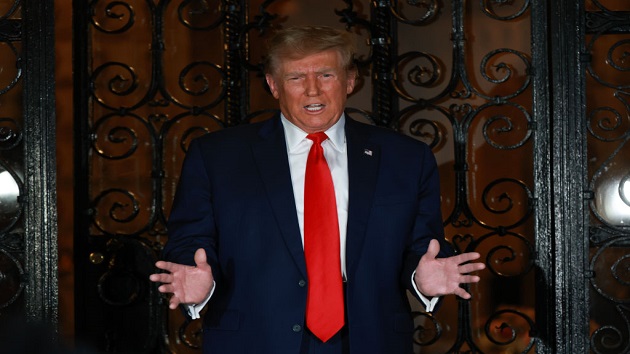
(PHILADELPHIA, Penn.)– The day after a New York judge fined him $355 million in the wake of a lengthy fraud trial, former President Donald Trump spent his Saturday in two battleground states, Pennsylvania and Michigan.
First stop: Sneaker Con in Philadelphia.
“Sneakerheads, your sneakerheads, right? Does everybody in the room consider themselves a sneakerhead?” Trump said in a short speech to an unusual crowd that was divided between chanting for and booing at him.
The event was supposed to be part of an unveiling of the latest Trump merchandise: gold “Never Surrender” high-top sneakers selling for $399, which are already listed as sold-out online, and “Victory47” fragrances for $99. (Also available: “Red Wave” and $199 “POTUS 45” shoes.)
Trump himself took the stage holding a pair of the high-top sneakers.
But his five-minute remarks, in a heavily Democratic city, were sometimes barely able to be heard as members of the diverse, young crowd were consistently screaming and chanting throughout.
While many booed and chanted at him, others attempted to drown them out with anti-Joe Biden and USA chants.
“This a slightly different audience than I’m used to, but I love this audience,” Trump said, struggling to get through his speech.
He attempted to divert the attention by acknowledging his supporters in the crowd, even bringing one of them, a woman, up to the stage where she talked about how much she loves Trump because she said he is a Christian family man.
“They’re after him for no reason. Go out and vote for Trump,” she said to boos and some cheers.
Trump even acknowledged he wasn’t necessarily in friendly territory — “Right after this, I go to Michigan … I’ll be talking about a slightly different subject than sneakers. But you know what? It’s all part of Americana,” he said.
That didn’t stop him from making his pitch in Philadelphia.
“What’s the most important thing: to go out and vote, right? We have to go out and vote. We got to get young people out to vote,” he said.
Later, in Michigan, an angry Trump came out swinging, railing against all the prosecutors investigating him. He faces 91 criminal charges, all of which he denies.
He told the fired-up crowd that if he wins swing state, which will likely be a key battleground, then he will win the entire election.
However, he also misstated the upcoming Republican primary date and gave the wrong year for when he won Michigan — gaffes that critics like primary rival Nikki Haley have seized on to argue that he is “diminished.”
Trump has attacked President Joe Biden for similar slips but defended his own mental acuity. “I feel my mind is stronger now than it was 25 years ago,” he said in January.
The former president returned to the campaign trail this weekend in the wake of perhaps his biggest legal setback to date, when the judgment came down at the end of a monthslong civil fraud lawsuit in New York.
With a 92-page order issued late Friday, Judge Arthur Engoron dealt Trump a legal and financial blow that could permanently damage the business empire that propelled him to the presidency.
In addition to the nine-figure penalty, Engoron temporarily stripped Trump and his sons of the ability to lead their own businesses or apply for financing.
Trump’s lawyers plan to appeal the ruling, vowing that higher courts would reverse Engoron’s ruling.
ABC News’ Peter Charalambous contributed to this report.
(BURNSVILLE, Minn.)– Two police officers and one firefighter were shot and killed in Burnsville, Minnesota, on Sunday after responding to a “call of a family in danger,” according to Gov. Tim Walz.
“Horrific news from Burnsville,” Walz began his statement on X. “While responding to a call of a family in danger, two police officers and one firefighter lost their lives, and other officers were injured.”
“We must never take for granted the bravery and sacrifices our police officers and first responders make every day,” Waltz continued. “My heart is with their families today and the entire State of Minnesota stands with Burnsville.”
Officers gathered near the intersection of 33rd Avenue and East Burnsville Parkway around 5:30 a.m. local time, a witness told ABC affiliate KSTP-TV.
The witness said they heard shots fired and a shelter-in-place order was sent to residents’ cellphones. KSTP-TV reported that the order has since been lifted.
The Minnesota Police and Peace Officers Association confirmed that a shooting took place Sunday morning after officers responded to a domestic abuse call, according to a statement posted to Facebook.
“We are heartbroken. Our law enforcement community is heartbroken. We’re just devastated at the horrific loss,” the statement said.
Burnsville is a Minnesota suburb located about 15 miles south of Minneapolis.
The Bureau of Alcohol, Tobacco, Firearms and Explosives said in a post on X that agents had responded to the scene.
Minnesota Sen. Amy Klobuchar shared a statement on X Sunday morning after being alerted to the fatal shooting by police.
“They were doing their jobs. They were protecting our community,” Klobuchar said, noting that she and her husband, John, are “praying for them and their families and the Burnsville P.D. this morning.”
(NEW YORK)– An already drenched California is bracing for a second storm as a multiday atmospheric river is projected to bring rainfall, wind and snowfall to the Golden state Sunday and extend through Wednesday.
The National Weather Service issued a flood watch for nearly the entire coast of California — from Redding to San Diego and the Mexico border — putting about 37 million residents on alert.
The first storm hit central California on Saturday, dumping less than half an inch of rain at lower elevations and around an inch at higher elevations.
The next storm starts Sunday afternoon, bringing stronger rainfall, wind and snowfall across the state.
The flood watch includes Northern California cities such as San Francisco, Monterey, Chico and Fresno; Central California cities including Santa Barbara, Los Angeles and Temecula; and San Diego in Southern California.
Total rainfall throughout the flood watch area includes two to five inches in the lower elevations and up to eight inches in the higher elevations.
Santa Barbara County has the highest threat of flash flooding, mudslides and rockslides, according to officials.
“Be prepared to sustain yourself and your household for multiple days if you choose not to evacuate, as you may not be able to leave the area and emergency responders may not be able to access your property in the event of road damage, flooding or debris,” Santa Barbara County officials said in a press release Saturday.
The coastal city is still recovering from the barrage of rain that hit the region less than two weeks ago.
Wind alerts are in effect for millions of California residents, including those in San Francisco and Santa Barbara, with wind gusts projected to be between 50 mph and 60 mph.
The strongest winds will be felt Sunday and Monday morning.
A few feet of snow is possible in the San Gabriel Mountains outside Los Angeles, with areas including Big Bear Lake seeing up to 8 inches of snow.
Gusty winds will also make travel difficult in these snow areas.
Back-to-back atmospheric river storms have soaked California this month. Atmospheric rivers are essentially rivers in the sky that collect moisture from tropical areas and redistribute the water to higher latitudes, according to the National Oceanic and Atmospheric Administration (NOAA).
“More of [California’s] precipitation, so rain and snowfall, will be coming from atmospheric rivers, according to the model projections,” Julie Kalansky, a climate scientist and deputy director of operations at the Center for Western Weather and Water Extremes at the University of California, San Diego’s Scripps Institution of Oceanography, told ABC News earlier this month.
Experts say that this shift in precipitation type could be accompanied by more frequent and intense extreme rainfall events.
(NEW YORK) — With a 92-page order issued late Friday, Judge Arthur Engoron dealt Donald Trump a legal and financial blow that could permanently damage the business empire that propelled him to the presidency.
Beyond the staggering $355 million Trump was ordered to pay – likely to climb to over $450 million with interest – Engoron stripped Trump and his sons of the ability to lead their own businesses or apply for financing for two or three years.
The penalties – which New York Attorney General Letitia James applauded as effective ways to “ensure this fraud cannot continue” – leave the Trump Organization in legal, financial, and personnel limbo, as the former president embarks on a costly presidential campaign amid his ongoing legal battles.
“We will get back to work,” Trump vowed Friday. “We’ll appeal, we’ll be successful, I think because frankly, if we’re not successful, New York State is gone.”
Trump’s lawyers plan to appeal the ruling, vowing that higher courts would reverse Engoron’s ruling.
“If allowed to stand, this ruling will only further expedite the continuing exodus of companies from New York,” a Trump Organization spokesperson said in a statement.
Lengthy appeal
Trump and his lawyers have already vowed to appeal Engoron’s ruling to New York’s Appellate Division, First Judicial Department.
That same court handed Trump an early victory in his case last year by pausing the cancellation of Trump’s business certificates, which Engoron ordered in his September summary judgment ruling. On Friday, Engoron reversed course on that penalty – nullifying part of his past order – but placed the Trump Organization under an independent monitor for at least three years.
“That was a very carefully crafted remedy that the judge put in place,” said former federal prosecutor Josh Naftalis, who said the early penalty was likely vulnerable to an appeal.
“It’s also much harder for the president to get [the new ruling] thrown out on appeal,” Naftalis said.
Engoron’s lengthy opinion also leaned heavily on the facts of the case – including lengthy portions on the testimony from each witness – in a manner that could strengthen the case on appeal, according to trial attorney Ryan Saba.
“This court sat one yard away from the witnesses on the stand, had a clearer view of the witnesses and was able to assess their credibility,” Saba said about Engoron’s role as a factfinder during the jury trial. “The findings in this opinion, if the appeal is based upon a factual challenge, are going to be very difficult to overturn.”
Even if the initial appeal is unsuccessful, Trump could ask New York’s Court of Appeals – the state’s highest court – to weigh in, possibly making the appeal a yearslong process. While that approach would give Trump more time to find money for the fine, the penalty will accrue annual interest and only becomes pricier over time.
Trump’s lawyers have expressed confidence in their future appeal, lauding the First Department’s past rulings limiting the statute of limitations for conduct in the case.
“President Trump will of course appeal and remains confident the Appellate Division will ultimately correct the innumerable and catastrophic errors made by a trial court untethered to the law or to reality,” Trump’s attorney Chris Kise told ABC News.
Not-so-family business
While Trump’s lawyers fight Engoron’s opinion in court, the former president’s namesake business faces its own challenges — beginning with a lack of leadership.
Currently run by senior vice presidents Donald Trump Jr. and Eric Trump, the Trump Organization lost its top executives on Friday when Engoron banned them from leading New York corporations for two years. Engoron also barred Trump from applying to loans from any New York banks, severely limiting Trump’s access to capital.
“He’s being choked on a personnel level, and he’s being choked on a capital level,” Naftalis said.
According to Trump’s most recent financial disclosure, the former president still owes money to Deutsche Bank but took new loans from California-based Axos Bank, potentially offering the president a workaround from the penalty.
Moreover, Engoron’s decision presents a red flag for potential lenders who might distrust any financial statement prepared by the Trump Organization, according to Naftalis.
“I think practically what this means is that a bank is not going to want to do business with them because he effectively has a scarlet letter on his chest,” Naftalis said.
Engoron ordered Judge Barbara Jones to continue monitoring the company as well as appoint a director of compliance for the company, increasing the independent oversight of the company. In addition to Jones’ past responsibilities, Engoron ordered that the Trump Organization would need to get prior approval from Jones before issuing any financial disclosure to a third party.
Potential cash crunch
If Trump’s appeal is unsuccessful in limiting the fines imposed by Engoron, the former president might be unable to find the cash to cover the fine, potentially forcing him to sell off some of his prized buildings. Trump also was ordered to pay columnist E. Jean Carroll $83.3 million last month in a civil suit, adding to his financial obligations.
“That’s a pretty significant hit towards anybody’s overall liquidity, regardless of the total amount of money that you have,” Saba said.
Even if Trump is elected president in nine months, he faces no way out of the disgorgement if his fraud trial appeal fails — and declaring bankruptcy would be unlikely to resolve the financial troubles since legal fines are generally not dischargeable, according to Illinois College of Law Professor Robert Lawless.
“There are remedies the person holding the judgment can do to force payment, everything from, you know, seizing property to taking the wages of the person that owes the money,” Lawless said.
(MOSCOW) — Allies of Russian opposition leader Alexei Navalny are demanding that Russian authorities release his body to his mother and lawyer, claiming it is being deliberately withheld. Russian authorities announced Navalny died in an Arctic prison camp on Friday.
After expressing skepticism over whether he died, Navalny’s team confirmed his death, alleging the 47-year-old was murdered and that Russian investigative authorities took away his body for further examination, according to Kira Yarmysh, Navalny’s spokesperson.
Navalny was a vocal critic of Russian President Vladimir Putin.
Navalny’s team claimed that Russian authorities are deliberately withholding his body from his family and lawyer, expressing concern that authorities could be trying to cover up signs of how he died if he was murdered.
Yarmysh said local investigative police have indicated Navalny’s body won’t be handed over until after a new “examination” is completed next week.
Navalny’s team also claimed that his body is not in the morgue in Salekhard — the town near to the prison colony where he died — despite officials telling them so.
Another of Navalny’s associates, Ivan Zhdanov, suggested that the body has not been released as the cause of death has not been established.
“When Alexey’s lawyer and mother arrived at the colony this morning, they were told that the cause of Navalny’s death was sudden death syndrome,” Zhdanov said in a statement.
Navalny’s team said they were told that a histological examination was performed on his body.
“The results will supposedly be available next week. It’s obvious that they are lying and doing everything they can to avoid handing over the body,” his team said in a statement.
Navalny’s death drew response from around the world, with world leaders sharing their condolences and U.S. officials blaming his death on Putin.
Biden addressed the nation on Friday, saying he was both “not surprised and outraged” while placing the blame directly on Putin and his allies. Asked whether the U.S. is considering imposing more sanctions against Russia, Biden told reporters that the U.S. is looking at a number of options.
Russian Foreign Ministry spokeswoman Maria Zakharova pushed back Friday against the reaction from NATO leaders to Navalny’s death, calling the accusations against Russia “self-exposing” and saying there hasn’t been a forensic examination yet, but the West’s conclusions were already ready.
Kremlin spokesman Dmitry Peskov also denounced blame from Western countries.
“The statements of Western countries are completely obvious,” Peskov said. “There is no statement from doctors, no information from forensic experts, no final information from the Federal Penitentiary Service, no information about the causes of death. And there are such statements. It is obvious that they are absolutely rabid. We consider such statements absolutely unacceptable.”
In Russia, at least 177 people have been arrested in 21 cities as people try to leave flowers at sites to pay their respects to Navalny, according to officials. Police in riot gear are roughly detaining some and threatening to disperse people.
In Moscow, dozens of police were posted by the monument to Victims of Political Repression, which honors victims of the Soviet-era police state, according to videos circulating. The videos show dozens of police officers appearing to roughly detain people and dragging some into police vans. In St. Petersburg, photos show police in full riot gear on guard at a similar monument where people have brought flowers.
Thousands of Russians also gathered in cities elsewhere around the world, including London, to protest Navalny’s death on Friday night.
(AVDIIVKA, Ukraine) — On the same day Alexey Navalny was declared dead in a Russian prison, Vladimir Putin was able to rack up another victory of sorts as Ukraine’s military announced it has retreated from the key city of Avdiivka in eastern Ukraine, ceding it to Russia after months of ferocious fighting that cost tens of thousands of Russian casualties.
Avdiivka is the first notable Ukrainian city to fall to Russia since Bakhmut nearly a year ago. It was a small city with 32,000 inhabitants that has been on the frontline since 2014. Russia has now reduced it to a few skeletal ruins.
It is also the first Ukrainian city to fall since the U.S. became deadlocked in sending more military aid.
Ukrainian forces had held off a huge Russian offensive there since October but as severe ammunition shortages have bitten amid the reduction in Western aid, Russia was able to restore a huge advantage in artillery and airstrikes, allowing it to grind through the defenses and effectively level the city.
In the past two weeks, Russia had managed to finally make significant advances in the north and south, closing in on the encirclement of Avdiivka. Ukrainian troops had no choice but to withdraw or risk being surrounded meaning the withdrawal should prevent the loss of more troops and equipment.
In many ways it was extraordinary Ukraine had held Avdiivka since the start of Russia’s full-scale invasion — partly the result of how heavily fortified it was — but it now underlines how the initiative is now in Russia’s hands.
Most military analysts do not believe Avdiivka’s fall will have an immediate major impact on Ukraine’s overall position because it will be difficult for Russia to advance further from it, just as it has been from Bakhmut.
Ukraine is focusing on regrouping their remaining troops, replenishing supplies and arranging units in new strategic positions, according to Commander of the Tavria direction Gen. Oleksandr Tarnavskyi.
Meanwhile, a U.S. official briefed last week said that Ukraine may face “catastrophic” shortages of ammunition by March if Congress doesn’t authorize more aid to the embattled country.
Russia has suffered enormous losses to reach this point, however, with losses estimated upward of as many as 20,000 killed and injured since October and over 1,000 armored vehicles since the beginning of its offensive against Avdiivka in October 2023.
(NEW YORK) — A sunbathed Dalmatian tiptoes across a windowsill, a Chinese New Year parade engulfs a city street, an archeologist digs up a chair from desert sand.
Videos posted online display these events, but none of them happened. They make up the first publicly available work created by OpenAI’s newly unveiled video-generation tool Sora.
Sora composes videos, lasting up to one-minute long, based on user prompts, just as ChatGPT responds to input with written responses and Dall-E offers up images.
The video-generator is currently in use by a group of product testers but is not available to the public, OpenAI said in a statement on Thursday.
These products carry the potential to improve and ease video storytelling, but they could also supercharge internet misinformation and enhance government propaganda, blurring the already-faint line between real and fake content online, experts told ABC News.
AI-generated videos, meanwhile, threaten to reinforce hateful or biased perspectives picked up from the underlying training materials that make their creation possible, they added.
“The clarity of truth we thought we had with recorded photography and video is gone,” Kristian Hammond, a professor of computer science at Northwestern University who studies AI, told ABC News. “We’ve inadvertently built a world of propaganda engines.”
In response to ABC News’ request for comment, OpenAI pointed to a webpage that outlines measures taken by the company to prevent abuse of Sora.
“We’ll be taking several important safety steps ahead of making Sora available in OpenAI’s products,” the company website says. “We are working with red teamers — domain experts in areas like misinformation, hateful content, and bias — who will be adversarially testing the model.”
The company plans to use some safety features already in palace for its image generator Dall-E, the website says, including a tool that polices text prompts to ensure they do not violate rules against “extreme violence, sexual content, hateful imagery, celebrity likeness, or the IP of others.”
Experts who spoke to ABC News emphasized the difficulty of evaluating a demo product that has yet to be released to the general public. They sounded alarm, however, over the opportunities for misuse of the video generator and the challenges of implementing fully effective safeguards.
“Realistic images of events play into people’s assumptions about what’s going on in the real world and can be used to deceive people,” Sam Gregory, executive director of Witness, an advocacy group that aims to ensure the use of video to protect human rights, told ABC News.
The risks posed by AI-generated content have stoked wide concern in recent weeks.
Fake, sexually explicit AI-generated images of pop star Taylor Swift went viral on social media in late January, garnering millions of views. A fake robocall impersonating President Joe Biden’s voice discouraged individuals from voting in the New Hampshire primary last month.
Experts commended the steps taken by OpenAI to prohibit abuses of Sora along these lines. They warned though of the product’s likely capability to create deep fakes and the difficulty of preventing such videos.
“They can probably put in a filter that says, ‘Don’t generate any videos with Taylor Swift,’ but people will find ways around it,” Gary Marcus, an emeritus professor at New York University and author of the book ”Rebooting AI,” told ABC News.
Sora, like other generative AI products, is trained on troves of online data, leaving it susceptible to widely reproduced biases, such as racial and gender stereotypes.
“There are biases in society and those biases will be reflected in these systems,” Hammond said.
In addition to moderating video prompts and the resulting content, OpenAI plans to implement a “detection classifier” that can identify when a video has been produced by Sora, the online statement said. The company said it will also include a popular recognized digital tag, which essentially amounts to a digital watermark.
Such precautions drew applause from experts, though they warned that videos could potentially be reproduced or altered as means of removing the labels.
“People will be trying to get around the guardrails put in place,” Hammond said. “It’s an arms race.”
(STERLING, Va.) — A firefighter was killed and 10 others injured when a house in Virginia exploded while they were responding to a gas leak, authorities said.
Firefighters responded to the home in Sterling around 7:48 p.m. Friday after a resident reported smelling gas, according to Keith Johnson, chief of the Combined Fire & Rescue System in Loudoun County.
A 500-gallon underground propane tank on the side of the house was leaking gas into the home, he said.
Nearly 40 minutes after arriving at the scene, there was a “catastrophic explosion” while firefighters were inside the house working the emergency, Johnson said.
“That was somewhat chaotic as we tried to figure out how many firefighters were trapped under the debris,” Johnson said at a press briefing on Saturday.
A volunteer firefighter was pronounced dead at the scene. He was identified as Trevor Brown, 45, with the Sterling Volunteer Fire Company.
He had been with the company since 2016 and is survived by a wife and three children, the fire company said.
“We lost a family member,” Johnson said.
The fallen firefighter from last night’s home explosion in Sterling has been identified as Firefighter Trevor Brown, 45, of the Sterling Volunteer Fire Company. He has been affiliated with the LC-CFRS since 2016. @Chief600KJpic.twitter.com/1olm23ySdX
Ten firefighters were transported to local hospitals, including to the Washington Burn Center in D.C., Johnson said. Four firefighters remain hospitalized with varying levels of injury and are expected to survive, he said.
The two occupants of the home and several pets had been evacuated, Johnson said. The two residents had minor injuries and have been treated and released, he said.
The exact cause of the explosion remains under investigation.
“We can assume it was propane related but no complete cause has been initiated,” Johnson said.
The investigation will also seek to determine how the leak occurred and how the gas got into the home.
The Loudoun Sheriff’s Office and the Bureau of Alcohol, Tobacco, Firearms and Explosives are aiding in the investigation, according to Loudoun Fire-Rescue Assistant Chief James Williams.
The large debris field stretched into the street and into the vicinity of neighboring homes. The house that exploded is destroyed, the assistant chief said.
“This is the worst call that we can respond to,” Williams said.
The chief said he is proud of the firefighters’ response and credited it with limiting the number of fatalities in the incident.
“Our folks did their job, they showed up and they did what they had to do,” he said. “We prepare for this. We have a full plan for dealing with line-of-duty deaths. We hope you never have to use it but we’re using it today.”
(LEWISTON, Maine) — Three months before the alleged Maine mass shooter would open fire at a bar and a bowling alley, killing 18 people and injuring 13 more, Robert Card told police in New York he was “capable” of doing “something,” as they coaxed him to go for psychological treatment and evaluation, police body camera shows.
New York State troopers were called by members of Card’s Army Reserve unit out of concern for his mental decline in July, as ABC News previously reported, after an incident the night prior with some of his fellow Reservists. Card was taken that day to an Army hospital at West Point before being transferred for further treatment at a civilian facility. He was released after 14 days. The body camera, obtained via a records request by ABC News’ affiliate WMTW, shows the moments before Card was taken in for treatment.
“Our concern is he is going to hurt himself or someone else,” one Reservist told New York State troopers in July, standing in the parking lot outside the facility they were staying at near West Point, before Card would go for what would be two weeks of psychiatric evaluation and treatment.
Though Card hadn’t explicitly threatened self-harm or harm to others, “He said he was going to ‘take care of it,'” one Reservist told the troopers, another chiming in that he was being “combative” toward the other men.
Card had “never been like this,” the reservists said multiple times – and they weren’t sure whether the behavior and hearing voices had been triggered by his new hearing aids, or something else. The night prior, Card had wheeled on his longtime colleague while on a beer run and “he clenches his fist and comes at me… I’m like, ‘Woah’ and just kind of backed up… was trying to fight me… I was like, this is crazy… he’s like hearing voices, it’s like paranoia… it’s weird,” one reservist said.
Card had lost so much weight in recent months that “his face is sagging, he took his shirt off at the pool and he’s like all skin and bones. I couldn’t believe how much weight he’s lost.”
“I’ve known him for a decade,” the reservist said. “I’ve been in this unit for ten years, he’s never been like that…”
Card was hearing voices that he had a “small d*ck” and that he was a pedophile, as ABC News has reported – to the point where he took a picture of his genitals and “showed the people at work,” the reservists told the troopers, adding, “His boss was like, ‘yo man, you can’t do that.'”
“On its face, it’s obviously weird behavior but the more concerning part is that he was never like this,” another reservist said.
“And he’s a gun nut too, he has a lot of guns,” one reservist said. “He spent 14 grand on a scope too so he’s like … I don’t know, I don’t know what he’s capable of, I’m not insinuating anything but – I’m just saying – he does have a ton of guns.”
Three months later, Card would allegedly open fire at a bar and a bowling alley in Lewiston, Maine, in back-to-back shootings that rocked the city and ricocheted across the nation.
The body camera footage from July shows troopers knocking on Card’s door, which he answers shirtless after some delay, his head shaved and wearing shorts with “Army” printed in yellow on one leg.
Card wordlessly leaned an arm with a bicep tattoo against the door frame as troopers said they wanted to speak with him, asking that he put a shirt on. Card, with a slight eye roll, let them in. He pulled on a black shirt with “Army” across the chest, and sat on an unmade bed. A picture of the Statue of Liberty hung on the concrete wall above his head.
Card said he understood the reason the police were called, because he “flipped out on someone” who “messed around with me and they’re cowards and ran away… I didn’t do anything wrong, I haven’t been physical with anyone.”
According to the footage, Card said people have been “saying sh*t” behind his back – as ABC News previously reported, he thought people had been saying he’s a “pedophile,” and that when he confronts people, “they pretend like I’m hearing stuff,” and that “it’s happening everywhere.”
“The staff here was concerned about you to the point that they have command directed you to talk with a counselor, okay?” One trooper asks, to which Card answered, “Alright.”
When asked if he’s willing to go for evaluation, Card shrugged, and said, “I have to if it’s command directed, obviously. But, is it going to help anything? No…” adding, he would “rather have people stop talking and stop looking at me, I’m a f**ing private person.”
“I can absolutely understand that,” one trooper responded.
Attempting to remind Card that his fellow Reservists were, until recently, his friends, Card responded “I don’t have any real good friends, obviously.”
“I hope you understand that they’re concerned enough about your welfare that they called us,” one trooper said.
Card responded riled up, “Oh, because they’re scared … ’cause I’m going to, friggin, do something. Because I am capable!” he said while rubbing his hands together.
“What do you mean by that?” The trooper asks.
“Huh?” Card responds, the trooper asking again – “What do you mean by that?”
Card answered, “Nothing.”
The newly released footage comes just as the independent commission investigating what led up to the Oct. 25, 2023 mass shooting is kicking into high gear.
This week, the commission has officially been granted subpoena power for its probe, which will allow the commission to compel documents and witness testimony from individuals and entities who would otherwise opt not to cooperate. Importantly, this power will include seeking compliance in any state, federal or military court or tribunal – relevant here, given the investigation involves not only Maine authorities but also New York, New Hampshire – and the US military, whose inspector general has launched a separate investigation into the Army’s role into what led up to the shootings.
The commission told ABC News they have received a response from the Army that they will allow some of their personnel to testify. That response comes after months where the commission has said there have been attempts to work with the Army, but as of late January, they had run into some “issues” with the Army, their executive director told lawmakers in lobbying for subpoena power.
“Commission members have always said that they hope and expect people will cooperate with this independent investigation and having the power to subpoena should only be necessary in circumstances where the investigation could be delayed or impeded without it,” a spokesperson for the commission told ABC News, adding they’re “pleased that the Army has agreed to make individuals available” so that it “can continue its important work gathering the facts and evidence it feels it needs to help provide answers for victims, their families, and the people of Maine.”
The Army has been invited to testify before the commission on March 7. Who will participate – and how much cooperation they will offer – remains to be seen.
(SAINT PAUL, Minn.) — Each year, winter sport enthusiasts flock to cold weather states where higher levels of ice and snow create the ideal environment for activities like skiing, skating, ice fishing and more.
The winter sports industry contributes over $12 billion to the U.S. economy every year, according to a report by the Natural Resources Defense Council and Protect Our Winters.
But as climate change driven by global warming prompts shorter and less predictable winters, winter recreation is changing and places that count winter as part of their tourism strategy, like Minnesota, are having to pivot.
“We have put more money into our winter budget over time, but really, as we saw this winter weather not showing up this year, we have sort of shifted some of our advertising focusing on outdoor activities,” Explore Minnesota executive director Lauren Bennett-McGinty told ABC News.
This winter is the warmest on record for Minnesota and the Twin Cities going back to the earliest records kept in the 1870s.
The state climatology office reported Friday that the “Lost Winter of 2023-24” now includes the longest “January Thaw” on record for the Twin Cities, with daytime high temperatures above freezing from Jan. 22 to Feb. 14.
“What we’re noticing here in Minnesota is that it’s getting warmer, particularly in the wintertime,” Luigi Romolo, State Climatologist with the Minnesota Department of Natural Resources, told ABC News. “And so what we’re seeing in the wintertime is an increase in the minimum temperature. So, the coldest temperature of the day is the minimum temperature and those are rising.”
Romolo explained that some other observed climate change impacts in the state are an overall shortening of the winter season and more extreme storms.
“We’ll get calls to our office from people who make a living off winter recreation here in Minnesota, whether it’s through ice fishing, or snowmobiling, or snowshoeing, and they’re calling us like, ‘Where’s winter? What happened to winter? This is how we eat.’ And so winters like this do have a major impact on our economy,” Romolo explained.
Several winter sports and recreational events have been canceled in Minnesota so far this year due to a lack of snow or ice. The Minnesota Ice Festival and the John Beargrease Sled Dog Marathon were just two such casualties of the unseasonably warm weather.
Romolo said this winter is even more unusual because, in addition to the effects of climate change, the state is also seeing effects from El Nino and drought.
This weekend the COOP FIS Cross-Country World Cup is headed to Minneapolis. A break in the recent warm temperatures means this event should be unaffected, but the colder temperatures and snow are not expected to last.
Jared Shumate, a professional cross-country skier and ski jumper based in Salt Lake City, Utah, told ABC News that more volatile winters are impacting his sport and others that typically take place during the winter months across the country and around the world.
“I started noticing climate changing before I understood it at all, like there were years when I was a little kid, like an early teenager, where the snow just stopped coming as early,” Shumate said. “And then, as an athlete, when I started competing internationally, I started having events and trainings get canceled or delayed or postponed due to lack of snow or warm temperatures.”
Shumate is a member of the Athlete Alliance with the climate advocacy group Protect Our Winters, which brings together athletes, scientists and outdoor enthusiasts to promote action on climate change.
Some events for sports like cross-country skiing can be held with man-made snow, Shumate explained. While he said professional athletes prepare for all sorts of snow conditions, but man-made snow doesn’t always behave the same way natural snow does, adding risk for those competing on it.
As the world moves toward warmer and shorter winters, Shumate said he’s not aware of any long-term plans to address that change.
“I feel like we’re all aware that that’s where we’re headed, but I don’t know if there’s been any like fundamental changes to address that or handle that,” he said. “It’s hard because we’re all experiencing it, and we know — we can see what’s happening, but there doesn’t seem to be like a plan necessarily to adapt to it. It kind of seems like we’re just gonna ride it as long as we can until we can’t anymore and then figure it out, instead of trying to plan accordingly for it.”
In Minnesota, state officials tell ABC News they’re working to adapt to the changes they’re seeing.
“I would say that more unpredictable weather has kind of become more the norm,” Bennett-McGinty said, explaining that last year the state actually saw a lot of snow.
“So yes, [this year] it’s been a really big struggle for a lot of people just not knowing what they were going to do,” she added. “But I think we’ve seen some real good, sort of pull up your bootstraps and make sure that you can make the best of it. But I think what that’s going to lead to is how do we keep having these conversations about making sure you’re covering up on every contingency not knowing what the weather’s gonna be like the following year.”
In 2019, Minnesota created an interagency effort across the state government to drive the state’s response to climate change.
Kate Knuth, Climate Director at the Minnesota Pollution Control Agency, told ABC News that the state is trying to lead the country in terms of climate change resilience efforts.
“The winter recreation is a sub-component of a bigger thing,” Knuth said. “So we’re taking the chance now before we see even worse impacts of climate change to make sure that Minnesota is leading across the country in terms of preparing for and adapting to climate change.”
“That looks like making sure our stormwater systems can handle bigger rain events. That looks like planting more trees in our communities because it’s hotter in the winters and we need to take care of the urban heat island effect,” she explained. “And that makes sure that we’re supporting them and helping them be adaptable and creative in the face of changing with winter recreation reality. So there’s not one thing we’re doing as a state but I think overall, we are trying to make sure that Minnesota is really leading across our country in terms of addressing the impacts of climate change and preparing for what’s here and what’s to come.”