Mesa County Clerk and Colorado Republican candidate for secretary of state Tina Peters reacts to early election returns during a primary night watch party at the Wide Open Saloon on June 28, 2022 in Sedalia, Colorado. (Marc Piscotty/Getty Images)
(MESA COUNTY, Colo.) — A Colorado appeals court has overturned the prison sentence of Tina Peters, the former Colorado county clerk who was convicted in a scheme to breach voting systems in search of evidence of election fraud in 2020.
In its decision on Thursday, the appeals court upheld Peters’ conviction but ordered her case to be sent to a lower court for a judge to issue a new sentence.
This is a developing story. Please check back for updates.
A burning car is seen following a crash at the Bedford Toll Plaza in Bedford, New Hampshire, March 31, 2026. (New Hampshire State Police)
(NEW HAMPSHIRE) — New Hampshire Gov. Kelly Ayotte and her security detail were among those who assisted in a fiery crash at a New Hampshire toll plaza on Tuesday — with a state trooper on her detail and two other bystanders helping pull the driver from the burning vehicle, according to state police.
The driver of the car was “Bob’s Burgers” star Eugene Mirman, 51, of Massachusetts.
“Eugene was in a very scary car accident. He wants to thank the bystanders, state police, first responders and hospital staff who saved him. He is grateful to be on the mend. At this time, we kindly ask for privacy for Eugene and his family as he focuses on recovering from his injuries,” Mirman’s agent, Jay Gassner, said in a statement.
The “dangerous” collision occurred at the Bedford Toll Plaza on the Everett Turnpike shortly before noon, according to New Hampshire State Police Director Col. Mark Hall.
The vehicle, a 2026 Lucid electric vehicle, “immediately became engulfed in flames,” Hall said during a press briefing on Tuesday.
The governor and her security detail came upon the accident just after the vehicle crashed into the toll plaza, Hall said. A New Hampshire state trooper assigned to her detail and two other bystanders helped Mirman — the lone occupant — out of the burning vehicle through the window, according to Hall.
Hall said he is not identifying the trooper due to the nature of the assignment.
“It is a veteran trooper, and certainly their actions were heroic in what they did — without hesitation, put themselves in danger to render aid to somebody that clearly was in need of it,” Hall said.
“I’m proud of the State Trooper and the bystanders who saved a life at the scene of yesterday’s crash in Bedford,” Ayotte said in a statement. “It’s an example of the great work first responders do each day to keep New Hampshire safe and how Granite Staters always step up to help someone in need.”
The governor and other witnesses also provided assistance at the scene, according to Hall.
“The governor did get out of the vehicle and tried to assist in any way that she could,” Hall said, adding he believed she tried to get a fire extinguisher from a vehicle to help put the fire out.
Mirman was transported to an area hospital with serious but non-life-threatening injuries, police said.
Photos released by police showed the burning vehicle and firefighters at the scene.
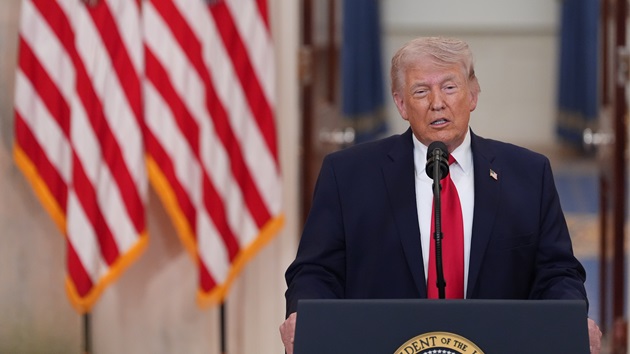
U.S. President Donald Trump speaks from the Cross Hall of the White House on April 1, 2026 in Washington, DC. (Alex Brandon-Pool/Getty Images)
(WASHNGTON) — President Donald Trump said on Thursday that he plans to sign an order to pay “all” employees at the Department of Homeland Security amid the record-long agency shutdown.
“Help is on the way for our Brave and Patriotic Public Servants who have continued to work hard, and do their part to protect and defend our Country,” Trump wrote in a post to his social media platform.
This is a developing story. Please check back for updates.
Traders work on the floor of the New York Stock Exchange, March 31, 2026 in New York City. (Spencer Platt/Getty Images)
(NEW YORK) — Stocks ticked lower in volatile trading on Thursday after President Donald Trump delivered a televised address vowing to hit Iran “extremely hard” over the coming weeks.
The Dow Jones Industrial Average fell 75 points, or 0.1%, after opening down by 600 points, while the S&P 500 dropped 0.06%. The tech-heavy Nasdaq declined 0.1%.
Each of the major indexes tumbled more than 1% in early trading, but they quickly recovered most of those losses.
The rollercoaster trading followed losses across Asian and European markets. Tokyo’s Nikkei 225 index slipped 2.3% and the pan-European STOXX 600 fell 0.6%.
Oil prices, meanwhile, surged as traders feared a persistent supply shortage amid the ongoing U.S.-Israeli war with Iran. U.S. oil prices climbed more than 8% on Thursday, registering at about $108 a barrel.
Gasoline prices in the U.S. ticked up to $4.08 on average per gallon, marking a leap of $1.09 over the past month, AAA data showed.
This is a developing story. Please check back for updates.
Traders work on the floor of the New York Stock Exchange, March 31, 2026 in New York City. (Spencer Platt/Getty Images)
(NEW YORK) — Stocks tumbled worldwide on Thursday after President Donald Trump delivered a televised address vowing to hit Iran “extremely hard” over the coming weeks.
The Dow Jones Industrial Average fell 600 points, or 1.3%, while the S&P 500 dropped 1.2%. The tech-heavy Nasdaq declined 1.6%.
The selloff followed losses across Asian and European markets. Tokyo’s Nikkei 225 index slipped 2.3% and the pan-European STOXX 600 fell 1.3%.
Oil prices, meanwhile, surged as traders feared a persistent supply shortage amid the ongoing U.S.-Israeli war with Iran. U.S. oil prices climbed more than 10% on Thursday, registering at $112 a barrel.
Gasoline prices in the U.S. ticked up to $4.08 on average per gallon, marking a leap of $1.09 over the past month, AAA data showed.
This is a developing story. Please check back for updates.
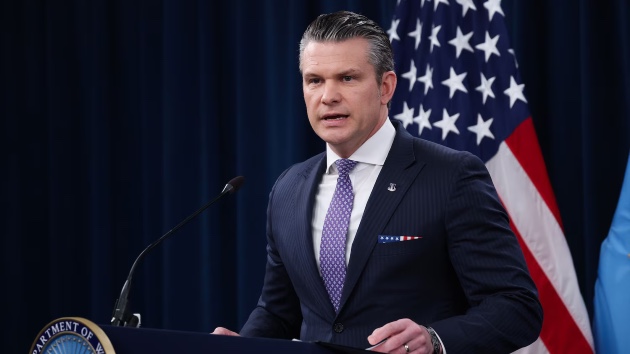
Secretary of Defense Pete Hegseth speaks during a press briefing at the Pentagon, March 31, 2026 in Arlington, Virginia. (Win McNamee/Getty Images)
(WASHINGTON) — A group of Senate Democrats are demanding more information about Secretary of Defense Pete Hegseth’s finances and investments following a report — which the Pentagon demanded be retracted — that he may have tried to invest in defense stocks before the war in Iran began roughly five weeks ago.
“If this report is accurate, it would appear to represent an appalling effort to profit off of your knowledge of the President’s plans for war,” Democratic Sens. Elizabeth Warren, Richard Blumenthal, Tammy Duckworth, Ed Markey and Gary Peters wrote in a letter to Hegseth — and provided exclusively to ABC News — on Wednesday night. “This would be a profound conflict of interest and a potential violation of your federal ethics agreement — and betrayal of the nation paying the price for this war and the troops you are sending into harm’s way.”
The Financial Times reported earlier this week that a broker for Hegseth at Morgan Stanley contacted BlackRock — an equity fund — and tried to make a multimillion-dollar investment into a fund with defense stocks weeks before the Iran war.
The investment did not go ahead because it was not yet available for Morgan Stanley clients, the Financial Times reported — adding that it’s not clear whether Hegseth’s broker found another defense fund to invest in.
ABC News has not independently confirmed the Financial Times’ report.
When reached by ABC News, Morgan Stanley and BlackRock declined to comment on the Financial Times report
In a post on X on Monday, Pentagon chief spokesman Sean Parnell dismissed the report calling it “entirely false and fabricated” and demanded a retraction from the Financial Times.
Still, the Democratic senators, led by Armed Services Committee member Warren, said in their letter that if the report turns out to be accurate, it would be a “serious breach of the public’s trust” and in violation of the ethics agreement he signed ahead of his confirmation as secretary of defense.
“The American people deserve leaders they can trust to put national security ahead of their own financial self-interest,” the senators wrote to Hegseth.
Hegseth is prohibited, under the Department of Defense’s standards of conduct, from owning stock in 10 major industry-specific corporations including Lockheed Martin, Northrop Grumman, General Dynamics, Huntington Ingalls Industries, Boeing, RTX Corporation and L3Harris, which are part of the fund that the Financial Times article claims Hegseth’s broker attempted to purchase.
Hegseth does not have any major holdings in defense companies, according to his most recent financial disclosure reviewed by ABC News.
“Since this was a multi-million dollar investment in a sector-specific fund, your agreement appears to indicate that your broker would have needed your approval or that you did not intend to meet the commitments you made in your ethics agreement,” the senators wrote.
The senators have asked Hegseth to respond to a number of questions about the Financial Times report.
They ask Hegseth to say whether he shared any information with his broker about pending military action or whether he directed his broker to invest in any defense related funds, including BlackRock as the Financial Times report suggests, ahead of the Iran war. They also ask what instructions Hegseth has given his broker to try to avoid conflict of interests and they ask for an accounting of defense stocks owned and sold by Hegseth and his wife.
In his statement, Parnell said that Hegseth and the Department of Defense “remain unwavering in their commitment to the highest standards of ethics and strict adherence to all applicable laws and regulations.”
The senators say that getting answers to their questions will help them to “understand where there may be gaps in current department practices and policies to prevent conflicts of interest.”
House Democrats are also looking into the allegations made about Hegseth in the Financial Times report.
Rep. Robert Garcia, the top Democrat on the House Oversight Committee, announced Tuesday that he’d launch an investigation into the matter.
Republicans have not been publicly commenting on Financial Times report. ABC News has reached out to Senate Armed Services Committee Chairman Roger Wicker for comment about Democrats’ calls for an investigation, but did not receive a response.
ABC News’ Elizabeth Schulze and Lauren Peller contributed to this report
Earthquake richter scale (Gary S Chapman/Getty Images)
(BOULDER CREEK, Calif) — A 4.9 magnitude earthquake shook Northern California early Thursday morning, according to the United States Geological Survey (USGS).
The epicenter struck at a depth of 10.9 km (6.77 miles) near Boulder Creek, California, approximately 65 miles southeast of San Francisco.
This is a developing story. Please check back for updates.
The Open AI logo, which represents the American-based artificial intelligence (AI) research organization known for releasing the generative chatbot language model AI ChatGPT and initiating the AI spring, is being displayed at the Mobile World Congress in Barcelona, Spain, on February 28, 2024. (Photo by Joan Cros/NurPhoto via Getty Images)
(WASHINGTON) — Millions of dollars tied to artificial intelligence are pouring into the 2026 midterms.
Interest groups funded in part by AI industry leaders are split on how the government should oversee AI — and that’s already having an impact on political ads, some experts told ABC News.
“It’s sort of an open question as to what regulation is going to look like,” University of Rochester professor David Primo told ABC News. “The stakes are really high because once a regulatory system gets entrenched, it’s really hard to change it.”
An AI-related political group, Innovation Council Action, tied to two of President Donald Trump’s advisors, announced on Sunday that it would spend at least $100 million, The New York Times reported.
The donations associated with the AI sector go beyond party lines. Federal Election Commission filings show that key industry players are pouring money into committees supporting both Democrats and Republicans, with certain groups criticizing candidates who have expressed support for new AI-related laws and others doing the opposite.
“Companies have always tried to shape regulations, and they’ve always tried to shape them in their favor. What we’re seeing now, though, is that the big companies are not united,” Primo said.
With AI’s presence being increasingly felt, some politicians are calling on their colleagues not to accept money from the burgeoning industry.
“Their money will end up being toxic anyway,” Rep. Alexandria Ocasio-Cortez, D-N.Y., posted on social media. “People are catching on.”
1 industry, different political priorities
In February, Anthropic, the developer of Claude AI, announced it would give $20 million to an organization called Public First Action, explaining that it agreed with most Americans that not enough was being done to regulate AI and that the technology comes with “considerable risks.”
Public First Action spokesperson Anthony Rivera-Rodriguez said that they have already run advertisements thanking Rep. Nikki Budzinski, D-Ill., Sen. Marsha Blackburn, R-Tenn., and Rep. Josh Gottheimer D-N.J., for their AI records.
Gottheimer introduced a bill in February that would provide tax credits for companies training workers on AI development.
It is not yet clear who else has contributed to Public First Action, which describes itself as a “pro-regulation” group.
“Public First Action doesn’t disclose its donors,” Rivera-Rodriguez told ABC News. “To date, the project has raised around $50 million. The aligned super PACs will publicly disclose their contributors in their upcoming FEC reports.”
One of Anthropic’s main competitors, ChatGPT owner OpenAI, has voiced support for nationwide “common-sense rules of the road,” but has cautioned that the U.S. should not fall behind other countries.
In an economic blueprint released last year, OpenAI compared AI’s ascent to the rise of the car, pointing out that while the motor vehicle “industry’s growth was stunted by regulation” in the United Kingdom, the U.S. “took a very different approach,” causing the American automobile sector to grow.
FEC disclosures show that OpenAI co-founder Greg Brockman and his wife each contributed $12.5 million to a group called Leading the Future, which describes itself as supporting candidates who “champion policies that harness the economic benefits of AI and reject attempts to hinder American innovation.”
Committees with links to Leading the Future have already made millions worth of contributions, filings indicate.
One group spent more than $500,000 each in support of North Carolina Republican House candidate Laurie Buckhout and Texas Republican House candidate Jessica Steinmann. The same committee spent more than $700,000 supporting Texas Republican House candidate Chris Gober.
Buckhout, Steinmann and Gober each won their March primaries. All three candidates include similar statements on their websites, mentioning that China cannot overcome the U.S. in the AI race.
Millions spent in Manhattan alone
Nowhere is the role of AI more front and center than in New York’s 12th Congressional District.
Numerous Democrats are running in this Manhattan race, but Assemblyman and former Palantir employee Alex Bores, who co-sponsored New York’s Responsible AI Safety and Education Act, is the candidate who has largely had AI’s focus.
Bores’ website says that he hopes to hold large AI companies accountable and would work to create national safety and privacy requirements.
A PAC associated with Anthropic-supported Public First Action is supporting Bores, Rivera-Rodriguez confirmed. Leading the Future is not.
“Alex Bores is a hypocrite pushing policies that would undermine America’s ability to lead the world in AI innovation and job creation,” Leading the Future spokesperson Jessie Hunt told ABC News.
As of March 16, a super PAC tied to Leading the Future had already spent more than $2.2 million opposing Bores, FEC filings show.
“There’s a few Trump megadonors that made billions of dollars from AI that don’t think there should be any regulation of AI whatsoever,” Bores told ABC News following a recent forum.
With so much AI-related money flowing into races like NY-12 around the country, Primo said these funds are not being spent secretly or for bribery. Instead, the cash is being used to convince voters of who they should elect.
“This might actually be democracy functioning really well,” he said.
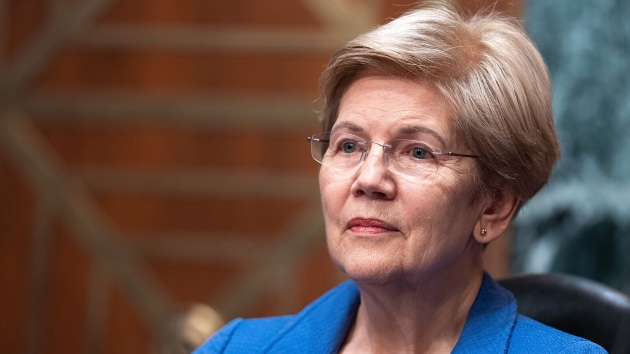
Senator Elizabeth Warren, a Democrat from Massachusetts and ranking member of the Senate Banking, Housing, and Urban Affairs Committee, during a hearing in Washington, D.C., March 26, 2026. (Aaron Schwartz/Bloomberg via Getty Images)
(WASHINGTON) — Sen. Elizabeth Warren, D-Mass., is petitioning the Department of Education to stop its transfer of federal student aid services to the Department of Treasury in her latest effort to halt the dismantling of the agency.
Thursday marks the one year anniversary of Warren’s “Save Our Schools” campaign — her wide-scale investigation against President Donald Trump and Secretary of Education Linda McMahon’s attempts to shutter the Education Department.
“Since Day One, the Trump administration has raised costs for borrowers and tried to undermine our public schools,” Warren said in a statement first obtained by ABC News. “I’ve fought back every step of the way, and I’ll keep fighting to protect our students, teachers, and families,” she said.
Warren told ABC News last year that her campaign would use a combination of federal investigations and oversight to do everything she can to fight back and defend public education.
Warren’s campaign has since triggered the Government Accountability Office (GAO) to probe the department dismantling, an agency watchdog investigation into the Department of Government Efficiency’s alleged “infiltration” of the Office of Federal Student Aid’s sensitive data systems, and other legal actions opposing the Trump administration’s overhaul of the agency.
Warren and top Democratic senators on education-related committees sent a letter to McMahon and Treasury Secretary Scott Bessent on Wednesday, urging the officials to immediately “rescind” the interagency partnership reached in March.
“The Trump Administration continues to move forward with illegal Interagency Agreements (IAAs) dismantling the Education Department (ED),” the lawmakers wrote in the letter, arguing “This latest illegal scheme from the Trump Administration threatens to trap student loan borrowers, students, and families in chaos and bureaucracy, all while American taxpayers are left to foot the bill for Treasury to administer programs that ED can and should administer itself, likely costing more money and burying borrowers and families in unnecessary red tape.”
The most recent agreement includes sending the nearly $1.7 trillion student loan portfolio to Treasury through a multi-phase process to procure the financial aid programs.
“With the student loan portfolio approaching $1.7 trillion and defaults nearing 25 percent, now is the time for a hard reset in how the federal government provides and services student loans,” Department of Education Press Secretary for Higher Education Ellen Keast wrote in a statement to ABC News. “We are confident that our partnership with the Treasury, an experienced and proven fiduciary, will strengthen program administration and better serve American students, borrowers, and taxpayers,” Keast wrote.
The Democratic lawmakers accuse the agencies of breaking the Consolidated Appropriations Act of 2026, which funds the administration of federal student aid and student loan servicing through the Department of Education. They argue that the myriad changes to federal agencies — including the massive reductions in workforce at Education and Treasury — will also result in harming millions of Americans who rely on the expertise of federal student aid civil servants. In 2025, the Trump administration cut over 40% of Education Department employees and nearly a quarter of Treasury staffers, according to an analysis by the Pew Research Center.
Their letter said moving statutory student aid programs, such as the Free Application for Federal Student Aid (FAFSA) and Pell Grants, is not only illegal but likely to throw the financial aid system into disarray.
McMahon has previously stressed that she is not defunding federal programs and will continue to perform all of the agency’s “statutory duties.” A senior Department of Education official said the agency has broad authority to move the services. Interagency agreements are a frequently used tool that Education has engaged in with other partner agencies more than 200 times over the years, the senior department official said on a call with reporters.
Meanwhile, the Education Department has phased out Biden-era student loan repayment plans, saying it is to streamline the process impacting more than 40 million borrowers. Under the Working Families Tax Cuts Act signed into law by Trump last summer, a new income-driven repayment plan will be made available for borrowers on July 1. The Democratic lawmakers fear that student loan borrowers are now left with limited options and guidance while increasing the number of borrowers in default and “economic distress,” according to the letter.
However, Andrew Gillen of the libertarian think tank Cato Institute’s Center for Educational Freedom noted the move should be welcome news for Americans.
“This will benefit students by streamlining the aid application and student loan repayment processes and save taxpayers money by reducing losses on student loans,” Gillen wrote in a statement to ABC News.
Student loan advocates, like Aissa Canchola Bañez, policy director at Protect Borrowers, decried the interagency agreement. Bañez called the announcement irresponsible and reckless, demanding Congress guarantee that the Treasury Department is equipped with the appropriate staff to support borrowers.
“For too long, borrowers have been failed at every turn — they don’t deserve to be failed again by an agency that isn’t ready to protect them,” she wrote in a statement to ABC News.
In this Aug. 8, 2020, file photo, an offshore petroleum drilling rig is shown in the Gulf of Mexico. (UIG via Getty Images, FILE)
(WASHINGTON) — A federal committee, comprised of senior Trump administration officials, voted unanimously to grant an exemption under the Endangered Species Act for oil and gas operations in the Gulf, citing national security concerns.
Environmental groups criticized the decision, warning that it could significantly jeopardize the conservation of dozens of threatened and endangered species in the region, including whales, sea turtles, whooping cranes and manatees.
The Endangered Species Committee convened Tuesday after Defense Secretary Pete Hegseth issued a national security finding that triggered the exemption process.
Under the Endangered Species Act, the Endangered Species Committee can grant rare exemptions when a federal action is of national or regional significance and the benefits of proceeding clearly outweigh the benefits of alternatives that would conserve the species. Economic, security and other public-interest factors can be considered alongside conservation mandates, though exemptions are rarely used.
“At the request of the Department of War, the Endangered Species Committee convened today to consider a national security exemption under the Endangered Species Act with respect to oil and gas activities in the Gulf of America,” the National Oceanic and Atmospheric Administration (NOAA) said in a statement to ABC News.
“The Committee voted in favor of the national security exemption, acknowledging the critical risks involved in restricting oil and gas activities in the Gulf of America, and also recognizing that the action encompassed protective measures for endangered species.”
Officials emphasized that sustained oil and gas production in the region is essential to U.S. national security and economic stability, and cautioned that critical energy operations should not be jeopardized by the threat of disruptive litigation.
The committee, created in 1978, is very rarely convened due to the strict, narrow standards for its implementation. It has not met in more than 30 years, and this is the first time a national security justification has been used to convene the committee.
The Endangered Species Committee, composed of the Secretary of the Interior, the Secretary of Agriculture, the Secretary of the Army, the chairman of the Council of Economic Advisers, the administrator of the Environmental Protection Agency and the administrator of the National Oceanic and Atmospheric Administration, was fully present and voted unanimously in favor of granting the exemption.
“This meeting made clear that energy streams in the Gulf of America must not be disrupted or held hostage by ongoing litigation,” said Secretary Burgum. “Energy production in the Gulf of America is indispensable to our nation’s strength, safeguarding our energy independence and preventing reliance on foreign adversaries. Robust development in the Gulf keeps our economy resilient, stabilizes costs for American families and secures the U.S. as a global leader for decades to come.”
On March 13, Defense Secretary Pete Hegseth notified Interior Secretary Doug Burgum, chair of the Endangered Species Committee, that a national security exemption under Section 7(j) of the Endangered Species Act, was necessary, prompting Secretary Burgum to publish a notice of the meeting in the Federal Register.
The meeting began with the defense secretary addressing the committee, stressing the importance of a steady, affordable domestic energy supply, which is currently under threat. He thanked the committee members for convening to discuss what he called “a matter of urgent national security.”
“This is not just about gas prices. It’s about our ability to power our military and protect our nation. That vital energy supply right now is under threat,” Hegseth said. “In January, well before Operation Epic Fury, the Department of the Interior notified the Department of War about ongoing Endangered Species Act litigation that threatened to halt oil and gas production in the Gulf of America.”
According to Hegseth, the litigation seeks to stop Gulf oil and gas activities rather than allow them to proceed alongside responsible endangered species protections.
“These legal battles waste critical government resources and make it impossible for energy companies to plan and invest in new projects. When development in the Gulf is chilled, we are prevented from producing the energy we need as a country and as a department,” Hegseth added. “The Strait of Hormuz is the world’s busiest oil route and recent hostile action by the Iranian terror regime highlights yet again why robust domestic oil production is a national security imperative.”
However, environmental groups argue this is not what the authors of this landmark law intended.
The Center for Biological Diversity sued Secretary Burgum on March 18, attempting to block the committee meeting, saying the government missed legal requirements, including filing deadlines, providing ample public notice, and having an administrative law judge preside. Following the committee’s decision, the group announced it will amend its existing lawsuit to challenge the defense secretary’s national security determination and the exemption.
“Americans overwhelmingly oppose sacrificing endangered whales and other marine life so the fossil fuel industry can get richer. This has nothing to do with national security and everything to do with Trump and his lackeys kowtowing to Big Oil,” Brett Hartl, government affairs director at the Center for Biological Diversity, said in a statement.
Environmental groups are particularly concerned about the Rice’s whale, which, according to NOAA, is one of the rarest and most endangered whales in the world and is found only in the Gulf.
NOAA Fisheries, which manages protections for marine species under the Endangered Species Act, listed the Gulf of Mexico Bryde’s whale as endangered in 2019 and, in 2021, updated its name to Rice’s whale to reflect the newly accepted scientific taxonomy and nomenclature of the species.
According to the Marine Mammal Commission, the most recent population estimates show there are only 51 Rice’s whales remaining.
The Rice’s whale’s small population, limited range and low genetic diversity make it highly vulnerable to threats such as vessel strikes and oil spills. NOAA says the 2010 Deepwater Horizon spill exposed about 48 percent of its habitat in the eastern Gulf, likely causing a population decline of up to 22 percent and leaving lasting impacts on reproduction and growth.
The committee’s decision will not have any immediate effect, and lawsuits challenging the action could delay its implementation further. It could be several years before any future additional oil production tied to the decision is realized.
“The action could make it easier for applications to be granted for further oil and gas exploration and development in the Gulf; but it takes several years between the filing of an application and the production of the first barrel of oil,” said Michael Gerrard, a professor at Columbia Law School and the faculty director of the Sabin Center for Climate Change Law. ”No court has ordered oil and gas production to be shut down in the Gulf, and such an order seems very unlikely.”