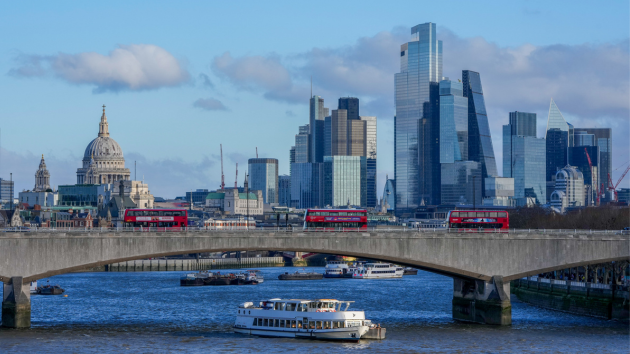
Tourist boats on the River Thames in London, UK, on Wednesday, Dec. 24, 2025. UK businesses ended 2025 feeling more upbeat about the economy’s prospects after they were spared much of the tax pain at last month’s budget. (Carlos Jasso/Bloomberg via Getty Images)
(LONDON) — The River Thames winds 215 miles through England, carving out the curves and bends that define much of the geography, including London’s. For centuries, the river has been called “monster soup” and the “dirty old river.”
For thirty years, Lubos Grajciarik, known online as Urban Angler Lou, has stood on its banks with a fishing rod in hand.
“Originally, I came from Slovakia… and I have fished most of my life,” he told ABC News.
He has witnessed firsthand the river’s slow transformation, from Canary Wharf’s rise to the quieter stretches upstream at Richmond and at the weir Teddington Lock.
“Yes, there is improvement,” he said. “Water is still polluted. But it is significantly lower than in previous years.”
Further improvement, and the hope for an even cleaner future, now rests on a monumental infrastructure project beneath London: the £4.5 billion, or about $6 billion, Tideway Tunnel, also known as the “super sewer.” The 25-km tunnel — the largest upgrade to London’s sewers in 150 years — is, according to its designers, intended to intercept overflows and capture waste before it reaches the river.
Four of the tunnel’s 21 gates, which are valves that are designed to stop the waste before it enters the Thames, are operational, with more to open in the coming months.
“The newly completed Tideway Tunnel will reduce the volume of discharges entering the tidal Thames in a typical year by 95%,” said a spokesperson for Thames Water, the company responsible for London’s wastewater.
Optimism from those along the riverbank appears to be supported by science. For more than half a century, the City of London Corporation has collaborated with anglers and ecologists in a citizen science project to track fish populations.
Scientists estimate that more than 100 species now inhabit the Thames, a river once declared biologically dead. In 2024, volunteers caught 122 fish across five species — bass, flounder, eel, pouting and dab.
Grajciarik said his catches reflect that resurgence. “There is a mixture of both species,” he said. “Freshwater pike and perch coexist with occasional mullets, sea bus, sea route.” The Thames, where saltwater meets fresh, has become a rare brackish habitat — alive again, yet still fragile.
But beneath the river’s revival, a darker current still runs.
“In many ways, the Thames is a much healthier ecosystem than it was. Though there are other pressures, like pharmaceuticals, chemicals, [micro]plastics, in the sewage now, against heavy metals several decades ago,” said Dr. Alexander Lipp, an Earth and environmental scientist who created Sewage Map, a platform that tracks sewage overflows in real time.
“Only 6% of the rivers and streams in the Thames basin are classed as in ‘good ecological health’ by the Environment Agency,” a spokesperson for Thames21, an environmental charity working to revive rivers in the Thames Basin, told ABC News. “The primary culprit is physical modifications (straightening, deepening or even paving over rivers), followed by sewage pollution.”
Thames Water saw serious pollution incidents more than double in 2024 — to 33 from 14 a year earlier — according to the Environment Agency’s latest report, which was released before the new “super sewer” began opening. Out of nine water companies assessed, Thames Water alone earned a one-star rating, the lowest possible.
Officials at the Environment Agency — a government agency responsible to protect and improve the environment in the U.K. — attributed the decline in the rating to a mix of factors: unusually wet and stormy weather, years of underinvestment, poor infrastructure maintenance and more rigorous monitoring.
Thames Water said that “all discharges of untreated sewage are unacceptable” in a 2023 statement.
Addressing the low ratings, a company spokesperson said in an emailed response to ABC News, that “in 2024-25, Thames Water also made a record capital investment of £2.225 billion. We know we need to further improve for our customers, community, and the environment, which is why we have embarked on the largest ever investment programme, delivering the biggest upgrade to our network in 150 years.”
Yet those promises are shadowed by debt — nearly £17 billion, or about $22.3 billion, as of March 2025 — amid the growing pressure of climate change. The company said this month that its debt had grown to nearly £20 billion and that it was negotiating with its creditors.
“Any sewage discharged into the Thames negatively affects the river, increasing nutrient loading, bacteria, and plastic pollution,” the Thames21 spokesperson said.
“Climate change is something that’s going to make this worse,” Lipp said. He explained that London’s combined sewage system, where stormwater and wastewater share the same pipes, is easily overwhelmed by heavy rain. With more intense downpours expected, spills will likely become even more frequent.
Still, Lipp noted, “I would say that Thames is better than other companies when it comes to data transparency.”
The company says long-term recovery will take patience. “Transforming Thames is a major programme of work that will take time; it will take at least a decade to achieve the scale of change required,” a spokesperson said.
“I can see the people taking more responsibility for our waters,” said Grajciarik, the fisherman. He often reports oil from nearby boats or sewage spills to the U.K.’s Environment Agency’s hotline number.
But whether the massive investments and new infrastructure will be enough remains uncertain.
(NEW YORK) — A major winter storm is making post-Christmas road travel extremely dangerous in parts of the Northeast, and bringing snow and ice to the New York City area.
The storm is also impacting flights. More than 1,500 flights were canceled on Friday, with New York City’s three airports and the Philadelphia International Airport hit the hardest.
More than 500 flights were canceled on Saturday.
New Jersey and New York were under state of emergencies.
“Please continue to monitor your local forecast, avoid unnecessary travel and if you must travel, take all necessary precautions to ensure you arrive safely,” New York Gov. Kathy Hochul said in a statement.
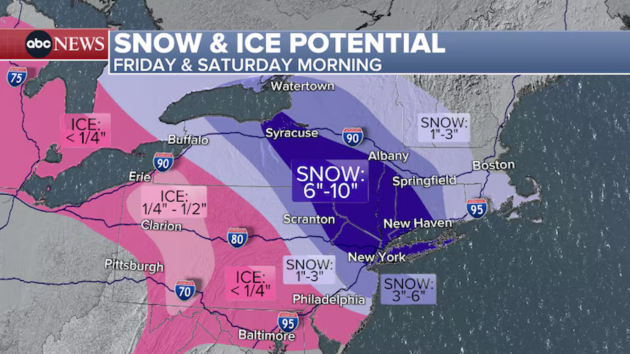
Heavy snow is expected to hit parts of New York, eastern Pennsylvania, New Jersey, Connecticut, western Massachusetts and Rhode Island.
The heaviest snow began moving into the tristate area Friday afternoon and will continue through the night, making travel difficult from Philadelphia to New York City to Albany, New York.
The snow began reaching New York City around 5 p.m. Friday and was expected to continue overnight, ending around 7 a.m. Earlier, New York City was forecast to get about 7 inches of snow — which would have been the most snow in nearly four years.
However, the National Weather Service later revised its forecast saying the mix of precipitation had shifted further northeast, lowering the expected snowfall totals around New York City and northeast New Jersey.
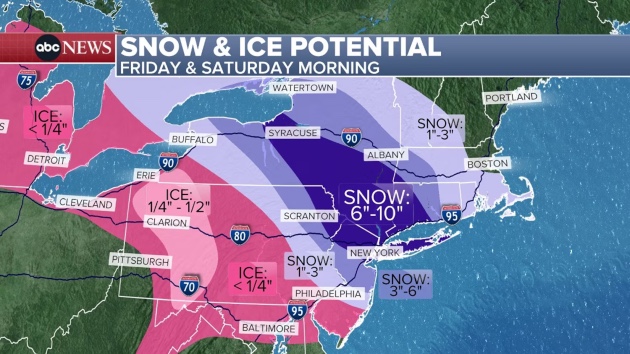
Instead, the New York City area was expected to see between 2 to 5 inches with some spots seeing 6 inches especially to the north. A “glaze of ice” from freezing rain was also expected.
New York City Mayor Eric Adams called it a “significant snow event” and said plows would be hitting the streets later Friday night.
Six to 10 inches of snow is possible from upstate New York to Long Island.
Philadelphia can expect 1 to 3 inches of snow along with a glaze of ice, making travel challenging on Friday night.
On Friday morning, the freezing rain moved into Pennsylvania and covered roads across the state with dangerous ice. An ice storm warning is in place in parts of western Pennsylvania, where numerous power outages and downed trees are possible.
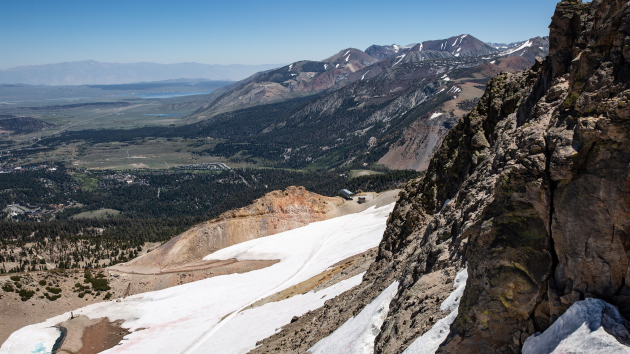
Mountan bikers have replaced skiers in early August as a record-breaking ski season comes to a slushy end on August 6, 2023, in Mammoth Lakes, California. After a series of winter atmospheric rivers slammed into this high elevation Sierra Nevada resort, dropping 900 inches of snow at the top of Mammoth Mountain and nearly 700 inches in the village, the ski season was pushed into August for only the third time in Mammoth’s history. (Photo by George Rose/Getty Images)
(CALIFORNIA) — Two ski patrollers performing avalanche mitigation work at a California ski resort were injured in an avalanche on Friday, the resort operator said.
The avalanche occurred at Mammoth Mountain at approximately 7:30 a.m. local time, prior to ski area operations. The two patrollers got caught in a slide and were transported to an area hospital, the resort said.
One person sustained serious injuries and was being transported out of the area for further care, while the other was evaluated for possible broken bones, the resort said.
The ski area was closed for the remainder of the day amid high avalanche danger, the resort said.
Mammoth Mountain, which is located in Mammoth Lakes in the Sierra Nevada mountains, has received more than 5 feet of snow since Tuesday, the resort said.
The White House Press Secretary Karoline Leavitt speaks at the White House press briefing room in Washington DC, United States, on December 11, 2025. (Photo by Celal Gunes/Anadolu via Getty Images)
(WASHINGTON) — White House press secretary Karoline Leavitt announced on Friday that she is pregnant with her second child.
“The greatest Christmas gift we could ever ask for – a baby girl coming in May 2026,” Leavitt wrote in a post to Instagram.
“My husband and I are thrilled to grow our family and can’t wait to watch our son become a big brother. My heart is overflowing with gratitude to God for the blessing of motherhood, which I truly believe is the closest thing to Heaven on Earth,” she wrote.
“I am also extremely grateful to President Trump and our Chief of Staff Susie Wiles for their support, and for fostering a pro-family environment in the White House. 2026 is going to be a great year and I am so excited to be a girl mom!” Leavitt added in the social media post.
Leavitt is 28 years old and is the youngest person to serve as White House press secretary. She previously worked in the press office during President Donald Trump’s first term and also served as the press secretary for his 2024 campaign.
Leavitt ran a failed bid for Congress in New Hampshire, her home state, in 2022.
She and her husband, Nicholas Riccio, welcomed their first child, Nicholas “Niko” Robert Riccio, in 2024.
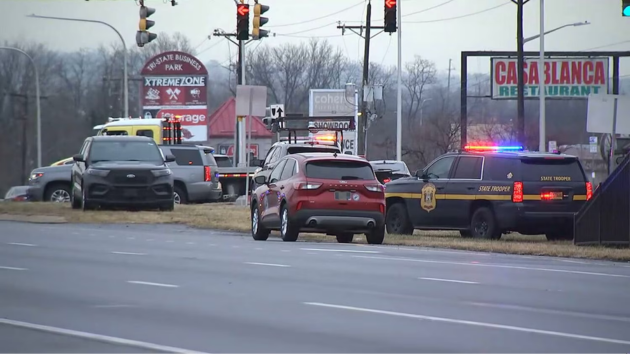
Authorities respond to a shooting at a DMV in New Castle, Delaware, Dec. 23, 2025. WPVI
(NEW CASTLE, Del.) — A state trooper was killed after authorities say a customer at a DMV location in Delaware opened fire on the law enforcement officer from behind while he was sitting at a reception desk.
Cpl. Matthew T. “Ty” Snook, 34, of Hockessin, Delaware, a 10-year veteran of the Delaware State Police, was killed in Tuesday’s shooting, the agency said.
The suspected shooter was fatally shot by a responding police officer, according to Delaware State Police. The suspect was identified by police on Friday as 44-year-old Rahman Rose, of Wilmington.
The suspect approached Snook a short time after entering the Karen L. Johnson Division of Motor Vehicles in New Castle and allegedly shot him from behind with a handgun, according to Delaware State Police.
Snook managed to push a DMV employee out of harm’s wayand told the individual to run as the suspect allegedly continued firing at him, according to state police.
Snook was transported to a local hospital, where he died, according to Delaware State Police spokesperson Cpl. Raushan Rich.
“We lost a brother, a son, best friend, a coach, a husband and a father,” Col. William Crotty, Superintendent of Delaware State Police, said at a press briefing Tuesday night. “Our trooper loved his community. He served with honor and integrity, and his life was cut short by senseless violence.”
“His last actions were that of a hero – a hero who saved lives today while sacrificing his own,” he added.
Snook was described as a dependable, professional and committed trooper by state police.
Multiple agencies responded to the shooting, which occurred Tuesday afternoon, police said.
“Rose allowed customers to leave the building and remained inside waiting for responding law enforcement,” Delaware State Police said in a statement. “As officers arrived, Rose fired multiple rounds at law enforcement as they approached the building.”
A New Castle County police officer shot Rose through a window from outside the DMV, according to state police.
The suspect was transported to an area hospital, where he died, according to Rich.
Several people sustained non-gunshot-related injuries, including a second trooper and a 40-year-old woman, according to Rich. A 35-year-old woman was evaluated for shortness of breath and declined transport to a hospital, he said.
“What happened today was an act of pure evil, and if not for the heroism of several troopers and other officers, the consequences could have been so much worse,” Delaware Gov. Matt Meyer said at the press briefing.
Snook was working an overtime assignment at the time. He is survived by his wife and their one-year-old daughter, officials said.
“Our DSP family extends its deepest condolences to the Snook family. We are forever grateful to them for sharing ‘Ty’ with us and for the sacrifices they made in support of his service to the citizens of Delaware,” state police said.
Police have not released any details on an alleged motive in the shooting, which remains under investigation.
Who needs Santa on Christmas when you have a performance from Snoop Dogg?
Snoop entertained fans Thursday with his Holiday Halftime Party, part of Netflix‘s NFL Christmas Day telecast. The performance took place at halftime of the matchup between the Detroit Lions and Minnesota Vikings and began with an introduction from Snoop’s longtime friend Martha Stewart, who put her own spin on the classic “Twas the Night Before Christmas.”
“I sprung from my bed and said, ‘What is cracking?’ Hailing from the one and only LBC, give it up for Snoop D -O- Double G,” Martha said as she flipped the pages to a book with illustrations of Snoop.
Snoop then emerged dressed in a red suit and coat, performing songs including “The One and Only,” “My Favorite Things” and “Nuthin’ But a ‘G’ Thang.” He was backed by an orchestra, a marching band and dancers.
Huntr/x, the trio behind Netflix’s Kpop Demon Hunters movie, joined Snoop for a pop rendition of “The 12 Days of Christmas” and then Lainey Wilson followed with “Santa Claus Is Coming to Town,” arriving in a white sleigh. Andrea Bocelli later took the stage with his son Matteo Bocelli to duet on “White Christmas.”
Kentucky police confiscated 55 pounds of meth wrapped in Christmas paper, Dec. 22, 2025. Jeffersontown Police Department
(JEFFERSONTOWN, Ky.) — Santa was not the only one trying to deliver Christmas surprises this year.
Police say they confiscated 55 pounds of suspected methamphetamine wrapped in Christmas paper Monday during a narcotics investigation in Jeffersontown, Kentucky, right outside of Louisville.
Jacob Talamantes, 23, of Nebraska, was arrested after a police K9 alerted officers to the presence of illicit drugs in Talamantes’ 2013 Chevrolet Malibu, according to a press release from the Jeffersontown Police Department. Police say they found the festively wrapped methamphetamine packages in the vehicle.
According to police, Talamantestried to walk away from the officers but was detained. Additionally, he allegedly told officers that he was traveling from Iowa and intended to traffic the drugs.
The Jeffersontown Police Department Chief Richard Sanders decried the crime.
“No amount of festive wrapping can disguise the harm these drugs inflict on families and communities. The coordinated efforts of partner agencies ensured these holiday-wrapped packages never reached the streets,” Sanders said in a Facebook post.
Talamantes is charged with first-degree trafficking in a controlled substance, according to police. The charge is a felony, per state law.
Jeffersontown Police credited the Kentucky State Police and the Drug Enforcement Administration for their assistance in the investigation.
Attorney information for Talamantes was not immediately available, but he is expected to next appear in court on Friday, Jan. 2, per court documents.
(NEW YORK) — A major winter storm is making the post-Christmas travel extremely dangerous in parts of the Northeast, and the storm is set to bring the most snow to New York City in years.
The storm is also impacting flights. Nearly 800 flights have been canceled so far on Friday, with New York City’s three airports and the Detroit Metro Airport hit the hardest.
The storm first hit the Midwest. People in Wisconsin and Michigan are waking up to a layer of ice on the roads, so drivers should use extra caution.
On Friday morning, the freezing rain moves east into Pennsylvania and will cover the entire state throughout the day, making the roads extremely treacherous. An ice storm warning is in place for nearly 1 million people in parts of western Pennsylvania.
On the north side of this storm, where temperatures are cold enough to create snow instead of ice, heavy snowfall is expected in parts of New York, eastern Pennsylvania, New Jersey, Connecticut, western Massachusetts and Rhode Island.
The snow will begin in western New York on Friday morning and reach New York City by 5 p.m. Friday.
The snow will be heavy at times and will greatly reduce visibility, making travel treacherous.
The snow will continue overnight, ending in New York City around 9 a.m.
New York City is forecast to get about 7 inches of snow — the most snow in nearly four years.
A winter storm warning in place for the tristate region. Six to 9 inches of snow is possible in upstate New York, with 10 inches possible in the Hudson Valley. Five to 8 inches is forecast for northern New Jersey, while Hartford, Connecticut, could get about 4 inches.
Philadelphia can expect 1 to 3 inches of a sleet and snow mix, along with a glaze of ice, making travel challenging on Friday night. Baltimore can also expect icy roads.
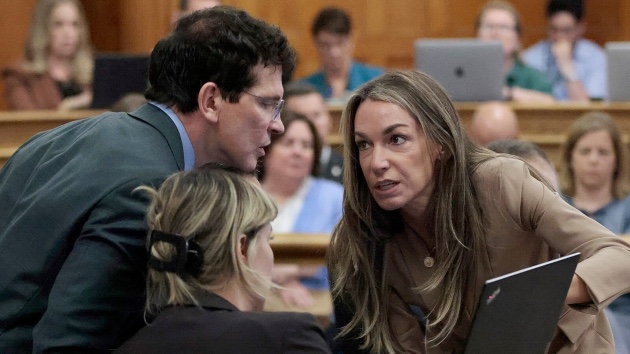
Karen Read confers with defense attorneys Robert Alessi, left, and Elizabeth Little on June 9, 2025. (Pat Greenhouse/The Boston Globe via Getty Images)
(NEW YORK) — This year was full of first-of-its-kind stories that got Americans talking. Here’s a look back at some of the most talked about U.S. stories of 2025 outside of politics, from the Los Angeles wildfires to Sean “Diddy” Combs’ trial.
LA wildfires
The Palisades and Eaton fires erupted in Los Angeles County on Jan. 7. With severe drought conditions and strong Santa Ana winds fueling the flames, the fires spread quickly, killing at least 29 people and wiping out thousands of homes in the densely populated neighborhoods of Pacific Palisades and Altadena.
In October, Jonathan Rinderknecht was arrested for allegedly igniting a brush fire in the Pacific Palisades on Jan. 1 — a fire that prosecutors say eventually became the Palisades Fire. Rinderknecht, a former Pacific Palisades resident, has pleaded not guilty to arson affecting property, timber set afire and destruction of property.
3 back-to-back plane crashes
On Jan. 29, an American Airlines regional jet was on approach to Washington, D.C.’s Ronald Reagan Washington National Airport when it collided with a U.S. Army Black Hawk helicopter, sending both aircraft plunging into the Potomac River.
All 64 people on board the plane and all three soldiers on the helicopter were killed.
The collision marked the nation’s first major commercial airline crash since 2009.
The National Transportation Safety Board has not released its final report, which will determine the probable cause of the crash, but investigators said during a July hearing that the Black Hawk pilots likely didn’t know how high they were flying or how close they were to the plane due to faulty altimeters inside the aircraft. NTSB Chair Jennifer Homendy told reporters, “It’s possible there was zero pilot error here.”
After the crash, Sen. Ted Cruz introduced legislation called the ROTOR Act. The law would require nearly all aircraft to transmit Automatic Dependent Surveillance – Broadcast (ADS-B), a system which allows aircraft to transmit their location to other aircraft as well as air traffic controllers. It would also close a loophole that allows military aircraft to operate without ADSB-Out. The ROTOR Act is awaiting a vote in the Senate.
The NTSB is expected to reveal the probable cause and its recommendations in late January.
Just two days after the D.C. crash, a medical transport jet crashed in Philadelphia. The jet, which was carrying a child and her mother along with four other people, was in the air for less than a minute after taking off from Northeast Philadelphia Airport. All six people on board, as well as one person on the ground, were killed. The NTSB has not released a cause.
Then on Feb. 17, a Delta plane crashed and overturned during landing at Toronto Pearson International Airport. All 80 people on board survived. Twenty-one passengers were injured, including two seriously injured.
A report released in March found that the right main landing gear broke and collapsed on impact as the plane landed at a high descent rate. Once the right main landing gear collapsed, the wing hit the runway, sprayed fuel and caused a fire. The Transportation Board of Canada has not yet released a probable cause for this crash.
Gene Hackman and his wife die in their home
When actor Gene Hackman and his wife Betsy Arakawa were found dead at their Santa Fe, New Mexico, home during a Feb. 26 welfare check, their causes of death were not immediately clear, which sparked national intrigue.
In March, investigators announced that Arakawa, 65, died from hantavirus pulmonary syndrome, a rare disease transmitted through rodent urine, droppings or saliva, officials said.
Hackman, 95, who died of cardiovascular and Alzheimer’s disease, was likely home with his deceased wife for one week before he died, officials said. Arakawa died around Feb. 12, while Hackman died around Feb. 18, officials said.
Hackman “was in an advanced state of Alzheimer’s, and it’s quite possible that he was not aware that she was deceased,” an investigator said.
One of the couple’s three dogs was also found dead in a crate during the welfare check. The dog likely died of dehydration and starvation, a report found.
Karen Read’s trial
On June 18, a Massachusetts jury found Karen Read not guilty of murdering her Boston police officer boyfriend, ending a criminal case that gripped the nation’s attention.
While Read was acquitted of the most serious charges — including second-degree murder, manslaughter and leaving the scene after an accident resulting in death — the jury did find her guilty of operating under the influence of liquor. The judge immediately sentenced her to one-year probation, the standard for a first-time offense.
The first criminal case against Read ended in a mistrial last year.
Prosecutors alleged Read hit her boyfriend, John O’Keefe, with her car outside the home of a fellow police officer after a night of heavy drinking in 2022 and then left him to die there during a blizzard. The defense had argued that Read’s vehicle did not hit O’Keefe and instead said O’Keefe was attacked by a dog and beaten by other people who were in the house before he was thrown outside in the snow to die.
Texas flooding
In the early hours of July 4, heavy rain inundated Texas’ Hill Country region, quickly sparking catastrophic flooding.
Over 130 people were killed, including at least 117 in Kerr County, officials said. More than two dozen of the victims were from Camp Mystic, a Christian all-girls sleepaway camp in Kerr County.
Some state leaders and environmental experts told ABC News in July that a number of the cabins were in known flood zones and close proximity to the river, according to officials and FEMA’s road maps.
In September, Texas Gov. Greg Abbott signed into law three bills aimed at improving the safety of camps in Texas and protecting Texans from future flooding events, after parents of Camp Mystic flooding victims advocated before the state legislature for better safety measures.
In October, legislative committees were formed by Lt. Gov. Dan Patrick and Speaker of the Texas House of Representatives Dustin Burrows to investigate the flooding. No investigative findings have been announced as of December.
In November, a slew of wrongful death cases were filed against Camp Mystic on behalf of many of the parents who lost their children. The families previously criticized Camp Mystic’s decision to reopen one of its campsites next year.
In a December letter to parents, Camp Mystic officials said they plan to implement safety measures that are not only in compliance of the new camp safety laws, but “exceed their requirements.” The camp’s partial reopening is slated for summer 2026.
Bryan Kohberger pleads guilty
Weeks before Bryan Kohberger was set to go on trial for the 2022 quadruple homicides at the University of Idaho, Kohberger admitted to the crimes at a change of plea hearing in July.
At sentencing, Kohberger was given four consecutive life sentences on the four first-degree murder counts and the maximum penalty of 10 years on the burglary count.
Survivors of the attack and relatives of the four slain students spoke out, sharing emotional statements at Kohberger’s sentencing hearing. Surviving roommate Dylan Mortensen said Kohberger “took away my ability to trust the world around me” and “shattered me in places I didn’t know could break.” Kristi Goncalves, mom of victim Kaylee Goncalves, told Kohberger that “hell will be waiting” for him.
The judge acknowledged Kohberger’s motive may never be known.
Sean Combs’ trial
Following an eight-week trial in Manhattan federal court that gripped the country, in July, music mogul Sean “Diddy” Combs was convicted of two counts of transportation for the purposes of prostitution. The jury acquitted Combs of more serious sex trafficking and racketeering charges.
At October’s sentencing hearing, Combs tearfully apologized in court, saying, “I’ve been humbled and broken to my core.”
The mogul is now serving a four-year sentence at FCI Fort Dix, a federal prison in New Jersey. Combs is appealing the conviction and his sentence.
It began on May 30 when Decker picked up his three daughters at his ex-wife’s home for a planned visitation.
On May 31, police announced the disappearance of the three daughters: Paityn, 9; Evelyn, 8; and Olivia, 5.
On June 2, the girls’ bodies were found near a campground. Decker allegedly suffocated his daughters to death, police said.
Decker, a former member of the military with “extensive training,” disappeared, sparking a multi-agency manhunt.
An attorney for Decker’s ex-wife told ABC News that Decker lacked mental health resources and struggled with post-traumatic stress disorder.
On Sept. 18, Decker’s remains were found in a remote, wooded area. The local coroner said an autopsy couldn’t be done due to how little remains were left.
Menendez brothers resentenced, but denied parole and denied new trial
In their continued push for freedom this year, Lyle and Erik Menendez had one big legal win, but two significant losses.
The brothers were convicted in 1996 of the first-degree murder of their parents and sentenced to two consecutive life prison terms without the possibility of parole. The last several years, they’ve pushed to be released, citing accomplishments in prison and the abuse they alleged they suffered from their parents.
This May, Judge Michael Jesic resentenced Erik and Lyle Menendez to 50 years to life in prison, making them immediately eligible for parole under youth offender parole laws. Jesic said he was moved by letters from prison guards and is amazed by what the brothers have accomplished in their decades behind bars.
But in August, the brothers were both denied parole. Commissioners reviewed Erik Menendez’s time in prison and noted some inappropriate behavior with visitors, drug smuggling, misuse of state computers, violent incidents and illegal cellphone use. Lyle Menendez’s panel of commissioners — who were different from those reviewing Erik’s case — noted he also was caught illegally using cellphones. The brothers will next be eligible for parole in three years.
Their second loss came in September, when Judge William Ryan denied the brothers’ habeas corpus petition, which they filed in 2023 to try to toss their conviction and get a new trial based on newly discovered evidence. The judge said “neither piece of evidence adds to the allegations of abuse that the jury already considered.”
Charlie Kirk killed
On Sept. 10, conservative activist Charlie Kirk was shot and killed in the middle of his outdoor event at Utah Valley University in Orem, Utah.
Kirk, 31, was the founder of the conservative youth activist organization Turning Point USA, and the Utah Valley event marked the first stop of his “The American Comeback Tour,” which invited students on college campuses to debate hot-button issues.
Charlie Kirk’s wife, Erika Kirk, said at her husband’s memorial that she forgives Robinson. “That young man, I forgive him. … The answer to hate is not hate,” she said.
Robinson has been charged with aggravated murder, felony discharge of a firearm causing serious bodily injury, obstruction of justice, two counts of witness tampering and commission of a violent offense in the presence of a child. He has not entered a plea.
Rob Reiner and Michele Singer Reiner killed
On Dec. 14, renowned Hollywood director Rob Reiner and his wife Michele Singer Reiner were found stabbed to death in their Los Angeles home.
Hours later, the suspect — the couple’s 32-year-old son, Nick Reiner — was taken into custody.
Nick Reiner — who was living on his parents’ property, according to a former family security guard — was charged with two counts of first-degree murder, with the special circumstance of multiple murders, prosecutors said. He has not entered a plea. The charges carry a maximum sentence of life in prison without the possibility of parole or the death penalty, prosecutors said.
“The horrific and devastating loss of our parents, Rob and Michele Reiner, is something that no one should ever experience. They weren’t just our parents; they were our best friends,” they said.
“We are grateful for the outpouring of condolences, kindness, and support we have received not only from family and friends but people from all walks of life,” Jake and Romy Reiner said. “We now ask for respect and privacy, for speculation to be tempered with compassion and humanity, and for our parents to be remembered for the incredible lives they lived and the love they gave.”
ABC News’ Olivia Osteen, Meredith Deliso, Clara Mcmichael, Ayesha Ali and Sam Sweeney contributed to this report.
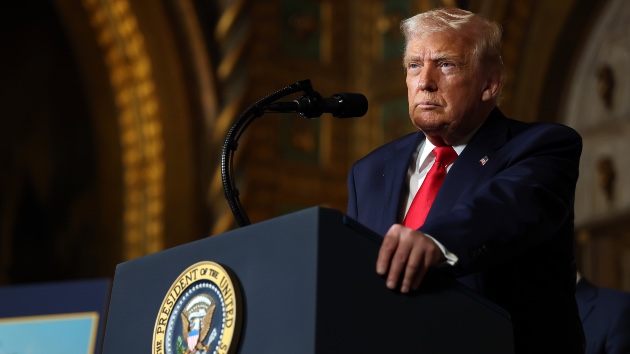
U.S. President Donald Trump at Trump’s Mar-a-Lago estate on December 22, 2025 in Palm Beach, Florida. (Photo by Tasos Katopodis/Getty Images)
(WASHINGTON) — President Donald Trump said in a post on his social media platform Thursday that he launched a “powerful and deadly strike” on ISIS terrorists in Nigeria, whom he claimed have been “targeting and viciously killing, primarily, innocent Christians.”
This comes after the president posted a video in early November threatening to go into Nigeria “guns-a-blazing.” Around that time, Defense Secretary Pete Hegseth echoed Trump’s message and said in a post on X that the Department of Defense was “preparing for action.”
“I have previously warned these Terrorists that if they did not stop the slaughtering of Christians, there would be hell to pay, and tonight, there was. The Department of War executed numerous perfect strikes, as only the United States is capable of doing,” Trump added in the post.
It is not yet clear the outcome of that strike or what the exact target was. ABC News has asked the White House for more information.
In a post on X, Hegseth further said there will be “more to come” and expressed his gratitude to the Nigerian government for its support and cooperation.
“The President was clear last month: the killing of innocent Christians in Nigeria (and elsewhere) must end.
“The @DeptofWar is always ready, so ISIS found out tonight — on Christmas.”
Hegseth ended his post with, “Merry Christmas!”
In a post on X, U.S. Africa Command confirmed the strikes, which it said were conducted “in coordination with Nigerian authorities.”
The Nigerian Ministry of Foreign Affairs in Abuja later released a statement saying that the U.S. strikes were carried out together with Nigerian authorities and are part of the ongoing security work they do with the U.S. and other partners to tackle ISIS and extremist groups.
“In line with established international practice and bilateral understandings, this cooperation includes the exchange of intelligence, strategic coordination, and other forms of support consistent with international law, mutual respect for sovereignty, and shared commitments to regional and global security,” the ministry said.
The Defense Department also reposted President Trump’s statement, along with a brief video clip labeled “unclassified” that shows a missile being launched from a ship, presumably at targets in Nigeria.
The strike against ISIS in Nigeria Thursday comes just days after U.S. strikes were launched against ISIS in Syria, following an attack on U.S. and partner forces in Syria that killed three Americans earlier this month.
Trump in November instructed the Pentagon to prepare for possible action against Nigeria after accusing the Nigerian government of not doing enough to protect Christians from violence.
Asked if there was a possibility of U.S. troops being boots on the ground in the West African country, Trump replied, “Could be.”
“They’re killing the Christians and killing them in very large numbers, we’re not going to allow that to happen,” he said.
Days later, the State Department officially updated its designation for Nigeria as a “Country of Particular Concern” (CPC) for its alleged “severe violations of religious freedom” and persecution of Christians.
Last week, Nigeria was also added to the U.S. travel ban list of countries facing partial restrictions and entry limitations.
Nigerian President Bola Tinubu doesn’t deny the violence against Christians in Nigeria, but says previous claims that Nigeria is religiously intolerant “does not reflect our national reality.”
Independent experts say extremist groups have targeted both Muslims and Christians in Nigeria, killing tens of thousands of civilians in recent years.
On Christmas Eve, Nigerian President Bola Tinubu posted on X, saying that he prayed “for peace in our land, especially between individuals of differing religious beliefs.”
“I stand committed to doing everything within my power to enshrine religious freedom in Nigeria and to protect Christians, Muslims, and all Nigerians from violence,” the post continued.