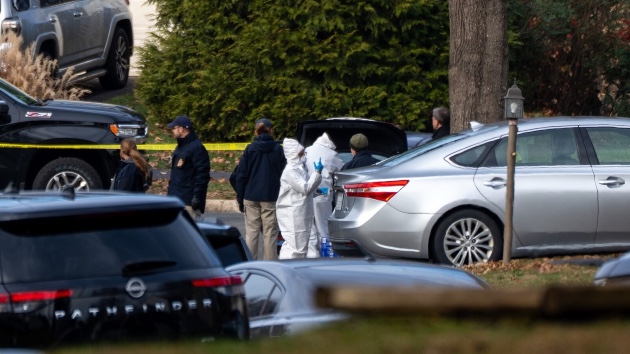
Prince William County police seal the street in front of the home of suspected Jan. 6, 2021, pipe bomber on Dec. 4, 2025, in Woodbridge, Virginia. (Andrew Leyden/Getty Images)
(NEW YORK) — Attorneys for the Virginia man charged with planting pipe bombs outside of the Republican National Committee and Democratic National Committee headquarters the night before the Jan. 6, 2021, riot at the U.S. Capitol are urging a judge to release him pending trial, arguing the government has presented no evidence that shows he poses a danger to the general public.
In a late-night filing on Monday, suspect Brian Cole Jr.’s attorneys said the “government-induced excitement” around Cole’s arrest earlier this month is both premature and potentially in violation of local court rules.
The filing came ahead of Cole’s scheduled court appearance on Tuesday afternoon for a detention hearing.
Cole, of Virginia, was arrested by federal authorities earlier this month following a massive probe that had stymied investigators for almost five years. He appeared in court on Dec. 5, where a judge detailed the two charges he currently faces. The charges carry a maximum sentence of up to 30 years if he is convicted.
Cole, who has not entered a plea, allegedly told investigators in a lengthy confession that he wasn’t targeting the joint session of Congress that was convening to certify former President Joe Biden’s election win, according to previous court filing from the Department of Justice.
After Cole saw himself on the news in videos released by the FBI seeking tips on his identity, he said in the interview that he discarded all of his bomb-making materials at a nearby dump and said he never told anyone about his actions in the nearly five years since Jan. 6, according to the filing. The filing also notes that over the past years he appeared to wipe data from his personal cellphone “nearly one thousand times.”
Prosecutors included the alleged details of Cole’s confession in a filing urging a judge to keep him detained pending trial, arguing his alleged actions and choice of the DNC and RNC as targets “demonstrates the extreme and deeply dangerous nature of his conduct.”
In their Monday filing, Cole’s attorneys specifically pointed to statements made by D.C. U.S. Attorney Jeanine Pirro in an exclusive interview with ABC News Chief Justice Correspondent Pierre Thomas following their client’s arrest in which they argue she improperly commented on the merits of the government’s case.
They further claim that the government’s inclusion of Cole’s alleged confession to planting the bombs in their detention memo Sunday may have also violated his rights.
While Cole’s attorneys didn’t specifically deny any of the allegations put forward by the government about Cole’s conduct, they used their filing Monday to dispute that prosecutors have made any clear showing he presents a danger to the public.
According to the filing, Cole has been diagnosed with autism spectrum disorder as well as obsessive compulsive disorder and has no criminal history.
His attorneys said he would submit to house arrest and wearing an ankle monitor if required, though they argue the government hasn’t proven he poses any risk of fleeing prosecution.
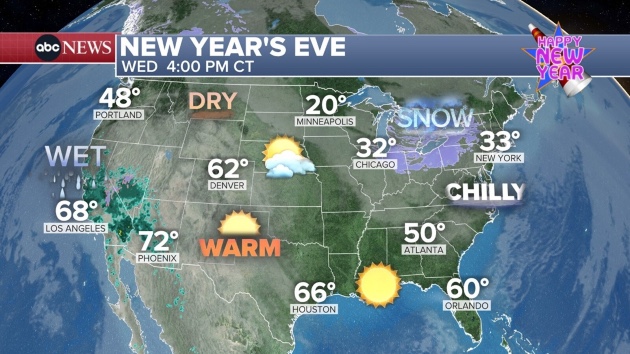
The new storm will bring widespread rain and mountain snow starting New Year’s Eve and continuing through the end of the week.
An excessive rainfall risk level of 2 out of 4 is in place in the Los Angeles and Santa Barbara areas on Wednesday and Thursday.
Through Friday, 2 to 4 inches of rain is possible at higher elevations, and 1 to 2 inches at lower elevations like downtown Los Angeles.
In the Northeast, another cold front is moving through on Wednesday and Thursday, which brings the slight chance for a few snow flurries to mix in with confetti as the ball drops in Times Square. But no measurable snow accumulation is expected and the flurries will be gone by sunrise on Thursday.
The only part of the Northeast to get intense snow is the Great Lakes, where lake effect snow will continue through the week. A winter storm warning is in place in Orchard Park, New York, home of the Buffalo Bills, where residents could see up to 3 feet of snow by the end of New Year’s Day.
The rest of the country will be dry, with above average temperatures through the Plains and much of the South on New Year’s Day.
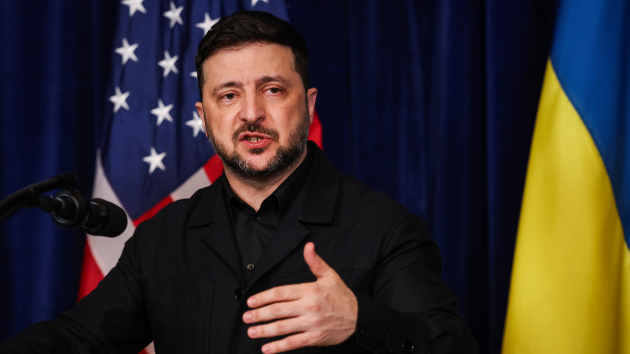
Ukrainian President Volodymyr Zelensky speaks during a press conference with U.S. President Donald Trump following their meeting at Trump’s Mar-a-Lago club on December 28, 2025 in Palm Beach, Florida. Trump invited Zelensky to his private club to work on the U.S.-proposed peace plan to end the war in Ukraine, as the conflict approaches four years since the sudden full-scale invasion by Russia on February 24, 2022. (Joe Raedle/Getty Images)
(LONDON) — A top Russian official on Monday issued personal threats against Ukrainian President Volodymyr Zelenskyy after Russia claimed that Ukraine launched a drone attack on one of Russian President Vladimir Putin’s official residences.
Russian Foreign Minister Sergei Lavrov alleged that Ukraine launched a drone attack on Putin’s state residence in Novgorod region on the night of Dec. 29. Lavrov offered no evidence to support the assertion, which Zelenskyy was quick to dismiss as a Russian disinformation effort.
Dmitry Medvedev — the former Russian president and prime minister now serving on the country’s Security Council — posted to X accusing Zelenskyy of “trying to derail the settlement of the conflict,” referring to the ongoing U.S.-sponsored peace talks.
“He wants war. Well, now at least he’ll have to stay in hiding for the rest of his worthless life,” Medvedev wrote.
In separate posts to Telegram, Medvedev — who, during Moscow’s full-scale war on Ukraine, has become known as a particularly hawkish voice within Putin’s security establishment — even appeared to suggest that Zelenskyy should be “exhibited” in St. Petersburg after his “imminent demise.”
Kiril Dmitriev, the Kremlin aide who also serves as the CEO of the Russian Direct Investment Fund and has been closely involved in negotiations with U.S. representatives, also questioned the Ukrainian president’s future.
“Who is after Zelenskyy?” Dmitriev said in a post to X.
The Kremlin said U.S. President Donald Trump was informed of the alleged attack during a Monday phone call with Putin. Russian officials also threatened retaliatory strikes in Ukraine.
Yuri Ushakov, a top aide to Putin, told the state-run Tass news agency that Putin and Trump discussed the issue by phone on Monday, with the U.S. leader expressing his surprise and anger.
Zelenskyy rejected the Russian reports of the supposed Ukrainian drone attack as “yet another lie.”
“Now, with their statement that some residence of theirs was attacked, they are simply preparing — I am sure — preparing the ground, in principle, to launch strikes, probably on the capital and, probably, on state buildings,” Zelenskyy said.
Ukrainian Foreign Minister Andrii Sybiha said in a post to X on Tuesday that “Russia still hasn’t provided any plausible evidence to its accusations of Ukraine’s alleged ‘attack on Putin’s residence.’ And they won’t. Because there’s none. No such attack happened.”
It is unclear what the latest developments might mean for the ongoing peace talks.
Kremlin spokesperson Dmitry Peskov told reporters on Tuesday that the alleged Ukrainian attack would prompt a “hardening of the Russian Federation’s negotiating position,” as quoted by the state-run Tass news agency.
“Russia is not withdrawing from the negotiation process,” Peskov added, describing the alleged attack as an effort aimed “at disrupting President Trump’s efforts to promote a peaceful resolution of the Ukrainian conflict.”
After talks with Zelenskyy — which were preceded and followed by phone calls between Trump and Putin — at his Mar-a-Lago residence on Sunday, Trump told reporters that the negotiating teams are “getting a lot closer, maybe very close” to achieving a peace deal to end Russia’s full-scale invasion, which Moscow launched in February 2022.
Lavrov said that Russia does not intend to withdraw from the negotiation process following the alleged attack. But the foreign minister said that the “targets and timing of Russia’s retaliatory strike” had “been determined.”
Ukraine’s air force said on Tuesday that Russia launched two missiles and 60 drones into the country overnight into Tuesday morning, of which one missile and 52 drones were shot down or suppressed. One missile and eight drones impacted across five locations, the air force said.
Russia’s Defense Ministry said that four Ukrainian drones were shot down on Tuesday morning over the southern Krasnodar region.
The operational headquarters of the Krasnodar region reported on Telegram that two people sustained shrapnel injuries caused by drones. Drone wreckage fell on a railway station in the region, the headquarters said.
Rosaviatsiya — Russia’s federal air transport agency — reported temporary flight restrictions at Krasnodar airport.
(NEW YORK) — From robotic surgery performed 7,000 miles away to the first blood test to help diagnose Alzheimer’s disease, 2025 has been a year full of medical breakthroughs.
Scientists discovered a brain implant to give some patients back their independence, prevented others from needing to take opioids and made a discovery that could help solve the organ shortage crisis.
Here are seven of the biggest innovations in the health and science space this year.
ALS patient is 1st to control iPad by thought with implantable brain sensor
A patient with amyotrophic lateral sclerosis (ALS) became the first person in the world to control an iPad entirely by thought, neurotech company Synchron announced earlier this year.
The patient, Mark Jackson, from western Pennsylvania, controls the tablet without using his hands or voice command but rather with an implantable brain-computer interface (BCI) that translates his thoughts into actions.
At the time, Jackson told ABC News he doesn’t have use of his arms so the BCI helps him watch TV shows, listen to audiobooks, browse social media and send text messages to his children.
BCIs are sensors implanted in the brain and translate brain signals into actions outside of the body. The BCI that Jackson is using was developed by the company Synchron, which involves a device implanted into one of the veins within the brain in a minimally invasive procedure.
“This is really an exciting field, because I think the opportunities are boundless,” Dr. Leah Croll, a neurologist at Maimonides Medical Center in New York City, told ABC News. “I think that we’re going to see, moving forward, not only using BCIs to control other electronic devices, but also using them to give patients back movement, to give patients back language, really bodily functions that they weren’t able to do after whatever neurologic insult happened to them.”
Croll said it’s important, going forward, to consider legal and ethical considerations such as privacy and data storage.
She also encouraged more research and clinical trials to generate data on how patients can be protected in both research and real-world settings.
“There’s so much we haven’t figured out legally and ethically when it comes to storing personal, private data from your brain, and how is that used, and how do we manage that responsibly,” she said. “There’s a lot of bio-ethical minds at work as to how we deal with this issue and how do we make it so that a patient isn’t sort of signing away the rights to their entire brain and inner world and manage something responsibly for them that’s helpful and not harmful.”
First pill for obstructive sleep apnea may be around the corner
The first oral pill for obstructive sleep apnea (OSA) could soon be available after a late-clinical showed positive results, according to pharmaceutical company Apnimed Inc.
The drug, AD109, showed “clinically meaningful and statistically significant reductions” in airway obstruction after 26 weeks, the company said in a press release in July.
OSA is a sleep disorder in which the airways become narrowed or blocked while sleeping, causing breathing to pause.
The investigational once-daily pill is a neuromuscular modulator that stabilizes upper airway muscles and prevents them collapsing, improving oxygenation.
OSA patients treated with the medication saw a nearly 50% reduction in the severity from baseline at week 26, compared to 6.8% of those in the placebo group.
The reduction was “significant” at the end of the study period, which concluded at 51 weeks. At the end of the trial, nearly 23% of participants saw “complete disease control.”
More recent trial data published in October found that a meaningful number of patients achieved complete disease control and experienced significant improvements in oxygenation measures.
First non-opioid medication in more than 20 years approved by FDA
Earlier this year, the FDA approved a new type of non-opioid pain medication to treat moderate to severe acute pain, the first of its kind on more than 20 years.
Suzetrigine, also known by the brand name, Journavx, is manufactured by biotech company Vertex Pharmaceuticals and doesn’t have addictive properties, unlike opioids often used for this type of pain.
“It’s significant in light of all the concerns about the opioid epidemic and addiction substance use disorder,” Dr. Jianguo Cheng, a professor of anesthesiology and medical director of the Cleveland Clinic Consortium for Pain at Cleveland Clinic, told ABC News.
In two clinical trials, tested on adults between ages 18 and 80, Journavx was found to reduce moderate to severe acute pain for adults from baseline by about 50% in 48 hours.
The average time to meaningful pain relief ranged from two to four hours, compared to eight hours in the placebo group, according to the trial.
Cheng, who was not involved in the clinical trials, said the studies demonstrated efficacy of the drug not compared to not only placebo, but also to weak opioids.
“Its efficacy is as good as a weak opioid. So why that is important?” Cheng said. “Because not all patients need opioids, and not all patients need a strong opioid. … If most of them do need a weak opioid, and if this can replace the weak opioid, that can be a big deal.”
Although gene-edited pig kidneys have been seen as a way to help ease the shortage of organs available for those on transplant waiting lists, many of the organs have been rejected not long after transplant surgery.
“Until 2021, we had never put one of these gene-edited pig organs into a human … so it was a bit of a mystery when we started doing the pig-to-human transplants, about what we were going to encounter,” Dr. Robert Montgomery, director of the NYU Langone Transplant Institute, told ABC News.
Last month, a team at NYU Langone Health published a study in which they discovered immune reactions that may explain why these organs get rejected.
The team collected two months of data from a patient who was brain dead and had a genetically engineered pig kidney transplanted into them. The family had donated the patient’s body to science.
The team learned that pig organs were being rejected due to an immune system reaction from specific antibodies — which recognize and attach themselves to foreign substances so they can be removed from the body — and from T cells, which are white blood cells that help the body fight off germs and other unfamiliar invaders.
‘So you have this very coordinated immune response that involves antibodies and white cells, and it seems to happen somewhere between two and four weeks after the transplant,” said Montgomery, lead author of the study. “Now the good news on that front is that we can detect when it’s coming before rejection happens, and we can begin to respond, and we have very good therapeutics that can block the rejection and prevent it from causing damage.”
After rejection, the team used an FDA-approved drug combination to successfully reverse it, with no signs of permanent damage or reduced kidney function.
In a second study, Montgomery and his team looked at the body’s immune response to the pig organ in greater detail. By measuring levels of biomarkers in the blood, they were able to spot an attack up to five days before it would be visible in bodily tissue.
Montgomery said the findings could lead to a future where gene-edited pig organs are a realistic alternative to human organs.
“The pig organ can really replace a human organ and do all the things that a human organ can do, and it’s really just a matter of overcoming the immunosuppression and preventing rejection,” he said. “I think it’s going to happen … and people will be receiving xenotransplants on a regular basis. It’s going to be normalized, and it’s going to be something that will benefit thousands, first, and then millions of people around the world.”
FDA clears 1st blood test to help diagnose Alzheimer’s disease
In May, the FDA cleared the first blood test to help diagnose Alzheimer’s disease.
The test, manufactured by Fujirebio Diagnostics, is for those aged 55 and older who are already exhibiting signs and symptoms of the disease, according to the federal health agency.
The new blood test works by measuring the ratio of two proteins — pTau217 and β-amyloid 1-42 — which are found in human plasma, a component of blood. That ratio is then linked to the presence or absence of amyloid plaques in the brain to determine whether a patient is showing signs of Alzheimer’s disease.
In a clinical study, more than 91% of nearly 500 cognitively impaired patients who tested positive on the blood test had their results confirmed by other diagnostic tools.
“Essentially, it does provide a first quantitative measure of an Alzheimer’s disease diagnosis,” Dr. Jeffrey Savas, an associate professor in the department of neurology at Northwestern University Feinberg School of Medicine, told ABC News. “This is very important to identify patients which could be good candidates for some of the emerging therapeutics.
Savas said the test is rapid, highly accurate and less expensive or invasive compared to previous diagnostic tests.
Because many Alzheimer’s patients need to wait months to see a specialist, the test can allow primary care providers to start the diagnostic process.
“Many neurological research centers have huge backlogs of patients, and there’s not enough physicians or nurses to really see the patients in a timely manner,” Savas said.
“Having this quick diagnostic test, which could be taken in other medical settings, should pave the way for quicker, more effective opportunities and chances for being treated in a timely manner.”
In October, the FDA cleared a second blood-based test called Elecsys pTau181, made by Roche.
Groundbreaking remote robotic surgery
A patient living in Angola with prostate cancer underwent surgery this year to cut the cancer out, but the doctor performing the surgery was 7,000 miles away in Orlando, Florida.
The patient was the first in a groundbreaking human clinical trial approved by the FDA to test transcontinental robotic telesurgery.
A team at OrlandoHealth operated on the patient via a multimillion-dollar robot with enhanced visuals and nimble controls.
Using a robot allows for the procedure to be less invasive, more precise and typically comes with a faster recovery time.
The team has said underserved areas in the U.S. and around the world could benefit from the technology by having a surgeon perform an operation even if they are not nearby.
1st-ever gene fix for rare deadly disease saves baby’s life
A baby with a rare and life-threatening metabolic disorder underwent a personalized treatment involving a first-of-its-kind type of gene-editing.
KJ Muldoon was diagnosed as a newborn with carbamoyl-phosphate synthetase 1 deficiency as a newborn. The disorder affects a bodily cycle that causes deadly levels of ammonia to build up in the blood, which can lead to severe and permanent brain damage.
If left untreated, it will typically result in the death of the patient, according to the National Organization for Rare Disorders.
The treatment for KJ involved the powerful gene-editing tool CRISPR, which allows scientists to precisely slice and repair faulty genes. Using CRISPR, the team was able to create a treatment tailored to the baby’s specific genetic mutation.
In June, KJ went home after spending the majority of his life at Children’s Hospital of Philadelphia. Earlier this month, he reached a big milestone: taking his first steps ahead of Christmas.
(NEW YORK) — The Federal Bureau of Investigation said fraudsters in 2025 bilked Americans out of more than $333 million with ruses perpetrated using bitcoin ATM machines, a marked uptick over previous years as the popularity of cryptocurrencies continues to grow.
The new FBI statistics, which document fraudulent transactions using cryptocurrency kiosks, reflect a “clear and constant rise” that is “not slowing down,” a bureau spokesperson told ABC News.
In 2024, scammers caused roughly $250 million in losses, more than double the figure from the previous year. From January through November 2025, that figure was $333.5 million, the bureau said.
There are more than 45,000 bitcoin ATMs nationwide that allow users to insert cash and send it to a digital wallet anywhere in the world. It takes only a few minutes, and once the transaction is executed, experts say, the money can be nearly impossible to recover — making it an attractive method for prospective fraudsters.
“Requesting crypto is now the No. 1 preferred method of criminals,” Amy Nofziger, AARP’s director of fraud victim support, told ABC News in October. “It is a huge problem.”
Authorities have taken notice. In September, the Washington, D.C., attorney general’s office sued Athena Bitcoin, one of the largest bitcoin ATM machine purveyors in the country, accusing it of “pocketing hundreds of thousands of dollars in undisclosed fees on the backs of scam victims.”
The lawsuit claims 93% of the transactions on Athena’s devices in the district “are the product of outright fraud,” and that “the median age of victims was 71 years.”
Athena forcefully denied those allegations in a statement to ABC News, asserting in part that it maintains “strong safeguards against fraud including transparent instructions, prominent warnings and consumer education.”
“Just as a bank isn’t held responsible if someone willingly sends funds to someone else, Athena does not control users’ decisions,” the statement said.
AARP has advocated for more stringent regulations to protect Americans from scams on bitcoin ATMs, like capping the amount of money a user can deposit in one day. At least 17 states have passed legislation in recent years regulating the machines, and some municipalities have moved to ban them outright.
(SAN ANTONIO) — Newly obtained dashboard camera video may show a Texas teenage girl right when she went missing on Christmas Eve, authorities said.
Camila Mendoza Olmos, 19, has been missing since Wednesday morning, according to the Bexar County Sheriff’s Office. Investigators previously released security footage showing a person they said they believe to be Mendoza Olmos searching her car in her driveway around 7 a.m. Wednesday.
Now, investigators have a dash cam video from someone who was driving to work on Wednesday morning and passed a woman walking by herself, and that person may be Mendoza Olmos, Bexar County Sheriff Javier Salazar said at a news conference on Monday.
The video was taken a few blocks from her home, he said.
The sheriff added that he couldn’t say with 100% certainty that Mendoza Olmos was in the video, but he said the clothing description matches up.
Salazar said authorities are releasing that footage “in hopes that somebody may have collected similar video.”
“This was the best direction of flight that we were able to develop,” he said.
Salazar told ABC News on Sunday that sheriff’s deputies and volunteers have been searching around the clock for Mendoza Olmos.
“Camila’s mother stated that Camila normally goes for a morning walk; however, she became concerned when Camila did not return within a reasonable period of time,” according to the sheriff’s office.
Multiple agencies have joined the search, including the FBI, which is providing technical assistance, and the Department of Homeland Security, which is monitoring border crossings and international travel, Salazar said.
“We definitely don’t want to miss anything,” Salazar said. “… We’re also not ruling out that this case may take us outside the borders of the continental United States.”
Salazar confirmed that Mendoza Olmos was not detained by U.S. Immigration and Customs Enforcement, despite her being a U.S. citizen.
“That was a personal concern. So, I had it checked to make sure that there were no stops, no detentions, and that she’s not somewhere in a federal detention facility. That is something we needed to check,” Salazar said.
The only items she took with her were her car keys and possibly her driver’s license, authorities said.
Salazar noted that it was unusual for Mendoza Olmos to leave her phone at home, saying she leads an active lifestyle and it’s “highly unusual” that she hasn’t returned.
“That’s why we’re working basically around the clock on this case,” Salazar said.
He said Mendoza Olmos recently went through a romantic breakup, but authorities said the breakup was mutual and don’t suspect anything “nefarious” was involved, saying everyone close to her is cooperating.
While Salazar would not disclose some details of Mendoza Olmos’s disappearance, he said there was enough information to suggest she is in “imminent danger.”
Salazar requested help from the community in the search, asking neighbors of Mendoza Olmos to check their surveillance cameras for any footage of the teenagers.
She was last seen wearing a baby-blue and black hoodie, baby-blue pajama bottoms and white shoes. Anyone with information on her whereabouts is asked to call the Bexar County Sheriff’s Office at (210)335-6000 or the BCSO Missing Persons Unit via missingpersons@bexar.org.
Stock photo of a sick child. Natalia Lebedinskaia/STOCK PHOTO/Getty Images
(NEW YORK) — Flu activity is increasing across the U.S. amid holiday travel and gatherings, according to the latest data the Centers for Disease Control and Prevention.
The CDC estimates there have been at least 4.6 million illnesses, 49,000 hospitalizations and 1,900 deaths from flu this season so far, according to data updated as of Dec. 19, and experts expect these numbers will continue to rise.
Public health experts previously told ABC News that many of this season’s cases are linked to a new flu strain called subclade K — a variant of the H3N2 virus, which is itself a subtype of influenza A — that has been circulating since the summer in other countries.
Of the 163 samples of H3N2 viruses collected since Sept. 28 and genetically characterized, 89% were subclade K, according to the CDC.
Additionally, three pediatric flu deaths have been reported so far this season, according to an ABC News tally.
Last season, the U.S. saw 288 children die from flu, which is the same number of children who died during the 2009 H1N1 pandemic. About 90% of kids who died from flu last year were not vaccinated, a CDC study published earlier this year found.
Meanwhile, New York state is reporting the highest number of flu cases it has ever recorded in a single week.
“The emergency room has been busy, and we’ve been following these numbers,” Dr. Darien Sutton, a board-certified emergency medical physician and ABC News medical correspondent, told “Good Morning America” on Monday. “Just a note, national numbers typically lag during the holiday, but state health department numbers are giving us insight to just how severe this flu season is.”
A total of 71,123 flu cases were reported for the week ending Dec. 20, according to the New York State Department of Health (NYSDOH). This marks the highest number of flu cases in a single week since it became mandatory for states to report in 2004.
This is also 38% higher compared to the previous week which saw 51,365 infections reported, bringing the total flu cases reported in the state to 189,312.
Hospitalizations climbed by 63% in the most recent week, increasing from 2,251 to 3,666 weekly admissions, according to data from NYSDOH.
Sutton said it’s important to understand that flu is present and to take steps to reduce risk, including masking, washing hands with soap and water and getting the flu vaccine.
Currently, the CDC recommends that everyone aged 6 months and older, with rare exceptions, get a flu vaccine.
The federal health agency states on its website that getting an annual flu shot prevents millions of illnesses and flu-related doctors’ visits every year and is especially important for those at higher risk of serious complications.
“The flu is so much more than a simple cold. I am treating it in the emergency room,” Sutton said. “Understand that people are coming in feeling like they are so sick that it has to be something else than the flu.”
Sutton noted that he is seeing more people in the emergency room and more people being hospitalized but that the disease itself is not more severe, adding “it’s not like a super flu.”
U.S. President Donald Trump takes questions during a statement to the media at Trump’s Mar-a-Lago estate on December 22, 2025 in Palm Beach, Florida. Tasos Katopodis/Getty Images
(WASHINGTON) — President Donald Trump said on Monday that the United States “hit” a dock in Venezuela where drugs were allegedly being loaded onto boats.
The comments came after Trump said in a radio interview last Friday that the U.S. “knocked out” a “big facility” in Venezuela as he touted his administration’s effort to stop drug trafficking from the region, including strikes against alleged drug boats.
“And we just knocked out, I don’t know if you read or you saw, they have a big plant or a big facility where they send the, you know, where the ships come from. Two nights ago we knocked that out, so we hit them very hard,” Trump said on WABC’s “Cats and Cosby,” though he didn’t provide specifics.
If Trump’s comments are accurate, then it would mark the first known attack on land in Venezuela since the Trump administration began its campaign against the country.
On Monday, as he welcomed Israeli Prime Minister Benjamin Netanyahu to his Mar-a-Lago club, Trump was pressed by a reporter for more details on the strike — including whether the action was carried out by the U.S. military after Trump confirmed in October that he authorized the CIA to operate inside the South American nation.
“Well, it doesn’t matter, but there was a major explosion in the dock area where they load the boats up with drugs,” Trump responded. “They load the boats up with drugs. So we hit all the boats and now we hit the area. It’s the implementation area. That’s where they implement. And that is no longer around.”
ABC News has reached out to the Pentagon and the White House for comment; the Pentagon referred ABC News to the White House for comment. The CIA declined to comment on the matter.
Trump has teased land action in Venezuela for weeks.
The U.S. has also built up its military presence in the region, with 15,000 U.S. troops and several warships standing ready in the Caribbean. Earlier this month, Trump ordered what he called a “complete blockade” of all sanctioned oil tankers going into and out of Venezuela, targeting the government’s main source of revenue.
“He can do whatever he wants, it’s alright, whatever he wants to do. If he wants to do something, if he plays tough, it’ll be the last time he’s ever able to play tough,” Trump said.
Prince Harry, Duke of Sussex and James Holt are seen after the swimming finals at swimming pool Het Hofbad during the Invictus Games on April 19, 2022, in The Hague, Netherlands. Patrick Van Katwijk/Getty Images
Holt’s departure comes weeks after the Duke and Duchess of Sussex announced the rebrand of the Archewell Foundation to Archewell Philanthropies.
Harry and Meghan’s longtime aide, who originally worked with Harry at Kensington Palace, and moved out to Los Angeles with the couple when they stepped back from their roles as working members of the royal family in 2020, announced his departure from the couple’s foundation in a statement on Monday.
“Working with Prince Harry and Meghan has been one of the great privileges of my career,” Holt began.
He went on, “From my first project with Prince Harry eight years ago to improve mental health support for soldiers in the British military, to our recent work helping injured children in Gaza, he has consistently challenged me to think bigger about how we can make a difference.”
Holt added that when he first met Meghan, “I recognized a kindred spirit – someone who finds joy even in difficult moments and connects authentically with people regardless of circumstance.”
“Above everything else, the work we’ve done together to support families affected by online harm will remain the most meaningful of my professional life. These families are extraordinary, and they inspire me every day,” he continued.
He ended his note saying that after five years in LA, “It’s time for my family to return to London. When I pass the baton to the team leading Archewell Philanthropies in the coming months, I’ll do so with immense pride and optimism for what lies ahead.”
“I’ll miss my colleagues deeply, and I’m grateful to Harry and Meghan for everything they’ve done – for me, and for the countless people we’ve worked to support,” he said.
In response to Holt’s statement, Harry and Meghan shared a statement of their own and called Holt a “stellar support for us for nearly ten years.”
“His enthusiasm and talent in overseeing our philanthropic endeavours have been extraordinary,” they continued. “As James moves his young family back to the UK, we are proud that he will continue to guide various humanitarian trips for us overseas through Archewell Philanthropies.”
A spokesman to Harry and Meghan clarified that Holt will remain a senior philanthropic advisor to the couple and Archewell Philanthropies and support the couple’s humanitarian overseas trips in 2026.
Archewell Philanthropies is home to the charitable work of Harry and Meghan. The couple shared why they were switching the name of their foundation in a statement on their website.
“After five beautiful years, the Archewell Foundation is becoming Archewell Philanthropies,” according to the Archewell Philanthropies website. “This charitable entity allows the couple and their children to expand upon their global philanthropic endeavors as a family.”
Harry and Meghan announced their nonprofit venture in April 2020 after completing their final engagements as working members of the royal family and relocating to LA.
Stock photo of two vintage mandolins (Joby Sessions/Guitarist Magazine/Future via Getty Images)
(NEW YORK) — In a sobering decision, one drunk thief apparently changed his tune and returned two mandolins that he had previously stolen, according to the owner of a New Jersey vintage guitar store.
In a social media post Friday, Lark Street Music said that two previously stolen mandolins – a small, guitar-like instrument in the lute family – had been returned to the store, along with a handwritten note partly in all caps that read, “SORRY, I BEEN DRUNK, MERRY CHRISTMAS You are good man.”
Buzzy Levine, who has owned the store since 1981, told ABC News that he was shocked when the instruments were returned.
“I couldn’t believe it. I said, ‘this is insane.’ This is like, some kind of weird movie that has a happy ending or something,” Levine said.
The store had previously posted surveillance video online depicting the alleged thief stuffing the instruments beneath his parka and leaving the store on Monday, Dec. 22, and asking for help in identifying the culprit.
“How to steal 2 mandolins at the same time! Be on the lookout for this criminal and the Gibson F-12 #A2985 and a Weber Yellowstone #9360302. This thief has a Montenegrin accent,” the post read.
Levine told ABC News that the mandolins were valued at $3,500 and $4,250, respectively.
Levine said in his online post that he saw the alleged thief “surreptitiously” open the store’s front door and return the mandolins in two shopping bags.
“An instant later, I wanted to see who did it, and so I went outside, and I saw the guy sort of trotting down the street. And I took chase, probably not the smartest thing to do, and he was he took off. He was running really fast and kept looking back to see if I was catching up or he was gaining ground, and then he took a turn – and then I lost them,” Levine said, adding that he then called 911.
Christopher Kurschner, captain of investigations for the Teaneck Police Department, told ABC News that they’re investigating the crime but haven’t made arrests. Anyone with information can call the Teaneck Police Department at 201-837-2600.