(WASHINGTON) — President Donald Trump issued vetoes for the first bills of his second term, including a bipartisan bill intended to provide funding for a water infrastructure project in Colorado, a measure that passed the House and Senate unanimously.
The Finish the Arkansas Valley Conduit Act was set to provide clean water to rural parts of Colorado.
“Enough is enough. My administration is committed to preventing American taxpayers from funding expensive and unreliable policies,” Trump wrote in a veto letter sent to Congress. “Ending the massive cost of taxpayer handouts and restoring fiscal sanity is vital to economic growth and the fiscal health of the nation.”
Trump also vetoed the Miccosukee Reserved Area Amendment Act, a bipartisan bill that aimed in part to optimize water flow into part of Everglades National Park designated for the Miccosukee Native American tribe and to incorporate the Osceola Camp into the Miccosukee Reserved Area to improve the governing structure of the tribe.
“[D]espite seeking funding and special treatment from the Federal Government, the Miccosukee Tribe has actively sought to obstruct reasonable immigration policies that the American people decisively voted for when I was elected,” Trump wrote in his veto. “My Administration is committed to preventing American taxpayers from funding projects for special interests, especially those that are unaligned with my Administration’s policy of removing violent criminal illegal aliens from the country.”
The Miccosukee tribe was part of the opposition to the construction of the so-called “Alligator Alcatraz” migrant detention facility in the Everglades.
Trump’s veto of the bipartisan bill supporting the Colorado project comes at a time when he has fractious relations with some of the state’s political leaders.
The bill was co-sponsored by House Republican Rep. Lauren Boebert of Colorado, who defied the Trump administration by signing onto the Epstein discharge petition that forced a vote on a measure to compel the DOJ to release the files. The pipeline would provide water to residents of Boebert’s district.
“This isn’t over,” Boebert said on social media on Tuesday, responding to the White House’s veto announcement.
Democrats also are responding to the bill’s veto, with Colorado’s Democratic Sens. Michael Bennet and John Hickenlooper lambasting Trump on social media, with both accusing him of playing partisan politics.
“Trump just vetoed my Arkansas Valley Conduit bill — passed unanimously to deliver clean, affordable water to Southeast Colorado,” Bennet said. “This isn’t governing. It’s a revenge tour.”
“Donald Trump is playing partisan games and punishing Colorado by making rural communities suffer without clean drinking water,” Hickenlooper said, adding that Congress should overturn Trump’s veto.
Since the bill cleared both chambers unanimously, Congress could overturn Trump’s veto. Doing so would require passing the measure by a two-thirds vote in both chambers. Trump vetoed ten bills total during his first administration, only one of which — the National Defense Authorization Act for Fiscal Year 2021 — was overridden by Congress.
Trump’s veto also comes two weeks after he attacked Colorado Gov. Jared Polis for refusing to release former Mesa County, Colorado, clerk Tina Peters from prison following her receiving a presidential pardon.
Peters was convicted on state charges for a scheme to tamper with voting systems driven by false claims about the 2020 election. Trump’s pardon power does not extend to state crimes.
“The poorly run state of Colorado with a governor whose incompetent and frankly, with a governor that won’t allow our wonderful Tina to come out of a jail, in a high intensity jail because she caught people cheating on an election and they said she was cheating,” Trump said on Dec. 15.
He added, “She wasn’t cheating. She went over, she looked at one of the election scams going on. And because she did that, they put her in jail for nine years.”
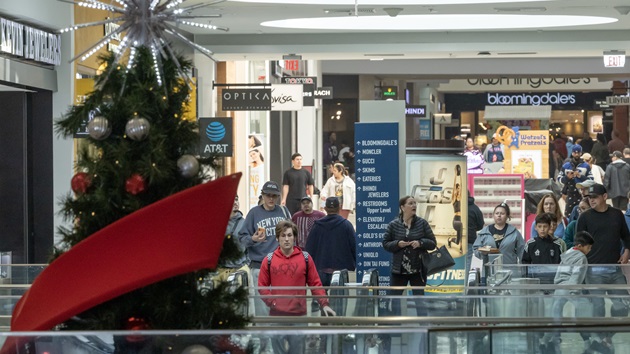
Shoppers at the Glendale Galleria in Glendale, CA on Saturday, Dec. 20, 2025. Myung J. Chun / Los Angeles Times via Getty Images
(NEW YORK) — Holiday shopping season sets forth an annual gut check for the U.S. economy, prompting buyers to splurge in a show of optimism or cut back out of fear of what next year holds.
In 2025, shoppers opened their wallets with gusto, though consumers appeared to favor low-cost options and discounts, according to spending data shared with ABC News.
The performance defied concerns overhanging the economy for months, as hiring slowed and inflation ticked higher. Seemingly undeterred, shoppers flexed their strength at the close of this year, offering some reassurance for the wider economy. Consumer spending accounts for about two-thirds of U.S. economic activity.
Holiday sales climbed 3.9% compared to last year, Mastercard SpendingPulse data showed, tracking online and in-store payments from the start of November to Christmas Eve. The data leaves out car sales and does not account for inflation.
The season-long buying spree followed a strong showing early on, as consumers revved up at the outset of the holiday season.
Digital spending on Thanksgiving jumped 5% from a year earlier, totaling $6.4 billion and exceeding expectations, Adobe Analytics data showed. On Black Friday, shoppers topped the previous day’s pace, as spending soared about 9% compared to 2024, adding up to $11.8 billion, Adobe found.
Adobe attributed the strong performance to better-than-anticipated discounts, especially for electronics. Discounts also touched an array of products from furniture to appliances to toys.
The search for price-savings marked a trend that would continue over the coming weeks.
While overall spending jumped, the largest uptick could be found in low-cost categories, according to Placer.ai, a data firm.
For instance, thrift shops and off-price retailers topped the apparel market with traffic up 11.7% and 6.6% respectively, compared to last year, Placer.ai said. Luxury chains and department stores, by comparison, posted meager gains of 1.8%, the data showed.
“Bifurcation has been a defining trend of consumer behavior in 2025 and continued to shape shopping patterns during the holiday season,” said Shira Petrack, head of content at Placer.ai.
Consumer spending among middle- and low-income Americans slowed earlier this year, triggering warnings from restaurant giants such as McDonald’s and Chipotle. A report this month showed consumer sentiment has fallen to its lowest point since a peak of pandemic-era inflation in 2022, University of Michigan data showed.
As of October, roughly half of buyers planned to use a by-now-pay-later plan for holiday shopping as a means of managing their budget, PayPal said.
Still, consumers have continued to power economic growth, even as they have balked at prices.
In the fall, shoppers helped propel the fastest quarterly U.S. economic growth in two years, federal government data last week showed.
The economy grew at a robust annualized rate of 4.3% in the third quarter in the government’s initial estimate, marking an acceleration from 3.8% growth recorded in the previous quarter, the U.S. Commerce Department said.
“Just as they have for several years now, the U.S. consumer continues to carry the baton for the economy,” Bret Kenwell, U.S. investment analyst at eToro, told ABC News in a statement.
Zohran Mamdani, mayor-elect of New York, during an announcement in New York, US, on Monday, Dec. 22, 2025. Adam Gray/Bloomberg via Getty Images
(NEW YORK) — Zohran Mamdani, the state assemblyman and democratic socialist who catapulted to national attention during the 2025 race for New York City mayor, is set to be inaugurated on New Year’s Day 2026 in a ceremony that will usher in historic leadership for America’s largest city, as Mamdani becomes the city’s first Muslim mayor and first mayor of South Asian descent.
“I think this is an important day for New Yorkers and even for the United States. The Mamdani inaugural on Jan. 1 is going to attract a global audience,” Mitchell Moss, a professor of urban policy at New York University, told ABC News.
Mamdani will be formally sworn in during a private ceremony by New York Attorney General Letitia James at midnight Thursday. That will take place in the now-decommissioned original City Hall subway station, which is known for its ornate arches and tiled ceiling.
Mamdani will be sworn in during the midnight ceremony on a centuries-old Qur’an from the New York Public Library’s collections, the library said Wednesday.
Laura Tamman, a political science professor at Pace University, said she sees both historical and practical significance in that location.
It is “acknowledging the history of the city,” she said. “It also, honestly, is a secure location … It was such a divisive campaign.”
Mamdani faced death and car bomb threats during his campaign, which included threats that targeted his Muslim faith.
“Whenever you have someone who’s making history like this — I’m sure that there are more security concerns than there were for, say, [former Mayor] Bill de Blasio’s swearing-in,” Tamman said.
At his public inauguration ceremony, set for 1 p.m. ET on the steps of New York City Hall on Thursday, Mamdani will be sworn in by Vermont Sen. Bernie Sanders, a Brooklyn-born independent and fellow democratic socialist who has been an ideological ally.
Rep. Alexandria Ocasio-Cortez, a fellow democratic socialist who represents a swath of the Bronx, will also deliver remarks.
Moss said that having Sanders be a part of the inauguration makes a statement “that this is a national event … so I think that [Mamdani is] identifying his ideological roots and his connection to national politics.”
Tamman, meanwhile, said that “Ocasio-Cortez was, similarly to [Mamdani], really underestimated by the Democratic establishment, and has gone on to become a really important leader in the party.”
Mamdani’s transition team has also said that Cornelius Eady, a prolific poet and a National Book Award finalist, will read a new poem at Mamdani’s inauguration, and that the inauguration will include a block party open to the public.
Mamdani triumphed over independent candidate former New York Gov. Andrew Cuomo and Republican candidate Curtis Sliwa after campaigning largely on making the city more affordable, although he often faced questions over his relative lack of political experience and feasibility of his proposals. His campaign promises included a rent freeze for rent-stabilized apartments, free bus fares and free childcare for children aged 6 weeks to 5 years.
During the campaign, he took stances on policing and public safety more moderate than how he had spoken about policing previously, and committed during his campaign to keeping on New York City’s current police commissioner, Jessica Tisch.
Mamdani will also face the challenge of translating his campaign promises into reality, which will include working with the state government, which controls taxes, and the city council on various city proposals.
At an event on Tuesday with reporters, Mamdani focused largely on administration appointments and the road ahead.
“I will demand excellence from my team, from myself, and also, I will ensure that we create the conditions where that excellence is possible to deliver on,” he said while responding to questions about the city’s Law Department.
Moss said that “no one expects a new mayor to do everything they promise, but they have to be making progress on their promises.”
“So Mamdani has to have some wins this year, which lay the ground for bigger wins in the future. And I think the key part is that he has identified what he wants,” Moss said.
The new mayor will also have to navigate the liberal-leaning city’s relationship with the Republican-controlled federal government. In November, Mamdani met with President Donald Trump in what was widely expected to be a contentious meeting, but ended up being very cordial.
During the meeting, Trump and Mamdani said they agreed on many things, after they had criticized each other for months during the campaign.
“I think you’re going to have, hopefully, a really great mayor; and the better he does, the happier I am,” Trump said at the time.
Neera Tanden, president of the liberal-leaning Center for American Progress, said on ABC’s “This Week” on Sunday that Mamdani “has to get the rents down. He has to make sure the city runs well.”
“But I think a lot of people look at the fact that he was able to get Donald Trump to basically compliment him,” she added.
ABC News’ Ivan Pereira contributed to this report.
Fireworks light up the sky over the Sydney Harbour Bridge and the Sydney Opera House during New Year’s Eve celebrations on January 01, 2026 in Sydney, Australia. (Izhar Khan/Getty Images)
(LONDON) — Countries across the globe are beginning to usher in 2026.
The Pacific island nation of Kiribati was the first to ring in the new year, while Alaska and Hawaii will be among the last places to say goodbye to 2025.
New Zealand
At 6 a.m. ET, New Zealand was one of the first countries to reach 2026, ringing in the new year with a fireworks display.
Australia
In Australia, fireworks over the famous Sydney Harbour Bridge went along as planned, but law enforcement presence was ramped up in Sydney in the wake of this month’s mass shooting at a Hanukkah celebration at Bondi Beach.
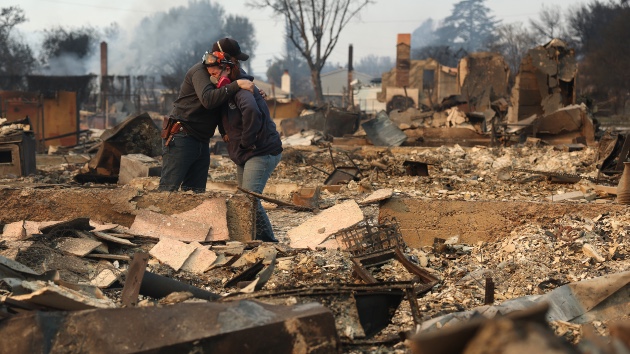
Khaled Fouad (L) and Mimi Laine (R) embrace as they inspect a family member’s property that was destroyed by Eaton Fire on January 09, 2025 in Altadena, California. (Photo by Justin Sullivan/Getty Images)
(NEW YORK) — Devastating wildfires, flooding and extreme heat events took place over the past year, several resulting in mass fatalities, with experts linking some of the worst events to human-amplified climate change.
These are the biggest weather stories of the year:
Los Angeles wildfires
Multiple wildfires that sparked in Los Angeles at the beginning of the year spread quickly and burned for weeks, destroying more than 16,000 structures and killing dozens of people.
Fueled by severe drought conditions and Santa Ana winds, the Palisades and Eaton fires both erupted on Jan. 7, eventually spreading more than 37,000 acres over the course of 24 days.
At one point, five wildfires — including the Hurst, Woodley and Lidia fires — were burning through Ventura and Los Angeles counties, according to officials.
Hydroclimate whiplash — the rapid shift between wet and dry conditions — likely contributed to the severity of the wildfires burning in Southern California.
In recent years, parts of the state shifted from a major drought to an extended period of above-average precipitation that allowed for abundant vegetation growth. After that, a stretch of intense, record-breaking heat dried out much of that vegetation and provided ample fuel for large and fast-growing wildfires.
Once the fires were sparked, an exceptionally strong mountain wave wind event, with northerly 80 to 100 mph gusts, spread the fires rapidly through densely populated neighborhoods in Los Angeles.
Among the neighborhoods heavily impacted were the Pacific Palisades, Topanga, Malibu and Altadena.
Celebrities including Billy Crystal, Paris Hilton, Mandy Moore and Eugene Levy were among the residents who lost their homes in the wildfires.
While wildfires are a natural and necessary part of Earth’s cycle, climate change and other more direct human influences have increased their likelihood, research shows.
Texas floods
Extreme flooding that occurred this year in a region in Texas known as “Flash Flood Alley” quickly turned to tragedy when it inundated a popular campground site.
In the early morning hours of July 3, torrential rains turned the Guadalupe River in Kerr County into a raging wall of water, causing the river to rise 26 feet in less than an hour. In some spots, rainfall rates of 2 to 4 inches per hour were measured.
Campsites along the river were filled with campers for the 4th of July weekend, including Camp Mystic, one of the hardest-hit sites.
The flash flooding killed more than 130 people, 36 of whom were children, according to officials.
Texas Hill Country is often colloquially referred to as “Flash Flood Alley” because the weather and landscape in the south-central Texas region have a tendency to produce rapid flood events, according to the Texas Water Resources Institute (TWRI). The “alley” stretches from Dallas to San Antonio and encompasses the Colorado and Guadalupe River basins.
The region’s steep terrain, shallow soil and repeated high rainfall events make it one of the most flood-prone regions in the country.
Drought also played a role in the severity of the event. Severe to exceptional drought conditions were prevalent for much of south-central Texas when the downpours came, making areas more susceptible to flash flooding because the soil could not absorb rainfall as efficiently.
Climate change is likely to make extreme weather events, like the flash flooding in Texas, occur more intensely and frequently, climate scientists told ABC News in July in the aftermath of the floods.
Deadly tornado outbreak in the South
Tornado outbreaks in Kentucky, Missouri and Virginia in mid-May killed at least 28 people, according to officials.
Strong supercell storms spurred tornado activity, tearing roofs off homes and causing several buildings to collapse.
In Missouri, St. Louis was particularly hard hit when an EF-3 tornado with 140 mph winds ripped through neighborhoods.
The first EF-5 tornado in the U.S. in over a decade also occurred this year.
On June 20, a monster tornado with peak winds topping 210 mph hit Enderlin, North Dakota, tipping several fully-loaded grain hopper cars and lofting tanker cars, including one empty tanker car that was tossed more than 475 feet, according to the National Weather Service.
There was also extensive tree damage throughout the entire Maple River valley, with only stubs of large branches or large trunks remaining and debarking with a “sandpapering” effect prevalent, officials said.
While the EF-5 tornado mostly struck a rural area, three people died as a result, according to the NWS.
No hurricanes made landfall in the US
The 2025 Atlantic hurricane season proved to be consequential, even though no hurricanes made landfall in the U.S for the first time since 2015.
Three Category 5 hurricanes formed during this past hurricane season, the second-most on record in the Atlantic basin. The only other season with more Category 5 storms was in 2005, when there were four Category 5 storms.
A combination of favorable conditions and a bit of luck helped the U.S. avoid a landfalling hurricane.
Prevailing winds and weather patterns steered storms away from the coast, and many variables aligned at the right times, keeping hurricanes from making landfall. Persistent dry air and other unfavorable atmospheric conditions hindered storm development during a historically busy timeframe.
Many of the storms that did form followed a similar path, curving away from the U.S. coastline and toward Bermuda. An unusually persistent upper-level trough, or area of lower pressure, sat over the Eastern U.S. throughout much of the season, bringing seasonably mild temperatures by late summer. The recurring trough frequently pushed the jet stream south, helping curve storms northward parallel to the East Coast and then out to sea, following the prevailing west to east wind pattern.
The trough also weakened the western side of the Bermuda High; the dominant high-pressure system located over the Atlantic Ocean that usually helps steer weather systems. When the Bermuda High is strong, storms are pushed farther west toward the East Coast and the Gulf. However, when it is weaker, they tend to turn northward earlier. This season, the weakened Bermuda High, combined with a dip in the jet stream, deflected storms away from land.
The Fujiwhara effect, a rare occurrence in the Atlantic basin, also helped keep Hurricanes Imelda and Humberto away from the U.S. as they were churning through the Western Atlantic at the same time. The Fujiwhara effect occurs when two tropical cyclones within several hundred miles of each other begin to interact and rotate around a common midpoint
Although no hurricanes made landfall in the U.S. in 2025, Hurricane Melissa became one of the most powerful hurricanes on record to make landfall in the Atlantic basin, ranking with Hurricane Dorian (2019) and the “Labor Day” hurricane (1935) for the strongest sustained winds at landfall.
Human-amplified climate change is expected to influence tropical activity in the coming decades. While the total number of tropical cyclones is expected to remain steady or even decrease slightly, the storms that do form are likely to be more intense, according to climate scientists.
Global warming has led to substantial ocean warming, which fuels hurricane intensification. More than 90% of the excess heat trapped by greenhouse gases has been absorbed by the oceans, creating conditions that favor rapid intensification and stronger peak winds. As a result, more storms are reaching major hurricane strength compared to past decades, the latest research shows.
The changing climate is also amplifying the indirect effects of tropical systems that remain well offshore, making coastal areas more vulnerable. Sea level rise and more intense storms increase the risks of flooding, erosion, and shoreline change, according to the federal government’s Fifth National Climate Assessment.
Record heat in Europe
Major heat waves across southern Europe over the summer pushed temperatures passed triple digits in many major cities.
Severe heat waves were recorded in Italy, Greece, Spain and Portugal at the end of June and beginning of July.
The heat was so severe that outdoor work activities were banned in several regions in Italy. On July 1, the Eiffel Tower in Paris was closed as temperatures topped 101 degrees Fahrenheit.
In Portugal, where two-thirds of the country was on alert for high heat and wildfires, temperatures reached 107 degrees Fahrenheit. Similar temperatures were recorded in Seville, Spain.
In Athens, a large wildfire broke out and was fueled by strong winds, forcing evacuations and road closures near the ancient Temple of Poseidon.
Multiple fatalities occurred, and tourists were advised by local governments to alter their plans as a result of the heat.
Climate scientists warn that extreme heat will become more commonplace across southern Europe as a result of global warming.
Europe is fastest-warming continent on planet, heating up twice as much as the global average since the 1980s, according to a 2023 report by Copernicus, European Union’s climate change service, and the World Meteorological Organization.
There is high confidence in the connection between human-amplified climate change and extreme heat events, research has shown. The attribution of climate change to extreme heat has the strongest connection and highest confidence compared to all other weather events.
ABC News’ Weather and Climate Unit contributed to this report.
A sign is displayed outside of the Mary E. Switzerland Memorial Building which houses the U.S. Department of Health and Human Services (HHS) on June 2, 2025 in Washington, DC. (Kevin Carter/Getty Images)
(MINNEAPOLIS) — An official with the Department of Health and Human Services says the agency has “frozen all child care payments” to the state of Minnesota after allegations of fraudulent day care centers there.
In addition, HHS is tightening requirements for payments from the Administration for Children and Families to all states, requiring a justification and a receipt or photo evidence, Deputy HHS Secretary Jim O’Neill said in a post on social media Tuesday.
The move comes after an unverified online video from conservative influencer Nick Shirley alleging fraud in child care in Somali communities in Minneapolis. Minnesota officials had disputed the allegations.
In the post, O’Neill wrote the agency was taking steps to address “blatant fraud that appears to be rampant in Minnesota and across the country” and said HHS was demanding Democratic Minnesota Gov. Tim Walz conduct a “comprehensive audit” of day care centers identified in the viral video.
In a post on social media, Walz responded to the move by HHS, writing: “This is Trump’s long game. We’ve spent years cracking down on fraudsters. It’s a serious issue – but this has been his plan all along. He’s politicizing the issue to defund programs that help Minnesotans.”
Earlier this week, Minnesota officials had also pushed back on the claims made in the video that went viral last week.
Conservative influencer Nick Shirley posted a 40-minute-long video alleging fraud in childcare in Somali communities in Minneapolis. In the video, Shirley allegedly visited daycares that he said have taken public funds, but there were no children when he visited.
ABC News has not independently verified any of his claims. Unrelated allegations of fraud have been under investigation by state officials dating back to the time of the Biden administration.
According to Minneapolis-St. Paul ABC News affiliate KSTP, Tikki Brown, the commissioner of the state Department of Children, Youth and Families, raised concerns about the video, including whether videos were taken during times when the businesses were scheduled to be open.
“While we have questions about some of the methods that were used in the video, we do take the concerns that the video raises about fraud very seriously,” Brown said on Monday.
“Each of the facilities mentioned in the video has been visited at least once in the last six months as part of our typical licensing process, and in fact, our staff are out in the community today to visit each of these sites again so that we can look into the concerns that were raised in the video,” she added.
Brown noted that children were present during the unannounced visits by the state at all the visits.
The Minnesota Department of Children, Youth and Families did not immediately respond to ABC News’ request for comment on the video or the allegations of fraud.
After the video Shirley posted to social media went viral, Homeland Security Secretary Kristi Noem said in an X post that her department was conducting a “massive investigation on childcare and other rampant fraud.” Similarly, FBI Director Kash Patel said the agency had already surged resources into Minnesota and that he believed alleged fraud already uncovered on federal food aid during COVID was “just the tip of a very large iceberg.”
“To date, the FBI dismantled a $250 million fraud scheme that stole federal food aid meant for vulnerable children during COVID,” FBI Director Kash Patel said in a Sunday evening X post. “The investigation exposed sham vendors, shell companies, and large-scale money laundering tied to the Feeding Our Future network.”
The COVID fraud scheme was uncovered during the Biden administration, but charges have been brought as late as this year.
At a cabinet meeting earlier this month, President Donald Trump criticized the U.S. Somali community, citing allegations of fraud in Minnesota.
One of the most senior career prosecutors at the U.S. Attorney’s Office in Minnesota commented on massive amounts of alleged fraud in the state at a press conference earlier this month.
“The magnitude of fraud in Minnesota cannot be overstated. It’s staggering amounts of money that’s been lost,” prosecutor Joe Thompson said on Dec. 18.
(NEW YORK) — This year began with a deadly New Year’s Day car-ramming terrorist attack in New Orleans and is finishing with a flurry of horrific shootings, including a mass shooting at Brown University, but 2025 is also poised to end with the largest one-year drop in U.S. homicides ever recorded, according to data from cities both large and small.
Based on a sampling of preliminary crime statistics from 550 U.S. law enforcement agencies, the year is expected to end with a roughly 20% decrease in homicides nationwide, Jeff Asher, a national crime analyst, told ABC News.
“So, even taking a conservative view, let’s say its 17% or 16%, you’re still looking at the largest one-year drop ever recorded in 2025,” said Asher, co-founder of AH Datalytics and a former crime analyst for the CIA and the New Orleans Police Department.
Experts say crime levels appear “back to normal” after a pandemic surge.
The dramatic drop in homicides surpasses a 15% decline in 2024, which was then the largest decrease on record, according to Asher. In 2023, the number of homicides across the country fell 13% and 6% in 2022, according to the FBI.
The number of homicides nationwide is expected to be the lowest since the FBI began keeping such records in 1960, Asher said.
Asher said his assessment is based on the Real-Time Crime Index, which he founded and is a collection of monthly crime data from 550 law enforcement agencies nationwide.
The FBI’s official annual report on crime isn’t expected to be released until the second quarter of 2026, leaving Asher and other experts to rely on preliminary data from a sampling of law enforcement agencies.
Preliminary data the FBI made public earlier this year showed that homicides across the country fell 18% between September 2024 and August 2025. The FBI data also showed an overall 9% decline in violent crime during the same time period and a 12% reduction in property crime.
“You’ve got places like Detroit, Philadelphia and Baltimore that are on track to have the fewest murders since the 1960s. New Orleans, in spite of the terrorist attack on January 1, is on pace to have the fewest murders since 1970,” Asher said. “San Francisco is on track to see the fewest number of murders since 1940.”
Homicides in Chicago are down 30% this year from 2024, according to crime statistics from the Chicago Police Department (CPD). The number of homicides this year is down 49% since 2021, when the city recorded nearly 800 homicides, the CPD data shows.
And it’s not just homicides that are plummeting to record lows in 2025, according to Asher.
“We’re seeing across-the-board drops in every type of reported crime, which happened in 2024 and we’re seeing again in 2025,” said Asher, adding that aggravated assaults across the country are down 8% this year and motor vehicle theft has fallen 23%.
My son was innocent Despite the plunge in violent crime this year, the perception for some is that crime was rampant at certain points in a number of major cities.
The falling homicide numbers offered little solace to Tamara Tarpinian-Jachym, whose 21-year-old son, Eric Tarpinian-Jachym, was killed on June 30 when he was caught in the crossfire of a shooting in Washington, D.C., less than a mile from the White House.
“You can skew data any way you want,” Tarpinian-Jachym of Massachusetts told ABC News. “I believe that there’s more crime, violent crime, especially in our major cities.”
Three teenagers, including two brothers, were arrested on murder charges and are being prosecuted as adults in federal court in the death of Tarpinian-Jachym’s son, a University of Massachusetts student who, at the time he was killed, was a Congressional intern for Rep. Ron Estes, R-Kan. One of the suspects charged in his death was also charged in a separate homicide of a 17-year-old girl in Washington, D.C.
All three defendants charged in Tarpinian-Jachym’s homicide have pleaded not guilty.
“My son was innocent. Others were innocent victims of this crime. If more people died, it would have been a mass shooting. But my son was the only one who died,” Tarpinian-Jachym said.
Citing her own experience, Tarpinian-Jachym said blanket homicide statistics don’t take into account the suffering of family members like her left to grieve.
“It tears the family apart. You never have inner peace,” Tarpinian-Jachym said. “My heart goes out to all murder victims this year.”
Tarpinian-Jachym told ABC News that she agreed with President Donald Trump’s decision in August to deploy National Guard troops to Washington, D.C., and several other large cities to help combat crime. The decision followed a May 21 shooting at the Capital Jewish Museum in Washington, D.C., that killed two staff members of the Israeli Embassy and came even as crime was already down, according to the Metropolitan Police Department of the District of Columbia (MPD) preliminary crime data posted online.
Homicides in Washington, D.C., as of Dec. 30, are down 31% compared to 2024, according to the MPD’s online data.
However, a lawsuit filed against the District of Columbia in 2020 by a former MPD sergeant-turned-whistleblower claimed the MPD routinely “misclassified crimes and that districts compete against each other to get the largest reduction in the crime statistics.” The lawsuit was settled out of court this past August. According to court documents, the District of Columbia agreed to dismiss the case “without any admission of any liability.”
On Dec. 14, the House Committee on Oversight and Government Reform released an interim staff report alleging that its investigation found MPD Chief Pamela A. Smith, who announced this month that she is stepping down, “pressured and at times directed commanders to manipulate crime data in order to maintain the appearance of low crime in the nation’s capital.”
In a Dec. 15 interview with NBC Washington, D.C., station WRC-TV, D.C. Mayor Muriel Bowser responded, saying, “I don’t see any evidence of that.”
Mass shootings drop in 2025 According to the Gun Violence Archive, a website that tracks shootings across the country, this year is poised to end with mass shootings down 22% from the 503 committed in 2024. The website defines a mass shooting as at least four victims shot, either injured or killed, not including the shooter.
Among the nearly 400 mass shootings across the country this year, two of the most devastating occurred at churches.
On Aug. 27, two children, ages 8 and 10, were killed and 21 people were injured at Annunciation Catholic School in Minneapolis when a 23-year-old shooter opened fire through the windows of the school’s church during a service, police said. The suspect, Robin Westman, whose mother once worked at the church, died from a self-inflicted gunshot wound, authorities said.
On Sept. 28, four people were killed and eight others were injured in a mass shooting at a Church of Jesus Christ of Latter-day Saints chapel in Grand Blanc, Mich., according to the FBI. The suspect, 40-year-old Thomas Sanford of Burton, Mich., allegedly set fire to the chapel after crashing his truck into the building, authorities said.
Sanford, who served as a Marine sergeant and was deployed in Operation Iraqi Freedom in 2007, was killed in a shootout with police.
And on Dec. 13, a gunman opened fire in a lecture hall at Brown University in Providence, Rhode Island, killing two students and injuring nine others. Following a weeklong search, the suspect, Claudio Manuel Neves Valente, a 48-year-old former Brown graduate student, was found dead at a New Hampshire storage facility from an apparent self-inflicted gunshot wound, authorities said.
Neves Valente is also suspected of killing MIT professor Nuno F.G. Laureiro two days after the Brown University shooting, according to federal prosecutors.
‘I’m seeing now that we’re back to normal.’ Despite the string of high-profile killings and attacks this year, Robert Boyce, a retired chief of detectives for the New York Police Department, said the dramatic drop in 2025 homicides is real.
Boyce said that when he retired from the NYPD in 2018, the city had fewer than 300 homicides that year.
But when the COVID pandemic hit in 2020, homicides across the country soared 30%, according to the FBI.
“Courts were being shut down, and schools were being shut down. We couldn’t do our job in the police department like we did in previous years,” said Boyce, adding that the police-involved killing of George Floyd in Minneapolis also led to mistrust of law enforcement and prompted calls to defund police departments.
Homicides in New York City went from 317 in 2019 to 462 in 2020, a 44% increase, according to NYPD crime statistics. Homicides jumped another 4% in 2021 to 488.
During the pandemic, which wasn’t declared over until May 2023, homicides dramatically increased in other major cities.
Chicago recorded 769 homicides in 2020, which was 274 more than the previous year, and jumped to 797 in 2021, according to Chicago Police Department data.
Philadelphia saw a 40% increase in homicides in 2020 compared to 2019, according to Philadelphia Police Department data. In 2021, homicides continued to climb, hitting a record high of 562.
“We fought back. We completely redid our police department to be more narcotics-focused and increased our narcotics division. And we saw the gradual decreases,” Boyce said of the NYPD.
As of Dec. 28, homicides are down in New York City by 21% this year compared to 2024. Earlier this month, New York Police Commissioner Jessica Tisch announced that in the first 11 months of 2025, the nation’s largest city saw the fewest shooting incidents and shooting victims in recorded history.
Boyce said the NYPD and other law enforcement agencies also worked with federal prosecutors to target gang members, who Boyce said were a major driver of violent crime during the pandemic and continue to be now. The federal government also strengthened partnerships with local police agencies and provided grants to support programs to reduce violent crime.
“I’m seeing now that we’re back to normal. The reset is here. That’s great news,” Boyce said.
Asked if the country is back to pre-pandemic crime levels, Boyce said, “We’re just a little above and not much.”
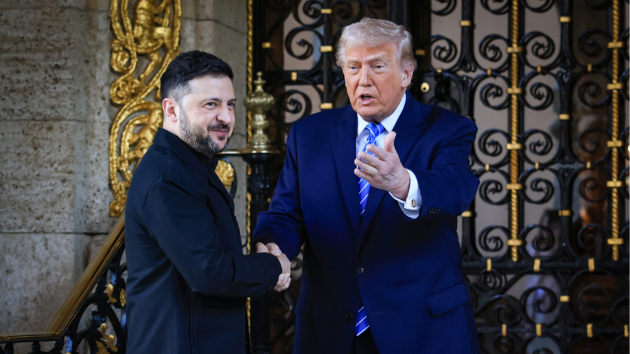
U.S. President Donald Trump greets Ukrainian President Volodymyr Zelensky at his Mar-a-Lago club on December 28, 2025 in Palm Beach, Florida. Trump invited Zelensky to his private club to work on the U.S.-proposed peace plan to end the war in Ukraine, as the conflict approaches four years since the sudden full-scale invasion by Russia on February 24, 2022. (Joe Raedle/Getty Images)
(LONDON) — Ukrainian President Volodymyr Zelenskyy on Tuesday suggested that U.S. President Donald Trump should visit Ukraine, amid the latest U.S.-led push for a peace deal to end Russia’s full-scale invasion of its neighbor.
“He talks about advocating a plan to end the war,” Zelenskyy said of Trump, answering questions in a group WhatsApp chat with reporters.
“I told him that we would be glad to see him. It is very useful for Ukraine. If U.S. President Trump flies to Ukraine, and it is desirable that he flies by plane not to Poland, but to Ukraine, then this will indicate that we definitely have the opportunity to count on a ceasefire,” Zelenskyy said.
Earlier this week, Trump told reporters that the negotiating teams are “getting a lot closer, maybe very close” to achieving a peace deal to end Moscow’s invasion, which has been ongoing since February 2022.
Zelenskyy traveled to Florida to meet with Trump on Sunday and discuss a 20-point plan that he described as a possible foundation for the end of the war. Trump also spoke with Russian President Vladimir Putin by phone before and after meeting Zelenskyy, the White House said.
On Tuesday, Zelenskyy said that Ukraine is discussing the possibility of an American troop presence as part of a settlement, and as part of the post-war security guarantees Kyiv says it needs to prevent a repeat Russian attack.
“These are U.S. troops and that is why it is America that makes such decisions,” Zelenskyy said. “Of course, we are discussing this with President Trump and with representatives of the ‘Coalition of the Willing.'”
“We would like this. This would be a strong position in security guarantees,” Zelenskyy added.
Zelenskyy also denied Russian reports of a rift between the U.S. and Ukraine. On Monday, Moscow accused Kyiv — without providing any supporting evidence — of launching a drone attack on Putin’s residence in the Novgorod region.
After speaking with Putin by phone about the alleged attack, Trump said he was “very angry,” though also acknowledged that it may not have happened.
“Despite all the media accusations of the Russians about the breakdown of our talks with the Americans, we are working every day,” Zelenskyy told reporters.
The Ukrainian president said there had been “several calls” on Tuesday between Rustem Umerov — the secretary of Ukraine’s National Security and Defence Council and a key negotiator — and American representatives, among them presidential envoy Steve Witkoff. “We are discussing our next steps,” Zelenskyy said.
Zelenskyy also posted to social media on Tuesday previewing a gathering of national security advisers of the mostly European “Coalition of the Willing” nations in Ukraine on Jan. 3, which is expected to be followed by a meeting of national leaders in France on Jan. 6.
Trump’s predecessor, President Joe Biden, made in February 2023 a surprise trip to Kyiv, where he met with Zelenskyy prior to the first anniversary of Russia’s full-scale invasion. Biden flew into Poland and undertook a 10-hour train journey to get to the Ukrainian capital, senior administration officials said at the time.
Both Russia and Ukraine continued their exchange of long-range drone strikes overnight.
Ukraine’s air force said Russia launched 127 drones into the country overnight into Wednesday morning, of which 101 were shot down or suppressed. Twenty drones impacted across 11 locations, the air force said.
The southern port city of Odesa was among the targets of the latest overnight barrage, officials said.
Odesa Gov. Oleh Kiper said in a post to Telegram that at least six people were injured by Russian drone strikes, among them three children. One adult was hospitalized and is in a critical condition, Kiper said.
“In total, four multi-apartment residential buildings, at least 14 cars and private garages were damaged,” Kiper said.
“These attacks are another indication of the terrorist tactics of the enemy, who deliberately attacks the civilian infrastructure of peaceful cities in the Odesa region, threatening the lives and health of people,” the governor added.
Kiper also reported at least two fresh strikes on Ukrainian energy infrastructure in the Odesa region. “Overall, during December, 10 substations in Odessa and the region were damaged as a result of enemy shelling,” he wrote. “Since the beginning of the year, Russia has attacked 25 energy facilities in the region.”
“The damage is significant and the repair work will take time,” Kiper said.
Russia’s Defense Ministry, meanwhile, said its forces shot down 86 Ukrainian drones overnight into Wednesday morning, of which 56 were reportedly downed over the Black Sea.
Rosaviatsiya — Russia’s federal air transport agency — reported temporary flight restrictions at airports in the southern Russian cities of Gelenjik and Krasnodar, as well as in Ivanovo and Yaroslavl which both sit northeast of Moscow.
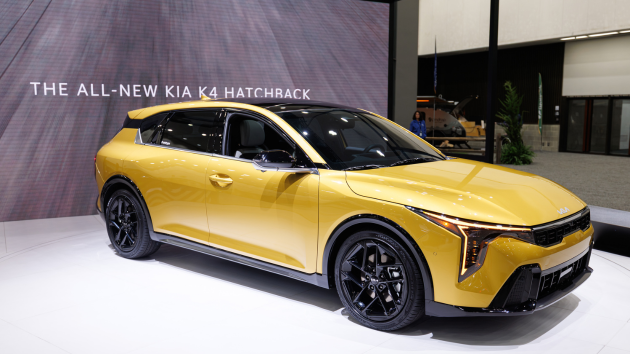
The all-new 2026 Kia K4 Hatchback is on display during the 2025 Los Angeles Auto Show at the Los Angeles Convention Center on November 21, 2025 in Los Angeles, California. (Josh Lefkowitz/Getty Images)
(NEW YORK) — If you’re looking for a new set of wheels next year, the choices can be overwhelming.
From 3-row SUVs to wagons and futuristic electric vehicles, buyers can select from a wide range of powertrains, prices and body styles.
Which models are already generating excitement in the industry? ABC News spoke to several insiders to get their take on the hottest vehicles headed to showrooms.
Mercedes-Benz CLA and GLB
The German automaker has a busy 2026 schedule planned with the launches of several newly updated models, including the CLA sedan, GLB SUV and the flagship S-Class.
Mercedes’ designers reimagined the interior of the GLB, which can be configured for five or seven passengers. The latest model offers greater comfort: headroom has increased as well as legroom for second-row passengers. A new panoramic roof is standard and owners can opt for a “floating” MBUX Superscreen that extends across the entire dashboard.
Buyers have three powertrains from which to choose. There’s a new 1.5-liter, inline-4 gasoline hybrid, and two electrics: the 250+ (268 horsepower) and 350 4MATIC (349 hp). The GLB can charge up to 260 kilometers (162 miles) of range in 10 minutes, according to Mercedes, and the hybrid version drives in electric-only mode at city speeds.
The latest CLA, available as an electric sedan ($47,250 for the 250+ and $49,800 for the 350 4MATIC) and hybrid, may be even more important for the luxury automaker. The entry-level car packs a ton of tech inside, making it “among the most intelligent vehicles from Mercedes-Benz to date,” according to the automaker.
The same four-cylinder turbocharged engine in the GLB powers the CLA220 hybrid, which is mated to an eight-speed dual-clutch transmission. A large, fixed panoramic glass roof in the CLA helps make the interior feel larger and more spacious. The CLA hybrid will be easy to spot at night: its radiator grille is adorned with the Mercedes‑Benz star pattern in chrome.
The electric CLA can travel 374 miles on a charge, according to Mercedes. Underneath the shell is an 800-volt electrical architecture, which allows the 48-volt lithium-ion battery to recoup roughly 200 miles in 10 minutes. DC fast charging up to 320 kilowatts (kW) is possible, too.
“It’s our vision for an EV to charge like fuel. We’re pushing the limits of what is possible with the CLA. Range anxiety will go away,” according to Markus Schäfer, a Mercedes board member and its chief technology officer.
The marque’s suite of advanced driver assistance systems is also available in the CLA models. Pricing for the GLB and CLA hybrid will be announced in 2026.
Kia K4 Hatchback
The K4 Hatchback, a stylish wagon that debuted in April, starts at $24,890 and will be available for sale in early 2026.
“I am so excited for it,” Robby DeGraff, manager of product and consumer insights at AutoPacific, told ABC News. “Hatchbacks might be making a comeback. It has a humongous cargo area and will be fun to drive. In terms of value, this should be a winner.”
A 2.0-liter engine produces 147 horsepower and 132 lb-ft of torque. For a sportier ride, consumers can choose the GT-Line Turbo model ($28,790); the 1.6-liter, turbocharged engine makes 190 hp and 195 lb-ft of torque.
The K4 Hatchback is also a new design for the Korean automaker and comes equipped with features like a heated steering wheel, Harman Kardon audio system and Digital Key technology that allows an owner’s smartphone to function as virtual key.
Degraff said Kia’s latest iteration of the Telluride SUV, now available with a hybrid powertrain, should also be popular with consumers.
“A hybrid Telluride is long overdue — we will see a big take rate for the hybrid version,” he said. “Losing the V6 [engine] will be a bummer for some people … there are shoppers out there that want a V6 in their 3-row SUVs. But the Telluride will be hit no matter what.”
According to Kia, the turbo hybrid powertrain adds more power and acceleration than the previous model: a combined 329 hp and 339 lb-ft of torque. The driving range is an estimated 600 miles. Kia’s flagship SUV, including the X-Line and X-Pro variants, go on sale in Q1 of 2026 and will be assembled at Kia’s plant in Georgia.
“The Telluride changed what Kia is,” according to Tony Quiroga, editor-in-chief of Car and Driver. “There was a ton of value in the first generation. The new Telluride looks more expensive than it will be and probably start around $40,000.”
“This version gives off a Range Rover vibe,” Quiroga added.
Subaru Outback
Subaru packed a ton of new tech in the latest Outback, including a 12.1-inch high-resolution infotainment screen and advanced driver assistance features. Drivers can now enable a Hands-Free Assist function that works at speeds up to 85 mph on highways.
The automaker is calling the 2026 Outback “the most connected and capable Subaru yet” with the “biggest styling updates in the model’s history.”
DeGraff said the SUV’s updated styling – a new front fascia, larger grille and boxier profile – could be “make or break” for consumers, but the amenities are a “good value” and Subaru still offers “the best all-wheel drive system in the entire industry.”
For Quiroga, the design changes make the Outback look more like a traditional SUV versus a lifted wagon.
“The latest Outback has the refinement and practicality of a wagon but is still very car-like. I see that as a plus,” he said.
The seventh-generation Outback starts at $34,995 for the Premium trim.
Chevy Bolt
The polarizing Chevy Bolt, one of the few affordable EVs to be sold in the U.S, will make its return as a 2027 model, though production will be limited.
The Bolt had both its fans and detractors; the unpretentious crossover won over motorists for its range and simplicity at an appealing price.
The latest trims – the Bolt RS and LT – will start under $30,000 and charge 2.5x faster than the previous model. Owners can expect to get 255 miles of range on a fully charged battery. The Bolt also is the first Chevy to be fitted with a NACS [North American Charging Standard] charging port. Deliveries begin in the first half of 2025.
“We really like the old Bolt, it had a ton of practicality,” said Quiroga. “The upcoming Bolt has a bit more range and a newer battery.”
Added DeGraff: “The 2027 Bolt is a clone of the outgoing one but it has more modern tech. It has all the safety features and Super Cruise. For budget shoppers who want to go electric, the Bolt is a home-run product.”
BMW iX3
The all-new iX3, BMW’s first series-production Neue Klasse model, goes on sale in summer of 2026 and will be a “hugely important vehicle” for the marque, according to Alistair Weaver, editor-in-chief of Edmunds.
The compact sport utility vehicle’s ($60,000) two-box design underwent a dramatic metamorphosis, with the latest iteration taller, longer, wider and more commanding. It also has a range of up to 400 miles, according to BMW. Plus, the company’s 800V architecture could be a game-changer for the industry: BWM said iX3 drivers can add nearly 175 miles of range in less than 10 minutes (it has a maximum charging rate of 400 kW). The vehicle’s dual-motor all-wheel drive powertrain makes 463 hp and 476 lb-ft of torque.
“Most EV owners are happy with 300 miles, but this will do 400, and it can recharge almost twice as fast as a Tesla,” Jared Rosenholtz, editor at large for CarBuzz, told ABC News. “Not only is range anxiety gone, but so is motion sickness. You can not feel the regen braking working in the iX3. It’s the smoothest braking I’ve ever felt in my decade of reviewing cars. All of this will be available for just over $60,000, not $100,000.”
(NEW YORK) — The stock market surged to record highs in 2025, hurtling past tariffs, a government shutdown and fears of a bubble in artificial intelligence.
The S&P 500 — the index that most people’s 401(k)s track — climbed about 17% this year, as of Dec. 23. That performance marks a slight slowdown from two consecutive years of more than 20% growth, but the latest uptick extends a run of gangbusters returns.
The yearslong bull market presents a stark choice for investors as the calendar turns to 2026: Flee from ever-higher stock prices or trust that the good times will continue to roll.
Earlier this month, investment bank Morgan Stanley summed up its market forecast with a single question: “Can the bull market endure?”
Analysts attributed the rise of share prices this year to overlapping trends: Resilient corporate earnings, a series of interest-rate cuts meant to boost hiring and near-inexhaustible enthusiasm for artificial intelligence.
Tariffs, which threatened to derail markets in the spring, eased into an afterthought over the latter half of the year.
A day after tariffs were announced on April 2, major stock indexes shed about $3.1 trillion in value. The selloff amounted to the biggest one-day decline in markets since the onset of the COVID-19 pandemic. Days later, a major swathe of the tariffs were suspended, sending the market to one of its largest ever single-day increases.
“While tariffs remain a source of uncertainty, markets are pricing in limited disruption,” JPMorgan Wealth Management said in an investor note last month.
Even as markets proved resilient, the gains this year remained concentrated in a handful of tech giants, known as the magnificent seven: Alphabet, Amazon, Apple, Meta, Microsoft, Tesla and Nvidia. In September, worries over AI threw cold water on those stocks, causing their prices to waver.
In November, blockbuster earnings from chip giant Nvidia helped rebuke AI fears and shake markets out of the doldrums. Nvidia recorded $57 billion in sales over a three-month span, the company said, setting a quarterly sales record and demonstrating near-bottomless demand for the semiconductors at the heart of AI.
Nvidia, the world’s largest company by market capitalization, soared 40% this year, as of Dec. 23.
Still, some analysts have continued to voice concern about the market’s dependence on AI, as tech firms face increased pressure to turn massive capital investment into profits.
“Equity markets may remain exuberant but face rising risks,” investment giant Vanguard said in December, citing AI as a threat to growth.
Other risks abound, some analysts said. Key measures of the U.S. economy have shown mixed results, making the path forward uncertain. Hiring slowed sharply this year, while inflation remained about a percentage point higher than the Fed’s 2% goal. Economic growth withstood headwinds from tariffs and elevated interest rates, but consumer sentiment sputtered.
Ultimately, Vanguard said its baseline expectation remains optimistic, forecasting overall stock returns next year as high as 8%.
Some analysts predicted even better performance in 2026. JPMorgan Wealth Management predicted stock gains next year between 13% and 15%. BNY Wealth estimated the S&P 500 would end 2026 as high as $7,600, which would amount to about a 10% jump from where the index stood on Dec. 23. Morgan Stanley also forecasted an increase in 2026 of 10%.
In response to its own question about whether the bull market could endure, Morgan Stanley answered with little doubt, saying the odds of a recession next year are “extraordinarily low” and the upswing in stocks “still has room to run.”