
Trump’s vow to ‘run’ Venezuela, sell oil, part of plan to dominate Western Hemisphere

Trump’s vow to ‘run’ Venezuela, sell oil, part of plan to dominate Western Hemisphere
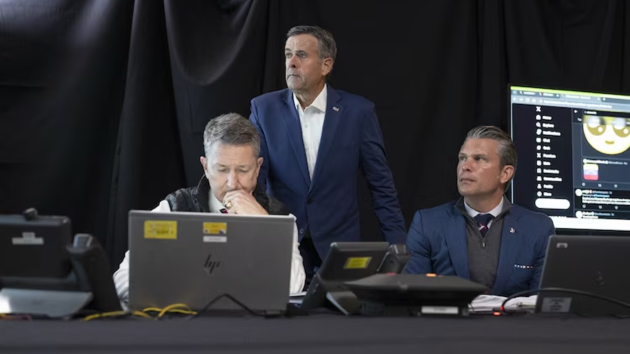
In this image posted to social media on President Donald Trump’s Truth Social account, General Dan Caine, Chairman of the Joint Chiefs of Staff, CIA Director John Ratcliffe and Secretary of Defense Pete Hegseth are shown at Mar-a-Lago in Palm Beach, Fla., on Jan. 3, 2026, watching a remote feed of the US military’s mission to capture Venezuela’s President Nicolas Maduro. (@realdonaldtrump)

(NEW YORK) – At a Mar-a-Lago news conference Saturday morning, hours after he ordered a military strike in Venezuela and the capture of the country’s president, Nicolas Maduro, and his wife, President Donald Trump started off calling it an anti-drug law enforcement operation.

His Secretary of State, Marco Rubio, said “at its core, this was an arrest of two indicted fugitives of American justice.”

But Trump’s framing of the issue appeared to quickly expand when he stunned observers by saying the U.S. was going to “run the country” temporarily, even if that involved troops on the ground, that American companies would soon start selling the country’s vast oil reserves, and that it was part of an overall strategy of U.S. dominance in the Western Hemisphere.

While Trump said that the U.S. would “make Venezuela great again,” when asked repeatedly about the specifics of America’s role, including a possible timetable, Trump gave few specifics.

“We’re going to be running it with a group, and we’re going to make sure it’s run properly. We’re going to rebuild the oil infrastructure, which will cost billions of dollars. It will be paid for by the oil companies directly. They will be reimbursed for what they’re doing, but that’s going to be paid,” Trump said.

Later, a U.S. official told ABC News what it would look like for the U.S. to “run” Venezuela.

The official said top Trump officials will continue to diplomatically engage with those remaining in the Venezuelan government, that the administration will engage with oil executives to begin oil expansion in the country and that the U.S. military will remain postured and ready, and that the oil embargo would remain in effect.

American boots on the ground possible
The president brushed off questions about concerns about the length and logistics of the U.S. operation.

Trump was asked about whether U.S. troops would be on the ground in order to “run” Venezuela and indicated he could use the military to make sure it’s run “properly.”

“Well, you know, they always say, ‘boots on the ground, oh.’ So, we’re not afraid of boots on the ground,” he said. “We had boots on the ground last night at a very high level. Actually, we’re not afraid of it. We don’t mind saying it, but we’re going to make sure that that country is run properly.”

When pressed again later, Trump suggested that the only U.S. presence will pertain “to oil,” suggesting the presence will be American oil companies.

“We’re going to be taking out a tremendous amount of wealth out of the ground, and that wealth is going to the people of Venezuela and people from outside of Venezuela that used to be in Venezuela, and it goes also to the United States of America in the form of reimbursement for the damages caused by that country,” he said.

The president also suggested that U.S. forces remain “ready” to carry out a “much bigger” second-wave attack on Venezuela.

Trump faced pushback from Democrats over his announcement.

“The idea that Trump plans to now run Venezuela should strike fear in the hearts of all Americans,” Sen. Minority Leader Chuck Schumer, D-N.Y., said in a statement. “The American people have seen this before and paid the devastating price.”

Republican Rep. Marjorie Taylor Greene of Georgia, who is leaving Congress Monday following a fallout with Trump, slammed the president over his actions.

“Americans disgust [sic] with our own government’s never ending military aggression and support of foreign wars is justified because we are forced to pay for it and both parties, Republicans and Democrats, always keep the Washington military machine funded and going,” she said in a statement. “This is what many in MAGA thought they voted to end.”

When pressed about how taking the action in Venezuela is “America First,” Trump said that it was for the U.S. to  surround itself with “good neighbors,” and “energy.”

Trump’s comments during the news conference were a far cry from his previous rhetoric in the weeks leading up to the strike in the Venezuelan capital, in which he condemned Maduro and his regime for allegedly contributing to drug trafficking, a charge Maduro has repeatedly denied..

Trump makes case using Monroe Doctrine
The president has reaffirmed and expanded his policy of a modern version of the Monroe Doctrine declared in 1823, the notion that views America as the dominant leader in the Western Hemisphere.

“All of these actions were in gross violation of the core principles of American foreign policy, dating back more than two centuries, and not anymore, all the way back. It dated to the Monroe Doctrine,” he said.

“And the Monroe Doctrine is a big deal, but we’ve superseded it by a lot, by a real lot. They now call it the ‘Donroe Doctrine,'” the president added, playing off his name.

Trump’s comments Saturday came after he released a message in December that he called the “Trump Corollary” to the Monroe Doctrine, saying that “the American people — not foreign nations nor globalist institutions — will always control their own destiny in our hemisphere.”

Foreign leaders in Russia, Cuba and Russia denounced Saturday’s strike.

“Venezuela should be guaranteed the right to determine its own fate without any destructive, especially military intervention from outside. We reaffirm our solidarity with the Venezuelan people and support for the course of their Bolivarian leadership aimed at protecting the national interests and sovereignty of the country,” the Russian foreign ministry said in statement.

Trump does not back opposition leader
When asked about whether he’d support opposition head María Corina Machado to become the country’s new leader, Trump dismissed the possibility.

“I think it would be very tough for her to be the leader. She doesn’t have the support within or the respect within the country. She’s a very nice woman, but she doesn’t have the respect,” Trump said.

Machado put out a statement Saturday praising Maduro’s removal.

“Today we are ready to take over power. We remain vigilant, active, and organized until a democratic transition is concrete. A transition that needs ALL of us,” she said. “To Venezuelans inside our country, be ready to mobilize what we will soon communicate to you through our official channels.”

Machado, who was awarded the Nobel Peace Prize last year, told reporters last month that she would return to the country “when we believe the security conditions are right, and it won’t depend on whether or not the regime leaves.”

After winning the prize, she posted a statement on X where she dedicated the prize to “to the suffering people of Venezuela and to President Trump for his decisive support of our cause!”

When asked how soon he wanted to see Venezuela hold elections, Trump indicated that he wants to see if it happens quickly, but noted that it “takes a period of time.”

Venezuelan Vice President Delcy Rodriguez demanded Maduro’s return in a speech on state TV. Trump had said “she’s essentially willing to do what we think is necessary to make Venezuela great again.”

“We had already warned that an aggression was underway under false excuses, under false pretexts, and that the masks had fallen and it had only one objective: regime change in Venezuela — and the capture of our energy, mineral, and natural resources,” Rodriguez said in Spanish.

Copyright © 2026, ABC Audio. All rights reserved.
‘What he ate’: Inside the meticulously planned operation to capture Maduro

‘What he ate’: Inside the meticulously planned operation to capture Maduro
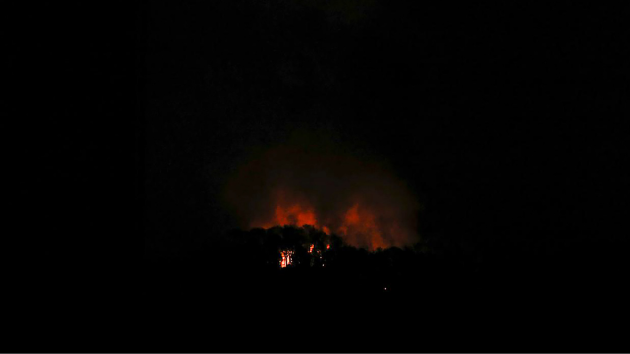
Multiple strong explosions were heard on Saturday in Venezuelaâs capital Caracas amid rising tensions with the United States on January 3, 2026. (Stringer/Anadolu via Getty Images)

(NEW YORK) — Gen. Dan Caine, chairman of the Joint Chiefs of Staff, provided a very detailed account of how the U.S. military’s mission to apprehend Nicholas Maduro and his wife took place early Saturday morning.

Here are highlights:

The mission was called Operation “Absolute Resolve”

Caine said that more than 150 aircraft were involved, including fighter aircraft, bombers, surveillance aircraft, intelligence aircraft, and helicopters. He said the entire joint force was involved in the mission (Army, Navy, Air Force, Marines, Space Force, intelligence agencies).

The aircraft involved were:

— Fighters: F-35s, F/A-18s, E/A-18s, F-22s

— Bombers: B-1 bombers

— Unmanned aircraft and E-2 Hawkeyes

He said the aircraft took off from 20 different bases on land at at sea and that support aircraft were involved as well.

President Donald Trump gave the order to undertake the mission at 10:46 p.m., Caine said. He said the president’s message of “Good luck and Godspeed” was communicated to the entire force.

The extraction force that captured Maduro and his wife included law enforcement.

The helicopters carrying the force flew at an altitude of 100 feet above the water as they approached Venezuela.

As they came near, air defense systems were disabled to ensure the safe passage of the helicopters to Maduro’s compound.  

The helicopters arrived at the compound at 1:01 a.m. Eastern Time, 2:01 a.m. local time. 

Upon arrival, they came under fire and responded in self-defense with “overwhelming force,” Caine said.  

One of the helicopters was hit, but remained flyable.

Maduro and his wife were taken into custody by Justice Department officials “assisted by incredible U.S. military” forces with “no loss of life,” Caine said. He did not provide any details of any injured Americans.

When the helicopters left the compound, they were protected by fighter aircraft and drones that provided suppressive fire.

The extraction force was over water at 3:39 a.m. Eastern Time, Caine said.

Maduro and wife were then taken to the USS Iwo Jima.

Venezuela’s Vice President Delcy Rodriguez, in a call to state TV Saturday morning, said that “innocent people” had died, but gave no specifics, and didn’t address during a later speech.

Caine said the mission was “meticulously planned” and was “the culmination of months of planning and rehearsals.”

“We think we develop, we train, we rehearse, we debrief, we rehearse again and again, not to get it right, but to ensure that we cannot get it wrong. Our jobs are to integrate combat power so when the order comes, we can deliver overwhelming force at the time and the place of our choosing against any foe anywhere in the world,” he said.

The military worked closely with the U.S. intelligence agencies: CIA, NGA, NSA. “We watched, we prepared, we remained patient and professional,” said Caine.

U.S. intelligence knew Maduro’s pattern of life — where he moved, lived, traveled, ate, and worked, he said.

The mission was ready in early December waiting for the right day to maximize the element of surprise, he said.

Copyright © 2026, ABC Audio. All rights reserved.
Republicans largely back Trump on Venezuela action, Democrats decry it as unjustified

Republicans largely back Trump on Venezuela action, Democrats decry it as unjustified
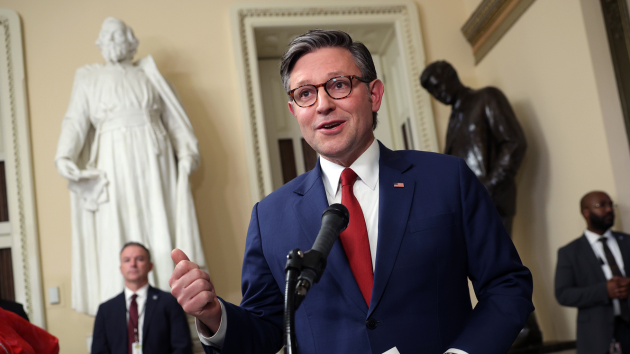
U.S. Speaker of the House Mike Johnson (R-LA) speaks to members of the media as he leaves the House Chamber at the U.S. Capitol on December 17, 2025 in Washington, DC. (Kevin Dietsch/Getty Images)

(WASHINGTON) — Top congressional leaders — comprising the “Gang of 8” — did not receive a briefing from the administration before the U.S. strike in Venezuela began, multiple sources told ABC News Saturday morning.

Per one source, the Department of Defense notified congressional staff after the operation started.

Weeks ago, President Donald Trump indicated he wouldn’t  brief lawmakers in advance of any land operations in Venezuela because he was worried they would “leak.” 

Early congressional reaction largely split along party lines.

Secretary of State Marco Rubio worked the phones Saturday morning to shore up support among Republicans on Capitol Hill.

Notably, Utah Republican Sen. Mike Lee initially seemed critical of the action being taken without authorization by Congress.

“I look forward to learning what, if anything, might constitutionally justify this action in the absence of a declaration of war or authorization for the use of military force,” Lee posted on X.

But later, Lee followed up his post saying he had spoken by phone with Rubio about and was now comfortable with the administration’s authority to take action.

“Just got off the phone with @SecRubio He informed me that Nicolás Maduro has been arrested by U.S. personnel to stand trial on criminal charges in the United States, and that the kinetic action we saw tonight was deployed to protect and defend those executing the arrest warrant This action likely falls within the president’s inherent authority under Article II of the Constitution to protect U.S. personnel from an actual or imminent attack Thank you, @SecRubio, for keeping me apprised,” Lee wrote.

He also said that Rubio told him he anticipates “no further action in Venezuela now that Maduro is in U.S. custody.”

Senate Intelligence Committee Chairman Tom Cotton, an Arkansas Republican, echoed Lee’s comments after saying he, too, had spoken with Rubio.

“Nicolas Maduro wasn’t just an illegitimate dictator; he also ran a vast drug-trafficking operation. That’s why he was indicted in U.S. court nearly six years ago for drug trafficking and narco-terrorism,” Cotton posted on X. “I just spoke to @SecRubio, who confirmed that Maduro is in U.S. custody and will face justice for his crimes against our citizens. I commend President Trump and our brave troops and law-enforcement officers for this incredible operation.”

Later, speaking to Fox News, Cotton said, “Congress doesn’t need to be notified ever time the executive branch is making an arrest. And that’s exactly what happened this morning in Venezuela, and now Maduro is going to come to the United States, and he’s going to face justice.”

House Speaker Mike Johnson said in a statement he has spoken to Rubio and Defense Secretary Pete Hegseth in “the last several hours” — calling the military action in Venezuela “decisive” and a “justified operation that will protect American lives.”

Johnson said the Trump administration is working to schedule briefings next week when Congress returns to Washington after the holiday break.

Senate Majority Leader John Thune, a South Dakota Republican, said in a statement that he had spoken with Rubio as well and argued Trump’s actions were undertaken as part of “the execution of a valid Department of Justice warrant.”

“President Trump’s decisive action to disrupt the unacceptable status quo and apprehend Maduro, through the execution of a valid Department of Justice warrant, is an important first step to bring him to justice for the drug crimes for which he has been indicted in the United States,” Thune said.

The top Democrat on the House Intelligence Committee, Rep. Jim Himes of Connecticut, countered that Rubio had denied regime change was the administration’s goal.

“Maduro is an illegitimate ruler, but I have seen no evidence that his presidency poses a threat that would justify military action without Congressional authorization, nor have I heard a strategy for the day after and how we will prevent Venezuela from descending into chaos,” he said in a statement. “Secretary Rubio repeatedly denied to Congress that the Administration intended to force regime change in Venezuela. The Administration must immediately brief Congress on its plan to ensure stability in the region and its legal justification for this decision.”

In a statement Saturday morning, Democratic Sen. Tim Kaine of Virginia, one of the Senate’s most vocal advocates for congressional war authorizations, issued a scathing statement on Trump’s actions in Venezuela and called for Congress to take up his resolution that would block the use of the U.S. armed forces to engage in hostilities within or against Venezuela unless authorized by Congress.

“Where will this go next? Will the President deploy our troops to protect Iranian protesters? To enforce the fragile ceasefire in Gaza? To battle terrorists in Nigeria? To seize Greenland or the Panama Canal? To suppress Americans peacefully assembling to protest his policies?” Kaine said.

“Trump has threatened to do all this and more and sees no need to seek legal authorization from people’s elected legislature before putting servicemembers at risk,” he said.

Kaine, along with California Democratic Sen. Adam Schiff and co-sponsor GOP Sen. Rand Paul of Kentucky, introduced a war powers resolution last month to block the use of the U.S. military to engage in hostilities within or against Venezuela unless authorized by Congress.

That legislation is ready to be called up for a vote. The Senate returns to Washington next week on Monday, while the House returns on Tuesday.

Last month, Republicans defeated two Democratic war powers resolutions that attempted to reign in the president’s military actions in the Caribbean and East Pacific.

The first measure, H. Con. Res. 61, would direct the president to remove U.S. Armed Forces from hostilities with any presidentially designated terrorist organization in the Western Hemisphere unless a declaration of war or authorization to use military force for such purpose has been enacted.

That resolution was authored by the ranking Democrat on the House Foreign Affairs Committee, Rep. Gregory Meeks. A vote failed on Dec. 17 by a count of 210-216, with two Republicans voting in favor and two Democrats opposed to the measure.

“This action is also a violation of international law and further undermines America’s global standing,” Meeks, D-N.Y., stated Saturday following the operation. “Congress must reassert its constitutional role before this escalation leads to greater instability, chaos, and unnecessary risk to American lives.”

A separate war powers resolution, H. Con. Res. 64 — championed by Massachusetts Democratic Rep. Jim McGovern and written to address hostilities with Venezuela, narrowly failed by a vote of 211-213, with three Republicans voting in favor — at odds with the rest of the House Republican Conference. One moderate Democrat, Rep. Henry Cuellar of Texas, voted to defeat the measure alongside Republicans.

On Saturday, McGovern argued the strikes are illegal.

“Without authorization from Congress, and with the vast majority of Americans opposed to military action, Trump just launched an unjustified, illegal strike on Venezuela,” he posted on X.

While congressional Republicans overwhelmingly expressed support for the Trump administration’s operation to capture Maduro, at least three House Republicans put out critical statements of the action.

GOP Rep. Thomas Massie of Kentucky posted on X: “If this action were constitutionally sound, the Attorney General wouldn’t be tweeting that they’ve arrested the President of a sovereign country and his wife for possessing guns in violation of a 1934 U.S. firearm law.”

Rep. Don Bacon of Nebraska posted on X, in part, “My main concern is now Russia will use this to justify their illegal and barbaric military actions against Ukraine, or China to justify an invasion of Taiwan. Freedom and rule of law were defended last night, but dictators will try to exploit this to rationalize their selfish objectives.”

Republican Rep. Marjorie Taylor Greene of Georgia posted, in part, “If U.S. military action and regime change in Venezuela was really about saving American lives from deadly drugs then why hasn’t the Trump admin taken action against Mexican cartels?”

She added, “And if prosecuting narco terrorists is a high priority then why did President Trump pardon the former Honduran President Juan Orlando Hernandez who was convicted and sentenced for 45 years for trafficking hundreds of tons of cocaine into America? Ironically cocaine is the same drug that Venezuela primarily traffics into the U.S.

Greene continued, “Americans disgust with our own government’s never ending military aggression and support of foreign wars is justified because we are forced to pay for it and both parties, Republicans and Democrats, always keep the Washington military machine funded and going. This is what many in MAGA thought they voted to end. Boy were we wrong.”

Copyright © 2026, ABC Audio. All rights reserved.
Why Venezuela? Trump’s shifting explanations about military buildup

Why Venezuela? Trump’s shifting explanations about military buildup
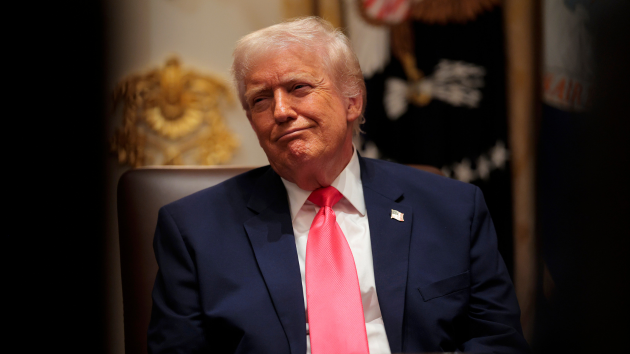
President Donald Trump looks on during a meeting of his Cabinet in the Cabinet Room of the White House on December 02, 2025 in Washington, DC. (Chip Somodevilla/Getty Images)

(NEW YORK) — Amid the news that the U.S. carried out a “large scale strike” on Venezuela overnight Saturday and captured the country’s leader, Nicolas Maduro, Americans may be wondering why Trump, who promised voters no more wars, would launch a risky ground operation to capture a foreign leader.

So far, Trump and his top aides have offered shifting explanations since Trump’s military buildup in Latin America began earlier this year.

Initially, Trump defended his military operations near Venezuela as keeping drugs out of the US, although experts say the cocaine that passes through Venezuela winds up mostly in Europe while fentanyl is sourced from China.

Trump also accused Maduro of emptying Venezuela’s prisons and “mental institutions” into the U.S., although there’s no evidence of that either. According to the nonpartisan Migration Policy Institute, hundreds of thousands of Venezuelans have settled in the U.S. in recent years due to economic and political instability in their home country.

By mid-December, Trump accused Maduro of “stealing” U.S. oil and land. Trump appeared to be alluding to work done in the 1970s in Venezuela by Western oil companies before the government there opted to nationalize its reserves, eventually forcing out American companies.

In a Dec. 17 social media post – around the same time sources say Trump was making a decision to greenlight the Jan. 3 military operation — Trump said the U.S. military threat to Venezuela will “only get bigger, and the shock to them will be like nothing they have ever seen before — Until such time as they return to the United States of America all of the Oil, Land, and other Assets that they previously stole from us.”

Trump aide Stephen Miller made a similar claim.

“American sweat, ingenuity and toil created the oil industry in Venezuela. Its tyrannical expropriation was the largest recorded theft of American wealth and property,” Miller wrote on X.

Two days later at a press conference, Secretary of State Marc Rubio offered a more general explanation than access to oil reserves, calling Maduro’s presidency “intolerable” because it was cooperating with “terrorist and criminal elements” instead of the Trump administration.

Rubio, the son of Cuban immigrants, has staked much of his political career as opposed to the communist Cuban government. He has long blamed Maduro as a primary source of instability in the region, including in Cuba where the regime still relies on Venezuela’s cheap oil.

“There is a regional threat, and in the case of Venezuela we have no cooperation,” Rubio told reporters Dec. 19. “To begin with, it is an illegitimate regime. Second, it is a regime that does not cooperate. It is anti-American in all its statements and actions. And third, it is a regime that not only does not cooperate with us, but also openly cooperates with dangerous, terrorist and criminal elements.”

The Venezuelan government issued a statement condemning what it called “the grave military aggression perpetrated by the current government of the United States of America.”

Copyright © 2026, ABC Audio. All rights reserved.

More than 100 firefighters battle massive blaze in Denver

More than 100 firefighters battle massive blaze in Denver
Perry Gerenday/Getty Images

(DENVER) — More than 100 firefighters battled a massive five-alarm fire Friday evening in Denver at an apartment building construction site — about the size of a city block — working for hours to keep the flames from spreading to nearby structures, officials said.

One firefighter was injured battling the fire and taken to the hospital, the Denver Fire Department told ABC News.  

There were no other injuries immediately reported.

The fire spurred evacuation orders for nearby residents.

By late evening, the fire was largely under control but not fully extinguished. Officials estimated the blaze was about 70% contained, with pockets of deep-seated fire still burning inside the structure. Firefighters were expected to remain on scene through the night to fully suppress hot spots.

The building, which was in the early to mid-stages of construction, was primarily made of wood, with some plastic materials used in wrapping and construction.

There’s no word yet on the cause of the blaze.

Copyright © 2026, ABC Audio. All rights reserved.

US captures Maduro, carries out ‘large scale strike’ in Venezuela: Trump

US captures Maduro, carries out ‘large scale strike’ in Venezuela: Trump
President of Venezuela Nicolás Maduro speaks during a military ceremony commemorating the 200th anniversary of the presentation of the ‘Sword of Peru’ to Venezuelan independence hero Simón Bolívar on November 25, 2025, in Caracas, Venezuela. (Jesus Vargas/Getty Images)

(NEW YORK) — President Donald Trump said the U.S. “successfully carried out a large scale strike against Venezuela” and said Venezuelan President Nicolas Maduro and his wife were “captured and flown out of the Country.”

The announcement on Trump’s social media platform came shortly before 4:30 a.m. Saturday a few hours after several explosions were heard in Venezuela’s capital city of Caracas, witnesses said, and photos and videos showed plumes of smoke and a large fireball in the night sky.

Trump said the operation was carried out in conjunction with U.S. law enforcement and said he would hold a news conference at 11 a.m. from Mar-a-Lago.

Attorney General Pam Bondi said that Maduro and his wife, Cilia Flores, “will soon face the full wrath of American justice on American soil in American courts” on a slew of charges in New York, including “narco-terrorism conspiracy” and “cocaine importation conspiracy” as well as weapons charges. Maduro has faced the charges in New York for years.

Sources familiar with the matter told ABC News Maduro was being flown to New York. While the sources did not specify where Maduro will be held, defendants awaiting trial in federal court in Manhattan are customarily held at MDC-Brooklyn.

The operation that led to Maduro’s capture was carried out by the Army’s Delta Force after the CIA had identified the leader’s precise location, according to two people familiar with the operation. Delta Force is an elite special operations group of soldiers trained in secret counterterrorism operations and hostage rescues.

One person told ABC News that Trump had given the green light to capture Maduro several days ago and troops were ready to strike on Christmas Day, but were delayed due to military airstrikes in Nigeria against ISIS. Subsequent opportunities were postponed partly due to weather, the person said.

CBS first reported the details on the operation.

In a brief phone interview with The New York Times, President Trump celebrated what he called the success of the mission to capture Maduro, who the U.S. has considered the head of a foreign terrorist organization since a November designation.

“A lot of good planning and lot of great, great troops and great people,” Trump told The New York Times. “It was a brilliant operation, actually.”

When asked whether he had sought congressional authorization for the operation or what would come next for Venezuela, Trump said he would address those matters during his news conference at Mar-a-Lago on Saturday morning.

‘No further action’ anticipated

Republican Sen. Mike Lee, of Utah, said in a post on X that he spoke with Secretary of State Marco Rubio over the phone about the actions being taken in Venezuela after initially asking “what, if anything, might constitutionally justify this action in the absence of a declaration of war or authorization for the use of military force.”

According to Lee, Rubio said that Maduro had been “arrested by U.S. personnel to stand trial on criminal charges in the United States,” and that the “kinetic action” was taken to protect those executing the warrant.

He also said that Rubio told him he anticipates “no further action in Venezuela now that Maduro is in U.S. custody.”

“This was an incredibly dangerous operation to conduct,” said ABC Contributor Mick Mulroy, a former CIA officer and senior Pentagon official. “It required precise intelligence, detailed planning and flawless execution by these Delta operators and all the support, especially the [Joint Special Operations Command] air component, to pull it off in the manner that they did.”

Senate and House Republicans praised Trump’s actions, with Sen. Rick Scott, of Florida saying “a new day is here for Venezuela and Latin America” in a post on X and Sen. Tom Cotton, of Arkansas saying Maduro “wasn’t just an illegitimate dictator; he also ran a vast drug-trafficking operation.”

But the action was criticized by Democrats.

Sen. Ruben Gallego, of Arizona, blasted Trump’s move, calling it the “second unjustified war in my life time” in a post on X. “This war is illegal, it’s embarrassing that we went from the world cop to the world bully in less than one year. There is no reason for us to be at war with Venezuela.”

The latest events come amid rising tensions between the U.S. and Venezuela including a build-up of U.S. military forces in the Caribbean and the targeting of alleged drug-smuggling boats.

Some 15,000 U.S. military personnel were in the area as well as the USS Gerald Ford aircraft carrier.

The operation also comes a short time after the first-known land strike carried out against a dock where Trump said drugs were being loaded onto boats.

International reaction

The Venezuelan government issued a statement condemning what it called “the grave military aggression perpetrated by the current government of the United States of America” in Caracas and the states of Miranda, Aragua and La Guaira.

In addition, President Nicolas Maduro ordered the implementation of national defense plans, and declared a “state of External Disturbance throughout the national territory,” according to the statement.

Russia condemned the action as “an act of armed aggression against Venezuela” and said it wanted to prevent “further escalation,” according to the country’s Foreign Ministry. And Colombian President Gustavo Petro said “Alert the world: Venezuela has been attacked!” in a post on X. But Trump ally and Argentinian president Javier Milei praised the move.

The U.S. has long considered Maduro the head of a corrupt dictatorial regime. In 2024, Maduro declared victory after a widely disputed presidential election for a third term.

US recently declares Maduro head of terror organization

In an unprecedented move in November, the Trump administration declared Maduro the head of a foreign terrorist organization, citing alleged links to drug cartels, which Maduro denied.

The designation put the Venezuelan leader on the same list as terror networks like al-Qaeda and the Houthi rebel group in Yemen. In August, Rubio announced the U.S. had increased the reward for information leading to Maduro’s arrest from $25 million to $50 million.

Maduro has faced charges in the United States of narcotics-terrorism since 2020, when federal prosecutors in New York accused him of partnering with a Colombian rebel group to “flood the United States with cocaine in order to undermine the health and wellbeing” of the nation.

The charges include narco-terrorism conspiracy, cocaine importation conspiracy and weapons possession conspiracy. Prosecutors allege that Maduro and 14 current or former officials ran a vast criminal enterprise for the last 20 years, using state resources to fuel the international drug trade, including in the U.S.

Copyright © 2026, ABC Audio. All rights reserved.

Colorado hiker killed in mountain lion attack: Officials

Colorado hiker killed in mountain lion attack: Officials
Mountain lion on a tree stump (Getty/John Conrad)

(LARIMER COUNTY, Colo.) — A female hiker was killed by a mountain lion on the Crosier Mountain trail in Larimer County, Colorado, on Thursday, according to state officials.

The victim’s identity has not been revealed, but her death marks the first fatal mountain lion attack in Colorado since 1999, Colorado Parks and Wildlife noted.

A group of hikers reported throwing rocks at a mountain lion on the trail after spotting it near the body of the victim, causing the animal to flee, CPW said in a press release. Officers euthanized two mountain lions in the area, as CPW policy dictates that wildlife that attacks humans must be euthanized.

“Mountain lions are more visible in winter as they follow deer and elk to lower elevations. If lions are spotted, make noise to scare them from the area, hold objects overhead to appear bigger and start backing away from the animal. Pets should be kept on-leash and not interact with wildlife,” the release reads.

It is unknown how many animals were involved in the attack, as authorities are looking for a potential third mountain lion associated with the incident, Colorado Parks and Wildlife spokesperson Kara Van Hoose told ABC News.

Kellie Mahoney, who owns a cabin near the site of the attack, said in a video shared with ABC News that she previously saw a family of four mountain lions in the area.

“I couldn’t believe it. When I saw the one big cat and then all of a sudden all you see are eyeballs coming down off the mountain and there were the four of them together, which I’ve never seen before,” Mahoney said.

The Estes Park Police Department, who responded to the scene of the attack, offered their condolences to the victim’s family on social media.

“The Town of Estes Park is deeply saddened by the tragic news of a suspected fatal mountain lion attack that occurred,” the Facebook post read. “Our hearts go out to the victim’s family, friends, and loved ones during this incredibly difficult time. We offer our sincere condolences to all those grieving this heartbreaking loss.”

The trails on the mountain remain closed, according to a post from the U.S. Forest Service.

Mountain lions are also known as cougars, pumas, panthers or catamounts, and there are projected to be 3,800 to 4,400 mountain lions currently in the wild in Colorado, the CPW noted.

Copyright © 2026, ABC Audio. All rights reserved.
Jan. 6 pipe bomb suspect ordered to remain detained until trial

Jan. 6 pipe bomb suspect ordered to remain detained until trial
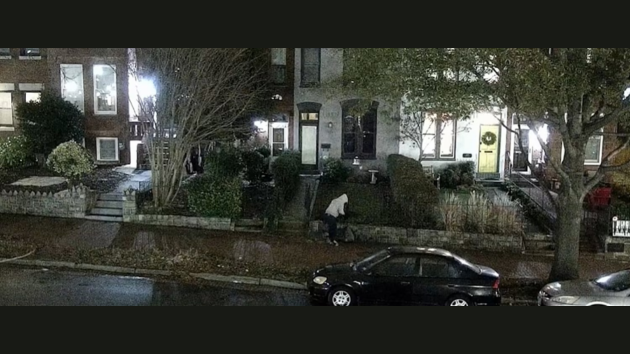
This is a screengrab from a video released by the FBI on Jan. 2, 2024, with new information given in the hunt for the Jan. 6 pipe bomber. FBI

(WASHINGTON) — A federal magistrate judge ordered Friday that the Virginia man charged with placing pipe bombs outside of the headquarters of the RNC and DNC the night before the Jan. 6 riot at the U.S. Capitol remain detained pending trial.

Magistrate Judge Matthew Sharbaugh said in the court filing Friday that the government’s evidence amassed thus far against Brian Cole established that there were no conditions he could place on him that would ensure the safety of the general public. 

Cole was arrested by federal authorities earlier last month following a massive probe that had stymied investigators for almost five years.

“Although home incarceration and a GPS monitor would provide some check against Mr. Cole’s ability to carry out any menacing or dangerous conduct in the community, the Court is simply not satisfied these conditions rise to the necessary level for the reasons explained,” Sharbaugh said.

“This is particularly true based on the severity of the potential danger Mr. Cole is alleged to pose, given his alleged persistent acquisition and retention of so-called ‘bombmaking parts’ and given his reported penchant and capacity to create explosive devices and deploy them in public settings,” the judge added.

Cole, who has not entered a plea, allegedly told investigators in a lengthy confession that he wasn’t targeting the joint session of Congress that was convening to certify former President Joe Biden’s election win, according to a previous court filing from the Department of Justice.

Sharbaugh’s ruling followed a detention hearing earlier this week, where he appeared to waver over whether he could put in place heavy restrictions on Cole and release him on bail under the supervision of his family. 

Assistant U.S. Attorney Charles Jones urged Sharbaugh to reject arguments made by Cole that he would pose no danger if released and remained under house arrest — noting such a setting was similar to where he had carried out his alleged planning to plant the pipe bombs in the first place.

Jones said that on the morning of his arrest, Cole allegedly wiped the memory from his phone for the 943rd time since December 2020, just days before he allegedly planted the devices. 

After Cole saw himself on the news in videos released by the FBI seeking tips on his identity, he said in the interview that he discarded all of his bomb-making materials at a nearby dump and said he never told anyone about his actions in the nearly five years since Jan. 6, according to a court filing.

Cole’s attorneys are expected to again seek his release when the case is ultimately assigned to a federal district judge, after prosecutors revealed in court that they secured a two-count indictment of Cole in D.C.’s Superior Court on Monday.

Copyright © 2026, ABC Audio. All rights reserved.

New York reports record-breaking number of flu hospitalizations in a single week

New York reports record-breaking number of flu hospitalizations in a single week
Stock photo of a sick child. (Natalia Lebedinskaia/STOCK PHOTO/Getty Images)

(NEW YORK) — New York is reporting the highest number of flu hospitalizations recorded in a single week, the state’s health department said on Friday.

During the week ending Dec. 27, 4,546 people were hospitalized with flu, a 24% increase from the 3,666 who were hospitalized the previous week, according to data from the New York State Department of Health (NYSOH)

It comes after the state reported a record-breaking number of flu cases in a single week with 72,133 infections during the week ending Dec. 20.

NYSDOH issued a declaration last month stating influenza is prevalent in New York, which requires health care facilities and agencies to ensure any staff who have not received this year’s flu vaccine wear masks in any areas where patients and residents may be present.

“We are having a more severe flu season than prior years, almost 1,000 more people were admitted to a hospital during this most recent seven-day period compared to the prior week,” Dr. James McDonald, the state’s health commissioner, said in a statement on Friday.

Meanwhile, flu activity is also spiking nationwide. The Centers for Disease Control and Prevention estimates there have been at least ​7.5 million illnesses, ​81,000 hospitalizations and ​3,100 deaths from flu so far this season.

New York is one of 20 states recording “very high” levels of respiratory illness activity, according to the latest CDC data.

Public health experts previously told ABC News that many of this season’s cases are linked to a new flu strain called subclade K — a variant of the H3N2 virus, which is itself a subtype of influenza A.

Subclade K has been circulating since the summer in other countries and was a main driver of a spike in flu cases in Canada, Japan and the U.K.

Of the 1,600 flu samples tested by the CDC, roughly ​92% were H3N2. Of those samples, nearly ​90% belonged to subclade K.

Experts expect flu-like illnesses to continue to climb in the coming weeks after holiday gatherings and colder weather.

Currently, the CDC recommends that everyone aged 6 months and older, with rare exceptions, get a flu vaccine.  

The federal health agency states on its website that getting an annual flu shot prevents millions of illnesses and flu-related doctors’ visits every year and is especially important for those at higher risk of serious complications.

The flu vaccine is currently available to New Yorkers aged 2 years and older at a health care provider’s office or at participating pharmacies while children aged 6 months and older can receive the flu vaccine at a health care provider’s office, according to the state health department.

“There is still time to get a flu shot and remember, flu can be treated with antiviral medication if started within 48 hours of symptom onset and your doctor deems appropriate,” McDonald said.

ABC News’ Youri Benadjaoud contributed to this report.

Copyright © 2026, ABC Audio. All rights reserved.
Why are mortgage rates at their lowest level since 2024?

Why are mortgage rates at their lowest level since 2024?
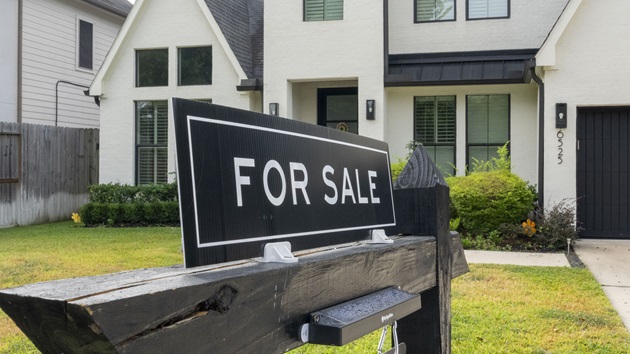
A for sale sign is seen in front of a house in a Spring Branch neighborhood in Houston, Monday, Oct. 27, 2025. Kirk Sides/Houston Chronicle via Getty Images

(NEW YORK) — Mortgage rates this week fell to their lowest level in 15 months, easing borrowing costs for homebuyers eager for a thaw in the housing market in 2026.

The average interest rate on a 30-year fixed mortgage stands at 6.15%, plummeting from a level of 6.89% in May, data from financial services company Freddie Mac showed. Last January, the average 30-year fixed mortgage rate exceeded 7%.

Each percentage point decrease in a mortgage rate can save thousands or tens of thousands in additional cost each year, depending on the price of the house, according to lender Rocket Mortgage.

Sam Khater, the chief economist at Freddie Mac, called the drop in mortgage rates an “encouraging sign for potential homebuyers heading into the new year.”

Mortgage rates closely track the yield on a 10-year Treasury bond, or the amount paid to a bondholder annually. Bond yields are shaped in part by expectations of the benchmark interest rate set by the Federal Reserve.

The sharp drop in mortgage rates over the latter half of 2025 owed in part to data showing a slowdown in hiring, which heightened expectations that the Fed would slash interest rates in an effort to boost the ailing labor market.

Starting in September, the Fed cut interest rates at three consecutive meetings, bringing the benchmark rate to a level between 3.5% and 3.75%. That figure marks a significant drop from a recent peak attained in 2023, but borrowing costs remain well above a 0% rate established at the outset of the COVID-19 pandemic.

After the Fed’s most recent rate cut in December, Fed Chair Jerome Powell suggested the central bank may be cautious about further rate reductions.

“We’re well positioned to wait and see how the economy evolves,” Powell said.

The housing market is suffering from a phenomenon known as the “lock in” effect, some experts previously told ABC News.

While mortgage rates have fallen, they remain well above the rates enjoyed by most current homeowners, who may be reluctant to put their homes on the market and risk a much higher rate on their next mortgage.

In turn, the market could continue to suffer from a lack of supply, making options limited and prices sticky.

Mixed results in recent economic data have clouded the outlook for the economy — and in turn, interest rates.

A jobs report released two weeks ago showed sluggish hiring and an uptick in the unemployment rate. Unemployment remains low by historical standards but has inched up to its highest level in years.

Days later, a report on gross domestic product defied concerns stoked by the hiring slowdown. The U.S. economy grew at a robust annualized rate of 4.3% in the third quarter in the government’s initial estimate, marking an acceleration from 3.8% growth recorded in the previous quarter, U.S. Commerce Department data showed.

Futures markets expect two quarter-point interest rate cuts next year, forecasting the first in April and a second in the fall, according to CME FedWatch Tool, a measure of market sentiment.

Redfin, a Seattle, Washington-based real estate giant, forecasts average 30-year fixed mortgage rates will remain in the low 6% range for most of 2026.

“Mortgage rates will continue their slow slide but remain high relative to the pandemic era,” Redfin said last month.

“Lingering inflation risk and the likelihood that we’ll avoid a recession will keep the Fed from cutting more than the markets have already priced in. That’s why rates may dip below 6% occasionally, but not for any meaningful period,” Redfin added.

Copyright © 2026, ABC Audio. All rights reserved.