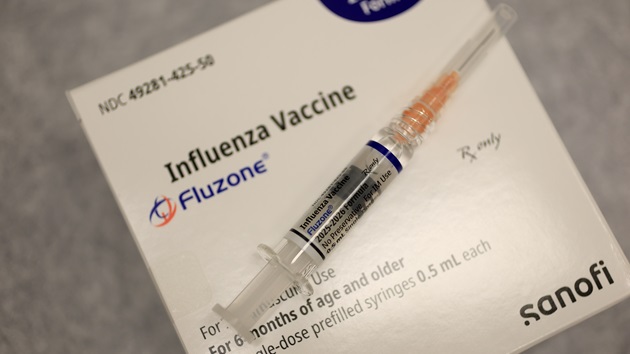
An Influenza Vaccine is prepared for a patient on September 12, 2025, in Coral Gables, Florida. Joe Raedle/Getty Images
(ATLANTA) — Flu activity is continuing to climb across the U.S. as hospitalizations rise, according to newly released data from the Centers for Disease Control and Prevention.
The CDC estimates there have been 120,000 hospitalizations so far this season, a 38.8% increase from the prior week.
Additionally, the CDC says there have been at least 11 million illnesses and 5,000 deaths due to flu so far this season.
This is a developing story. Please check back for updates.
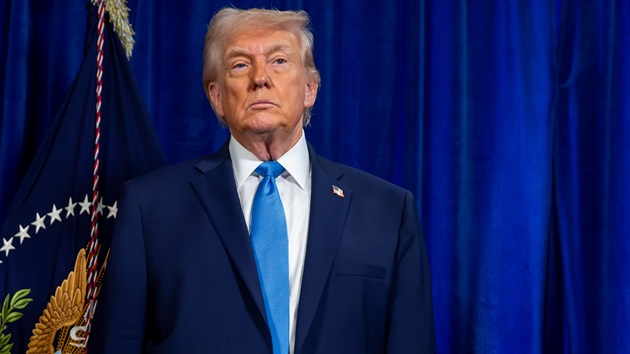
US President Donald Trump during a news conference at the Mar-a-Lago Club in Palm Beach, Florida, US, on Saturday, Jan. 3, 2026. Nicole Combeau/Bloomberg via Getty Images
(LONDON) — President Donald Trump implied on Sunday that Colombian President Gustavo Petro could face U.S. action soon, following the American attack on Venezuela that saw its president, Nicolas Maduro, captured and taken to face trial in the U.S.
Trump also appeared to threaten Cuba, the leftist government that has been a longtime ally of Maduro and his authoritarian regime in Venezuela.
“Colombia is very sick too, run by a sick man who likes making cocaine and selling it to the United States. And he’s not going to be doing it very long, let me tell you,” Trump told reporters Sunday.
Asked if the U.S. would launch a military operation against Colombia, Trump responded, “It sounds good to me.”
Earlier on Sunday, Petro released a statement on the operation against Venezuela and Trump’s previous comments about him, saying, “I deeply reject Trump speaking without knowing; my name does not appear in the judicial files on drug trafficking over 50 years, neither from before nor from the present.”
“Stop slandering me, Mr. Trump. That’s not how you threaten a Latin American president who emerged from the armed struggle and then from the people’s struggle for Peace in Colombia,” he added.
Following the removal of Maduro in Venezuela, reporters asked Trump if the U.S. had a similar plan to deal with Cuba, to which he said that the government in Havana only survived because of Venezuelan largesse.
“Now, they won’t have that money coming in. They won’t have the income coming in. You know, a lot of Cubans were killed yesterday, you know that a lot of Cubans were killed,” Trump said.
Trump said the Cubans killed on Saturday were trying to protect Maduro. According to Cuban officials, at least 32 Cuban nationals were killed in the U.S. operation.
“Cuba looks like it’s ready to fall. I don’t know how they — if they’re going to hold out, but Cuba now has no income,” Trump said. “They got all of their income from Venezuela, from the Venezuelan oil. They’re not getting any of it. And Cuba literally is ready to fall. And you have a lot of great Cuban Americans that are going to be very happy about this.”
Asked again if the U.S. is considering action in Cuba, the president said he did not think it necessary because “it looks like it’s going down.”
In Venezuela, meanwhile, Vice President Delcy Rodriguez was appointed as interim president by the country’s Supreme Court, which described the U.S. capture of Maduro as a “kidnapping.”
Maduro and his wife, Cilia Flores, are scheduled to make their initial appearances on Monday in a federal court in Manhattan.
On Saturday, Rodriguez demanded Maduro’s return and vowed to defend Venezuela against American aggression.
On Sunday, Rodriguez posted a statement to social media in which she invited “the U.S. government to collaborate with us on an agenda of cooperation oriented towards shared development within the framework of international law to strengthen lasting community coexistence.”
In comments to The Atlantic, Trump threatened further action in Venezuela if Rodriguez failed to “do what’s right.” Asked what he wanted from Rodriguez, Trump called for “total access” to the country’s oil reserves.
“We’re in charge,” Trump told reporters of the situation in the country on Sunday. The president said that he had not spoken to Rodriguez. Asked if he planned to, the president said, “At the right time, I will.”
ABC News’ Meghan Mistry, Hannah Demissie and Will Gretsky contributed to this report.
Vice President JD Vance speaks on the final day of Turning Point USA’s annual AmericaFest conference at the Phoenix Convention Center on December 21, 2025 in Phoenix, Arizona. (Photo by Caylo Seals/Getty Images)
(CINCINNATI) — A man was taken into custody after allegedly breaking windows at Vice President JD Vance’s home in Ohio, the Secret Service said on Monday.
The suspect, 26-year-old William Defoor of Cincinnati, allegedly damaged the victim’s car and four windows at the house, according to the arrest report.
“The residence was unoccupied at the time of the incident, and the Vice President and his family were not in Ohio,” the Secret Service said.
The suspect was physically detained by Secret Service personnel just after midnight. He’s been charged with vandalism, obstruction of a official business and criminal trespass, according to the Hamilton County Sheriff’s office.
Vance spoke out on social media, expressing his gratitude to the Secret Service and Cincinnati police for responding quickly.
“As far as I can tell, a crazy person tried to break in by hammering the windows,” Vance said.
Vance and his wife, Usha, purchased the home for about $1.4 million in 2018 in Cincinnati’s East Walnut Hills neighborhood, which sits along the Ohio River and east of downtown, according to the Hamilton County Auditor’s Office.
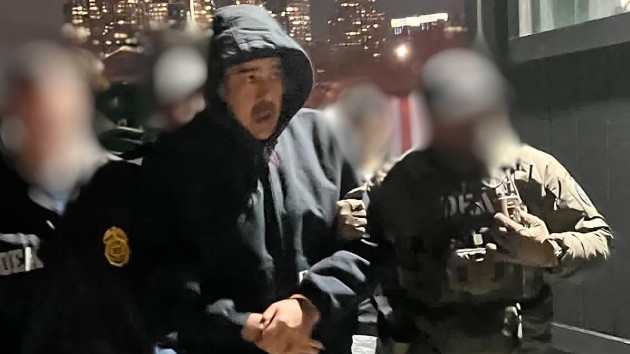
Venezuela’s President Nicolas Maduro is escorted by U.S. Drug Enforcement Agents after arriving in New York City, January 3, 2026. Obtained by ABC News
The couple is expected to appear in front of Judge Alvin Hellerstein at 12 p.m. ET. Both are currently being held in federal custody at MDC-Brooklyn.
Maduro and Flores are among six defendants named in a four-count superseding indictment that accused them of conspiring with violent, dangerous drug traffickers for the last 25 years. Maduro has long denied all the allegations.
Texas lawyer Mark Donnelly is representing Flores, according to a notice filed Monday with the court. Donnelly is admitted to practice in Texas but applied for pro hac vice admission to represent her in New York.
Maduro has retained attorney Barry Pollack, according to a notice on the court docket posted Monday. Pollack previously represented Wikileaks founder Julian Assange.
Neither defense attorney immediately responded to ABC News’ request for comment.
Dueling groups of protesters have gathered across the street from the courthouse; one is holding signs urging President Donald Trump to “Free President Maduro,” and the other is supportive of his capture.
More people protesting against what they call “illegal kidnapping” are expected to arrive shortly before the court appearance.
Maduro’s son, two high-ranking Venezuelan officials and an alleged leader of the Tren de Aragua criminal gang are the other defendants.
Trump said on Saturday that the U.S. “successfully carried out a large-scale strike against Venezuela” in which Maduro and Flores were “captured and flown out of the Country.”
Trump said the operation was carried out in conjunction with U.S. law enforcement. Members of Congress said the military, which sources said included the elite Delta Force, was in place to support that law enforcement operation.
In a move that alarmed some observers, Trump, who campaigned on “America First” and against foreign entanglements, said during a press conference at Mar-a-Lago the U.S. would “run” Venezuela for an unspecified “period of time.”
He said a team comprised of some of his Cabinet officials along with a local team in Venezuela would be “running the country” because there is “nobody to take over.”
“We’ll run it properly. We’ll run it professionally. We’ll have the greatest oil companies in the world go in and invest billions and billions of dollars and take out money, use that money in Venezuela, and the biggest beneficiary are going to be the people of Venezuela,” Trump said.
Venezuelan Vice President Delcy Rodriguez has been sworn in as interim leader to lead the country after what the Venezuelan Supreme Court described as Maduro’s “kidnapping.”
Rodriguez demanded Maduro’s return and vowed to defend Venezuela against American aggression.
On Sunday, Rodriguez posted a statement to social media in which she appeared to soften her tone, inviting “the U.S. government to collaborate with us on an agenda of cooperation oriented towards shared development within the framework of international law to strengthen lasting community coexistence.”
Trump told reporters on Sunday that the U.S. is “in charge” of Venezuela.
The president said he had not yet spoken to Rodriguez. Asked if he wanted to, Trump said, “At the right time, I will.”
ABC News’ Meghan Mistry and Hannah Demissie contributed to this report.
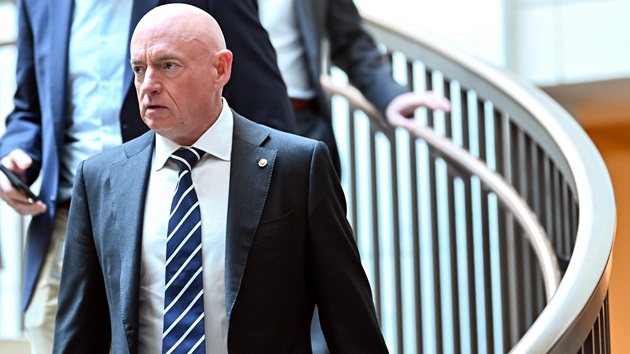
Senator Mark Kelly, a Democrat from Arizona, arrives for an all-Senate briefing at the US Capitol in Washington, DC, US, on Tuesday, Dec. 16, 2025. Graeme Sloan/Bloomberg via Getty Images
(WASHINGTON) — Defense Secretary Pete Hegseth, in a post on X, said the Pentagon will hold Democratic Sen. Mark Kelly accountable under the military code of justice for “conduct [that] was seditious in nature,” referring to a video Kelly participated in that told United States service members they have a right to refuse unlawful orders.
This is a developing story. Please check back for updates.
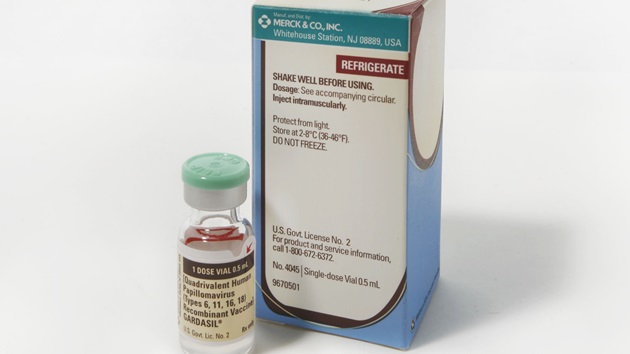
In this handout from Merck & Co, a box and vial of Gardasil, a new cervical cancer vaccine, is seen is this undated photo. Russell Kirk/Merck & Co. via Getty Images
(NEW YORK) — A major update to federal women’s health preventive guidance will make it easier for women to get screened for cervical cancer, including a self-collection option that allows some women to test themselves at home instead of going to a doctor for a pelvic exam.
The new option will be covered by private insurance beginning in January 2027.
The updated Health Resources and Services Administration (HRSA) guidance now advises that people receive a high-risk HPV test – which checks for the virus types most likely to cause cervical cancer – every five years for average-risk women ages 30 to 65 as the preferred screening approach. This can be done with a clinician-collected sample or by the patient at home.
Women in that age group still have other choices: a combination of an HPV and Pap test every five years, or Pap testing alone every three years if HPV testing isn’t available.
“The addition of self-collection really empowers women to make this choice for themselves,” Ann Sheehy, MD, the HRSA’s chief medical officer, told ABC News. “We do retain the option for Pap smear … this is just an additional choice for women.”
For women ages 21 to 29, the recommendations stay the same: Pap tests every three years, which Sheehy said aligns with available evidence.
“By doing this, we’re going to get some of those people that have been falling through the cracks and not getting this testing done in advance,” Tom Engels, administrator of the HRSA, told ABC News. “And by doing that, we’re going to save lives.”
Engels emphasized that the update is meant to expand testing options, not replace the Pap test. Self-collection is intended to remove barriers for women who find in-office screening difficult to schedule, uncomfortable, or hard to access, he stressed.
American Cancer Society (ACS) guidelines updated in December, by contrast, recommend that cervical cancer screening should begin at age 25 and centers on primary HPV testing, including self-collection tests.
“The combination of good evidence of the benefits of self-collection, which include increased access to cervical cancer screening, combined with FDA approval, led the ACS and HRSA to include self-collection in their guideline update,” Dr. Robert Smith, senior vice president, Early Cancer Detection Science at the American Cancer Society and author of the organization’s updated guidelines, told ABC News.
Cervical cancer screening is often cited as a major public health success. Over the last 50 years, cervical cancer incidence and deaths have fallen by more than 50% in the U.S., according to the American Cancer Society, largely because screening can catch precancerous changes early, before patients notice any symptoms.
When cervical cancer is found early, five-year survival is higher than 90%, Centers for Disease Control and Prevention (CDC) data suggests. But the HSRA guidance notes that more than half of diagnoses happen beyond the earliest stage, after the disease is spread to other areas of the body. In those later stages, five-year survival is only about 20%, according to the CDC.
Wide use of the HPV vaccine is expected to push cervical cancer rates even lower over time, but most of the historical decline happened before widespread vaccination efforts.
Sheehy said she has seen the consequences when screening doesn’t happen, and why early detection matters.
“I’ve seen women who didn’t have access to screening, and their cancer presented at a very late stage,” she said. “Most women who have early-stage cervical cancer or precancer lesions are asymptomatic, and the only way we’re going to detect that is with screening.”
The updated guidance aims to address stubborn gaps despite the decades of progress, she added, pointing out that about half of women diagnosed with cervical cancer have either never been screened or their screening isn’t up to date, and about one in four women in the U.S. are not up to date with screening, according to the CDC.
Only FDA-approved tests are recommended for self-collection. The FDA first expanded approvals in May 2024 to allow patients to self-collect samples in a clinical setting. In May 2025, the FDA approved the first at-home self-collection cervical cancer screening kit.
The at-home option is available by prescription. Exactly how patients access a covered self-collecting test may vary by insurer and plan.
“There’s some FDA tests that are approved for self-collection in an office-based setting and there is one that is available for self-collection at home,” Sheehy noted.
Sheehy and Smith both added that a positive HPV result is not a cancer diagnosis, but it can mean additional testing is necessary.
The updated guidance also aims to reduce costs that can pile up after an abnormal screening result by clarifying what insurers must cover without cost-sharing, including follow-up testing and diagnostic evaluation such as Pap testing, biopsy, and lab work, depending on individual needs.
A separate HRSA guideline that took effect Jan. 1 also requires insurance coverage for patient navigation services that help women schedule screenings, address care challenges, and follow up after abnormal results.
“We know the health care system is incredibly complicated for patients to navigate,” Sheehy said.
Both Engles and Sheehy emphasized how optimistic they are about the potential benefits of expanding access to cervical screening.
“This could be really, really, game-changing for women,” Sheehy said.
Radhika Malhotra, MD, is an internal medicine-preventive medicine resident at Rutgers New Jersey Medical School and a member of the ABC News Medical Unit.
ABC News’ Liz Neporent contributed to this report.
In this handout from Merck & Co, a box and vial of Gardasil, a new cervical cancer vaccine, is seen is this undated photo. Russell Kirk/Merck & Co. via Getty Images
(NEW YORK) — A major update to federal women’s health preventive guidance will make it easier for women to get screened for cervical cancer, including a self-collection option that allows some women to test themselves at home instead of going to a doctor for a pelvic exam.
The new option will be covered by private insurance beginning in January 2027.
The updated Health Resources and Services Administration (HRSA) guidance now advises that people receive a high-risk HPV test – which checks for the virus types most likely to cause cervical cancer – every five years for average-risk women ages 30 to 65 as the preferred screening approach. This can be done with a clinician-collected sample or by the patient at home.
Women in that age group still have other choices: a combination of an HPV and Pap test every five years, or Pap testing alone every three years if HPV testing isn’t available.
“The addition of self-collection really empowers women to make this choice for themselves,” Ann Sheehy, MD, the HRSA’s chief medical officer, told ABC News. “We do retain the option for Pap smear … this is just an additional choice for women.”
For women ages 21 to 29, the recommendations stay the same: Pap tests every three years, which Sheehy said aligns with available evidence.
“By doing this, we’re going to get some of those people that have been falling through the cracks and not getting this testing done in advance,” Tom Engels, administrator of the HRSA, told ABC News. “And by doing that, we’re going to save lives.”
Engels emphasized that the update is meant to expand testing options, not replace the Pap test. Self-collection is intended to remove barriers for women who find in-office screening difficult to schedule, uncomfortable, or hard to access, he stressed.
American Cancer Society (ACS) guidelines updated in December, by contrast, recommend that cervical cancer screening should begin at age 25 and centers on primary HPV testing, including self-collection tests.
“The combination of good evidence of the benefits of self-collection, which include increased access to cervical cancer screening, combined with FDA approval, led the ACS and HRSA to include self-collection in their guideline update,” Dr. Robert Smith, senior vice president, Early Cancer Detection Science at the American Cancer Society and author of the organization’s updated guidelines, told ABC News.
Cervical cancer screening is often cited as a major public health success. Over the last 50 years, cervical cancer incidence and deaths have fallen by more than 50% in the U.S., according to the American Cancer Society, largely because screening can catch precancerous changes early, before patients notice any symptoms.
When cervical cancer is found early, five-year survival is higher than 90%, Centers for Disease Control and Prevention (CDC) data suggests. But the HSRA guidance notes that more than half of diagnoses happen beyond the earliest stage, after the disease is spread to other areas of the body. In those later stages, five-year survival is only about 20%, according to the CDC.
Wide use of the HPV vaccine is expected to push cervical cancer rates even lower over time, but most of the historical decline happened before widespread vaccination efforts.
Sheehy said she has seen the consequences when screening doesn’t happen, and why early detection matters.
“I’ve seen women who didn’t have access to screening, and their cancer presented at a very late stage,” she said. “Most women who have early-stage cervical cancer or precancer lesions are asymptomatic, and the only way we’re going to detect that is with screening.”
The updated guidance aims to address stubborn gaps despite the decades of progress, she added, pointing out that about half of women diagnosed with cervical cancer have either never been screened or their screening isn’t up to date, and about one in four women in the U.S. are not up to date with screening, according to the CDC.
Only FDA-approved tests are recommended for self-collection. The FDA first expanded approvals in May 2024 to allow patients to self-collect samples in a clinical setting. In May 2025, the FDA approved the first at-home self-collection cervical cancer screening kit.
The at-home option is available by prescription. Exactly how patients access a covered self-collecting test may vary by insurer and plan.
“There’s some FDA tests that are approved for self-collection in an office-based setting and there is one that is available for self-collection at home,” Sheehy noted.
Sheehy and Smith both added that a positive HPV result is not a cancer diagnosis, but it can mean additional testing is necessary.
The updated guidance also aims to reduce costs that can pile up after an abnormal screening result by clarifying what insurers must cover without cost-sharing, including follow-up testing and diagnostic evaluation such as Pap testing, biopsy, and lab work, depending on individual needs.
A separate HRSA guideline that took effect Jan. 1 also requires insurance coverage for patient navigation services that help women schedule screenings, address care challenges, and follow up after abnormal results.
“We know the health care system is incredibly complicated for patients to navigate,” Sheehy said.
Both Engles and Sheehy emphasized how optimistic they are about the potential benefits of expanding access to cervical screening.
“This could be really, really, game-changing for women,” Sheehy said.
Radhika Malhotra, MD, is an internal medicine-preventive medicine resident at Rutgers New Jersey Medical School and a member of the ABC News Medical Unit.
ABC News’ Liz Neporent contributed to this report.
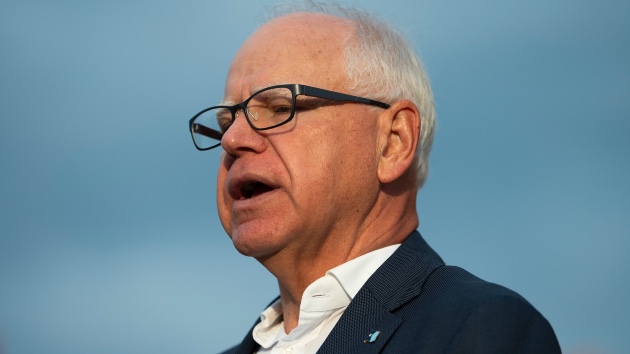
: Minnesota Gov. Tim Walz speaks to media gathered on the first day of school at Deerwood Elementary on September 2, 2025 in Eagan, Minnesota. (Photo by Stephen Maturen/Getty Images)
(NEW YORK) — Minnesota Gov. Tim Walz, a Democrat, announced Monday that he would drop his bid for reelection as governor of Minnesota, saying that he would not be able to give a campaign all of his attention as he works to defend Minnesota against allegations of fraud and right-wing scrutiny.
This is a developing story. Please check back for updates.
Vice President JD Vance speaks on the final day of Turning Point USA’s annual AmericaFest conference at the Phoenix Convention Center on December 21, 2025 in Phoenix, Arizona. (Photo by Caylo Seals/Getty Images)
(CINCINNATI) — A man was taken into custody after allegedly causing property damage, including breaking windows, at Vice President JD Vance’s home in Ohio, the U.S. Secret Service said on Monday.
Just after midnight the man was physically detained by Secret Service personnel and then taken into custody by the Cincinnati Police for property damage.
“The residence was unoccupied at the time of the incident, and the Vice President and his family were not in Ohio,” the Secret Service said.
Vance and his wife, Usha, purchased the home for about $1.4 million in 2018 in Cincinnati’s East Walnut Hills neighborhood, which sits along the Ohio River and east of downtown, according to the Hamilton County Auditor’s Office.
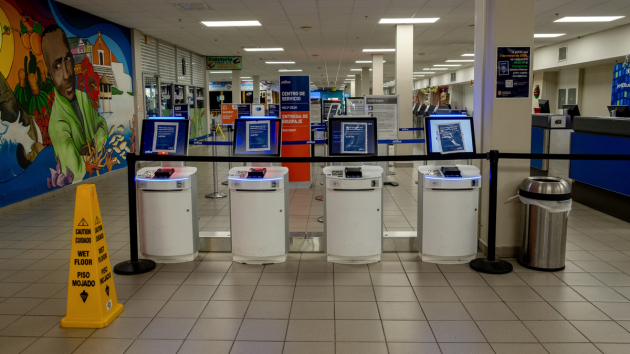
Self check-in kiosk are blocked off at Rafael Hernandez International Airport in Aguadilla, Puerto Rico. (Yadira Hernandez-Pico/Bloomberg via Getty Images)
(NEW YORK) — Despite the Federal Aviation Administration reopening the Eastern Caribbean airspace following the dramatic capture of Venezuelan President Nicolás Maduro by U.S. forces, some American tourists said they remain stranded across the region.
As airlines scrambled on Sunday to add flights and get people home from the Caribbean, tourists such as Nydia Han said they remain stuck.
Han, an anchor and reporter for ABC Philadelphia station WPVI, said she and her family were supposed to fly from San Juan, Puerto Rico, to Philadelphia on Sunday night. But now, she said she has been told by the airlines that she can’t get a flight home until Friday.
“Unfortunately, because of Maduro’s capture and airspace being closed, we are stuck here in Vieques,” Han said in a video she shared with ABC News.
The FAA issued a so-called notice to airmen (NOTAM) to airlines early Saturday that it was banning flights from entering the Eastern Caribbean airspace “due to safety-of-flight risk associated with ongoing military activity.”
U.S. Transportation Secretary Sean Duffy said in a social media post later on Saturday that the Caribbean airspace ban would expire at midnight Eastern time on Sunday.
Major U.S. air carriers — including Southwest, JetBlue, United, Delta and American — canceled hundreds of flights during the airspace ban and some are scrambling to add additional flights to the region to accommodate affected customers.
Delta says they’ve added 2,600 seats through extra flights on Monday and the airline says it’s working to reaccommodate all customers by Tuesday.
Delta said delays could occur in the Caribbean on Monday because of the increased airline capacity and recommended that customers with confirmed and rebooked tickets on Monday arrive three hours early to allow for crowded airports.
Customers without confirmed tickets should not go to the airport until they’ve been rebooked.
American Airlines has added a total of 7,000 more seats with 43 extra flights. On Monday, for the first time in over a decade, American will operate interisland flights in the Eastern Caribbean with two flights connecting Anguilla Wallblake, Anguilla (AXA) and Beef Island, BVI (EIS) to San Juan, Puerto Rico.
Flights throughout the Caribbean — including other popular destinations such as Aruba, Bonaire, Curacao, St. Martin and St. Thomas in the U.S. Virgin Islands — were also canceled during the airspace ban, but some airports are getting back to normal.
Flights were arriving and departing from the Queen Beatrix International Airport in Oranjestad, Aruba, according to FlightRadar24.
About 29 flights into and out of Luis Muñoz Marín International Airport in Puerto Rico were canceled on Sunday, a far cry from the 400 inbound and outbound flights canceled on Saturday.
Billy Gunther of Florida said he and his wife are newlyweds and were wrapping up their stay at an Airbnb in Puerto Rico on Saturday when they got a notification that their flight was canceled.
Gunther told ABC affiliate station WZVN in Naples, Florida, that it could be another three days before he and his wife get a flight back home. Gunther said he has spoken to other tourists coping with flight cancellations.
“So, you have a lot of people who are anxious, that they don’t know when they’re going to come home,” Gunther said.