(STOCKTON, Calif.) — A suspected serial killer in the California city of Stockton was arrested Saturday and police say they believe he was “out hunting” when he was nabbed.
“We are sure we stopped another killing,” Chief Stanley McFadden, of the Stockton Police Department, said at a news conference Saturday.
Wesley Brownlee, 43, was arrested in connection with six unprovoked murders of men ages 21 to 54 over the last few months. He was booked on a homicide charge Saturday.
Police said that surveillance teams followed Brownlee while he was driving, and stopped in area of Village Green Drive and Winslow Avenue around 2 a.m. Saturday morning.
“Our surveillance team followed this person while he was driving. We watched his patterns and determined early this morning; he was on a mission to kill. He was out hunting,” McFadden said.
McFadden added, “As officers made contact with him, he was wearing dark clothing and a mask around his neck. He was also armed with a firearm when he was taken into custody.”
Brown will be arraigned Tuesday and more charges are likely, police said.
The San Joaquin County’s Office of the Medical Examiner identified the victims. Paul Yaw, 35, was killed on July 8; Salvador Debudey Jr., 43, died on Aug. 11; Jonathan Hernandez Rodriguez, 21, was killed on Aug. 30; Juan Cruz, 52, was the Sept. 21 victim; and Lawrence Lopez Sr., 54, was slain on Sept. 27.
The men were alone at the time when they were fatally shot, officials said. All of the killings took place at night or in the early morning hours, police said.
Another shooting, of a 46-year-old Black woman at Park Street and Union Street in Stockton at 3:20 a.m. on April 16, 2021, was also linked to the investigation, police said earlier this month. The woman survived her injuries in that shooting, they said.
Police said that a motive is not known for the killings but it is believed to have been intentional.
ABC News’ Mark Osborne and Emily Shapiro contributed to this report.
(NEW YORK) — Rap lyrics have been used by prosecutors in the U.S. for decades as alleged evidence in criminal cases, helping put rappers behind bars. But it wasn’t until lyrics were used in the indictment of hip-hop stars Young Thug and Gunna on gang-related charges that the controversial practice sparked a movement in the music industry and fueled a wave of support for legislation seeking to limit the practice.
“I will protect Black art like it’s my family because it’s my family,” Kevin Liles, the former president of Def Jam Recordings, told “Nightline,” adding that to him, this is not just about the lyrics – “our culture is on trial.”
Liles is backing federal legislation that would limit the use of rap lyrics in court and is joined by the top power players in the music industry, including the Recording Academy, the Recording Industry Association of America, Universal Music Group, Sony Music Group, Warner Records, Atlantic Records, Warner Music Group and the Black Music Action Coalition.
TONIGHT ON NIGHTLINE: R&B/Hip-Hop executive and activist @KevinLiles1 discusses rap music as it finds itself in the crosshairs of the justice system pic.twitter.com/oDJsqaAPQT
“I’m proud that the Recording Academy … that many of my friends – rock friends, pop friends, country friends, alternative friends, and jazz friends have joined the movement of protecting Black art,” Liles said.
The music industry also backed a California bill that was signed into law by Gov. Gavin Newsom earlier this month that limits the use of rap lyrics as evidence in court. A bill banning the practice is being proposed in New Jersey and one that limits the practice stalled in the New York state assembly last year.
Hip-hop artist Fat Joe, who is advocating for such legislation, told “Nightline” that the practice is “unfortunate.”
Referencing lyrics from rapper Rakim, “we like to exaggerate, dream and imaginate,” the Grammy-winning New York rapper said. “This is all art, and to actually use something that was just made up and use it against you in a trial, it’s very dangerous.”
TONIGHT ON NIGHTLINE: Rapper @FatJoe on his fight to get prosecutors banned from using hip hop lyrics against artists in court. pic.twitter.com/HIWrJIXnRn
Hip-hop artist E-40 backed the legislation in his home state of California and spoke with Newsom about the importance of the bill.
“Just like people write books, we write lyrics and make music and songs,” he told “Nightline. “Music is our art…and the goal is to protect our heart and our creative expression.”
TONIGHT ON NIGHTLINE: Rapper @E40 on his fight to stop hip hop lyrics from being used in court against the artists behind them. pic.twitter.com/cGoKu5ccjB
Attorney Areva Martin told “Nightline” that the growing movement could lead to change on the legislative front.
“As rappers become businessmen and as they become involved in social justice and social action movements, I think we are going to see some changes, at least in liberal states and liberal counties,” she said.
Referencing the lyrics of hip-hop artists in criminal charges – some of which mention acts of violence or criminal activity – is a practice that has drawn criticism from both freedom-of-speech advocates and the musicians themselves, who argue that introducing lyrics into case with the implication that they are reflections of reality, discounts rap as a form of artistic expression.
“Violence in music is nothing new. Whether it’s outlaw country music or rap music. But what I saw in my childhood is that rap was treated radically different,” said Atlanta hip-hop artist Killer Mike, who has been advocating against the practice for years.
According to Erik Nielson, the co-author of the 2019 book “Rap on Trial: Race, Lyrics, and Guilt in America,” rap lyrics used by prosecutors in court usually lack a factual connection to an alleged crime and are often used as a form of character evidence that could prejudice a jury and prevent a defendant from getting a fair trial.
“It’s absolutely racist,” Nielson said. “Rap music is the only art form that’s targeted this way.”
Nielson, who has served as an expert witness in close to 100 cases across the country in which rap lyrics were used as alleged evidence in court, has been advocating against the use of rap lyrics in court for years. He said that the indictment of Young Thug brought national attention to the controversial practice.
“This practice targets amateurs, up-and-coming artists who don’t have name recognition and who typically don’t have the resources to mount a vigorous defense,” Nielson said. “Young Thug is one of the most prominent artists to be caught in this web.”
Young Thug, whose legal name is Jeffrey Lamar Williams, was initially charged with one count of conspiring to violate the state’s Racketeer Influenced and Corrupt Organizations (RICO) Act and one count of participating in street gang activity, according to charging documents obtained by ABC News. He now also faces six additional drugs and weapons charges after law enforcement searched his home following his arrest.
“Mr. Williams has committed no violation of law, whatsoever. We will fight this case ethically, legally and zealously. Mr. Williams will be cleared,” Young Thug’s attorney Brian Steel told ABC News.
Meanwhile, Grammy-nominated rapper Gunna, whose real name is Sergio Kitchens, was charged with one count of conspiring to violate the RICO Act.
“Mr. Sergio Kitchens, known as Gunna, is innocent. The indictment falsely portrays his music as part of criminal conspiracy,” the rapper’s attorneys, Steve Sadow and Don Samuel, told ABC News.
Both rappers pleaded not guilty and were repeatedly denied bond.
Their trials were scheduled for January 2023, Fulton County District Attorney Fani Willis requested a 2-month delay.
Although the scope of the indictment, which names 28 individuals, goes far beyond the lyrics, the use of rappers’ lyrics as part of the alleged evidence is what has drawn pushback from the music industry.
“We gotta stop somewhere,” Liles said. “… that next kid that’s coming up on YouTube, that next kid that’s thinking about being creative, I’m fighting for them too.”
But Willis argued that Young Thug is the ringleader of the YSL gang and his lyrics are fair game.
The district attorney defended the use of lyrics as alleged evidence in the YSL indictment, saying in a May 10 press conference, “the First Amendment does not protect people from prosecutors using it as evidence.”
“We put it as overt within the RICO count because we believe that’s exactly what it is,” she added.
The DA’s office did not immediately reply to ABC News’ request for comment.
(NEW YORK) — Colleges and universities offering the abortion pill on campus could help reduce barriers to abortion care access, even in states that currently have protections for this care, students advocating for abortion rights say.
Students in California and New York told ABC News that increasing the points of access to care, such as requiring schools to provide medication abortions, would likely go a long way toward lightening the burden on clinics that are being overwhelmed with patients traveling from other states.
A 2019 law signed by California Gov. Gavin Newsom will require state colleges and universities to provide abortion pills on campus starting on Jan. 1. This summer, Massachusetts also enacted a law requiring public universities to submit a plan for providing medication abortions on campus by November 2023.
A similar bill is in the works in New York State. It would require that all student health centers on college and university campuses in the state offer medication abortion services free of charge.
The University of California, Berkeley, already offers medication abortions at its student health center for pregnancies up to 10 weeks. Recently, Barnard College, a women’s only school in New York, announced it would offer medication abortions starting in Fall 2023.
The decision at Barnard came after over two years of pressure from student groups on campus, led by a group called the Reproductive Justice Collective.
The RJC found a need for access to abortion pills on campus for three main reasons: overwhelmed New York abortion clinics; the high cost of abortion care; and long travel time to reach clinics off campus, Niharika Rao, a student at Barnard and activist with the RJC, told ABC News in an interview.
Rao said that clinics in New York are overwhelmed and have long wait times, with many patients coming from Pennsylvania and Ohio for care. Long wait times can often lead to patients needing more complicated and expensive abortion care.
Medication abortion is approved by the Food and Drug Administration for up to 10 weeks into pregnancy, but some studies have shown it is an effective method of abortion up to 11 weeks.
The closest Planned Parenthood clinic to Barnard’s campus is a 40-minute train ride away, according to Rao.
Rao said many students hope that abortion services at Barnard will be subsidized by the university and be more affordable to students than care at clinics unaffiliated with the school.
“If students who are obviously going to Planned Parenthoods now are able to access this type of care on their campus, then we’re hoping that reduces the load on [New York’s] clinics. It also hopefully reduces the funding pressure on our abortion funds,” Rao said.
The RJC is also advocating for medication abortion to be available on campus for students at other New York schools including Columbia University, New York University and CUNY system schools.
Even in states like New York that protect abortion rights, “very real barriers to care and access still exist, despite the fact that abortion is very much legal. And if we want to be a sort of pro-choice, abortion friendly state, then we have to reconcile and deal with those barriers,” Rao said.
When campuses require that a student go off campus for care, that often means they miss school, miss assignments, have to pay for travel, have to miss jobs or internships, according to Tamara Marzouk, director of abortion access at Advocates for Youth, a non-profit that helps youth, including the RJC, organize around reproductive justice issues.
While California is a state that protects abortion rights, students told ABC News that similar barriers to abortion care exist there as well.
Abortion care being offered on campuses would especially make a difference for undergraduate students who may not have local providers they trust or a means of transportation to get them to off-campus services, MacKenna Rawlins, a graduate student at the University of California, San Diego, and the vice president of external affairs for the school’s Graduate and Professional Student Association, told ABC News.
That being said, Rawlins said she has not seen a lot of student activism surrounding abortion care on her campus after Roe fell, which she largely attributes to the perceived “safety net” of living in California, where there are protections for the right to abortion.
Lauren Adams, a student at the University of California, Berkeley, told ABC News that she feels supported by her university but also recognizes her responsibility to demand more protections and fight for women in other states where the right to abortion is being taken away.
Student in nearly 30 states staged protests earlier this month, demanding their universities step in and protect their reproductive rights, months after the U.S. Supreme Court ruled to overturn Roe v. Wade, ending federal protections for abortion rights.
(OKMULGEE, Okla.) — The Okmulgee Police Department recovered four male bodies from a river on Friday. The discovery came as police search for four close friends in Oklahoma after their mysterious disappearance last Sunday.
Mark Chastain, 32; Billy Chastain, 30; Mike Sparks, 32, and Alex Stevens, 29, were last seen leaving one of their homes in Okmulgee around 8 p.m. Sunday reportedly riding bicycles, according to the Okmulgee Police Department. Both of the Chastain men and Sparks were reported missing by one of their spouses during the overnight hours on Monday, police said. Stevens’ mother contacted authorities a few hours later also to report her son’s disappearance.
The bodies recovered from the river are being taken to the medical examiner’s office in Tulsa for autopsy.
No identifications were made at the scene and the medical examiner will have to make the official identifications, according to police.
In a press conference, Okmulgee Police Chief Joe Prentice said a passerby noticed suspicious items in the river near Sharp Road and reported it just before 2 p.m. on Friday.
Officers responded and discovered what appeared to be multiple human remains partially submerged in a river, he said.
The families of the missing men were notified of the discovery, but police were not able to make an identification at the scene.
Both of the Chastain men and Sparks were reported missing by one of their spouses during the overnight hours on Monday, police said. Stevens’ mother contacted authorities a few hours later also to report her son’s disappearance.
The Okmulgee Police Department gathered video and additional GPS information and followed up on potential sightings on Thursday, but said they were unable to confirm any reported sightings of the men.
According to investigators, two of the men are believed to have cellphones with them, however, attempts to contact them go straight to voicemail.
Chastain’s cellphone was tracked to an area south of Okmulgee, but was turned off or lost power at some point. Officers checked the area, but found no sign of the men, police said.
(ATLANTA) — The president of iHeartMedia Atlanta has left after videos of him allegedly using racial slurs came to light, the radio broadcast company said Friday.
Drew Lauter is heard in the videos taken by a company executive in August 2021 appearing to shout racial slurs, and fatphobic and sexually explicit remarks while riding in a vehicle with other iHeartMedia employees.
Meg Stevens, the senior vice president of programming at iHeart Atlanta, issued a statement to ABC News on Friday confirming that Lauter is no longer employed by iHeartMedia.
“Allegations of this nature go against both our company values and our policies and we take them very seriously,” the statement read. “As soon as they were brought to our attention we acted quickly, retaining an outside investigator to conduct a thorough review, and when we received the outside investigator’s findings we immediately took decisive action. The employee is no longer with the company.”
Lauter has not responded to ABC News’ requests for comment.
Attorneys Jason Castle and Roosevelt Jean represent an unnamed Black executive who took the videos. Castle claims iHeartMedia was aware of the incident the day it happened, but immediate action was not taken. The company and an outside investigative firm were provided with copies of the videos weeks ago, but the firm is still finalizing a report on the incident, he told ABC News.
No legal action has been taken against iHeartMedia or Lauter, but Castle says his client is considering litigation.
“To our knowledge, that incident as captured by our client on video was representative of other instances that gave rise to a hostile work environment, a discriminatory environment, a sexually harassing work environment,” Castle said.
He told ABC News that for his client, this matter is not just about him personally, but about shedding light on the environment at his workplace.
“Our client doesn’t have to comment on, or interpret, or characterize because the comments themselves are clear. The person who said them is clear. The question is, when is it ever appropriate for statements, comments, and those actions in the workplace? When is it ever appropriate?”
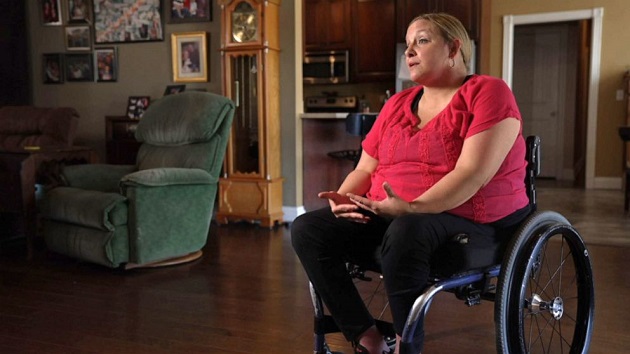
(NEW YORK) — Missy Jenkins Smith was a student at Heath High School in Paducah, Kentucky, in 1997 when a shooter opened fire, killing three of her classmates and injuring her and four others.
Last month, she testified in front of the Kentucky parole board about how the events 25 years ago continue to impact her today.
“I could speak for hours about what my life has been like every minute of every day for the last quarter century without the use of my legs,” she said during the hearing. Smith is paralyzed from the chest down and now relies on a wheelchair.
Watch “Impact x Nightline,” Disney’s ABC News Studios’ first weekly streaming news magazine, exclusively on Hulu. New episodes are available every Thursday.
Jenkins Smith’s testimony came as the board was considering whether to release shooter Michael Carneal on parole. Carneal, who told the parole board that he heard voices on the day of the 1997 shooting and also heard voices just a few days before appearing before the panel, was denied parole and will serve out his life sentence. He also said, “I’m sorry for what I did.”
The shooter, who was 14 years old at the time, has since received multiple mental health diagnoses. He would have been the first school shooter to be released on parole.
ABC News’ “Impact x Nightline” team spoke with survivors and families of the victims for the latest episode in the series.
The shooting was one of the first school shooting tragedies, preceding the shootings at Columbine High School, Newtown Elementary, Marjory Stoneman Douglas High School and, most recently, Robb Elementary in Uvalde, Texas.
Bill Bond, who was the high school principal at the time, remembered where he was when Carneal began shooting. “I’m sitting in my office,” he told ABC News. “And I hear, ‘Pow. Pow.'”
Bond left his office and entered the lobby of the high school, where he saw “one of my own students had a pistol in his hand,” he told ABC News. “Kids were running, and he was shooting. And they were falling.”
Bond confronted the shooter. “I was just moving slow, steady forward, so it didn’t panic him,” he said.
“And all of a sudden, he just looks at the pistol, and just lays it down,” Bond said. “And all he said was, ‘I’m sorry.’ And I wasn’t in a forgiving mood. All I said was, ‘Shut up.’ And that was all I said to him. ‘Shut up. Sit down.'”
Three mothers had to bury their children in the subsequent days, and an entire community was left to grieve.
“Almost 25 years later, I’m still hearing stories of Kayce’s acts of kindness,” said Sabrina Steger, who lost her daughter Kayce Steger in the shooting. “She’s just an amazing girl. I was lucky to be her mama.”
The victims were Nicole Hadley, Jessica James and Kayce Steger, ages 14, 17, and 15, respectively.
“The community healing as a whole, I don’t think it happened,” Kelly Hard Alsip, another one of the survivors of the shooting, told ABC News. “I think that it will always live inside us.”
“I’m very grateful for it,” survivor Christina Ellegood told ABC News, referring to the parole board decision. “But still very lost on how to feel and how to react to it.”
“We live. We thrive,” said Kelly Hard Alsip. “But it never leaves.”
(NEW YORK) — Eleven civil rights and democracy groups have sent a new letter calling for social media CEOs to combat and curb the rampant problem of election disinformation ahead of the upcoming midterm elections as advocates warn that they expect disinformation to increase as Election Day draws near.
Advocates have been calling on the social media giants to do more to combat disinformation for months. In May, 120 organizations called on the platforms to do more to combat disinformation and on Thursday, the 11 organizations that sent the letter to the CEOs of Meta (Facebook), Twitter, YouTube, Snap, Instagram, TikTok, and Alphabet claimed that “the platforms have simply rolled out essentially the same set of policies that led to the social media election disinformation disaster two years ago.”
The advocates wrote that the “disinformation narratives about voting procedures and policies continue to proliferate, including false information about the use and security of mail-in ballots, drop boxes, and ballot collection.” They added, “Preemptive false claims of fraud are now spreading before elections take place, and election workers are increasingly harassed online.”
This is not the first time advocates have been concerned about disinformation as several of the civil rights groups who signed onto the letter were vocal leading up to the 2020 election about concerns. The organizations wrote to the CEO’s “disinformation around the 2022 midterms is inextricably intertwined with disinformation from the 2020 presidential election, with bad actors recycling many of the false claims made just two years prior.”
Additionally, the advocacy groups called on the social media giants to focus and invest more in non-English disinformation. They noted in their letter, “all users should be able to use your platforms without being inundated by election disinformation regardless of the languages they speak.”
Meta told ABC News that they have invested in $5 million worth of fact-checking and media literacy initiatives ahead of the November midterms. They’ve partnered with Telemundo, TelevisaUnivision, and Reuters to launch fact-checking tip lines in Spanish on WhatsApp and now offer free media literacy courses on SMS and WhatsApp to help teach individuals to identify misinformation. The social media giant says they have built the largest global fact-checking network of any platform and have with more than 90 fact-checking partners globally.
Snap told ABC News that Snap doesn’t “allow unvetted content the opportunity to ‘go viral.’ Snap does not offer an open newsfeed where people or publishers can broadcast false information.” Ahead of the midterms, Snap says it has established an internal process for information-sharing and monitoring the effectiveness of its companies polices ensuring that they can calibrate their approach as needed.
Snap added that it will “help mitigate the risks of foreign interference in elections, we prohibit the purchase of political ads from outside the country in which the ad will run.”
ABC News reached out to Twitter, TikTok and Alphabet, who did not yet return request for comment.
(CHICAGO) — A fifth grade teacher has been arrested after telling one of her students that she had made a “kill list” of the students she taught and the colleagues she worked with.
At approximately 5 p.m. on Wednesday, officers from the East Chicago Police Department were dispatched to speak with the principal and assistant principal of St. Stanislaus School — located about 20 miles south of downtown Chicago — in reference to a threatening report that school officials had learned about earlier in the day regarding fifth grade teacher Angelica Carrasquillo-Torres, a 25-year old educator from Griffith, Illinois.
“At approximately 12:45 p.m. a 5th grade student told his/her Counselor that their 5th grade teacher made comments to him/her about killing herself, students, and staff at St. Stanislaus School,” East Chicago Police Department said in a statement released on social media. “The teacher further told the student that she has a list and that he/she was on the bottom of that list.”
School officials say the teacher was immediately escorted to the principal’s office to discuss the disturbing incident and subsequently admitted to them that she did actually make those statements to the student and also confirmed that she had a “kill list” as well.
“During the conversation the teacher named a specific student on her list, but did not provide the list,” authorities confirmed. “The Principal then advised the teacher to leave and not return to school pending an investigation.”
The East Chicago Police Department said that they were not notified by the school until approximately four hours after the incident and the teacher was freely allowed to leave the premises. However, once officers were notified, they immediately notified the Criminal Investigation Division who obtained an emergency detention order for the educator from the Lake County Prosecutors Office.
Carrasquillo-Torres was taken into custody by the East Chicago Police Department on Thursday at approximately 11:15 a.m. without incident.
It is unclear if Carrasquillo-Torres has obtained legal representation but the investigation is still ongoing and authorities say no further details about the case or statements regarding the incident will be made at this time.
(NEW YORK) — America’s graduating high school class of 2022 had the lowest average ACT score in more than 30 years, according to new data.
This year’s high school seniors who took the ACT, a standardized test used for college admissions in the United States, had a national average composite score of 19.8, compared to 20.3 for the class of 2021. It’s the first time since 1991 that the average ACT composite score was below 20, according to data released Wednesday by a nonprofit organization of the same name that administers the exam.
“This is the fifth consecutive year of declines in average scores, a worrisome trend that began long before the disruption of the COVID-19 pandemic, and has persisted,” ACT CEO Janet Godwin said in a statement.
What’s more, the data showed that only 22% of students among the 2022 graduating class met the benchmarks in all four main ACT test sections — english, math, reading and science — while 42% did not meet a single one. The benchmarks “demonstrate the minimum ACT scores required for students to have a higher probability of success in credit-bearing first-year college courses,” according to ACT. Last year, 25% of students met all four benchmarks while 38% of students met none.
The four ACT test sections are individually scored on a scale of 1 to 36, and a composite score — the rounded whole number average of the four sections– is provided.
“The magnitude of the declines this year is particularly alarming, as we see rapidly growing numbers of seniors leaving high school without meeting the college-readiness benchmark in any of the subjects we measure,” Godwin added. “These declines are not simply a byproduct of the pandemic. They are further evidence of longtime systemic failures that were exacerbated by the pandemic. A return to the pre-pandemic status quo would be insufficient and a disservice to students and educators. These systemic failures require sustained collective action and support for the academic recovery of high school students as an urgent national priority and imperative.”
However, more high school students are taking the ACT now than ever before — a trend that has been increasing since 2015, when only 27% of graduates had taken the test as part of a statewide or districtwide administration. For the class of 2022, 60% of students tested at least once through the program, which also enables lower-income students to participate when they wouldn’t have otherwise.
The data released included ACT score results from all 50 U.S. states as well as the District of Columbia. Sixteen of those states required all high school students to take the ACT as part of their statewide testing programs, while another seven states funded ACT testing on an optional basis.
The College Board, another nonprofit organization that administers standardized tests, has also noted a slight decline in scores for the SAT, which is widely used for college admissions in the U.S. According to data released in September, the average SAT total score for the graduating high school class of 2022 was 1050, compared to 1060 for the class of 2021.
Scores on the SAT range from 400 to 1600, combining test results from two main sections — math and evidence-based reading and writing — scored on a scale of 200 to 800.
(NEW YORK) — A juror in a trial connected to the 1996 disappearance of California college student Kristin Smart was excused Thursday after the judge learned he had discussed the case with his priest.
Smart, 19, a student at California Polytechnic State University, San Luis Obispo, went missing while walking home from a party.
Two separate juries started deliberating last week in the trials of Paul Flores, 45, and his father, Ruben Flores, 81, who were both arrested and charged last year in connection with her disappearance.
Paul Flores, a former classmate of Smart’s, was charged with murder, while his father was charged with being an accessory to the crime. Prosecutors say he helped hide Smart’s body on his property in Arroyo Grande before moving it in 2020.
Monterey County Superior Court Judge Jennifer O’Keefe excused the male juror from the trial of Ruben Flores Thursday afternoon after he had disclosed to another juror that he discussed his difficulties with making a decision during confession. The other juror then informed the judge in a note through the bailiff.
O’Keefe heard from both jurors on the record Thursday, starting with the since-excused juror, #262.
Juror #262 told the judge he had to “cleanse my body, that’s all,” and that he “did not discuss the facts of the case.”
“This case hasn’t been easy. It’s very hard. There’s lives at stake,” he told the judge, before being sent to the jury room.
O’Keefe then heard from the female juror, who reported that juror #262 told her he had told his priest he could only talk about the case inside confession — which indicated to her that he was discussing the case outside the courtroom.
The judge has reminded the jurors throughout the months-long trial that they cannot discuss the case with anybody, including spiritual advisers.
The judge brought juror #262 back to the courtroom and told him she had received information “that’s clearly opposite of what you’ve told us in court.”
She thanked him but explained that she needed to excuse him.
“Sometimes the appearance of impropriety is just as bad as actual impropriety. I need to protect the record,” O’Keefe said.
An alternate female juror was soon sworn in, and the jury was informed they need to begin their deliberations from the start.
Paul and Ruben Flores are being tried at the same time with separate juries hearing the case together. Once a verdict is reached by one jury, it will be sealed until the other jury reaches its verdict.
Both men have pleaded not guilty to their charges.
A judge earlier this year ordered that the Flores trials be moved out of San Luis Obispo County more than 100 miles away — north to Monterey County — to ensure fair legal proceedings.