

In SNAP appeal, Trump administration says it faces more harm than people who can’t buy food: ANALYSIS

In SNAP appeal, Trump administration says it faces more harm than people who can’t buy food: ANALYSIS
Pete Kiehart/Bloomberg via Getty Images

(NEW YORK) — There is a paragraph on page 22 of the Trump administration’s appeal of a federal judge’s requirement that it make full November SNAP payments that has to be seen to be believed.

The opening sentence asserts that “the district court’s order threatens significant and irreparable harm to the government which outweighs any claimed injury to plaintiffs.”

In plain English, the Justice Department is telling the court that it would hurt the federal government more to comply with a judge’s order requiring full food stamp payments than it would hurt millions of low-income Americans to potentially starve.

Let’s simplify this further: the government is arguing that once the money is spent, it can’t be unspent (and that would be horrible). But the hungry can’t eat tomorrow (and that’s not as bad). That is the contention.

In a 40-page filing to the 1st Circuit Court of Appeals, the administration insisted that being forced to spend money Congress has already appropriated is a graver injury than the hunger and disruption that would follow from withholding it. Friday night, the administration filed a nearly identical emergency stay request with the Supreme Court, and Justice Ketanji Brown Jackson issued a temporary pause that will remain in effect until the circuit court issues a judgment on the matter.

At stake is the Supplemental Nutrition Assistance Program—SNAP—which provides monthly benefits to roughly 42 million Americans. During the ongoing government shutdown, the U.S. Department of Agriculture (USDA) planned to fund only part of the November payments, prompting lawsuits from cities, religious groups, and nonprofits that argued that the administration was flouting its legal obligation to deliver full benefits. 

Twice, a Rhode Island federal judge, John J. McConnell Jr., agreed, ordering the government to draw on existing accounts to cover the gap. Twice, the administration appealed, contending that the judiciary had usurped Congress’s spending power by directing the executive branch to find the money.

The Justice Department’s latest emergency filing makes that claim in even starker terms. It asserts that McConnell’s injunction “makes a mockery of the separation of powers” and that there is “no lawful basis” for forcing the USDA “to somehow find $4 billion in the metaphorical couch cushions.” It also warns that by compelling compliance, the court has “thrust the Judiciary into the ongoing shutdown negotiations,” implying that judicial enforcement of basic statutory duties somehow exacerbates the fiscal standoff.

But what makes the filing remarkable is not just its tone—it’s the value judgment embedded in it. Traditionally, when courts decide whether to grant emergency relief, there is a calculus: the courts consider which outcome would cause greater damage, keeping the challenged policy on hold or letting it take effect? Here, the “policy” in question is the administration’s refusal to fully fund SNAP despite having ample reserves.

The Justice Department argues that the “irreparable harm” lies in being required to obey the court order and spend the money. By that logic, the government’s institutional discomfort outweighs the hunger of millions of families, seniors, veterans and children whose grocery money hangs in the balance.

Whether in disputes over public health, environmental regulation, or economic relief, the Trump administration’s lawyers have often equated executive prerogative with public interest—as though what benefits the administration necessarily benefits the nation. In this case, that conflation leads to the extraordinary claim that “the government” suffers greater harm by feeding people than by letting them go hungry.

The administration’s insistence that it “cannot” find the funds also rings hollow. By its own admission, the USDA controls multiple accounts with more than enough money to sustain SNAP for the month—including a $5 billion emergency reserve created by Congress specifically for that purpose. It has already drawn on similar pools of money to protect other nutrition programs from shutdown disruptions. The problem, in other words, is not fiscal incapacity but political choice.

The Justice Department’s appeal thus functions as both legal brief and ideological statement. It asks the courts to privilege administrative convenience over human need.

If that argument succeeds, the precedent would reach far beyond SNAP. It would signal that any time a court orders the government to meet a statutory duty—to pay benefits, deliver services, or enforce protections—the executive may claim “irreparable harm” merely because it prefers not to act. That is not separation of powers; it is the substitution of political preference for law.

Judge McConnell, for his part, put the matter bluntly: “This should never happen in America.” He was referring to the spectacle of a federal government choosing to let its citizens go hungry while pleading poverty amid abundant reserves.

The Justice Department’s legal arguments transform that spectacle into doctrine.

James Sample is an ABC News legal contributor and a constitutional law professor at Hofstra University. The views expressed in this story do not necessarily reflect those of ABC News or The Walt Disney Company.

Copyright © 2025, ABC Audio. All rights reserved.

3 shot dead at landscape supply company in San Antonio, suspect ‘down’

3 shot dead at landscape supply company in San Antonio, suspect ‘down’
mphotoi/Getty Images

(SAN ANTONIO) — Three people were shot dead at a landscape supply company in San Antonio, Texas, early Saturday, authorities said.

San Antonio Police Chief William McManus said on social media that the suspect is “down” with a “self-inflicted” wound.

McManus said at a news conference earlier on Saturday that “the people involved in this event are employees of that landscape supply company.”

“There may be others wounded, but we’re not sure,” McManus said.

The motive is not known, but the chief said it was not a random shooting.

McManus did not identify the victims killed, but said two were males and one was female.

Copyright © 2025, ABC Audio. All rights reserved.
Midwest, parts of northern New England could see 1st snow of the season

Midwest, parts of northern New England could see 1st snow of the season
ABC News

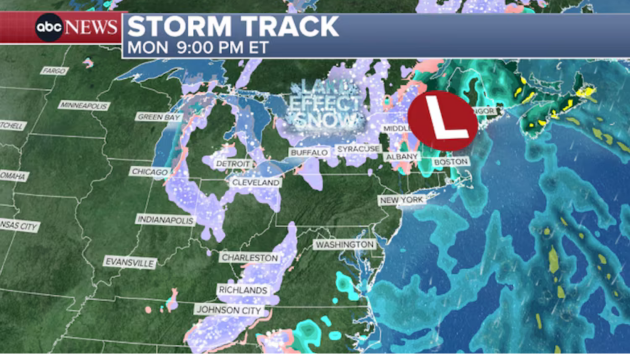
(NEW YORK) — Americans in parts of the Midwest to northern New England could see their first snow of the season early next week due to an arctic blast.

The very warm Great Lakes combined with arctic air will kickstart the lake-effect snow season late this weekend into the new workweek, but this will not be historic snowfall by any measure.

A Winter Storm Watch is in effect for Chicago and South Bend, Indiana, from late Sunday night through Monday afternoon for potentially heavy lake-effect snow. Snow rates exceeding 2 inches per hour, event snow totals up to 6 inches and over 35 mph wind gusts are possible.

While this snow will be very localized and most areas are not expected to see accumulating snow, this combination will likely produce slick and hazardous driving conditions during the morning commute and afternoon on Monday.

Winter Weather Advisories are currently in effect in parts of the Upper Peninsula and northern Wisconsin until Monday afternoon for lake-effect snow bringing between 2 to 5 of total snow and up to 8 inches in localized areas.

By Monday into Tuesday, the first lake-effect snow event will begin to set up in the eastern Great Lakes from Erie to Buffalo and possibly Syracuse.

Some areas off the lakes could see a few inches of snow, but it’s still too soon to know exactly how much will fall and where. Also, reiterating that this will not be historic lake-effect snow by any measure.

The interior Northeast from Appalachia to Pittsburgh up to northern New England could also see its first snow late Monday through Tuesday.

This snow will not stick around for long, as warming temperatures next week will quickly melt any snow that sticks to the ground with this quick blast of arctic air.

Copyright © 2025, ABC Audio. All rights reserved.

Body of missing Charleston college student is found, death ruled suicide: Police

Body of missing Charleston college student is found, death ruled suicide: Police
mphotoi/Getty Images

(CHARLESTON, S.C.) — The body of a missing College of Charleston student has been recovered over one week after he went missing, police said, and investigators have determined he died by suicide.

Owen Kinney, a 19-year-old from New Jersey, was found dead in the water near Patriots Point around 8:45 a.m. on Saturday, the Charleston Police Department said.

The teen was last seen by friends around 2 a.m. on Oct. 31 in an area near the college, police said. Detectives confirmed he walked alone onto the Ravenel Bridge pedestrian walkway shortly after 3 a.m., and his phone’s last recorded location was there around that time, police said.

Investigators determined Kinney died by suicide after going on the Ravenel Bridge pedestrian walkway at 3:49 a.m., police said.

“I would like to thank everyone who took part in the effort to get Owen back to his family,” Charleston Police Chief Chito Walker said in a statement on Saturday. “We hope this recovery brings some measure of closure to a family experiencing unimaginable loss.”

Police said earlier this week that they had concluded the teenager died by suicide and that the missing persons case was shifting to a recovery effort.

“There are no words that can ease the pain of losing someone so young and so full of promise,” College of Charleston President Andrew T. Hsu said in a statement on Saturday.

“Now is the time to surround his family with love, to support the friends and classmates who are grieving and to remind each other that no one in our campus family carries this weight alone,” Hsu said. “We have encouraged students who have been impacted to seek support through the Counseling Center, and faculty and staff may contact AllOne Health. These resources are free, confidential and available to all College of Charleston affiliates.”

If you or someone you know is struggling with thoughts of suicide — free, confidential help is available 24 hours a day, 7 days a week. Call or text the national lifeline at 988.

Copyright © 2025, ABC Audio. All rights reserved.

4 dead, 11 injured after speeding car crashes into business, pedestrians

4 dead, 11 injured after speeding car crashes into business, pedestrians
mbbirdy/Getty Images

(TAMPA, Fla.) — At least four are dead and 11 others were injured when a driver lost control of a vehicle while moving at a high speed, crashing into a business and hitting more than a dozen people in Tampa, Florida, police said.

The vehicle involved in the deadly crash has been previously observed street racing in Tampa, according to police.

There victims died at the scene and a fourth victim died at the hospital. One victim is in critical condition and eight others are in stable condition, being treated at other hospitals, police said. Two others were treated for minor injuries at the scene, police said. 

Silas Sampson, 22, was detained at the scene of the crash, according to police. 

The suspect was allegedly “driving recklessly” on I-275 before exiting the interstate at “a high rate of speed,” police said.

Air Service was monitoring the vehicle around 12:45 a.m. Police pursuing the car attempted an “unsuccessful PIT maneuver,” but the driver continued speeding. Shortly after, the driver crashed into the business, police said. 

“What happened this morning was a senseless tragedy, our hearts are with the loved ones of the victims and all those who were impacted,” Tampa Police Chief Lee Bercaw said in a statement.

“Reckless driving put innocent lives in danger. The Tampa Police Department and the Florida Highway Patrol are committed to seeking justice for the victims and their families,” Bercaw said.

Copyright © 2025, ABC Audio. All rights reserved.
Trump administration moves to dissolve ban on Abrego Garcia’s removal to deport him to Liberia

Trump administration moves to dissolve ban on Abrego Garcia’s removal to deport him to Liberia
Anna Moneymaker/Getty Images

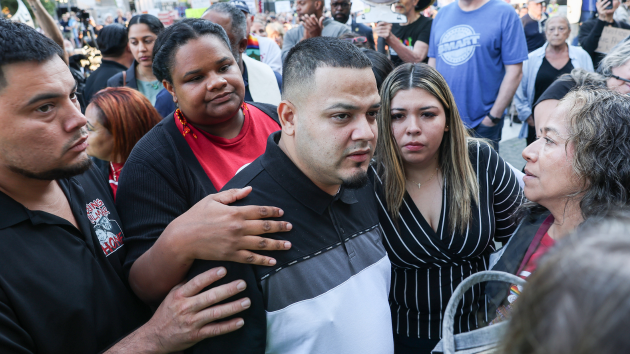
(NEW YORK) — The Trump administration has moved to dissolve the ban on Kilmar Abrego Garcia’s removal so that it can proceed with his deportation to Liberia.

In a series of filings overnight, government attorneys said that the Salvadoran native’s claim of fear of torture or persecution in the African nation was denied after he was interviewed by U.S. Citizenship and Immigration Services last week.

The attorneys for the Department of Justice argued that the preliminary injunction blocking Abrego Garcia’s removal to Liberia should be dissolved because the government received assurances from the government of the West African country that he will not be persecuted or tortured.

The government also said that Abrego Garcia’s lawsuit to stop his removal is improper because he is a member of a separate class action lawsuit in Massachusetts regarding third-country removals. In that case, the Supreme Court allowed the Trump administration to proceed with third-country removals.

“Even if the merits were properly presented here, Petitioner’s claims fail,” the DOJ said. “The Constitution does not entitle Petitioner to process beyond what the political branches have chosen to afford.”

Abrego Garcia, who had been living in Maryland with his wife and children, was deported in March to El Salvador’s CECOT mega-prison — despite a 2019 court order barring his deportation to that country due to fear of persecution.

He was brought back to the U.S. in June to face human smuggling charges in Tennessee, to which he has pleaded not guilty.

The DOJ called Abrego Garcia a member of MS-13 and said his removal is “in the public interest.”

On Friday, Abrego Garcia’s attorneys asked U.S. District  Judge Paula Xinis to block his removal to Liberia until an immigration judge reviews the denial of his reasonable fear claim by USCIS.

“The Government insists that the unreasoned determination of a single immigration officer—who concluded that Abrego Garcia failed to establish that it is “more likely than not” that he will be persecuted or tortured in Liberia— satisfies due process,” his attorneys said. “It does not.”

Abrego Garcia’s attorneys also said that the government has “cycled through” four third-country destinations—Uganda, Eswatini, Ghana, and now Liberia—without providing “the notice, opportunity to be heard and individualized assessment that due process requires.”

They argued that the government has disregarded their client’s “statutory designation” of Costa Rica, despite the country’s previous assurances that it would accept him and give him refugee or resident status.

Abrego Garcia is currently being held in a detention facility in Pennsylvania.

Copyright © 2025, ABC Audio. All rights reserved.
More than 700 flights nationwide canceled Saturday

More than 700 flights nationwide canceled Saturday
Justin Sullivan/Getty Images

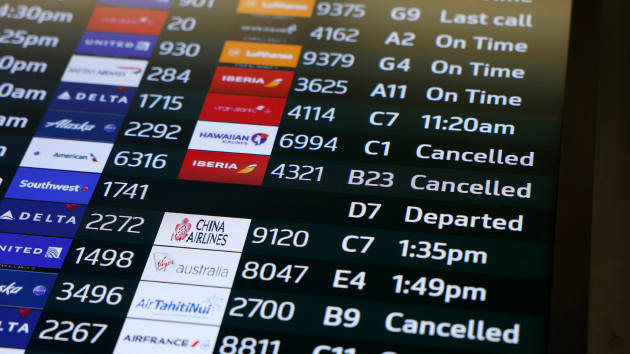
(NEW YORK) — More than 700 flights nationwide have been canceled Saturday as the Federal Aviation Administration continues limiting flight capacity at 40 major U.S. airports amid the government shutdown.

As of 6 a.m. ET on Saturday, 754 flights have already been canceled nationwide and the total could eclipse Friday’s toll of 1,024 cancellations.

However, despite more than 1,000 flights being canceled on Friday, major delays at airports across the country continue to persist due to staffing issues in air traffic controller towers and centers.

If the government shutdown continues, more air travel reductions could be on the way, Transportation Secretary Sean Duffy said in an interview on ABC News Live on Friday.

“My hope is that this government shutdown will end soon and we can get back in the business of letting Americans travel,” Duffy said in the interview.

It is possible the Department of Transportation may ask airlines to cancel more than 10% of their flights if controllers keep calling out in higher numbers, Duffy told ABC News.

Duffy said the FAA has asked private jets to avoid flying at the 40 airports impacted by the flight reductions, though they are currently not prohibited from flying there. He said private jet companies have been cooperative and are choosing alternate airports to help alleviate the pressure at those airports.

The cancellations are the latest — and perhaps biggest — disruption to air travel since the government shutdown began more than a month ago.

The FAA decided not to cut any international flights as it would be a violation of international agreements with the countries, according to Duffy.

“We have international agreements that we abide by, and because of those international agreements, I’m not going to impact those international flights. And because if I do, what will happen is we have other countries that are waiting to have a breach of those contracts from the US so they can cut down American flights, and then that would have a very long lasting impact on our ability to to to send travelers from the U.S. to those partners that have the agreements,” Duffy said.

Copyright © 2025, ABC Audio. All rights reserved.
Man dies after slipping and falling off edge of the Grand Canyon: Sheriff’s office

Man dies after slipping and falling off edge of the Grand Canyon: Sheriff’s office
Nico De Pasquale Photography/Getty Images

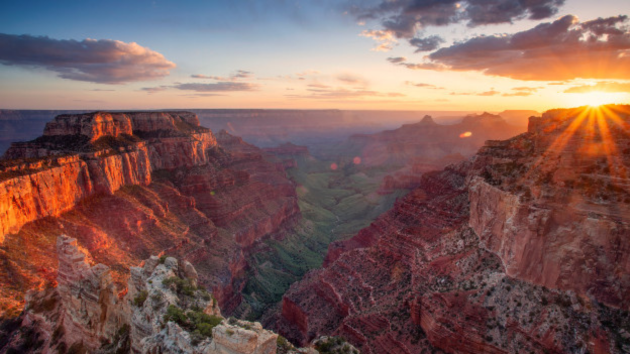
(GRAND CANYON, Ariz) — A 65-year-old man died after slipping off the edge of the Grand Canyon and falling more than 100 feet, authorities in Arizona said.

The incident occurred at Guano Point on the canyon’s western rim on the Hualapai Reservation, according to the Mohave County Sheriff’s Office.

The sheriff’s office said it responded to assist the Hualapai Nation in a technical recovery Thursday afternoon.

A search and rescue crew located the man approximately 130 feet down into the canyon on a pile of rock fragments, according to the sheriff’s office.

Technical rope technicians used ropes to recover the body, which was then transported to the Mohave County Medical Examiner’s Office, authorities said.

The Hualapai Nation Police Department, Hualapai Nation Fire and Grand Canyon West security also assisted in the recovery, the sheriff’s office said.

The name of the man was not released.

Guano Point is known for its dramatic viewpoints of the Grand Canyon from the western rim.

ABC News has reached out to Grand Canyon Resort Corporation, which manages the Grand Canyon West area, for comment.

Copyright © 2025, ABC Audio. All rights reserved.
Judge permanently blocks deployment of National Guard to Portland, saying Trump exceeded his authority

Judge permanently blocks deployment of National Guard to Portland, saying Trump exceeded his authority
Sean Bascom/Anadolu via Getty Images

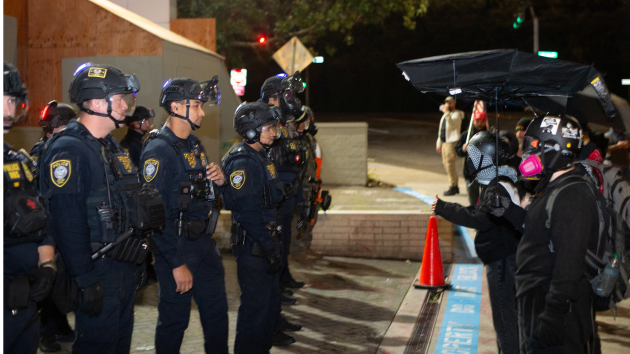
(PORTLAND, Ore.) — A federal judge ruled on Friday that Donald Trump “exceeded the President’s authority” when he sent federalized National Guard troops into Portland.

In a 106-decision, Trump-appointed U.S. District Judge Karin Immergut made permanent an order she issued last month blocking the deployment into the city.

“The evidence demonstrates that these deployments, which were objected to by Oregon’s governor and not requested by the federal officials in charge of protection of the ICE building, exceeded the president’s authority,” the judge wrote.

After a three-day trial, Immergut rejected the Trump administration’s argument that immigration-related protests amounted to rebellion or danger of a rebellion — the standard needed to justify a federal takeover of the National Guard.

“When considering these conditions that persisted for months before the President’s federalization of the National Guard, this Court concludes that even giving great deference to the President’s determination, the President did not have a lawful basis to federalize the National Guard” she wrote.

With Trump threatening to send the National Guard into Democratic-run cities across the country, Immergut acknowledged the magnitude of the issue in her order, writing the legal issue was bound for a higher court. 

“The ‘precise standard’ to demarcate the line past which conditions would satisfy the statutory standard to deploy the military in the streets of American cities is ultimately a question for a higher court to decide,” she wrote.

In late September, Trump issued an order federalizing 200 members of the Oregon National Guard to protect federal property amid ongoing protests at a Portland ICE facility, despite objections from local officials.

The city of Portland and state of Oregon sued.

Around the same time, Trump sought to deploy Guard troops to Chicago — a move that was similarly opposed by local officials and blocked by the courts.

Copyright © 2025, ABC Audio. All rights reserved.
Day care worker detained by immigration agents had valid work permit, temporarily barred from removal

Day care worker detained by immigration agents had valid work permit, temporarily barred from removal

(NEW YORK) — A federal judge has barred the Trump administration from removing Diana Patricia Santillana Galeano from the United States and transferring her to any federal jurisdiction outside of Illinois, Indiana and Wisconsin, court documents show.

Santillana, 38, was detained at a day care center in Chicago earlier this week. Judge Jeremy C. Daniel has scheduled a hearing in her case on Nov. 13.

Santillana is currently detained at an ICE facility in Clark County, Indiana, her attorney, Charlie Wysong, said in a statement.

Copyright © 2025, ABC Audio. All rights reserved.