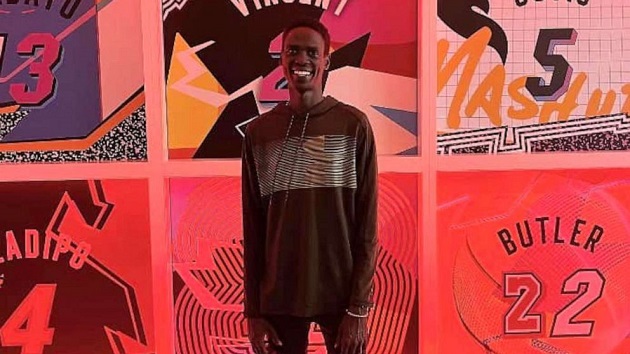
(DELRAY BEACH, Fla.) — A missing youth basketball coach in Florida was found dead nearly a week after police said he was last seen going for a run.
Makuach Yak, 31, was found dead Friday evening inside the Delray Oaks Natural Area, a park in Delray Beach, Florida, local authorities said.
“Right now, it appears his death is not criminal in nature,” the Delray Beach Police Department said in a social media post.
The medical examiner will determine Yak’s cause of death, and the investigation remains open, police said.
Yak, a youth basketball coach from Delray Beach, was supposed to coach on May 20 but was nowhere to be found, his friend and business partner, Tate VanRoekel, told ABC West Palm Beach affiliate WPBF.
Home security footage shared with WPBF recorded Yak in his front yard around 6:30 a.m. that day in a purple shirt and black shorts, the station reported.
VanRoekel told WPBF that Yak’s wallet, keys, cellphone and Apple Watch were “all on the counter, just sitting there.”
In the days since he was reported missing, friends and family have held search parties throughout Delray Beach, a city on Florida’s east coast located between West Palm Beach and Boca Raton.
Friends also spread the word through a Facebook group, Missing: Find Coach Yak.
“We ask that you pray for his family and all who loved him. We are devastated,” the group posted on Friday.
Yak, a native of South Sudan who was also known by the name Paul, coached youth basketball in the South Florida region. He competed in cross country at Augustana University in South Dakota and once had ambitions to compete in the Olympics, according to a 2018 Des Moines Register profile of the runner.
(NEW YORK) — Top teachers across the country say they face major hurdles in the classroom — including staffing shortages, the pinch of low pay and addressing students’ mental health — many of which stem from closures during the COVID-19 pandemic, a recent ABC News survey found.
“I think teachers are just the fabric of our communities,” Rebecka Peterson, the 2023 educator of the year, told ABC News earlier this year. “And I think we have to think of big and small ways that we can wrap our arms around teachers and remind them how important they are to us individually and to us as communities.”
For this story, ABC News solicited responses from each state teacher of the year winner to see what they viewed as the greatest current challenge facing educators.
Thirty-five out of the 55 teachers answered and the rest elected not to participate, according to a spokesperson for the Council of Chief State School Officers, which runs the state teacher of the year program.
The issues that the group highlighted include navigating advancements in technology, teaching larger class sizes and more.
The two most common answers were meeting students’ social, emotional and academic needs and solving the staffing shortage.
Despite emerging cultural flashpoints in the classroom like instruction on LGBTQ topics, book bans and the appropriateness of discussing critical race theory, the teachers instead pointed to student mental health, low pay and burnout as causes for concern.
Iowa’s teacher of the year, Krystal Colbert, described the latter as a “real” and “recognizable” crisis that deserves more attention.
Meeting students where they are
Nine respondents said what deserves the most attention is how to reach students who may be struggling amid broader emotional challenges, whether it’s what they called a youth mental health crisis or trauma brought on by the pandemic.
Maine’s Matt Bernstein believes it’s time to maximize this moment.
“Meeting the needs of all students is a responsibility that educators are proud to take on, but it is challenging and takes a lot of work, energy, and dedication,” Bernstein, a professional learning coach, wrote in the survey.
He and other educators stressed how cultivating relationships is also a solution for a problem they described as largely created by social isolation and distance learning when schools shuttered three years ago to limit the health risks of COVID-19.
“By building solid relationships and comprehensively investing in education, we have a better chance of ensuring that every student can achieve their full potential and contribute to the success of our society,” wrote Alabama fifth-grade teacher Reggie LeDon White.
Washington, D.C.’s Jermar Rountree, a health and physical education teacher and 2023 national finalist, explained that kids also need movement, which will help them handle their emotions.
“We as teachers need the support to be able to handle the traumatic experiences that our students are coming to school with,” Rountree wrote “Teachers are constantly swimming upstream to meet students where they are, but after the pandemic we do not even know where to begin. However, one place to start would be to prepare our new teachers on what to expect and how they can be severely helpful to our veteran teachers. Giving all teachers the tools to be successful increases the [professional] lifespan of a teacher 2 times over.”
Teachers have to accommodate students not only in their lessons but in all aspects of life, according to Stephane Camacho Concepcion, a Guam elementary school teacher.
“Educators have to be able to be counselors, social workers, and etc to ensure that they [children] have all they need to have a successful academic journey,” she wrote.
Recruiting and retaining teachers
According to experts, education departments, agencies and associations, 42 states and territories report ongoing shortages this school year.
Seven teacher of the year respondents — from rural Alaska to New Jersey — indicated they’re feeling that strain.
“Shortages have always been fairly normal, but the past few years have seen the shortages drastically increase,” wrote Alaska first-grade teacher Harlee Harvey, a 2023 national finalist. “This provides issues for several reasons. First, students are without highly qualified teachers in their classrooms, which will negatively impact the quality of instruction. Second, it puts an additional burden on teachers and paraeducators who have stayed, increasing the stress of their jobs and the likelihood that they will step away from our schools as well,” she added.
Arizona’s Ty White, who teaches high school chemistry, explained that the “massive” shortage is more pronounced in rural districts in the U.S., especially for aspiring educators.
“Since most university driven teaching programs are located in larger cities, many teachers aren’t familiar with rural communities to begin with,” White wrote. “When these new teachers start job searching and find rural job postings, they are often less attractive because in states with Local Education Agency control, salaries are not competitive with larger communities.”
In New Jersey, where state officials have said special education, science and math teachers are in high demand, Christine Girtain called for better funding practices that would help instructors earn more amid the shortage.
The National Education Association (NEA) found that teachers make thousands less than they did a decade ago when adjusted for inflation. The average salary of classroom teachers declined by an estimated 6.4% over the past decade, according to NEA data.
“Teachers should not have to work 2nd & 3rd jobs to afford to live,” Girtain, a high school science teacher and director of authentic science research, wrote. “We need larger nationwide investment in funding education and paying teachers a living wage.”
School safety
Two respondents included school safety in their answers to this survey. Still, recent fears of gun violence also has other teachers on edge.
Melissa Collins said learning loss was this nation’s greatest education challenge. But in the wake of the mass shooting at the Covenant School in Nashville, Tennessee, Collins said she hopes the massacre prompts legislators to pass more gun reform.
“I don’t have a hand to carry a gun,” the state’s teacher of the year told “Good Morning America” in March. “My hands are full because I am carrying our future leaders.”
Respecting the profession
Respect remains a major challenge facing public educators, too, the surveyed teachers said.
Rebecka Peterson, this year’s national teacher of the year, aims to use her platform to share positive messages about education. But recently she told ABC News that many teachers still feel they aren’t valued as much as they should be.
“What every teacher says when I ask them the recruit and retain [question], right, they come back to respecting and appreciating the profession,” Peterson said last month before being honored with a crystal apple at the White House.
Most teachers in Peterson’s cohort agree: The lack of appreciation is undeserving of the job.
“In any other profession, professionals are treated with respect and dignity,” Kentucky sixth-grade English Language Arts teacher Mandy Perez wrote in the ABC News survey. “We deserve to be treated with the same importance and value,” she wrote.
Tara Hughes believes respecting education could even improve working conditions for teachers. “Uplifting the education profession and retaining teachers will lead to smaller class sizes, resulting in higher student engagement, the ability to meet academic and social-emotional needs, and a decrease in teacher burnout,” Hughes, who teaches Pre-K in New Mexico, wrote.
Working with the community to respect and prioritize students’ needs is at the top of Missouri English teacher Christina Andrade Melly’s agenda.
“Public education is a public good – we have to respect it and invest in it for our students to thrive,” Melly wrote, adding, “All of us want our students to be successful, and we must remember how to work together towards that goal.”
(NEW YORK) — Board games like Monopoly, Clue and The Game of Life are iconic in many Americans’ lives and in pop culture. Now some designers are exploring a wider range of topics, including how to use games to spark discussion about bigger issues.
One of those games, Daybreak, is set to launch this spring after years of development to tackle one of the most complex topics of all, how to bring the world together to combat climate change.
“The game started from a conversation on what could we do about climate change as game designers,” game designer Matteo Menapace told ABC News. “We felt we can use games to talk about climate change, to model this big problem in a way that is playable, that is understandable by players and in a way that gives people agency over their choices.”
In Daybreak, players take on the role of world powers like the United States, European Union and China and have to negotiate ways to achieve drawdown, which is the point when greenhouse gas emissions are reduced enough to prevent temperatures from continuing to rise. Instead of playing against each other players work together to win against the game, but the whole group will lose if any player has too many communities in crisis from the impacts of climate change.
Designers Menapace and Matt Leacock, who also designed the game Pandemic, said they were overwhelmed by all the problems associated with climate change at first, but wanted to use their skills to help do something about it.
They said the game became a way for them, and they hope for players as well, to process their feelings about climate change and better understand the possible solutions.
“I think that just watching it kind of play out through the dynamics of the game made it also easier to kind of understand and get my arms around and feel better about. So it was a very positive thing for me to develop it. And I’m kind of hoping that people who play the game will have a similar experience,” Leacock said.
Board games surged in popularity in recent years, with a 33% increase in sales in the first year of the pandemic, according to market research firm Circana. Several independently designed games like Cascadia and Wingspan have taken on nature-related themes and have been recognized with multiple design awards.
But even with the gains in popularity, it actually isn’t the first time board games have been used to help players interact with or learn more about nature.
Sherri Sheu curated an exhibit at the Science History Institute in Philadelphia focused on environmental board games. Sheu’s work as a historian focuses on environmental history and she said there are clear parallels between what you see in games from decades like the 1960s and 70s and the conversation about environmental issues going on at the time.
“I think most people tend to think of board games as fun family entertainment. As things that we’re just we play on a Saturday night with our friends or we’re playing at home with our families and usually we’re thinking more about, more in terms of who’s cheating at Monopoly than we’re thinking about what we’re learning from these games,” Sheu said.
“But what we discovered is actually that game makers and game designers have just been fascinated by environmental issues and have made a lot of games about environmental issues over the last 50 years,” Sheu said.
She said some of those games, like Litterbug a children’s game that teaches about the consequences of littering or Clean Water, a game created after the passage of the Clean Water Act, came at a time in the 1970s when people were becoming a lot more politically engaged and aware of environmental issues.
“These board games really serve as a way of both harnessing this really strong energy that people are having about protecting the environment, that they want to get out there, that they want to do something about it, and also showing that these issues can often be quite complex,” she told ABC News.
Adam Procter, a professor at the University of Southampton’s Winchester School of Art who teaches game design, said he sees a similar energy in his students today who come to work with him because of his focus on using gameplay to tackle difficult topics.
Procter and his students helped test Daybreak. In those sessions, he said he noticed that even losing the game sparked conversations that relate to climate solutions in the real world.
“Afterwards, the conversation about what they think they should do better and that .. they want to play like almost straight away again, too, because they suddenly realize ‘oh okay, we need to collaborate on this. We should definitely have done more of that. I think we need to invest in this technology or these things’,” Procter told ABC News.
“And so the conversation after the game is really interesting because they certainly are having conversations about the climate crisis, which is not just, it’s not a topic you just want to bring up,” Procter said.
Leacock and Menapace said that despite the serious nature of the subject matter, the game had to be fun. And that in addition to providing a fun experience with friends and family, the game can help people navigate the anxiety and sense of overwhelm that’s often connected to climate change.
Leacock said the game provides a safe space to talk about climate-related topics and they also plan to include links to resources to learn about the real world equivalents of the scenarios in the game.
“You’re seeing that you can actually make a difference or that people, society can make a difference. So you’re less likely to be caught up in a feeling of doom and that can feel pretty empowering,” he said.
Daybreak will be shipped to people who pre-ordered it in June and is expected to be available online and in stores later this spring.
(WASHINGTON) — Two members of a climate activist group were arrested and charged Friday for allegedly defacing an art exhibit at the National Gallery of Art in Washington, D.C., during a protest last month.
Timothy Martin of North Carolina, and Joanna Smith of New York, both 53, surrendered to authorities after they were indicted on conspiracy to commit an offense against the United States and injury to a National Gallery of Art exhibit, according to the U.S. Attorney’s Office for the District of Columbia.
On April 27, the pair, members of climate activist group Declare Emergency, allegedly entered the gallery and threw red and black paint on the case of the Edgar Degas sculpture “Little Danger Aged Fourteen,” according to prosecutors.
The pair then sat in front of the defaced exhibit with the paint still on their hands and posed for photos, which were later posted on Declare Emergency’s site, investigators said.
“The conspiracy specifically targeted the Little Dancer based on her fragility,” the U.S. Attorney’s office said in a statement.
Prosecutors said Martin and Smith’s alleged actions caused approximately $2,400 in damage and the exhibit was removed from public display for 10 days so that it could be repaired.
Attorney information for the defendants wasn’t immediately available.
Other protesters who were involved in the museum defacing haven’t been named or charged.
If convicted, Martin and Smith face up to five years in prison and a fine of up to $250,000.
A few days before the museum incident, Declare Emergency shut down a section of the George Washington Memorial Parkway, causing heavy traffic jams around Washington, D.C.
Museums and art exhibits have become a growing target for climate activists around the world in the last couple of months.
In October, climate activists threw soup over Vincent van Gogh’s “Sunflowers” in London’s National Gallery to protest fossil fuel extraction.
In November, two climate activists were arrested after they tried to glue themselves to Edvard Munch’s “The Scream” in an Oslo, Norway, museum.
Later that month, protesters from threw a black oily liquid on Gustav Klimt’s painting “Tod und Leben” at the Leopold museum in Vienna, Austria, before gluing their hands to the frame.
ABC News’ Julia Jacobo contributed to this report.
(WASHINGTON) — The LSU Tigers women’s basketball team’s national championship celebration at the White House on Friday was marked by a scary moment when a player fainted during the event.
Sa’Myah Smith, a freshman forward, seemed to signal she was in distress before she collapsed. The event paused for several moments while medical staff attended to her,
Eventually, applause broke out when Smith was helped to a chair and wheeled out of the event. Later on, head coach Kim Mulkey assured the crowd she was alright and more embarrassed than anything.
“That’s not the first time that’s happened,” President Joe Biden said. “Not to her but to a lot of folks standing on that stage.”
Aside from the scare, the event also saw some mending of fences between team co-captain Angel Reese and Dr. Jill Biden.
The tiff began after the first lady suggested she would invite both LSU and the team it defeated to the White House. Reese called that a “joke” and suggested that she would not come to the White House before ultimately agreeing to attend.
Reese helped present jerseys to the Bidens and gave them hugs.
“Watching you was pure magic,” the first lady said of the team’s performance in the NCAA championship. “The way you pass, like you can read each other’s thoughts. The air crackling with the electricity of that connection. The crowd seemed to breath with one breath. Our hearts racing to the rhythm of each thump of the ball.”
“Every basket was pure joy, and I kept thinking about how far women’s sports have come,” she continued.
The president also gave Reese a shout out in his remarks, saying he “wasn’t surprised” when she was named the most outstanding player.
“You know, you made it more expensive for people to come. The cost of tickets went up 10 times. 10 times. And more than the men’s games,” Biden said to laughter.
Present at the event were two top debt ceiling negotiators and Louisiana natives: Rep. Garret Graves and Office of Budget and Management Director Shalanda Young. Both took a break from ongoing talks to commemorate the team.
“She’s now helping lead the critical budget talks we’re in the middle of now. But she said, ‘I’m not – I’m leaving the talks to be here,'” Biden said of Young in what was his only reference to the budget talks during the event.
The Tigers dominated the Iowa Hawkeyes to win their first basketball title in school history.
(NEW YORK) — The threat to Social Security payments posed by a debt ceiling impasse keeps Linda Stanberry, 76, dwelling on her worst fear: the loss of the home she has lived in for 48 years.
Stanberry, who depends entirely on about $1,800 she receives in federal benefits each month, said she hardly saves anything after expenses like food, utilities, prescription drugs and supplemental insurance for cancer coverage.
The federal government could fail to pay some of its bills as soon as June 1, Treasury Secretary Janet Yellen warned this week. If that shortfall interrupts Social Security, Stanberry would need emergency cash, she said.
“I would have nothing,” Stanberry, who lives in Southwest Virginia, told ABC News. “There’s no way I could keep my home.”
Stanberry is one of millions of low-income older Americans who rely on Social Security for almost the entirety of their funds. In all, roughly 1 in 7 Americans age 65 or older depend on the federal benefits for 90% or more of their income, Social Security Administration data shows.
If the U.S. fails to make Social Security payments next month, or even delays payments for a few days, low-income older people would face dire circumstances, foregoing basic necessities like food and medical care, experts and advocates told ABC News.
“For older adults living paycheck to paycheck, this debt ceiling process has been absolutely terrifying,” Ramsey Alwin, the president and CEO of nonprofit National Council on Aging, told ABC News. “Losing that check means they wouldn’t be able to put food on the table.”
A failure to make Social Security payments would hit some older Americans by next week.
The federal government is scheduled to make payments on June 1 to enrollees in a supplemental social security program for low-income older people with disabilities. The following day, a batch of Social Security payments totaling $25 billion is scheduled to go out to general recipients, targeting the most vulnerable such as older enrollees.
Additional payments are scheduled to go out on June 14, June 21 and June 28, each of which amounts to about $25 billion.
“This could be absolutely disastrous,” Peter Kempner, the legal director at New York City-based Peter Kempner Volunteers of Legal Service, who works closely with older adults in poverty, told ABC News.
Many low-income older people lack savings, leaving them especially vulnerable to a financial shock, he added.
“They live government paycheck to government paycheck,” Kempner said. “They don’t have reserves to float themselves for a couple months in case benefits are suspended because of what’s going on in Washington.”
As a debt default nears, House Speaker Kevin McCarthy told reporters on Friday that he remained confident that negotiators would soon strike a deal.
Negotiators “made progress” overnight, McCarthy said, declining to offer specifics of the potential agreement.
McCarthy is commiting to provide House members 72 hours to review the bill before bringing it to the floor for a vote, leaving little time for a deal to be ratified before a potential cash shortfall on June 1.
Even a delay in Social Security payments of a few days could put low-income older people in an agonizing position of prioritizing their little remaining spending between rent, food and transportation to medical appointments, experts and advocates told ABC News.
“Every single day that goes by makes a difference,” Cindy Cox-Roman, the president and CEO of advocacy group HelpAge USA, told ABC News.
Charles Turner, 74, relies solely on some $1,000 in Social Security that he receives each month, he said.
Since he suffers from a disability that limits his mobility and use of public transportation, Turner depends on rideshare services that cost as much as $25 each way to get to weekly doctor’s appointments and Tai Chi classes at a senior center, he said.
“It would be a challenge to just even go shopping for food and get to physical therapy appointments,” said Turner, who lives in Washington D.C.
Policymakers engaged in debt ceiling negotiations, he added, overlook these direct consequences for older people.
“They don’t see us,” Turner said. “We’re just lost in the lurch.”
ABC News’ Katherine Faulders, Gabe Ferris, Allison Pecorin and Alexandra Hutzler contributed reporting.
Rafael Henrique/SOPA Images/LightRocket via Getty Images
(NEW YORK) — A South Korean man faces 10 years in prison after he allegedly opened an emergency exit door while the plane was still in the air preparing to land.
The incident had flyers on Friday asking: How could that happen?
The aircraft landed safely at the Daegu airport, but officials said 12 people were taken to the hospital for respiratory issues.
The Asiana Airlines Airbus A321 was reportedly about 800 feet above the ground when the passenger opened the door.
Witnesses told local media other passengers tried to restrain the passenger.
Dramatic video shows extreme wind blowing passengers in the final moments of the flight.
Opening an aircraft door is impossible while the plane is at cruising altitude or above 10,000 feet due to air pressure.
However, as the plane gets lower, experts say it is possible for a door to open as the pressure outside equalizes with the pressure inside the plane.
“At cruising altitude there is enough pressure inside the cabin that it pushes the door against the hull of the airplane but, as the airplane descends, then the pressure begins to equalize. It is possible at very low altitudes as we’ve seen here for that door to be opened while the aircraft is still in flight,” ABC News contributor and former Marine Col. Steve Ganyard explained.
“The fact that this happened in very low altitude just prior to touch down means that everybody should have been belted in. Nobody was going to get sucked out of the airplane but the person who opened the door certainly was in danger of falling out,” he said.
The Asiana Airlines flight had 194 passengers and six crew members on board.
South Korean transportation officials say they are investigating exactly how the door opened.
Officials have not released a motive, but said the man did not appear to be intoxicated.
The domestic flight was traveling to Daegu from the resort island of Jeju.
(NEW YORK) — A South Carolina judge has granted abortion providers’ request to block a newly enacted six-week abortion ban while a legal challenge proceeds, Planned Parenthood South Atlantic confirmed to ABC News.
Planned Parenthood, one of the providers involved in the lawsuit, celebrated the decision on Twitter.
BREAKING NEWS: A South Carolina state court just granted abortion providers’ request to block the newly-enacted ban on abortion after about six weeks of pregnancy.
The ban was signed into law by Gov. Henry McMaster on Thursday after passing in the state Senate earlier this week.
The new ban prohibits all abortions after fetal cardiac activity is detected, which generally occurs at six weeks of pregnancy, with limited exceptions. Anyone who violates the ban is guilty of a felony and, upon conviction, must be fined $10,000, face prison time of up to two years or both.
Physicians or medical providers found guilty of performing illegal abortions will also have their licenses revoked.
The suit challenging the ban was filed by Planned Parenthood and Greenville Women’s Clinic. It claims the ban violates constitutional rights to privacy, equal protection and substantive due process.
“Today the court has granted our patients a welcome reprieve from this dangerous abortion ban. Our doors remain open, and we are here to provide compassionate and judgment-free health care to all South Carolinians. While we have a long fight ahead, we will not stop until our patients are again free to make their own decisions about their bodies and futures,” Jenny Black, the president and CEO of Planned Parenthood South Atlantic, said in a statement Friday.
McMaster had signed a previous so-called “heartbeat ban” into law in 2021, but it was struck down by the state’s Supreme Court in January.
Fifteen states have ceased nearly all abortion services since the U.S. Supreme Court overturned Roe v. Wade, ending federal protections for abortion rights.
The White House criticized the ban in a statement late Thursday. White House press secretary Karine Jean-Pierre said South Carolina’s “extreme and dangerous” ban on abortions past six weeks ” will criminalize health care providers and cause delays and denials of health and life-saving care.”
“South Carolina’s ban will cut off access to abortion for women in the state and those across the entire region for whom South Carolina is their closest option for care,” Jean-Pierre said.
(NEW YORK) — A Navy investigation found that the already tough selection course for Navy SEALs had become dangerous with lax oversight and medical care as course instructors pushed SEAL candidates to their physical limits, leaving some injured and hospitalized, and leading some to use performance enhancing drugs they believed would help them pass the course.
The Navy has committed to putting in place the investigation’s recommendations that followed earlier changes prompted by the investigation of the February, 2022 death of SEAL candidate Kyle Mullen.
The 24-year-old former Yale football team captain died just hours after having successfully completed the grueling “Hell Week” that is part of the Basic Underwater Demolition/SEAL course, known as BUD/S, that selects sailors to become elite SEALs.
His death triggered investigations into how he had died and a broad command investigation of the entire BUD/S program.
The report into Mullen’s death led to changes that included better oversight of course instructors, more thorough medical screenings for cardiac conditions, updated medical policies, and more authorization to screen for performance enhancing drugs.
The nearly 200-page command investigation released Thursday identified “failures across multiple systems that led to a number of candidates being at a high risk of serious injury,” Rear Adm. Peter Garvin, the commander of Naval Education and Training Command, wrote in a summary accompanying the report.
Garvin said the safety risk to SEAL candidates amounted to “a near perfect storm” that resulted from “inadequate oversight, insufficient risk assessment, poor medical command and control, and undetected performance enhancing drug use,” and “wholly inadequate” medical monitoring and care following Hell Week.
He also described “a degree of complacency and insufficient attentiveness to a wide range of important inputs meant to keep the students safe.”
Already a grueling course, the investigation found that in recent years the SEAL selection process had become dangerous with poor leadership and little medical oversight.
Inexperienced instructors focused on “weeding out” candidates and “hunting the back of the pack” instead of fostering teamwork that led to a significant increase in attrition rates from the course.
One commander urged instructors to keep pushing the SEAL candidates whom he described as having “less mental toughness” than previous generations.
The change in tone increased the risks for potential injury to SEAL candidates as the medical care available to them was insufficient and inadequate according to the report.
Garvin described the course’s medical care as “poorly organized, poorly integrated, and poorly led” a situation that “put candidates at significant risk.”
The investigation also found what Garvin described as “strong indicators” of the use of performance-enhancing drugs (PEDS) in BUD/S by some SEAL candidates who believed they could help improve their chances of making it through the course.
“Illicit PEDS use represents a significant hazard to candidate health, and is also contrary to the SEAL ethos and the Navy’s core values,” wrote Garvin who supports the investigation’s recommendations to put in place a “robust” and increased education program to eliminate its use.
The report also provided additional details about the circumstances surrounding Mullen’s death, noting that in his final medical check after completing the course his lungs were weak and his legs were so swollen that he was sent back to his barracks in a wheelchair.
Once back at the barracks, there were delays in getting Mullen the medical care he needed and by the time emergency medics arrived he was already “without a pulse,” the report said. He died shortly after having been taken to a hospital.
“We want to make sure people are getting adequate care and not being left to die on the ground,” T.J. Mullen, Kyle Mullen’s brother, told ABC News in an exclusive interview. “We just need medical to look at these guys, it’s utterly pathetic that they weren’t being taken care of.”
Based on the report’s conclusions, Garvin determined that “accountability actions are also necessary.” A Navy spokesman told ABC News that some Navy personnel could face “potential accountability actions.”
“From our perspective, many people were involved and many people tried to cover up committed wrongdoings and accountability has not come,” T.J. Mullen told ABC News.
“We’ve been waiting for a year and a half almost at this point since my brother passed, and no one has gotten in trouble,” he added.
Following the Navy investigation of Mullen’s deat, three Navy officers who oversaw the program received administrative “non-punitive” letters. Earlier this month, two of the officers who headed the program were pulled from their jobs two months ahead of schedule.
“In the case of the training death of Seaman Mullen, the investigation revealed a lack of leadership and medical oversight and support,” said Eric Oehlerich, an ABC News contributor and a former SEAL commander. “It’s tragic, but where required, accountability is occurring.”
“We will honor Seaman Mullen’s memory by ensuring that the legacy of our fallen teammate guides us towards the best training program possible for our future Navy SEALs,” said Rear Adm. Keith Davids, commander, Naval Special Warfare Command, in a statement.
(NASHVILLE, Tenn.) — A Tennessee judge’s unprecedented ruling granting parents the legal right to object to the release of police evidence in a Nashville school mass shooting case could produce a chilling effect on what law enforcement officials make public about violent crime in the future, experts told ABC News.
Davidson County Chancery Court Judge I’Ashea L. Myles ruled on Wednesday that the parents of students who were killed or traumatized by the March 27 massacre at the Covenant School have a legal standing to intervene on behalf of their children in lawsuits requesting evidence, including the shooter’s writings, be released to the public.
“There’s no roadmap on this,” Deborah Fisher, executive director of the Tennessee Coalition on Open Government, a nonprofit that advocates for transparency in government, told ABC News.
The Covenant School parents filed a motion to be heard in a now consolidated lawsuit filed against the Nashville Metropolitan Government by media companies, the Tennessee Firearms Association Inc. and a private investigator for the National Police Association to compel the police department’s release to the public evidence collected in an ongoing investigation of the school shooting that left three 9-year-old students and three adults, including the head of the school, dead.
An attorney for the parents said at a court hearing before Myles this week that the parents don’t want to see any of the police evidence ever made public, specifically the journals of the alleged shooter, 28-year-old Audrey Hale, who was killed by police.
Police have not commented on a motive for the attack.
Attorney Eric Osborne, who said he represents 100 families affected by the school shooting, said during Monday’s hearing that the parents fear the evidence, if made public, could inspire copycat attacks and add additional pain to the children who survived the rampage.
“We are grateful for the opportunity to enter this case on behalf of our children and loved ones,” Brent Leatherwood, a Covenant School parent who attended the Monday hearing, said in a statement to The New York Times. “Our intention is to safeguard our families and do all we can to prevent this horror from spreading to any other community.”
In their motion, the parents cited the Tennessee Crime Victims’ Bill of Rights which says victims “have the right to be free from harassment, intimidation, and abuse throughout the criminal justice system.”
“Let me be clear, what would create a slippery slope is if she (Myles) decides that victims have a right to prevent access to police records,” Fisher said. “I think we’re about to hear, according to what the lawyers said, testimony from witnesses that say why the writings of mass shooters should not be released.”
Myles has scheduled a June 8 “show cause” hearing for attorneys on both sides of the issue to make arguments.
Osborne said many of the Covenant School parents want to address the court on why they don’t want the records released. He also said he’d like to call expert witnesses to explain how such a release of information could leave the victims open to “harassment, intimidation, and abuse.”
In addition to the parents, Myles granted the Covenant Presbyterian Church and its school the right to intervene in the litigation.
During a hearing on Monday, lawyers for the church and school argued they don’t want the evidence seized in the investigation released because the material contains the school’s safety plan and other documents pertaining to health and social security records of school and church employees.
In her ruling, Myles wrote that “the court was stirred” by the argument that the public release of sensitive private documents could have “harmful and irreversible consequences.”
“We’re interested because we’re used to police being able to release things about crimes,” Fisher said. “We don’t know what will happen if victims could, basically, prevent the release of police information, any police information. If that were the case, the police’s hands will be tied on releasing information without the consent of the victim.”
Fisher noted that two days after the mass shooting, Metropolitan Nashville Police Department released body camera footage of police officers charging into the school and killing the shooter. Police officials also released surveillance camera footage of Hale firing an AR-15-style rifle through the school’s glass doors and stalking the hallways looking for victims to shoot.
“Even though it’s graphic and scary to see that, police released it and it made them look like heroes and they were. They really went into that situation, and you could see what police had to do,” Fisher said. “That video of the shooter going through the school, I don’t know what the parents think about that being released.”
John Lott, president of the Crime Prevention Research Center, a national gun rights advocacy group, told ABC News that it’s “incredibly unusual” that the Covenant School shooter’s writings haven’t already been released.
“To me, the important thing is to learn the motivation why the person picked the particular place they did to attack,” Lott said.
The Covenant parents’ motion to have a say in the release of the police evidence was filed two days after more than 60 members of the Tennessee House Republican Caucus signed a letter they sent to Chief John Drake of the Metropolitan Nashville Police Department, asking him to release Hale’s writings. The lawmakers wrote that Tennessee Gov. Bill Lee has called upon the General Assembly to hold a special session to consider public safety legislation in response to the shooting.
“In order for this special session to be successful, it is paramount we understand the behavior and motives of the Covenant School perpetrator,” the letter said.