Flanked by attorneys, former U.S. President Donald Trump appears in the courtroom for his arraignment proceeding at Manhattan Criminal Court on April 4, 2023, in New York City. (Photo by Seth Wenig-Pool/Getty Images)
(NEW YORK) — Former President Donald Trump is on trial in New York City, where he is facing felony charges related to a 2016 hush money payment to adult film actress Stormy Daniels. It marks the first time in history that a former U.S. president has been tried on criminal charges.
Trump last April pleaded not guilty to a 34-count indictment charging him with falsifying business records in connection with a hush money payment his then-attorney Michael Cohen made to Daniels in order to boost his electoral prospects in the 2016 presidential election.
Here’s how the news is developing. All times Eastern:
May 06, 10:48 AM McConney’s notes show Cohen’s repayment schedule
Former Trump Organization controller Jeff McConney’s handwritten notes from a conversation with then-Trump Organization CFO Allen Weisselberg memorialize a monthly reimbursement schedule to Michael Cohen that prosecutors allege was ultimately falsified to keep voters in the dark about the hush payment to Stormy Daniels.
“We were going to wire the funds monthly from Mr. Trump’s personal account,” McConney said.
Cohen was to be paid $35,000 each month for twelve months. “That was just math,” McConney said.
McConney calculated the monthly payment based the $130,000 wire to Keith Davidson, Daniels’ attorney, plus $50,000 to the IT consulting company Red Finch.
Cohen doubled the $180,000 total.
“Michael recorded $360,000 for tax purposes,” McConney said. There was an addition $60,000 to be paid as a bonus after “Michael was complaining his bonus wasn’t large enough.”
May 06, 10:34 AM McConney says Weisselberg told him about reimbursing Cohen
Former Trump Organization controller Jeffrey McConney testified about how he learned about the need to reimburse Michael Cohen in 2017.
“Allen [Weisselberg, the CFO] said, ‘We have to get some money to Michael — reimburse Michael,” McConney said. “He tossed a pad toward me and I started taking notes on what he said. That’s how I found out about it.”
McConney said that the money included Cohen’s bonus for the year and “some other money he was owed.” Prosecutors allege that the payment reimbursed Cohen in part for his $130,000 hush-money payment to Stormy Daniels ahead of the 2016 election.
Asked to describe Cohen’s role in the company, McConney responded, “He said he was a lawyer.”
May 06, 10:27 AM McConney says only Trump could sign personal checks
Former Trump Organization controller Jeffrey McConney testified that Donald Trump was the only one who could sign checks that were cut from his personal checking account.
“Who had signature authority for checks from the DJT account?,” he was asked.
“Just President Trump,” McConney responded.
But McConney also testified that in 2017 there were multiple individuals who could have signed checks that cut from the revocable trust, including Eric Trump and then-CFO Allan Weisselberg.
“For checks under $10,000 any of them [could sign],” McConney said. “Over $10,000 needed two signatures”
Eric Trump, who is seated in the first row, did not react when his name was repeatedly mentioned from the witness stand. He continued staring at the monitor to his left.
May 06, 10:21 AM McConney tells story of Trump saying, ‘You’re fired’
Trump once told McConney, “You’re fired” — but it was just a “teaching moment,” the former Trump Organization controller testified.
McConney shared an anecdote from early in his tenure at the Trump Organization, in the late 1980s — which might have foreshadowed the iconic catchphrase Trump later brandished on his reality TV show, The Apprentice.
“I would hand-deliver the [cash position] report to him once a week,” McConney explained.
On one of those occasions, McConney said he entered Trump’s office while Trump was on the phone. After he dropped off the report, McConney said he turned to leave. Trump asked whoever he was on the phone with to “hold on.”
“Jeff, you’re fired,” he said Trump told him, before turning back to his conversation on the phone.
McConney said he waited until Trump rang off. When he did, he said, “Jeff, you’re not fired. But my cash balances went down since last week.”
“It was a teaching moment,” McConney said. “Just because someone is asking for money, negotiate with ’em, talk to ’em — don’t just do it mindlessly.”
Trump, sitting at the defense table, appeared to flash a smile as McConney relayed the anecdote.
May 06, 10:08 AM McConney says he worked daily with CFO Allen Weisselberg
Prosecutor Matthew Colangelo began his questioning of former Trump Organization controller Jeffrey McConney, who is testifying under subpoena. McConney said the Trump Organization is paying for his attorneys in this matter.
McConney, who oversaw the company’s general ledger and managed the accounting department, told jurors that he directly reported to Allen Weisselberg, the former Trump Organization CFO, from “the day I was hired until the day he left.”
McConney told jurors that he interacted with Weisselberg on a daily basis.
“Other than having lunch everyday, whenever I needed to. His office was next to mine,” McConney said.
May 06, 9:53 AM DA calls ex-Trump Organization comptroller as next witness
Prosecutors have called as their next witness Jeffrey McConney, the former longtime controller at the Trump Organization.
McConney served as the Trump Organization’s controller for over 20 years before leaving the company with a $500,000 severance payment amid multiple criminal and civil investigations. He was among the Trump Organization executives who, along with Trump himself, was found liable earlier this year for committing a decade of business fraud.
Prosecutors have said he allegedly received and processed nearly a dozen fraudulent invoices from Michael Cohen to reimburse him for paying Stormy Daniels a $130,000 hush money payment just days ahead of the 2016 election.
May 06, 9:38 AM Judge again holds Trump in contempt, threatens jail time
Judge Juan Merchan has found former President Trump violated the limited gag in the case for a 10th time and has held him in contempt.
“I find you in criminal contempt for the 10th time,” Merchan said.
Merchan said that the $1,000 dollar fines per violation “are not serving as a deterrent” and threatened to jail Trump moving forward.
“Mr. Trump, last thing I want to do is put you in jail, you are the former president of the United States, and possibly the next president as well,” Merchan said, directly addressing Trump.
“At the end of the day I have a job to do,” Merchan said.
May 06, 9:30 AM Trump enters courtroom
Trump has entered the courtroom, carrying a stack of papers in his hand.
The former president is joined for the second time by his son Eric Trump, who is sitting in the front row of the gallery next to Trump lawyer Alina Habba, who is in court for the first time.
Prosecutors have also filed into the courtroom.
May 06, 7:36 AM 3rd week of testimony to begin
The third week of testimony in former President Trump’s criminal hush money trial gets underway this morning.
Jurors on Friday heard the completion of Hope Hicks’ testimony, as the former top Trump aide recounted the 2016 Trump campaign’s reaction to the release of the infamous “Access Hollywood” tape, and also said she felt it would have been out of character for Michael Cohen to have made the $130,000 Stormy Daniels hush money payment on his own.
The trial is scheduled to resume this morning with testimony from the prosecution’s next witness.
(NEW YORK) — Protests have broken out at colleges and universities across the country in connection with the war in Gaza.
Many pro-Palestinian protesters are calling for their colleges to divest of funds from Israeli military operations, while some Jewish students on the campuses have called the protests antisemitic and said they are scared for their safety.
The student protests — some of which have turned into around-the-clock encampments — have erupted throughout the nation following arrests and student removals at Columbia University in New York City. Students at schools including Yale University, New York University, Harvard University, University of Texas at Austin, University of Southern California and more have launched protests.
Here’s how the news is developing. All times Eastern:
May 06, 10:28 AM Emory to move commencement ceremony off campus
Emory University in Atlanta announced Monday they will be moving commencement activities off campus, citing “concerns about safety and security.”
“Please know that this decision was not taken lightly. It was made in close consultation with the Emory Police Department, security advisors, and other agencies — each of which advised against holding Commencement events on our campuses,” Emory President Gregory Fenves wrote in a message to the university.
The commencement ceremonies will now be held in Duluth, about a half hour from campus, the university said.
On April 25, there were 28 people arrested, including 20 affiliated with Emory University, during a protest on campus, according to the school.
-ABC News’ Ahmad Hemingway
May 06, 9:08 AM Columbia will not hold campuswide commencement
Columbia University announced Monday it will not hold a campuswide commencement ceremony on May 15 as originally scheduled.
Columbia will focus on the smaller, school-based ceremonies instead based on “input and feedback from student leaders,” the school said.
“Our students emphasized that these smaller-scale, school-based celebrations are most meaningful to them and their families,” the school said in a statement. “They are eager to cross the stage to applause and family pride and hear from their school’s invited guest speakers.”
The smaller school ceremonies will begin on Friday. Columbia said it may hold “a festive event” on May 15 instead.
One of the reasons Columbia said it had called in the New York Police Department last Tuesday was in order to make room for the schoolwide ceremony in the same location as the encampment.
May 05, 4:24 PM UCLA chancellor announces changes to boost campus safety
UCLA Chancellor Gene Block announced Sunday that the university is taking several immediate steps to increase campus safety following protests that prompted the closure of the school last week.
Block said the newly created Office of Campus Safety will oversee the management of the UCLA Police Department and the Office of Emergency Management. The administrative vice chancellor was previously in charge of the agencies.
Rick Braziel, the former Sacramento chief of police, will head the new Office of Campus Safety, Block said. Braziel will report directly to Block.
Additionally, Block said he has created a formal advisory group of safety experts who will partner with Braziel, including U.C. Davis Police Chief Joh Farrow; Vickie Mays, professor of psychology and health policy and management at UCLA, and Jody Stiger, the U.C. Office of the President systemwide director of community safety.
“In the past week, our campus has been shaken by events that have disturbed this sense of safety and strained trust within our community,” Block said in a statement Sunday. “In light of this, both UCLA and the UC Office of the President have committed to a thorough investigation of our security processes. But one thing is already clear: To best protect our community moving forward, urgent changes are needed in how we administer safety operations.”
-ABC News’ Izzy Alvarez
May 05, 3:34 PM Classes set to resume Monday at UCLA
Classes are scheduled to resume Monday at UCLA after the campus was closed due to protests that broke out last week, officials said Sunday.
The school announced that employees are expected to resume work on Monday and faculty are “encouraged to resume in-person instruction as soon as possible.”
Some instructors are being given the option of conducting courses remotely at their discretion through May 10 “without the need for departmental authorization.
“A law enforcement presence continues to be stationed around campus to help promote safety,” school officials said in a statement.
-ABC News’ Tristan Maglunog
May 05, 3:13 PM USC campus reopens after tent encampment dismantled
The University of Southern California’s University Park campus has reopened Sunday after a pro-Palestinian tent encampment was cleared out and dismantled, the university said.
All students, faculty and staff must present valid identification, USC said.
May 05, 11:03 AM New York City mayor defends NYPD’s handling of college protests
New York City Mayor Eric Adams on Sunday defended the police crackdown on college campus protests that have broken out in America’s largest city.
“When those protests reach the point of violence, we have to ensure that we use a minimum amount of force to terminate what is perceived to be a threat,” ” Adams told ABC News “This Week” co-anchor Jonathan Karl.
Adams added that the police intervention resulted from days of communication between the police and school officials.
“We knew we had to get permission unless there’s imminent threat to life, or severe threat to property,” he said, adding, “We were not going to overstep our legal authority.”
When pressed by Karl about criticism, including from some other Democrats, that the response to protesters was disproportionate given that they were largely nonviolent, Adams said, “One has the right to have his or her opinion, and I respect that. … And I have an obligation and responsibility to ensure the city is safe.”
-ABC News’ Kristina Abovyan
May 05, 10:39 AM No arrests made in clearing of USC protest encampment: Official
A pro-Palestinian tent encampment on the University of Southern California campus was cleared out and dismantled Sunday morning without any arrests being made, university officials said.
Joel Curran, a spokesperson for USC, said in a statement that the encampment, established by protesters 12 days ago, was “peacefully” taken down.
“Earlier today, the University of Southern California Department of Public Safety (DPS) successfully removed the illegal encampment rebuilt on the university’s campus. It was necessary to request the Los Angeles Police Department to respond to provide security as this was carried out peacefully,” Curran said. “No arrests have been reported. We want to thank LAPD for assisting DPS in clearing the encampment and restoring normalcy for students and community as quickly and safely as possible. We will share more information with our community later today.”
-ABC News’ Tristan Maglunog
May 05, 9:52 AM USC says encampment has been cleared
The University of Southern California said the encampment at University Park Campus has been cleared and the campus remains closed.
May 05, 9:21 AM USC protest encampment being cleared: Police
A pro-Palestinian encampment on the campus of the University of Southern California was being cleared Sunday morning as campus police warned protesters to leave or be arrested.
The announcement came as the USC Department of Public Safety closed the campus “as a result of significant activity at the center of campus.”
“If you are in the center of campus, please leave. People who don’t leave will be arrested. We will issue another alert when it is clear to return,” the DPS said on X.
The campus police said officers from the Los Angeles Police Department are assisting in “clearing the center” of the University Park Campus.
Sunday’s action came after USC President Carol Folt sent an email to the school’s community, saying “steps would be taken to ensure a quiet and safe environment for students to complete their finals.”
“[L]et me be absolutely clear: free speech and assembly do not include the right to obstruct equal access to campus, damage property, or foment harassment, violence, and threats,” Folt said. “Nor is anyone entitled to obstruct the normal functions of our university, including commencement.”
-ABC News’ Cory Peeler
May 04, 11:50 PM 25 arrested at University of Virginia after police clash with protesters
Authorities arrested 25 protesters at the University of Virginia for trespassing on Saturday, according to the university’s communications office.
The school said it was still awaiting confirmation on how many of those arrested were affiliated with UVA.
May 04, 10:52 PM Dozens of protesters arrested at Art Institute of Chicago
Approximately 50 people were arrested, including some students, at The Art Institute of Chicago on Saturday, according to a spokesperson from the museum.
“Today, a group of individuals, including some SAIC students, began a protest in the museum’s North Garden, and as it progressed, protesters surrounded and shoved a security officer and stole their keys to the museum, blocked emergency exits, and barricaded gates,” the statement read.
Protesters were offered an alternative location to continue the protest on campus, but they did not accept that offer, according to the spokesperson.
“During multiple rounds of negotiations, SAIC student protesters were promised amnesty from academic sanction and trespassing charges if they agreed to relocate. The School also agreed to meet with a student group to discuss their demands. After approximately five hours, an agreement could not be reached.”
Chicago Police Department assisted with ending the protests and arresting individuals, the museum spokesperson said.
May 04, 7:17 PM University of Virginia president calls removal of protesters ‘upsetting, frightening and sad’
The president of the University of Virginia, Jim Ryan, released a statement Saturday on the removal of protesters from the encampment on campus.
Ryan said that up until Friday, the demonstrations on campus had remained peaceful and “complied with requests to adhere to University policies including a long-standing prohibition on erecting tents absent a permit.”
However, Ryan said protesters were given a “final warning” on Saturday morning that “was ignored” and the university’s police department officers “were met with physical confrontation and attempted assault.”
Virginia State Police were called to clear the encampment after it was deemed an “unlawful” assembly, according to the president.
“I recognize and respect that some will disagree with our decisions,” Ryan said in the statement. “This entire episode was upsetting, frightening and sad.”
May 04, 3:15 PM Police appear to prepare to empty University of Virginia encampment
The University of Virginia alerted students to avoid the chapel area of the school’s Charlottesville campus — where protesters have set up an encampment — for police activity.
Around 40 police officers from multiple police agencies are on campus to potentially clear pro-Palestinian protesters, according to the student paper, the Cavalier Daily.
Albemarle County Police and Virginia State Police arrived with riot gear to support Charlottesville Police and University Police, according to an affiliate reporter.
May 03, 10:15 PM UCLA classes to resume on Monday
The University of California Los Angeles announced classes are “expected to resume in full on Monday,” in an update Friday evening.
“Campus operations will be limited through the weekend, and are expected to resume in full on Monday. Classes continue remote through the weekend. Work, events and research activities are encouraged to remain remote or be rescheduled wherever possible during that period,” UCLA said in a statement.
A law enforcement presence will continue “to be stationed around campus to help promote safety,” the university said.
May 03, 6:09 PM NYU president explains use of NYPD to end encampment
Linda G. Mills, the president of NYU, posted a statement Friday evening explaining why the school called in the NYPD to break up an encampment on the Greene St. Walkway earlier in the day.
Mills said 14 people who refused orders to leave the area were arrested and the incident was non-violent.
The president said that the police were called in for numerous reasons, including noise complaints from nearby residents and businesses, safety concerns over the crowds of supporters and counter-protesters and escalating threats.
“The encampment had become increasingly untenable for the NYU community and the neighborhood we inhabit,” she said.
Mills said three senior administrators spoke with the protesters over the weekend to come to an agreement over shutting down the encampment.
The president said things escalated on Wednesday when a group of people from a May Day march came to the walkway and got into altercations.
The May Day incident and other issues, including threats leveled at NYU administrators, led the school to call the NYPD, according to Mills.
“The university’s senior leadership and I were compelled to conclude that we could not tolerate the risk of violence any longer and that we could not responsibly or in good conscience wait until something drastically worse were to happen in order to act. We needed to bring this to a close,” she said.
May 03, 2:44 PM University of Mississippi protest confrontation draws scrutiny
Footage from the University of Mississippi campus captures intense confrontations between pro-Palestinian protesters and counter-protesters.
The dozens of pro-Palestinian protesters gathered on the campus to call for divestment from military operations in Gaza and for the university to condemn what they call “genocide.”
Footage shows a much larger counter-protest surrounding the students, with many donning American flags.
Protesters reported being subject to racism and violent threats and having food thrown at them by counter-protesters.
In one video, a Black protester can be seen recording and speaking to counter-protesters, moving past the protective barricades around pro-Palestinian protesters.
Law enforcement officers can be seen urging her to walk back as counter-demonstrators taunt her, including on student making a monkey impersonation and others chanting “lock her up,” according to the Stacey Spiehler, who took the video.
Law enforcement also urged counter-protesters to stand back.
Jacob Batte, Ole Miss’ director of news and media relations, told ABC News they “cannot comment specifically about that video,” but that “statements were made at the demonstration on our campus Thursday that were offensive and inappropriate.”
The university said it is looking into reports about specific actions and “any actions that violate university policy will be met with appropriate action.”
In a statement following the confrontations, protesters said they were met with “blind reactionism that had little to do with the genocide we were protesting as well as our demands.”
-ABC News’ Chris Looft and Kiara Alfonseca
May 03, 12:32 PM NYPD sergeant accidentally discharged gun during Columbia building operation
An officer accidentally discharged his gun as the New York Police Department worked to clear Hamilton Hall — a building that had been occupied by Columbia University students on April 30, Assistant Chief Carlos Valdez, the commanding officer of the NYPD Emergency Service Unit, said Friday.
During the operation, a sergeant unintentionally discharged his firearm while attempting to gain access to an office.
“The sergeant was transitioning his firearm to his non-dominant hand to unlock the office door from the inside when the discharge occurred,” Valdez said.
There were no injuries and the bullet was contained within the vacant office. Valdes said that at no point were police officers, members of the public or protesters in danger.
“This was purely unintentional,” he said.
May 03, 12:03 PM New York University, New School explain decision to remove, arrest students
New York University and New School, in separate statements, said they requested police move students from their campuses after multiple rounds of negotiations failed.
NYU said the “encampment had become increasingly untenable for the NYU community and the neighborhood we inhabit.” Classes will proceed as normal today.
NYU said it is aware of calls for a 4 p.m. protest at the former site of the encampment.
The New School, which switched to remote learning Friday, said students continued to set up in the lobby of the University Center building and block access to the “residence hall, classrooms, library, and cafeteria.”
Despite the university “pleading to allow their fellow students to enter their residence hall, the protesters would not budge.”
The New School said the protests continued even after they “provided a confirmed date this month for the Investment Committee to consider a vote on disinvestment.”
“It is a sad day for all of us who are part of this university community and who believe in free speech, which we have pledged to protect and will continue to protect,” The New School said in a statement.
May 03, 8:49 AM 56 people arrested at New School, NYU
Fifty-six people have been arrested at The New School and New York University after the schools authorized police to clear encampments, according to the New York Police Department.
Forty-three people were arrested at The New School and 13 people where arrested at NYU, the NYPD said.
-ABC News’ Aaron Katersky
May 03, 6:48 AM NYU has authorized NYPD to clear encampment
NYU has requested assistance from the NYPD to “disperse the illegal encampment on their property.”
“As per their request, we are on site and our officers will be assisting with the unparalleled professionalism embodied by our police officers,” NYPD Deputy Commissioner, Operations Kaz Daughtry, said in a statement on social media.
May 03, 2:07 AM 30 arrested at Portland State University throughout the day: Police
Portland police say that at least 30 people have been arrested over their involvement in ongoing protests at Portland State University.
“Additional arrests have been made at PSU’s library after trespassers illegally entered the building again despite efforts to secure it,” police said in their statement. “Preliminary count is 30 arrests over the course of the day. Officers will continue to monitor for criminal activity and will make arrests when lawful and appropriate.”
Authorities say that officers encountered acts of vandalism, and one suspect deployed a fire extinguisher at an officer during an altercation.
“Seven officers suffered injuries, the most serious was a knee injury that required ambulance transport to the hospital. Other injuries are still being assessed or were minor,” Portland police said.
The identities of those arrested will be released once a full list has been completed.
May 03, 1:55 AM USC says arrested student protesters will be referred to ‘disciplinary process’
USC has sent an email to the arrested protesters on Thursday evening warning that any student protesters who have been arrested for their “alleged conduct” of criminal trespassing on April 24 will be “referred to the University’s disciplinary process.”
“Please be aware that any further violation of university policies – including but not limited to the university’s policies against camping, amplified sound, defying DPS directives, vandalism, harassments, bullying, and theft of property – will result in further discipline up to expulsion as well as an immediate ban from campus,” the email obtained by ABC News said.
May 02, 11:22 PM 7 additional protesters arrested at Portland State University: Police
The Portland Police Bureau announced seven additional arrests were made Thursday evening amid ongoing protests at Portland State University.
The seven arrests came a couple of hours after PPB announced 22 people had been arrested on Thursday, bringing the total to 29 people arrested on Thursday.
PPB said the seven arrests were from “trespassers” breaking “back into the library” by pulling the fence down.
“Arrests have also been made for people refusing to leave the park block at the library,” the bureau said in an update on X late Thursday evening.
May 02, 1:03 PM Photos show the aftermath of police clearing encampment at UCLA
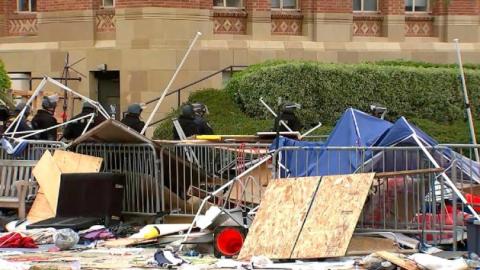
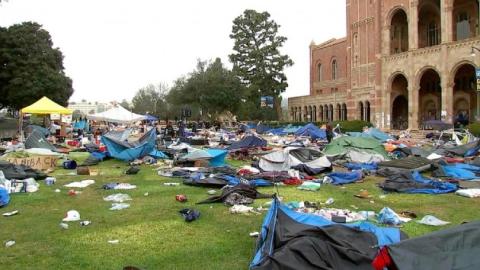
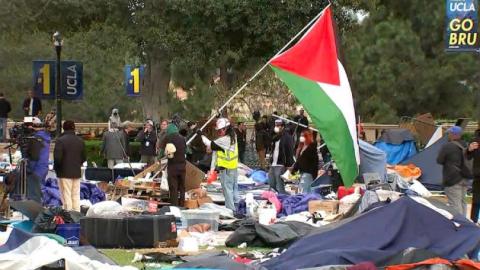
Photos taken Thursday show the aftermath of police clearing a pro-Palestinian encampment at UCLA where at least 132 people were arrested.
Image
Image
Image
May 02, 12:52 PM 2 arrests made as police empty library occupied by Portland State University protesters
Portland police have arrested two people outside the Portland State University campus library, as they move to clear the building, which was occupied by protesters. Police said they encountered “barricades” as they entered the building.
Individuals remaining in the building are under arrest for second-degree trespassing, police announced Thursday. The area surrounding the library has been closed off.
Police also warned that anyone resisting arrest could have force used against them and be subject to more criminal charges.
May 02, 11:34 AM Biden says free speech and rule of law ‘must be upheld’
President Joe Biden addressed the nation on Thursday saying that free speech and the rule of law must both be upheld.
“We are not an authoritarian nation where we silence people or squash dissent, the American people are heard. In fact, peaceful protest is the best tradition of how Americans respond to controversial issues,” Biden said, speaking from the White House.
But, he condemned the destruction of property, shutting down campuses and forcing the cancelation of classes and graduation, saying it isn’t peaceful protest.
“Dissent is essential to democracy, but dissent must never lead to disorder or to denying the rights of others so students can finish the semester and their college education,” Biden said.
Biden last commented on college protests on April 22 — before there was an escalation of suspension and arrests at campuses across the country — at the time condemning antisemitic actions and those who don’t understand the plight of Palestinians in Gaza, a message he reiterated Thursday.
“There is no place for hate speech or violence of any kind whether it’s anti-Semitism, islamophobia or discrimination against Arab Americans or Palestinian Americans. It’s simply wrong. There’s no place for racism in America,” Biden said.
May 02, 11:22 AM Biden says protests have not pushed him to reconsider policies
President Joe Biden, making his first remarks on the surge in protests on college campuses, said the protests have not pushed him to reconsider his policies in the region.
“Mr. President, have the protests forced you to reconsider our policies?” a reporter asked Biden Thursday.
“No,” Biden said, before walking away from the podium.
May 02, 10:53 AM At least 132 arrested at UCLA protests
At least 132 people were arrested on Thursday in protests at UCLA according to California Highway Patrol.
May 02, 10:32 AM More than 70% of Columbia protesters arrested Tuesday were affiliated with university: NYPD
Thirty-two of the people arrested at Columbia University on Tuesday were not affiliated with the school, while 80 people were affiliated, based on a preliminary background analysis by the New York Police Department.
At City College of New York, 102 people arrested Tuesday night were not affiliated with the university, while 68 people were affiliated, based on the NYPD analysis.
-ABC News’ Aaron Katersky
May 02, 10:23 AM University of Minnesota strikes agreement to end encampment
The University of Minnesota has reached an agreement to end the student-led encampment on campus.
The university will reopen previously closed buildings and the student coalition has pledged not to organize disruptions during final exams and the commencement ceremony.
Representatives of the student coalition will be given the opportunity to address the Board of Regents at its May 10 meeting over its call for a divestment, students will receive amnesty for their encampment, and the university will also explore an affiliation with Palestinian universities, hosting scholars at risk.
“Our meetings have been grounded in listening, learning, and respect, and I believe they were a very positive first step in reaching mutual understanding. Though the original meeting was scheduled for 30 minutes yesterday, we engaged in constructive conversation for more than 90 minutes. We then met two more times to discuss the proposed agreements,” University of Minnesota interim President Jeff Ettinger said in a statement.
“We regret that these meetings did not happen sooner, and have committed to regular meetings moving forward to continue to discuss this coalition’s concerns,” Ettinger said.
Ettinger also highlighted that the university supports freedom of expression as a fundamental part of its mission.
“While we do not condone tactics that are outside of our policies, we appreciate student leaders’ willingness to engage in dialogue. I value the challenging and healthy conversations we’ve had,” Ettinger said
May 02, 7:33 AM Police begin arresting UCLA protesters
Officers began arresting protesters on the University of California Los Angeles campus early Thursday, detaining some with their hands zip-tied behind their backs.
Those who were detained appeared to have been moving willingly with officers, ABC News station KABC-TV reported.
As law enforcement moved into the encampment, some of the protesters began chanting, repeating the phrase “Shame on you” in chorus.
May 02, 6:50 AM UCLA issues evacuation order as police confront protesters
UCLA officials issued an evacuation order for all protesters in the area of Royce Quad, saying the encampment was “unlawful.”
Smoke billowed around law enforcement officials as they began breaking through the barricades on the campus encampment. It was not immediately clear whether the smoke had been dispersed by the police or the protesters.
The encampment in Dickson Plaza, along with all unauthorized tents and structures, had been declared “unlawful,” campus public safety officials said in an alert.
“The University requires that everyone must leave the encampment and adjacent areas, as well as all unauthorized structures and tents immediately, until further notice,” the alert said.
May 02, 6:24 AM Highway Patrol officers in riot gear enter UCLA campus
California Highway Patrol officers in riot gear streamed early Thursday onto the University of California Los Angeles campus.
The officers were met by a wall of protesters, who appeared unwilling to move. Officials had earlier ordered protesters to abandon their encampment.
Officers were working to tear down barricades of plywood boards that been erected along some of the edges of that encampment.
Los Angeles Police Department officers had earlier retreated from the encampment. At one point, LAPD and protesters briefly scuffled as officers made their way out of the encampment.
May 02, 5:37 AM 90 arrested at Dartmouth protest, police say
At least 90 people were arrested Wednesday during a protest on the campus of Dartmouth University, local police said.
The people who were arrested included both students and non-students, Hanover Police Department said in a statement released Thursday. Charges included criminal trespass and resisting arrest, police said.
Ahead of Wednesday’s planned protest, campus security had warned demonstrators that tents or encampments wouldn’t be allowed.
“Once tents were erected, Dartmouth Safety & Security made multiple announcements to participants that they must dispel, and they refused,” Charles B. Dennis, Hanover’s chief of police, said in a media release.
Hanover police and the New Hampshire State Police continued with “multiple” announcements, but some protesters refused to disperse, he said.
May 01, 10:29 PM UCLA announces remote classes through the end of the week
UCLA’s public safety department said in an alert Wednesday night that all on campus classes were “required to pivot to remote” through the end of the week.
The announcement comes after overnight protests turned violent, injuring 15 and sending one person to the hospital, university officials previously confirmed.
Campus operations will be limited on Thursday and Friday, the public safety department said in its evening update.
“We have a large law enforcement presence stationed throughout campus to help promote safety,” the department said. “Student Affairs will have essential staff on campus to support our students.”
May 01, 11:05 PM UCLA police declare encampment is an ‘unlawful gathering,’ order demonstrators to leave
Police at UCLA have announced to the gathered crowd that the encampment on campus is an “unlawful gathering.”
Demonstrators have been ordered to leave by the LAPD, according to KABC 7.
UCLA is broadcasting a message of its own, telling protesters to disperse. The message, which appears to be recorded, says those who don’t leave will be subject to administrative action.
May 01, 8:56 PM ‘This is just the beginning’: Columbia and CUNY students vow to keep ‘fighting’
During a press conference on Wednesday evening, student protestors from Columbia University and City University of New York responded to the intervention of the NYPD to dismantle encampments and suspend and arrest hundreds of protesters across both universities last night and today.
“We will not stop fighting. This is just the beginning,” Cameron Jones of Columbia’s Justice for Palestine chapter said.
Corinna Mullin, a member of CUNY faculty, joined the press conference and called the students “brave” and said that the administration’s actions against its own students was “shameful.”
The students from Columbia and CUNY vowed to continue their efforts, saying, “The more they will try to silence us, the louder we will be.”
May 01, 8:08 PM NYPD arrests 15 people for misdemeanor trespassing at Fordham University
After authorizing NYPD officers to move on the Fordham University to clear an “unlawful encampment” in a campus building on Wednesday, the institution said 15 individuals were arrested for misdemeanor trespassing.
In a statement Wednesday evening, Fordham University said several dozens of people pushed inside the lobby of the Lowenstein building and set up tents.
Most individuals left the encampment after “threats of conduct sanctions” but the remaining 15 people were arrested, according to the statement, which notes, “We believe some of those were Fordham students.”
“We met with student leaders as recently as yesterday, readily agreeing to allow them to present their case about divestment and transparency to trustees and our chief investment officer,” the university said, adding, “We remain committed to that process.”
May 01, 7:54 PM Why LAPD did not intervene in violent UCLA protests sooner: Sources
The LAPD and California Highway Patrol are facing backlash over not intervening in the UCLA protests sooner, as violence broke out overnight, however, law enforcement sources told ABC News the hesitancy came from jurisdiction over the campus.
The LAPD and CHP don’t have jurisdiction over UCLA and cannot unilaterally race in because UCLA has its own full-fledged police department and dispatch center, sources said.
The delay, as described by sources, was due to UCLA and its police department not authorizing a response.
UCLA’s limited police force was overwhelmed and tried to deal with the protest internally, according to sources, until the call to the LAPD and CHP was eventually made.
The protests led to 15 injuries, including one hospitalization, according to officials.
May 01, 6:57 PM ‘These were not peaceful protesters’: Columbia official addresses 202 arrests
In a press briefing Wednesday, Ben Chang, a Columbia University spokesperson, addressed the over 200 arrests made Tuesday evening, stemming from the ongoing protests.
The NYPD confirmed that the arrests from last night numbered 202, with 109 being from Columbia University.
“These were not peaceful protesters,” Chang said. “I surveyed the damage myself, and as the president has indicated, severe damage was inflicted on that building.”
In response to the disruptions, Chang said the university leadership, backed by the trustees, decided to call in the NYPD to help restore order.
Academic activities at Columbia will continue remotely for the remainder of the semester, according to Chang, who noted, the university is making adjustments to ensure that final exams and assessments proceed smoothly.
-ABC News’ Jason Volack
May 01, 6:38 PM Fordham requests NYPD disperse encampment in campus building
NYPD Deputy Commissioner Kaz Daughtry said Fordham University requested NYPD assistance in clearing an “unlawful encampment of individuals inside one of their buildings,” in a statement posted to X on Wednesday.
Daughtry said individuals who refused to disperse from the encampment were placed inside a building at Fordham under arrest.
May 01, 6:39 PM Los Angeles Mayor condemns ‘absolutely detestable violence’ at UCLA protest
Los Angeles Mayor Karen Bass addressed the protests that turned violent overnight at UCLA in a statement Wednesday, saying she met with Los Angeles police, sheriffs and other agencies.
“This morning, I met in person with LAPD, LASD, CHP, CalOES, UCPD and other regional agencies at the UCLA incident command post about the absolutely detestable violence on campus last night,” Bass said.
Bass warned that any demonstrator involved in “launching fireworks at other people, spraying chemicals and physically assaulting others will be found, arrested, and prosecuted, as well as anyone involved in any form of violence or lawlessness.”
The mayor noted that she’s spoken to California Governor Gavin Newsom and thanked him for “his continued support.”
May 01, 6:08 PM ‘Student’s blood on my hands’: UCLA faculty member recounts violent overnight protest
The day after protests turned violent at UCLA, faculty members held a conference addressing the protests and the university’s response.
“Last night I went to bed at around 4:00 a.m. with student’s blood on my hands and I’m not speaking figuratively,” UCLA Assistant Professor Nicholas Shapiro said. “I mean, a student collapsed into my hands with blunt force trauma and mace in their eyes, and I had to treat them.”
The protests led to 15 injuries, including one hospitalization, according to officials.
“This is a failure of our institution and we need to put a stop to it today,” Shapiro said.
UCLA Associate Professor Bharat Venkat also addressed the violent scene on campus, saying, “It felt like walking through a war zone.”
“They’re screaming, they’re crying,” Venkat said of the student demonstrators. “They’re having a difficult time breathing. This shouldn’t be happening anywhere and this shouldn’t be happening here at UCLA.”
May 01, 5:39 PM University of California President orders independent review of overnight violence at UCLA
University of California President Michael V. Drake addressed the ongoing protests at UCLA that “turned violent” overnight, announcing in a statement on Wednesday an “independent external review” has been ordered.
The university summoned mutual aid from LAPD officers to “restore control” to the protest, according to Drake, who noted, there were 15 injuries, including one hospitalization, that stemmed from the protest.
“My office has requested a detailed accounting from the campus about what transpired in the early morning hours today,” Drake said.
“But some confusion remains, therefore we are also ordering an independent external review of both UCLA’s planning and actions, and the effectiveness of the mutual aid response,” Drake said.
May 01, 4:42 PM 170 of protesters arrested at Columbia and City College receive summonses
Of the approximately 280 arrests at Columbia University and City College, 170 are summonses, while the remaining people will receive desk appearance tickets or will work through the court system, according to Manhattan District Attorney Alvin Bragg.
Each case would be evaluated individually, including a review of body camera footage and other evidence, Bragg said. But, he did not reveal how many of those arrested were affiliated with the colleges and how many were outside agitators.
-ABC News’ Aaron Katersky
May 01, 2:25 PM Columbia to hold final exams remotely
Columbia University announced final exams will be held remotely amid a tense campus climate, according to a letter sent out by the university’s provost.
“In order to address the concerns of our members in an evolving campus environment, all academic activities for schools on the Morningside Heights campus will be fully remote for the remainder of the semester (with carve-outs noted below). Any remaining class meetings, review sessions, or office hours should be held fully remotely, and all final exams and other final assessments should be fully remote,” Columbia said in a statement.
All final exams scheduled for Friday will be automatically rescheduled for May 10.
May 01, 2:11 PM 34 arrested at University of Wisconsin-Madison
A total of 34 people were arrested while emptying a pro-Palestinian encampment at University of Wisconsin-Madison Wednesday, the university said.
The majority of those arrested have been released with no citation issued, but four people have been booked, according to the university. The charges they are facing include attempted disarming a police officer, resisting arrest, attempted escape and battery to a police officer.
May 01, 12:31 PM 4 police officers injured as University of Wisconsin-Madison empties encampment
Four police officers were injured at the University of Wisconsin-Madison where police were dispersing an encampment of protesters on the Library Mall.
Three of the four officers sustained injuries “directly related to the physical resistance,” according to the university. A state trooper sustained injuries when a protester allegedly “struck their head with a skateboard.”
May 01, 12:13 PM ‘I’m sorry we reached this point,’ Columbia president says
Columbia University President Minouche Shafik said that tensions on campus had “rose to new heights” when a group of protesters broke into Hamilton Hall and barricaded themselves. Shafik said it pushed the university “to the brink,” according to a letter sent to the Columbia University community Wednesday.
“I know I speak for many members of our community in saying that this turn of events has filled me with deep sadness. I am sorry we reached this point,” Shafik said.
The NYPD said it arrested 119 people at Columbia Tuesday night, but it has not yet revealed how many of those arrested are students.
“The University offered to consider new proposals on divestment and shareholder activism, to review access to our dual degree programs and global centers, to reaffirm our commitment to free speech, and to launch educational and health programs in Gaza and the West Bank. Some other universities have achieved agreement on similar proposals. Our efforts to find a solution went into Tuesday evening, but regrettably, we were unable to come to resolution,” Shafik said.
Negotiations broke down between the university and members of the encampment after Columbia refused to divest from companies linked to Israel and the war in Gaza.
May 01, 11:39 AM UCLA cancels all classes due to ‘violence’ overnight
The University of California, Los Angeles announced that it will cancel all Wednesday classes due to the “distress caused by the violence that took place on Royce Quad” overnight, according to a statement from the university.
The hospital and health system, the Luskin Conference Center and PreK through 12 schools will remain open.
“We have law enforcement presence stationed throughout campus to help promote safety. Student Affairs will have essential staff on campus to support our students who have been impacted by this tragedy,” UCLA said in a statement.
May 01, 11:34 AM 12 arrested at University of Wisconsin-Madison as it empties encampment
At least 12 people have been arrested at the University of Wisconsin-Madison as campus police moved to disperse an encampment of protesters. About 100 to 200 people had arrived for a demonstration Monday and began putting up tents.
The University of Wisconsin said several people resisted arrest, but it is not yet clear how many of the arrested are affiliated with the university.
Several tents have been taken down and dissembled.
“Tents and camping are not allowed on any university property under Chapter 18 of the Wisconsin Administrative Code, which defines the types of activities permitted on campus, information which was shared to all members of the campus community on Friday,” the university said in a statement.
May 01, 10:40 AM People who occupied Columbia building were led by people unaffiliated with school, NYPD says
The mayor said those who occupied Hamilton Hall were led by people unaffiliated with Columbia University.
Those protesters made a change to more aggressive tactics and represented an “elevated concern,” Rebecca Weiner, the NYPD deputy commissioner of intelligence and counterterrorism, said Wednesday.
“The situation had deteriorated to the point where the safety of students, staff and the public was at risk,” Police Commissioner Edward Caban said.
There were 282 arrests on a range of mainly minor offenses — 173 at City College and 119 at Columbia.
“It was a tough decision,” Adams said, of the university authorizing the NYPD to move onto campus. “The action had to end and we brought it to a peaceful conclusion.”
-ABC News’ Aaron Katersky
May 01, 10:07 AM New York officials say outside individuals hijacked Columbia protests
New York City Mayor Eric Adams and New York Police Department officials told reporters that protesters at Columbia University were being influenced by outside individuals, part of a movement “globally” to “radicalize young people”
“Students have a right to protest and free speech is the cornerstone of our society. But as our major concern we knew and we saw that there were those who were never concerned about free speech. They were concerned about chaos. It was about external actors hijacking peaceful protests influence students to escalate,” Adams said.
“You don’t have to be a majority to influence and co-opt an operation,” Adams said.
May 01, 9:40 AM 300 arrested at Columbia and City College, Adams says
About 300 people were arrested at Columbia University and City College Tuesday night, New York Mayor Eric Adams said Wednesday.
“We are processing the arrests to distinguish between who were actually students and who were not supposed to be on the grounds,” Adams said.
“It was led by individuals who are not affiliated with the university. The school needed the NYPD assistance to clear Hamilton Hall at the encampments outside of dual operations on the grounds that took place successfully,” Adams said.
May 01, 6:49 AM Campus police deploy ‘chemical irritant’ at University of Arizona
Campus police officers at the University of Arizona in Tucson shot “chemical irritant” munitions at a gathering of protesters early Wednesday, the department said.
The university’s president, Robert C. Robbins, had asked the campus police and school officials to “immediately enforce campus use policies and all corresponding laws,” according to a statement from his office.
The Tucson Police Department and other law enforcement agencies also responded to campus, the university said.
Campus officers closed several blocks of Park Avenue as they responded to the “unlawful assembly,” the department said.
Video appeared to show police handcuffing individuals on the ground and protesters forming a human chain facing officers.
“Police deploying chemical irritant munitions,” the department said amid a series of updates on social media. “Follow orders of police and disperse immediately. Avoid the area of University Blvd & Park Ave.”
May 01, 6:07 AM UCLA officials ‘sickened’ by violence on campus, chancellor says
As groups of counter-protesters clashed with Pro-Palestinian demonstrators on the UCLA campus early Wednesday, a university official said staff were “sickened” by the violence.
“Horrific acts of violence occurred at the encampment tonight and we immediately called law enforcement for mutual aid support,” Mary Osaka, a vice chancellor, said in a statement.
Osaka aded that the fire department and medical responders were near the scene.
“We are sickened by this senseless violence and it must end,” she said.
May 01, 6:05 AM At least 100 arrested at two NY campuses, NYPD says
The New York Police Department made at least 100 arrests overnight, with most at Columbia University. Arrests were also made at City College of New York, officials said.
Many of those taken into custody are still being processed at police headquarters.
May 01, 5:32 AM Protesters clash on UCLA campus, LAPD responds
Clashes between opposing groups of protesters at the University of California Los Angeles included “multiple acts of violence,” prompting university officials to ask police to enter the campus, the Los Angeles Police Department said.
Officers responded to assist campus police “to restore order and maintain public safety,” the LAPD said.
State and local politicians said they were monitoring the situation, with Los Angeles Mayor Karen Bass calling the violence “absolutely abhorrent and inexcusable.”
Gov. Gavin Newsom said his office had been in contact with law enforcement leadership.
May 01, 2:38 AM Police confront CUNY protesters, arrest 25, university says
At least 25 people were arrested at CUNY’s City College of New York campus as police confronted protesters early Wednesday, the university said in a statement.
University officials said they asked the New York Police Department for assistance in clearing protesters, including a “large crowd” of people who had marched from Columbia University to City College.
The school described a “series of violent indents” that it said put public safety at risk over the last six days.
“This includes a fire Sunday night at the Marshak Science Building caused by use of a flare gun that brought FDNY to campus, clashes with public safety, an attempted break-in at Shepard Hall tonight, and a break-in at the Administration Building tonight that included the vandalizing of offices and smashing glass doors,” the university said in a press release early Wednesday.
Police entered the campus just before midnight and began making arrests, the university said.
“Students have a right to demonstrate peacefully and exercise their First Amendment rights,” the university said. “Tonight’s actions were taken in response to specific and repeated acts of violence and vandalism, not in response to peaceful protest”
May 01, 12:55 AM Columbia restricts Morningside campus to on-campus student residents, certain employees
After Columbia University was cleared of encamped protesters Tuesday night, the school said it its Morningside campus was immediately restricted to students who live there and workers providing essential services.
“Effective immediately, access to the Morningside campus has been limited to students residing in residential buildings on campus (Carman, Furnald, John Jay, Hartley, Wallach, East Campus and Wien) and employees who provide essential services to campus buildings, labs and residential student life (for example, Dining, Public Safety, and building maintenance staff). There is no additional access to the Morningside campus,” the notification read.
The university said the restrictions would stay in place “until circumstances allow otherwise.”
May 01, 12:46 AM NYPD officers move on to City College of New York campus
NYPD officers entered the campus of the City College of New York late Tuesday night.
“As requested by the university, we are currently on campus to assist the university in dispersing those trespassing,” NYPD Deputy Commissioner of Operations, Kaz Daughtry, said in a post on X, sharing video of the police moving in.
In a note to the campus community, university president Vince Boudreau, said protests on campus presented “heightened challenges.”
“Most importantly, this is not primarily a CCNY demonstration, and perhaps not primarily a CUNY demonstration. The significant inclusion of un-affiliated external individuals means that we don’t have established connections to them,” Boudreau’s letter read.
He continued: “Specifically, this demonstration has been more contentious and violent than anything we’ve seen on campus before. Today, we distributed a letter to members of the encampment detailing specific examples of threats to the safety of people within and outside the encampment, so that all of them understand the full scope of the activity. We also want all of them, and those of you reading this note, to understand that in no way does our response to this particular and extraordinary threat overwrite our more fundamental commitments to free speech, academic freedom, or the right to peacefully protest that comply with CCNY and CUNY regulations.”
Boudreau said the encamped demonstrators were told to take down their encampment and follow CUNY guidelines for “future activities.”
The university president also said classes would be remote on Wednesday due to the situation on campus.
May 01, 12:16 AM Columbia details backstory on Hamilton Hall takeover
In a letter authorizing the NYPD to enter the Columbia University campus and break up the protest, the school detailed the backstory on its recent talks with those in the encampments and the takeover Tuesday night of Hamilton Hall.
According to the letter, from Columbia President Minouche Shafik, an individual “hid in the building” at Hamilton Hall until it was closed and let others in. The group’s purpose was “occupying the building,” the letter read.
Two security guards were inside the building at the time, and the university said in the letter to the NYPD they were able to “secure their release.”
“We believe that while the group who broke into the building includes students, it is led by individuals who are not affiliated with the University,” the letter read. “The individuals who have occupied Hamilton Hall have vandalized University property and are trespassing.”
Addressing the encampment on the school’s Morningside campus, the university told police discussions had been carried out with group representatives, but on Sunday, they “reached an impasse.”
At that time, the university says it told the group they did not have permission to “occupy spaces on campus” and were “in violation” of school rules and policies.
On Monday morning, the protesters were told they would be suspended if they didn’t disperse by Monday at 2 p.m. ET.
The university said in its Tuesday night NYPD letter that those in the encampment were “suspended” and “not authorized to be on University property and are trespassing.”
The university said it believed the actions of those in the protest were escalating.
“These activities have become a magnet for protesters outside our gates which creates significant risk to our campus and disrupts the ability of the University to continue normal operations,” the letter read.
Columbia’s president concluded the letter by asking the NYPD to “help to clear all individuals from Hamilton Hall and all campus encampments.”
She further asked police to have a campus presence through May 17 — graduation is May 15 — “to maintain order and ensure encampments are not reestablished.”
Police moved onto the Columbia University campus a little before 9 p.m. ET and began making arrests.
The NYPD also used a vehicle with an extendable roof ramp to help officers breach Hamilton Hall from an upper floor. From there, the police cleared the building.
The campus encampment and hall were cleared before 11:30 p.m.
Apr 30, 11:24 PM NYPD says Hamilton Hall, encampment cleared at Columbia
The NYPD said Tuesday night that Hamilton Hall and the encampment have been cleared.
In a short media briefing, the NYPD said the only thing that remains are the tents at the encampment, which the university will clear.
No injuries have been reported, the NYPD said.
An official also said no tear gas was deployed Tuesday night.
Apr 30, 11:20 PM Nearly 50 arrests so far at Columbia: Police sources
There have been about four dozen arrests so far by the NYPD at Columbia University, according to police sources.
The first bus of protesters apprehended by police just left the campus area.
Apr 30, 10:18 PM Police head toward encampments after clearing a fortified Hamilton Hall
Police officers were met with a heavily fortified building when they entered Hamilton Hall on Tuesday night, sources told ABC News.
There have been a number of arrests, however no specific number was immediately available.
With the situation at Hamilton Hall believed to be contained, a number of officers are making their way from building to tent encampments.
Apr 30, 10:08 PM Columbia asks NYPD to ‘retain a presence’ through May 17
Columbia University has asked the NYPD to “retain a presence on campus through at least May 17.”
The request came in the letter the university sent to the NYPD Tuesday night, allowing them to move onto campus grounds.
Apr 30, 9:55 PM Columbia on authorizing NYPD to go on campus: ‘We were left with no choice’
Columbia University has released a statement addressing its authorization to allow the NYPD on campus, saying the decision was “made to restore safety and order to our community.”
In its statement, the university said after they learned protesters had entered Hamilton Hall last night and “occupied, vandalized, and blockaded” it, they were left with “no choice” but to allow the police in. The university also said in a statement that they believe “that the group that broke into and occupied the building is led by individuals who are not affiliated with the University.”
“Columbia public safety personnel were forced out of the building, and a member of our facilities team was threatened. We will not risk the safety of our community or the potential for further escalation,” the university’s statement continued.
The university said in its statement the NYPD’s presence is about the “actions of the protestors, not the cause they are championing.”
“We have made it clear that the life of campus cannot be endlessly interrupted by protesters who violate the rules and the law,” the statement read.
Apr 30, 9:46 PM NYPD expected to charge Hamilton Hall protesters with burglary, criminal mischief
Ahead of the move into Columbia University Tuesday evening, NYPD officials detailed what charges arrested protestors will face.
“For the individuals that are inside of Hamilton Hall they will be charged with burglary in a third degree, criminal mischief, and trespassing. For the individuals that are in the encampments outside they will be charged with trespassing and disorderly conduct,” NYPD officials said.
Apr 30, 9:32 PM NYPD officers have entered Hamilton Hall through second-floor window
New York Police Department officers have entered Hamilton Hall through the second-floor window.
Apr 30, 11:14 PM NYPD moves in at Columbia, begins making arrests
New York Police Department officers have moved onto the Columbia University campus and have begun making arrests.
Apr 30, 8:50 PM Columbia authorizes NYPD to move onto campus
New York City has received authorization from Columbia University to send the NYPD onto campus, a senior city official told ABC News.
Apr 30, 8:50 PM USC President condemns swastika drawn on campus
University of Southern California President Carol Folt released a statement Tuesday after being alerted to an alleged swastika drawn on the USC campus.
“I’ve just been made aware of a swastika drawn on our campus,” Folt said in an update on X Tuesday afternoon.
“I condemn any antisemitic symbols or any form of hate speech against anyone. Clearly it was drawn there to incite even more anger at a time that is so painful for our community,” Folt continued.
Folt said the university is investigating and that the swastika has been removed.
Apr 30, 8:37 PM Columbia University students told to shelter in place amid ongoing protest
Columbia University students were told to shelter in place Tuesday evening due to “heightened activity” on the Morningside campus.
“Shelter in place for your safety due to heightened activity on the Morningside campus,” the university’s emergency management operations team said in an alert Tuesday.
Officials warned that “Non-compliance may result in disciplinary action” and that students should “avoid the area until further notice.”
Apr 30, 7:37 PM City College of New York shifting remote amid protests
The City College of New York said it will hold classes remotely starting on Wednesday until further notice due to “current encampment activities” on the Manhattan campus.
Campus buildings will be closed except to essential personnel, the university said.
The announcement comes nearly a week after the university, which is part of the City University of New York (CUNY) system, said a group of demonstrators calling themselves the “CUNY Gaza Solidarity Encampment” set up a tent encampment on the campus’ quad.
“The demonstrators appear to be made up of students, faculty and staff from City College and across the CUNY system and a sizable contingent that is not affiliated with any CUNY campus,” City College President Vince Boudreau said in a letter to the community earlier this week, noting that school leaders had begun discussions with representatives from the group.
“We are working to minimize risks to people within the encampment and to protect all members of our campus community, while also minimizing the encampment’s impact on campus operations,” Boudreau said.
Apr 30, 6:55 PM NYC mayor on Columbia University building occupation: ‘This must end now’
New York City Mayor Eric Adams urged protesters at Columbia University to “walk away” after dozens of demonstrators stormed the campus’ Hamilton Hall in what he called a “violent spectacle that serves no purpose.”
Adams said the peaceful demonstrations were being co-opted by “professional outside agitators” seeking to “create discord and divisiveness.”
“That is why I’m urging every student, every protester to walk away from this situation now. Continue your advocacy through other means,” Adams said at a press briefing Tuesday evening. “We will always protect the right to protest, but we must balance that right with the right to keep students in school and our city safe.”
“We cannot wait till this situation becomes even more serious. This must end now,” he added.
Chief Edward Caban reiterated that protesters who are not Columbia students are working to escalate the situation and said the New York City Police Department is ready to assist the university as needed.
“We have seen the tactics changing in a way that’s endangering public safety,” he said.
The NYPD showed footage of what Deputy Commissioner for Intel Rebecca Weiner said showed outside actors making barriers inside Hamilton Hall and “escalating” tactics such as scaling buildings and breaking windows. Cameras in the building have also been destroyed, Weiner said.
Individuals who occupied Hamilton Hall could face charges including burglary in the third degree, trespass and criminal mischief, police said.
A Columbia University spokesperson said Tuesday evening that dozens of protesters were in Hamilton Hall.
Apr 30, 6:19 PM American flag briefly replaced with Palestinian flag at UNC Chapel Hill
Some protesters at the University of North Carolina Chapel Hill briefly replaced an American flag with the Palestinian flag on the campus’ main quad Tuesday afternoon amid ongoing demonstrations.
The crowd chanted “U.S.A!” and sang “The Star-Spangled Banner” as the American flag was returned to the flagpole, footage shows. The flag was later removed for safekeeping, according to ABC Chapel Hill affiliate WTVD-TV.
The university canceled classes for the rest of the day as of 3 p.m. local time due to the demonstrations on campus.
Education Secretary Miguel Cardona condemned what he deemed the “unacceptable” behavior of protesters on college campuses across the country.
“I think what’s happening on our campuses is abhorrent,” Cardona told Sen. Shelley Moore Capito, R-W.Va., at the Senate’s budget requests hearing for fiscal year 2025 on Tuesday. “It’s unacceptable and we’re committed as a Department of Education to adhering to Title VI enforcement.”
The secretary said the department could reduce federal funds for schools that violate Title VI of the federal Civil Rights Act of 1964, which prohibits discrimination on the basis of race, color or national origin.
Pressed on whether the department was acting to eliminate antisemitism from college campuses amid the growing unrest, particularly at Columbia University, Cardona said the department is reviewing 137 discrimination investigations at Columbia.
He maintained campus safety is of “utmost importance.”
“I wouldn’t want to send my child to campus if I feel that they’re not safe,” he said. “That’s the most important thing to me — to make sure that our kids are safe on campus.”
-ABC News’ Arthur Jones II
Apr 30, 5:07 PM 79 people arrested at UT Austin
Police arrested 79 people at the University of Texas at Austin, Monday and the Travis County Prosecutor’s Office has now received 65 cases for criminal trespassing.
“An initial review of the probable cause affidavits does not appear to show deficiencies,” Travis County Attorney Delia Garza told reporters Tuesday.
Last week, trespassing charges against protesters were dismissed because they did not show probable cause.
Garza criticized the arrests and charges brought against peaceful protesters and said it is putting a strain on the state’s criminal justice system and police response.
“I’m also deeply concerned about how matters will escalate when people believe they are being prevented from exercising their right to participate in nonviolent protest,” Garza said.
Apr 30, 3:27 PM Brown University reaches agreement to end encampment, agrees to divestment sit-down
Brown University said it has reached an agreement with pro-Palestinian student protesters to end their encampment, which began on April 24.
“After productive discussions between members of the Brown University administration and student leaders of the Brown Divest Coalition, we have reached an agreement that will end the encampment by 5 p.m. today,” Brown President Christina Paxson said in a statement.
Five students have been invited to meet with five members of the Corporation of Brown University to make their arguments to divest Brown’s endowment from “companies enabling and profiting from the genocide in Gaza.”
Paxson will also ask the Advisory Committee on University Resource Management to provide a recommendation on divestment by Sept. 30, which the corporation will vote on in October.
Students, faculty, staff and alumni will not face retaliation for being involved in the encampment, according to the agreement, and no registered student organizations will loose their recognition.
While Brown said it will continue to follow its conduct process for individual students who were involved in any activities related to the encampment or support of the encampment, the university said ending the encampment will be viewed favorably in disciplinary proceedings. Reports of bias, harassment or discrimination will continue to be investigated.
-ABC News’ Nadine El-Bawab
Apr 30, 2:31 PM Columbia protesters say school ‘isolating’ them with no access to food, water, bathrooms
Columbia University’s Students for Justice in Palestine hit back at the university saying its decision to limit campus access to students living in on-campus dorms means protesters will not have access to food, water or bathrooms without swiping in.
Protesters are calling for students to join them for a rally at the occupied building they have renamed Hind’s Hall at 2 p.m.
Apr 30, 1:32 PM Columbia threatens ‘consequences’ for protesters who occupied building
Columbia University has threatened student protesters with “clear consequences” after protesters occupied a building in an escalating standoff. Students defied a 2 p.m. deadline to disperse Monday.
Students occupying the building face expulsion, the university warned.
“We made it very clear yesterday that the work of the University cannot be endlessly interrupted by protesters who violate the rules. Continuing to do so will be met with clear consequences. Protesters have chosen to escalate to an untenable situation—vandalizing property, breaking doors and windows, and blockading entrances—and we are following through with the consequences we outlined yesterday,” Columbia said in a statement.
Students who did not commit to the terms Columbia’s proposed agreement to vacate the encampment by 2 p.m. Monday have been suspended.
“Those students will be restricted from all academic and recreational spaces and may only access their individual residence. Seniors will be ineligible to graduate,” Columbia said.
“This is about responding to the actions of the protesters, not their cause,” Columbia said.
Apr 30, 12:47 PM Columbia limits access to Morningside campus
Columbia University said it has limited access to its Morningside campus except to students residing in seven residential buildings, labs and employees who provide essential services.
The school has also limited access into and out of the building to one gate, closing all other campus entry points.
The restrictions will remain in place “until circumstances allow otherwise,” Columbia said.
Apr 30, 12:27 PM 82 protesters arrested at Virginia Tech
Virginia Tech said it has cleared an encampment on campus and arrested 82 protesters for trespassing, after refusing to comply with university policies.
“Virginia Tech strongly supports free speech, even when the content of that speech may be disagreeable to some. However, those rights do not extend beyond the point where they interfere with the rights of others, violate our policies, the Code of Virginia, or federal laws and/or create a threat to safety for others,” Virginia Tech President Tim Sands said in a statement.
Meanwhile, Virginia Tech Muslim Student Association said in a letter the 91 students faculty and staff were arrested for peacefully protesting.
“As we reach the end of the semester, 7 months after Oct. 7, we are finding our voices still unheard. We are waiting for your support of us and Palestine,” the Virginia Tech MSA said in a statement.
California State Polytechnic University, Humboldt said it has cleared two campus buildings that had been occupied by protesters for over a week and arrested 25 people.
“Those arrested faced a range of different charges depending on individual circumstances including unlawful assembly, vandalism, conspiracy, assault of police officers, and others. In addition, students could face discipline for conduct violations while any University employees arrested could face disciplinary action,” Cal Poly said in a statement.
The university called the occupation of the two buildings “criminal activity” and said there were “serious concerns it would spread even further on campus.”
“This morning’s enforcement action was determined to be necessary to restore order and to address the lawlessness and dangerous conditions that had developed. What was occurring was not free expression or a protest,” the university said in a statement.
The campus will remain closed until May 10.
Apr 30, 11:41 AM Northwestern reaches deal with students, faculty to end encampment, reveal investments
Northwestern University announced it has reached a deal with pro-Palestinian protesters, ending an encampment of students and faculty, but allowing peaceful demonstrations to continue through June 1.
The university said it would “answer questions from any internal stakeholder about holdings, held currently or within the last quarter, to the best of its knowledge and to the extent legally possible” — meeting a key call from divestment protesters and students around the country who are seeking more transparency over universities’ investments.
Northwestern will also reestablish an Advisory Committee on Investment Responsibility in the fall, which will include representatives from students, faculty and staff.
The university also pledged more inclusivity, funding two Palestinian faculty members and the full cost of attendance for five Palestinian undergraduate students annually, as well as a commitment to raising funds to sustain the program beyond this commitment.
Under the agreement, Northwestern says tents will be removed immediately but one aid tent will be allowed to remain. Protesters will need to suspend the use of “non-approved” amplified sound.” Protesters who refuse to follow the agreement will be suspended and non-affiliated individuals must leave campus.
Apr 30, 11:12 AM UConn removes encampment, makes arrests after protesters refuse to leave
The University of Connecticut cleared an encampment of pro-Palestinian protesters early Tuesday after they refused orders to disperse. UConn has not yet revealed the number of arrests and charges.
UConn said that protests were permitted but setting up tents violated university guidelines.
“The group was warned multiple times over a period of days that while they were free to be in the space and exercise their free speech rights, the guidelines needed to be followed and the tents needed to be taken down. This was ignored,” UConn said in a statement.
“UConn Police directed them four times on Tuesday morning to remove the tents and disperse, and they again repeatedly ignored the directives. Officers then entered the site to remove the tents and tarps, and to arrest those who refused compliance,” UConn said in a statement.
-ABC News’ Mark Osborne
Apr 30, 10:07 AM Reporter arrested while covering protest on Cal Poly campus
Adelmi Ruiz, a reporter for Redding, California, ABC affiliate KRCR, was arrested at Cal Poly Humboldt while filming police approaching an encampment of pro-Palestinian protesters.
A livestream showed Ruiz filming police in riot gear approaching protesters, who could be heard chanting, when an officer asks her to come over and tells her they need her out of the way.
An officer then tells Ruiz to put her phone away and put her hands behind her back because he is going to put her in flex cuffs — plastic handcuffs used by police for protesters. Ruiz identifies herself as a reporter multiple times but is still arrested.
“You had an opportunity to leave. You were told multiple times to leave otherwise you were gonna be arrested,” the officer says, according to a livestream which continued after Ruiz placed her phone in her pocket.
She responded that she was on assignment covering the protest.
“Find a different job if this causes you to break the law,” the officer says.
As she is escorted away, Ruiz can be heard asking for help.
Apr 30, 9:42 AM 17 protesters arrested at University of Utah, encampment cleared
The University of Utah has removed an encampment of pro-Palestinian protesters and arrested 17 people after the university said protesters do not have a right to set up encampments on campus property and threatened to disperse them.
About a dozen tents, stashes of water, food and toilet paper were removed from the encampment.
The university had issued warnings to students, staff and faculty members telling them to remove their encampments, or face consequences, including arrests.
The university had threatened criminal trespass and disorderly conduct charges, termination for faculty and staff and discipline for students ranging from probation to suspension against those who refused to leave the encampment.
Apr 30, 4:06 AM Columbia protesters occupy campus hall
Pro-Palestinian protesters at Columbia University occupied a hall on campus early Tuesday, hours after school officials ordered the dispersal of a protest encampment.
Videos viewed by ABC News appeared to show protesters creating a barricade with metal chairs outside Hamilton Hall after midnight.
Several were seen in the videos unrolling protest posters from one of the building’s balconies.
It was unclear how many demonstrators had occupied the hall, which is on Amsterdam Avenue. The Columbia Spectator, a campus newspaper, reported the people who were inside were working to block the building’s exits with tables, chairs and zip-ties.
Apr 29, 11:35 PM University of Texas at Austin says it took action to ‘preserve a safe, conducive learning environment’ for students
After police and protesters clashed on the campus of the University of Texas at Austin following a dispersal order, leading to some arrests on Monday, the school issued a statement, saying it “took swift action to preserve a safe, conducive learning environment for our 53,000 students as they prepare for final exams.”
“UT Austin requested backup assistance from the Texas Department of Public Safety to protect the safety of the campus community and enforce our Institutional Rules, such as the rule that prohibits encampments on campus. Because of the encampments and other violations of the University’s Institutional Rules related to protests, protestors were told repeatedly to disperse. When they refused to disperse, some arrests were made for trespassing. Others were arrested for disorderly conduct,” the university’s statement read.
UTA said protests since the start of the Israel-Hamas war have happened “largely without incident.”
“The University strongly supports the free speech and assembly rights of our community and we want students and others on campus to know that protests on campus are fully permissible, provided that they do not violate Institutional Rules or threaten the safety of our campus community,” the statement concluded.
Apr 29, 10:51 PM ‘Multiple arrests’ at Virginia Commonwealth University: Officials
“Multiple arrests” were made at Virginia Commonwealth University Monday night, following tense conflict between police and pro-Palestinian protesters on the Richmond campus, officials said.
Addressing the arrests, the university said in a statement that final exams start this week and the school “must provide students the opportunity to safely and successfully complete the semester.”
“The gathering violated several university policies. VCU respectfully and repeatedly provided opportunities for those individuals involved — many of whom were not students — to collect their belongings and leave,” the university’s statement continued. “Those who did not leave were subject to arrest for trespassing. While supporting an environment that fosters protected speech and expressive activity, VCU must maintain an atmosphere free of disruption to the university’s mission.”
Apr 29, 5:27 PM Columbia begins suspending students who refuse to leave encampment
A representative from Columbia University said the school has begun suspending students who have defied the 2 p.m. deadline to leave the encampment.
Ben Chang, the vice president of the office of public affairs, did not say how many people would be suspended but said those students would not be able to attend classes or graduate.
The school’s campus is still closed to anyone who doesn’t have a student ID.
-ABC News’ Darren Reynolds
Apr 29, 4:23 PM Protesters clash with police at UT-Austin
Police and protesters clashed on the campus of the University of Texas at Austin on Monday afternoon after authorities issued a dispersal order.
The UT Austin Police Department asked protesters to leave the South Mall area at about 1 p.m. local time.
Protesters could be heard chanting, “There is no riot here, why are you in riot gear?” Soon after, police moved in to clear the area by force.
The university said in a statement, “After protesters ignored repeated directives from both the administration and law enforcement officers to comply with Institutional Rules and remove tents assembled on the University’s South Lawn, then physically engaged with and verbally assaulted Dean of Students staff who attempted to confiscate them, UT and partner law enforcement agencies dismantled an encampment and arrested several protesters.”
It continued, “Baseball size rocks were found strategically placed within the encampment. The majority of protesters are believed to be unaffiliated with the university.”
More than 50 people were arrested at a pro-Palestinian protest on the campus last week, however, charges were later dropped.
Apr 29, 3:31 PM Protesters clash with police at UT-Austin
Police and protesters clashed on the campus of the University of Texas at Austin on Monday afternoon after authorities issued a dispersal order.
The UT Austin Police Department asked protesters to leave the South Mall area at about 1 p.m. local time.
Protesters could be heard chanting, “There is no riot here, why are you in riot gear?” Soon after, police moved in to clear the area by force.
More than 50 people were arrested at a pro-Palestinian protest on the campus last week, however, charges were later dropped.
Apr 29, 3:05 PM Columbia protesters defy 2 p.m. deadline to disperse
Protesters camped out at Columbia University are defying the school’s order to pack up and leave by 2 p.m.
Sueda Polat, a representative from the protesters’ negotiating team, told reporters that the university did not engage in good-faith negotiations and failed to meet their demands to divest from Israel.
“It is against the will of the students to disperse,” she said. “We do not abide by university pressures. We act on the will of the students.”
Police were outside of the campus as the deadline approached but they did not immediately enter after it passed.
“Students are aware of the risk of law enforcement. … They know how to come together in that risk,” Polat said.
Apr 29, 1:57 PM Cal Poly Humboldt campus leaders offer escorts to concerned students
Cal Poly Humboldt said it will close off campus to non-school members through May 10 as protesters have occupied two buildings.
Campus leaders also said it will now offer escorts off campus to anyone who feels their safety is threatened.
The school urged the protesters who have been occupying Siemens Hall and Nelson Hall East since last week to leave immediately.
“Leaving voluntarily will be considered as a possible mitigating factor in University conduct processes and may reduce the severity of sanctions imposed. This does not, however, eliminate responsibility for any potential conduct or criminal charges.”
-ABC News’ Bonnie McLean
Apr 29, 12:24 PM UGA arrests protesters after ‘crossing a line,’ blocking sidewalks
The University of Georgia-Athens said protesters who set up an encampment on campus “crossed a line” Monday morning and several were arrested.
Approximately “25 protesters began erecting tents and a barricade, blocking sidewalks and building entrances and using amplified sound,” school spokesman Greg Trevor said in a statement.
The protesters met with university police and student affairs members to discuss the violation and were given multiple warnings to remove the barriers, but they refused, according to Trevor.
“At 8:30 a.m., UGA Police were left with no choice but to arrest those who refused to comply,” he said.
The school did not specify how many people were arrested.
“While we must provide ample opportunity for protected expressive activities, we also have the right and duty to regulate the time, place and manner in which they occur,” Trevor said.
-ABC News’ Ahmad Hemingway
Apr 29, 11:11 AM Columbia tells protesters to leave encampment by 2 p.m.
Columbia University has distributed a letter to members of the encampment on campus telling them to gather their belongings and leave the area by 2 p.m., saying if they identify themselves and sign a form “to abide by all University policies through June 30, 2025, or the date of the conferral of your degree, whichever is earlier, you will be eligible to complete the semester in good standing.”
The school said it has “already identified many students in the encampment” and “if you do not identify yourself upon leaving and sign the form now, you will not be eligible to sign and complete the semester in good standing.” The school warned it could take action up to suspension or expulsion if they do not leave the encampment.
The school reiterated that negotiations with protesters had broken down and said the protests are a “disruption” to those taking final exams and preparing for graduation.
“As you are probably aware, the dialogue between the University and student leaders of the encampment is, regrettably, at an impasse,” the letter states. “The current unauthorized encampment and disruption on Columbia University’s campus is creating an unwelcoming environment for members of our community. External actors have also contributed to this environment, especially around our gates, causing safety concerns – including for our neighbors.”
Apr 29, 9:09 AM Columbia cannot come to agreement with protesters, president says
Protesters at Columbia University, who sparked many of the protests across the nation earlier this month, are now being asked to voluntarily disperse after the school’s president said it was not able to come to an agreement through negotiations.
Since Wednesday, “a small group of academic leaders has been in constructive dialogue with student organizers to find a path that would result in the dismantling of the encampment and adherence to University policies going forward. Regretfully, we were not able to come to an agreement,” Columbia President Minouche Shafik said in a statement Monday morning.
One of the top demands of the protesters, for Columbia to divest from Israel, was flatly denied by the university, according to the statement.
The school asked protesters, who number in the hundreds, to voluntarily disperse, but offered no explanation for what would happen if they did not. The school said it did not “want to deprive thousands of students and their families and friends of a graduation celebration.” The school’s graduation ceremony is set to be held May 15.
“We urge those in the encampment to voluntarily disperse,” Shafik wrote. “We are consulting with a broader group in our community to explore alternative internal options to end this crisis as soon as possible. We will continue to update the community with new developments.”
Apr 29, 8:54 AM Dozens of arrests made at Virginia Tech
Police cleared out an encampment at Virginia Tech late Sunday after protesters had set up tents on the lawn of the campus’ Graduate Life Center.
“Those who gathered were advised by university officials to remove their possessions and to disperse voluntarily; those who failed to comply were then approached by Virginia Tech Police and were again asked to leave and advised that anyone who failed to comply would be charged with trespassing, in accordance with Virginia law,” the school said in a statement.
The university added, “At approximately 10:15 p.m., police approached protesters to ask them to disperse within five minutes. Those who remained were subject to arrest.”
Dozens of protesters were taken into custody, according to Lynchburg, Virginia, ABC affiliate WSET.
Apr 28, 8:52 PM UCLA increases security measures after physical altercations during protest
UCLA announced it is instituting additional security measures amid protests on campus over the Israel-Hamas war in a statement on Sunday.
“UCLA has a long history of peaceful protest and we are heartbroken to report that today, some physical altercations broke out among demonstrators on Royce Quad,” Mary Osako, vice chancellor of UCLA Strategic Communications said.
“We have since instituted additional security measures and increased the numbers of our safety team members on site,” Osako said.
“As an institution of higher education, we stand firmly for the idea that even when we disagree, we must still engage respectfully and recognize one another’s humanity,” Osako continued.
Addressing the physical altercations during the protests, Osako said, “We are dismayed that certain individuals instead chose to jeopardize the physical safety of the community.”
Last week, the University of California rejected calls to divest from companies that do business with Israel.
Apr 28, 10:07 AM White House: ‘We don’t want to see anybody hurt in the process’
The White House said Sunday that President Joe Biden respects the right of demonstrators to make their voices heard — peacefully — and “we don’t want to see anybody hurt in the process.”
“The president knows that there are very strong feelings about the war in Gaza. He understands that, he respects that, and as he has said many times, we certainly respect the right of peaceful protest. People should have the ability to air their views and to share their perspectives publicly, but it has to be peaceful,” White House national security spokesman John Kirby told ABC News’ This Week anchor George Stephanopoulos on Sunday.
Kirby did warn that some language heard during the demonstrations crossed a line with the administration.
“We absolutely condemn the antisemitism language that we’ve heard of late, and we certainly condemn all the hate speech and the threats of violence out there. These protests, we understand they’re important, but they do need to be peaceful,” he said.
“We’ll leave it to local authorities to determine how these protests are managed,” Kirby told Stephanopoulos, “but we want them to be peaceful protests and obviously we don’t want to see anybody hurt in the process of peacefully protesting.”
Apr 28, 12:07 AM USC temporarily closes main campus due to ‘disruption,’ LAPD issues alert
The University of Southern California closed its main campus Saturday evening “due to a disturbance,” the university said on X.
Los Angeles Police Department issued a citywide tactical alert due to a protest on USC’s campus, urging people to avoid the area.
A tactical alert allows LAPD to keep officers on past their shifts and to move officers between divisions if they need extra staffing in one area of the city.
(NEW YORK) — Donald Trump is standing trial in New York on felony charges connected with hush money paid to allegedly conceal claims of an affair from voters before the 2016 presidential election.
It’s a historic event — at a time when Americans are also weighing who to vote for in the former president’s upcoming rematch with Joe Biden.
Trump denies all wrongdoing and has pleaded not guilty. He says the alleged affair never happened.
But polls show the charges carry some electoral risk: A poll conducted by ABC News and Ipsos in April 2023 found that 52% of Americans viewed the New York charges against Trump as significant.
And a new ABC News/Ipsos poll found that a fifth of Trump’s supporters said they would either reconsider their support (16%) or withdraw it (4%) if he’s convicted of a felony.
At the same time, with the weekslong trial still ongoing, the details don’t appear to be changing many minds, according to recent interviews with seven voters who were polled by ABC and Ipsos last year, both those who felt Trump’s charges were at least somewhat serious and those who didn’t.
The voter interviews suggested that their strong opinions of the former president are coloring how they are reacting to the twists and turns of the hush money trial — rather than the other way around.
“Yes,” Charles Carabelli, a Michigan retiree who identifies as an independent and said last year the charges were very serious, told ABC News when asked if he was keeping up with the trial. “And I hope he [Trump] gets convicted.”
When pressed on what makes him think the case is serious, rather than pointing to specific details, Carabelli tied his views to his opinion of Trump more broadly: “Because he’s a shyster and a liar. And he lied to the American people. He’s all about himself.”
James Mitchell, a retired lawyer and Republican from Wyoming, indicated he didn’t feel the trial would ultimately matter.
“Am I really keeping up on it? Not really because, yes, it’s serious, [but] I think the system’s rigged,” said Mitchell, who last year called the charges somewhat serious.
Interviews with Trump’s defenders showed a similar trend.
Ray Flores, a 77-year-old Marine Corps veteran and Republican who lives in Dyer, Indiana, said he voted for Trump in 2016 and 2020 and has been keeping up with the trial as well but believes it is a “sham,” echoing claims of persecution from Trump himself, which prosecutors deny. Flores said in last year’s poll that he felt the hush money charges were not serious.
“It’s all political what they’re doing to Trump,” he said in an interview. “Everything was good four years ago. I have no complaints from then.”
One of the voters who said last year that the case was very serious expressed openness to coming around to Trump — entirely separate from the details of the case.
Felicia Anderson, a home health nurse from Fullerton, California, said in an interview that she’s leaning toward voting for President Biden in November. But a change in tone from Trump could sway her.
“To me, he talks down to people. If he would learn not to talk down to people, oh, he has me,” Anderson, who said she identifies as a Democratic-leaning independent, told ABC News.
Some outside political experts predicted that any political fallout from the trial may be blunted unless Trump ends up behind bars — an unlikely scenario for a first-time offender in a case such as the one in New York.
“I think they’re probably following it less closely, and it’s just kind of background noise right now,” GOP pollster Robert Blizzard said of voters. “Now, if something happens, he gets thrown in jail or there’s some huge thing that comes out that nobody knows about yet, that has the potential to maybe shift some attitudes.”
“But Trump’s gonna get what Trump’s gonna get,” Blizzard said, referencing the former president’s likely share of the electorate.
Experts note that Trump, a brash-talking and often controversial real estate mogul and former reality TV star with universal name recognition and a well-established public persona, has seen his political career survive a series of scandals, none of which have upended his standing with the Republican base. Early polls this year show him in a close race with Biden.
“The attitudes toward everything revolving around Trump’s legal issues coincides directly with your preconceived attitudes toward Trump,” Blizzard, the pollster, said.
That’s not to say the trial hasn’t been newsy, including fights over Trump’s conduct regarding a gag order, headline-making details about how a tabloid publisher said he worked to quash unflattering stories for Trump and emotional testimony from a former aide.
Trump faces other notable legal problems, including three other pending trials — over his alleged mishandling of classified documents after leaving office and his efforts to overturn his 2020 loss. He has pleaded not guilty in all cases.
But even if any of those cases are heard ahead of the election — a big if — the political fallout could remain the same without a conviction or acquittal before voting ends, Blizzard said.
“When we do an open-ended question on a survey or when you’re doing qualitative focus groups or things like that, nobody is bringing up Trump trials organically,” he told ABC News. “It’s just not in the bloodstream and not something that people are paying attention to on a day-to-day basis as much as the media thinks.”
Flanked by attorneys, former U.S. President Donald Trump appears in the courtroom for his arraignment proceeding at Manhattan Criminal Court on April 4, 2023, in New York City. (Photo by Seth Wenig-Pool/Getty Images)
(NEW YORK) — Former President Donald Trump is on trial in New York City, where he is facing felony charges related to a 2016 hush money payment to adult film actress Stormy Daniels. It marks the first time in history that a former U.S. president has been tried on criminal charges.
Trump last April pleaded not guilty to a 34-count indictment charging him with falsifying business records in connection with a hush money payment his then-attorney Michael Cohen made to Daniels in order to boost his electoral prospects in the 2016 presidential election.
Here’s how the news is developing. All times Eastern:
May 06, 9:53 AM DA calls ex-Trump Organization comptroller as next witness
Prosecutors have called as their next witness Jeffrey McConney, the former longtime controller at the Trump Organization.
McConney served as the Trump Organization’s controller for over 20 years before leaving the company with a $500,000 severance payment amid multiple criminal and civil investigations. He was among the Trump Organization executives who, along with Trump himself, was found liable earlier this year for committing a decade of business fraud.
Prosecutors have said he allegedly received and processed nearly a dozen fraudulent invoices from Michael Cohen to reimburse him for paying Stormy Daniels a $130,000 hush money payment just days ahead of the 2016 election.
May 06, 9:38 AM Judge again holds Trump in contempt, threatens jail time
Judge Juan Merchan has found former President Trump violated the limited gag in the case for a 10th time and has held him in contempt.
“I find you in criminal contempt for the 10th time,” Merchan said.
Merchan said that the $1,000 dollar fines per violation “are not serving as a deterrent” and threatened to jail Trump moving forward.
“Mr. Trump, last thing I want to do is put you in jail, you are the former president of the United States, and possibly the next president as well,” Merchan said, directly addressing Trump.
“At the end of the day I have a job to do,” Merchan said.
May 06, 9:30 AM Trump enters courtroom
Trump has entered the courtroom, carrying a stack of papers in his hand.
The former president is joined for the second time by his son Eric Trump, who is sitting in the front row of the gallery next to Trump lawyer Alina Habba, who is in court for the first time.
Prosecutors have also filed into the courtroom.
May 06, 7:36 AM 3rd week of testimony to begin
The third week of testimony in former President Trump’s criminal hush money trial gets underway this morning.
Jurors on Friday heard the completion of Hope Hicks’ testimony, as the former top Trump aide recounted the 2016 Trump campaign’s reaction to the release of the infamous “Access Hollywood” tape, and also said she felt it would have been out of character for Michael Cohen to have made the $130,000 Stormy Daniels hush money payment on his own.
The trial is scheduled to resume this morning with testimony from the prosecution’s next witness.
Nathan Wade, Fulton County prosecutor, at the Fulton County Courthouse in Atlanta, Georgia, US, on Friday, March 1, 2024. — Alex Slitz/AP/Bloomberg via Getty Images
(ATLANTA) — Nathan Wade, the former Fulton County, Georgia, special prosecutor who was forced to resign from the election interference case against Donald Trump after a judge’s order over his relationship with District Attorney Fani Willis, told ABC News in an interview that he believes there will be a “day of reckoning” in the case despite it being sidelined for months over scandal.
“I have to believe in the case,” Wade said in an exclusive sit-down interview with ABC’s Linsey Davis. “And I believe that, you know, there’s going to be that day of reckoning where a Fulton County jury there in Fulton County, Georgia, would have to make that decision.”
He went on to say a jury would “do the right thing” in the Georgia case against former President Trump and 14 other defendants, all of whom have pleaded not guilty. Four defendants took plea deals and agreed to cooperate.
“We talk about a verdict that speaks the truth, and that’s what I expect,” said Wade, who is now in private practice. “I expect them to listen attentively to the facts, and the evidence in the case and apply the law that the judge instructs them, and to come up with a true verdict that would speak the truth.”
Wade resigned in March following a judge’s ruling that said either he or Willis must resign due to a “significant appearance of impropriety” due to their romantic relationship. He declined to discuss facts of the case or Trump, saying his intention was to “protect the integrity of this prosecution” and he didn’t “want to say or do anything that would jeopardize this case.”
“I do not speak for the district attorney’s office. I do not speak for their position,” Wade said. “As a matter of fact, I’m certain that they would rather me not be having this exchange with you.”
On Willis, Wade said the timing “could have been better” and that she would have her own voters to answer to.
“In terms of the relationship that evolved between the district attorney and I, she certainly has to answer to the citizens who elected her,” Wade said. “And I think that she’s done a phenomenal job doing that.”
Moreover, he said the two had privately acknowledged the problematic nature of the relationship.
“She’s an intelligent woman. I like to think that I’m above average intelligence as well,” Wade said. “It wasn’t lost upon the two of us that things could bleed over into the case and start to affect it. And so, we made the adult-like decision to do what we did.”
Still, he said the citizens should have “110% unequivocal confidence” in Willis and the investigation and the two “remain friends even today.”
“How could we not?” Wade said. “The world is breathing down our necks.”
Wade’s remarks mark the first time he has spoken since leaving the case. In drawn-out, televised public hearings on the issue, both Wade and Willis testified that their relationship began in early 2022 and ended in 2023 after he was hired in 2021.
In the interview with ABC News, he called those hearings a “mockery” and said he was surprised they went forward after the court filings.
“I think it essentially made a mockery of the profession. And that hurts. I was not thrilled at all that the system that I’ve dedicated my life to, and that I’ve put so much into, would even allow a sideshow like this,” Wade said.
“I thought that it would be dealt with swiftly, without the need for an entire circus,” Wade continued, “But unfortunately, it wasn’t.”
Speaking about McAfee’s ruling that ultimately forced his resignation, Wade said he may have had a “cultural lack of understanding” about their use of cash.
“You can get that impression from a lack of understanding, could be a cultural lack of understanding. Could be a conceptual lack of understanding overall,” Wade said. “I mean, and what I mean by that is, culturally, we do things that other cultures may not. We might keep cash and other cultures may not do that.”
Wade’s comments were in response to McAfee’s order, which said an “odor of mendacity” remained on the case.
Of the relationship, he conceded that it was not “ideal timing,” and opened up about how it began.
“So, we begin to spend inordinate amounts of time communicating during the course of the investigation — nights, weekends, evenings, mornings. I can’t tell you how much time that we spent together,” Wade said. “You can imagine a case of this magnitude, how much time and preparation it takes. And that’s what it took.”
“[I]n doing so, you know, unbeknownst to me, unintended consequences would happen,” Wade continued. “We got closer and closer and closer.”
Still, Wade said he did not believe the case was compromised.
“Do you think that you’ve done any kind of damage to this case?” Davis asked him.
“None at all,” Wade responded. “None at all.”
“Even the public perception of it?” Davis pressed.
“This takes me back to the initial statement that I made,” Wade said. “My private life became the focal point of the case, and my private life has nothing to do with the merits of that prosecution.”
After working on the case for over two years, Wade reflected on bringing a case against Trump, who frequently attacks his opponents on his social media platform or at his rallies.
“I did not realize that my life would be in danger. The microscope I don’t have a problem with,” Wade said.
He recounted the barrage of threats he said he’d received.
“Upon accepting the role as special prosecutor in this case, my life and the lives of my family, my children, has changed dramatically,” Wade said.
“I got a lot of emails. You know, I was emptying my office voicemail twice, sometimes three times a day, from just people making vile and violent threats and saying things that were not appropriate or suitable for your viewers. I got hate mail, to my home, to my office. There were sometimes notes left on some of the vehicles that I might drive.”
In the days ahead of the 2016 election, Michael Cohen wired Stormy Daniels’ lawyer $130,000 and entered into a confidential settlement agreement to kill the story, according to prosecutors. — Manhattan District Attorney’s Office
(NEW YORK) — When jurors heard opening statements in Donald Trump’s criminal hush money trial two weeks ago, prosecutors presented a coherent timeline of events to argue that the former president had committed crimes to hide damaging information from voters before and after the 2016 election.
Over the last two weeks, the evidence of Trump’s alleged criminal conduct has arrived in bits and pieces.
Jurors have so far heard from nine witnesses and seen over 120 exhibits. Some witnesses have been able to narrate the evidence to the jury, sharing what was going through their head at the time of the text message or email entered into evidence. Other evidence has been introduced by custodians — witnesses called by prosecutors to authenticate records — who were not direct participants in the events and are unable to provide the same kind of context for the evidence.
Trump is on trial for allegedly falsifying business records to hide the reimbursement of a hush money payment his then-attorney Michael Cohen made to adult film actress Stormy Daniels in order to boost his electoral prospects in the 2016 presidential election. The former president has denied all wrongdoing.
Prosecutors have vowed that by the end of their case, the jurors will have a full picture of Trump’s conduct and “inescapably” reach the conclusion that the former president is guilty.
“I am sure we can all agree that media accounts may be inaccurate or only tell parts of the story,” prosecutor Joshua Steinglass advised potential jurors last month about their pre-existing knowledge of the case. “After all, the media has not yet had access to the evidence that you are going to see in this case.”
Here are eight pieces of the evidence that jurors have already seen during the trial, contextualized by witness testimony and background events.
PX-218: Email from reporter about ‘Access Hollywood’ tape, Oct. 7, 2016
Prosecutors argued to the jury that the October 2016 release of the Access Hollywood tape — where Trump could be heard bragging about grabbing women’s genitals — launched Trump’s campaign into panic mode.
“I think there was consensus among us all that the tape was damaging, and this was a crisis,” former campaign press secretary Hope Hicks testified.
During Hicks’ testimony, jurors saw the email from a Washington Post reporter requesting a comment about Trump’s remarks before the newspaper broke the story.
In an email to then-campaign staffers Jason Miller, Kellyanne Conway, and Stephen Bannon, Hicks laid out an initial strategy.
“FLAGGING. 1) Need to hear the tape to be sure. 2) Deny, deny, deny,” Hicks wrote in the email.
“Strategy number two was going to be a little more difficult,” Hicks told jurors when asked about the email.
Trump issued a video statement apologizing for his remarks, but the story dominated the news cycle for the following day.
“We were anticipating a Category 4 hurricane making landfall somewhere on the East Coast, and I don’t think anybody remembers where or when that hurricane made landfall,” Hicks said about the weekend when the news broke. “It was all Trump, all the time, for the next 36 hours.”
According to prosecutors, the news set into motion a series of events including Trump’s effort to kill Stormy Daniels’ allegations of an affair, denied by Trump, and his eventual criminal indictment for concealing information from voters.
As news broke about Trump’s remarks on the Access Hollywood tape, attorney Keith Davidson — who represented both Stormy Daniels and Karen McDougal who also alleged an affair with Trump– reacted to the development in a text message exchange with the former National Enquirer editor Dylan Howard.
“Trump is f—-,” Davidson wrote.
“Wave the white flag. It’s over people,” Howard replied.
Davidson testified last week that a business opportunity soon emerged from the reputational rubble of the Access Hollywood tape, as Daniels’ agent began shopping around the story of Trump’s alleged affair with the adult film actress.
“It wasn’t until ‘Access Hollywood’ that interest sort of reached a crescendo,’ Davidson testified about Daniels’ story.
Davidson testified that over the coming weeks, he began negotiating a deal with Michael Cohen to buy the rights to the story, to guarantee Daniels’ silence, for $130,000.
PX-409B: Clip from Trump rally, Oct. 14, 2016
As Davidson and Cohen negotiated the rights for Daniels’ story, the Trump campaign continued with its whirlwind schedule of rallies in the weeks leading up to the election.
Jurors last week saw a clip of Trump’s remarks at an Oct. 14, 2016, campaign rally in Greensboro, North Carolina, where Trump appeared to recognize the impact of the allegations on his electoral odds.
“These are all horrible lies, all fabricated, and we can’t let them change the most important election in our lifetimes,” Trump said. “If just 5% of the people think it’s true and maybe 10% we don’t, we don’t win.”
Prosecutors argued that Trump’s remarks demonstrated his motivation to kill Daniels’ story.
PX-276, PX-376: Documents related to Daniels payment, Oct. 26-27, 2016
Just days before the 2016 election, Cohen successfully negotiated the rights to buy Stormy Daniels’ story for $130,000. Davidson testified that while Cohen made the payment using his own money, he believed Trump would ultimately fund — and be the beneficiary of — the payment.
Jurors saw the wire transfer authorization form from Cohen’s shell company, Essential Consultants LLC, to Keith Davidson’s trust account for Stormy Daniels.
Jurors also saw a signed confidential settlement agreement between David Dennison and Peggy Peterson, pseudonyms Davidson said he created for Donald Trump and Stormy Daniels.
Hope Hicks testified that Donald Trump told her in 2018 that he believed Cohen made the payment “out of the kindness of his own heart.”
“I would say that would be out of character for Michael,” Hicks told jurors about Trump’s assertion. “I didn’t know Michael to be an especially charitable person or selfless person. He’s the kind of person who seeks credit.”
PX-179: Photo of Pecker and Trump at White House, July 11, 2017
After winning the election, Donald Trump continued to keep an eye on the allegations of infidelity, according to the former National Enquirer publisher David Pecker.
Pecker told jurors that he entered into an agreement with Trump and Cohen in the early days of the Trump campaign to serve as Trump’s “eyes and ears” by looking out for negative stories about Trump related to women. Pecker testified that, as part of that agreement to help the Trump campaign, his company American Media Inc. had purchased the rights to former Playboy model Karen McDougal’s story of an alleged affair, denied by Trump, for $150,000 in August 2016.
In the months following the election, Pecker said that Trump invited him to the White House for a “thank you dinner.” Jurors saw a July 2017 photo of Pecker and Trump walking together along the White House colonnade.
“At the time to have dinner, Mr. Trump asked me to join him in a walk from the Oval Office to the dining area. We passed the Rose Garden,” Pecker told jurors. “And as we walked out, President Trump asked me, ‘How is Karen doing?'”
“‘So, I said, ‘She’s doing well. She’s quiet. Everything is going good,'” Pecker recounted to jurors.
PX-181: Journal article on Daniels payment, Jan. 12, 2018
Despite Stormy Daniels staying quiet for more than a year after the 2016 election, the story of Cohen’s hush money payment to the adult film actress broke in 2018.
Jurors saw the article from the Wall Street Journal about the payment, which was published under the headline, “Trump Lawyer Arranged $130,000 Payment for Adult-Film Star’s Silence.”
Hope Hicks testified about Trump’s reaction to the story.
“He wanted to know how it was playing, and just my thoughts and opinion about this story versus having the story — a different kind of story before the campaign had Michael not made that payment,” Hicks told jurors. “And I think Mr. Trump’s opinion was it was better to be dealing with it now, and that it would have been bad to have that story come out before the election.”
PX-278: A later-recanted statement from Daniels, Jan. 30, 2018
Weeks after the Wall Street Journal broke the story of Cohen’s hush-money payment, Daniels was scheduled to appear on “Jimmy Kimmel Live!”
“She wanted to talk about her life and reinvigorate her career,” Davidson told jurors.
Jurors saw text messages from Cohen and Davidson, who attempted to coordinate a denial statement ahead of the late-night appearance.
“Michael Cohen had requested yet another statement from Stormy Daniels and on the day that she was appearing on Jimmy Kimmel, and he wanted to know whether or not she was going to release it,” Davidson told jurors.
Jurors saw the statement that Davidson drafted for Daniels, which was put out hours before Daniels went on the show.
“I had a pretty clear idea of what I wanted to ask you tonight but then about like three hours ago I go on the internet and I see this letter that pops up,” Kimmel asked Daniels on the show. “Did you sign this letter that was released today?”
“I don’t know, did I?” Daniels said. “That does not look like my signature, does it?”
Though jurors have not seen the footage of the Kimmel appearance, they saw Cohen’s immediate response.
“She just denied the letter,” Cohen texted Davidson.
(NORTH BRADDOCK, Pa.) — A church service in Pennsylvania came to a terrifying halt on Sunday when authorities say a man pulled a gun on the pastor and allegedly attempted to shoot him during his sermon.
Allegheny County authorities later said they had found a body in the accused’s home.
“First responders found an adult male victim deceased inside a residence,” the Allegheny County Police Department said in a statement. “Detectives are initiating the investigation.”
The alleged attempted shooting happened at Jesus’ Dwelling Place Church in North Braddock, Pennsylvania, shortly after 1:00 p.m. ET, according to the Pennsylvania State Police.
The suspected gunman, who police identified as 26-year-old Bernard Junior Polite, entered the church and allegedly attempted to shoot the pastor, Glenn Germany, as he was delivering his sermon on a live stream, according to police.
The suspect’s firearm failed to discharge and a congregation member and the pastor were able to subdue and disarm him before anyone was harmed, police said.
“I’m thankful to God that I’m still here because he definitely pulled the trigger,” Germany told ABC News affiliate WTAE.
Describing the alarming encounter, Germany told the outlet Polite smiled at him before the attempted attack.
“I started to begin to preach, and all of a sudden, from my left-hand side, I saw him move from the back to the front of the church, and he set up in the front corner of the church and smiled at me,” Germany said.
“All of a sudden, I just saw a gun pointing right at me. And at that point, all I could try to do is run for cover,” he said.
The pastor went on to praise the congregation member who sprang into action to subdue Polite, saying, “He could have lost his life in that struggle, but he sacrificed himself for everyone, and he’s the hero.”
The suspect was held at the church until Pennsylvania State Police troopers arrived at the scene and arrested him.
Police said charges have been filed. Information on Polite’s arraignment and a legal representative were not immediately available.
ABC News’ Victoria Arancio contributed to this story.
(HOUSTON, Texas) — More than 20 million people remain under a flood watch in Texas, Oklahoma and Arkansas on Sunday.
Harris County, Texas, Judge Lina Hidalgo said Sunday that 224 people and 153 pets have been rescued amid the flooding. No deaths or injuries have been reported.
“Unfortunately, what we saw was basically what we predicted, which was a lot of flooding,” Hidalgo had said Saturday, noting that in some areas, there has been flooding “all the way up to the power lines.”
The east fork of the San Jacinto River crested at 77.8 feet above sea level and the water is still rising on the west fork, according to Hidalgo.
The judge warned that it was too late for residents to evacuate without calling 911.
Israel’s main cable provider halts Al Jazeera broadcasts, citing government ban “We’re not out of the woods yet and a level of uncertainty remains,” Hidalgo said.
Several rivers in the Houston area are at major flood stage, with the Trinity River, located northeast of Houston, likely swelling to its highest level on record today.
Not only is it forecast to go higher than it was during Hurricane Harvey in 2017, but it is likely to surpass its all-time record from 1945.
The heaviest rain has eased up in southeast Texas on Saturday morning, with the region set to experience a reprieve for the day.
However, on Sunday, a mass of heavy rain is positioned to move back in and is expected to drench that region with an additional 1 to 3 inches of rain. There should also be heavy rain across much of Oklahoma, with cities like Oklahoma City and Tulsa facing 1 to 3 inches as well.
Meanwhile, powerful thunderstorms have popped up seemingly every day this week across parts of Texas, and that will be the case again on Saturday.
An enhanced risk for severe thunderstorms is in the forecast for parts of western Texas on Saturday and this afternoon and into the evening, strong storms could bring the potential for damaging wind, huge hail and scattered tornadoes to cities like Midland and San Angelo, Texas.
Additionally, that severe weather threat is expected to shift east into the Houston area on Sunday, bringing a flooding rain chance with it as the potential for more severe thunderstorms on Monday in the central plains from Dallas to Sioux Falls is possible.
Across parts of the country, the first scorching heat wave of the year next could happen by the middle of the week as temperatures across much of the south are expected to jump into the 90s and 100s.
(LONG BEACH, Calif.) — About seven people were injured in a shooting in Long Beach, California, late Saturday, police said.
Officers responded at about 11:15 p.m. to the area near the intersection of South Street and Paramount Boulevard, the Long Beach Police Department said in a statement.
Four of the injured were in critical condition at local hospitals, police said. Three others were being treated for injures that weren’t considered life-threatening, police said.
“The suspect(s) fled prior to officers’ arrival,” police said in a statement. “Suspect information and motive are unknown at this time.”
(WASHINGTON) — A vehicle traveling “at a high rate of speed” crashed into a gate at the White House complex late Saturday, killing the driver, a U.S. Secret Service spokesperson said.
There was “no threat” to the White House after the vehicle crashed into a barricade just before 10:30 p.m., officials said in a statement.
“Security protocols were implemented as officers cleared the vehicle and attempted to render aid to the driver who was discovered deceased,” the statement said.
The Washington Metropolitan Police will investigate the crash alongside the Secret Service.
“At this time, the incident is being investigated only as a traffic crash by MPD’s Major Crash Investigations Unit,” police officials said in a statement.