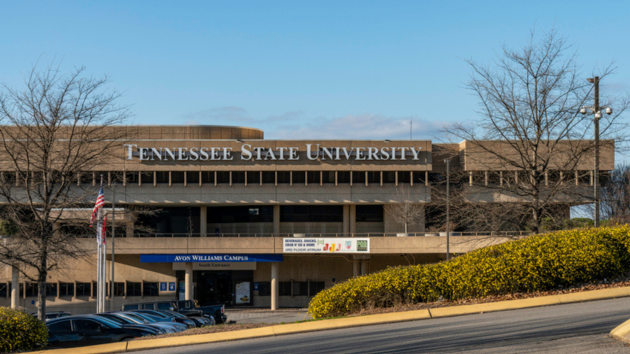
(NASHVILLE, TN.) — One person is dead, and nine others are shot and injured after gunfire erupted during homecoming celebration events for Tennessee State University, Nashville Police Department officials said.
Of the nine injured, three were juveniles ranging in age from 12-14 years old, and all are in non-critical condition at a local hospital, MNPD Public Affairs Director Don Aaron said.
Shortly after 5 p.m., an exchange of gunfire occurred between two groups of people. Officials said it was likely that innocent bystanders were shot during the incident. A total of ten people were shot, with one person, a 24-year-old, succumbing to their injuries.
Five people were transported to local hospitals via ambulance. Five others were transported by private vehicle, Metro Nashville Police Department Public Affairs Officer Brooke Reese said.
Officials believe that some of those injured and hospitalized were involved and are suspected of being involved in the gunfire, said Reese.
Injuries range from minor to critical condition, with some sustaining graze wounds, said Aaron.
One gun, a handgun, was recovered at the scene, he said. Officials believe that the suspects used handguns in the shooting.
Fire and police officials were already at the event to participate in the homecoming parade earlier today, authorities said. Some personnel were already at the scene when gunfire erupted, and used their belts to apply tourniquets to gunshot victims, Nashville Fire Department PIO Kendra Loney said.
Most people celebrating homecoming went to the Tennessee State University football game, which is being held at Nissan Stadium, Nashville North Precinct Commander Anthony McClain said. During the day, there was a large group of people gathered for the parade.
When the gunfire began about two hours ago during the event, “a few folks ruined it for everybody,” McClain said.
This is a developing story. Please check back for updates.
(NEW YORK) — Dangerous, record-breaking heat is ongoing in the West, with the temperature in Phoenix reaching the triple digits every day for the last three weeks.
Phoenix climbed over a scorching 110 degrees on 80 days in 2024 — shattering the record set last year with 55 days of temperatures over 110 degrees.
The heat spreads across the Southwest and the South this weekend, with temperatures soaring to the 90s in cities including Las Vegas, Austin, Dallas and Little Rock, Arkansas.
There are hundreds of deaths each year in the U.S. due to excessive heat, according to CDC WONDER, an online database, and scientists caution that the actual number of heat-related deaths is likely higher.
Meanwhile, as Florida cleans up from the devastation left by Hurricane Milton, lingering river flood warnings are ongoing for parts of Florida and Georgia.
Choppy seas are also keeping the rip current risk high for many beaches in Georgia and Florida’s east coast.
(OKLAHOMA CITY) — At least one person has been killed and 12 others have been injured in a shooting that took place at a party at an event center in Oklahoma City, police have confirmed.
Oklahoma City Police said that it appears there was a disturbance which led to “multiple shots being fired both inside and outside the event center.”
The names and ages of those involved in the incident have not yet been released but authorities have confirmed that at least one person was killed in the altercation and 12 others have been injured.
The suspects are currently unknown at this time but several people have been detained, according to law enforcement.
“We are in the process of interviewing witnesses,” authorities told ABC News. “We will provide more details when we get them.”
The investigation is currently active and ongoing.
This is a developing story. Please check back for updates.
(LONGBOAT KEY, Fla.) — When Coast Guard pilot Lt. Ian Logan went out to search the waters off Longboat Key in the wake of Hurricane Milton roaring ashore on the western Florida coast, he didn’t expect to find anyone who needed help.
To all of their surprise, he and his crew found a man clinging to a cooler 30 miles out in the Gulf of Mexico.
“We thought it might’ve been a buoy,” Logan said. “I remember looking down and seeing the strobe and like seeing him holding on to the cooler. So once we pulled up in that 50-foot hover right next to the guy, we’re like, ‘Oh my gosh, he’s on like a cooler that’s opened up and he’s just floating on it,’ which is insane.”
The man had gone out to his boat early Wednesday to make repairs after it became disabled earlier that week approximately 20 miles off John’s Pass, a barrier island west of St. Petersburg, according to the Coast Guard. As he was bringing the boat back to port, it got disabled again, the Coast Guard said.
The man contacted the Coast Guard, hoping for help. But weather conditions had already started to deteriorate as Milton approached Florida’s west coast, and the Coast Guard said it instructed him to put on a life jacket and “stay with the vessel’s emergency position indicating radio beacon.” The Coast Guard said it then lost contact with the man at 6:45 p.m. ET Wednesday.
By the time he was found, with his boat long gone, Logan said the man was essentially strapped to the cooler.
“I didn’t believe it at first. There are a lot of questions going through my head. So I paused for like, 10 seconds, as we’re making this turn, going to make our approach to the water,” Logan said. “And I’m like, ‘Are you sure?’ And the swimmer is like, ‘Yes, he’s waving his hands at us like, this is the guy.’ And I remember all of us are like, ‘My goodness, I can’t believe we’re so excited that we found this guy.’ Like searching for a needle in a haystack.”
“I look back over my shoulder and he’s over my back right shoulder and I see this guy — hair looks like the ‘Castaway’ movie, where he’s covered in salt,” he said. “He’s got a life vest on, he’s soaked. And at that point, it really set in, like, ‘Oh my God, I can’t believe we just found this guy.'”
Logan said the moment was one of the highlights of his career.
ABC News’ Leah Sarnoff and Meredith Deliso contributed to this report.
(NEW YORK) — Former President Donald Trump has not played golf since the apparent assassination attempt near one of his courses last month, and is not expected to hit the golf course again until a new security plan is in place — which sources tell ABC News is not expected to be in effect until after the election.
The Secret Service had previously expressed its concern to Trump over his golfing and told him during a briefing last month that additional planning and security procedures are needed for him to be able to continue his golf outings.
Trump, who owns several golf courses, typically plays on a regular basis.
Asked about the development, a Secret Service spokesperson referred questions to the Trump campaign.
“Since the attempted assassination of former President Trump on July 13, the U.S. Secret Service has made comprehensive changes and enhancements to our communications capabilities, resourcing, and protective operations,” said Secret Service Chief of Communications Anthony Guglielmi. “Today, the former President is receiving heightened protection and we take the responsibility to ensure his safety and security very seriously.”
Ryan Routh, 58, pleaded not guilty on Sept. 30 to federal charges in connection with an alleged attempt to assassinate Trump at the former president’s golf club in Florida. On the day of the alleged attempted assassination, Trump was playing golf on the course when a Secret Service agent spotted a gun barrel poking out from the tree line near the sixth green, according to investigators.
Routh fled after the agent fired in his direction, and was subsequently apprehended. Trump was not harmed in the incident.
(TAMPA, Fla.) — Hospitals, emergency departments and health care facilities across Florida are reopening after they evacuated patients and canceled elective surgeries due to Hurricane Milton.
BayCare health care system said some of its ambulatory surgery centers, imaging centers, laboratories, urgent care facilities and medical group offices are opening on Friday, according to an update on its website.
Of its 13 hospitals, 12 are open with just one, Morton Plant North Bay Hospital, remaining closed. The hospital evacuated before the storm and is currently not accepting new patients, BayCare said.
Four emergency rooms under the HCA Florida Healthcare network in Julington Creek, Lake Tarpon, New Tampa and Riverview reopened Friday to care for patients, according to an alert posted on the network’s website.
Six of HCA Florida’s 18 hospitals reopened Thursday but at least five remain closed, having suspended services and, in some cases, having transferred patients to other hospitals.
Additionally, in the University of Florida Health’s (UF Health) latest tropical weather alert Thursday afternoon, a number of facilities — including hospitals, outpatient clinical facilities and physician practices — reopened or removed their modified hours on Thursday and Friday including in Archer, Gainesville, Jacksonville, St. Augustine and The Villages.
Tampa General Hospital (TGH) said in a press release that two of its emergency centers reopened Thursday evening and the main hospital resumed normal operations on Friday.
The hospital said its physicians and emergency management team members remained onsite throughout the storm and the emergency room in its main campus was able to remain open thanks to a hurricane preparedness plan that was activated.
“Preparing for Hurricane Milton was an incredible effort by the entire team and a true test of our resources, but it ensured we could continue to provide exceptional care for our patients in a high-quality, safe and uninterrupted environment before, during and after the storm,” John Couris, president and CEO of TGH, said in a statement.
“Tampa General is open to support communities impacted and particularly our first responders. Working together, we will come back from Milton stronger than ever,” the statement continued.
TGH said it faced no major power outages during Hurricane Milton and its AquaFence, a water-impermeable barrier, protected the hospital from winds and flooding. The hospital has previously said the AquaFence can withstand storm surges of up to 15 feet above sea level.
There are still hospitals that remain temporarily closed. In a post on the social platform X, the James A. Haley Veterans’ Hospital, in Tampa, said the hospital and all outpatient clinics will be closed for in-person appointments between Friday, Oct. 11, and Monday, Oct. 14 “except for time-sensitive clinical services due to anticipated impacts from Hurricane Milton.”
(NEW YORK) — As Florida struggles to recover from the damage caused by Hurricane Milton, and the lingering effects from Helene two weeks earlier, the long-term health consequences could be devastating, studies suggest.
A recent study published in the journal Nature examining nearly 500 tropical cyclones from 1930 to 2015 in the U.S. suggested that big storms lead to thousands of extra deaths after the storms, and leave lasting impacts on public health.
The reasons for the extra deaths aren’t yet clear, but studies speculate that they may be related to socioeconomics, infectious diseases, and exacerbating effects on chronic health conditions like heart disease and mental stress.
“We find that there are elevated rates of mortality that extend far beyond that immediate aftermath of a storm, and it persists for up to 15 years,” Rachel Young, an environmental economist at University of California, Berkeley, and co-author of the study, told ABC News.
“We estimate that these indirect deaths that occur through a number of channels over many, many years are equal to between 7,000 to 11,000 deaths per storm, which is 300 times greater than the official death count,” she continued.
That translates to between 55,280 and 88,080 excess deaths every year. The study also found that hurricanes and their aftereffects are estimated to have caused more deaths in the U.S. than all recorded car accidents, infectious diseases and war fatalities combined, totaling between 3.6 million and 5.2 million deaths.
A 2018 study published in the Journal of the American Medical Association examined the aftermath of 2017’s Hurricane Maria and noted 1,139 additional deaths reported, compared to the official count of 64 deaths officially attributed to the storm.
Other studies have shown that tropical cyclones can increase hospitalizations by up to 10% for older adults, primarily for respiratory and infectious diseases.
Some studies also suggest that people with lower incomes often have less access to healthcare, and communities of color are more likely to be exposed to harmful pollution, making them more vulnerable to a storm’s immediate effects and aftereffects.
Infants and Black communities are particularly at risk after a storm, the Nature study revealed. About 99% of infant deaths happen more than 21 months later, meaning even babies born after the storm are affected. Additionally, those in Black communities face about three times the risk of death compared to white communities.
Although the Nature study doesn’t specifically explore why these differences exist, researchers are still working to better understand the phenomenon.
“We know that the Southeastern portion of the United States has elevated rates of mortality for infant and young populations compared to the rest of the country,” Young said. “And we find that tropical cyclones – that these states are being impacted by tropical cyclones a lot – [are] a major driver of this sort of difference in the mortality rates between the Southeast and the country.”
Storm surges are another phenomenon that could harm health long after a major a weather event is over. After Hurricane Milton, the water surged as high six feet in some areas of Florida. The risk of waterborne diseases can increase as much as 50% after such surges, which in turn can trigger respiratory illnesses due to mold, allergens and contaminated water, according to the Centers for Disease Control and Prevention.
According to Young, the public health challenges that last far beyond clean-up and recovery are something that needs to be evaluated and considered when determining how to respond to natural disasters.
“We don’t want to see people having significant delays in getting aid,” Young added. “There’s been a push for a more proactive disaster policy and less just responding in the aftermath of the event.”
Dr. Faizah Shareef is an internal medicine resident physician and a member of the ABC News Medical Unit.
(ST.PETERSBURG, Fla.) — As Hurricane Milton pummeled the St. Petersburg area, with winds strong enough to shred the roof of Tropicana Field, Kristy Austin said it sounded like a “freight train” was coming through her apartment building.
“It sounded like the ocean was hitting our windows and the water was just pouring through,” Austin, who lives across the street from the stadium, told ABC News on Thursday.
Water was coming in the windows of her eighth-floor apartment, going up to almost her knees, Austin said, while the wind also howled.
“We thought the windows were going to blow and might cut us and kill us,” she said.
Austin said she and her best friend grabbed blankets and emergency bags with their birth certificates and ended up sheltering in the windowless stairwell on the 14th floor of their building all night.
“It still sounded like a freight train coming through the building,” she said. “And the whistling of the storm, it was really scary.”
The St. Petersburg area saw gusts up to 102 miles an hour during Hurricane Milton. More than 18 inches of rain also fell.
The roof of Tropicana Field, home of the Tampa Bay Rays, lay in tatters Thursday, most of it completely ripped off during the high winds. The roof was built to withstand 115 mph winds, according to the Tampa Bay Rays media guide.
No one was injured as the stadium roof was torn off during the storm, officials said. The Tampa Bay Rays said Thursday they are working with authorities to secure the building.
“We are devastated by the damage incurred by so many,” the team said.
Ahead of Hurricane Milton’s arrival, Tropicana Field was set up to serve as a base camp for operations and 10,000 first responders. However, in a press conference Thursday morning, Florida Gov. Ron DeSantis confirmed they were moved out of Tropicana as the forecast changed.
“As it became clear that there was going to be something of that magnitude that was going to be within the distance, they redeployed them out of Tropicana,” DeSantis said.
Pinellas County had no no running water in the immediate aftermath of Milton after several water main breaks overnight, officials said. By Thursday afternoon, officials said potable water service was back but that pressure may be low.
As St. Petersburg cleans up from the powerful storm, Steven Kauvaris, who lives near Tropicana Field, wanted to see the devastation firsthand.
“That was honestly just pretty impressive,” Kauvaris told ABC News near the stadium Thursday morning. “It’s definitely impressive to see the kind of damage that this storm created.”
Austin said she decided not to evacuate because her building is secure and on the hospital grid, so she didn’t lose electricity. Between the damage to Tropicana Field and the flooding in her apartment, she said she’s never seen anything like Milton.
“It was horrifying,” she said. “We weren’t sure if we were going to make it out alive.”
(TAMPA, Fla.) — The fiberglass roof of Tropicana Field in St. Petersburg, Florida, was left in tatters, a 10,000-square-foot sheriff’s facility was demolished and several people were killed at a senior living community in St. Lucie County. That was among the widespread damage emerging Thursday after Hurricane Milton slammed Florida’s west coast with ferocious wind gusts, torrential rain and at least 36 reported tornadoes the whirling storm spawned even before making landfall, officials said.
Department of Homeland Security Secretary Alejandro Mayorkas said Thursday at least 10 people are confirmed dead, likely caused by the tornadoes.
Search and rescue is the “highest priority” at the moment, Mayorkas said.
“Milton may have passed, but the danger it poses has not,” he said. “Downed power lines. Floodwaters, non-potable drinking water and debris are creating deadly conditions. Keep listening to local officials and shelter in place until it is safe.”
Officials said state, county and National Guard search-and-rescue crews had rescued hundreds of people, including more than 400 trapped by high water at an apartment complex in Clearwater.
Florida Gov. Ron DeSantis said earlier that authorities are still assessing damage in hard-hit areas, including Siesta Key south of Sarasota, where Helene made landfall around 8:30 p.m. ET Wednesday as a Category 3 storm packing 120 mph winds.
“Right now, it looks like Sarasota County had the most significant storm surge, likely somewhere between 8 to 10 feet. And remember with Helene, we had 15 to 20 feet up in Taylor County,” DeSantis said at a news conference.
However, DeSantis said the early damage assessment indicates the hurricane, which came on the heels of the devastation wrought by Hurricane Helene less than two weeks ago, “was not the worst-case scenario.”
“The storm did weaken before landfall and the storm surge as initially reported had not been as significant overall as what was observed for Hurricane Helene,” DeSantis said.
The most tornado warnings in state history
About 125 homes were destroyed by suspected tornadoes before the hurricane came ashore, many of them mobile homes in communities for senior citizens, said Kevin Guthrie, the director of the Florida Division of Emergency Management.
At least 36 tornadoes were reported across Florida, and, according to the National Weather Service, there were 126 tornado warnings issued Wednesday across the southern half of the state, the most in any day on record for the state of Florida and the second most of any state in the nation for one day.
The St. Lucie Medical Examiner confirmed Thursday that four people were killed when a tornado ripped through the Spanish Lakes County Club Village, a retirement community in St. Lucie County. No further details were released.
St. Lucie County Sheriff Keith Pearson told ABC News that a twister also demolished his department’s 10,000-square-foot storage facility, which was constructed of red iron.
“Our team was within 50 yards of this structure that got hit,” Pearson said. “And we were actually storing all of our high-water rescue vehicles and our patrol vehicles (were) in this structure to prevent them from damage from the hurricane. Within seconds, a tornado came through and just demolished the structure.”
Sarasota Mayor Liz Alpert told ABC News Thursday morning that the storm toppled numerous trees in her city and pushed several boats onto shore. She said the windows of some high-rises were also broken and that a small bridge leading to Lido Key was compromised.
“Overall, I think we’re doing better than we thought. In the city of Sarasota, believe it or not, we had no calls for rescues,” said Alpert, adding that most residents in the town heeded evacuation warnings.
Roof blows off Tropicana Field, crane collapses on Tampa Bay Times office
Dramatic photos and videos emerged overnight as Milton ripped into Florida. Winds of 90 mph whipped through downtown St. Petersburg, collapsing a crane at a building construction site there, according to city authorities. No injuries were reported, but video from the scene showed damage to nearby buildings.
Wind also tore off a large portion of the translucent fiberglass roof at the Tropicana Field stadium in the city, home of the Tampa Bay Rays baseball team.
“The majority of the roof has been ripped off and is now located south of the stadium,” St. Petersburg City Development Administrator James Corbett said Thursday morning, adding that 14 staff members inside the stadium at the time of the incident were found safe.
The non-retractable dome stadium, built in 1990, was to be used as a staging area for first responders.
The storm also dumped 18 inches of rain on St. Petersburg, causing flooding and serious damage to key infrastructure, including drinking water systems, power lines and sewage facilities, officials said.
Don Tyre, the city’s building official, said a 500-foot section of a T-crane being used to construct a 46-story residential skyscraper in downtown St. Petersburg collapsed due to the high winds, striking a nearby building. However, the remaining 600-foot section was intact and will be inspected by an engineer before it is brought back into service.
There were no reports of injuries from the toppled crane. Part of the crane fell onto the office of the Tampa Bay Times, wrecking the newspaper’s newsroom.
Times’ officials said Thursday morning that its building was closed ahead of Milton’s landfall and no employees were inside the office when the crane collapsed.
Milton also caused a major water main break in St. Petersburg, which is impacting portable water service across the city. The subsequent shutdown of the water main is expected to last until necessary repairs can be completed, officials said.
Tampa-area 7-Eleven store damaged
To the north of Tampa, the Pasco Sheriff’s Office said authorities received more than 140 calls regarding roadway obstructions. First responders “are working to remove these hazards as quickly as possible,” the office wrote on X.
The Hillsborough County Sheriff’s Office reported significant storm damage to a 7-Eleven store northwest of Tampa, with Sheriff Chad Chronister warning of downed trees and power lines in the county. Chronister urged residents to stay indoors while responders cleared the damage.
Hundreds of apartment complex residents rescued
Pinellas County Sheriff Bob Gualtieri said his department’s personnel were stationed across the county and responded to several rescue calls.
“We had eight high-water rescue teams ready to assist, and it became necessary to utilize them overnight,” the sheriff said. “Fortunately, there were no serious injuries reported, but we did have significant rescues.”
One notable rescue operation occurred at a Clearwater apartment complex, where rising waters threatened the lives of about 2,000 residents, the sheriff’s office said.
“We rescued approximately 430 people using high-water vehicles and boats,” Gualtieri said. “The water was so high that it reached the second-floor balconies of some apartments, but thankfully, many residents had moved to higher ground.”
Gualtieri added, “We appreciate the cooperation of the residents, especially those on the barrier islands, who evacuated and helped minimize the impact of the storm. We are all working together to rebuild and recover from this challenge.”
ABC News’ Victoria Arancio and Ahmad Hemingway contributed to this report.
(TAMPA, Fla.) — Cleanup and damage assessments are underway at airports in Florida after Hurricane Milton barreled into the state’s western coast as a Category 3 storm.
Multiple airports in the Tampa, Sarasota and Orlando areas closed in the hours and days ahead of landfall, with thousands of flights canceled.
Bridges and roads were also closed in the wake of Milton, with damage assessments underway.
Here’s a look at the latest on when airports are expected to reopen.
Tampa International Airport
The airport announced it will reopen for commercial and cargo operations at 8 a.m. Friday, after conducting a “thorough inspection of the 3,300-acre campus and its buildings.”
“Roadways are clear and parking garages are in good shape,” airport officials said. “The City of Tampa confirmed the Airport is not experiencing wastewater issues and the Airport Rescue and Fire Fighting station had no significant damage. The FAA reports the air traffic control tower is ready for full operations.”
The airport’s campus did sustain some damage following the extreme wind gusts and heavy rainfall during the hurricane and some areas will need repairs, airport officials said. Among the impacts, six boarding bridges that move passengers to aircraft were damaged by high winds and parts of the main terminal had leaks and need repairs.
The airport is also “evaluating staffing levels after one of the biggest evacuation events we’ve had in recent Tampa Bay history.”
St. Pete-Clearwater International Airport
All flights out of the Tampa Bay-area airport have been canceled on Thursday.
Airport officials had previously announced the airport will be closed on Wednesday and Thursday and advised passengers to contact airlines directly “for information regarding cancellations and resumption of service.”
Sarasota Bradenton International Airport
The Sarasota airport will remain closed on Thursday and Friday, airport officials said.
“SRQ is currently assessing conditions and beginning cleanup post Hurricane Milton,” the airport said while advising customers to watch for further updates on social media.
The airport recorded one of the strongest gusts of any location during the storm at 102 mph.
Orlando International Airport
The airport remains closed to commercial and private passenger operations, after the Orlando region was hit with powerful wind gusts and rain overnight, as crews conduct damage assessments.
“Greater Orlando Aviation Authority leadership will make a determination on when both airports can reopen, based on feedback from crews surveying the buildings and grounds,” airport officials said.
The airport noted that a Notice to Air Mission (NOTAM) filed with the FAA before Milton’s arrival showed the airport is scheduled to open at 6 p.m. Thursday, but noted that does not take into account damage assessment.
“The airport and partners also need time to bring in adequate staff and to prepare working areas to better serve customers,” airport officials said. “The public should not rely on the NOTAM for a guaranteed opening announcement.”
Orlando Sanford International Airport
The airport, located north of Orlando in Sanford, said it will resume operations on Friday.
Allegiant passengers were advised to check with the airline for questions about how Milton might impact their flights.