
Here are the Menendez brothers’ potential tracks to freedom

Here are the Menendez brothers’ potential tracks to freedom
Ted Soqui/Sygma via Getty Images

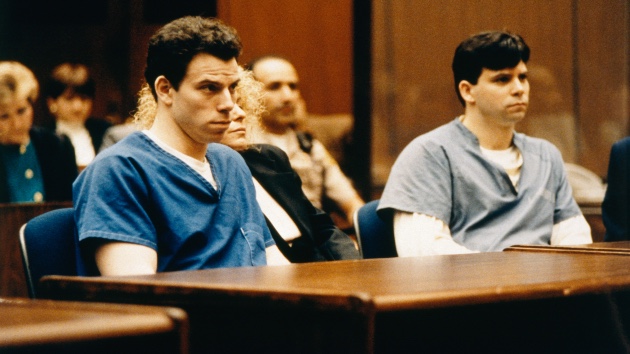
(LOS ANGELES)  — Lyle and Erik Menendez are currently serving life behind bars for the murders of their parents in the family’s Beverly Hills home. But after more than three decades in prison, a renewed interest in the headline-grabbing trial has the brothers pursuing two tracks to potential freedom.

The Menendez case dates back to August 1989, when Lyle Menendez, then 21, and Erik Menendez, then 18, shot and killed their parents, Jose and Kitty Menendez.

Prosecutors alleged Lyle and Erik Menendez killed their wealthy parents for financial gain, while the defense argued the brothers acted in self-defense after enduring years of sexual abuse by their father.

Their first trials — which captured the nation’s attention with cameras in the courtroom — ended in mistrials.

In 1996, at the end of a second trial — in which the judge barred much of the sex abuse evidence — Lyle and Erik Menendez were convicted of first-degree murder and sentenced to two consecutive life prison terms without the possibility of parole.

The sensational case gained new attention this fall with the release of the Netflix drama “Monsters: The Lyle and Erik Menendez Story” and the Netflix documentary “The Menendez Brothers.”

The brothers currently have two potential paths to their release before the Los Angeles County District Attorney’s Office.

Resentencing

One track involves a review of their sentence based on factors including rehabilitation, which Los Angeles County District Attorney George Gascón is evaluating.

Gascón said he plans to make his resentencing decision this month. If Gascón recommends resentencing, his recommendation will go to a judge to decide whether the brothers will be released, receive a lesser sentence or get a new trial.

Gascón told ABC News in October any recommendation for resentencing would take into account the decades the brothers already served and their behavior in prison.

Mark Geragos, the Menendez brothers’ lawyer, called Erik and Lyle model prisoners who worked tirelessly to reform themselves with no expectation they’d be released.

“Given the totality of the circumstances, I don’t think that they deserve to be in prison until they die,” Gascón told ABC News.

Gascón said since he’s been in office, they have resentenced over 300 people, of which four have reoffended.

The other track concerns the brothers’ petition filed last year for a review of new evidence not presented at the original trial. Through the habeas corpus petition, the court could reverse the conviction or reopen proceedings.

Gascón said his office is evaluating allegations from a member of the boy band Menudo who said he was molested by Jose Menendez, and a letter Erik Menendez wrote to a cousin eight months before the murders detailing his alleged abuse.

Erik Menendez’s cousin testified about the alleged abuse at trial, but Erik Menendez’s letter — which would have corroborated the cousin’s testimony — wasn’t unearthed until several years ago, according to Geragos.

“The combination of those two we believe provide more than ample basis to set aside the result of the second trial,” Geragos said at a press briefing earlier this month.

Geragos said the district attorney could either oppose the habeas and decide to litigate it, or “they could concede the habeas and say, give them a new trial.”

“I’m hoping that sometime before Thanksgiving, which is when the next response is due, that the DA will either concede the habeas or join us in asking for resentencing,” Geragos said.

The next court date in the case is scheduled for Nov. 26, Gascón said.

Family calls for release

Nearly two dozen relatives have urged the district attorney to recommend the brothers be resentenced and released.

Lyle and Erik Menendez “were failed by the very people who should have protected them — by their parents, by the system, by society at large,” Kitty Menendez’s sister, Joan Andersen VanderMolen, said at a news conference on Wednesday.

“Their actions, while tragic, were the desperate response of two boys trying to survive the unspeakable cruelty of their father,” she said of the murders. “As their aunt, I had no idea of the extent of the abuse they suffered.”

Behind bars, the siblings “persevered,” Anamaria Baralt, niece of Jose Menendez, said. “They have sought to better themselves and serve as a support and inspiration for survivors all over the world. Their continued incarceration serves no rehabilitative purpose.”

Copyright © 2024, ABC Audio. All rights reserved.

Florida’s farmlands, iconic orange groves recovering following back-to-back hurricanes

Florida’s farmlands, iconic orange groves recovering following back-to-back hurricanes
Everoak Farms volunteers harvest sugar cane that could be salvaged after heavy winds and water from Hurricane Milton wrecked and flooded crops on the Orlando, Florida, farm. (Rich Pope/Orlando Sentinel/Tribune News Service via Getty Images)

(TALLAHASSEE, Fla. ) — Florida’s agricultural fields — including the state’s iconic orange groves and berry farms — are routinely damaged by strong storms that roll through the state.

Some of the Sunshine State’s most important farms are now recovering from two of the 2024 season’s most powerful hurricanes, which struck one after the other.

On Sept. 27, Hurricane Helene became the strongest hurricane to strike Florida’s Big Bend. Less than two weeks later, on Oct. 10, Hurricane Milton made landfall near Siesta Key. After both Category 4 storms brought life-threatening storm surge to the Gulf Coast, they turned toward the heart of the state, destroying farmland with strong winds and heavy rains, experts told ABC News.

While the state is no stranger to hurricanes, its agriculture industry is threatened every time a strong hurricane rolls in, Angela Lindsay, associate professor and disaster specialist at the University of Florida’s Institute of Food and Agricultural Sciences (IFAS), told ABC News.

Florida’s groves were heavily impacted by the recent hurricanes, which tore through regions with some of the most productive citrus acreage in the state, Matt Joyner, executive vice president and CEO of Florida Citrus Mutual, the state’s largest citrus trade association, told ABC News.

Hurricane-force winds caused defoliation — or the leaves to fall off — damaged limbs and branches and even downed entire trees, snapping them at the roots, Lindsay said. While oranges are not yet ready for harvest, they are currently near maturity and heavier, making it easier for high winds to pull the fruit from their branches, Joyner said.

“We know that we have a lot of fruit on the ground for this year’s crop,” Joyner said.

At Showcase of Citrus, an orange grove in Clermont, Florida, near Orlando, the gusts from Milton bent some trees at a 45-degree angle, owner John Arnold told ABC News.

Floods often kill the citrus groves, especially young orange trees planted in low-lying areas, Arnold said, adding that several of his young orange trees were lost to flooding.

Mitigation is difficult, the farmers said. Complicating matters even further is the uncertainty of the forecast up until just a few days before landfall, making it difficult to tend to hundreds and thousands of acres in a short amount of time, Michael Hill, co-founder and CEO of H&A Farms in Mount Dora, Florida, told ABC News.

Citrus trees can be staked in order to provide support from the hurricane-force winds, Lindsay said. Some farmers have tried wrapping the trees in tarp-like material, but that technique is not commonly used, Lindsay added.

“I’ve seen storms that tipped over entire groves of mature trees,” Arnold said.

There’s not much that can be done to protect crops in the ground, said Hill, who grows strawberries and blueberries — two of the most vulnerable crops in the state, after citrus, experts say.

A tree fell on Hill’s home in Eustis, Florida, but once the storm passed, all he cared about was the state of his fields.

“That’s the least of my worries,” he said of the downed tree.

About 60% of the plastic mulch the strawberries were planted in on Hill’s farm were torn up by Milton, he said. Hill and his workers are attempting to re-lay the plastic while keeping the plants alive in a cooler.

For the dairy industry, the cows still need to be milked, but the stressed cows likely produce much less, Jeb Smith, president of the Florida Farm Bureau Federation, told ABC News.

“It may be a month before they’re able to get back to where production should be,” Smith said.

Structural damage often includes buildings and fences that require re-building, Smith said. Showcase of Citrus sustained some damage to its screen buildings for growing grapefruit, Arnold said. A barn at H&A Farm was destroyed by Milton’s hurricane-force winds, and the entire facility lost power for days, Hill said.

Once the storm rolls through, farmers try to save whatever fruit fell to the ground and attempt to stake damaged trees in an attempt to support what’s remaining, Lindsay said.

Milton was the fourth named storm to hit many of the farms in Central Florida in 14 months, following Hurricane Irma in September 2023 and Debby in early September 2024, Smith said.

“It leads to more impact, when you have blow after blow,” Smith said.

In 2022, Florida’s agriculture industry generated $182.6 billion in revenue and supported more than 2.5 million jobs, according to the Florida Department of Agriculture & Consumer Services. While citrus is Florida’s signature crop, the state is an important producer of many other agricultural products. Florida is the second-largest producer of all oranges, strawberries, sweet corn and non-Valencia oranges in the country. More than 40 vegetables are grown commercially in the state, which ranks in the top three on production value of tomato, bell pepper, snap bean, squash, cabbage and cucumber, according to the University of Florida.

Sugarcane, timber, cattle and dairy are also major commodities for the state, according to the U.S. Department of Agriculture.

Other storms in the recent past have been just as devastating, the experts said.

Farmers were in disbelief over the amount of fruit that had been blown to the ground after Hurricane Irma in 2017 and Hurricane Ian in 2022, Lindsay said. The citrus industry saw a 1,000% loss as a result of Ian, Smith said.

In 2018, after Hurricane Michael struck the panhandle, researchers and officials couldn’t even get to some of the fields — many of which contain row crops of tomatoes and cotton — to assess the damage because of the damaged roadways, Lindsay said.

“We were using drones to look at them,” she said. “There wasn’t a lot there.”

Hurricane Ian in 2022 led to an estimated $7.9 billion in agricultural losses and impacted nearly 5 million acres, a report by the university found. Hurricane Irma in 2018 caused about $1.3 billion in losses, impacting about 1.9 million acres, according to an IFAS report.

Milton resulted in losses between $1.5 billion and $2.5 billion, in addition to the estimated $1.5 billion in damage caused by Idalia, Debby and Helene in the 13 months prior, according to a preliminary assessment by the Florida Department of Agriculture and Consumer Services released Thursday.

Every named storm in recent memory that has passed through central Florida has caused damage to Arnold’s farmland, he said.

“Just as we replant trees and rehabilitate groves and look to recover and move into better seasons, we’re getting hit with these storms,” Joyner said. “It’s really been difficult for growers to kind of regain their footing and move forward.”

In addition to crop insurance, there are several programs in place for farmers, including loan and recovery programs by the USDA’s Farm Service Agency, Lindsay said. The data collected by IFAS is sent to federal officials, who then determine the amount of aid to be distributed to farmers.

Once the damage is assessed, farmers then must make long-term decisions on how to move forward, Smith said.

“Some of these producers will have impacts years down the road,” Smith said, adding that the adverse impacts on the citrus industry can even last for decades.

Hurricanes are just one of the hazards Florida farmers face regularly. The last few years have been tough on the industry, with citrus farmers experiencing widespread greening, a disease that impacts citrus trees, Arnold said.

Combined with freezes, market prices, other diseases, labor challenges and inflation, farmers in the state have left many farms struggling to keep afloat, Hill said.

“When you see Florida strawberries in your stores this year, know that it came from a farmer that chose not to give up,” Hill said.

Copyright © 2024, ABC Audio. All rights reserved.

Robert Roberson ‘shaken baby syndrome’ execution on hold after Texas Supreme Court decision

Robert Roberson ‘shaken baby syndrome’ execution on hold after Texas Supreme Court decision
Ilana Panich-linsman/Innocence Project/AFP via Getty Images

(AUSTIN, Texas) — In an 11th-hour turn of events, Robert Roberson, the first person set to be executed in the U.S. based on the largely discredited “shaken baby syndrome” hypothesis, was granted a temporary hold on his death sentence.

Late Thursday evening, the Texas Supreme Court issued a temporary stay in the case, delaying the looming execution and capping, for now, a back-and-forth series of legal maneuvers, including an earlier decision by the U.S. Supreme Court not to intervene in the case.

When he learned of the last-minute delay of his execution, Roberson, who was convicted of murder in the death of his 2-year-old daughter, was “shocked,” and then “praised God, thanked his supporters and proclaimed his innocence,” said Amanda Hernandez, director of communications for the Texas Department of Criminal Justice, during a news conference Thursday evening.

The Texas high court’s ruling came after Travis County District Court Judge Jessica Mangrum initially put a temporary hold on Roberson’s execution to allow him to testify in a legislative hearing next week — something sought by a bipartisan group of state lawmakers who had subpoenaed Roberson to appear in a bid to delay the execution.

The temporary hold came through less than two hours before Roberson was scheduled to be executed. Shortly thereafter, however, the Texas Court of Criminal Appeals reversed it, putting the execution back on track.

In response, state lawmakers quickly sought a temporary stay by the state’s Supreme Court, which ultimately granted the request.

Notably, Roberson’s execution warrant was only valid through Oct. 17.

A legislative hearing at which Roberson is set to testify is scheduled for noon on Monday in the Texas State Capitol.

“For 22 years, this man has been held in prison — on death row — and we’re hoping that with this ruling today we’ll be able to bring light and get to truth,” Texas State Rep. John Bucy told reporters after the Texas Supreme Court issued its order halting the execution.

Monday’s hearing, in part, will examine laws in Texas targeting “junk science” or unreliable forensic science evidence.

“We needed Robert to be there as a first-hand account, to be able to testify to how it’s been used in his case,” Bucy said.

Roberson was found guilty of the murder of his 2-year-old daughter, Nikki, based on the testimony from a pediatrician who described swelling and hemorrhages in her brain to support a “shaken baby syndrome” diagnosis, even though there is limited evidence that this is a credible diagnosis.

The hypothesis has come under serious scrutiny in biomechanical studies, as well as a growing body of medical and legal literature. The medical examiner at the time also suspected that Nikki sustained multiple head injuries and considered the death a homicide in the official autopsy.

Roberson is autistic, according to his legal team, which affects how he expresses emotions — a concern that also arose during the trial.

Since his conviction, newly presented evidence found that Nikki had pneumonia at the time of her death and had been prescribed respiratory-suppressing drugs by doctors in the days leading up to her death.

A medical expert who performed post-mortem toxicology reports and reexamined her lung tissue said they found that chronic interstitial viral pneumonia and acute bacterial pneumonia were damaging her lungs, causing sepsis and then septic shock, likely leading to vital organ failure.

Over 30 medical and scientific experts have written to the Texas Board of Pardons and Paroles, asking it to reconsider Roberson’s sentence because it hinged on the “shaken baby syndrome.”

A bipartisan group of 86 Texas House of Representatives members have also spoken in support of Roberson’s clemency request, arguing that a state law enables reviews of wrongful convictions based on changes in scientific evidence. In Roberson’s case, they believe that the new evidence should have led to a new trial.

In his plea to halt the execution to the Supreme Court, Roberson argued that his federal due process rights were violated when Texas’ highest court refused to consider his bid to reopen the case based on “substantial new scientific and medical evidence.”

The plea itself followed two previous efforts: to have his sentence commuted to life in prison and to have his execution delayed. Both requests were denied by the Texas Board of Pardons and Paroles.

In its statement of opposition to the Supreme Court on Wednesday, the state of Texas claimed that there has been no violation of Roberson’s constitutional rights that would warrant intervention from the higher court.

It said that its own courts have adequately considered and rejected Roberson’s requests to review the evidence, writing: “As noted by the [Criminal Court of Appeal’s] opinion on direct review and Judge [Kevin] Yeary’s recent concurrence, ‘the tiny victim suffered multiple traumas’ that are inconsistent with a short fall from a bed or complications from a virus.”

Before the flurry of back-and-forth decisions in Texas on Thursday, the U.S. Supreme Court denied Roberson’s request for a stay and his petition that the justices take up the case.

Copyright © 2024, ABC Audio. All rights reserved.
Charges dropped against deaf Black man who was punched by Phoenix police

Charges dropped against deaf Black man who was punched by Phoenix police
Jeremy Hogan/Getty Images

(PHOENIX) — All charges were dropped Thursday against Tyron McAlpin, a disabled Black man in Arizona who had been facing charges of felony assault and resisting arrest after a pair of Phoenix police officers punched him and shocked him with a stun gun. McAlpin is deaf and has cerebral palsy.

The incident, which took place on Aug. 19, was captured on both surveillance video and police body-worn camera. The officers said they were investigating an assault at a nearby Circle K, and McAlpin fit the description of the suspect given by a bystander. However, the original description of the suspect was for a white man who had been creating a disturbance in the store. They also claimed that McAlpin became combative and tried to run when they approached him.

McAlpin’s lawyers said the video shows otherwise.

In the video, police are seen pulling up to McAlpin and ordering him down to the ground. He doesn’t appear to immediately comply. The video then shows the officers punching him 10 times in the head and shocking him with a stun gun four times while yelling: “Get your hands behind your back.” McAlpin’s attorney said he didn’t know what was going on and could not hear the commands.

A union for the department’s officers argued that people should know what to do if a police car comes up and uniformed officers approach and that the officers had to force McAlpin to comply, not knowing he was deaf at the time. The union also said McAlpin took a fighting stance and bit the officers.

“After reviewing all evidence presented, Maricopa County Superior Court Commissioner Nick Saccone determined there was sufficient evidence for the felony charges against the suspect due to his actions against the officers,” Phoenix Law Enforcement Association President Darrell Kriplean said in the weeks after the incident. A Maricopa County judge ruled that there was probable cause for the arrest and that there was cause for the charges.

The Phoenix Police Department said it stood behind its officers and suggested people avoid making judgments about the incident until all the evidence was reviewed. The police department also said that it is investigating the arrest.

On Thursday, Maricopa County Attorney Rachel Mitchell made an announcement that all charges against McAlpin had been dismissed.

“I promised I would personally review the case including a large volume of video recordings, police reports, and other materials that have been forwarded to my office,” she said.

With the support of senior attorneys and after hearing from members of the community, Mitchell said, “I have now completed my review and have made the decision to dismiss all remaining charges against Mr. McAlpin.”

The incident came after the Department of Justice in June released a report concluding that the Phoenix Police Department engaged in civil rights violations including racial discrimination and bias against the disabled. Their investigation found “systemic problems” within the department’s policies, training, supervision and accountability systems that were “perpetuated” for years.

The DOJ opened its investigation in August 2021 after complaints about use of excessive force among Phoenix police. The department said it welcomed this inquiry to help them understand how they can better serve the community.

Copyright © 2024, ABC Audio. All rights reserved.

2nd suspect in Michigan home invasion where perpetrators posed as utility men charged with murder

2nd suspect in Michigan home invasion where perpetrators posed as utility men charged with murder
amphotora/Getty Images

(NEW YORK) — The second suspect who was arrested earlier this week in connection to the deadly Michigan home invasion on Oct. 11 that left 72-year-old Rochester Hills businessman Hussein Murray dead has been formally charged with multiple counts, including felony murder, police said.

“Joshua Zuazo, 39, of Dearborn, is charged in a three-count warrant issued today by prosecutors with felony murder – a life offense if convicted – and two counts of unlawful imprisonment – 15-year felonies,” said the Oakland County Sheriff’s Office in a statement announcing the charges. “The warrant was signed late [Thursday] afternoon by 52-3 District Judge Laura Polizzi.”

Zuazo is now being held in the Oakland County Jail and is expected to be arraigned on the charges on Friday at 1:15 p.m. ET.

Murray was found dead Friday last Friday in the basement of his Rochester Hills home, according to the sheriff’s office. His wife, who called 911, had been tied up with her hands duct-taped.

The woman told law enforcement officials that the night before the attack, the two suspects had also shown up to the home claiming to be responding to a gas leak, but they were not allowed inside.

When they showed up again on Friday, they were let into the home, and her husband went with them into the basement, “ostensibly to look for the leak,” according to the sheriff’s department.

When they came back upstairs without her husband, they tied her up and taped her hands, the woman said. She did not see him come out afterward and “assumed he had been kidnapped.”

In home security camera footage released by the sheriff’s department, the since-arrested suspect can be seen wearing a utility worker’s uniform and a mask while holding a clipboard.

“We’re DTE. We’re checking for gas leaks,” the man can be heard saying in the video, naming the Michigan-based energy company.

The other suspect, Carlos Jose Hernandez, 37, was arrested last Saturday, according to the Oakland County Sheriff’s Office. He has been charged with murder, and law enforcement officials are seeking his extradition from Louisiana.

“I want to reiterate how proud I am of our whole team and what they did to quickly move this case forward, not only taking our suspects off the street, but bringing evidence to the prosecutor to move this into her court for the next phase,” Oakland County Sheriff Michael Bouchard said in a statement Thursday.

ABC News’ Julia Reinstein contributed to this report.

Copyright © 2024, ABC Audio. All rights reserved.
Incident reported as a possible bear attack was actually vicious murder, investigators say

Incident reported as a possible bear attack was actually vicious murder, investigators say
Gallatin County Sheriff’s Office

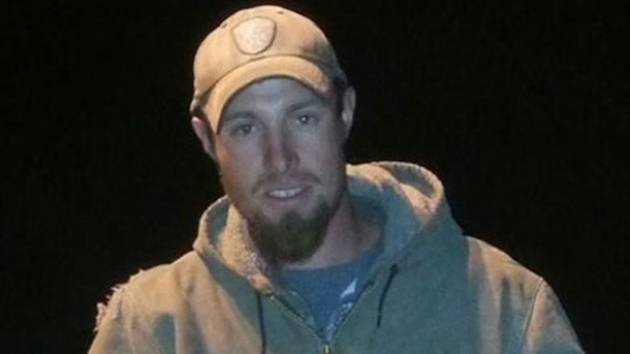
(GALLATIN COUNTY, MT) — Investigators are asking for help solving a “vicious” murder that was so brutal a 911 caller had reported it as a possible bear attack, according to the Gallatin County Sheriff’s Office.

A friend found 35-year-old Dustin Kjersem dead in a tent on Saturday morning about 2.5 miles up Moose Creek Road, in a fairly remote camping area in Montana, according to Gallatin County Sheriff Dan Springer.

Kjersem was last heard from on Oct. 10 as he was leaving to go camping for the weekend. He had plans to meet with a friend on Friday afternoon, according to the sheriff’s office.

After he did not make it to the meetup location, Kjersem’s friend went looking for him and ultimately found him dead.

When investigators responded to the scene of the crime, a Montana Fish, Wildlife and Parks agent with expertise in bear attacks did not find any signs of bear activity at the scene, prompting investigators to treat the incident as a murder, according to the sheriff’s office.

This was further confirmed through evidence gathered during an autopsy which determined multiple wounds led to his death.

Investigators are not sure what the murder weapon was, but the weapon was something “hard enough to cause significant damage to the skull as well as some flesh areas of the body,” Springer said at a press conference Wednesday. 

“This incident was a vicious attack, and detectives are working hard to develop and track down leads. A suspect has not been arrested at this time,” the sheriff’s department said in a statement.

It has not yet been determined what time he was killed and investigators have not identified any suspects in the murder.

Kjersem had lots of equipment at the campsite with him and it was “very well kept,” according to Springer.

The remote location of the murder makes it difficult for the investigation due to limited cellphone services, which typically can be very helpful to investigators, Springer said.

“If you are out in the woods, I need you to be paying attention, you need to remain vigilant. Please, just call us,” Sheriff Dan Springer said at a press conference Wednesday.

The sheriff’s office said people have reached out to them already, giving them multiple leads that they will explore as the investigation into what happened continues.

“If you were in the Moose Creek area, or anywhere in Gallatin Canyon, between Thursday afternoon and early Saturday morning and noticed anything unusual — whether you saw Dustin, Dustin’s truck, noticed suspicious activity, have footage from game cameras or in-vehicle cameras from the area or observed something out of place — please come forward. Even the smallest detail could be crucial to the investigation,” the Gallatin County Sheriff’s Office said in a statement on Facebook.

Copyright © 2024, ABC Audio. All rights reserved.
As Nov. 5 nears, Trump steps up attempts to recast Jan. 6 violence as ‘day of love’

As Nov. 5 nears, Trump steps up attempts to recast Jan. 6 violence as ‘day of love’
Joe Raedle/Getty Images

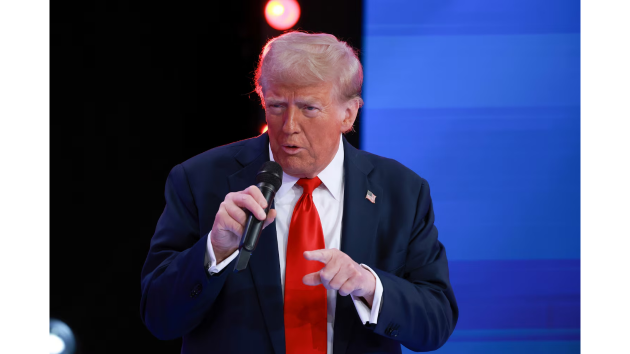
(MIAMI, FLORIDA) — As Election Day nears, Donald Trump is continuing his long-standing effort to recast the violent events of Jan. 6, 2021, now calling it a “day of love” even as he tries to distance himself from what happened.

A Republican audience member, during a Univision town hall on Wednesday, pressed Trump on his actions that day as thousands of his supporters stormed the U.S. Capitol, temporarily disrupting the congressional certification of President Joe Biden’s victory.

“I want to give you an opportunity to win back my vote,” the participant said, adding he found Trump’s actions and alleged inaction on Jan. 6 a “little disturbing” and wanted to know why some of Trump’s former top administration officials are no longer supporting him — some even calling him a danger to national security and democracy.

Trump quickly went on defense and in the process repeated some false or misleading claims that have been long disproved or debunked.

The former president said he “totally disagreed” with then-Vice President Mike Pence’s adamance to his constitutional duty to uphold the certification process and not unilaterally reject the election results. Pence has said he is not endorsing Trump this cycle.

Trump then claimed thousands of his supporters who traveled to Washington “didn’t come because of me,” despite his posting on social media in mid-December 2020 that there would be a “big protest” on Jan. 6.

“Be there, will be wild!” Trump famously wrote on Twitter, where he’d amassed some 88 million followers.

One man who admitted to illegally entering the Capitol that day, Stephen Ayres, testified in court documents and before the House Jan. 6 committee that he was influenced heavily by Trump’s activity on social media to come to Washington for the rally at the Ellipse.

“They came because of the election,” Trump said on Wednesday. “They thought the election was a rigged election, and that’s why they came. Some of those people went down to the Capitol but I said peacefully and patriotically. Nothing done wrong at all.”

Trump went on to say, “Ashli Babbitt was killed. Nobody was killed. There were no guns down there.”

Babbitt, a 35-year-old Trump supporter and Air Force veteran, was fatally shot by a U.S. Capitol Police officer as one of a group of rioters who tried to break into the House floor through barricaded entrances near the Speaker’s Lobby.

She was one of several people who died during or after the riot of various causes. Four officers who responded to the Capitol attack later died by suicide. Capitol Police Officer Brian Sicknick, who was pepper sprayed by rioters, suffered strokes and died the next day. A Washington medical examiner determined he died of natural causes but said his experience that day played a role.

The Justice Department has noted that in court it has been proven that “weapons used and carried on Capitol grounds include firearms; OC spray; tasers; edged weapons, including a sword, axes, hatchets, and knives; and makeshift weapons, such as destroyed office furniture, fencing, bike racks, stolen riot shields, baseball bats, hockey sticks, flagpoles, PVC piping, and reinforced knuckle gloves.”

More than 1,500 people have been federally charged with crimes associated with the Capitol attack, the Justice Department said earlier this year. That includes 571 charged with assaulting, resisting, or impeding law enforcement agents and 171 defendants charged with entering a restricted area with a dangerous or deadly weapon.

At least 943 individuals have pleaded guilty — including 161 who pleaded guilty to assaulting law enforcement and 67 who pleaded guilty to assaulting law enforcement with a dangerous or deadly weapon — and an additional 195 people have been found guilty at trial.

Approximately 140 law enforcement officers were injured during the riot, the DOJ has said.

Jan. 6 began with Trump’s speech at the Ellipse, in which he did tell supporters to march “peacefully and patriotically” to the Capitol, as he now likes to note, but also stoked tensions by saying they have to “fight like hell” or they wouldn’t have a country.

“But that was a day of love,” Trump said at the Univision town hall. “From the standpoint of the millions, it’s like hundreds of thousands. It could have been the largest group I’ve ever spoken to before. They asked me to speak. I went and I spoke, and I used the term ‘peacefully and patriotically.'”

The comments come as Trump and his running mate Ohio Sen. JD Vance continue to deny the 2020 election outcome and downplay what transpired on Jan. 6.

Vance on Wednesday when asked if Trump lost the election replied, “No, I think there are serious problems in 2020 so did Donald Trump lose the election? Not by the words that I would use.”

Vance has also said he wouldn’t have certified the election were he in Pence’s shoes in 2021.

The election denialism and Jan. 6 comments have prompted swift push back from Democrats and Vice President Kamala Harris. Harris has cast Trump as a threat to democracy as the 2024 campaign enters its final weeks.

ABC News’ Jack Date, Soorin Kim, Lalee Ibssa and Kelsey Walsh contributed to this report.


Copyright © 2024, ABC Audio. All rights reserved.
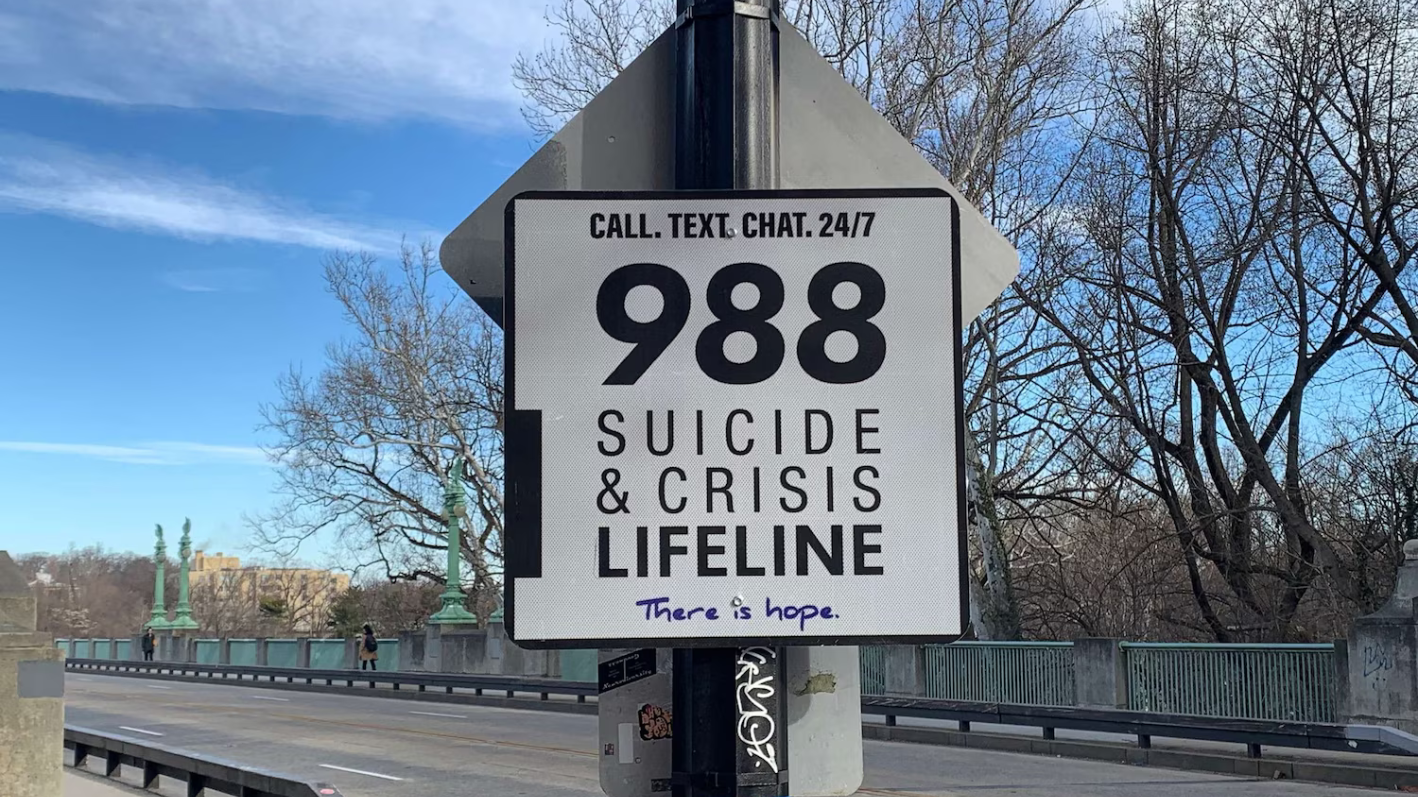
FCC approves georouting for 988 Suicide & Crisis Lifeline, clearing the way for more localized care

FCC approves georouting for 988 Suicide & Crisis Lifeline, clearing the way for more localized care
Kelly Livingston/ABC News

(NEW YORK) — The Federal Communications Commission unanimously voted Thursday to approve new rules requiring all wireless carriers to implement georouting for calls to the 988 Suicide & Crisis Lifeline in a move it says will help “save more lives.”

“Time and again, across many different communities, I have heard stories of how important the 988 Lifeline is for individuals in need of support,” Commissioner Anna Gomez said during the FCC’s Thursday meeting. “Today we affirm the experiences of these individuals and take steps to enhance the lifesaving capability of this service.”

“Doing everything we can to ensure that individuals in a crisis can receive the support they need saves lives and is simply good policy,” she added.

When a person calls 988, that call is routed to one of the Lifeline’s 200-plus crisis centers around the United States. The new rules will require carriers to route calls based on where the call was placed, allowing for a more localized response. Since the three-digit number launched in July 2022, it has been using area code-based call routing.

“This is a mismatch I have long believed we should fix — and I believe we can save more lives if we do so,” FCC Chairwoman Jessica Rosenworcel said during the Thursday meeting. “Because if we get more people connected to the Suicide & Crisis Lifeline, to resources that are local, we can help more people with more meaningful assistance in more places.”

Rosenworcel explained that when the original 10-digit Lifeline number was created in 2005, most calls came in on landlines, so area code routing made sense. Now, she said, almost 80% of calls come from cellphones, creating the need for georouting to provide localized care.

Advocates have called for georouting to be implemented for years, saying callers would benefit from localized follow-up care, though there have been some concerns about caller privacy. Under the new georouting system, calls will be routed based on the location of the cell tower that originates the call, as opposed to the precise location of the caller — a move meant to protect privacy, according to the FCC.

The order passed Thursday only requires georouting for phone calls to the Lifeline. There is currently no requirement for text contacts to the Lifeline to be georouted. However, the FCC also voted to propose and begin seeking comments on a rule that would require georouting for texts.

Phone calls accounted for about 72% of contacts to the Lifeline for the month of August, according to Substance Abuse and Mental Health Services Administration data. Texts accounted for about 19% of August contacts. The remaining contacts come from web-based chat services, the data showed.

“We’re not going to stop working to improve the Lifeline until everyone gets access to the local help and resources that they need,” Rosenworcel said.

Last month, wireless carriers Verizon and T-Mobile implemented voluntary georouting for 988 calls placed on their networks — a move that accounted for about half of all calls to the Lifeline, according to the U.S. Department of Health and Human Services.

“Around 80% of calls to the 988 Lifeline are done through wireless phones, and many people have phone numbers with different area codes from where they live, work or visit,” T-Mobile President of Technology Ulf Ewaldsson said at the time. “Georouting ensures that those seeking help will reach the available crisis center nearest their location for support. It’s about making sure help is there when and where it’s needed most.”

All national carriers will have 30 days to implement georouting for their 988 calls. Smaller providers will have 24 months.

Since the 988 launch, the Lifeline has fielded more than 10 million contacts.

If you are experiencing suicidal, substance use or other mental health crises, or are worried about a friend or loved one, please call or text the 988 Suicide & Crisis Lifeline. You will reach a trained crisis counselor for free, 24 hours a day, seven days a week. You can also go to 988lifeline.org.

Copyright © 2024, ABC Audio. All rights reserved.
Earliest snow since 2010 hits parts of Vermont, blankets upstate New York

Earliest snow since 2010 hits parts of Vermont, blankets upstate New York
ABC News

(BURLINGTON, Vt.) Residents of parts of upstate New York and Vermont awoke to winter-like weather Thursday morning, including the earliest a foot of snow has fallen in the higher elevations of the Green Mountain state in 14 years.

The overnight snowfall brought 12 inches to Mount Mansfield, the highest peak in Vermont, and 15 inches to the summit of Whiteface Mountain in New York’s Adirondack Mountains.

The snowy weather ties 2010 as the earliest date that the snow depth at Mount Mansfield has reached a foot, according to the National Weather Service in Burlington, Vermont.

Winter storm watches and warnings were also issued in the West from Oregon to Colorado, where one to more than two feet of October snow is forecast through Saturday for the Rocky Mountains.

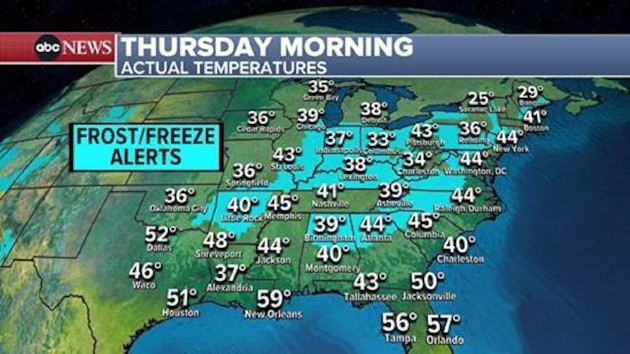
Millions of people from Oklahoma to Maine were feeling their coldest air of the season Thursday morning. Frost and freeze alerts were issued in 20 eastern states or about half of the country.

Frost alerts were also issued for Little Rock, Arkansas, Birmingham, Alabama and Atlanta. Asheville, North Carolina, which is still recovering from devastating floods caused by Hurricane Helene last month, was under a frost alert Thursday.

The weather was also chilly in Tampa Bay, Florida, where temperatures dipped to the 50s Thursday morning.

The cold spell is expected to be short-lived. A warm-up is on the way for much of the eastern half of the United States. Temperatures are forecast to jump to the 70s in the Northeast and the 80s across the South over the weekend.

The high forecast for New York City on Sunday is 73 degrees, while Tampa could reach 83 on Sunday.

The first major winter storm of the season is moving through the Pacific Northwest on Thursday. Ahead of this storm, gusty winds and dry conditions are sparking fire weather alerts across the West Coast.

Red flag warnings signaling elevated fire danger have been issued for the San Francisco Bay Area and much of Northern California. Red flag warnings were also in place Thursday for parts of Colorado and Minnesota, and extreme fire danger is forecast for Nebraska, where warm, dry and gusty winds could spread fires quickly.

Copyright © 2024, ABC Audio. All rights reserved.
Florida man arrested for threatening utility workers restoring power after Hurricane Milton

Florida man arrested for threatening utility workers restoring power after Hurricane Milton
Robert Brook/Getty Images

(NEW YORK) — A man was arrested Wednesday for threatening utility workers who were restoring power in Hillsborough County, Florida, following mass outages caused by Hurricane Milton, according to officials.

Crews were working on a road repair when the man allegedly verbally threatened them and drove his vehicle toward them in an intimidating manner.

The Hillsborough County Sheriff’s Office has identified the suspect as 57-year-old Kenneth Ray Velasco.

When the incident occurred, a power line crew was working on a road that was closed for repairs, creating a traffic delay. The man was in his vehicle and grew impatient.

He backed into a utility pole and fence, causing an estimated $1,000 in damage, according to official reports, and then attempted to flee the scene.

When the linemen tried to prevent him from leaving, he drove toward them in a deliberate manner that caused them to jump out of the way and also threatened to shoot them, officials said.

“Linemen have been working tirelessly to restore power after the storm,” said Sheriff Chad Chronister. “For this person to threaten their lives and deliberately endanger them, all because of a traffic delay, shows a disturbing lack of regard for the safety of others and the critical work being done.”

Velasco was pulled over in a traffic stop and charged with aggravated assault and felony criminal mischief for vandalism of property, according to the sheriff’s office.

He was arrested without incident, officials said.

“We’re grateful no one was seriously hurt, and this suspect will face the full extent of the law for his egregious crimes,” the sheriff said.

As of Wednesday evening, nearly 20,000 residents of Hillsborough County are without power.

The investigation into the incident is ongoing.

ABC News’ Victoria Arancio contributed to this report.

Copyright © 2024, ABC Audio. All rights reserved.