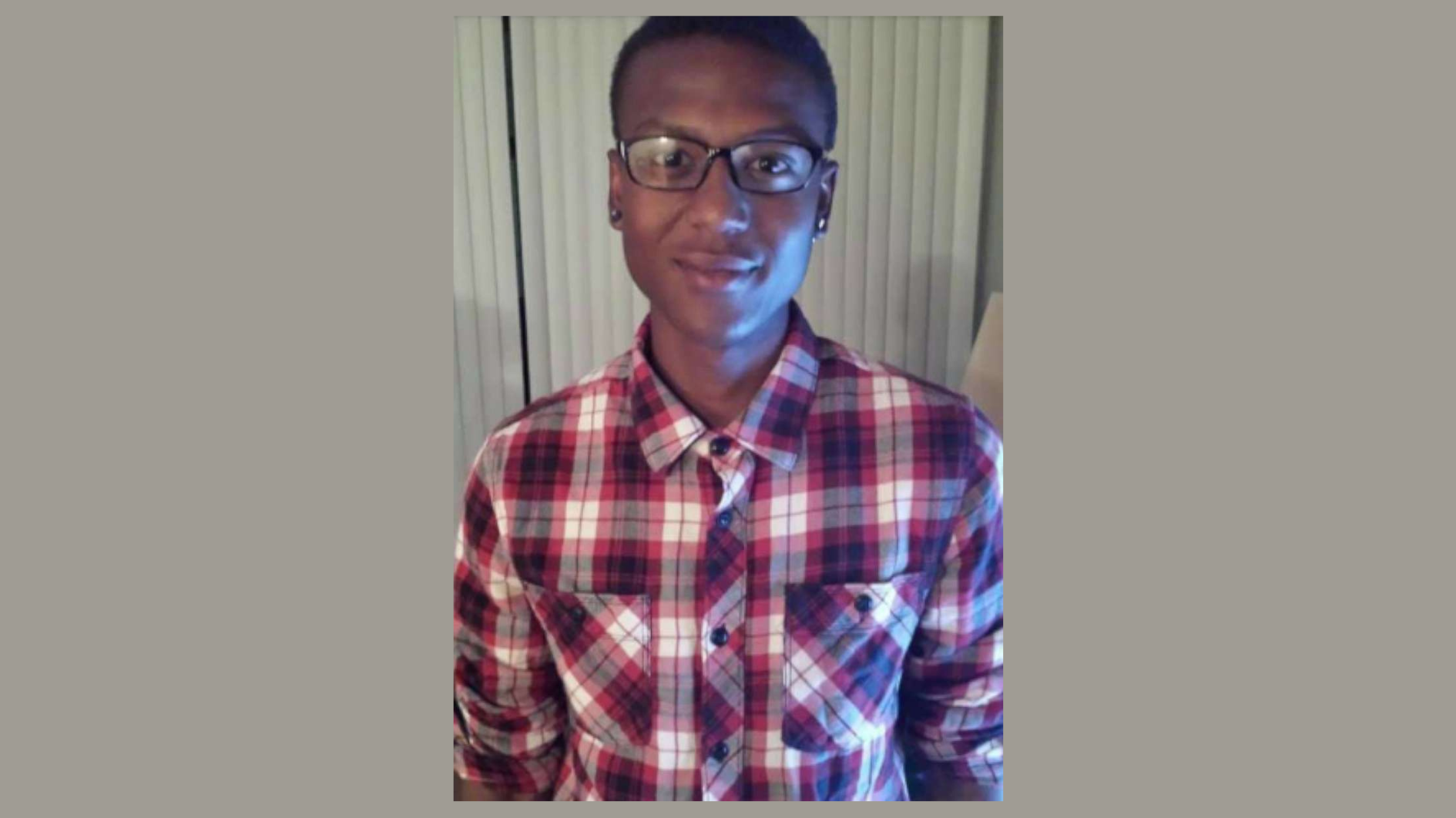
Elijah McClain in an undated photo. (Family photo)
(NEW YORK) — The Colorado Court of Appeals reversed the convictions of two former Aurora paramedics, who were convicted in December 2023 of criminally negligent homicide in the 2019 death of Elijah McClain, a 23-year-old unarmed Black man who was walking home from a convenience store.
In reversing the convictions, the judge ruled on Thursday that the case should be sent back to the district court for a possible retrial.
McClain’s case gained national attention, particularly in the wake of the May 2020 killing of George Floyd, becoming one of the prominent cases that fueled Black Lives Matter protests across the country.
Sheneen McClain, Elijah McClain’s mother, reacted to the reversal of the convictions in a post on social media on Thursday, calling the move “corrupt and cowardly.”
“I am not surprised by the denial of true justice for American citizens in the hands of government branches who allow criminal behaviors in their police agencies,” she wrote. “They are corrupt and cowardly.”
ABC News has reached out to attorneys for the paramedics, Peter Cichuniec and Jeremy Cooper, for comment.
Colorado Attorney General Phil Weiser told ABC News in a statement that his office stands by its decision to charge the paramedics and “is committed to defending these convictions through the appeals. Justice demands it.”
ABC News reached out to Weiser’s office for further comment.
The charges
Cichuniec and Cooper were accused of administering an excessive amount of ketamine to sedate McClain after an encounter with police on Aug. 24, 2019.
Cichuniec and Cooper were found guilty of criminally negligent homicide on Dec. 23, 2023. Cichuniec was also convicted of assault in the second-degree via the unlawful administration of drugs. Cooper was acquitted of the assault charge in 2023, and they both pleaded not guilty at trial.
The appeals court ruling upheld Cichuniec’s assault conviction, but reversed the negligent homicide conviction.
Cooper was sentenced in 2024 to a four-year probationary sentence for negligent homicide. Meanwhile, Cichuniec was sentenced to five years in prison with a three-year period of parole for the assault charge and one year to be served concurrently on the negligent homicide charge.
Cichuniec and Cooper separately appealed their convictions.
In Thursday’s ruling, the appeals court agreed with Cooper’s defense team that the lower court “misled” jurors by failing to clarify the standard of care applicable to the charge of criminally negligent homicide after jurors asked the court for a definition.
“By telling the jurors to apply the ‘common and ordinary meanings’ of the words in the instruction, the court failed to shine any light on the issue and in fact misled the jurors as to the applicable standard of care: The proper standard wasn’t that of a generic reasonable person but of a person in Cooper’s profession under the existing circumstances,” the ruling reads.
The judge ruled that the reversal of Cooper’s conviction also applies to Cichuniec because they were both tried together in that case.
“The two were tried on identical theories of guilt and the evidence against them was, while not identical, sufficiently similar that we can’t conclude that the errors were harmless as to Cichuniec,” the ruling says.
What happened to Elijah McClain?
McClain was confronted by police while walking home from a convenience store after a 911 caller told authorities they had seen someone “sketchy” in the area.
McClain was unarmed and wearing a ski mask at the time. His family says he had anemia, a blood condition that can make people feel cold more easily.
When officers arrived on the scene, they told McClain they had a right to stop him because he was “being suspicious.”
In police body camera footage, McClain can be heard telling police he was going home, and that “I have a right to go where I am going.”
Officer Nathan Woodyard placed McClain in a carotid, or choke, hold and he and the other two officers on the scene moved McClain by force to the grass and restrained him.
When Cooper and Cichuniec arrived, McClain was given a shot of 500 milligrams of ketamine to sedate him and he was loaded into an ambulance where he had a heart attack, according to investigators.
McClain died on Aug. 30, 2019, three days after doctors pronounced him brain dead and he was removed from life support, officials said.
Former police officer Randy Roedema was found guilty of criminally negligent homicide and assault in the third degree in McClain’s death. He was sentenced to more than one year in the county jail in January.
Two other officers, Jason Rosenblatt and Woodyard, were found not guilty on charges of reckless manslaughter and criminally negligent homicide. Rosenblatt was also acquitted on charges of assault in the second degree.
Karen Read and Alan Jackson greet her supporters after she is acquitted on many of the charges against her on June 18. (Staff Photo By Stuart Cahill/Boston Herald via Getty Images)
(Canton, Mass.) — Karen Read has filed a lawsuit against Massachusetts State Police and the Canton Police Department nearly a year after she was acquitted of killing her police officer boyfriend.
Prosecutors had accused Read of fatally hitting John O’Keefe with her car outside of another officer’s home and leaving him to die in a blizzard in January 2022, to which she pleaded not guilty.
Her first trial ended in a hung jury. In her second trial she was found not guilty of the most serious charges, including second-degree murder, manslaughter and leaving the scene after an accident resulting in death.
The jury did find her guilty of operating under the influence of liquor. The judge immediately sentenced her to one-year probation, the standard for a first-time offense.
In the lawsuit filed Thursday, Read claims she was “wrongfully prosecuted” for the death of O’Keefe — a Boston Police officer — costing her employment and leading to reputational damages, millions of dollars in legal expenses and serious emotional and physical distress and injury.
In the lawsuit, Read alleges that two former officers assigned to the case, former Massachusetts Police Officer Michael Proctor and former Canton Police Officer Sean Goode, were “misogynist bigots” who led a “conflicted and corrupt ‘investigation'” into the death of O’Keefe.
The suit listed some of the text messages found on Proctor and Goode’s phones with sexist and racist remarks that came under scrutiny during the course of Read’s criminal trials.
Proctor previously said he developed strong negative feelings about Read “as the case went on,” in an interview with ABC News. He said he “shouldn’t have” expressed his emotions in that way and should not have texted his friends about the case, calling the texts “regrettable.”
In a statement Friday, an attorney for Proctor pushed back against Read’s claims and maintained that there is “overwhelming” evidence that Read killed O’Keefe by “backing up and striking him” with her vehicle while “highly intoxicated.”
“The focus on anything other than Ms. Read’s own conduct on the night Officer O’Keefe was killed is as telling as it is predictable. Events in Mr. Proctor’s personal life have been reviewed, ad nauseum, by a grand jury, the District Attorney and the Massachusetts State Police,” Matthew Hamel, Proctor’s attorney in the Karen Read case, told ABC News in a statement.
“It is a matter of undisputed fact that anything Mr. Proctor did or said in his personal life, years before Officer O’Keefe was killed, had no bearing whatsoever on the investigation of Karen Read,” Hamel said.
In a statement Thursday, Massachusetts Police said Proctor’s comments are “not tolerated within our ranks.”
“These disturbing messages are entirely inconsistent with any basic standard of decency and certainly with the expectations of a Massachusetts State Trooper. These racist, sexist and abhorrent comments absolutely do not reflect the values of the Massachusetts State Police and are not tolerated within our ranks. They underscore and fully support my decision to terminate Michael Proctor,” Massachusetts State Police Col. Geoffrey Noble said in a statement to ABC News.
Noble also recognized that “this misconduct harmed the public trust on which our mission depends.”
An attorney for Proctor did not immediately respond to ABC News’ request for comment Thursday. Attorney information for Goode was not immediately available Thursday.
The Town of Canton said in a statement Thursday it “learned of a lawsuit filed by Karen Read from the news media and via a press release issued by Read’s legal team. Town Counsel had previously attempted to communicate with Read’s legal team as to the status of her claim, but received no response at the conclusion of the notice period.”
“The Town has not been served, and as such we have nothing to review with legal counsel at this time,” the statement added.
The statement went on to say, “The Town of Canton has the utmost faith and confidence in the new leadership of Canton Police Department under Chief Michael Daniels, and we would refute any broad stroke characterizations about the brave and dedicated men and women who serve in the Department. The Department has made significant strides forward over the past two years, including the acceptance and implementation of findings and recommendations in the outside audit report.”
Read’s suit alleges that the officers began “targeting and framing the female outsider, Ms. Read” after the owners of the house where O’Keefe was found in the front lawn “falsely” told police he never entered the house.
In a statement to ABC News in 2023, the prosecutors said, “There was no conspiracy or coverup. Such claims have been systematically refuted by evidence submitted to Norfolk Superior Court.”
Proctor denied fabricating evidence in the June 2025 interview with ABC News, saying “there is no evidence of it.”
Goode said during his testimony at the trial that he stood by his investigation in the case.
In the lawsuit, Read alleges that O’Keefe had gone into the house of fellow cops and friends Brian and Nicole Albert and claimed that there were signs of dog bites and scratches on his arm and a laceration on his head that “could have only come from a backwards fall on a ridged surface in the house.”
The prosecution said in its statement to ABC News that, according to O’Keefe’s cellphone GPS records and 11 witness statements, O’Keefe never entered Albert’s home. The medical examiner found “no signs of Mr. O’Keefe being involved in any type of physical altercation or fight.”
The Alberts previously said in a statement after Read’s acquittal that they “mourn with John’s family and lament the cruel reality that this prosecution was infected by lies and conspiracy theories spread by Karen Read, her defense team, and some in the media.”
“Today, our hearts are with John and the entire O’Keefe family. They have suffered through so much and deserved better from our justice system,” the statement at the time said.
Read’s suit alleges that Proctor and Goode’s investigative approach was born out of “singling out and vilifying an outsider while protecting the ‘blue line’ and their families.”
Goode resigned this week while on paid administrative leave from the Canton Police Department amid an outside investigation into alleged misconduct, the Boston Herald reported. The resignation does not alter the completion of the investigation and the results will still be submitted to the town and the Peace Officer Standards and Training Commission, the town of Canton told ABC Boston affiliate WCVB.
Read’s suit criticizes police for not searching the home where O’Keefe was found for blood, fingerprints or DNA evidence. Police only entered the “crime scene house” a week later, according to the suit.
Prosecutors said that evidence shows O’Keefe never entered the home and was not murdered by anyone inside the residence, alleging his injuries were sustained by Read hitting him with her car. Prosecutors insisted that those gathering inside the house had no idea O’Keefe was outside until he was discovered the next morning.
Read is asking the court for a ruling against Massachusetts State Police and Canton Police, an unspecified amount of damages to be calculated at trial and attorney’s fees.
The Hammond Police Department is searching for gunmen who shot and killed an innocent 50-year-old woman at a Chevron gas station in Hammond, Louisiana, June 4, 2026. (Hammond Police Department)
(HAMMOND, La.) — An innocent woman was killed when gunmen fired 70 to 80 bullets into a car at a Louisiana gas station, apparently believing that their target was in the car, according to police.
Hammond police said the gunmen’s alleged target had been in the car before the shooting, but not at the time of the shooting.
Before the gunfire erupted early Thursday, the suspects were stalking a car at a farm, Hammond Police Chief Edwin Bergeron Jr. said at a news conference.
“At some point [the alleged target] was in the vehicle, and then exited the vehicle to ride with someone else,” Bergeron said.
The victim’s car then left the farm and went to a Chevron gas station, the chief said, and the suspects followed.
When the driver of the victim’s car got out and went inside the gas station, the suspects’ car “pulled up next to it … and began shooting,” Bergeron said.
The suspects fired between 70 and 80 shots, taking the life of 50-year-old Patricia Shepard, who was sitting in the car, Bergeron said.
She was an “absolute innocent victim,” the chief said. “She was not involved.”
Bergeron said investigators are searching for at least two or three suspects.
“We will not rest until the scumbags like this go to jail … for them to roll up and kill an innocent woman in a car because they thought it was somebody else,” he said.
The suspects were driving a car that was stolen in Mississippi earlier in the week, police said.
Authorities urge anyone with information to call the Hammond Police Department at 985-277-5755 or the Crime Stoppers anonymous tip line at 1-800-554-5245.
The judge’s gavel and scales as a symbol of the judiciary and justice. (SimpleImages/Getty Images)
(NEW YORK) — A Virginia man found guilty of killing his wife and a stranger lured to their home in an elaborate plot to get rid of his spouse so he could be with his au pair is set to be sentenced on Friday.
Brendan Banfield was convicted in the 2023 murders of his wife and a man prosecutors said he “catfished” on a fetish website. Prosecutors said Brendan Banfield pretended to be his wife to lure the man to their Fairfax County home for what was believed to be a consensual fake rape scenario in order to frame that stranger for his wife’s murder.
A jury found him guilty of two counts of aggravated murder in February. He faces a life sentence without the possibility of parole.
The former IRS agent was charged with two counts of aggravated murder in 2024 following a monthslong investigation into the deaths of his wife, 37-year-old nurse Christine Banfield, and the stranger, 39-year-old Joseph Ryan.
Prosecutors said Brendan Banfield plotted the murders with the family’s au pair, Juliana Peres Magalhães, with whom he was having an affair.
Police responded to a 911 call from the home in Reston on Feb. 24, 2023, and found Ryan dead in an upstairs bedroom with gunshot wounds to his head and chest. Christine Banfield had been stabbed seven times in the neck, prosecutors said.
At the time, Magalhães and Banfield told police they came home to find Ryan stabbing Christine Banfield to death. Banfield and Magalhães each shot Ryan, they said in their 911 call and to responding officers at the scene.
Magalhães was arrested first and initially charged with second-degree murder for the death of Ryan. She pleaded guilty to manslaughter in 2024 and was sentenced to 10 years in prison, the maximum, in February. Prosecutors said she admitted to shooting Ryan at Brendan Banfield’s direction.
Brendan Banfield was arrested several months after Magalhães and charged with two counts of aggravated murder for the deaths of his wife and Ryan.
Prosecutors said Brendan Banfield stabbed his wife with a kitchen knife that Ryan had been instructed to bring, and, before calling 911, altered the crime scene to make it look as though Ryan stabbed her — including by transferring some of his wife’s blood onto Ryan’s hands.
Magalhães testified against Brendan Banfield during his trial, telling the court that he expressed his desire to “get rid of” his wife in October 2022. She said he told her he wanted to marry her and have children with her, and that he didn’t want to divorce his wife because “she would have more money than he would” and because he wanted custody of the couple’s daughter.
She prayed for forgiveness from the victims’ families during her sentencing hearing.
“There is nothing I could possibly do to make it up to you, for your loss. There are so many regrets, this is my biggest. It’s a tragedy I have been carrying with me, and I know I can never take back the devastation of what I have done,” she said.
Following Magalhães’ sentencing, Fairfax County Commonwealth’s Attorney Steve Descano said the au pair’s testimony was “invaluable in helping the jury understand the convoluted double-murder plot orchestrated by Brendan Banfield.”
During his three-week-long trial, Brendan Banfield testified in his own defense. He admitted to the affair though maintained his innocence.
He said he came home on Feb. 24, 2023, after the au pair called to alert him about a stranger in the home. He said he went up to his bedroom with his gun drawn and found his wife naked with Ryan and that she called out, “Brendan, he has a knife!”
“I was extremely terrified,” Brendan Banfield told the jury. “I don’t think I’ve ever been more panicked in my life.”
He said he fired his government-issued firearm, striking Ryan in the head, after he said the man appeared to stab his wife.
The couple’s then-4-year-old daughter was in the basement of the house at the time of the killings. Brendan Banfield was additionally found guilty of child endangerment, as well as using a firearm while committing or attempting to commit murder.
ABC News’ Sophie Sonnenfeld contributed to this report.
A 31-page report on the White House ballroom submitted to the panels reviewing the project show the proposed addition to the White House from additional angles and features new renderings of the project. Commission of Fine Arts
(WASHINGTON) — President Donald Trump’s plans to build a White House ballroom are in the hands of three appellate judges who will hear oral arguments Friday over whether construction should be allowed to continue.
The panel of the U.S. Court of Appeals for the D.C. Circuit will weigh the Trump administration’s request to throw out a lower court judge’s order halting the construction, in a lawsuit brought by historic preservationists.
U.S. District Judge Richard Leon ruled in late March that Trump has gone beyond his authority in building the ballroom, given that it has not been authorized by Congress. Leon’s order was administratively stayed by the appellate panel on April 17, a move that has allowed construction to continue since then.
The Trump administration has argued in court papers that beyond the president’s desire to build a large, permanent event space to host future inaugurations and state dinners, the ballroom — part of a broader “East Wing Modernization Project” — is essential to national security.
The Justice Department points to recent shootings that have occurred in relatively close proximity to the president, including at the White House Correspondents’ Dinner in April and on Pennsylvania Avenue in May, as examples of why the ballroom is needed for security reasons. Both of those incidents had gunmen allegedly exchanging fire with Secret Service police officers.
The government’s filings in the case have described the ballroom project as a fortification of the entire White House complex, saying that with its “deeply ensconced bunker, and its attendant bomb shelters, hospitals, medical facilities, and other National Security functions, to the highly sophisticated Drone Port and Sniper Nests atop the Ballroom, the complex is a highly knitted, unified whole.”
The administration also argues that the group that has sued, the National Trust for Historic Preservation, lacks the standing necessary to bring a case.
Lawyers for the National Trust say that it’s Congress, not the president, that controls the grounds of the White House, and that Leon was correct to determine in his ruling that no statute “comes close” to giving Trump the authority he claims to construct a large edifice next to the executive mansion.
“The public’s interest in its government following the law, and the maintenance of the President’s proper role in our system of separated powers, underscore that the district court did not abuse its discretion,” they write in a brief, urging the appeals court judges to let Judge Leon’s injunction stand.
Prior to beginning consideration this week of an immigration enforcement funding bill, Senate Republicans removed a $1 billion provision, drafted in response to a request from the Secret Service, that officials said a portion of which would have gone toward security-related aspects of the ballroom project.
Arguments in the case will be heard by Obama-appointee Patricia Millett, Trump-appointee Neomi Rao and Biden-appointee Brad Garcia.
ABC News’ Peter Charalambous contributed to this report.
(MIAMI) — A man, woman and two girls were found stabbed to death in what investigators believe is a murder-suicide in Miami.
Investigators said they believe 42-year-old Ryan Charles Whiten killed 46-year-old Melanie Lauren Hyer, 11-year-old Savannah Whiten and 8-year-old Sienna Whiten before taking his own life, according to the Miami-Dade Sheriff’s Office.
Ryan Charles Whiten was the biological father of Savannah Whiten and Sienna Whiten, and Hyer was the girls’ mother, according to the sheriff’s office.
Doral Police Officers responded to a residence in Miami-Dade for a welfare check on Tuesday at around 7:30 p.m., according to the sheriff’s office.
Officers entered the residence when they arrived on the scene to find a woman, man and two girls all unresponsive, according to the sheriff’s office. All four individuals suffered stab wounds and were pronounced dead at the scene.
“The Miami-Dade Sheriff’s Office Homicide Bureau investigation is currently leading detectives to believe this incident was a murder-suicide. Investigators are continuing to work closely with the Miami-Dade County Medical Examiner’s Office as the investigation remains active,” the sheriff’s office said in a statement.
A composite posted to the Department of Justice’s X account, June 4, 2026. (Department of Justice)
(WASHINGTON) — Senior Justice Department leaders on Thursday announced a number of cases against those who they say perpetrated fraud in Ohio.
Four people, including two state of Ohio employees, were charged with a $30 million fraud scheme targeting the state’s behavioral health department.
Two of the defendants owned businesses which claimed to provide behavioral health services for young adults that attend summer camps, church groups and recreational programs, according to the Justice Department.
The Justice Department alleges the two businesses submitted fraudulent claims for services that were never rendered. After the claims were not submitted because one of the behavioral health organizations’ accreditation was invalid, the two allegedly conspired with another individual to submit claims.
The funds were used to fund a lavish lifestyle, according to DOJ, including purchasing 14 vehicles worth $800,000.
“The days of the brazen theft that we’ve seen of taxpayer dollars, abusing the generosity of the American taxpayer is over,” acting Attorney General Todd Blanche said at a press conference in Columbus, Ohio. “Our message to fraudsters is simple: With our state and local partners, the Department of Justice will be working day and night to identify you, arrest you and imprison you.”
Blanche and other federal leaders, including FBI Director Kash Patel and Centers for Medicare & Medicaid Services Administrator Dr. Mehmet Oz, were in Ohio to not only announce charges against alleged fraudsters, but to also announce a Top 10 fraudsters list and tout the cooperation between Ohio authorities and the federal government on fraud issues.
“Our best form of information is the American public,” Patel said. “Take a look at this Top 10 most wanted. Let us know any information. There is no bad piece of information. The only bad piece of information is the one you don’t give us.”
Earlier this week, the Justice Department charged five individuals with scamming older Americans in romance fraud schemes totaling $15 million. The five — mostly from Ghana — allegedly used AI to create false stories and indicate to people they were interested in them romantically to get them to send them money.
“Once they establish trust, they use false pretenses and stories about vast inheritances of money, gold, or diamonds, and then convince these elderly Americans to help finance bogus legal proceedings in the nation of Ghana,” U.S. Attorney for the Northern District of Ohio David M. Toepfer said at the press conference.
The scheme allegedly went on for almost two years and impacted more than 100 people.
“They then use this stolen money to buy a mansion in Ghana. Diamond-encrusted jewelry, a Lamborghini and other high-end luxury vehicles. All of those assets have now been seized and are going through the forfeiture proceedings so that they will not profit from their fraudulent efforts,” Toepfer said.
(NEW YORK) — As residents of the Great Plains brace for more severe weather stretching into the weekend, summer-like temperatures are heating up the Northeast.
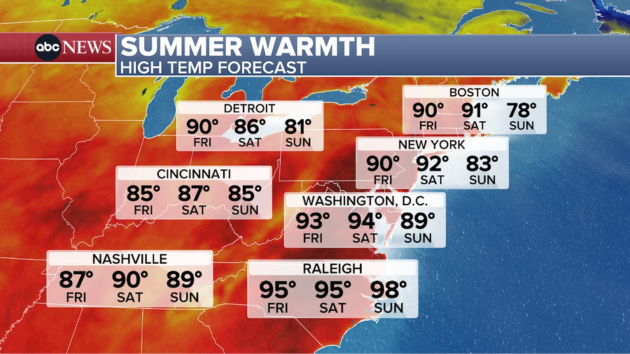
From New York City to Raleigh, North Carolina, temperatures are expected to be in the 90s on Friday and Saturday before a cold front arrives on Sunday.
The temperature in Raleigh is expected to hit 100 this weekend. Washington, D.C., is also forecast to see 90-degree temperatures through Saturday.
Humidity is not expected to be much of a factor in the Northeast as dew points remain low, meaning the “feels-like” temperatures will be nearly identical to the actual temperatures.
Some areas of the West are expected to see triple-digit temperatures. Phoenix, Arizona, could reach 110 degrees on Thursday.
Damaging winds and hail expected in the Great Plains
Severe weather is expected to continue in the Great Plains through the end of the week, with damaging winds and large hail forecast to be the main threats.
An isolated tornado or two and some instances of flash flooding are also possible on Thursday across the Great Plains, including South Dakota, southeast Montana, northeast Wyoming and northern Nebraska.
On Friday, severe weather, including damaging winds and large hail, is expected from Nebraska to Iowa and into southern Minnesota, including the cities of Omaha and Lincoln, Nebraska; Rochester, Minnesota; and Des Moines, Iowa.
On Saturday, severe weather is expected to move into the Great Lakes region and bring rain to parts of the Northeast on Sunday.
The foul weather in the Great Plains comes after the region was hit by severe thunderstorms and damaging winds on Wednesday. Thunderstorms and wind gusts of more than 80 mph were reported in Frederick, South Dakota, on Wednesday, leaving buildings damaged, a radio tower and power lines toppled, and trees uprooted.
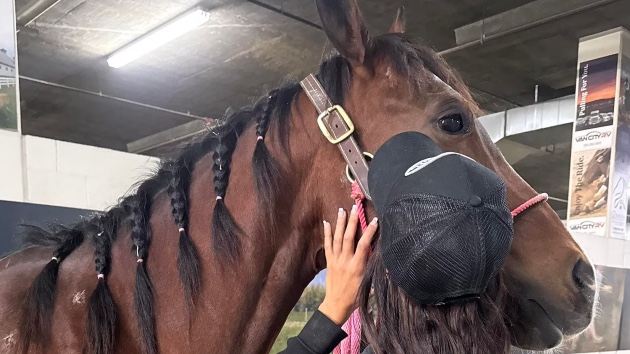
A horse, named Detail, who was unable to compete due to a stabbing injury. (Obtained by ABC News)
(LAS VEGAS) — The teenage girl accused of stabbing three horses made her first appearance in juvenile court in Nevada on Thursday as prosecutors hope to move her case to adult court.
The judge said he believed the teen was a public safety risk and ordered her to remain in custody with no bail, ABC Las Vegas affiliate KTNV reported. She’s due to return to court on July 8 when attorneys will discuss the possibility of moving her case to adult court, according to the Clark County District Attorney’s office.
The girl — who was in Las Vegas for the National Barrel Horse Association’s Professional’s Choice Vegas Super Show — is accused of attacking three horses in a barn early Saturday, according to Las Vegas police and the NBHA.
She allegedly had access to the barn and authorities believe she may have used a knife to wound the horses, authorities said.
The horses’ injuries were non-life-threatening but the wounds did keep the animals from competing in the event, which took place over the weekend, according to police.The teenager was arrested for 12 counts of willful/malicious kill/maim/torture animal — horse and three counts of felony malicious destruction of private property over $5,000, authorities said.
The Clark County District Attorney’s office said Tuesday that it wants the teen charged in adult court.
“These allegations involve deliberate acts of extreme cruelty against defenseless animals and have had a significant impact on the victims, the owners, and the broader equestrian community,” DA Steve Wolfson said in a statement.
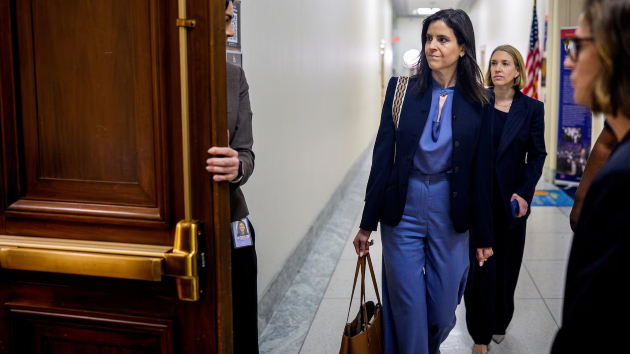
Jeffrey Epstein’s former assistant Sarah Kellen arrives to testify at a closed-door interview with the House Oversight Committee on Capitol Hill, May 21, 2026 in Washington. (Andrew Harnik/Getty Images)
(WASHINGTON) — House Oversight Committee Chairman James Comer (R-Ky.) on Thursday asked the Justice Department to investigate allegations of sexual abuse raised by a former assistant to Jeffrey Epstein during her interview with the committee last month, according to a letter from Comer and three other Republican lawmakers.
Sarah Kellen, a longtime personal assistant to Epstein, told the Oversight Committee that she was sexually abused by Epstein for over a decade, and disclosed for the first time allegations that she was also abused by Ghislaine Maxwell, Epstein’s convicted accomplice, and by two other men in his orbit, according to a transcript of Kellen’s interview made public Thursday.
Kellen alleged that celebrity hairstylist Frédéric Fekkai and Phillip Levine, a wealthy businessman who was later elected mayor of Miami Beach, were the other men who had also abused her.
Comer’s letter asks the DOJ to “use all available tools, including immunity for certain witnesses, to investigate the allegations against, and any other criminal conduct committed by, Phillip Levine and Frédéric Fekkai.” The committee also asked the DOJ for an explanation as to why Kellen was never interviewed by law enforcement until Epstein’s arrest in July of 2019.
Both men, through their representatives, denied the allegations in statements to ABC News.
Kellen’s closed-door appearance before the Oversight Committee, which took place May 21, was part of the panel’s ongoing inquiry into the federal government’s handling of investigations into Epstein and his alleged co-conspirators.
One of four women named as potential co-conspirators in Epstein’s controversial 2007 non-prosecution agreement, Kellen was previously a subject of criminal investigations in Florida and New York. She has never been charged — due, in part, to her own allegations of persistent sexual abuse at the hands of the disgraced financier, according to court documents and records released earlier this year by the Justice Department.
“I was there only to serve and to submit. Only after Jeffrey confirmed that I would submit to his sexual abuse did he begin paying me,” Kellen told the committee in her opening remarks.
Kellen said she did not know her name was included in Epstein’s non-prosecution agreement until the document was made public a few years later. The deal allowed Epstein to avoid federal charges for alleged sexual crimes involving dozens of underage girls.
“The Federal Government of the United States branded me a criminal in a secret deal with my own abuser, without ever once speaking to me,” Kellen said. “I have spent every year since trying to live underneath that piece of paper.”
‘A terrible scenario’
Kellen appeared before the committee voluntarily, accompanied by two attorneys. The scope of her appearance was limited — by advance agreement with the committee — and focused primarily on her own alleged victimization. On advice of her counsel, she largely declined to answer questions about other alleged victims and about Epstein’s scheme to recruit underage girls for massages — the core activity that led to Epstein’s criminal charges.
“She’s not going to answer questions about other victims and questions specific to massages in Palm Beach [that] could implicate other victims,” said attorney Kimberly Hamm, citing privacy concerns and Kellen’s constitutional rights.
Kellen told the lawmakers she would be “a hundred percent” willing to answer more questions if given immunity by Congress or the Justice Department.
In advance of Kellen’s appearance, Comer told reporters that committee members were split on their perceptions of her, given the allegations that Kellen was involved in scheduling some of Epstein’s massages.
“There are some that believe she was 100% a victim or survivor, and then there are some that think she was a victim and victimizer. So, it’s just a terrible scenario,” he said.
After the interview Comer said he believed Kellen “was a victim” and called her appearance “the most substantive, productive interview that we’ve had.”
Rep. Robert Garcia of California, the committee’s top Democrat, used his time to query Kellen about her knowledge of Epstein’s previous relationship with President Donald Trump, who had a friendship with Epstein until they had a falling out around 2004 and has repeatedly denied any knowledge of Epstein’s crimes.
Kellen said she recalled Epstein “using the gym a lot” at Trump’s Mar-a-Lago estate during the early years of her employment, and assumed Epstein and Trump were friends based on photographs Epstein displayed in his homes. She said she met Trump just once, during a brief encounter at Mar-a-Lago in 2001 or 2002.
“Jeffrey introduced me to him,” she said. “That was my only encounter with him during my employment.”
‘He took advantage of me’
One of the committee’s central interests was whether Kellen had directly witnessed any inappropriate sexual activity by prominent individuals linked to Epstein — and in each case, Kellen said no.
But when asked if anyone associated with Epstein had abused her, Kellen named Maxwell, Fekkai and Levine.
Kellen alleged that Fekkai, now 68, abused her before she began working for Epstein. She told the panel that in the early 2000s, when she was trying to get modeling opportunities, Fekkai invited her to a fashion show in Hawaii. When she arrived, there was no show.
“I didn’t have any money to get my own hotel room or fly back, and he took advantage of me that night,” she said, according to the interview transcript. Kellen said was in her early 20s at the time. She said that Fekkai later introduced her to Epstein, who he described as a model scout for Victoria’s Secret.
A representative for Fekkai denied Kellen’s allegations in a statement to ABC News.
“Mr. Fekkai was astonished to read of Ms. Kellen’s testimony. Mr. Fekkai never abused anyone. He never participated in any illegal behavior, He knew nothing about Epstein’s repugnant depravity or trafficking. He did nothing wrong,” the spokesperson, Mark Herr, said in the statement.
The incident involving Levine, Kellen said, allegedly occurred during a summer trip to France around 2003, when Levine was a houseguest at a property Epstein and Maxwell had rented in Saint-Tropez. After Epstein and Maxwell had gone to sleep, Kellen claimed Levine “basically forced himself” on her.
“He came up to me, and he was like, ‘You know, must be so lonely for you, working with them, because you’re with them all the time, and you can’t have your own life, so you must be really lonely,’ and he basically forced himself on me,” she said.
She claimed it happened again during a walk on the beach when Levine “grabbed my hand and pulled me” into a wooden shack.
A spokesperson for Levine, 64, denied Kellen’s allegations in a statement to ABC News.
“Nearly a quarter century ago, our client had a brief intimate encounter with another consenting adult,” the statement said. “Any allegation suggesting otherwise is not true.”
Levine has previously said that he “never had a friendship or business relationship” with Epstein, according to a report in the Miami Herald.
Kellen told the committee she did not know what, if anything, Epstein and Maxwell knew about either alleged incident. She did not report them at the time, and said she had not considered pursuing legal action against Levine.
‘Cold sheets’
Kellen, 47, said she began working for Epstein and Maxwell around 2001, after being approached about the job by a co-worker at a hotel in Hawaii. She said she had no idea it was Epstein until she arrived at his private island.
Kellen described Epstein to lawmakers as controlling every dimension of her life — dictating her clothing, her haircut, her hair color, and where she lived. She said he had a code phrase, “cold sheets,” that meant she was to come to his residence and sleep with him. He referred to her, she said, as his “human hot water bottle.”
“I was being paid, in part, to be raped,” she told the committee.
The assaults, she said, occurred on average once a week. Even during his Florida jail sentence, she said, Epstein made a video call to her from inside the Palm Beach County Stockade and ordered her to undress on camera.
Maxwell, Kellen said, was present and participated in her abuse on one occasion on the island. “And I just remember her touching me and showing me how to touch Jeffrey and what he liked,” Kellen said. Maxwell was also, she said, a pervasive psychological force — repeatedly reinforcing Epstein’s power, allegedly calling Kellen her “slave” and “minion.”
“She just fed him and catered to every whim that he wanted,” Kellen said of Maxwell, adding: “I always felt like she turned him into the monster that he became.”
Maxwell — who is serving a 20 year sentence at a federal prison camp in Texas — could not be reached for comment. She has maintained her innocence and has argued that the government prosecuted her as a substitute for Epstein, following his death in custody in 2019.
Kellen described two incidents suggesting possible efforts by Epstein to obstruct the first investigation into his conduct during the mid-2000s. While on Epstein’s private island in 2005, she said she overheard Epstein on the phone instructing another assistant to go to the Palm Beach house and remove computers.
The following February, she said, Epstein summoned her to his New York townhouse and directed her to collect all of his printed contact directories and certain framed photographs and bring them to his lawyers. She said she did not know what happened to the items afterward or why she was asked to gather them.
Kellen also said that in 2007 — as she and another woman were leaving Epstein’s private island — an airport employee informed them that FBI agents wanted to speak with them. Epstein told them to wait, walked over to the agents himself, and returned ten minutes later. “OK, let’s go,” he said, according to Kellen.
Kellen also told the committee that she had received gifts from Epstein through the years, including jewelry, luggage and clothing, as well as a New York City apartment to stay in. She said Epstein gave her money to help pay for her wedding in 2013, and $250,000 in late 2018, after the Miami Herald had published in-depth reports on Epstein.
After Epstein’s arrest in July 2019, federal prosecutors cited the $250,000 payment to Kellen to suggest that Epstein was attempting to buy her silence.
Kellen claimed to the committee that the money was to assist her and her then-husband after he had health issues, and was not connected to the Herald articles, which she said Epstein dismissed as “old news.. She acknowledged that Epstein told her not to tell anyone about the payment, but didn’t say why.
“I had no idea. I didn’t know if he maybe didn’t want to make other people jealous or something,” she said.
‘A very vulnerable victim’
Kellen’s appearance on Capitol Hill came as the committee ramps up for a busy stretch of its investigation, officially launched in February of last year. Other notable witnesses scheduled in the coming weeks include another longtime Epstein assistant Lesley Groff, former Goldman Sachs chief counsel Kathryn Ruemmler, Epstein’s former personal banker Jes Staley, and billionaires Bill Gates and Leon Black.
Comer has indicated that a report on the committee’s findings will be produced before the end of the year.
Following Epstein’s death in custody in July 2019, federal prosecutors in New York investigating possible collaborators engaged in discussions with Kellen and her attorneys that spanned more than a year. Documents released by the DOJ earlier this year included prosecutors’ internal assessments of a potential case against Kellen and emails from her attorneys arguing against charges.
“We feel that given [Kellen’s] abuse, and given the fact that we see her basically as a cog in Epstein’s wheel, acting entirely at his direction and doing what she did at a time that she herself was a very vulnerable victim, a [non-prosecution] would be the appropriate disposition,” an attorney for Kellen wrote in the spring of 2020.
According to DOJ records, the government did not dispute that Kellen “was herself a victim of abuse by Epstein.” Prosecutors detailed in a proposed “statement of facts” sent to Kellen’s attorneys in late 2020 that several “minor victims reported to federal agents that Epstein paid them for sexualized massages … including during massages that [Kellen] scheduled.”
Kellen claimed to prosecutors that she was provided a directory of names and instructed by Epstein on who to call, and denied having knowledge that some who came to the house were underage.
She told prosecutors she viewed the “masseuses as her peers — i.e. young adults … and it never [crossed] her mind that any of them were minors,” government lawyers wrote in a December 2019 memo summarizing their investigation.
Kellen said she “only learned that Epstein was sexually abusing minors when news articles started coming out about it” in the mid-2000s, and recalled being “shocked, angry, and disappointed,” the records said.
Federal prosecutors ultimately decided against charging Kellen, though the internal deliberations that led to that outcome remain redacted in the publicly available versions of the DOJ records.
Maxwell, Epstein’s former girlfriend and associate, remains the only other person charged in connection with Epstein’s crimes. She is presently seeking to have her conviction vacated or her sentence reduced.
When Maxwell was sentenced in 2021, U.S. District Judge Alison Nathan said the evidence showed that Maxwell supervised Kellen, who Nathan described as a “criminally responsible participant” in Epstein’s scheme. Kellen was not called as a witness by the government or by Maxwell.