A 13-year-old was apprehended for allegedly targeting young girls in a string of home invasions in Michigan, authorities said. Oakland County Sheriff’s Office
(DETROIT) — A 13-year-old was apprehended for allegedly targeting young girls in a string of home invasions in Michigan, authorities said.
The teen was allegedly involved in nine break-ins in Pontiac and two in Detroit, Oakland County Sheriff Michael Bouchard said.
On Feb. 4, the suspect — who was wearing a ski mask and was armed with a knife — choked a sleeping 10-year-old girl, according to the sheriff’s office. The girl screamed, and then her mom saw the suspect run down the stairs and out of the house, the sheriff’s office said.
“This is the worst nightmare for any parent — that somebody might be trying to climb in through a window to get after their kids, especially a young teenage girl,” Bouchard said at a news conference.
There were few physical injuries, but Bouchard stressed the immense “emotional trauma” of being targeted in bed.
The break-ins began two years ago, Bouchard said. The suspect allegedly looked for unlocked windows and had a knife during several incidents, he said.
Charges are not yet clear. The 13-year-old’s parent has been cooperative, Bouchard said.
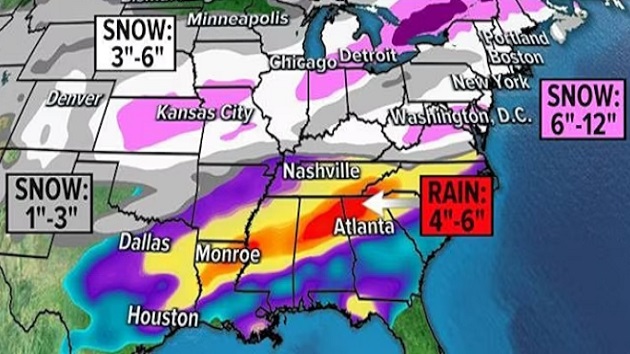
(NEW YORK) — Two major winter storms are bearing down on the U.S. this week and are expected to bring some of the highest snow totals of the season for cities including Chicago and Washington, D.C.
The first storm, which spans from Colorado to Delaware, will hit Tuesday morning through Wednesday morning.
By 7 a.m. ET Tuesday, heavy rain is expected from Dallas to Nashville, Tennessee, while snow will be falling from Louisville, Kentucky, to Richmond, Virginia.
The snow will arrive in D.C. by noon on Tuesday and may last for over 12 hours. Some light snow may make it as far north as Philadelphia.
Four to 6 inches of snow is possible for the D.C. and Baltimore region.
Meanwhile, the heavy rain in the South may cause flash flooding.
By the time that first storm leaves the East Coast, the second storm will have already started in the Midwest.
At 7 a.m. ET Wednesday, widespread snow is expected from Colorado to Iowa to Missouri, while heavy rain will be falling from Houston to Louisiana.
In Chicago, the snow will begin around 9 a.m. Wednesday and may last for over 12 hours. Five to 9 inches of snow is possible in the Windy City.
Then, in the East, a mix of rain and freezing rain expected in D.C. and Philadelphia beginning after 5 p.m. Wednesday and continuing overnight.
In New York City and Boston, the snow is forecast to start Wednesday night and then change to rain overnight.
Both storms combined will result in hefty snow totals in the Midwest and the Mid-Atlantic, and potentially flooding rain for a wide swath of the South.
(AUSTIN, Texas) — An American Airlines flight was delayed last week after the crew alerted authorities about suspicious activity on the plane “regarding the name of a WiFi hotspot involving the word ‘bomb.'”
American Airlines Flight 2863 was scheduled to travel from Austin, Texas, to Charlotte, North Carolina, with a planned departure time of 1:42 p.m.
Bruce Steen, 63 years old, of Charlotte, North Carolina, was one of the passengers aboard the flight amid the incident at Austin-Bergstrom International Airport.
Steen told ABC News that he was traveling home from a meeting in Austin on Feb. 7 when the incident occurred.
He said that he was seated toward the front of the plane and saw a young man walking up to a flight attendant with a tablet to show her something. The flight attendant immediately called the cockpit, Steen said, and soon the pilot announced that the flight would be returning to the gate due to an “administrative issue.”
In the meantime, the crew had reported the incident to the Austin Police Department and the Department of Aviation.
Steen said that after a few minutes, the pilot came back on and announced that “somebody renamed their hotspot.” Steen said the crew said the hotspot was called: “There is a bomb on the flight.”
A lieutenant from Austin PD then came onboard and told passengers the renaming was not funny, Steen told ABC News, recalling that the official said: “If this is a joke, please raise your hand now, because we can deal with the practical joke differently than if this, if we have to do a full blown investigation of what’s going on here.”
Steen said no one raised their hands — and everyone was escorted off the plane in groups by the Austin PD.
At one point, every passenger had to show their hotspot to police officers, Steen said.
The Transportation Security Administration said in a statement to ABC News that the agency and its partners in the transportation sector “take bomb threats very seriously.”
“All passengers and their checked baggage were rescreened,” the TSA confirmed.
A dog sniffed all the luggage and the police checked the baggage compartment on the plane, Steen told ABC News.
After the aircraft and luggage were swept for explosives, the aircraft was cleared by the Austin PD.
The flight departed around 6:15 p.m. local time, according to airport officials.
Austin Airport said there were no significant impacts to airport or airline operations, other than the delayed flight that was involved in the incident.
The Austin Police Department did not immediately respond to a request for comment.
(BOSTON) — A federal judge in Boston Monday will consider whether to block President Donald Trump and tech billionaire Elon Musk from carrying out their unprecedented plan to buy out tens of thousands of federal employees.
Three federal employee unions — with the support of 20 Democratic attorneys general — have argued that the Office of Personnel Management’s deferred resignation offer is an “unlawful ultimatum” to force the resignation of government workers under the “threat of mass termination.”
“OPM’s Fork Directive is a sweeping and stunningly arbitrary action to solicit blanket resignations of federal workers,” wrote lawyers for the American Federation of Government Employees, the American Federation of State, County and Municipal Employees, and the National Association of Government Employees. “Defendants have not even argued — nor could they — that the Fork Directive was the product of rational or considered decision-making.”
The buyout offer, part of Trump’s effort to trim the size of government through Musk’s newly formed Department of Government Efficiency, was sent out under the subject line “Fork in the Road” — the same language Musk used when he slashed jobs at Twitter after taking over that company in 2022.
In court, the Trump administration has described the buyout as one of the first steps in the president’s plan to “transform the federal workforce,” arguing that any further delay of the buyout would cause “remarkably disruptive and inequitable repercussions.”
Monday’s hearing comes less than two weeks after more than two million government employees received the “Fork in the Road” email from the Office of Personnel Management, offering full pay and benefits until September for any federal employee who accepted a deferred resignation by Feb. 6.
Just hours ahead of Thursday’s deadline for employees to accept the offer, U.S. District Judge George O’Toole Jr. — who was nominated to the bench by President Bill Clinton — temporarily blocked the offer until Monday so he could consider issuing a temporary restraining offer pausing the order.
“I enjoined the defendants from taking any action to implement the so-called ‘Fork Directive’ pending the completion of briefing and oral argument on the issues,” Judge O’Toole said in his ruling. “I believe that’s as far as I want to go today.”
The Trump administration, in response, “extended” the deadline for the offer, which more than 65,000 federal employees have already taken.
“We are grateful to the judge for extending the deadline so more federal workers who refuse to show up to the office can take the Administration up on this very generous, once-in-a-lifetime offer,” press secretary Karoline Leavitt said last week.
The unions who brought the lawsuit argued that Trump exceeded his authority as president with the offer, which they described as a “slapdash resignation program.”
According to the plaintiffs, Trump’s offer violates federal law, lacks congressionally appropriated funding, and does not offer employees reassurance that the president would follow through with the offer. Their claim in part relies on a federal law from the 1940s called the Administrative Procedure Act that governs how federal agencies create and enforce rules.
“In the tech universe, ‘move fast and break things’ is a fine motto in part because they’re not playing with the public’s money, and it’s expected that most initiatives are going to fail,” Loyola Marymount law professor Justin Leavitt told ABC News. “Congress knows that, so in 1946 they basically said, ‘When agencies do stuff … they have to be careful about it. They’ve got to consider all aspects of the problem.”
The plaintiffs also argued that the buyout is unlawful because it relies on funding that Congress has yet to appropriate, violating the Antideficiency Act.
“Defendants’ ultimatum divides federal workers into two groups: (1) those who submit their resignations to OPM for a promised period of pay without the requirement to work, and (2) those who have not and are therefore subject to threat of mass termination,” the lawsuit said.
Lawyers for the federal government have pushed back on those claims, arguing that Trump has the legal authority to provide the buyout for employees within the federal branch, and that any further delay would do more harm than good.
“Extending the deadline for the acceptance of deferred resignation on its very last day will markedly disrupt the expectations of the federal workforce, inject tremendous uncertainty into a program that scores of federal employees have already availed themselves of, and hinder the Administration’s efforts to reform the federal workforce,” DOJ attorney Joshua E. Gardner wrote in a filing last week.
Judge O’Toole will consider issuing a temporary restraining order that would block enforcement of the offer for as long as two weeks.
More than 15 million people across a large portion of the nation were under winter storm alerts on Super Bowl Sunday morning, with many digging out from snow left by the first of three storms forecast to slam the U.S. through Thursday.
Snow was continuing to fall in upper New England on Sunday morning, with Boston expecting to get a total of 6 to 8 inches of snow from the weekend storm. Residents of northern Massachusetts are bracing for 8 to 12 inches before the snow tapers off around midday.
Many of the winter alerts are expected to expire by midmorning Sunday, while others will linger into the early afternoon.
Preliminary overnight snow totals showed Medford, Wisconsin, receiving 13 inches of snow, while 8 inches fell in Andover, Minnesota, and Cadillac, Michigan. New York City’s Central Park recorded 3 inches of snow and Minneapolis got 3.3 inches.
Sunday’s Super Bowl between defending NFL champs the Kansas City Chiefs and the Philadelphia Eagles will be played inside New Orleans’ climate-controlled Caesars Superdome and will not be affected by a chance of passing rain around the 6:30 p.m. ET kickoff.
On Saturday, New Orleans hit 85 degrees, tying a daily high-temperature record. Sunday is expected to bring a mix of sun and clouds to the Big Easy and temperatures are expected to reach near 77.
Elsewhere, people were digging out on Sunday from the snowstorm that socked the Midwest and the Northeast on Saturday night into Sunday morning.
But a reprieve from the snow will be short-lived for many people across the country as two more storms are lining up and threatening to bring heavy rain and possible flash flooding to the South and more snow to the Midwest and Northeast.
Lake-effect snow warnings for Fair Haven and Oswego, New York, go into effect at 4 p.m. ET Sunday and are expected to last into Tuesday. Up to 16 inches of snow is forecast for the upstate New York area.
The next storm is expected to develop on Monday over Texas and Oklahoma before pushing into the Midwest on Tuesday with rain south of the Ohio River and snow generally north of it. In the areas that see rain, there is a chance for flash flooding on Tuesday from north Louisiana to southeastern Tennessee — or from Shreveport to Atlanta. The rain is expected to last for hours before the atmospheric faucet shuts off.
By Tuesday night, the storm is forecast to bring snow to the mid-Atlantic and Northeast. The storm will likely dump the heaviest snow on Washington, D.C., which is expected to get around 6 inches possibly by sunrise Wednesday. Philadelphia could also get 3 to 6 inches of snow, and an inch to 3 inches is forecast from New York City to Boston.
Yet another storm is expected to arrive on Wednesday across the Great Plains and bring heavy snow to Nebraska, Colorado and Kansas. The storm is expected to spread east on Wednesday to Missouri, Iowa, Illinois, Michigan and Indiana. Chicago could see snow for about 20 hours from Wednesday morning into early Thursday.
The storm will likely just bring rain to the mid-Atlantic states as the snow line will be farther north, where snow is expected again for Boston and upstate New York on Thursday morning.
Roughly half of California’s farm workers are undocumented immigrants. Via ABC News
(LOS ANGELES) — California’s Central Valley is considered “America’s bread basket,” supplying a quarter of the nation’s food and producing 40% of its fruits, nuts and other table foods.
However, roughly half of California’s farm workers are undocumented immigrants, so President Donald Trump’s plan to fast track mass deportation and the images of Immigration and Customs Enforcement (ICE) raids across the country have spread fear on these farms.
It started shortly before Trump returned to office on Jan. 20. The U.S. Border Patrol raids in Central Valley’s southern Kern County — dubbed “Operation Return to Sender” — hit close to home for people in the region.
“Op Return to Sender brought 78 undocumented noncitizens, many w/criminal records, out of the shadows,” USBP Chief Patrol Agent Gregory Bovino wrote in a Jan. 16 post on X.
The people arrested didn’t all have criminal records, and immigrant rights groups say fear is trickling through undocumented workers.
“You have families that are being ripped apart. You have community members that are living in fear,” immigration attorney Ana Alicia Huerta told ABC News. “They’re scared to go outside. They’re asking neighbors and friends who have status to drive them back and forth because they’re concerned that they may be targeted.”
Advocacy groups say the raids have prompted some farmworkers to stay home, which could reduce the harvesting of produce and other goods.
“It’s not easy to live in fear, when we are the ones putting food on your table,” farmworker Xochilt Nuñez told ABC News in Spanish. “Since the beginning I’ve said, do not bite the hand that feeds you.”
Nuñez has worked in the fields of Central Valley for 16 years, and said she loves the feeling of the soil, the smell and “la libertad” — the freedom of the fields.
“We are glad to be at work at 6 a.m. and have an hour commute,” she said. “We do it happily, from the bottom of our hearts. Because we love this soil.”
She noted that immigrants are “living in terror” because they’re concerned immigration officials will come to the fields. She also expressed concern that farm workers staying home for fear of deportation or actually getting deported may result in produce prices increasing due to a labor shortage.
“Can you believe there are people who have been here for more than 35 years, working, paying taxes and do not have the right to a work permit?” Nuñez said. “We need to be empathetic with those people. Because they do not rest — and the economy lays on their backs.”
The United Farm Workers Foundation, the largest union representing America’s farmworkers, held a virtual press briefing in January after Border Patrol detained at least two of their union members.
“Both members had lived and worked in the United States for over 15 years,” they said. “One leaves behind two children under the age of 10, and the other leaves behind four children between the ages of four and 10.”
Elizabeth Strater, national vice president and director of strategic campaigns for the UFW, said that a report claiming 75% of farm workers were staying home from work is not accurate. She noted that the workers can’t afford to miss work, especially since it is peak harvest season for citrus.
“Farm workers are enduring great anxiety after the chaotic immigration sweeps targeting farmworker communities earlier this month. They still have to provide for their families,” she said. “Regardless of status, they all deserve better than to be profiled and terrorized for simply doing the work it takes to feed this country.”
Some immigrant families are too afraid to leave home to even get groceries, prompting groups like Latino nonprofit Celebration Nation to set up food drives. Its founder, Flor Martinez Zaragoza, told ABC News the group will be feeding farm workers every day for the next six weeks.
“It’s very ironic that we’re feeding those that feed the nation because they’re very food insecure,” she said during a food drive in Fresno.
In Kern County, rapid response groups are teaming up with immigration attorneys like Huerta — she emphasized that people have rights regardless of their status.
“If you’re arrested, don’t sign anything,” she said. “Ask to speak to an attorney.”
Huerta said this isn’t the first time her community has had to fight for their humanity. Central Valley is home to famed labor organizers and civil rights leaders like her grandmother Dolores Huerta, along with César Chávez.
Three generations later, their grandchildren are carrying on that legacy. Andrés Chávez does so as the executive director of the National Chavez Center.
“If there’s anything that the last week has taught us, it’s that it’s going to be a long four years. And so folks like myself and groups like ourselves are having to prepare for this long-term fight,” he told ABC News. “And I think back to my tata César’s words — he would always say, ‘You only lose when you give up.'”
(WASHINGTON) — In classrooms across the country, children of immigrants are facing heightened fears over news that immigration enforcement officers are now allowed to enter schools, according to educators.
While it’s unclear if immigration raids have actually taken place in schools, the lifting of the prohibition itself by the Trump administration and the highly publicized enforcement activities elsewhere have triggered anxieties in the classroom, educators say.
Immigration and Customs Enforcement (ICE) has not responded to ABC News requests for comment on whether ICE raids have taken place at schools since the implementation of the new policy. However, the end of schoolhouse restrictions on ICE activity and a false alarm incident at a Chicago elementary school has put community members on edge.
The sounds of sirens or a routine lockdown drill can set children on edge, stoking fears about what lies ahead for their families or friends, according to Denise Sheehan, a bilingual teacher in New Mexico.
Sheehan, who works in a school district about 40 minutes from the U.S.-Mexico border, said some students stop coming to school altogether; for others, it’s a challenge for teachers to keep them focused or engaged in the day’s schoolwork when worries hover heavy over the students.
She said that students hear what’s going on in the news – and are racked with questions about raids or documentation, concepts some might not fully understand: “‘Am I going home to an empty house? What’s going to happen to me? Am I going to be here tomorrow? Is my family going to be here tomorrow?’” Sheehan recalled.
The Trump administration has publicized the arrests of thousands of immigrants by federal agents since the president took office, as well as revoking long-standing restrictions that thwarted Immigration and Customs Enforcement (ICE) from conducting raids on schools and other sensitive areas, such as churches. ICE is now allowed to make arrests in these so-called sensitive areas, but many local officials have made it clear that ICE must have a warrant to enter certain spaces.
In a statement touting the move, the Department of Homeland Security said, “criminals will no longer be able to hide in America’s schools and churches to avoid arrest.”
The statement continued, “The Trump administration will not tie the hands of our brave law enforcement, and instead trusts them to use common sense.”
President Donald Trump made immigration a key focus of his campaign, promising mass deportation efforts targeting the estimated 11 million undocumented immigrants in the U.S.
However, these fears are not new. In fiscal year 2023, under President Joe Biden, ICE Enforcement and Removal Operations (ERO) conducted 170,590 administrative arrests, representing a 19.5% increase over the previous year, and more than any year of the first Trump presidency.
In the United States, more than 16.7 million people live with at least one undocumented family member – about 6 million of whom are children under the age of 18, according to past estimates from the American Immigration Council. Hundreds of thousands of children in the U.S. are undocumented, according to research from Pew Research Center.
The threat of immigration enforcement has the potential to cause emotional, developmental, or economic challenges for millions of children who live day to day with the anxiety of deportation, according to many sources on the mental health of children impacted by immigration.
“Schools are not places that are open to the public. They’re limited in terms of access and that’s because we want to keep children safe so that they can focus on learning, they can focus on growing and developing and just living their lives as children,” said Nicholas Espíritu, the legal director of the National Immigration Law Center, in an interview.
In an online statement urging educators to know the rights of their students as well as their own, the National Education Association warned that mass immigration enforcement panic “will predictably harm school environments, including by causing increased absences, decreased student achievement, and parental disengagement.”
One study from Children found that there are higher rates of depression, anxiety, social isolation, stress, and aggression in children who live with an undocumented person or have a parent who has been deported.
Deportations and detention efforts send further shockwaves through immigrant communities, and “serve only to complete the trauma” facing undocumented communities, another study states.
Schools – once unauthorized targets for ICE – now play a central role in how children will face the potential threat. Some local officials have said they will “welcome” ICE agents into their schools, while others have urged the community to learn their rights ahead of any ICE encounters in school.
“Silence is not OK,” said Sheehan, a representative on the National Education Association Board of Directors, who has been collaborating with her fellow educators on how to respond ahead of any ICE activity in her schools. “During these times, we need to continue to inform our educators. We need to make sure that everybody’s aware of the resources that our district offers, and make sure that there’s a plan.”
From schools, to churches, to supermarkets, there is an absence of familiar faces, as community members say that some residents are staying out of sight for fear of law and immigration enforcement efforts.
“These are churchgoers. These are hardworking individuals. These are the parents of your children’s best friend at school, right? These are individuals that are living in fear,” immigration attorney Ana Alicia Huerta, granddaughter of famed labor rights leader Dolores Huerta, told ABC News.
For the past month, California resident Adriana, who asked to be identified by only her first name for privacy reasons, has been delivering food to families too scared to leave their homes. Walking to her car with a box of donated food, she describes meeting families with little ones who are scared of what is to come.
“Their kids – some of them, they have babies,” said Adriana. “They can’t go out and buy diapers, baby formula. They’re scared to come out.”
For Adriana, the decision to help the families is not about legal status: “It’s about humanity. It’s about our community. Sometimes you see faces, you see you’re not thinking, ‘Oh, this person is legal.’ ‘Oh, this person is not.’”
(WASHINGTON) — A federal judge blocked the Trump administration from orchestrating its plan to place 2,200 employees of the United States Agency for International Development on leave at midnight.
In an order late Friday, U.S. District Judge Carl Nichols — a Trump appointee — issued a temporary restraining that prevents Trump and the Department of Government Efficiency from placing the employees on administrative leave as had been planned. The judge also ordered the reinstatement of some 500 USAID workers who had already been put on administrative leave and ordered that no USAID employees should be evacuated from their host countries before Feb. 14 at 11:59 p.m.
The judge’s order came several hours after a hearing Friday afternoon during which Nichols said he would issue the temporary restraining order.
Two foreign service unions had sued the federal government amid the Trump administration’s attempts to reduce USAID’s workforce from 14,000 to only 300 employees as part of its efforts to slash government spending.
Earlier Nichols had said the order would prevent the “accelerated removal” of USAID employees from their posts overseas.
“This is about how employees are harmed in their capacity as employees — in the employee/employer relationship — and it seems to me that, for reasons I will discuss in this order, that I will enter there, the plaintiffs have established at least that there is irreparable harm as it relates to that relationship,” Nichols said at the hearing.
Lawyers from the Department of Justice acknowledged that 500 employees from USAID have already been placed on leave, with 2,000 more set to go on leave at midnight.
Acting assistant attorney Brett Shumate told the judge the layoffs were necessary because “the president has decided there was corruption and fraud at USAID.”
“He doesn’t have to justify to the plaintiffs and the court how he exercises his foreign affairs,” Shumate argued. “The president has determined, in his view, significant serious action needs to be taken tonight to prevent taxpayer funds from being sent outside the United States, used for purposes that he doesn’t think are appropriate.”
The American Foreign Service Organization and the American Federation of Government Employees filed the lawsuit in D.C. federal court Thursday, alleging that Trump engaged in a series of “unconstitutional and illegal actions” to systematically destroy USAID.
“Children are being pulled out of school during the middle of the school year at developmentally fragile time periods,” plaintiffs’ attorneys told the judge Friday. “People are being cut off from their access to health care without being able to make arrangements for new health care providers when they have serious health conditions. People are being asked to go back to the United States where they may not have housing they don’t have a home to come back to, and they’re being asked to do that with no source of income or in prospects.”
These actions have generated a global humanitarian crisis by abruptly halting the crucial work of USAID employees, grantees, and contractors. They have cost thousands of American jobs. And they have imperiled U.S. national security interests,” the lawsuit said.
The plaintiffs said Trump has unilaterally attempted to reduce the agency without congressional authorization, arguing that Congress is the only entity with the authority to dismantle USAID.
The lawsuit reads like a timeline of the last two weeks, laying out each step that formed the groundwork to break USAID, beginning with Trump’s first day in office. Shortly after Trump froze foreign aid via an executive order on his first day, he began to target USAID by ordering his State Department to begin issuing stop work orders, the lawsuit said.
“USAID grantees and contractors reeled as they were — without any notice or process — constrained from carrying out their work alleviating poverty, disease, and humanitarian crises,” the lawsuit said.
Next came the layoffs, the lawsuit alleges, with thousands of contractors and employees of USAID losing their jobs, leading medical clinics, soup kitchens, and refugee assistance programs across the world to be brought “to an immediate halt.”
“The humanitarian consequences of defendants’ actions have already been catastrophic,” the lawsuit said.
The lawsuit alleges the Department of Government Efficiency and Elon Musk — who boasted about “feeding USAID into the woodchipper” — made the final move to gut the agency, locking thousands of employees out of their computers and accessing classified material improperly.
While each step to dismantle the organization differed, the lawsuit alleged that they were unified by one thing: “Not a single one of defendants’ actions to dismantle USAID were taken pursuant to congressional authorization.”
The plaintiffs have asked the court to declare Trump’s actions unlawful and issue an order requiring the Trump administration to “cease actions to shut down USAID’s operations in a manner not authorized by Congress.”
(WASHINGTON) — The decades-long wait for the release of the government’s secret files on the assassination of President John F. Kennedy could be nearing an end, with word from the Office of the Director of National Intelligence (ODNI) that a plan to make the documents public has been delivered to the White House under an order from President Trump.
“In accordance with the President’s executive order, ODNI submitted its plan to the White House,” a spokesperson for the office said in a Friday afternoon statement to ABC News.
However, it remains unclear how soon thousands of assassination-related documents will actually be declassified. The executive order the president signed last month required only the delivery of a plan by Friday’s deadline “for the full and complete release of records relating to the assassination of President John F. Kennedy.”
Researchers and authors have expressed the hope that a national security establishment that has historically insisted on secrecy and dragged its heels for years on such requests from others would be spurred to fast action by Trump. But skepticism lingers among experts that any classified materials will be swiftly unredacted by officials at the CIA, FBI and other agencies.
“They face harder choices than Trump knew when he made this breezy proclamation,” author Jefferson Morley, founder of the website jfkfacts.org, told ABC News Friday. “How serious [Trump] was is going to be tested.”
Morley and other experts are particularly interested in having unfettered access to CIA documents regarding surveillance the spy agency conducted on Kennedy assassin Lee Harvey Oswald prior to Kennedy’s killing. The CIA first opened a file on Oswald following his attempted defection to the Soviet Union in 1959. In the months prior to the assassination, the agency tracked his visit to Mexico City, where he attempted to obtain a visa to travel to Cuba.
“If the Trump order is seriously implemented, we would get those files,” Morley said.
Congress voted in 1992 to have all of the government’s assassination-related documents declassified by 2017, a deadline that has been repeatedly extended by presidents Trump and Biden due to concerns raised by the national security agencies. Ongoing classification was necessary, they argued, to protect the names of agency employees, intelligence assets, sources and methods still in use by U.S. spies, as well as “still-classified covert action programs still in effect,” per a December 2022 CIA memo to the White House.
President Trump’s Jan. 23 order said he has determined that redactions are no longer “consistent with the public interest” and that “the release of these records is long overdue.”
Trump in that same order also requested a plan for the release of classified records related to the assassinations of Martin Luther King Jr. and Robert F. Kennedy, with a deadline of early March.
The National Archives, which holds custody of the assassination-related records, said in a statement to ABC News Friday that it “looks forward to implementing the President’s direction in partnership with our agency partners.”
(SPOKANE, Wash.) –A 40-year-old man attacked a priest during a church service in Spokane, Washington, on Tuesday night, according to officials.
Around 350 to 400 people had gathered at the Cathedral of Our Lady of Lourdes in downtown Spokane on Tuesday for the second night of novena, a tradition of gathering for prayer for nine days or nine weeks, when the man, identified as Joshua James Sommers, allegedly attacked the priest.
Security camera footage shows Sommers leaving his pew, rushing up to the altar near the end of the service and attempting to strike Rev. David Gaines in the face. Gaines was able to pin down Sommers, with other staff and churchgoers running up to help.
In the footage, Sommers lets out screams, and Gaines continues to say, “It’s OK, just calm down.”
Security guards quickly came to assist, and the Spokane Police Department was also notified immediately of the incident, according to the church. Gaines was not harmed in the attack.
Father Darrin Connall, who was kneeling at the altar when the attack occurred, told ABC News the church has not seen “anything quite this serious.”
“All of us were pretty shaken,” Connall said. “You don’t expect to see something like that when you’re gathering together to pray and worship.”
Once Sommers was escorted out by police, Connall said the entire group stopped the service and prayed for him.
“Whatever demons he was struggling with needed to be healed,” Connall said.
Sommers was arrested on misdemeanor assault charges, and also has a previous record of harming others. In 2023, Sommers was charged with third-degree assault after attacking an employee at a mental health facility. Sommers, who was a patient at this facility, allegedly punched the employee multiple times and stole their keys to try and escape, according to the affidavit on those charges.
Sommers appeared in court Wednesday on assault charges, along with the outstanding warrant from his previous assault. He will return to court later this month and remains behind bars.
ABC News’ Irving Last and Jennifer Watts contributed to this report.