(HONOLULU) — A Hawaii man was arrested for allegedly trapping an elderly woman in her car for several days and later forcing her to withdraw money from her bank account, according to the Honolulu Police Department.
On March 30, officials received reports of a kidnapping incident occurring in the Kailua and Kaneohe area, police said.
The suspect, a 22-year-old male, was arrested on Thursday for allegedly restraining a 78-year-old woman from leaving her vehicle for about three or four days, police said in a statement.
The woman was then brought to a bank by the suspect and “instructed to withdraw money from her account,” police said.
She was able to inform the employees at the bank, “who in turn contacted the police and informed the police of the situation,” officials said.
The suspect was “positively identified and arrested for kidnapping and robbery,” police said.
On Saturday, the suspect was charged with first-degree robbery, with a bail set to $30,000, police said.
The name of the suspect was not released by police.
(SACRAMENTO, Calif.) — An 80-year-old man has been arrested for allegedly shooting and killing another man in a turkey hunting incident in Northern California, authorities said.
The 65-year-old victim was shot once on Sunday morning while turkey hunting at the Fremont Weir Wildlife Area, which is about 20 miles north of Sacramento, the Sutter County Sheriff’s Office said. He was pronounced dead at the scene.
The suspect, 80-year-old John Lee, of Sacramento, was turkey hunting separately from the victim, authorities said.
Lee was taken into custody on charges of second-degree murder and negligent discharge of a firearm, the sheriff’s office said.
(CHANDLER, AZ) — Lori Daybell, the mother convicted of murdering two of her children in a so-called doomsday plot, is now on trial in Arizona on allegations she conspired to also kill her fourth husband.
Opening statements are scheduled to start Monday in Maricopa County in the 51-year-old’s latest trial. She is representing herself and has pleaded not guilty to first-degree murder.
The trial is scheduled through mid-May.
She was indicted by a Maricopa County grand jury in 2021 in connection with the killing of her estranged husband, Charles Vallow, who was fatally shot by her brother in July 2019 during a confrontation at her home in Chandler, Arizona.
Her brother, Alex Cox, told police he shot his brother-in-law in self-defense. Police were investigating the claims when Cox himself died from natural causes months later.
Dubbed the “doomsday mom,” Lori Daybell is currently serving life in prison without parole after a jury found her guilty of two counts of first-degree murder for the 2019 deaths of her children, Joshua “J.J.” Vallow, 7, and Tylee Ryan, 16.
J.J. and Tylee were last seen in September 2019 and, following a monthslong search, their remains were found on an Idaho property belonging to Lori Daybell’s fifth husband, Chad Daybell, in June 2020.
She was also found guilty of conspiring to kill her children and her husband’s first wife, Tamara Daybell, in the high-profile case.
She and Chad Daybell, the author of religious fiction books, both reportedly adhered to a doomsday ideology. She once claimed she was “a god assigned to carry out the work of the 144,000 at Christ’s second coming in July 2020” and didn’t want anything to do with her family “because she had a more important mission to carry out,” according to court documents obtained by ABC News.
Friends have said Lori Vallow’s 13-year marriage to Charles Vallow started to deteriorate after she became a fan of Daybell’s books, with the two separating in 2019. Their blended family had included Tylee from Lori Daybell’s third marriage, and Charles Vallow’s nephew J.J., whom they adopted.
Lori Daybell has denied murdering her children, saying in court at her sentencing in July 2023: “Jesus Christ knows the truth of what happened here. … No one was murdered in this case. Accidental deaths happen. Suicides happen. Fatal side effects from medications happen.”
Chad Daybell was also convicted of murdering the two children, as well as his first wife, in a separate trial in last year. He was sentenced to death and now awaits execution on Idaho’s death row.
In Arizona, Lori Daybell is additionally accused of scheming with her brother to kill Brandon Boudreaux, the ex-husband of her niece.
She will stand trial for premediated murder in that case in Maricopa County following the murder trial. She has pleaded not guilty.
(LOS ANGELES) — A minivan plowed into a crowd of bystanders in Los Angeles on Sunday afternoon, leaving several injured — including two children and one teenager, according to the Los Angeles Fire Department.
The incident took place shortly after 3 p.m. local time in the downtown area, the LAFD reported.
“A total of 9 patients were assessed for injury on scene,” the fire department said in a statement. That included four adults who were transported to a nearby hospital for medical treatment, two adults who refused treatment, and three minors — ages 8, 11 and 17 — who were also transported for treatment.
The LAFD said that there were no fatalities and “no critical patients at time of transport.”
It also stated that fire companies were still on the scene, where the minivan was “static under a collapsed patio.”
Traffic officers initiated an investigation into why the van went into the patio area. The Los Angeles Police Department told ABC News that there were no early indications that the collision was intentional or criminal in nature.
Later in the evening, the LAPD confirmed that there no alcohol or drugs were involved. Based on statements, police told ABC News, the driver swerved to avoid a stopped car and hit the barrier next to the restaurant.
This is a developing story. Please check back for updates.
(BALTIMORE) — A federal judge is defending her decision to order the Trump administration to facilitate the return of Kilmar Abrego Garcia from a notorious El Salvador prison by Monday and has denied the government’s request to stay her order while it appeals her decision.
In a new court filing, U.S. District Judge Paula Xinis called the government’s decision to send the 29-year-old Abrego Garcia to El Salvador’s CECOT prison a “grievous error.”
A U.S. Immigration and Customs Enforcement (ICE) official admitted in a sworn declaration on March 31 that an “administrative error” led to Abrego Garcia, who is married to a U.S. citizen, being sent to El Salvador despite a 2019 court order barring the government from deporting him to his home country.
“As Defendants acknowledge, they had no legal authority to arrest him, no justification to detain him, and no grounds to send him to El Salvador – let alone deliver him into one of the most dangerous prisons in the Western Hemisphere,” Xinis wrote in the court document, filed Sunday.
In 2019, an immigration judge issued a withholding of removal order for Abrego Garcia, prohibiting the government from sending him back to his home country because he feared persecution there from gangs.
Judge Xinis argued that Abrego Garcia’s placement in the El Salvadorian mega-jail despite the “risk of harm shocks the conscience.”
“Defendants have forcibly put him in a facility that intentionally mixes rival gang members without any regard for protecting the detainees from ‘harm at the hands of the gangs,'” the judge wrote.
“Defendants have claimed – without any evidence – that Abrego Garcia is a member of MS-13 and then housed him among the chief rival gang, Barrio 18. Not to mention that Barrio 18 is the very gang whose years-long persecution of Abrego Garcia resulted in his withholding from removal to El Salvador,” Xinis further wrote.
Abrego Garcia’s attorneys have maintained that he is neither a member of nor has any affiliation with Tren de Aragua, MS-13, or any other criminal or street gang. They also argue that the U.S. government “has never produced an iota of evidence to support this unfounded accusation.”
In Sunday’s filing, Xinis wrote that the government has not produced any evidence to suggest they cannot secure Abrego Garcia’s return and said that the court retains jurisdiction in the case because Abrego Garcia challenges his removal to El Salvador, “not the fact of confinement.”
“They do indeed cling to the stunning proposition that they can forcibly remove any person – migrant and U.S. citizen alike – to prisons outside the United States, and then baldly assert they have no way to effectuate return because they are no longer the ‘custodian,’ and the Court thus lacks jurisdiction,” Xinis wrote.
“As a practical matter, the facts say otherwise,” Xinis added.
Citing Department of Homeland Security Secretary Kristi Noem’s own words from a video posted March 26 on X that the CECOT prison is “one of the tools in our toolkits that we will use,” Xinis said the record reflects that the defendants have “outsourced part of the U.S. prison system.”
“Just as in any other contract facility, Defendants can and do maintain the power to secure and transport their detainees, Abrego Garcia included,” Xinis wrote.
Xinis also included some of the arguments made by Erez Reuveni, the U.S. Department of Justice attorney who argued on behalf of the government on Friday in a lawsuit brought by Garcia’s family. Reuveni was placed on administrative leave by the DOJ over what the department alleged was a “failure to zealously advocate” for the government’s interests during the hearing.
“As their counsel suggested at the hearing, this is not about Defendants’ inability to return Abrego Garcia, but their lack of desire,” Xinis wrote.
During Friday’s hearing, Xinis asked Reuveni, “Can we talk about, then, just very practically, why can’t the United States get Mr. Abrego Garcia back?”
“Your Honor, I will say, for the Court’s awareness, that when this case landed on my desk, the first thing I did was ask my clients that very question. I’ve not received, to date, an answer that I find satisfactory,” Reuveni responded.
Xinis claimed in Sunday’s filing that, while the legal basis for the Trump administration’s decision to deport over 200 alleged gang members to El Salvador “remains disturbingly unclear,” there is no legal grounds for Abrego Garcia to be among them.
“Nor does any evidence suggest that Abrego Garcia is being held in CECOT at the behest of Salvadoran authorities to answer for crimes in that country. Rather, his detention appears wholly lawless,” Xinis wrote.
On Saturday, the Trump administration filed an emergency motion to stay Judge Xinis’ order. The appellate court has given Abrego Garcia’s legal team until 2 p.m. Sunday to respond.
In March, Abrego Garcia was stopped by ICE officers who “informed him that his immigration status had changed,” according to his attorneys. After being detained over alleged gang affiliations, he was transferred to a detention center in Texas. He was then sent to El Salvador on March 15, according to a complaint his lawyers filed last month in a U.S. District Court in Maryland.
During a news conference on Friday, Abrego Garcia’s wife, Vasquez Sura, demanded that the Trump administration return her husband to the United States.
“If I had all the money in the world, I would spend it all just to buy one thing: a phone call to hear Kilmar’s voice again,” Vasquez Sura said. “Kilmar, if you can hear me, I miss you so much, and I’m doing the best to fight for you and our children.”
(NEW YORK) — A 49-year-old man wielding a blood-covered meat cleaver was shot and critically injured by New York City police officers on Sunday after allegedly stabbing four young girls believed to be his relatives in their home, authorities said.
Two officers opened fire on the suspected attacker when they forced their way into the home and he allegedly ignored repeated orders to drop the bloody weapon and stepped toward the officers, NYPD Police Commissioner Jessica Tisch said at a news conference Sunday outside the home where the attack occurred.
Tisch said officers found a “horrific scene” with the walls and floors spattered with blood when they arrived at the apartment in the Bensonhurst neighborhood of Brooklyn.
The commissioner said officers went to the home when one of the victims, an 11-year-old girl, called 911 after running and hiding in a bedroom as the attack was going on.
“The 11-year-old caller stated that she and her siblings had been stabbed by their uncle,” Tisch said.
Tisch said the girl didn’t know her address and police used technology to trace the phone the child used to make the call to find the location of the assault in progress.
“Officers and EMS arrived at the door within minutes of receiving the 911 call. Their fast, decisive action pinpointing the location and taking down the door absolutely saved the lives of these young girls,” Tisch said.
The incident unfolded around 10:15 a.m., Tisch said. She said that once the attack began, a young boy who is related to the family ran to a neighbor’s apartment to get help and let police into the building when they arrived.
Tisch said officers were standing in a vestibule of the building when they heard screams coming from an apartment to their left. Officers then kicked open the door to the apartment, she said.
“Once they entered, they encountered a man standing near the entrance holding a large meat cleaver covered in blood and they could see blood on the floor and the walls of the home,” Tisch said.
She said the suspect was ordered several times to drop the weapon.
“He refused and advanced toward them,” Tisch said. “Two officers discharged their firearms, firing seven total rounds between them, striking the subject, ending the threat.”
The suspect was taken to Maimonides Medical Center in Brooklyn, where he was in critical condition, police said.
Tisch said the victims — four sisters ages 8, 11, 13 and 16 — all suffered serious slash and stab wounds. They were also taken to Maimonides, where they were being treated. All of the victims are expected to survive.
A motive for the attack remains under investigation.
NYPD Chief of Department John Chell said detectives are attempting to confirm the relationship between the victims and the suspect. He said the mother of the children was not at home at the time of the attack.
Chell said relatives of the suspect told police he has a history of mental illness and lives at the home where the attack occurred.
He added that the preliminary investigation shows that the NYPD had received no previous calls for service to the address.
Besides the meat cleaver, police recovered a second kitchen knife from the scene that Tisch said was also covered in blood.
Tisch said the police shooting was captured on police-worn body cameras.
(NEW YORK) — Federal prosecutors are urging a judge to sentence disgraced former U.S. Rep. George Santos to seven years and three months in prison, calling his conduct a “brazen web of deceit” that defrauded donors, misled voters, and fueled his political rise through lies, theft, and identity fraud.
The government outlined the extent of Santos’s fraudulent activity across the 2020 and 2022 election cycles in a detailed sentencing memo filed on Friday.
Prosecutors allege Santos, 35, with the help of former Campaign Treasurer Nancy Marks, falsified Federal Election Commission filings, fabricating donor contributions and inflating fundraising totals to meet the $250,000 threshold required to join the National Republican Congressional Committee’s (NRCC) coveted “Young Guns” program. Marks pleaded guilty and is awaiting sentencing in June.
When informed he hadn’t reached the NRCC benchmark, Santos texted an associate, “We are going to do this a little differently. I got it.”
That “different” approach included submitting fake donations attributed to family members, fictitious individuals and even identities stolen from elderly supporters, according to the filing.
In tandem, Santos was running a fraudulent political consulting firm, Redstone Strategies LLC, falsely presenting it as a registered Super PAC or 501(c)(4) nonprofit. It was neither, according to prosecutors.
Prosecutors say Santos used Redstone to launder donor money, keep commissions and fund personal expenses. In one scheme, he used an elderly woman’s credit card — originally provided for a one-time donation — to charge $12,000 through Redstone’s merchant account, netting himself $11,580 after fees. He wired the money directly into his personal bank account.
When questioned by his business partner, Santos lied, claiming the woman — who suffers from a brain injury — was a consulting client, according to the filing. Between February and August 2022, prosecutors say Santos used her credit card repeatedly, attributing donations to her, her daughter, or fictitious names.
Another victim, referred to as “Individual 2” in the filing, had their credit card charged at least five times in March 2022, totaling more than $30,000 in fake campaign contributions, including some attributed to Santos’s uncle and to people who didn’t exist. These donations were strategically routed to other campaigns that were clients of Redstone, ensuring Santos earned a financial kickback while boosting his political visibility.
In July 2020, he used another victim’s credit card to contribute $28,400 to his own campaign, some under the name of a personal friend who neither donated nor gave consent, according to the filing.
In April 2022, prosecutors say Santos falsely reported a $500,000 personal loan to his campaign, enabling him to boast an $800,000 Q1 fundraising haul. He approved a press release promoting the lie and pitched the narrative in conversations with Republican leaders, including a sitting congresswoman. According to the prosecution, the loan never existed.
That lie, combined with his doctored FEC filings and a fabricated resume claiming degrees from NYU and jobs at Citigroup and Goldman Sachs, helped Santos secure Young Guns status from the NRCC in June 2022. The designation brought significant support: $103,000 in advertising, $33,000 in polling, and direct contributions from joint fundraising efforts.
However, by fall 2022, campaign staffers discovered the truth. When confronted about the nonexistent loan, Santos admitted it wasn’t real and scrambled to fill the gap by soliciting a $450,000 loan from a donor referred to as “Individual 1” in the filing. Santos wired $400,000 of it to his campaign, never reported it to the FEC, and never repaid the donor. He covered the remaining $100,000 by misappropriating more funds from the same donor via Redstone.
Santos was expelled from Congress in December 2023 and has pleaded guilty wire fraud and aggravated identity fraud.
Defense attorneys said in their own memo Santos deserves no more than two years in prison, arguing he “accepted full responsibility for his actions.”
“This plea is not just an admission of guilt,” Santos told reporters in August. “It’s an acknowledgment that I need to be held accountable like any other American that breaks the law.”
The former congressman’s sentencing is on April 30.
(NEW YORK) — Significant severe weather and life-threatening flash flooding continue to impact much of the mid-South up through the Ohio River Valley.
Saturday will be the final day of this multi-day high impact flood event that has wreaked havoc across portions of the Lower and Mid-Mississippi River Valley, which remains under a high risk for flooding.
With the potential of seeing another 3 to 6 inches of rain Saturday into Sunday (and locally more in some places), catastrophic flooding is likely to occur, if not already ongoing, for the places under the high risk.
Even though the threat for severe storms will gradually lessen over the weekend as this stationary front slowly pushes east, more unsettled weather will continue to erupt over the areas already hit hard by tornados and life-threatening flooding.
On Saturday, the threat for severe weather extends from eastern Texas up through Kentucky, with parts of the lower and Mid-Mississippi River Valley under the greatest threat.
Millions are under an enhanced risk (level 3 of 5), where damaging winds, large hail and several tornadoes are possible, some which could be strong. Places like Memphis, Tennessee; Shreveport, Louisiana; Lafayette, Louisiana and Jackson, Mississippi, all face the greatest risk of seeing the most intense storms that could generate strong tornadoes, very large hail and powerful winds.
Both the threat for severe weather and excessive rainfall will ease a bit on Sunday as this system begins to slide eastward. However, parts of the Tennessee and Ohio River Valley could see another 3 to 6 inches before this frontal boundary completely moves out of the region by Monday.
Parts of the Southeast are under a slight risk (level 2 of 5) for severe weather, where storms could generate damaging winds, hail and isolated tornadoes.
With that, thunderstorms generating heavy rainfall (with rates potentially reaching 2 to 3 inches per hour) could cause flash flooding in prone areas. A good portion of Georgia and Alabama, as well as parts of the Florida Panhandle, southern Mississippi and southeastern Louisiana are under a slight risk for flooding.
Following a third night of destructive storms, portions of the mid-Mississippi and Ohio River Valleys are not out of the woods yet. A stagnant frontal boundary stretching over the region will bring additional rounds of torrential rain and strong storms again on Saturday.
More than a dozen tornadoes were reported yesterday across Texas, Arkansas and Missouri.
Flood alerts stretching from Texas up through Pennsylvania remain in effect. Overnight, flash flood emergencies were issued for Cape Girardeau County and Van Buran in Missouri. Emergency management reported water rescues.
American teacher Stephen Hubbard was taken prisoner by Russian forces in Ukraine. Image via ABC News.
(NEW YORK) — The last time Stephen J. Hubbard was seen in public, he was being led handcuffed into a Moscow courtroom.
The 73-year-old American has spent roughly three years in Russian captivity. In early 2022, he was swept up by the Kremlin’s troops as they occupied parts of Ukraine following Russia’s full-scale invasion. He is believed to be the only American Russia has taken from Ukraine and put on trial.
Russia has convicted Hubbard as a mercenary fighting for Ukraine. But his family, the U.S. government and Ukrainian officials say the reality is that the elderly American was an innocent teacher.
“We didn’t even know if he was dead or alive until July,” Hubbard’s sister, Patricia Hubbard Fox, told ABC News. “It’s dire. His health is dire. It’s been reported he’s passing blood. They need to bring him home.”
Hubbard is one of a string of Americans seized by Russia on dubious charges in recent years, as the Kremlin has seized hostages to use as political bargaining chips, among them WNBA star Brittney Griner and Wall Street Journal reporter Evan Gershkovich. The State Department has designated Hubbard as “wrongfully detained” meaning the U.S. government can negotiate for his release.
In September, Russian state media reported Hubbard pleaded guilty to the mercenary charges. His sister said the allegations were absurd and that he had been forced into the guilty plea after years of torture and mistreatment.
“It’s just a lie,” Patricia said. “Steve was 70 years old, there’s no way he was a mercenary. Steve was an English teacher. It’s an excuse to kidnap Americans. Steve is nothing but a pawn for Russia.”
The State Department called on Russia to release Hubbard.
“He never should have been taken captive,” the State Department said in a statement. “The United States will continue to work for the release of Mr. Hubbard and all other Americans unjustly detained in Russia.”
Born in Big Rapids, Michigan, Hubbard briefly joined the Air Force after high school but left after three years. In the 1980s, he moved to Japan with his second wife, where he spent the next 25 years working as an English teacher, according to his sister. After the couple divorced, he and his son from that marriage moved to Cyprus, where he met a Ukrainian woman.
In 2014, he and the woman moved to Ukraine, settling in Izyum, a small, sleepy city in the country’s east. Hubbard, who doesn’t speak Russian or Ukrainian, continued to teach English online to support himself, his sister said.
Hubbard was in Izyum when Russia launched its full-scale invasion in February 2022. Russian troops quickly overran the city and conducted one of the most brutal occupations of the war over the seven months that followed.
After Ukrainian forces liberated Izyum in September 2022, they discovered evidence of Russian atrocities — including hundreds of mass graves in a nearby forest. Soldiers had dumped bodies, with many showing signs of torture.
Hubbard was among the hundreds of civilians detained in Izyum and the surrounding villages during the Russian occupation. Ukrainian police investigating war crimes said they have been able to establish that a group of Russian soldiers seized Hubbard from his home in April 2022.
He was brought to a torture chamber in the nearby village of Balaklia, where many of those detained passed through, prosecutors in the Kharkiv region told ABC News.
A month later, Russian television aired a report featuring Hubbard from a prison in occupied Ukraine. Another video published by Mash, a channel with links to Russia’s security services, shows a zip-tied Hubbard being beaten in the back of a Russian APC.
Ukrainian prisoners of war have said they crossed paths with Hubbard at different times during his imprisonment. Ihor Shyshko told ABC News he shared a cell with Hubbard for about a month in 2023 at a prison in Pakino, around 150 miles from Moscow.
“The day began and ended with tortures,” Shyshko said.
In addition to subjecting them to electric shocks for interrogations, guards would force prisoners to stand in uncomfortable positions and then hit them in the genitals or knock them to the ground, according to Shyshko.
The prisons were freezing, Shyshko said, and prisoners were kept on a starvation diet, fed mostly water with a few spoons of buckwheat in it. Many Ukrainian prisoners of war return from captivity looking skeletal and suffering serious health problems.
Shyshko was released in a prisoner exchange between Russia and Ukraine last year. Photos show him gaunt and wasted after his release, with bruises and rashes from scabies on his legs. He still wears hearing aids on both ears because of damage from beatings, he said.
The conditions were even harder for an elderly man like Hubbard, whom inmates believed was subjected to harsher treatment because he was American, Shyshko said. He recalled other inmates having to carry Hubbard to a medical center because he was unable to walk properly.
“He had very damaged knees, there was practically no skin, everything was rotten,” he said. “He is an old man. And he could not understand why this was happening to him.”
Patricia said she learned which prison her brother had been in after the wife of a Ukrainian soldier tracked her down. After Shyshko’s release, he also made contact with U.S. government representatives in an effort to help Hubbard.
Ukrainian police and prosecutors have opened a war crimes case over Hubbard’s abduction. After months interviewing witnesses and checking with government organizations, they said they had no evidence he had any involvement with Ukraine’s military or any fighting. Ukrainian officials and soldiers also noted Hubbard’s health and age likely meant he would not have been chosen to fight.
“He had nothing to do with the Ukrainian Armed Forces. He did not participate in the territorial defense. He is simply a civilian teacher,” Oleksandr Kobyliev, who heads the war crimes department of the Kharkiv regional police, told ABC News.
Patricia hopes her brother can be released in a prisoner exchange similar to those that have freed other U.S. citizens.
Last July, Russia released Americans, including Gershkovich, in the largest exchange since the end of the Cold War after reaching an agreement with the Biden administration. In February, American teacher Marc Fogel was freed in exchange for a Russian cyber criminal, in a swap agreed with the Trump administration.
Patricia said she is selling her house in order to buy another place with room for Hubbard to stay and recover when he is eventually freed. She pleaded for President Donald Trump to help save her brother.
“You went and got another schoolteacher, go get my brother,” she said. “Before it’s too late.”
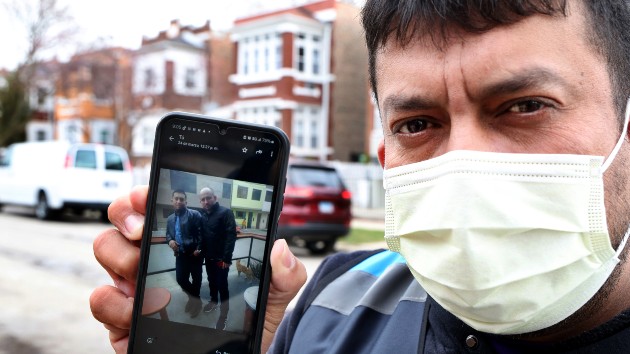
Alfredo Pacheco, a Venezuelan migrant who earlier this year was diagnosed with end-stage kidney failure, displays a photo of himself and his brother Jose Gregorio Gonzalez, March 26, 2025, in Cicero, Illinois. Gonzalez, also a migrant from Venezuela, was set to donate a kidney for his brother but was arrested and now detained by ICE. (Antonio Perez/Chicago Tribune/Tribune News Service via Getty Images)
(BROADVIEW, Ill.) — A man who was detained by Immigration and Customs Enforcement (ICE) earlier this month was temporarily released from an Illinois facility on Friday, after community advocates and officials appealed for his freedom so he can resume the kidney donation process in hopes of saving his brother’s life.
José Gregorio González, who was detained by ICE on March 3, was reunited with his brother José Alfredo Pacheco, who is in end-state kidney failure.
The brothers spoke out during a press conference in Chicago on Friday morning, where they were joined by their legal team, local officials and community advocates from the The Resurrection Project — the group that advocated for González’s release.
“I want to inform you that I’m extremely happy for the liberation of my brother. We fought for one month and one day to reach this goal,” Pacheco said in Spanish, addressing a group of supporters. “Thank you to the team of my lawyer Peter, thank you to the press that has helped get to this goal. I’m extremely thankful. Thank you very much.”
Visibly emotional and wearing a mask, Pacheco told reporters that he had a dialysis appointment earlier in the morning and he wouldn’t wish this illness on anybody.
Asked about the first thing he and his brother will do together, Pacheco said that they are going to call their mother so she can see them together.
According to The Resurrection Project, González was released from ICE custody three hours ahead of schedule on Friday morning. He was being held in the Clay County Jail in Brazil, Indiana, ICE records showed, and transferred to Broadview, Illinois, for release.
González answered one question during the press conference, speaking in Spanish.
“He said that he’s very happy for all the help the community has given him, for all the support that he thought was unbelievable, and to see his brother, he thinks it was something just very unbelievable,” a translator said. “He never would have imagined that that was possible.”
According to his attorney Peter Meinecke, González has been granted supervised release for one year.
“ICE has granted José a stay of removal for one year and released him under an order of supervision,” Meinecke said at Friday’s press conference. “This means ICE has decided José’s release is warranted due to urgent humanitarian factors. José will now be able to return home where he can resume the process of donating his kidney and saving his brother’s life.”
He noted that González will have to check in with ICE periodically during this time.
“This is part of an alternative to detention program for individuals whose continued detention is not in the public interest,” Meinecke said on Friday. “While José is released on an order supervision, he will be eligible to apply for a work permit at the end of one year, ICE could detain him and could ultimately seek to remove him to Venezuela.”
An ICE spokesperson provided a statement Friday evening in response to an ABC News request for comment evening stating: “Jose Gregorio Gonzalez, 43, is a citizen of Venezuela who has been ordered removed to his home country by an immigration judge. Gonzalez was arrested and placed in ICE custody March 3 without incident. After providing proper documentation ICE granted Gonzalez a temporary stay on humanitarian grounds.”
Meinecke, an attorney with The Resurrection Project, told ABC News in an interview on Wednesday that Pacheco reached out to the group earlier this month seeking support after González was detained.
Speaking in Spanish, Pacheco addressed a crowd of supporters during a press conference on Monday and called for his brother’s release.
“My health is at serious risk — I have 100% kidney failure and depend on dialysis three times a week,” he said, according to a translation provided by The Resurrection Project.
“It’s extremely difficult — sometimes, I can barely get out of bed. I have three children, 9-year-old twins and a 17-year-old back home, and I want to live to see them grow up. My brother used to take me to my appointments, but now I’m alone. My brother is a good man, not a criminal in Venezuela or here — he came only with the hope of donating his kidney to me. I thought I was alone, but seeing the support of this community has moved me deeply.”
Meinecke said that he had been in touch with González’s ICE officer over the past few weeks and submitted a request for release on temporary humanitarian parole on March 25.
“He needs to show that his release is either in the public interest or is necessary for like, urgent humanitarian factors. And in his case, we argue both,” Meinecke said. “You know, obviously, the medical conditions kind of speak to both. They’re both urgent humanitarian factors by now, but organ donation is in the public interest as well.”
Meinecke explained that Pacheco was admitted into the U.S. from Venezuela in 2023 and was permitted to apply for asylum, so he has a work permit while his asylum application is pending. His wife and three children remain in Venezuela. But soon after he arrived in the U.S., he suffered from stomach pain, according to Meinecke.
“[Alfredo] went to the hospital with severe abdominal pain, which is when he was diagnosed with end-stage kidney failure,” Tovia Siegel, director of organizing and leadership at the Resurrection Project, told ABC News on Wednesday. “At the time, he was told he had 2% functioning of his kidneys and would need dialysis consistently, multiple times a week to survive, and really, his best chance to live a full, healthy life would be a kidney transplant.”
Since his diagnosis in 2023, Pacheco’s condition has deteriorated, Siegel said.
“[Alfredo] currently receives [dialysis] three times a week, from 4 a.m. to 8 a.m., and his brother José came here to help care for him, and with the intention of being able to donate his kidney and save Alfredo’s life,” Siegel said. “And so for the last year, José has essentially been a full-time caretaker for Alfredo, helping with cooking, cleaning, etc, and with the intent to donate his kidney.”
But unlike Pacheco, when González arrived to the U.S. from Venezuela “primarily to assist” his brother, he failed to pass the credible fear screening, which did not allow him to apply for asylum like Pacheco had done, according to Meinecke, so he was detained by ICE for several months and then he was granted temporary supervised release but still faced a pending removal order. During his time on supervised release, González routinely checked in with his ICE officer, provided his address and wore an ankle monitor, Meinecke said.
Siegel said that González was detained while the brothers were leaving their home to go to Pacheco’s kidney dialysis appointment.
“It was shocking and devastating,” she said. “They had been living life together, and an incredibly difficult life where one of the brothers was undergoing incredible medical distress and suffering.”
“They were taking care of one another and surviving for a year together,” she added. “And during that time, clearly, you know, caring deeply for one another, loving each other as family members do. José [Gregorio] had no contact with police, the criminal legal system, and then one morning, with, you know, completely unexpected, ICE came to their home.”
González is likely going to donate for a swap but is hoping he’s a match, according to Siegel.
Friday’s release came after ICE denied on Monday a stay of removal request submitted by his attorneys and then the case was elevated to an ICE Chicago Field Supervisor, according to The Resurrection Project.
“This is literally a matter of life and death,” said Erendira Rendón, vice president of immigrant justice at The Resurrection Project. “ICE has the discretionary authority to release Mr. González on humanitarian grounds. Every day he remains detained is another day his brother’s life hangs in the balance.”