

Looming New Jersey Transit strike could impact 350,000 commuters, say officials

Looming New Jersey Transit strike could impact 350,000 commuters, say officials
Gary Hershorn/ABC News

(NEW YORK) — Some 350,000 New Jersey commuters could soon find themselves scrambling for other ways to get to work if contract disagreements between New Jersey Transit and its engineers’ union aren’t resolved, according to transit officials.

The Brotherhood of Locomotive Engineers and Trainmen (BLET) has threatened to strike as early as Friday, May 16 unless NJ Transit and the union are able to agree on new contract terms and conditions for the workers who drive the trains. If no deal is reached, all New Jersey Transit commuter trains – and the MTA Metro-North West of Hudson service – will stop running.

“We have sought nothing more than equal pay for equal work, only to be continuously rebuffed by New Jersey Transit,” BLET General Chairman Tom Haas said during a press conference on May 9. “New Jersey Transit engineers want to keep the trains moving but the simple fact is that trains do not run without engineers.”

BLET National President Mark Wallace said during the press conference that it’s been five years since train engineers working for NJ Transit have received a pay increase. He also said many engineers might seek work at Amtrak or the Long Island Railroad if their contract requirements are not met.

“Reasonable people would vote for an agreement that is fair,” Wallace said.

Haas said during the news conference that engineers working for NJ Transit earn an average salary of $113,000 a year. If New Jersey Transit CEO Kris Kolluri agrees to an average salary of $170,000 a year for engineer operators, then “we got a deal,” Haas said.

“NJ TRANSIT locomotive engineers already have average total earnings of $135,000 annually, with the highest earners exceeding $200,000,” according to a statement on the New Jersey Transit website regarding negotiations with the BLET.

During a separate press conference the same day, Kolluri responded to the union’s arguments, saying Haas previously agreed to a wage increase to $49.82 an hour but then later demanded even higher wages because he thought there was “a better pot at the end of the rainbow.”

“I cannot keep giving money left and right to solve a problem. It all comes down to, who is going to pay for this? Money does not grow on trees,” Kolluri said.

ABC News requests sent to NJ Transit and the BLET for comment regarding Wallace, Haas and Kolluri’s statements concerning pay increase claims did not receive a response.

According to TV station WABC in New York, both sides will meet again Thursday morning for 11th-hour negotiations to avert the strike.

New Jersey Transit and BLET representatives met Monday with the National Mediation Board in Washington, D.C. to continue negotiations.

“We want to thank the National Mediation Board (NMB) for convening today’s meeting,” NJ Transit said in a statement on their website following the meeting. “We found the discussion to be constructive and look forward to continuing negotiations in good faith. To respect the collective bargaining process, we will not be sharing any additional details publicly at this time.”

There was no public BLET statement following the National Mediation Board meeting, nor did BLET immediately respond to an ABC News request for comment.

NJ Transit states that if they were to accept BLET’s terms, it would cost both them and New Jersey taxpayers $1.363 billion between July 2025 and June 2030. Additionally, if BLET chooses to strike, the taxpayer cost of providing a limited alternative service via buses would be $4 million per day, NJ Transit claims.

NJ Transit commuters were already hit with a 15% fare increase on July 1, 2024, with an additional systemwide 3% fare increase scheduled to go into effect July 1 of this year and every subsequent year. NJ Transit said that the increase was necessary in order to cover a budget deficit caused in part by a pandemic-era decrease in ridership, as well as other increased costs, including inflation.

Should the strike commence on May 16, NJ Transit said it “strongly encourages all those who can work from home to do so and limit traveling on the NJ Transit system to essential purposes only.”

NJ Transit officials also said that they’ve developed a contingency plan that includes adding “very limited capacity to existing New York commuter bus routes in close proximity to rail stations and contracting with private carriers to operate bus service” for commuters that typically rely on the trains.

Even with the expanded bus service, however, NJ Transit said that it “estimates that it can only carry approximately 20% of current rail customers” because the bus system doesn’t have the capacity to replace commuter rail service.

Xuan Sharon Di, associate professor of civil engineering and engineering mechanics at Columbia University, told ABC News the potential NJ Transit strike would be a “disaster” for the traffic in Manhattan due to the increased bus and car traffic into the city from commuters unable to take the train. There also will be the added penalty of commuters into Manhattan having to pay recently enacted congestion pricing.

“New Jersey Transit is the backbone for people who live in New Jersey to move around. This is actually shocking to me,” Di told ABC News of the prospect of a strike.

Steven Chien, civil and environmental engineering professor at the New Jersey Institute of Technology, said many of his colleagues use NJ Transit to commute and that a strike will “paralyze vital transportation arteries in our regions.”

Copyright © 2025, ABC Audio. All rights reserved.

Mother allegedly buys ammunition, tactical gear for son’s planned ‘mass targeted violence’ at middle school: Officials

Mother allegedly buys ammunition, tactical gear for son’s planned ‘mass targeted violence’ at middle school: Officials
Bexar County Sheriff’s Office

(SAN ANTONIO, Texas) — A Texas mother has been arrested and charged for allegedly buying ammunition and tactical gear for her son’s planned “mass targeted violence” at his middle school, officials said.

Ashley Pardo, 33, was arrested on Monday and charged with aiding in commission of terrorism after she allegedly provided ammunition and tactical gear to her son, whose behavior demonstrated plans for a “mass targeted violence” aimed at Rhodes Middle School in San Antonio, according to an affidavit obtained by ABC News.

Back in January, Pardo’s son was first contacted in reference to “drawings of the local school he currently attended,” the affidavit said. These drawings included a map of the school — labeled “suicide route” — and the name of the school written beside a rifle, the affidavit said.

The son, who was not named in the affidavit, was contacted by officials at the time and described a “fascination with past mass shooters,” according to the affidavit.

In April, the son was found researching the 2019 Christchuch mosque shooting in New Zealand — a tragedy that killed 51 people — on a school-issued computer, the affidavit said.

He was “subsequently suspended and later in the day attempted suicide with a straight razor causing significant injuries and requiring over 100 stitches,” the affidavit noted. The boy attended an alternative school until May 7, according to officials.

His grandmother, with whom he had been staying “on various occasions,” contacted police on Monday after she found her grandson “hitting a live bullet with a hammer,” the affidavit said.

The middle schooler told his grandmother he received the bullet from Pardo and that she had “guns and ammunition at her house,” according to the affidavit.

The grandmother told officials Pardo had been taking the boy to a local surplus store and bought him magazines, a tactical black vest “capable of concealing ballistic plates,” a tactical black helmet and various army clothing, the affidavit said.

On Monday, the boy told his grandmother he was “going to be famous” before being picked up by his mom and taken to school, according to officials.

The grandmother then looked through the boy’s bedroom, where she found magazines loaded with live rifle ammunition and pistol magazines loaded with live ammunition, the affidavit said.

She also found an “improvised explosive device” — a mortar-style firework wrapped in duct tape — among the boy’s belongings, the affidavit noted. The explosive device had the words “For Brenton Tarrant,” referencing the shooter in the 2019 mosque attack, along with multiple “SS” symbols and “14 words” — referencing white supremacy — written on it, according to the affidavit.

Along with the weaponry, the grandmother found a handwritten note referring to previous mass shootings, mass shooting suspects and the number of victims in each incident, the affidavit said.

Pardo had been aware of the threats made by her son, expressed to the school her support of his “violent expressions and drawings” and said she did not feel concerned for his behavior, according to the affidavit.

The affidavit noted that Pardo was purchasing the gear and ammunition for her son in exchange for babysitting his younger siblings.

Copyright © 2025, ABC Audio. All rights reserved.

Menendez brothers win resentencing fight: What’s next for their case?

Menendez brothers win resentencing fight: What’s next for their case?
Ted Soqui/Sygma via Getty Images

(LOS ANGELES) — Erik and Lyle Menendez have been resentenced to 50 years to life in prison, which makes them immediately eligible for parole — a vindication years in the making for the brothers and their family.

But that doesn’t mean an automatic release from prison.

Here’s a look at what’s next:

The new sentence

Erik and Lyle Menendez, who were arrested in March 1990, were initially sentenced to life without the possibility of parole for the 1989 murders of their parents, Jose and Kitty Menendez. The brothers said they committed the murders in self-defense after years of abuse by their father.

At the conclusion of Tuesday’s resentencing hearing, Judge Michael Jesic granted them a new sentence of 50 years to life in prison, which follows the recommendation made in October by then-Los Angeles County District Attorney George Gascón.

Gascón recommended the brothers’ sentences of life without parole be removed, and said they should instead be sentenced for murder, which is 50 years to life. Because both brothers were under 26 at the time of the crimes, they’re eligible for parole immediately under California law.

Gascón’s office said its resentencing recommendations took into account many factors, including rehabilitation in prison and abuse or trauma that contributed to the crime. Gascón praised the brothers’ conduct in prison, saying they rehabilitated themselves and started programs to help other inmates.

In November, Gascón lost his reelection bid to Nathan Hochman, who in March filed a motion to withdraw the resentencing petition, calling the brothers’ claims of self-defense part of a litany of “lies.” The judge denied Hochman’s request.

The brothers, who appeared via video at Tuesday’s hearing, addressed the judge directly.

“I killed my mom and dad,” Lyle Menendez told the judge. “I give no excuses.”

He also admitted to committing perjury by lying in court in the ’90s. He apologized to his family for years of lies and the shock and grief of the crimes.

“I committed an atrocious act,” Erik Menendez told the judge. “My actions were criminal, selfish and cowardly. … No excuse.”

He admitted to lying for years and apologized.

What’s next — resentencing case

It could take months before Erik and Lyle Menendez are assigned a parole date for the resentencing case. They are eligible for that parole date right away, as inmates with a sentence of 25 years-to-life or longer can get their hearing during the 25th year of incarceration, according to the California Department of Corrections and Rehabilitation.

The brothers will likely each have their own individual hearings in front of a three-member parole board at the Richard J. Donovan Correctional Facility, the San Diego prison where they’re both housed, according to ABC News legal analyst Matt Murphy.

Murphy said the California Board of Parole’s newly completed risk assessment — which was conducted as a part of the brothers’ separate clemency path — does raise serious red flags that the parole board will take under consideration.

The risk assessment concluded that Erik and Lyle Menendez pose a moderate risk to the community if they’re released, noting that the brothers didn’t follow rules in prison so there’s a likelihood they won’t follow the law outside of prison.

The assessment revealed the brothers possessed illegal cellphones. Erik Menendez had a phone as recently as January of this year, which Hochman stressed was during the resentencing effort when he should have been on his best behavior.

“Cellphones are very dangerous in prison because they can be used to commit crime — they can be used to put hits on people, they can be used to intimidate witnesses,” Murphy explained.

For most prisoners, being caught with a cellphone is enough to be denied parole, Murphy said.

Erik Menendez also allegedly bought and traded drugs and allegedly helped inmates commit tax fraud years ago, according to the assessment.

“Simply because they’re eligible does not mean they’ll be released,” Murphy said. “A majority of life prisoners serving time for murder with parole dates are not released if they’ve had problems in prison.”

The parole board is also likely to weigh if the brothers have taken full responsibility, Murphy said.

The brothers admitted to the crime and admitted to lies in court Tuesday, and their family said they’ve “apologized to all of us” and “spent the last 35 years becoming better men worthy of a second chance.” But the DA insists that they’ve still “failed to come clean with the full extent of their criminal conduct, their cover-up, their lies and their deceit.”

The psychologists also found Lyle Menendez to be narcissistic. The brothers will undergo further psychological evaluations beyond the risk assessment, Murphy said.

If granted parole, they’d be eligible for release immediately after the decision is finalized, which takes about five months, according to the California Department of Corrections and Rehabilitation. If parole is denied, the denial could be for either three, five, seven, 10 or 15 years, according to the department.

What’s next — clemency case

In the meantime, the brothers have a special parole hearing on June 13 regarding their bid for clemency from California Gov. Gavin Newsom. As they did Tuesday, the brothers are expected to appear via video from prison.

The clemency path is separate from the resentencing path. The brothers’ defense team submitted the request for clemency in October 2024 and Newsom can grant clemency at any time.

After the June 13 hearing, Newsom will “submit that report to the judge for the resentencing, and that will weigh into our independent analysis of whether or not to move forward with the clemency application to support a commutation of this case,” the governor said in March on his “This is Gavin Newsom” podcast.

The bigger picture

In an exclusive statement to ABC News hours after the resentencing decision, Erik Menendez said he hopes his case can serve as “one step on the path of widespread justice reform that will give us and so many hopeless souls in prison the continued hope to earn personal redemption.”

“My goal is to ensure there are no more people spending 35 years in prison without hope,” he said. “That possibility of having hope that rehabilitation works is more important than anything that happened to me today.”

The brothers’ attorney, Mark Geragos, agreed, saying their case “encourages people who are incarcerated to make the right decisions, to take the right path.”

But Murphy said he’s concerned the brothers’ win on Tuesday shows the success of victim-blaming.

The brothers have “continued to insist that they believe that Kitty Menendez posed a threat of imminent death or great bodily harm to them, which was rejected by every single appellate court,” Murphy said. Now Murphy predicts “every lifer in the state of California is going to ask for their resentencing.”

Copyright © 2025, ABC Audio. All rights reserved.

Federal court rules against attempt to withhold Endangered Species Act protections from Joshua tree

Federal court rules against attempt to withhold Endangered Species Act protections from Joshua tree
Mario Tama/Getty Images

(NEW YORK CITY) — A federal court in California sided with environmentalists, striking down a U.S. Fish and Wildlife Service (FWS) attempt to withhold protections for the Joshua tree under the Endangered Species Act.

The Central District of California ruled on Monday that the FWS decision to not provide ESA protections for the Joshua tree is unlawful and sidesteps climate science.

Known for its twisted stalks and unusual outline, the Joshua tree is native to the arid southwestern U.S. and thrives in harsh desert environments.

In 2015, WildEarth Guardians, an environmental nonprofit group, petitioned the FWS to list Joshua trees as a threatened species, but a second 2023 species status assessment by the FWS found that neither Joshua tree species — Yucca brevifolia and Yucca jaegeriana — requires protections.

The FWS said it looked at threats from wildfire, invasive grasses, climate change and habitat loss and fragmentation. It found that none of the threats rose to the level to meet the definition of a threatened or endangered species throughout all or a significant portion of their ranges, according to the assessment.

“Through our scientific assessment, the Service determined that Joshua trees will remain an iconic presence on the landscape into the future. Although the two species do not need the protections of the Endangered Species Act, the Service cares deeply about Joshua trees and their roles in the desert environment,” said Service Pacific Southwest Regional Director Paul Souza in a statement in 2023.

“We are coordinating closely with partners to ensure the long-term conservation of these species, including the National Park Service and other Federal agencies, and the State of California, which is also considering measures for the protection of Joshua trees.”

However, multiple studies have shown that shifts in climate in the Mojave Desert is a major contributor to weather events that threaten Joshua trees, including wildfires.

“The agency’s decision, for a second time, reflected a massive disconnect from what the best available science shows — that climate change and wildfire will prevent Joshua trees from successfully recruiting new generations over the coming years,” Jennifer Schwartz, managing attorney for WildEarth Guardians, said in a statement sent to ABC News.

After the FWS analysis was released, WildEarth Guardians sued the FWS “for its failure to follow federal law” in denying protections for the Joshua tree.

The Central District of California ruled in favor of the environmental nonprofit’s claims, writing in the decision “that the Service has not provided a rational explanation as to why climate change alone does not threaten the species to become threatened or endangered.”

“The Service provides no explanation as to why it did not use current trends and standards regarding greenhouse gas emissions as a basis for its decision, when this data currently is available,” the decision states.

The court also noted that when assessing the “foreseeable future” of the Joshua tree, the FWS only looked to the middle of the 21st century, while the end of the 21st century is the commonly used timeline for most scientific assessments.

“It is essential that the Service considers climate change’s effect on habitat suitability in relation to young Joshua trees, and not just the persistence of stronger, adult Joshua trees,” the order states.

The federal court has instructed the FWS to reconsider whether the Joshua tree should receive ESA protections with more scientific analysis.

The ruling “serves as yet another reminder that the U.S. Fish and Wildlife Service must completely grapple with the ongoing and incoming threats from human-created climate change,” Casey Bage, legal fellow for WildEarth Guardians, said in a statement sent to ABC News.

Bage noted that the science “is clear” in this case.

“We must face these facts head-on in order to protect Joshua trees — and other species — to give them the fighting chance that they deserve,” Bage said.

The U.S. Fish and Wildlife Service did not immediately respond to ABC News’ request for comment.

Copyright © 2025, ABC Audio. All rights reserved.

Recession warnings fade after Trump rolls back tariffs

Recession warnings fade after Trump rolls back tariffs
Liu Yanan/Xinhua via Getty Images

(NEW YORK) — Recession alarms blared across Wall Street in the aftermath of President Donald Trump’s “Liberation Day” tariff announcement last month, but a recent trade agreement between the U.S. and China has dialed back many of those warnings.

JPMorgan on Tuesday lowered its odds of a recession this year from 60% to below 50%, meaning the U.S. is more likely to grow in 2025 than enter a downturn. Similarly, Goldman Sachs reduced its chances of a recession this year from 45% to 35%.

Stock market gains reflected such optimism. The S&P 500 soared in the immediate aftermath of the U.S.-China agreement, shrugging off previous tariff-induced losses and bringing the index into positive territory for 2025.

The accord between the world’s two largest economies slashed U.S. tariffs on Chinese goods from 145% to 30%, while cutting Chinese levies on U.S. products from 125% to 10%.

The previous set of sky-high tariffs had threatened a surge in prices, a disruption of global trade and a possible U.S. recession.

“The risk of a recession over the next 12 months looks substantially lower following the tariff cuts,” Bill Adams, chief economist for Comerica Bank, told ABC News in a statement.

The drawdown of U.S.-China tariffs marks the latest softening of Trump’s levies.

The White House last month paused far-reaching “reciprocal tariffs” on dozens of countries, just hours after the measures took effect. Trump has also eased sector-specific tariffs targeting autos, and rolled back duties on some goods from Mexico and Canada.

“These massive tariff reductions at this time likely take a recession off the table for now,” Dan Ives, a managing director of equity research at the investment firm Wedbush, told ABC News in a statement on Monday.

Still, an array of tariffs remain in place. An across-the-board 10% levy applies to imports from nearly all countries. Additional tariffs have hit auto parts, as well as steel and aluminum.

Even after the pullback, a 30% tariff on China far exceeds the level before Trump took office, posing a risk of price increases for a large swathe of products that includes apparel, toys and some electronics.

The rollback of levies on Chinese goods is expected to reduce the average cost of tariffs per household nearly by half but the cost burden will still reach $2,800 in 2025, the Yale Budget Lab found.

Federal Reserve Chair Jerome Powell warned last week of a possible tariff-induced bout of “stagflation,” a term that describes a rise of inflation alongside a slowdown of the economy.

Under such a scenario, the central bank could face difficulty as it weighs a choice between lower rates intended to boost the economy or higher rates aimed at easing inflation.

“If the large increase in tariffs that have been announced are sustained, they’re likely to generate a rise in inflation and a slowdown of economic growth,” Powell said. “All of these policies are evolving, however, and their effects on the economy remain highly uncertain.”

For now, the economy has defied inflation fears. Inflation eased in the aftermath of the tariff escalation last month, reaching its lowest level since 2021, government data on Tuesday showed.

The path forward for tariffs remains uncertain, however, clouding the economic outlook, some analysts told ABC News.

The lowered U.S.-China tariffs will remain in place for 90 days while the two sides negotiate a wider trade deal. The White House says it has launched trade discussions with dozens of countries in an effort to strike trade agreements before a pause of the “reciprocal tariffs” lifts in July.

“Will the unpredictable nature of U.S. policy continue or are we now on a more conventional path?” Jim Reid, a strategist at Deutsche Bank Research, said in a note to clients this week, just hours after the U.S. and China announced the trade agreement. “Not sure I have the answers.”

Copyright © 2025, ABC Audio. All rights reserved.

Fatal New Jersey house fire ruled a murder-suicide: Prosecutor

Fatal New Jersey house fire ruled a murder-suicide: Prosecutor
Washington Township Police Department

(WASHINGTON TOWNSHIP, NJ) — A massive fire on Sunday that leveled a New Jersey home, where first responders later recovered the bodies of a man and a woman, has been ruled a murder-suicide, authorities said Tuesday.

Neighbors reported hearing a blast around the time of the fire early Sunday in the Gloucester County community of Washington Township and said it sounded like a bomb going off.

In a statement released on Tuesday, the Gloucester County Prosecutor’s Office said the woman found dead in a bed at the destroyed residence had suffered a fatal bullet wound to the head before the house became engulfed in flames. Her death was ruled a homicide by the Gloucester County Medical Examiner’s Office.

The man was discovered dead in the living room of the destroyed home with a handgun lying near his body, the prosecutor’s office said. His death was ruled a suicide by fire, according to the statement from the prosecutor’s office.

The identities of the two people were being withheld pending official confirmation by the medical examiner, according to the prosecutor’s office.

“The investigation conducted in the aftermath of the fire revealed the presence of an accelerant and that the home’s gas line had been tampered with, enabling unrestricted flow of natural gas into the home’s interior,” the statement said.

A motive for the murder-suicide remains under investigation by the prosecutor’s office, the Washington Township Police Department and the Gloucester County Fire Marshal’s Office.

News of the medical examiner’s findings came a day after the Washington Township Police Department said the explosion had prompted a “criminal investigation” and that the incident was “not accidental.”

The fire occurred at 2:02 a.m. on Sunday and prompted multiple 911 calls from neighbors reporting a loud explosion and fire in the area of Tranquility Court and Orion Way, according to a statement released by the Washington Township Police.

“Responding officers arrived at 13 Tranquility Court and observed that the residence was fully engulfed in flames and appeared to have been heavily damaged by an apparent explosion,” according to the police statement.

Washington Township Fire Department firefighters arrived shortly after the police and extinguished the flames, according to the statement.

Video taken by ABC Philadelphia station WPVI showed damage to at least one home near the destroyed house. The footage also showed a car that had apparently been damaged.

Neighbors who live blocks away reported being rattled awake.

Investigators said the fire was likely not caused by an explosion and that the blasts neighbors heard may have happened after the fire had already ignited, according to WPVI.

Copyright © 2025, ABC Audio. All rights reserved.

Flooding forces evacuation of 2 Maryland elementary schools as flash flood emergency issued

Flooding forces evacuation of 2 Maryland elementary schools as flash flood emergency issued
Potomac Fire Company No.2 Inc.

(ALLEGANY COUNTY, MD) — A flash flood emergency has been issued for parts of northwestern Maryland on Tuesday, where severe flooding led to the evacuation of two elementary schools.

A flash flood emergency was issued for Westernport, Luke and Barton in Allegany County, where up to 5 inches of rain had fallen as of Tuesday afternoon. Rainfall rates were up to 1 to 2 inches an hour.

Numerous water rescues have occurred, including at two elementary schools in Allegany County, officials said.

About 200 students and teachers were evacuated from Westernport Elementary School in Westernport by motorized boats to a nearby church, Allegany County officials confirmed to ABC News.

All students and staff were safely evacuated, according to the Allegany County Department of Emergency Services. The Allegany County Sheriff’s Office led the evacuation efforts and the Maryland State Police were assisting with the reunification of students.

Students at Georges Creek Elementary in Lonaconing were also being evacuated to a nearby high school, the Allegany County Department of Emergency Services said Tuesday afternoon.

Students at Westmar Middle School in Lonaconing were sheltering in place, the department said. Family reunifications have been delayed due to ongoing road closures caused by flooding, a government source told ABC News. No injuries at been reported at this time.

State police were helping with additional road closures due to high water.

County officials urged drivers to avoid all flooded roadways and not attempt to drive through standing water.

“Severe flooding is currently impacting Georges Creek and surrounding areas in Allegany County due to rising water levels,” the Allegany County Department of Emergency Services said in a social media post Tuesday afternoon. “Multiple areas have already been evacuated.”

More than 15 million Americans across the Mid-Atlantic remain on alert for flooding and heavy rain on Tuesday into Wednesday.

A flood watch remains in effect for portions of east-central North Carolina, east-central Virginia, eastern West Virginia, west-central Maryland and central Pennsylvania until Wednesday morning. That includes the cities of Raleigh, North Carolina; Richmond, Virginia; and Hagerstown, Maryland.

Pockets of heavy rain and showers are expected to continue from North Carolina up to Pennsylvania on Tuesday into Wednesday. Some of these heavier pockets could feature strong to severe storms capable of producing some hail, isolated damaging wind gusts, and an isolated tornado, especially for east-central North Carolina and east-central Virginia.

The heavier pockets of rain will be focused more over Maryland, Delaware, and Pennsylvania, with lighter rain in the surrounding areas.

Copyright © 2025, ABC Audio. All rights reserved.

Pete Rose among players removed from MLB’s banned list, eligible for Hall of Fame

Pete Rose among players removed from MLB’s banned list, eligible for Hall of Fame
Rich Pilling/MLB via Getty Images

(COOPERSTOWN, NY) — Pete Rose, “Shoeless” Joe Jackson and 15 other deceased baseball players have been removed from MLB’s permanent list of banned players, according to a memo from the league’s commissioner.

The decision allows Rose, who accepted a ban for life from MLB in 1989 for gambling on games, to be eligible for the Baseball Hall of Fame posthumously.

The decision only applies to dead players who have been placed on the ineligible list.

“The National Baseball Hall of Fame has always maintained that anyone removed from Baseball’s permanently ineligible list will become eligible for Hall of Fame consideration,” Hall of Fame Chairman Jane Forbes Clark said in a statement. “Major League Baseball’s decision to remove deceased individuals from the permanently ineligible list will allow for the Hall of Fame candidacy of such individuals to now be considered.”

However, a vote by the Historical Overview Committee, often known as the veterans committee, which considers players who made their greatest impact prior to 1980, will not vote on candidates to be included in the hall again until December 2027.

Rose died last October at 83 years old. Rose petitioned the league to be removed from the list in 1992, 1998, 2003, 2015 and 2022 — but either was rejected or received no response each time, including from Manfred.

Rose and Jackson are likely the only two players on the list of players whose body of work would make them likely to be voted to the Hall of Fame.

Rose’s workmanlike attitude and hustle on the field won him innumerable fans. By the end of his 24-year career, 19 of which were with the Cincinnati Reds, he held the record for most career hits, as well as games played, plate appearances and at-bats. He was also a 17-time All-Star, the 1973 NL MVP and 1963 Rookie of the Year.

He also won three World Series — two with Cincinnati’s “Big Red Machine” clubs in 1975 and 1976, and a third with the Philadelphia Phillies in 1980.

But Rose will always be remembered for being banned for life over gambling on games while he was managing the Reds.

With Rose under suspicion, new MLB Commissioner Bart Giamatti commissioned an investigation led by John Dowd, a lawyer with the Department of Justice, in April 1989. By June, the damning report was released, documenting at least 52 bets on Reds games in 1987, his first season as solely a manager after serving as player/manager for three seasons. The bets totaled thousands of dollars per day, according to the Dowd Report.

“While it is my preference not to disturb decisions made by prior Commissioners, Mr. Rose was not placed on the permanently ineligible list by Commissioner action but rather as the result of a 1989 settlement of potential litigation with the Commissioner’s Office,” MLB Commissioner Rob Manfred said Tuesday. “My decision today is consistent with Commissioner Giamatti’s expectations of that agreement.”

Jackson, meanwhile, was banned from baseball for life in 1920 by then-Commissioner Kenesaw Mountain Landis in connection to the so-called “Black Sox Scandal.”

Jackson and seven other members of the Chicago White Sox were given money by an organized gambling ring to fix the 1919 World Series for the Reds. The players made a paltry sum of money compared to today’s mega-millionaire contracts and were angry about the team owner, Charles Comiskey, paying them a pittance. There was no baseball players union at the time.

All eight of the players — featured in the 1988 movie “Eight Men Out” — have been reinstated: Jackson, Eddie Cicotte, Happy Felsch, Chick Gandil, Fred McMullin, Swede Risberg, Buck Weaver and Lefty Williams. Gandil was known as the ringleader of the group and allegedly set up the payment, while it’s always been disputed how much Jackson even knew about the plan. He did, however, allegedly admit to accepting $5,000 as part of the scheme, according to testimony from a criminal trial over the case, something he later recanted.

If he did accept money, he didn’t show any signs of throwing games on the field. Jackson hit 12-for-35 (.375) with three doubles, five runs scored and six runs batted in over the eight games in the series. The World Series was a best-of-9 format at the time.

Jackson was one of the best hitters of the early 20th century. Over 13 seasons with Philadelphia, Cleveland and Chicago, the outfielder had a lifetime batting average of .356 with a .423 on-base percentage. He finished in the top 10 in MVP voting four times and led the majors in hits twice, triples twice and total bases twice.

The other former players banned from the league and now reinstated — who are not as widely known — were Joe Gedeon, Gene Paulette, Benny Kauff, Lee Magee, Phil Douglas, Cozy Dolan, Jimmy O’Connell and William Cox.

Copyright © 2025, ABC Audio. All rights reserved.
Milwaukee Judge Hannah Dugan indicted by grand jury on federal charges

Milwaukee Judge Hannah Dugan indicted by grand jury on federal charges
Scott Olson/Getty Images

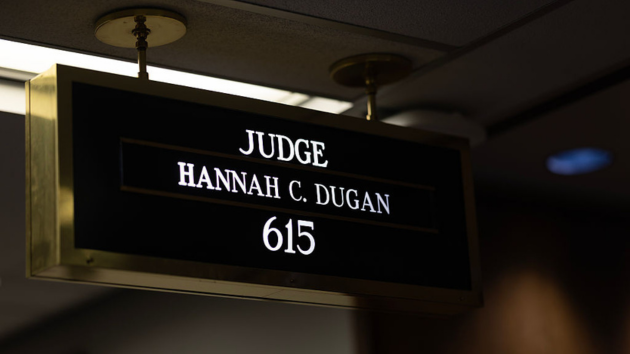
(MILWAUKEE) — A federal grand jury has indicted a Wisconsin judge who was arrested and charged last month with allegedly helping an undocumented immigrant evade arrest.

Milwaukee County Circuit Court Judge Hannah Dugan has been indicted on charges alleging she concealed a person from arrest and obstructed a proceeding before a department or agency of the United States — the same charges she was initially charged with by complaint.

She is scheduled to be arraigned on the charges on Thursday.

Following the indictment on Tuesday, her legal team said in a statement, “As she said after her unnecessary arrest, Judge Dugan asserts her innocence and looks forward to being vindicated in court.”

The judge was arrested on April 25. U.S. Attorney General Pam Bondi said in a statement at the time that two FBI agents arrested Dugan “for allegedly helping an illegal alien avoid arrest” by Immigration and Customs Enforcement.

Dugan appeared in U.S. District Court for the Eastern District of Wisconsin following her arrest and was released on her own recognizance. If convicted, she could face up to six years in prison.

The Wisconsin Supreme Court suspended Dugan in the wake of her arrest, stating in an order that it found it was “in the public interest that she be temporarily relieved of her official duties.”

Her case stems from the arrest of an undocumented immigrant — Eduardo Flores-Ruiz — on April 18, county court records show. Flores-Ruiz was set to appear in court that day before Dugan for a pretrial conference in an ongoing case where he has been charged with three misdemeanor counts of battery/domestic abuse.

Upon learning ICE officers were present in court to arrest Flores-Ruiz, Dugan allegedly became “visibly angry” and confronted one of the officers, according to the federal complaint that was unsealed following her arrest.

Multiple witnesses cited in the complaint later allegedly said Dugan returned to her courtroom after directing members of the arrest team to the office of the court’s chief judge, according to the complaint.

A DEA agent saw Flores-Ruiz and his attorney in the public hallway of the courthouse and he appeared to be making efforts to evade arrest, the complaint stated. After he was encountered by FBI and DEA agents outside the building, Flores-Ruiz “turned around and sprinted down the street” before he was ultimately apprehended, according to the complaint.

In a post on social media, FBI Director Kash Patel claimed Dugan “intentionally misdirected federal agents away from the subject to be arrested in her courthouse.”

Copyright © 2025, ABC Audio. All rights reserved.
US v. Combs day 6: Freak offs, violence and fear – Cassie Ventura takes the stand at Diddy trial

US v. Combs day 6: Freak offs, violence and fear – Cassie Ventura takes the stand at Diddy trial
John Lamparski/Getty Images

(NEW YORK) — For six hours on Tuesday in a packed Manhattan courtroom, Cassie Ventura testified about how her decade-long relationship turned violent as her then-boyfriend, Sean “Diddy” Combs, seized control of her personal and professional lives and demanded she orchestrate his drug-fueled sex parties known as “freak offs.”

Ventura is the star witness in the federal racketeering and sex-trafficking case against Combs, who faces the possibility of life in prison if he is convicted. Ventura’s 2023 civil lawsuit — which Combs settled with no admission of guilt — prompted federal authorities to begin investigating Combs’ conduct, and he was indicted last September.

Combs has pleaded not guilty and denied the federal charges. His lawyers insist that any sexual conduct was consensual and, though Combs’ lifestyle may not be appropriate for everyone, law enforcement has no right to invade his bedroom and private life. They also insist that any acts of assault show domestic violence, but not coercion or evidence of trafficking.

Ventura testifies about her relationship with Combs turning violent

Ventura testified that her relationship gradually became violent, as Combs allegedly took control of her personal and professional lives.

Combs signed Ventura to his Bad Boy record label in 2006, when she was 19 years old. Though 17 years younger than Combs, Ventura said she wanted to be around the man who helped catapult rap music and urban fashion into the mainstream.

“I wanted to be around Sean for the same reasons as everyone else at the time. He’s just this exciting and entertaining fun guy that just also happened to have my career in his hands.”

As she continued her relationship with Combs, Ventura told jurors, she began to experience “a different side” of the mogul – one that featured fits of rage, violent outbursts and unpredictable mood swings.

“He would bash my head, knock me over, drag me, kick me, stomp me in the head when I was down,” she said, recounting violent arguments with Combs.

“How frequently was Sean physical with you during your relationship?” prosecutor Emily Johnson asked.

“Too frequently,” Ventura responded, saying she feared triggering his anger.

Ventura added that members of Combs’ security team would “keep an eye” on her and that Combs would incessantly call her if she ignored him. With Combs paying for her apartment, she experienced her “stomach in knots” moments when he would drop by unannounced, not knowing if he was angry.

Ventura recounts ‘Freak Offs’ in detail

Ventura broke down in tears on the witness stand as she testified how she participated in drug-fueled sex parties called “freak offs” or “wild king nights.”

She said she had just turned 22 when Sean Combs first proposed these marathon, drug-addled sex performances with male prostitutes.

She said she originally agreed to participate in order to indulge Combs’ voyeuristic fantasies. Eventually, she told the jury, the orgies “became almost weekly,” oftentimes lasting two or three days, and once going on for four straight days. She testified she was awake the whole time, fueled by ecstasy, molly and cocaine supplied by Combs.

According to Ventura, she participated in the sex parties in every one of Combs’ homes and, most frequently, in hotels in New York, Miami, Los Angeles, Atlanta, Las Vegas, Ibiza, and Turks and Caicos. She described that Combs carefully directed the freak offs, ordering specific lighting and candles, and insisting that only Johnson & Johnson Baby Oil be used to ensure participants “glistened.”

Combs shook his head as Ventura testified about the use of baby oil, describing at least one party where a baby pool was filled with oil that Combs ordered she immerse herself in while fully clothed.

“It was a mess,” she said.

She testified about another instance when she thought she would choke because Combs and a male sex worker both urinated on her; multiple jurors shook their heads and looked down as she recounted the story.

It did not take long, Ventura said, before she realized she did not want to participate in future parties.

“Did you want to participate in every freak off?” prosecutor Emily Johnson asked.

“No,” Ventura answered. “I felt like it was all I was good for. It was disgusting. I felt humiliated. I didn’t have the words for how horrible I really felt.”

She said that Combs “would be violent” with her if she refused to participate, adding that her professional career stalled as she was forced to devote nearly all her time to planning the freak-offs that Combs demanded. As she testified, Ventura flipped through a binder containing the photographs of the male escorts she says were hired for the freak-offs and recounted needing to self-medicate with illegal drugs to make it through the prolonged sessions that were demeaning and emotionally and physically draining.

When Johnson asked if there was any part of the freak offs she enjoyed, Ventura began to sob. She grabbed a tissue and, through tears, said, “I thought it was the only time I could get.”

“The version of him I was in love with was no longer there,” she said.

Early witnesses lay foundation for Ventura’s testimony

Ventura was long billed as the key witness against Combs after CNN last year obtained a 2016 videotape showing Combs kicking and dragging her in a hotel elevator lobby.

Prior to Ventura taking the stand, the jury heard from two other witnesses who appeared to corroborate and bolster part of Ventura’s testimony.

Male escort Daniel Phillip testified he was paid as much as $6,000 for having sex with Ventura while Combs watched and masturbated. He also testified that he witnessed Combs throw a bottle at Ventura after she did not immediately obey his instructions and then “grabbed her by her hair and dragged her by her hair into the bedroom.” Defense attorney Xavier Donaldson tried to raise doubts about Phillip’s testimony, pointing to a discrepancy about dialogue in a previous statement to authorities, Philip stood by his account of the physical abuse.

On the first day of the trial, prosecutors showed the 2016 video to the jury and prepared jurors for Ventura’s testimony to come. Israel Florez, an LAPD officer who was working security at the now-shuttered InterContinental Hotel in Los Angeles, testified that Combs offered him money to cover up the assault and that he noticed Ventura had a “purple eye.” Florez said he refused the money.

“These are foundational witnesses. They create the context and the backdrop in which Cassie then testifies and gives more color and more examples, building upon earlier testimony to be the star witness that the government expects her to be,” ABC News legal contributor Brian Buckmire said.

Ventura concluded her testimony on Tuesday by explaining the moment depicted in the video watched by jurors was the result of her effort to try to escape one of the freak-offs.

“There’s an instance in Los Angeles where it got violent, and I chose to leave,” she said. “When I chose to leave, I grabbed what I could and got out and Sean followed me into the hallway by the elevators, grabbed me, tried to drag me back to the room.”

While jurors have already seen the video, it was played again in court on Tuesday afternoon. “That’s me,” Ventura said.

Ventura is expected to return to the stand when the trial resumes Wednesday morning.

Copyright © 2025, ABC Audio. All rights reserved.