(NEW YORK) — A 30-year-old man has drowned in Pennsylvania near a family picnic area while attempting to swim across the river and went under, officials said.
The emergency communications center at Delaware Water Gap National Recreation Area in Bushkill, Pennsylvania, received a report of a drowning in the Delaware River near the Kittatinny Point picnic area at about 4:10 p.m. on Tuesday, according to a statement from the National Park Service.
National Park Service rangers and dive team members, New Jersey State Police and water rescue teams from the Portland Volunteer Fire Department responded to the call, officials said, and the crews “quickly located and recovered the body of a 30-year-old Parsipanny, New Jersey, man from the river, where the water was approximately 17 feet deep.”
“The man was swimming with family members near the picnic area when he tired while attempting to swim across the river and went under,” NPS said.
Authorities have not yet named the man and it is unclear what the swimming conditions were like at the time of the drowning, but the National Park Service took the opportunity to remind all river users to wear a properly-fitted, U.S. Coast Guard-approved life jacket while swimming, floating, fishing or boating on the Delaware River.
Jay L. Clendenin / Los Angeles Times via Getty Images
(NEW YORK) — No winner was declared after Wednesday night’s Powerball drawing, resulting in the jackpot climbing to $1.7 billion.
The jackpot’s estimated cash value of $770.3 million is now the third-highest in U.S. lottery history, according to Powerball.
The numbers drawn were: 3, 16, 29, 61 and 69, with Powerball 22 and Power Play multiplier of 2.
After there was no billion-dollar Labor Day Powerball winner, the jackpot continued to climb and reached $1.4 billion before the drawing.
The next drawing will take place on Saturday, Sept. 6, at 10:59 p.m. ET.
Nationwide, 11 tickets matched all five white balls to win $1 million prizes. The $1 million-winning tickets were sold in California, Colorado, Florida, Georgia, Illinois, Maryland, Minnesota, Ohio and Pennsylvania, Powerball said.
Winners can choose between annual payments over 30 years, with a 5% increase each year, or the immediate cash option.
Powerball’s history includes record-breaking prizes, with the largest being a $2.04 billion jackpot won in California in November 2022, followed by a $1.765 billion prize claimed in California in October 2023, and a $1.586 billion jackpot split among winners in California, Florida and Tennessee in January 2016.
Saturday’s drawing will be the 42nd since the Powerball jackpot was last won on May 31, 2025, in California. The current streak has tied the game’s record for the most consecutive drawings without a jackpot winner.
Tickets cost $2 and are available in 45 states, the District of Columbia, Puerto Rico and the U.S. Virgin Islands. The odds of winning the jackpot are 1 in 292.2 million, while the overall odds of winning any prize are 1 in 24.9.
Drawings are broadcast live from Tallahassee, Florida, every Monday, Wednesday and Saturday at 10:59 p.m. ET and streamed on Powerball.com.
(MILWAUKEE) — Milwaukee County Circuit Court Judge Hannah Dugan’s trial on federal charges alleging she tried to help an undocumented immigrant evade arrest has been set for Dec. 15.
Jury selection will be on Dec. 11 and 12, Judge Lynn Adelman determined during a scheduling hearing on Wednesday.
Dugan has pleaded not guilty.
This is a developing story. Please check back for updates.
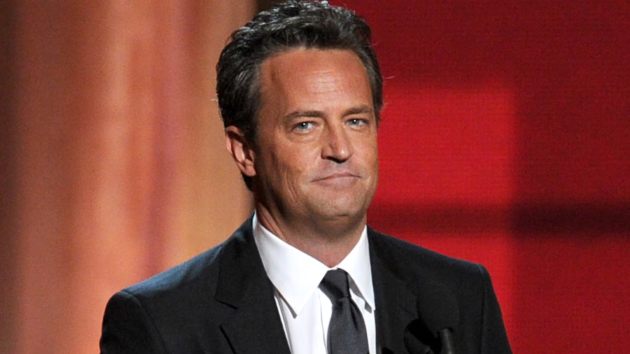
(LOS ANGELES) — A woman reportedly known as the “Ketamine Queen” has pleaded guilty to providing the dose of ketamine that led to Matthew Perry’s death in October 2023, becoming the fifth and final person to be convicted in connection with the “Friends” actor’s fatal overdose.
Jasveen Sangha, 42, pleaded guilty Wednesday in Los Angeles federal court to one count of maintaining a drug-involved premises, three counts of distribution of ketamine, and one count of distribution of ketamine resulting in death or serious bodily injury, the Department of Justice said.
Sangha had been scheduled to go on trial in late September. The dual U.S-U.K. citizen has been in custody since her arrest in August 2024, nearly a year after Perry’s death.
Her attorney said Sangha has “accepted responsibility.”
“She feels horrible. She’s felt horrible from Day 1,” her attorney, Mark Geragos, told reporters outside the courthouse on Wednesday. “This has been a horrendous experience.”
Her sentencing hearing is scheduled for Dec. 10. She faces 45 years in prison. Geragos said he feel there’s “a lot of mitigation in this case” regarding the sentencing, but didn’t go into specific detail on what those factors would be.
“I think there’s a lot of things that we will present that will give a clear picture as to what actually happened and levels of responsibility,” he said.
Perry died from a ketamine overdose on Oct. 28, 2023, at the age of 54. The actor was discovered unresponsive in a jacuzzi at his Los Angeles home, police said. An autopsy report revealed he died from the acute effects of ketamine.
In addition to Sangha, four other people were charged and pleaded guilty in connection with Perry’s death — Kenneth Iwamasa, Perry’s live-in personal assistant; two doctors, Salvador Plasencia and Mark Chavez; and Erik Fleming.
Prosecutors said Sangha worked with Fleming to distribute ketamine to Perry, and that in October 2023, they sold the actor 51 vials of ketamine, which were provided to Iwamasa, the DOJ said.
“Leading up to Perry’s death, Iwamasa repeatedly injected Perry with the ketamine that Sangha supplied to Fleming,” the DOJ said in a press release last month. “Specifically, on October 28, 2023, Iwamasa injected Perry with at least three shots of Sangha’s ketamine, which caused Perry’s death.”
Iwamasa, who admitted in court documents to administering the ketamine on the day that Perry died, pleaded guilty in August 2024 to one count of conspiracy to distribute ketamine causing death, the DOJ said. He is scheduled to be sentenced Nov. 19.
Fleming admitted in court documents that he distributed the ketamine that killed Perry, prosecutors said. Like Iwamasa, he pleaded guilty in August 2024 to one count of conspiracy to distribute ketamine and one count of distribution of ketamine resulting in death and will be sentenced on Nov. 12.
Plasencia pleaded guilty in July to four counts of distribution of ketamine. Plasencia distributed ketamine to Iwamasa in order to inject the actor, however, he did not supply the doses that killed Perry, prosecutors said. He is scheduled to be sentenced on Dec. 3.
Chavez pleaded guilty in October 2024 to one count of conspiracy to distribute ketamine. He admitted he sold Plasencia ketamine to then give to Perry. He is set to be sentenced on Dec. 17.
In her plea agreement, Sangha also admitted to selling ketamine in connection with another overdose death, prosecutors said. Victim Cody McLaury died hours after Sangha sold him four vials of ketamine in August 2019, according to the DOJ.
She additionally admitted to using her North Hollywood residence to “store, package, and distribute narcotics, including ketamine and methamphetamine, since at least June 2019,” the DOJ said. Authorities found 79 vials of liquid ketamine, among other drugs and drug trafficking items such as a money-counting machine, in her residence during a search in March 2023, the DOJ said.
Views from the Drift Hotel March 25, 2019 Overseas Highway, Key Largo Florida (Photo by Paul Harris/Getty Images)
(KEY LARGO, Fla.) — The family of the 8-year-old old boy who was bitten by a shark while snorkeling off the coast of Key Largo, Florida, on Labor Day released a statement Wednesday thanking those who helped with his rescue.
Richard Burrows was bitten by a blacktip shark Monday afternoon while snorkeling with his father, David, and his sister, his family said in their statement.
The incident occurred around 3:24 p.m. on Monday, the Monroe County Sheriff’s Office said in a Facebook post. The child was airlifted by Trauma Star to Jackson Memorial Hospital in Miami.
“Richard’s 10-year-old sister, Rose, was instrumental in her brother’s rescue and both of her parents are immensely proud of the strength of character and composure she demonstrated under pressure,” the family statement said.
A good Samaritan, identified as Richard Hayden, heard calls for help over the radio and helped guide the boy’s boat to shore, according to an incident report. Hayden assisted the child’s father in applying tourniquets to the boy’s right leg to control bleeding before emergency responders arrived, the report stated.
The family thanked Hayden in their statement, as well as law enforcement, first responders and medical staff.
“Richard is recovering well from his surgery and is gaining strength by the day. He is in good spirits,” the family statement said. “Our hope is that he will be back enjoying his passion for the ocean and marine life with his older sister in no time.”
“The Burrows family sincerely appreciate and thank everyone for their messages of support and well wishes and assistance in these past days. We now request some privacy for the family to focus solely on Richard’s recovery and will not be commenting further,” the family statement concluded.
The Labor Day attack marks the latest in a series of shark encounters in the Florida Keys region. Last July, Jose Abreu, 37, survived multiple bites from a bull shark while spearfishing near a reef off Key West.
The area has seen several serious shark incidents in recent years. Jameson Reeder Jr., who lost his leg in a bull shark attack in 2022, recently returned to the same waters where he was bitten.
“I was a little scared before I jumped in,” Reeder told ABC News in July. “For a split two seconds, it was like a whole flashback of the shark attack, but I knew I had the Lord and I just had a lot of fun.”
Scientists say there has been an increase in shark populations, which they attribute to warmer water temperatures and successful conservation efforts.
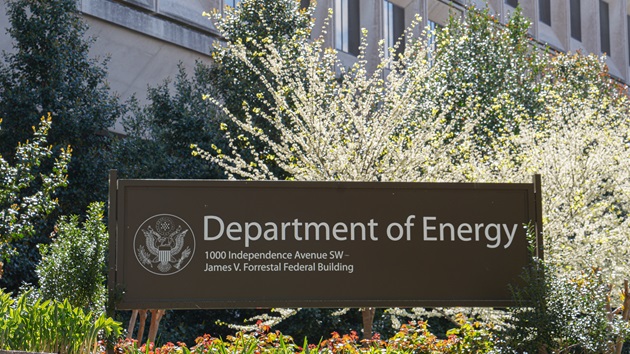
A sign marks the U.S. Department of Energy Headquarters Building on April 13, 2025, in Washington, DC. (J. David Ake/Getty Images)
(WASHINGTON) — A group of more than 85 climate scientists released a critical review of a recent U.S. Department of Energy (DOE) report on climate change, finding it “biased, full of errors, and not fit to inform policymaking.”
The DOE report, compiled by the agency’s “2025 Climate Working Group,” a five-person panel hand-picked in March by Energy Secretary Chris Wright, was released in late July alongside a proposed regulatory repeal of the Environmental Protection Agency’s “Endangerment Finding.”
In 2009, the EPA issued an Endangerment Finding determining that human-amplified climate change poses a threat to human health and safety, which became the basis for its regulation of greenhouse gas emissions.
“The rise of human flourishing over the past two centuries is a story worth celebrating. Yet we are told, relentlessly, that the very energy systems that enabled this progress now pose an existential threat,” Wright said at the time of the report’s release.
The Climate Working Group, which is at the center of a lawsuit against the Trump administration alleging it was improperly formed, operated without transparency and engaged in unlawful activities, began preparing its findings in early April and compiled the report in about two months.
The conclusions in the report are a stark contrast to well-known climate assessments, such as those from the Intergovernmental Panel on Climate Change (IPCC) and U.S. National Climate Assessment, which include contributions from thousands of scientists around the world and undergo a rigorous years-long process of open and independent review.
The IPCC found that “Human activities, principally through emissions of greenhouse gases, have unequivocally caused global warming.” The U.S. National Climate Assessment determined that “Human activities, principally through emissions of greenhouse gases, have unequivocally caused global warming” and that “without deeper cuts in global net greenhouse emissions and accelerated adaptation efforts, severe climate risks to the United States will continue to grow.”
The release of the DOE report met swift backlash from veteran climate scientists who were critical of the findings, the process and the people selected for the working group. Dozens of members of the climate science community then got together to prepare a detailed, public rebuttal of the DOE report.
“This report makes a mockery of science. It relies on ideas that were rejected long ago, supported by misrepresentations of the body of scientific knowledge, omissions of important facts, arm waving, anecdotes, and confirmation bias. This report makes it clear DOE has no interest in engaging with the scientific community,” Andrew Dessler, a climate researcher at Texas A&M University, who helped organize the effort, said.
Experts involved in reviewing the report said that it includes “biased assessments” and “fundamentally flawed” arguments. They pointed out that the DOE report was produced by a small, hand-picked group, often writing outside their expertise, which led to basic factual errors. The report lacked peer review, was developed in secret, and showed no accountability to public input, these experts said in their review.
According to the rebuttal report, the DOE team “selectively cites outdated or discredited studies” and “misrepresents mainstream sources” of climate science. Reviewers also raised concerns that the report was purposely designed to support a predetermined policy agenda, particularly to undermine the EPA’s Endangerment Finding, rather than to offer an objective scientific assessment.
The DOE report claims that climate models used by scientists overestimate warming trends, that long-term trends for disasters generally don’t show much change and the economic impacts of carbon emissions are “negligible.” The DOE report also said there are advantages to a world with more carbon, like increased plant growth.
“The DOE report is not a neutral scientific assessment, it is a policy-driven document that selectively presents information to support a predetermined narrative. Rather than engaging with the full body of climate science, it highlights isolated findings that, when removed from context, give the misleading impression that rising CO₂ levels are broadly beneficial,” said Becca Neumann, associate professor in the Department of Civil and Environmental Engineering at the University of Washington and head of the hydro-biogeochemistry research group.
In a statement to ABC News, a DOE spokesperson said, “Unlike previous administrations, the Trump administration is committed to engaging in a more thoughtful and science-based conversation about climate change and energy.”
The report was reviewed internally by DOE scientific researchers and policy experts from the Office of Science and National Labs and is open to wider peer review from the scientific community and general public via the public comment period, the DOE spokesperson said.
“The purpose of this report is to restore an open and transparent dialogue around climate science,” the DOE spokesperson concluded. “Following the public comment period, we look forward to reviewing and engaging on substantive comments.”
The benefits from rising carbon dioxide concentrations in the atmosphere are among the key points made in the DOE’s report, emphasizing that higher carbon dioxide levels can enhance photosynthesis and boost crop yields and aren’t necessarily a bad thing. Neumann acknowledges that this effect is real and well-documented, but said it’s already factored into the climate and agricultural models the report seeks to discredit.
“What the report fails to acknowledge is that these benefits are offset by the broader impacts of climate change: rising temperatures, altered rainfall patterns, and more extreme weather—all of which pose serious challenges to agriculture. For most regions in the U.S. and globally, the net effect of climate change on food production is projected to be negative. Yet the report repeatedly suggests the opposite,” said Neumann.
The DOE report not only criticizes numerous climate science findings but also attempts to cast doubt on the reliability of the weather and climate data being collected for analysis, claiming that urbanization effects, like the Urban Heat Island, significantly bias global temperature observations.
However, the scientific consensus, reflected in IPCC assessments, finds that these effects have a minimal to negligible impact on global warming trends. Climate scientists explain that standard data homogenization techniques effectively identify and correct non-climatic biases, and these adjusted datasets are independently validated by rural-only networks and satellite observations.
The critical review, which totals more than 400 pages, was submitted to the Department of Energy during the report’s public comment period.
The DOE report is already facing legal challenges. In August, the Union of Concerned Scientists (UCS) and the Environmental Defense Fund filed a lawsuit in the Federal District Court for the District of Massachusetts, contesting the Trump administration’s use of a secretly convened group to undermine established climate science and regulations. The suit names Secretary Wright, the DOE, EPA Administrator Lee Zeldin, the EPA, and the Climate Working Group as defendants.
The lawsuit cites the Federal Advisory Committee Act, enacted in the aftermath of Nixon-era scandals, which requires that federal government advisory committees operate transparently, make their materials publicly available, and maintain balanced membership.
“Decades of rigorous scientific analysis shows burning fossil fuels is unequivocally contributing to deadly heat waves, accelerating sea level rise, worsening wildfires and floods, increased heavy rainfall, and more intense and damaging storms across the country. We should all relentlessly question who stands to gain from efforts to upend this unassailable and peer-reviewed scientific truth,” Dr. Gretchen Goldman, the president and CEO of UCS, said at the time the lawsuit was filed.
The EPA told ABC News regarding the lawsuit, “As a matter of longstanding practice, EPA does not comment on current or pending litigation.”
Plush dolls Labubu are displayed inside a craw machine on September 2, 2025, in Hong Kong, China. (Sawayasu Tsuji/Getty Images)
(SEATTLE) — Over 11,000 counterfeit Labubus — the dolls that have recently exploded in global popularity — were seized at Seattle’s airport, with officials estimating their worth to be over half a million dollars, according to a Customs and Border Protection spokesperson.
“Fake Labubus are not welcome in America. Thanks for the good catch Seattle!” CBP said on X on Friday.
The bust occurred on Aug. 26 when CBP officers assigned to Seattle Air Cargo at Sea Tac began searching a shipment from South Korea that was “falsely manifested as ‘LED Bulb,'” a CBP spokesperson told ABC News in a statement. Inside the boxes, officials found 11,134 counterfeit Labubu dolls — also known as “Lafufus” — with a manufacturer suggested retail price of $513,937.76, CBP said.
The shipment of dolls, which breached federal laws of importation and merchandise involved in copyright or trademark violations, was destroyed by officers, the spokesperson said.
There have not been any charges or arrests made for the counterfeit shipment, but the “smugglers engaged in this contraband attempt have incurred in a significant economic loss by having their products seized by the U.S. government,” the spokesperson said.
Brian Humphrey, the director of field operations for the CBP Seattle field office, said officers are “still on the lookout for the one and only 24K GOLD Labubu.”
Labubus, which debuted in China in 2015, have exploded in popularity this year, with revenue for Pop Mart — the company behind the dolls — reaching $1.8 billion in 2024, according to the company’s annual financial report.
While the dolls retail for about $30, they can go for hundreds and sometimes even thousands of dollars on the resale market.
The dolls counterfeit alternative, “Lafufus,” are typically made with lower-quality materials and may have different features than authentic Labubus.
This bust in Seattle comes after dozens of boxes of Labubus, totaling around $7,000, were stolen from a California store last month, according to the Los Angeles County Sheriff’s Department.
ABC News’ Alondra Valle contributed to this report.
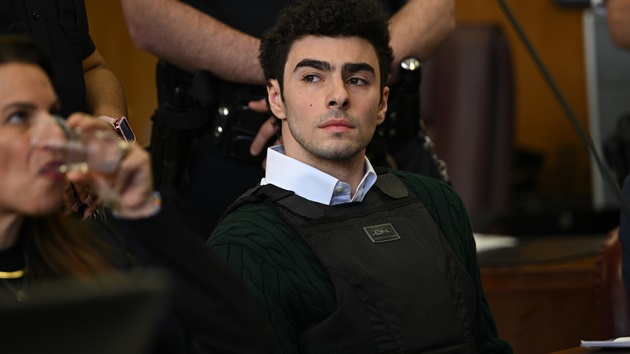
Luigi Mangione appears at a hearing for the murder of UHC CEO Brian Thompson at Manhattan Criminal Court on February 21, 2025 in New York City. (Curtis Means – Pool/Getty Images)
(NEW YORK) — Fast fashion giant Shein is conducting an investigation of its internal processes after using the likeness of Luigi Mangione to model clothing.
The company has since taken down the image of Mangione – who is accused of carrying out the assassination-style killing of UnitedHealthcare CEO Brian Thompson last year – and vowed to review their monitoring processes.
“The image in question was provided by a third-party vendor and was removed immediately upon discovery. We have stringent standards for all listings on our platform. We are conducting a thorough investigation, strengthening our monitoring processes, and will take appropriate action against the vendor in line with our policies,” a Shein spokesperson said in a statement to ABC News.
In an archived page from Shein’s website, an image of Mangione’s likeness was used to advertise a patterned short-sleeve shirt that retailed for about $10.
The exact origin of the image and how long it was used by Chinese e-commerce giant is unclear. A Shein spokesperson said the image was provided by a “third party vendor,” who they plan to take “appropriate action against.”
An analysis of the image conducted by ABC News could not conclusively determine if artificial intelligence was used to generate the image.
Mangione has pleaded not guilty to charges that he murdered Thompson on a Midtown Manhattan Street in December. Prosecutors are seeking the death penalty if Mangione is convicted. His trial date has not been set.
Prosecutors at the United States Attorney’s Office for the Southern District of New York declined to comment about the image.
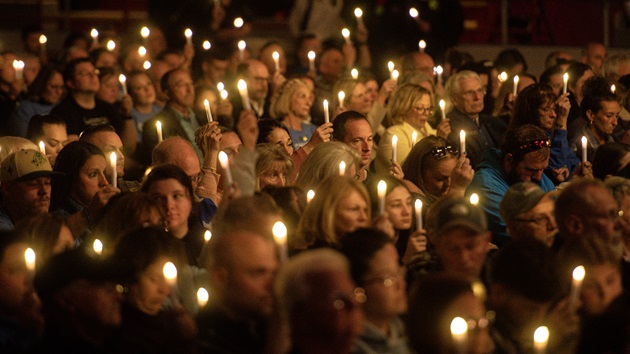
Mourners hold candles during a candlelight vigil to commemorate the first anniversary of a mass shooting that claimed 18 lives at Just-In-Time Recreation and Schemengees Bar & Grille on October 25, 2024 in Lewiston, Maine. (Zhu Ziyu/VCG via Getty Images)
(LEWISTON, Maine) — Dozens of survivors and families of victims of the 2023 mass shooting in Maine are suing the federal government over its “negligence” in failing to address “known dangers” posed by the Army reservist who would go on to kill 18 people.
Lawyers for about 100 survivors and families of victims announced their intent to sue the government last October. Now, with no response or acknowledgement, the group said, they are officially filing suit.
At least 18 people were killed and more than a dozen others injured after a gunman opened fire at two locations in Lewiston, Maine: a bowling alley where a children’s league was taking place and a local bar. The massacre was one of the deadliest shootings in U.S. history.
The gunman, Robert Card, displayed multiple warning signs in the weeks and months leading up to the shooting, including a clear pattern that was known to the Army, but to which they did not respond, the 119-page suit alleged.
“Well before the mass shooting, the Army was aware that Robert Card had classic warnings signs of high risk to himself and the public. The Army’s knowledge; its mandatory processes; its promises to Card’s family, medical providers and local law enforcement; and its actions in undertaking to intervene individually and in combination created a legal duty on the part of the Army to address the risks posed by Card in a reasonable manner,” the suit said.
The actions that should have been taken were buttressed by a wealth of knowledge of the “unique risks” service members with “mental health crises” pose to “themselves and the public,” but instead those policies were “violated” in failing to take “mandatory action” with Card, according to the suit.
“The Army knew that the combination of mental health deterioration, blast-induced brain injury, access to weapons, and paranoid delusions required immediate and decisive intervention to prevent tragedy,” the suit said. “The Army had mandatory reporting systems, crisis intervention protocols, and state law utilization procedures designed for such situations.”
The Army’s own investigation into what led up to the shooting found, among other things, “multiple communication failures between military and civilian hospitals, as well as with SFC Card’s chain of command,” as ABC News has previously reported. Those failures “impacted” Card’s “continuity of care,” and possibly, could have prevented him from wielding weapons as he did, the investigation found.
The group’s suit now seeks “accountability from the U.S. Army, Department of Defense, and Keller Army Community Hospital after those institutions ignored warning signs of the dangers posed by Army Reserve Sergeant, Robert Card, including Card’s threat six weeks before the tragedy that he planned to commit a mass shooting.”
(NEW YORK) — Dozens of fires are burning throughout the West as parts of the country remain under advisories for high temperatures.
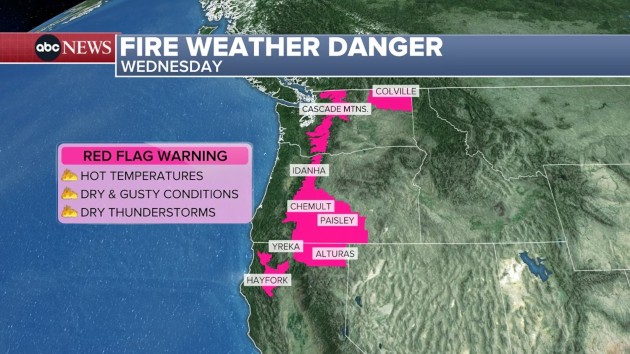
Red flag warnings are in place for Northern California and parts of Oregon due to dry thunderstorms possible on Wednesday. The storms bring little to no rain but still produce lightning and strong wind gusts, which can start new fires and exacerbate existing fires. Dry, warm conditions also continue.
In Washington’s Cascade Mountains, a red flag warning is in place for Thursday due to relative humidity dropping to 12% in places and high temperatures in the valleys between 97 and 102 degrees and 85 to 90 degrees in the mountains. These hot, dry conditions will lead to potential rapid fire growth.
High temperatures and heat alerts are forecast for the Northwest. Temperatures are expected to be between 93 and 103 on Wednesday and Thursday.
Yakima and Spokane, Washington, may hit their all-time September highest temperature record on Wednesday, with highs around 102 degrees possible in both locations.
Los Angeles and Burbank, California, remain under a heat advisory on Wednesday for temperatures reaching between 92 and 102 degrees.
Wildfire smoke continues to blanket the Northwest, and now additional smoke from Canadian wildfires will join the American fire smoke as northerly flow begins. A plume of heavy smoke is expected to reach Omaha, Nebraska, by sunset on Wednesday.
On Thursday afternoon, very heavy smoke is expected throughout much of the Rocky Mountains, reaching from Washington to Kansas.
Heavy smoke will also spread across southern Minnesota, Iowa and Missouri on Thursday.
From Wichita, Kansas, to Kansas City, Missouri, there is a slight risk — level 2 of 5 — for severe storms Wednesday after 6 p.m.
Large to very large hail is possible, potentially as large as tennis balls, with damaging wind gusts in excess of 60 mph also possible.