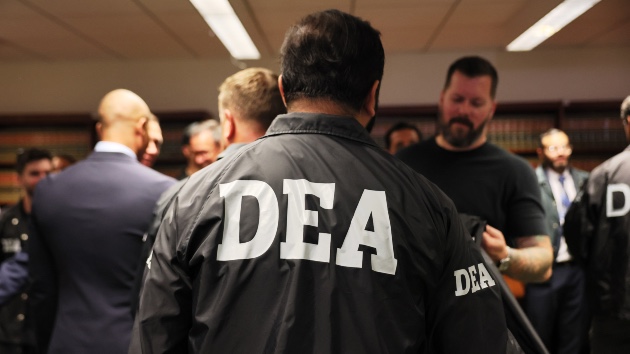
Members of the DEA attend a press conference at the U.S. Attorney’s Office on August 25, 2025 in the Brooklyn Heights neighborhood of the Brooklyn borough in New York City. (Photo by Michael M. Santiago/Getty Images)
(NEW YORK) — The Drug Enforcement Administration said that it arrested over 600 people during a weeklong operation targeting the Sinaloa drug cartel.
The arrests were “aimed at dismantling the Sinaloa Cartel, one of the world’s most violent and powerful drug cartels, responsible for flooding the United States with fentanyl, methamphetamine, cocaine, and heroin,” according to the DEA.
In February, the Trump administration designated the Mexico-based Sinaloa cartel, along with seven other groups, as a foreign terrorist organization. The cartel remains one of the most significant threats to public safety, public health and national security in the U.S., according to the DEA’s statement on the arrests.
From Aug. 25 through Aug. 29, DEA agents across 23 domestic field divisions and seven foreign regions carried out coordinated enforcement actions that resulted in the arrests of 617 people, along with the seizure of 480 kilograms of fentanyl powder, 714,707 counterfeit pills, 2,209 kilograms of methamphetamine, 7,469 kilograms of cocaine, 420 firearms and currency and assets worth close to $13 million, the DEA said.
“These results demonstrate the full weight of DEA’s commitment to protecting the American people,” said DEA Administrator Terrance Cole. “Every kilogram of poison seized, every dollar stripped from the cartels, and every arrest we make represents lives saved and communities defended. DEA will not relent until the Sinaloa Cartel is dismantled from top to bottom.”
“There are tens of thousands of Sinaloa members, associates, and facilitators operating worldwide, in at least 40 countries who are responsible for the production, manufacturing, distribution, and operations related to trafficking dangerous and deadly synthetic drugs,” the DEA continued.
Brian M. Clark, special agent in charge of the Los Angeles Field Division, said that while the numbers reflect a one-week snapshot, the efforts to combat the cartel persist year-round.
“The Sinaloa Cartel’s reach is vast and unremitting. This ruthless cartel is intent on cashing in, permeating our communities with their poison, with no regard to human suffering. For that reason, DEA’s work remains critical and laser-focused. The success achieved during this operation is a direct result of the unwavering and exceptional work by the men and women of DEA,” said Clark.
(WASHINGTON) — The Trump administration is suing migrants with removal orders and issuing fines of up to $1.8 million to pressure them into self-deporting, immigration attorneys tell ABC News.
In recent months, Immigration and Customs Enforcement has revived a rarely enforced 1996 law, using it to issue fines to migrants with deportation orders as part of the administration’s aggressive immigration crackdown.
The notices order them to voluntarily leave the U.S. to avoid the monetary penalty.
Merle Kahn, an attorney with the Immigrant Legal Resource Center, said the fines were never used until 2017, during the first Trump administration. She told ABC News that during Trump’s first term the fines were rarely used, and when Joe Biden took office as president, he rescinded all of them.
“Now, they have started issuing the fines again, and they’ve increased them,” Kahn said. “They could be fined over $1.8 million if they have an outstanding deportation order and didn’t leave.”
In June, the Trump administration announced new regulations to streamline the process of issuing fines to immigrants who are in the country without authorization, including new fines, reduced time for appeal, and the elimination of a 30-day notice period.
That same month, ICE said it had issued more than 10,000 fines.
The fines include between $100 and $500 for each unlawful entry or attempted entry, and up to $998 per day, assessed for up to five years, for failing to comply with a removal order.
Immigration attorneys call the fines a “scare tactic” to force people to self-deport.
“There’s zero consideration of the circumstances surrounding why the person didn’t leave,” Kahn said. “It doesn’t matter if they never got notice, and the process for challenging these fines is really truncated.”
ICE and DHS officials did not respond to request for comment from ABC News. The Department of Homeland Security said in a statement in June that the fines apply to individuals who enter the U.S. illegally, ignore or delay removal orders, or “do not honor agreements to comply with judges’ voluntary departure orders.”
“Financial penalties like these are just one more reason why illegal aliens should use CBP Home to self-deport now before it’s too late,” DHS Assistant Secretary Tricia McLaughlin said in the statement.
John Gihon, a Florida immigration attorney, told ABC News the notices have changed in recent months.
Before July, Gihon said people would receive a notice of intent that they could respond to and appeal. Now, he said, individuals “are just getting invoices.”
“You can appeal this if you think it’s incorrect, but it’s going to be decided by basically the same exact office and agency who issued the fine in the first place, and there’s no appeal after that,” Gihon said. “It’s gotten amazingly draconian.”
Gihon told ABC News that one of his clients recently received a $1.8 million fine due within 30 days. He said his client can’t voluntarily leave the country because he doesn’t have a passport or other travel documents.
“He’s been physically unable to leave the United States unless he illegally entered another country,” Gihon said. He said his client also has a business and family in the U.S.
“He’s unable to comply, and does not want to have to pay all these fines and lose his only livelihood for him and his family,” Gihon said.
Edward Cuccia, a New York immigration attorney, said he has clients who work minimum wage jobs who have received million-dollar fines. He said the government is spending “more on postage to send the notices” than it will ever collect.
In an escalation, the Trump administration is now suing some of the immigrants who received these fines.
“If you fail to pay the full amount on or before the deadline listed below, the Department of Justice may initiate legal proceedings against you at any time,” said a notice included in a recent lawsuit filed by the Department of Justice. “However, you can avoid payment if you voluntarily depart the United States immediately.”
According to several lawsuits reviewed by ABC News, the DOJ is asking courts to issue judgments against individuals for the fines, and to award “other relief as may be appropriate.”
“It’s a scare tactic to encourage people to self-deport,” Kahn said. “I think anyone with an outstanding deportation order can expect to receive a fine if the order was issued within the past five years.”
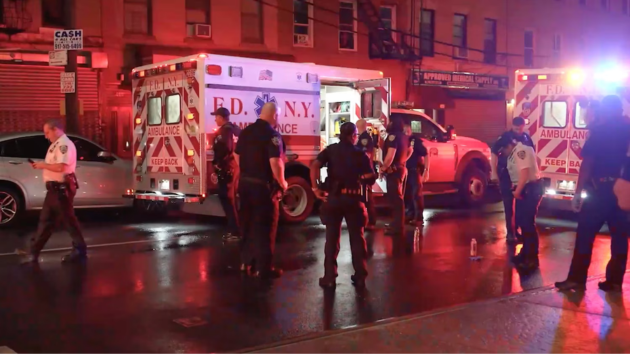
New York City police officers at a scene in Brooklyn, September 7, 2025, where several officers fatally shot a man suspected of entering a nearby police precinct and attacking an officer with a butcher knife. (WABC
(NEW YORK) — New York City police officers opened fire early Sunday and killed a man alleged to have barged though the back door of a police precinct station house and attacked an officer with a butcher knife when she tried to fight him off, authorities said.
The deadly shooting occurred on a street in the Brownsville section of the New York City borough of Brooklyn near the 73rd Precinct station house, where the suspect slashed an officer with a knife that authorities said had a 14-inch blade, according to police.
On Monday, the New York Police Department (NYPD) identified the deceased suspect as 35-year-old Justin Coleman of Brooklyn.
“Every day our officers put on their uniforms, they encounter dangerous situations out in the street, but it’s another kind of danger when someone comes directly into a precinct armed with a knife and attacks our officers,” Chief of Patrol Phillip Rivera of the New York York Police Department (NYPD) said at a news conference on Sunday.
A motive for the station house attack remains under investigation.
The attack occurred at around 5:24 a.m. when the suspect was captured on surveillance video attempting to enter the locked front door of the station house, Rivera said on Sunday. The suspect then allegedly walked to the rear of the station house and entered through a door that Rivera said is clearly marked for use by authorized NYPD personnel only.
“He entered the rear of the precinct and was immediately confronted by a police officer who was assigned to station-house security,” Rivera said.
When the officer directed the suspect to the front of the station house for assistance, he allegedly pulled out the butcher knife and attacked her but the officer was able to fight him off, Rivera said. The suspect slashed the officer in the forehead before fleeing, the NYPD said in a statement on Monday.
Rivera said the suspect ran out of the back door allegedly still wielding the knife. Several officers followed the suspect down the street, ordering him repeatedly to drop the weapon, according to Rivera.
Officers initially deployed a stun gun on the suspect but it had no effect, Rivera said during Sunday’s news conference.
At one point, the suspect “lunged at an officer with the knife extended toward that officer,” prompting officers to open fire, hitting the suspect multiple times, Rivera said Sunday.
On Monday, the NYPD said that two officers shot the man.
The suspect was taken to Brookdale Hospital Medical Center in Brooklyn where he was pronounced dead, according to Rivera on Sunday.
The officer who was attacked at the station house was taken to a hospital, treated for what Rivera described as superficial injuries, and released.
“Thank god our sister is on the road to recovery, but this was a clear targeted attack on New York City police officers,” Patrick Hendry, president of the Police Benevolent Association union, said in a statement. “This individual had no fear when he walked into a police precinct and attacked a uniformed cop – there is no telling what he might have done to innocent New Yorkers out on the street. Despite being injured, our sister pursued this individual along with her fellow police officers, and they stopped the threat before anyone else was hurt.”
“This is another example of the extraordinary work our police officers are doing in an incredibly dangerous environment,” Hendry’s statement said.
(AUBURN, Ala.) — A man is in custody for allegedly killing a retired Auburn University professor, whose body was discovered in an Alabama dog park, authorities said.
Dr. Julie Gard Schnuelle, a veterinarian and longtime employee of Auburn University’s College of Veterinary Medicine, was found dead in a wooded area of Kiesel Park on Saturday, Auburn police said.
The 59-year-old died from an assault, police said.
Harold Rashad Dabney III, of Montgomery, Alabama, was arrested on Sunday and charged with two counts of capital murder, police said.
Dabney, 28, also allegedly stole the former professor’s car, which has been recovered, police said.
Dabney is being held without bond, police said. The Lee County District Attorney declined to discuss details of the case with ABC News.
Auburn University called Schnuelle a “beloved” faculty member at the Department of Clinical Sciences in the Large Animal/Food Animal section, where she worked from 2003 to 2021.
“She was a cherished educator, mentor and colleague whose dedication to students and passion for theriogenology and veterinary medicine left a lasting impact on Auburn,” an Auburn spokesperson told ABC News. “Dr. Gard Schnuelle’s legacy of compassion, scholarship and service will continue to inspire generations of veterinarians.”
Tommy Tuberville, an Alabama senator and former Auburn football coach, wrote on social media, “Suzanne and I are devastated by the news of this tragic loss in our community. We are praying for the victim’s family and loved ones and for justice to be served.”
(HAPPY VALLEY, Ore.) — A man in Oregon was arrested for living in a crawl space of a condominium complex for an “extended period of time,” according to the Clackamas County Sheriff’s Office.
Beniamin Bucur, 40, was arrested on Wednesday after officials investigated a “suspicious circumstance at a condominium complex” in Clackamas County near Happy Valley, the sheriff’s office said in a press release last week.
On Wednesday at around 11 p.m., a witness reported seeing a man “who was not known to live in the complex parking his car and walking to the back of one of the buildings,” officials said.
Upon further investigation, the witness also noticed the “door to the crawl space was open and light was coming from inside,” according to authorities.
Once officials arrived at the scene, they said they noticed the door to the space was “damaged and now locked,” along with an extension cord running through a vent.
Deputies reached out to the owner of the complex, who said “nobody was supposed to be down there” and that they had heard “strange noises coming from the crawl space before,” officials said.
When the keys the owner gave deputies did not unlock the door to the space, officials “breached the door and located the man,” identified as Bucur, according to authorities.
Bucur had taken “significant steps to improve the conditions of the crawl space,” with a bed, lights, chargers, televisions and other electronics all found “plugged into the house,” the sheriff’s office said.
A pipe with white residue that “tested positive for methamphetamine” was also found at the scene, according to officials.
Bucur was transported to the Clackamas County Jail where he was booked on charges of first-degree burglary and the unlawful possession of methamphetamine, authorities said.
The suspect’s preliminary hearing was on Thursday, with his bail set to $75,000, officials said.
It remains unclear whether Bucur has an attorney who can speak on his behalf.
(MEMPHIS) — Four children, including a 3-year-old and a 6-year-old, were shot Sunday night in Memphis, Tennessee, according to police.
The shooting occurred around 9:54 p.m. at a home in the Hickory Hill area. Memphis Police and Fire Departments responded to the scene, where they found four juvenile victims.
Two 15-year-old victims — one male and one female — were transported to a local hospital in critical condition. A 3-year-old girl and a 6-year-old boy were also taken to the hospital in non-critical condition, officials said.
According to police, multiple suspects fled the scene on foot, heading northbound. The suspects were wearing all-black clothing and ski masks at the time of the shooting.
As police secured the area with crime scene tape, distraught family members began arriving at the scene late Sunday night, according to police dispatch audio.
Memphis Police are actively investigating the incident. Anyone with information is urged to contact Crime Stoppers at 901-528-CASH.
ABC News’ Charlotte Slovin contributed to this report.
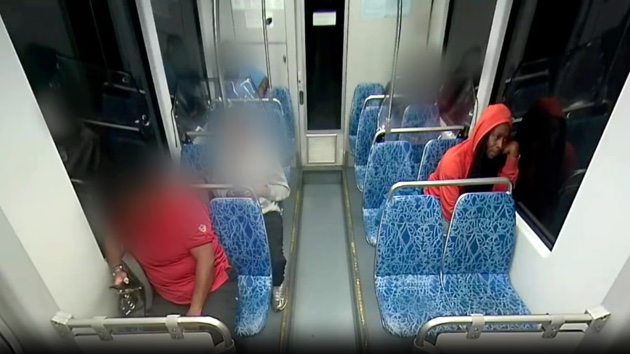
Iryna Zarutska, who is not pictured, was stabbed to death in an unprovoked attack while riding the light rail in Charlotte, North Carolina, according to the Charlotte-Mecklenburg Police Department. (Charlotte Area Transit System)
(CHARLOTTE, N.C.) — North Carolina Gov. Josh Stein said Monday he was “appalled” by the unprovoked murder of a Ukrainian woman on Charlotte’s light rail system late last month, with the recent release of the attack on video causing outrage nationwide.
“I am heartbroken for the family of Iryna Zarutska, who lost their loved one to this senseless act of violence, and I am appalled by the footage of her murder. We need more cops on the beat to keep people safe,” Stein said in a statement on Monday.
Zarutska, 23, was fatally stabbed on Aug. 22 just before 10 p.m. while riding the Lynx Blue Line in Charlotte, according to an affidavit obtained by ABC News.
According to the affidavit, Zarutska boarded the train and sat in an aisle seat directly in front of the suspect, 34-year-old Decarlos Brown Jr., who is seen in a window seat wearing an orange sweatshirt.
The train travels for “approximately four and half minutes before the suspect pulls a knife out of his pocket, unfolds the knife, pauses, then stands up, and strikes at the victim three times,” according to an affidavit obtained by ABC News.
Prior to the stabbing, there appeared to be “no interaction between the victim and defendant,” the affidavit said.
Zarutska was pronounced dead at the scene and a witness directed officials to the location of the suspect, the affidavit said.
Brown was arrested after he was released from the hospital with “non-life-threatening injuries sustained at the time of the incident” and was charged with first-degree murder, according to the Charlotte-Mecklenburg Police Department.
The suspect’s next court appearance is scheduled for Sept. 19, according to court records. It is unclear whether Brown has an attorney who can speak on his behalf.
Charlotte Mayor Vi Lyles said the murder was a “senseless and tragic loss” and Lyles’ “prayers remain with [Zarutska’s] loved ones as they continue to grieve through an unimaginable time.”
“Like so many of you, I’m heartbroken — and I’ve been thinking hard about what safety really looks like in our city. I remain committed to doing all we can do to protect our residents and ensure Charlotte is a place where everyone feels safe,” Lyles said in a statement on Saturday.
The Charlotte Area Transit System, or CATS, confirmed to ABC News there was not security on board the train at the time of the attack, with a spokesperson saying a security team “patrols the system, they are not stationed in one area.”
“At the time of the incident they were riding on a train directly in front of where the incident occurred,” a spokesperson for CATS told ABC News.
According to Zarutska’s obituary, she was born in Ukraine and emigrated to the U.S. with her mother, sister and brother to “escape the war, and she quickly embraced her new life in the United States.”
The 23-year-old, who was described as a “gifted and passionate artist,” will be remembered for her “kindness, her creativity and the lasting impression she left on everyone she met,” according to her obituary.
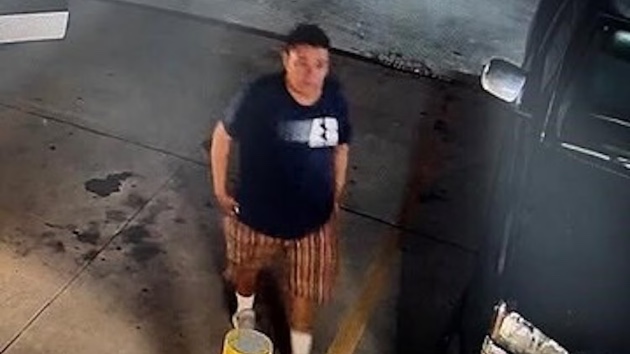
Police released surveillance images of the unidentified suspect wanted in a shooting, Sept. 7, 2025, at a bar in Cleveland, Texas, that left one man dead and five victims injured. (Liberty County Sheriff’s Office)
(CLEVELAND, Texas) — As a manhunt stretched into its second day for a gunman whom police alleged shot six people, one fatally, on the patio of a bar in suburban Houston early Sunday, investigators released surveillance images of the suspect and his alleged getaway vehicle.
The shooting occurred at the Alas Locas sports bar in Cleveland, Texas, about 45 miles northeast of Houston, according to the Liberty County Sheriff’s Office.
The shooting was captured on security video, authorities said.
Overnight, the Liberty County Sheriff’s Office released images from the security video showing an unidentified man at the sports bar during the shooting, whom they identified as the suspected shooter. Investigators also released an image of a white van with no side windows in which they said the suspect fled the scene after the shooting.
Police officials are asking anyone who spots to suspect or has information about the shooting to contact investigators immediately.
Witnesses told investigators that prior to the shooting, the gunman was quietly sitting by himself drinking at the bar, according to Capt. David Myers of the Liberty County Sheriff’s Office.
Based on the number of shell casings collected at the scene by investigators, including Rangers from the Texas Department of Public Safety, Myers said the gunman fired at least 20 shots before fleeing the bar.
A motive for the shooting remains under investigation.
The shooting unfolded at around 2:30 a.m. local time Sunday, when police received multiple calls of shots fired at the bar, Myers said in an interview at the scene with ABC Houston station KTRK.
Myers said witnesses told investigators that the suspect arrived at the bar between midnight and 2 a.m. and ordered a beer but was “not really conversing with anyone for about an hour prior to the shooting.”
At some point, according to Myers, the suspect walked out of the bar and later reemerged on the bar’s outdoor patio, where he allegedly opened fire without warning with a .40 or .45-caliber handgun, shooting at patrons who were eating and drinking on the deck.
The shooter fled the bar and drove off in an unknown direction in a white full-size van with no side windows, authorities said.
One victim, who was at the bar with his wife, was critically injured and taken by medical helicopter to Memorial Hermann-Texas Medical Center, where he was pronounced dead, according to officials.
Five other men and a woman were shot in the incident, including two who were in critical condition, Myers said.
The incident marked the second mass shooting at a bar in the Houston metropolitan area this year.
On March 23, six people were shot, including four who were critically injured, at the Latinas Sports Bar in southwest Houston.
Two days after the shooting, the Houston Police Department arrested a 25-year-old Venezuelan national, Jose Miguel Briceno, who was charged with aggravated assault mass shooting stemming from the shooting at the Latinas Sports Bar. A second suspect in the shooting is still being sought and police believe he fled to Mexico, authorities said.
According to a criminal complaint, Briceno, who authorities said is an undocumented immigrant, used a firearm to shoot inside the doorway of the bar and then discarded the firearm, which law enforcement never recovered. If convicted, he faces a sentence of up to 15 years in prison. Briceno has yet to enter a plea to the charges.
In June, Briceno was among 16 foreign nationals illegally residing in the Houston area indicted on federal drug trafficking and weapons charges following a law enforcement operation targeting Venezuelan nationals and alleged members or associates of the Anti-Tren transnational criminal organization, according to the U.S. Justice Department.
In the indictment, federal prosecutors alleged that the shooting at the Latinas Sports Bar was the result of a “turf war” between the Anti-Tren and the TdA gangs.
“These arrests are the largest takedown of suspected Anti-Tren members and associates by the FBI, so far, and they happened right here in Houston,” Douglas Williams, special agent in charge of the FBI Houston Field Office, said in a June 30 statement. “These individuals are accused of engaging in a turf war with TdA members and carrying out numerous violent crimes throughout our city, including a mass shooting at a local sports bar that left six people wounded. Fortunately, for the good and safety of our community, these individuals are now in federal custody facing U.S. justice.”
ABC News’ Tristan Maglunog contributed to this report.
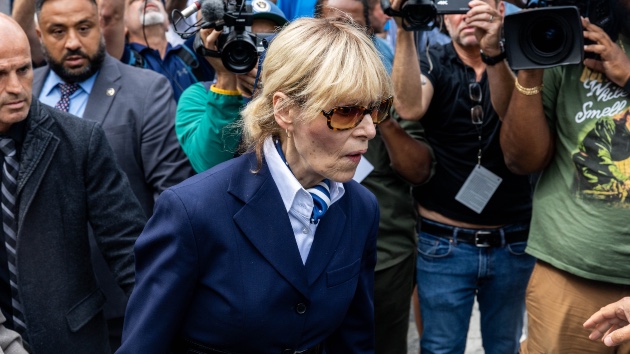
E. Jean Carroll leaves the courthosue on September 6, 2024 in New York City. Both parties appear in court today as Trump’s lawyers fight to overturn the jury’s finding that he sexually abused E. Jean Carroll. (Photo by Alex Kent/Getty Images)
(NEW YORK) — A federal appeals court in New York on Monday upheld the $83.3 million judgment imposed on President Donald Trump for defaming former magazine columnist E. Jean Carroll in 2019.
“Trump has failed to identify any grounds that would warrant reconsidering our prior holding on presidential immunity. We also conclude that the district court did not err in any of the challenged rulings and that the jury’s damages awards are fair and reasonable,” the opinion said.
This is a developing story. Please check back for updates.
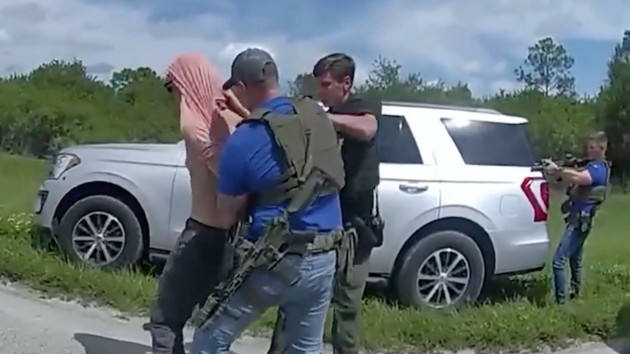
Martin County Sheriff’s Office / Handout/Anadolu via Getty Images
(NEW YORK) — Jury selection in the case of the man accused of trying to kill Donald Trump on his golf course last year got off to a rocky start Monday morning.
Ryan Routh, who is representing himself despite not being a lawyer and having limited legal experience, was barred by U.S. District Judge Aileen Cannon from asking most of his proposed jury questions due to them being “politically charged” and irrelevant.
According to Cannon, Routh proposed asking jurors about Trump’s proposed acquisition of Greenland and that country’s stance on Palestine. Routh also wanted to ask jurors what they would do if they were driving and they saw a turtle in the middle of the road — a question he suggested could speak to their character and mindset.
“They are all really off base and have no relevance to the jury selection process,” Judge Cannon said of Routh’s proposed questions.
Routh, a 59-year-old construction worker from North Carolina and Hawaii, has pleaded not guilty to five criminal charges that risk sending him to prison for life, including attempting to kill a presidential candidate and possession of a firearm in furtherance of a crime of violence.
He entered the federal courthouse in Fort Pierce, Florida, Monday morning for what is expected to be three days of jury selection followed by a month-long trial.
Attorneys will question three sets of 60 people to settle on twelve jurors and four alternates.
Routh also disclosed Monday that two of his proposed witnesses will likely not be able to testify. One witness has planned a trip to Vietnam during the trial, and the other fears being deported to his home country of Costa Rica if he testifies in Routh’s defense, Routh claimed.
“He doesn’t want to be deported. He likes being in America,” Routh said. Neither the prosecutors nor Judge Cannon addressed the alleged risk of deportation.
Routh has been sitting by himself on the far side of the courtroom, far from the long row of federal prosecutors who intend to send him to prison for life.
Despite lacking any legal training, Routh has spoken confidently in court and defended his proposed questions. But Judge Cannon has so far had little patience for some of his behavior, cutting him off occasionally and reminding him to follow the court’s rules.
Since taking over his own defense, Routh, according to court filings, has requested a “beatdown session” with Trump, asked to compete for his life in a round of golf with the president, and proposed being part of a prisoner swap instead of going to trial.
Judge Cannon — a Trump appointee who oversaw and dismissed one of the president’s criminal cases — is allowing Routh to defend himself but has imposed strict rules to prevent the trial from spiraling into what she called “calculated chaos.”
“I will be representing myself moving forward; It was ridiculous from the outset to consider a random stranger that knows nothing of who I am to speak for me,” Routh wrote in a letter to Judge Cannon in July. “I am so sorry, I know this makes your life harder.”
‘I tried my best’
Prosecutors allege that Routh planned his attack for months, then hid in the bushes of Trump’s Palm Beach golf course with a rifle in the predawn hours of Sept. 15.
With Trump just one hole away from Routh’s position, a Secret Service agent spotted a rifle poking out of the tree line, according to prosecutors. Routh allegedly fled after the agent fired at him, and was later arrested after being stopped on a nearby interstate.
Routh faces five criminal charges, including attempted assassination of a major presidential candidate, using a firearm in furtherance of a crime, assaulting a federal officer, possessing a firearm as a felon, and using a gun with a defaced serial number.
To secure a conviction, prosecutors will need to prove that not only did Routh intend to kill Trump, but that he also took at least one “substantial step” to carry out his plan.
According to prosecutors, Routh set his plan into motion after the unsuccessful attempt on Trump’s life in Butler, Pennsylvania, which Routh was not involved in. Prosecutors say Routh acquired a military-grade rifle, purchased more than a dozen burner phones, and researched Trump’s movements and campaign events.
Prosecutors also allege that Routh tried to purchase anti-aircraft weapons the month before his alleged assassination attempt, coordinating with someone he believed was a Ukrainian with access to military weapons. He allegedly shared a photo of Trump’s private plane, discussed the price of the weapon, and wrote, “I need equipment so that Trump cannot get elected.”
In addition to ammunition and the weapon allegedly used by Routh, which federal agents plan to bring into the courtroom to show the jury, prosecutors plan to use Routh’s own words against him during the trial.
According to court filings, Routh, in the months leading up to the assassination attempt, dropped off a box with a friend that included a note detailing his plans..
“This was an assassination attempt on Donald Trump, but I failed you. I tried my best and gave it all the gumption I could muster. It is up to you now to finish the job; and I will offer $150,000 to whomever can complete the job,” the handwritten letter said. “He [the former president] ended relations with Iran like a child and now the Middle East has unraveled.”
Routh has argued in court filings that prosecutors are misrepresenting the letter by only using a portion of it. and that the entire note is about “gentleness, peacefulness, and non-violent caring for humanity.”
Prosecutors also allege that Routh expressed similar sentiments in a 2023 self-published book, in which he encouraged readers to “assassinate Trump” in part due to his foreign policy with Iran. They also allege that Routh boasted about his alleged crimes in emails from jail.
Prosecutors have disclosed more than 40 potential witnesses and hundreds of exhibits, including forensic evidence allegedly tying Routh to the weapon found at the crime scene.
‘Character is the whole of this entire case’
After being represented by federal defense lawyers for months, Routh dismissed his lawyers earlier this year. Though his former lawyers will be present in court on standby, Routh will address the jury, question witnesses, and participate in the jury selection process.
In handwritten letters from prison while awaiting trial, Routh suggested his defense would center on his character as part of an effort to prove he lacked the intent to kill Trump.
“Character is the whole of this entire case — there is nothing else,” he wrote. “If one argues lack of intent then that totally hinges on character and character alone.”
Judge Cannon has warned Routh against representing himself and threatened to sanction him or revoke his ability to maintain his pro se status if he engages in “vexatious, obstructionist, or obstreperous behavior.”
Routh will wear business attire during the trial and be permitted to use a podium; however, he will not be allowed to roam the courtroom freely.
Prosecutors have expressed concern about Routh’s antics.
Routh’s self-representation has already created issues, according to Judge Cannon, who has sharply rebuked some of his tactics in court filings. She accused Routh of using the Federal Rules of Evidence to create “calculated chaos” and called one of his potential witnesses “a farce to bring about obviously ludicrous and absurd results in a court proceeding.”
Routh’s witness list included two dozen people, including a group of Palestinian activists and professors, his own son, a former girlfriend, and Trump himself.
In one court filing, Routh offered to drop his objections to most of the other evidence disputes if prosecutors allowed him to question Trump, whom he has described as a “mad fool.” He has also requested “female strippers,” asked for a putting green to prepare for a golf match with Trump, and proposed brawling with Trump.
“I think a beatdown session would be more fun and entertaining for everyone; give me shackles and cuffs and let the old fat man give it his worst,” he wrote. “A round of golf with the rascist pig, he wins he can execute me, I win I get his job.”
Routh family told investigators that while Routh had no diagnosed mental illness, he “fixated” on things, multiple sources briefed on the investigation told ABC News.
Judge Cannon has curtailed some of Routh’s potential arguments, including trying to justify his actions, claiming he did not plan to follow through with the alleged assassination, and encouraging the jury to exercise its nullification power. She has also clamped down on his witness list, allowing him to call experts and a few friends who could testify to his character.
‘Appearance of impartiality’
Opening statements in the trial are expected to take place as early as Wednesday afternoon, and the trial is scheduled to take 2-4 weeks.
Judge Cannon has opted to keep the jury anonymous and partially sequester them during the trial, with federal marshals picking up and dropping off the jurors from a confidential location daily.
Routh unsuccessfully tried to have Judge Cannon recuse herself from the case to prevent an “appearance of impartiality” stemming from her association with Trump, who appointed Cannon to her position.
Cannon oversaw the criminal case regarding Trump’s retention of classified documents after leaving the White House 2021, and dismissed the case on a novel legal theory that was widely criticized by legal scholars. Trump has repeatedly commended Judge Cannon’s actions overseeing his case — calling her the “absolute model of what a judge should be” — and one of Cannon’s recent law clerks is now in a senior Department of Justice position.
“Although Mr. Trump is the alleged victim here, he previously served as President of the United States. While in office, he nominated Your Honor to her current position as a U.S. District Judge on the Southern District of Florida. Your Honor thus owes her lifetime appointment to the alleged victim in this criminal case,” Routh’s former lawyers argued, adding that Trump could still nominate her to a higher court.
Judge Cannon denied the request to recuse herself, concluding that Routh could not identity a legal basis that required recusal and pushing back against some of his claims.
“I have never spoken to or met former President Trump except in connection with his required presence at an official judicial proceeding, through counsel. I have no ‘relationship to the alleged victim’ in any reasonable sense of the phrase,” she said.