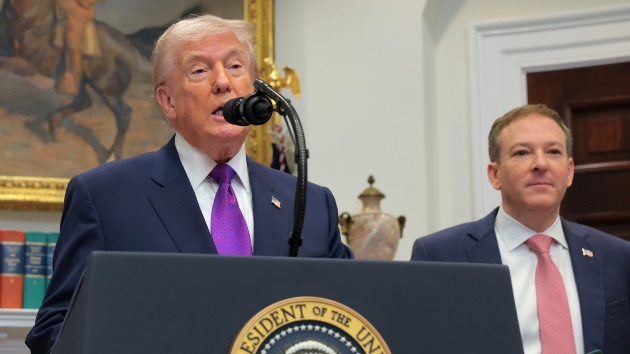
U.S. President Donald Trump (L) speaks alongside U.S. Environmental Protection Agency Administrator Lee Zeldin during an event to announce a rollback of the 2009 Endangerment Finding in the Roosevelt Room at the White House on February 12, 2026 in Washington, DC. (Photo by Anna Moneymaker/Getty Images)
(WASHINGTON) — Less than a week after the Environmental Protection Agency repealed its own endangerment finding, which gave the agency authority to regulate greenhouse gas emissions, a coalition of health and environmental organizations sued the agency over its decision.
The case, filed in the U.S. Court of Appeals for the District of Columbia Circuit, is being brought by the American Public Health Association, the American Lung Association, the Center for Community Action and Environmental Justice, Physicians for Social Responsibility, the Union of Concerned Scientists, the Center for Biological Diversity, the Natural Resources Defense Council and the Sierra Club, among others.
The lawsuit names EPA Administrator Lee Zeldin and the EPA as defendants.
Made during the Obama administration, the 2009 decision found that certain greenhouse gases endanger public health and welfare. The regulations that resulted cover everything from vehicle tailpipe emissions to the release of greenhouse gases from power plants and other significant emission sources.
President Donald Trump announced the repeal at the White House last Thursday, alongside Zeldin.
“The Endangerment Finding has been the source of 16 years of consumer choice restrictions and trillions of dollars in hidden costs for Americans,” Zeldin said in a statement at the time.
The litigants in the case say that “Under the Clean Air Act, the EPA is legally required to limit vehicle emissions of any ‘air pollutant’ that the agency determines ’cause or contribute to air pollution that may reasonably be anticipated to endanger public health or welfare.’ “
The coalition says the Trump Administration is “rehashing legal arguments” that were already rejected by the Supreme Court in its 2007 Massachusetts v. EPA case.
“In keeping with a longstanding practice, EPA does not comment on current or pending litigation,” the agency said in a statement to ABC News.
(SAUKVILLE, Wis.) — Tom Uttech has lived on his 52-acre property in Saukville, Wisconsin, for nearly 40 years.
From outside Uttech’s home art studio, the landscape is filled with rolling hills, topped with wildflowers that build to the highest point in the township, where rows of evergreens that Uttech says he planted by hand in 1988 have since grown into mature trees.
“That kind of scares me because I didn’t think I was that old,” Uttech said of the trees that he’s watched grow over the decades.
The 83-year-old renowned landscape painter, whose work has been displayed at museums across the country, has spent hundreds of hours and years of work over the last few decades maintaining and curating his land into a sweeping prairie that has come to serve as the inspiration for his work and his livelihood.
It’s a lifetime of work that Uttech now says has come under threat after receiving a letter in the mail from his utility company informing him that a massive power line would need to be built through his property, undoing years of work and stripping away the muse for his art.
“I couldn’t believe it, and I still don’t,” Uttech told ABC News correspondent Elizabeth Schulze when asked what his initial reaction was to the news. “They’d be putting power lines that are 300 or something feet tall, taller than apparently the Statue of Liberty.”
Uttech later learned that the transmission line would be used to help power a massive $15 billion data center campus that’s set to be built on over 500 football fields’ worth of farmland in nearby in Port Washington — a signature part of the Trump administration’s $500 billion Stargate partnership with OpenAI and Oracle, which President Donald Trump hopes will help supercharge the artificial intelligence revolution.
Uttech is facing what other residents in his town — and others around the country — are facing more and more: the risk of losing parts of his land to eminent domain, the government’s legal authority to seize private property for public use, in support of the growing expansion of AI data centers as the demand to power them continues to grow.
The threat, in some ways, is a physical manifestation of what many people like Uttech fear the artificial intelligence boom could mean for their work.
Across the United States there currently more than 3,000 data centers, and that number will soon grow by 1,200 more now under construction, according to Data Center Map, an industry service that tracks data center development.
”These facilities are so energy-intensive,” Ari Peskoe, who directs the Electricity Law Initiative at Harvard University, told ABC News. “A single sort of warehouse can use as much electricity as a large U.S. city. The amount of new infrastructure that has to be built to power that facility is unlike anything we’ve seen in generations.”
The Trump administration has pushed to rapidly build and deploy AI with urgency, arguing it will be vital to stay ahead of rivals like China and protect national security.
“I’m going to help a lot through emergency declarations, because we have an emergency, we have to get this stuff built,” Trump said at a White House event announcing the Stargate initiative last January. “So they have to produce a lot of electricity. And we’ll make it possible for them to get this production done easily, at their own plants if they want.”
‘It’s going to transform our community’ In nearby Port Washington, Mayor Ted Neitzke wants to make sure that investment is made right in his town, which he says is desperate for it.
“It’s exciting because it’s going to transform our community, it’s going to create a tax base and jobs and secondary and tertiary workforce and opportunities that we have not even envisioned, and it’s going to lead us into a real renaissance,” said Neitzke, who told ABC News the project would bring thousands of new jobs and much needed tax revenue.
“In a few years when the financing and everything is all done and the deal solidifies, they will pay the overwhelming majority of property taxes for the citizens of the city of Port Washington,” he said.
A representative for the industry group Data Center Coalition, when asked about the Port Washington project, told ABC News that the industry is making “multi-billion-dollar investments across the nation, including Wisconsin, to advance the digital economy, and in the process, provide significant benefits to local communities.”
“These include creating hundreds of thousands of high-wage jobs, providing billions of dollars in economic investment, and generating significant local, state, and federal tax revenue that helps fund schools, transportation, public safety, tax relief for residents and small businesses, and other community priorities,” the group said.
On top of outcries from the community over growing eminent domain concerns, the project has ignited backlash from some residents who are fearful that, as has been the case in some other communities around the country, the data center’s potential stress on the current electrical grid could lead to higher electric bills.
Nationwide, electricity prices jumped 6.9% in 2025 — more than double the inflation rate of 2.9% — according to new analysis by Goldman Sachs economists, who said they “expect data centers to boost electricity demand significantly, accounting for about 40% of total power demand growth over the next five years.”
In response, activists in Wisconsin, led by the community group Great Lakes Neighbors, have organized protests including a rally at the state capitol earlier this month. The tensions in the city were on full display last December when multiple anti-AI data center protesters were arrested, and one was dragged out of the city council meeting after chanting “Recall, recall, recall,” directed at Mayor Neitzke, after her allotted time had ended.
“I did go to the council meeting purely intending to speak. I had a speech prepared. Again, I had spoken earlier in other council meetings,” Christine LeJeune, the protester who was forcibly removed from the council meeting, told ABC News about the incident, adding that from her perspective, “the message was if you speak out, then this is what will happen to you.”
Pressed on the arrests at the recent council meeting, Neitzke, who faced a failed recall attempt over his support for the data center project, defended law enforcement when asked about the incident, while adding that incidents like that are “not the norm here.”
“I stand right next to our police department,” Neitzke said. “I thought they were very kind. They were very cordial, multiple warnings. Please, please, please.”
The mayor told ABC News that amid the backlash over the project, he’s been on the receiving end of threats to him and his family.
“I can play you the voicemails of the threats I receive from all over the country to my family’s safety,” he said. “What I did not see coming was that our officers following the law and enforcing the law would lead to people threatening our physical safety. That’s not OK.”
Paying their own way With the construction of the data center already underway, local activists around Port Washington are hoping to push for commitments from companies to cover increases to their bills and not pass any increases on to customers.
Both OpenAI and Oracle said in statements to ABC News that they were committed to paying their own way and said they would mitigate the impact of these data centers on customers and their electricity bills by pledging to build out renewable energy sources to create more power.
“In Wisconsin, and across all of our U.S. Stargate sites, we are committed to paying our own way on energy so that our operations do not increase local electricity prices,” OpenAI spokesperson Jamie Radice said in a statement. “Our Port Washington site will help support AI services used by millions of people and businesses across the country — the majority of whom use it for free — and it will bring jobs and long-term investment to the region.”
In a statement to ABC News, Oracle said, “In partnership with WE Energies, we’re paying our own way on energy so ratepayers’ bills and electric grid reliability are never impacted by our data center. Seventy percent of the energy used for the Port Washington campus will come from zero-emission sources, including wind, solar, and batteries. The project will add about 2,000 MW of new zero-emission power to Wisconsin’s grid, which means more reliable, affordable energy will be available to local families and businesses. Oracle — not ratepayers — will fund these electrical infrastructure upgrades.”
The fate of Uttech’s land rests with whether the American Transmission Company (ATC) moves forward with what the company has called either the “preferred route” for the new transmission lines — or the “preferred alternative route,” the latter of which follows existing transmission lines. The Public Service Commission of Wisconsin, the state agency that regulates utilities, will review ATC’s project application for the data center, including the proposed route options, and will select the final route.
Vantage, the data center operator, told ABC News in a statement that it supports the alternative route and that they are “committed to being a good neighbor” and are “prioritizing investing in sustainable energy, minimizing local impact and partnering closely with the community to be an economic driver for the state while enhancing the daily lives of residents.”
“Residents and businesses in Port Washington will not see an increase in their electric bills due to this project,” the Vantage statement said.
A representative from ATC told ABC News that they consider “several factors such as cost to ratepayers, landowner impacts, environmental sensitivities, and engineering considerations when studying power line routes and locations for supporting infrastructure” and that “The route designated as ‘preferred’ offers a lower cost to ratepayers and maximizes the use of existing corridors.”
“We understand that others may favor the alternative route for different considerations,” the ATC representative said.
‘I’m not going to just roll over’ Uttech, who at 83 still regularly jumps on a four-wheeler to traverse his sprawling property in search of inspiration, is working with the Wisconsin Institute for Law & Liberty, a conservative law firm, to take on the data center that could cost him his land.
“The use of eminent domain power must be the absolute last resort … This is not such a case,” the firm wrote in a letter to ATC. “We will do all we can to protect the Uttech family’s private property rights.”
“Building the power lines on their land would cause irreparable damage to the natural beauty and wildlife the Uttech family has spent decades developing, and which Tom enjoys as inspiration for his work,” WILL deputy council Lucas Vebber said.
While Uttech says he understands that AI is a growing billion-dollar industry that is already in motion and can’t be stopped, he is vowing to continue his fight.
“They brought the fight to me and I’m not going to just roll over,” he told ABC News, saying he plans to fight “right to the end.”
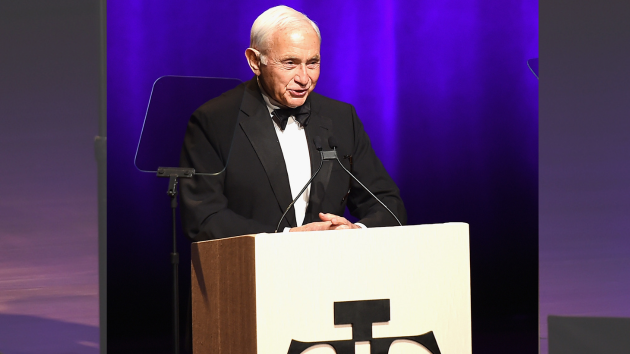
Les Wexner speaks onstage at the 2016 Fragrance Foundation Awards presented by Hearst Magazines – Show on June 7, 2016 in New York City. (Nicholas Hunt/Getty Images for Fragrance Foundation)
(WASHINGTON) — Members of the House Oversight Committee on Wednesday are set to depose retail billionaire Leslie Wexner, whose wealth fueled Jeffrey Epstein’s fortune before an alleged multimillion dollar theft ended their relationship, newly revealed documents suggest.
After learning that Epstein stole hundreds of millions from him in 2007, Wexner opted to quietly resolve the issue with Epstein, who at the time was being investigated by federal prosecutors for both sex crimes and money laundering, according to emails and a memo later drafted by prosecutors.
A vitally important person in the transformation of Epstein from college dropout to multimillionaire adviser to the ultra-wealthy, Wexner — a businessman behind brands like Victoria’s Secret and Bath & Body Works — has received substantial scrutiny over his association with Epstein since Epstein’s arrest and death by suicide in 2019.
Years after the two severed ties, prosecutors in New York initially included Wexner in a group of potential co-conspirators to be investigated after Epstein was arrested in July 2019, though they later determined there was “limited evidence regarding his involvement,” according to a recently-released 2019 email from an FBI agent who was part of the sex crimes investigation.
“The Assistant U.S. Attorney told Mr. Wexner’s legal counsel in 2019 that Mr. Wexner was neither a co-conspirator nor target in any respect,” a spokesperson for Wexner told ABC News in a statement following the release of Epstein files by the Department of Justice last month. “Mr. Wexner cooperated fully by providing background information on Epstein and was never contacted again.”
Lawyers for Wexner, in a meeting with federal prosecutors about two weeks after Epstein’s arrest, claimed that Wexner “had no knowledge of any inappropriate or unlawful activity with young women by Epstein” and that Wexner’s dealings with Epstein were “more professional than social,” according to a December 2019 prosecution memo summarizing the investigation into Epstein’s potential collaborators.
Wexner’s attorneys said the two ended their relationship after Wexner learned that “Epstein had stolen or otherwise misappropriated several hundred million dollars” from him, according to the memo. The memo stated that Epstein personally profited by repeatedly purchasing properties for the Wexners before buying them for himself at a fraction of the cost.
“The Wexners then decided to cut off Epstein,” prosecutors wrote in the memo summarizing their discussion with Wexner’s counsel.
‘All I can say is I feel sorry’ Epstein was — throughout 2007 — the subject of an ongoing investigation in Florida into sex crimes involving minors that had expanded to probe potential financial crimes and money laundering. The Wexners did not report the alleged theft of their funds to law enforcement and instead resolved the matter privately, according to prosecutors.
Wexner was contacted by federal prosecutors in Florida as early as August 2007 regarding the Epstein investigation, according to handwritten notes released last month by the Department of Justice. Notes from an August 2007 call between an attorney for Wexner and a DOJ representative suggest that prosecutors inquired about Wexner’s interactions with his “money manager,” documentation of their meetings, and whether Wexner ever visited Epstein’s home.
At the time, prosecutors had begun to broaden their investigation to not only cover sex crimes but also potential money laundering and wire fraud, documents suggest.
“She just wanted to know if Les has been to my house,” Epstein emailed his associate Ghislaine Maxwell in August 2007, in an apparent reference to the prosecutor’s contact with Wexner’s lawyer, according to emails obtained by DDOSecrets, a transparency website that received a cache of Epstein emails that were not included in the DOJ’s disclosures.
“That’s odd?? Why” Maxwell responded.
“It’s bulls—, she just wanted to let him know about an investigation is my guess,” Epstein wrote back.
It is unclear if Wexner was aware of the investigation into financial crimes when his attorney was contacted, but in the following months, Wexner began the process of ending Epstein’s role as his money manager, according to emails in the DDOSecrets collection between lawyers for Epstein and Wexner.
“All I can say is I feel sorry. You violated your own number 1 rule … Always be careful,” Wexler emailed Epstein in 2008 days before Epstein reported to prison for soliciting underage sex, according to documents included in DDOSecrets collection.
“No excuse,” Epstein replied.
‘She pretty much wants everything’ According to a 2019 prosecution memo, Wexner’s wife began to look into Epstein’s management of their money after Epstein claimed he was “having legal problems involving an overly aggressive police chief and some sort of massage.”
According to the memo, Abigail Wexner discovered Epstein “misappropriated a significant amount of the family’s funds,” including by purchasing property on the Wexners’ behalf before selling it to himself at a fraction of the cost.
“When confronted, Epstein tried to convince Wexner’s wife that she did not understand the financials and insisted that he had the Wexners’ best interests at heart,” the memo said. “The Wexners did not want to bring unnecessary public attention to the issue, so they withdrew the power of attorney, and hired counsel to negotiate a private settlement with Epstein.”
Epstein resigned from the foundation and all of his roles with Wexner in September 2007, according to an independent review conducted in 2020 of Epstein’s involvement with the Wexner Foundation.
“Mr. Wexner terminated Epstein as his financial advisor, revoked his power of attorney, and directed that he be removed from all bank accounts,” a spokesperson for Wexner said in a statement to ABC News.
As early as October 2007, emails indicate that Epstein began transferring assets back to Wexner.
“When speaking with [Abigail Wexner], she pretty much wants everything,” Wexner’s financial controller told an attorney for Epstein.
Later that year, an attorney for Wexner pushed the process along, telling an attorney for Epstein that his client “is eager to execute documents,” according to the DDOSecrets cache.
Prosecutors wrote in a 2019 memo that Epstein returned $100 million to Wexner by January 2008.
Though the dispute with Wexner was privately resolved by January 2008, Epstein’s attorneys appeared to have mounted a pressure campaign to discredit the prosecutor pursuing a money laundering investigation into Epstein, according to emails in the DDOSECRETS collection. Epstein had signed a non-prosecution agreement in September 2007, but his lawyers continued to negotiate with the government over its terms for several more months.
“In what can only be seen as an attempt to intimidate Mr. Epstein, Ms. Villafana [an assistant U.S. Attorney] then added money-laundering and unlicensed wire-transmittal to the list of violations under investigation even though there was no evidence against Mr. Epstein concerning these charges,” attorneys for Epstein wrote in a letter to the Office of Professional Responsibility dated Feb. 11, 2008.
By June 2008, Epstein began his jail sentence in Palm Beach after reaching the controversial plea deal that allowed him to avoid federal charges.
‘You and I had gang stuff for over 15 years’ Although Epstein and Wexner appear to have severed ties following Epstein’s plea deal, documents released by the DOJ suggest that Epstein may have attempted to rekindle their relationship in subsequent years by drafting a letter reminding Wexner of shared experiences and alleged secrets. In the letter, Epstein wrote that he protected him when he was questioned by Wexner’s wife about his management of their money.
“You and I had ‘gang stuff’ for over 15 years. A great deal of it, that she was unaware of. I had no intention of divulging any confidence of ours, no matter what accusations she made. And she made quite a few,” Epstein wrote in the draft note. Based on publicly available documents, it is unclear whether Epstein ever sent the note to Wexner.
Wexner publicly addressed his relationship with Epstein in August 2019 amid mounting public pressure, saying in a letter to his charitable foundation that he was “deceived” by Epstein.
“As the allegations against Mr. Epstein in Florida were emerging, he vehemently denied them. But by early fall 2007, it was agreed that he should step back from the management of our personal finances. In that process, we discovered that he had misappropriated vast sums of money from me and my family. This was, frankly, a tremendous shock, even though it clearly pales in comparison to the unthinkable allegations against him now,” Wexner wrote.
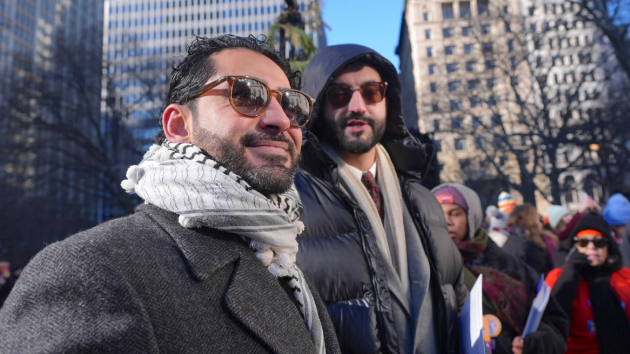
Mohsen Mahdawi, a Columbia University student and Palestinian activist, who was arrested by US immigration authorities in mid-April 2025, attends the inauguration ceremony at City Hall in New York, United States, on January 1, 2026. (Selcuk Acar/Anadolu via Getty Images)
(NEW YORK) — For the second time in a little more than a week, attorneys have announced that an immigration court has terminated deportation proceedings against a pro-Palestinian student after Secretary of State Marco Rubio claimed they posed a threat to foreign policy.
According to a letter filed in court, attorneys for Mohsen Mahdawi, the Columbia University student who was detained at his naturalization interview in April, a judge has found that the Department of Homeland Security “did not meet its burden of proving by clear and convincing evidence” that he is removable.
It comes after an immigration court terminated removal proceedings against Tufts University Ph.D. student Rümeysa Öztürk. Her attorneys announced the order in a letter to the federal judge overseeing the case challenging her detention on Feb. 9.
For Mahdawi’s case, immigration judge Nina Froes appears to have based her decision on the finding that DHS failed to authenticate a memo allegedly signed by Rubio claiming Mahdawi was a threat to U.S. foreign policy.
Mahdawi’s attorneys have argued that, like other pro-Palestinian demonstrators, organizers and students, he was being targeted for his constitutionally protected speech.
Öztürk, like Mahdawi, was also labeled a foreign policy risk by Rubio in a memo.
Both cases can be appealed by the Trump administration, so their habeas petitions will likely continue to play out in federal court.
“I am grateful to the court for honoring the rule of law and holding the line against the government’s attempts to trample on due process,” Mahdawi said in a statement. “This decision is an important step towards upholding what fear tried to destroy: the right to speak for peace and justice.”
“In a climate where dissent is increasingly met with intimidation and detention, today’s ruling renews hope that due process still applies and that no agency stands above the Constitution,” he added.
In response to a request for comment about both cases, the Department of Homeland Security sent a previous statement about Mahdawi and said: “It is a privilege to be granted a visa or green card to live and study in the United States of America. When you advocate for violence, glorify and support terrorists that relish the killing of Americans, and harass Jews, that privilege should be revoked, and you should not be in this country. No activist judge, not this one or any other, is going to stop us from doing that.”
Mahdawi was detained in Vermont last spring during his citizenship interview. Arguing that he should continue to be detained, lawyers for the Trump administration pointed to a 2015 FBI investigation, in which a gun shop owner alleged that Mahdawi had claimed to have built machine guns in the West Bank to kill Jews.
However, the FBI closed that investigation and Mahdawi was never charged with any crime, a point a federal judge highlighted when he ordered Mahdawi’s release.
In response to the government’s allegations against him, Mahdawi and his lawyers have firmly refuted allegations that he ever threatened Israelis or those of the Jewish faith. He told ABC News he has been advocating for peace and protesting against the war in Gaza.
“So for them to accuse me of this is not going to work, because I am a person who actually has condemned antisemitism,” Mahdawi said. “And I believe that the fight against antisemitism and the fight to free Palestine go hand in hand, because, as Martin Luther King said, injustice anywhere is a threat to justice everywhere.”
Öztürk was detained in March by masked federal agents, and the arrest was captured on camera. Attorneys representing her said she was targeted, like other high-profile arrests of students, for her Pro-Palestinian views, specifically, for co-authoring an Op-Ed in the student paper in March 2024 calling on the school’s administration to take steps to “acknowledge the Palestinian genocide.”
A federal judge ordered her release in May.
“Today, I breathe a sigh of relief knowing that despite the justice system’s flaws, my case may give hope to those who have also been wronged by the U.S. government,” Öztürk said in a statement on Feb. 9. “Though the pain that I and thousands of other women wrongfully imprisoned by ICE have faced cannot be undone, it is heartening to know that some justice can prevail after all.”
Los Angeles Mayor Karen Bass delivers her State of the City address Monday, February 2, in Los Angeles at the Expo Center.(Photo by Hans Gutknecht/MediaNews Group/Los Angeles Daily News via Getty Images)
(LOS ANGELES) — Los Angeles Mayor Karen Bass has called for 2028 Los Angeles Olympics chair Casey Wasserman to step down following the release of the Hollywood mogul’s emails with convicted sex offender Jeffrey Epstein’s co-conspirator, Ghislaine Maxwell, who is serving a 20-year sentence for child sex trafficking and other offenses.
Some flirtatious emails sent between Wasserman and Maxwell in 2003 surfaced through the Department of Justice’s release last month of millions of Epstein-related documents. They followed a previously known trip to Africa that Wasserman took on Epstein’s plane in 2002 alongside former President Bill Clinton for a humanitarian mission with the Clinton Foundation.
The LA28 Executive Committee of the Board said last week it stands by Wasserman after its review found that his relationship with Epstein and Maxwell “did not go beyond what has already been publicly documented.”
In an interview with CNN on Monday, Bass said she disagrees with the board.
“The board made a decision. I think that decision was unfortunate. I don’t support the decision,” Bass said.
The mayor, who noted that she is not able to fire Wasserman, said she thinks that “we need to look at the leadership” of LA28 and that her job is to ensure the city is “completely prepared” to host the Summer Olympics.
Wasserman heads LA28, the organizing committee responsible for delivering the 2028 Games, including securing corporate sponsors and other funding. He was previously the LA Olympic Bid Committee president.
“My opinion is, is that he should step down,” Bass said. “That’s not the opinion of the board.”
ABC News has reached out to Wasserman’s spokesperson and LA28 for comment regarding Bass’ remarks and has not yet received a response.
Maxwell was convicted of child sex trafficking and other offenses in connection with Epstein in 2021.
In the newly publicized emails, sent nearly 20 years before Maxwell’s arrest, Wasserman told her in one exchange, “I think of you all the time… So what do I have to do to see you in a tight leather outfit?”
Since the emails came to light, Wasserman’s eponymous sports marketing and talent management company has lost several clients, including the singers Chappell Roan and Orville Peck and the former soccer player Abby Wambach.
Wasserman apologized for what he called his “past personal mistakes” in a message to his staff last week obtained by ABC News through his spokesperson.
“Hopefully by now you know the facts about my limited interactions with those two individuals,” he said. “It was years before their criminal conduct came to light, and, in its entirety, consisted of one humanitarian trip to Africa and a handful of emails that I deeply regret sending. And I’m heartbroken that my brief contact with them 23 years ago has caused you, this company, and its clients so much hardship over the past days and weeks.”
Wasserman said in his message to his staff that he believes he has become a “distraction” and has started the process to sell his company while he devotes his “full attention to delivering Los Angeles an Olympic Games in 2028 that is worthy of this outstanding city.”
The LA28 Executive Committee of the Board said last week that it “takes allegations of misconduct seriously” and conducted a review of Wasserman’s past interactions with Epstein and Maxwell with the help of outside counsel.
“We found Mr. Wasserman’s relationship with Epstein and Maxwell did not go beyond what has already been publicly documented,” the board said in a statement, citing the 2002 flight to Africa on Epstein’s plane and the 2003 emails with Maxwell.
“The Executive Committee of the Board has determined that based on these facts, as well as the strong leadership he has exhibited over the past ten years, Mr. Wasserman should continue to lead LA28 and deliver a safe and successful Games,” the board said.
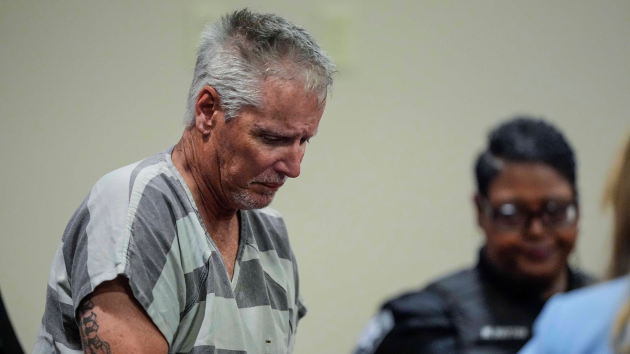
Colin Gray, 54, the father of Apalachee High School shooting suspect Colt Gray, 14, enters the Barrow County courthouse for his first appearance, on September 6, 2024, in Winder, Georgia. Colin Gray is being charged with involuntary manslaughter, second-degree murder and cruelty to children after his son opened fire and killed 4 at the high school on Wednesday. (Photo by Brynn Anderson-Pool/Getty Images)
(GEORGIA) — In often tearful and painful testimony, students wounded in a 2024 mass shooting at a Georgia high school took the witness stand on Tuesday in the murder trial of the alleged gunman’s father.
As the defendant, 55-year-old Colin Gray, sat just feet away listening, the students recounted the horror they endured on Sept. 4, 2024, at Apalachee High School in Winder, Georgia, allegedly at the hands of Gray’s then 14-year-old son, Colt.
Judge Nicholas Primm, who is presiding over the case, ordered the media not to show the students’ faces during the televised trial. The defense did not cross-examine any of the students who testified.
All of the students who testified Tuesday said they were in algebra teacher Cassandra Ryan’s class when they heard a loud bang outside their classroom door.
“I remember standing up and turning my back towards the door, and that’s when I saw him, Colt. He was pointing the weapon, just aiming anywhere, I guess,” testified Melany Delira-Castaneda, who was a freshman at the time of the shooting.
The now 16-year-old girl testified that she didn’t realize she had been shot until after the gunshots subsided.
“I remember standing up and I turned around. I didn’t know I was shot, but I was. My body was telling me to hold my arm, so I was holding my arm,” Delira-Castaneda testified. “I think I was just in shock and scared.”
She said she was shot in the shoulder.
“I feel like just seeing a lot of what I saw that day, it just sticks with me, and not being able to trust certain people,” Delira-Castaneda told the court.
Prosecutors called the students to testify in an effort to show what Barrow County District Attorney Brad Smith described in his opening statement as the “horrific consequences” of the alleged actions or inaction Colin Gray took with his son leading up to the shooting.
Gray is the latest parent that prosecutors in various U.S. states have attempted to hold criminally culpable for their children’s alleged deadly actions.
The father is charged with four counts of involuntary manslaughter, two counts of second-degree murder and eight counts of cruelty to children. He has pleaded not guilty to the charges.
Gray’s son, Colt, now 16, has been charged as an adult and is awaiting a separate trial on multiple counts of felony murder and aggravated assault. He has pleaded not guilty.
Killed in the shooting were math teacher and football coach Richard Aspinwall, 39; math teacher Cristina Irimie, 53; and students Mason Schermerhorn, 14, and Christian Angulo, 14, officials said.
Angulo was also in Ryan’s class when he was shot and killed.
“This case is about this defendant and his actions – his actions in allowing a child that he has custody over access to a firearm and ammunition after being warned that his child was going to harm others,” Smith said in his opening statement on Monday.
Prosecutors allege that despite repeatedly being warned about his son’s mental deterioration and that he was a danger to himself and others, Colin Gray gave the boy an AR-15-style rifle as a Christmas present and allowed him to keep the weapon propped against a wall in his bedroom. The rifle, prosecutors allege, was used in the mass shooting at Apalachee High School.
Nautica Walton, another student in Ryan’s algebra class on the day of the shooting, testified on Tuesday that when she heard a loud bang outside the classroom door, “I realized something was wrong.”
“I remember my teacher falling to the floor, and then Taylor, [a student] in front of me, I remember seeing her fall down before I turned around and saw there was somebody at the door with a weapon,” Nautica, now 16, testified.
She told the court that she got on the ground next to Melany Delira-Castaneda.
“I remember Melany, she had blood all on her arm. I remember her blood was getting on the side of me because I was lying on the side of her,” Walton testified.
Walton further testified that she was shot in the leg during the episode and recalled going in and out of consciousness.
“I remember my teacher telling me to stay awake because I was feeling really tired,” Walton said on the witness stand. “I remember Natalie [another student] lying on the floor, saying she was hit and crying with a big puddle of blood,” said Walton, adding that a classmate took off her jacket and wrapped it around her leg.
“And then I passed out after that,” she testified.
Walton also told the court that since the shooting, she has been unable to play sports and has been “very paranoid.”
“I don’t like being in front of doors at school. I don’t use the bathroom at school,” testified Walton, adding that she had nightmares for months after the shooting.
Student Taylor Jones, now 16, testified that when she realized she had been shot in the leg, she asked a classmate to hold her hand “because I was scared.”
She told the court that she remembers being on the classroom floor before she passed out and then waking up at Grady Memorial Hospital in Atlanta, where she was flown to by a medical helicopter.
Jones, a one-time volleyball player on her school team, told the court that she has since undergone multiple surgeries and has been unable to play sports.
Natalie Griffith, now 16, recalled to the court looking down at her hand during the shooting and seeing a hole and blood near her wrist.
“I didn’t know this at the time, but I had another one up on my shoulder,” she testified of a second bullet wound. “I was also worried that I was going to die and how that would affect my parents because my dad has a heart problem.”
Griffith told the court that as she was being carried out of the classroom, she saw Colt Gray on the floor being detained with his hands behind his back.
“I said a lot of curse words. I was very angry at the time because I thought they were going to have to amputate my hand,” Griffith testified. “I remember yelling at him that we were kids, because we were kids.”
Jaxxon Beaver, 16, another student in the algebra class, testified that he was also shot in the leg.
“I noticed that when I was hurt, I looked down and saw a hole in my shorts and noticed I was bleeding,” Beaver said on the stand.
Beaver further testified that he was unable to go to school for at least three months after the shooting, and eventually gave up on going back.
“Every time I went back to school, I would feel like something bad was going to happen again. I couldn’t wait and had to go home, like right after,” Beaver testified.
Ronaldo Vega, now 16, recalled to the court seeing Colt Gray at the door wearing yellow gloves and firing a rifle that had a scope.
“He shot, I don’t know how many times. I went down to duck,” Vega testified.
Vega testified that when the shooting stopped, he barricaded the classroom door with desks and chairs. He said he saw Christian Angulo curled up on the floor motionless near the door.
“A girl was screaming that he was dead,” Vega told the court.
(NEW YORK) — Storms are hitting Southern California with heavy rain that flooded roads, as millions are on alert for damaging winds on Tuesday. Meanwhile, in the North, millions are preparing for a winter storm.
Heavy thunderstorms in Southern California brought 1 to 3 inches of rain to the area, with the highest elevations seeing more than 3 inches.
Damaging winds gusted between 50 and 70 mph during the strongest thunderstorms. The highest wind gust reported was 81 mph in the hills above Malibu. This toppled trees and caused roof damage.
Issues popped up throughout the region, including flooded businesses in the Fairfax District, stranded drivers in Commerce, and a massive tree that fell on a car in Crestline, according to ABC News Los Angeles affiliate KABC.
A flood watch is in effect for the Santa Barbara and Los Angeles areas again Tuesday night due to the risk of flash flooding, debris flows and mudslides — especially in burn scar areas.
Two more rounds of rain are expected across the Southern California area this week. The first is forecast to arrive Tuesday evening and continue overnight. The second is expected to arrive on Thursday morning to early afternoon.
This rain will be shorter-lived and less impactful than Monday’s event. Winds will be calmer, too. An additional 0.5 to 2 inches is possible through Thursday.
It will remain dry and sunny, with a warming trend through the weekend before more rain arrives Monday through Wednesday of next week.
In Sierra Nevada, heavy snow, strong winds and avalanche dangers have closed mountain roads and forced ski lodges to close as well.
The heavy snow will continue through the week, with snow accumulations of 4 to 8 feet through Friday.
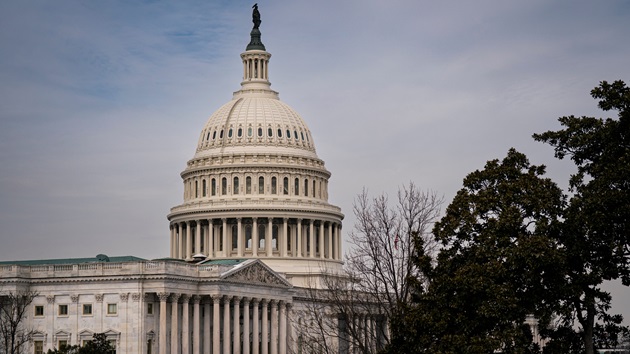
The US Capitol in Washington, DC, US, on Tuesday, Feb. 10, 2026. (Al Drago/Bloomberg via Getty Images)
(WASHINGTON) — An 18-year-old man was apprehended after running toward the U.S. Capitol with a loaded shotgun, according to Capitol police.
Just after noon on Tuesday, the man parked a white Mercedes SUV, got out of the car and started running toward the Washington, D.C. building, Capitol Police Chief Michael Sullivan said at a news conference.
As he approached the building, officers with the Capitol police saw him and ordered him to drop the weapon, the chief said.
“He immediately complied,” Sullivan said, noting that the man put down the gun, got on the ground and was then taken into custody.
The man had additional rounds with him, as well as a tactical vest and tactical gloves, according to Sullivan. A Kevlar helmet and gas mask were found in his car, he added.
“Who knows what could’ve happened” if the officers were not standing guard, Sullivan said.
Officers cleared the area, which has since reopened, according to police.
“There does not appear to be any other suspects or ongoing threat,” authorities said.
Both chambers of Congress are out of session this week.
A motive is not clear, Sullivan noted.
The man, who does not live in the area, was not known to Capitol police, he said.
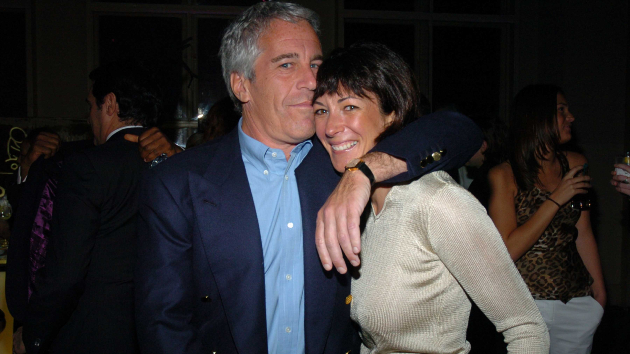
Jeffrey Epstein and Ghislaine Maxwell attend The 2005 Wall Street Concert Series on March 15, 2005 in New York City. (Joe Schildhorn/Patrick McMullan via Getty Images)
(NEW YORK) — Ian Maxwell, the brother of convicted Jeffrey Epstein accomplice Ghislaine Maxwell, is speaking out on his sister’s ongoing effort to overturn her conviction, her recent Congressional deposition, her transfer to a federal prison camp in Texas, and more in a broad interview Tuesday with ABC News.
Ian Maxwell’s comments come a week after his sister invoked the Fifth Amendment during a closed-door virtual deposition before the House Oversight Committee last Monday, where she was asked questions about her relationship with Epstein and her involvement in the late sex offender’s criminal activity.
“The legal advice was absolutely clear. And you need to think about this quite carefully,” Ian Maxwell said of his sister’s decision to not answer the questions, reiterating that she did speak with United States Deputy Attorney General Todd Blanche in July.
“He asked her over two days of questioning several hundred questions. She didn’t fail to answer a single one of those,” he said.
During her interview with Blanche, a former personal attorney for President Donald Trump, Maxwell continued to deny any involvement in Epstein’s sexual exploitation and said she had not witnessed any wrongdoing by any other man — including Trump or former President Bill Clinton. Maxwell was granted limited immunity for the interview as long as she answered questions truthfully.
Ian Maxwell also touched on the possibility of President Trump pardoning his sister, though he noted she had not asked Trump for a pardon. He said the idea that she could exonerate Trump and Clinton of any wrongdoing with her testimony was attributable to a former lawyer of Maxwell’s.
“Ghislaine has not asked President Trump for a pardon. The fact of the matter is that the Epstein scandal is being used by both sides of the aisle to beat the present president and the former president,” he said.
Ian Maxwell also discussed a petition pending in federal court in New York that seeks to overturn her conviction or reduce her sentence.
The petition alleges nine separate grounds — including juror misconduct and government suppression of evidence — for Ghislaine Maxwell’s contention that constitutional violations undermined the integrity of her 2021 trial.
“I am hopeful that the petition will reach the judge presiding over the petition based on the evidence, the evidentiary record,” he said.
In the interview, the British businessman addressed Ghislaine Maxwell’s transfer from a federal prison in Florida to a federal prison camp in Texas over the summer.
“Ghislaine is possibly the most notorious prisoner in the U.S. federal system today,” he said. “We know that prison is a very violent place. Jeffrey Epstein died. Ghislaine did have many threats in Tallahassee where she was. It was a notoriously violent and dangerous place for her own safety. She had to be moved.”
At the time of the move, the reason for the transfer was not made clear. FCI Tallahassee in Florida, where Maxwell had been held, is a “low security” prison for men and women, while FPC Bryan is a “minimum security” camp just for women.
Ian Maxwell disputed the idea that his sister was transferred as any sort of reward for protecting Trump.
“President Trump has not done anything wrong. You tell me, have you found anything wrong in the papers yet? I haven’t seen anything there,” he said regarding the recent release of Epstein files by the Justice Department.
Ian Maxwell also discussed the authenticity of a photograph of his sister with the former Prince Andrew and his late accuser Virginia Giuffre.
“I would maintain that Ghislaine continues to have tremendous doubt about the picture that was published and believes that it is not the original and may have been doctored in some way. We don’t know,” said Ian Maxwell, who backs his sister’s stance that she was not responsible for introducing the former prince to Epstein.
Ghislaine Maxwell was convicted in December 2021 on five of six counts related to the abuse and trafficking of underage girls. In his interview, Ian Maxwell maintained that his sister “did not receive a fair trial” and said that “the verdict is deeply unsafe.”
Ian Maxwell was asked to elaborate on claims made in Ghislaine Maxwell’s pending petition that as many as 25 other men settled claims privately with Epstein accusers.
“The only person who is in jail, the only person whose been tried and found guilty is a woman, my sister,” Ian Maxwell said. “All of these men have disappeared into the ether.”
The U.S. military says it hit three more vessels suspected of carrying drugs in the Eastern Pacific and Caribbean Sea, killing 11 men. (U.S. Southern Command/X)
(NEW YORK) — The United States military says it hit three more vessels suspected of carrying drugs in the Eastern Pacific and Caribbean Sea, killing 11 men.
U.S. Southern Command says in an online post that the vessels were traveling along drug-trafficking routes and “engaged in narco-trafficking.” A video accompanying the strike shows the three separate strikes.
Officials said four men were killed in the strike on the first vessel in the Eastern Pacific, four on the second vessel in the Eastern Pacific and three on the third vessel in the Caribbean.
No U.S. military forces were harmed, according to SOUTHCOM.
According to the government’s count, the U.S. has killed a total of 144 people in the strikes, which are now being led by U.S. Southern Command Gen. Francis Donovan.