(PHOENIX) — Multiple areas across the country are expected to have dangerous heat and fire weather concerns this weekend with over 35 million Americans on alert for dangerous heat.
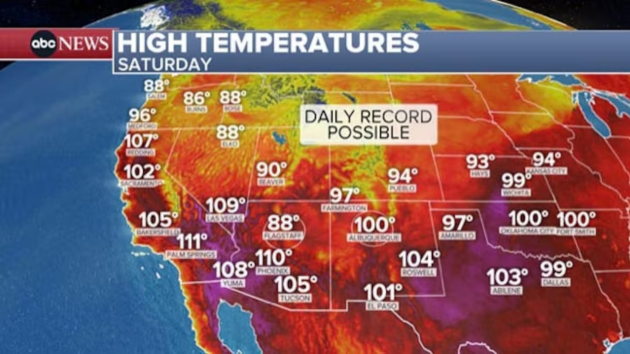
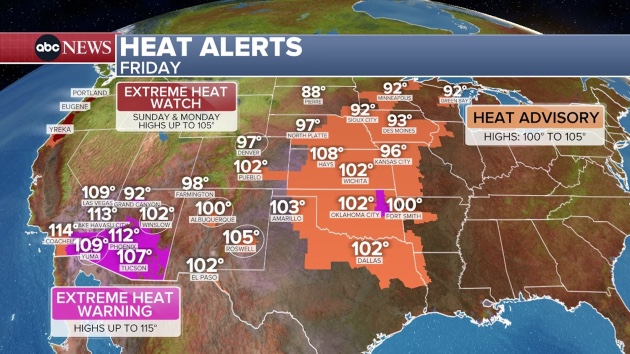
Extreme Heat Warnings remain in effect for Phoenix, Arizona, Palm Springs, California, and lower elevations of the Grand Canyon National Park. High temperatures there will once again be well into the 100s and go up to 115 in spots during the weekend.
Heat advisories are also in effect on Saturday for other scattered areas of the Southwest, with more widespread Heat Advisories stretching across the Plains as the heat begins to expand out.
Places under these heat advisories include: Albuquerque, New Mexico; El Paso and Dallas, Texas; Oklahoma City, Oklahoma; Little Rock, Arkansas; Wichita, Kansas; Springfield, Missouri; and Kansas City, Missouri.
High temperatures between 100 and 110 are possible for these areas on Saturday. Record high temperatures are possible for Albuquerque, New Mexico, and Flagstaff, Arizona, later Saturday.
The extreme heat peaked on Friday for parts of the Desert Southwest and is expected to ease this weekend.
There are also fire weather alerts in places across four states in the West — Oregon, Utah, Colorado and Wyoming — for critical fire weather conditions keeping a strong foothold into the weekend.
Single digit humidity and gusty winds are possible, which will be conducive for rapid fire spread with any new or existing wildfires in these areas.
While the extreme heat and the fire weather concerns are lingering for select parts of the Southwest this weekend, both will generally continue to wane into the beginning of next week.
Heat is also building up in the Northwest, where there’s an extreme heat warning in effect for Medford, Oregon, as well as from Eugene to Portland, Oregon.
High temperatures between 97 and 110 degrees are possible during the weekend into the beginning of next week. Very warm, low temperatures between 65 and 70 degrees are possible for these areas, providing little relief at night from the extreme heat.
Other areas of the Northwest are under heat advisories this weekend for high temperatures between 93 and 112, as well as low temperatures only getting into the 60s and 70s. These areas include Spokane, Washington; Lewiston, Idaho; Longview, Washington; and Mount Shasta, California.
Next week, widespread heat will return to the Northeast and much of the country.
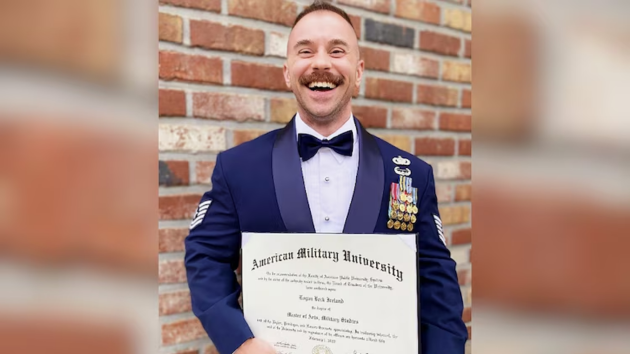
(WASHINGTON) — After the Supreme Court cleared the way for the Trump administration to enforce its ban on transgender service members, Master Sgt. Logan Ireland, who has served in the Air Force for 15 years, was faced with the options of separating from the military voluntarily or being processed for involuntary separation – a prospect that comes with losing half of his separation pay.
When Logan was presented with the option of applying for early retirement at 15 years, he applied and was relieved when the Air Force approved his request and gave him an early retirement date of Dec. 1, 2025.
“It’s kind of like your golden ticket. So I felt solid,” Ireland told ABC News.
But on Monday, Ireland said he received a memo from Brian Scarlett, who is performing the duties of the assistant secretary of the Air Force for manpower and reserve affairs, indicating that early retirement at 15-18 years for transgender service members would be denied.
“After careful consideration of the individual applications, I am disapproving all Temporary Early Retirement Authority (TERA) exception to policy requests in Tabs 1 and 2 for members with 15-18 years of service,” the memo said, adding that those denied early retirement would need to be processed for separation instead.
Military service members are eligible for full retirement benefits after they complete 20 years of service. Anything less than that requires an approved exemption. Air Force personnel who had 18 but less than 20 years of service were approved for early retirement because they were close to the 20 years, while several dozen senior Airmen who had between 15 and 18 years of service also sought approval for this early retirement, the Air Force said. Early retirement would allow them to receive part of their pension.
The memo, which was reviewed by ABC News, includes a “script” for commanders to communicate with applicants regarding TERA denial and separation, and explains that the Department of the Air Force (DAF) “prematurely notified some DAF members that their TERA applications under the gender dysphoria provision had been approved.”
The Air Force said in a statement to ABC News, “Approximately a dozen service members between 15 and 18 years of service were prematurely notified that their TERA applications under the gender dysphoria provision had been approved, but higher level review was required under the DoD gender dysphoria policy for those members.”
Ireland, who has served multiple overseas tours to countries like Afghanistan, the United Arab Emirates and South Korea, said that the reversal was a “betrayal.”
“The first feeling I felt was betrayal. I’ve given my life to the service,” he said.
“I was promised this. I had my retirement orders in hand,” he added. “I’ve been starting to process what life looks like outside of uniform, and now we don’t know what that looks like.”
According to the Scarlett memo, transgender service members who choose to voluntarily separate will receive separation pay at twice the rate of those who choose involuntary separation.
The memo from Scarlett also says that while service members like Ireland would not be eligible for early retirement, they will still be “entitled to an honorable discharge characterization, separation benefits and transition assistance.”
Air Force Cmdr. Emily Shilling, who is the president of Sparta Pride — an organization advocating for about 2,400 transgender people in the military and those who hope to join — criticized the move in a phone interview with ABC News on Thursday, saying that the Air Force “reneged on their promise.”
Shilling said that some applications for early retirement had already been approved, but now the lives of those service members who have dedicated close to two decades of service to their country have been upended again.
Shilling, who will be eligible for retirement at 20 years in September, previously told ABC News that she chose to self-identify as transgender and begin the process of voluntarily separating from the military, but said that she made the decision “under duress.”
“I was coerced into it because we knew that the voluntary separation would give me an honorable discharge with some portion of my retirement, and I’d be able to keep all of my benefits,” Shilling said. ABC News reached out to the Air Force but a request for comment was not returned.
The Department of Defense offered transgender service members the opportunity to voluntarily separate before they were forced out through involuntary separations. Incentives were offered for voluntary separations that amounted to double the benefits that they might have received if they were involuntarily separated.
Shilling and Ireland both decided to fight the ban in federal court, each becoming lead plaintiffs in separate federal lawsuits – Shilling vs. Trump and Ireland vs. Hegseth. A third lawsuit, Talbott vs. Trump, also challenges the ban, which was announced in a Jan. 27 executive order by President Donald Trump, who directed the Defense Department to revise the policy allowing transgender troops to openly serve.
“Expressing a false ‘gender identity’ divergent from an individual’s sex cannot satisfy the rigorous standards necessary for military service,” the Trump order said, arguing that receiving gender-affirming medical care is one of the conditions that is physically and mentally “incompatible with active duty.”
Defense Secretary Pete Hegseth echoed this sentiment in a Feb. 7 memo, saying that “efforts to split our troops along lines of identity weaken our Force and make us vulnerable.”
Professor Nathaniel Frank, a cultural historian and researcher at Cornell University who studies the history of LGBTQ+ people in the military, told ABC News that decades of research dispute the administration’s arguments that transgender individuals are not fit to serve.
“There’s never been any evidence found that gay or transgender service members present any problems to unit cohesion or readiness, and that the evidence finds the opposite, that the prohibitions against trans people are what harm readiness and cohesion because they undermine trust,” Frank said.
Despite the legal challenges, the Supreme Court ruled in May that the administration can enforce the ban as the lawsuits move forward.
In response to the letter denying his early retirement, Ireland signed a memo on Wednesday indicating that he understands that his TERA exception to policy application was denied.
The memo, which was reviewed by ABC News, included a box in which Ireland was asked to indicate whether he does or does not intend to submit a voluntary separation request.
Ireland checked the box that says, “I do not,” electing involuntary separation instead.
“One thing the military failed to teach me was how to retreat,” Ireland told ABC News. “I’m not going down without a fight.”
ABC News’ Luis Martinez contributed to this report.
(WASHINGTON) — William H. Webster, a longtime U.S. public servant who served as the head of both the FBI and the CIA in a career spanning the late 1970s to the early 1990s, has died. He was 101.
The FBI confirmed his death in a statement Friday.
Webster, who was the only person to have led both agencies, “was a dedicated public servant who spent over 60 years in service to our country, including in the U.S. Navy, as a federal judge, director of the CIA, and his term as our Director from 1978-1987,” the FBI statement said.
A statement from Webster’s family said, “We are proud of the extraordinary man we had our lives who spent a lifetime fighting to protect his country and its precious rule of law.”
A memorial service for Webster will take place in Washington, D.C., on Sept. 18, the family said.
As FBI director, Webster served under presidents Jimmy Carter and Ronald Reagan.
He then served as CIA director from 1987 to 1991 under Reagan and President George H.W. Bush.
“As the only individual to have led both the FBI and the CIA, Judge Webster’s unwavering integrity and dedication to public service set a standard for leadership in federal law enforcement,” the FBI Agents Association said in a statement.
Webster was born on March 6, 1924, in St. Louis, Missouri. He attended Amherst College in Massachusetts and earned his law degree at Washington University Law School in St. Louis.
He served as a U.S. Navy lieutenant in both World War II and the Korean War. A practicing attorney in St. Louis from the late 1940s to the late 1950s, Webster went on to serve as U.S. attorney for the Eastern District of Missouri.
In the 1970s, he was appointed as a U.S. District Court judge and then a U.S. Court of Appeals judge before taking the FBI director post.
He is survived by his second wife, Lynda Clugston Webster, three children, 7 grandchildren and spouses and 12 great grandchildren.
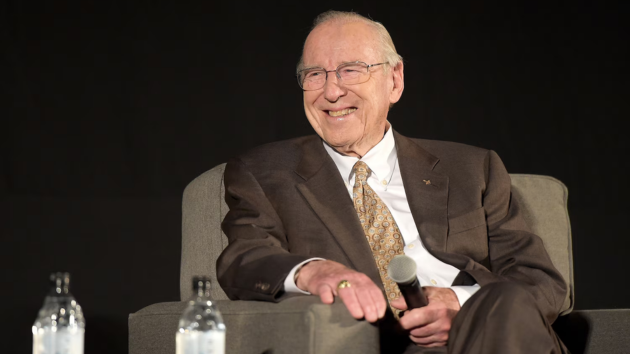
(LAKE FOREST, Ill) — Jim Lovell, the commander of the famed Apollo 13 mission, has died, according to NASA. He was 97.
“We are saddened by the passing of Jim Lovell, commander of Apollo 13 and a four-time spaceflight veteran,” the space agency said. “Lovell’s life and work inspired millions. His courage under pressure helped forge our path to the Moon and beyond—a journey that continues today.”
Lovell died Thursday in Lake Forest, Illinois, according to a statement from acting NASA administrator Sean Duffy.
In 1968, as Apollo 8’s command module pilot, he became, with Frank Borman and William Anders, one of the first three astronauts to fly to and orbit the Moon.
A veteran of several missions, Lovell became the commander for Apollo 13, which nearly avoided disaster after an oxygen tank in the service module exploded two days into the mission.
Lovell was portrayed by Tom Hanks in the Ron Howard-directed “Apollo 13,” which depicted the events surrounding the mission.
Born in Cleveland, Ohio, on March 25, 1928, Lovell attended the University of Wisconsin in Madison and the U.S. Naval Academy. He was selected as an astronaut by NASA in 1962.
He served as a backup pilot for the Gemini 4 flight and backup commander for the Gemini 9 flight, and was selected as the backup commander for Neil Armstrong on the Apollo 11 lunar landing mission.
In December 1965, he and Borman launched into space on the history-making Gemini 7 mission. The flight included the first rendezvous of two manned maneuverable spacecraft.
The Gemini 12 mission, commanded by Lovell with pilot Edwin “Buzz” Aldrin, began on Nov. 11, 1966. This 4-day, 59-revolution flight brought the Gemini program to a successful close.
Lovell served as the command module pilot and navigator on the six-day journey of Apollo 8 in late December 1968. Lovell, Borman and Anders became the first humans to leave Earth’s gravitational influence and the first to reach the Moon, with the crew orbiting the Moon ten times without landing.
As commander of the Apollo 13, he became the first person to journey twice to the Moon. Launching on April 11, 1970, and scheduled to last 10 days, the mission was aborted due to a malfunction in the oxygen tank in the service module two days into the mission.
Lovell and fellow crewmen, John L. Swigert and Fred W. Haise, working with Houston ground controllers, then converted their lunar module into an effective lifeboat. Their emergency activation and operation of lunar module systems conserved both electrical power and water in sufficient supply to assure their survival while in space.
The Apollo 13 crewmembers returned safely to Earth on April 17, 1970.
Lovell retired from the Navy and the space program on March 1, 1973. He worked in the telecommunications industry and retired as executive vice president of Centel Corporation in 1991.
He was a recipient of the Congressional Medal of Honor and the Presidential Medal of Freedom.
He was married to his wife Marilyn for over six decades until her death in 2023. He is survived by four children.
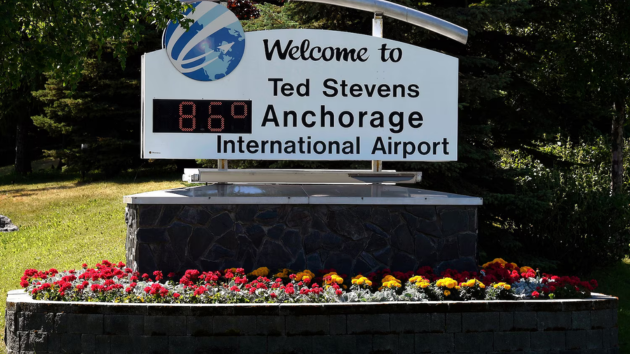
(ANCHORAGE, Alaska) — An employee at an Alaska airport has been arrested for allegedly stalking fellow staff members by placing GPS tracking devices underneath their vehicles, according to the state department of transportation.
Dustin Madden, a 40-year-old airport operations specialist at Ted Stevens Anchorage International Airport, was arraigned on Thursday afternoon “in connection with an investigation involving unauthorized GPS tracking devices placed on employees’ personal vehicles,” the Alaska DOT said in a press release on Thursday.
Officials said Madden’s arrest follows “multiple reports” from airport staff members who “discovered GPS trackers on their personal vehicles while parked in the airport’s employee parking lot.”
Madden was charged with four misdemeanor counts of stalking and one felony count of tampering with evidence, but officials said “further charges may be forthcoming.” Two of the stalking incidents known by officials occurred in July, with a third in 2024 and a fourth in 2022, according to court records.
The suspect had been an employee at the airport since Sept. 30, 2020, and is now on administrative leave, officials said.
He remains in custody at the Anchorage Correctional Complex, according to jail records.
DOT officials are asking for anyone impacted by this incident to contact authorities, as officials said they believe “there may be additional victims who have not yet come forward.”
If someone does discover a tracking device on their vehicle, officials said to not remove or tamper with it, to contact law enforcement immediately and allow officials to “respond, coordinate appropriate next steps and work to preserve the device as potential evidence.”
“The Anchorage International Airport is committed to ensuring a safe, respectful and secure workplace, and acts of surveillance, intimidation or harassment will not be tolerated. Security and privacy protocols are under review to ensure strong protection of staff and visitors, and Anchorage Police and Fire are increasing patrol of parking areas,” the department of transportation said.
It is unclear whether Madden has an attorney who can speak on his behalf. Court records indicate his next court appearance is scheduled for Aug. 26.
The Anchorage Department of Transportation and the Anchorage International Airport Police and Fire did not immediately respond to ABC News’ requests for comment.
Anyone who was affected by the incident or has relevant information is urged to contact airport police at 907-266-2411.
(BOSTON) — Suffolk County Sheriff Steven Tompkins was arrested Thursday on federal extortion charges, according to the U.S. Attorney’s Office for the District of Massachusetts.
Federal prosecutors allege the 67-year-old Massachusetts sheriff had pressured a cannabis company executive for a secret investment deal worth $50,000.
Tompkins, who had led the Suffolk County Sheriff’s Department since 2013 and oversaw about 1,000 employees, was arrested in Florida and charged with two counts of extortion, the U.S. attorney’s office said.
According to federal court documents, Tompkins had used his position as sheriff to force his way into buying pre-IPO (initial public offering) stock in a Boston cannabis company at a discounted price. When the investment later lost value, prosecutors alleged he demanded and received a full refund of his money.
The scheme started in 2019 when the cannabis company, which wasn’t named in court documents, wanted to open a store in Boston, the indictment stated. The company needed Sheriff Tompkins’ help, according to the indictment, as his department would refer former inmates to work at the store, which was required by the Massachusetts Cannabis Control Commission for their state license.
Federal investigators said Tompkins allegedly took advantage of this partnership. According to the indictment, he pressured a company executive, reminding them that he had helped with their license application. The executive feared Tompkins would end their partnership if they didn’t give in to his demands for stock, prosecutors said.
After getting the shares in November 2020, court documents showed Tompkins initially saw his $50,000 investment grow to about $138,000 when the company went public.
However, when the stock price later fell, prosecutors alleged Tompkins demanded his money back. The executive paid him through five separate checks, with some labeled as “loan repayment” to hide what the payments were really for, according to the indictment.
The executive agreed to the demands for repayment, fearing Tompkins would use his position to harm their business operations, according to the indictment.
“What the Sheriff saw as an easy way to make a quick buck on the sly is clear cut corruption under federal law,” FBI Boston Division Special Agent in Charge Ted E. Docks said in a statement.
If found guilty, Tompkins could face up to 20 years in prison, three years of supervised release, and a $250,000 fine, according to the U.S. attorney’s office.
U.S. Attorney Leah B. Foley said in a statement that the case showed her office’s commitment to fighting public corruption.
“Elected officials, particularly those in law enforcement, are expected to be ethical, honest and law abiding – not self-serving,” Foley said in the press release.
According to federal officials, Tompkins will first appear in court in Florida before facing the charges in Boston at a later date.
ABC News reached out to Tompkins’ attorney who did not immediately respond for comment.
The Suffolk County Sheriff’s Department declined to comment when contacted.
(NEW YORK) — The Justice Department is seeking to unseal the exhibits shown to the federal grand juries in New York that indicted Jeffrey Epstein and his former companion Ghislaine Maxwell in addition to the transcripts of testimony, according to a court filing Friday.
Justice Department officials have conceded that much of what is in the transcripts is already publicly known, but the exhibits contain names that did not appear in the transcripts, the filing said.
The government is now trying to notify those individuals “to the extent their names appear in grand jury exhibits that were not publicly admitted at the Maxwell trial,” the filing said.
The Justice Department asked the court to give it until Aug. 14 to make the necessary notifications. The filing did not say how many individuals needed to be contacted.
The Trump administration has been seeking to release materials related to the investigation into Epstein, the wealthy financier and convicted sex offender who died by suicide in jail in 2019, following the blowback it received from MAGA supporters after it announced last month that no additional files would be released.
Attorneys for victims of Epstein and Maxwell have criticized the administration’s approach to transparency, saying in a letter to the court that it “reinforces the perception that the victims are, at best, an afterthought to the current administration.”
The victims say they are generally supportive of transparency, but that they want the chance to review the records and propose additional redactions.
Maxwell, a longtime associate of Epstein, is currently serving a 20-year prison sentence for sex trafficking and other offenses in connection with Epstein.
(NEW YORK) — Prosecutors in the state case against Luigi Mangione denied on Friday violating the medical privacy rights of the accused UnitedHealthcare CEO killer, as his attorneys alleged, arguing they sought nothing more than “entirely unremarkable” information from his health insurer.
The defense accused prosecutors with the Manhattan District Attorney’s Office of violating Mangione’s rights protected under the Health Insurance Portability and Accountability Act when they subpoenaed Aetna for information and “partially reviewed confidential, private, protected documents.” The defense sought to suppress the information.
The district attorney’s office said in a filing on Friday that there was nothing “secretive or nefarious” about a subpoena that sought “entirely unremarkable” information like Mangione’s account number and time period of coverage.
In response, Aetna turned over more information than prosecutors requested, prosecutors said.
“Given these circumstances, defendant’s real complaint is not about the subpoena itself, but about Aetna’s response to the subpoena, which included documents that the People had not requested,” Assistant District Attorney Joel Seidemann said. “The People issued a valid subpoena to Aetna for an appropriately limited set of relevant information. Through no fault of the People, Aetna seemingly provided materials outside the scope of the subpoena. The People then properly identified the error and notified the Court and the defense and deleted our copy of said materials.”
The defense compounded Aetna’s mistake by sending prosecutors an email attaching the entire Aetna file that prosecutors had already deleted, Seidemann said.
“The defense nonetheless seeks to punish the People for the administrative mistakes of others, claiming that the People have perpetrated a ‘lie and a fraud’ against defendant — an inflammatory and dubious accusation without any basis,” Seidemann said.
Prosecutors urged the judge to grant no relief to Mangione and instead set a date for trial.
Mangione has pleaded not guilty to state charges alleging he murdered United Healthcare CEO Brian Thompson outside the Midtown hotel where the executive was about to attend an investor conference last year. Mangione has also pleaded not guilty to federal charges that could result in the death penalty.
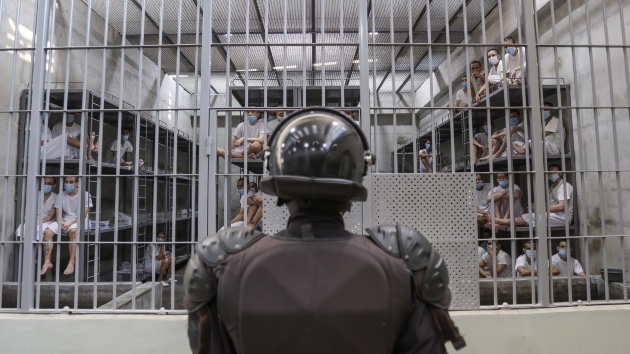
A prison officer guards a cell at maximum security penitentiary CECOT (Center for the Compulsory Housing of Terrorism) on April 4, 2025 in Tecoluca, San Vicente, El Salvador./ Photo by Alex Peña/Getty Images
(NEW YORK) — A federal appeals court on Friday overturned U.S. District Judge James Boasberg’s attempt to initiate contempt proceedings against the Trump administration related to the March deportation of hundreds of migrants to El Salvador, in what the panel’s majority described as an “extraordinary, ongoing confrontation between the Executive and Judicial Branches.”
In a 2-1 decision, Judges Gregory Katsas and Neomi Rao — both Trump appointees — vacated Judge Boasberg’s contempt-related order that sought to determine if members of the Trump administration deliberately defied a court order after the president invoked the Alien Enemies Act in March.
“The district court’s order raises troubling questions about judicial control over core executive functions like the conduct of foreign policy and the prosecution of criminal offenses. And it implicates an unsettled issue whether the judiciary may impose criminal contempt for violating injunctions entered without jurisdiction,” Judge Katsas wrote in a concurring opinion.
The Trump administration invoked the Alien Enemies Act — an 18th century wartime authority used to remove noncitizens with little-to-no due process — to deport two planeloads of alleged migrant gang members to the CECOT mega-prison in El Salvador by arguing that the Venezuelan gang Tren de Aragua is a “hybrid criminal state” that is invading the United States.
Boasberg issued a temporary restraining order and ordered that the planes be turned around, but Justice Department attorneys said his oral instructions directing the flight to be returned were defective, and the deportations proceeded as planned.
Boasberg subsequently sought contempt proceedings against the government for deliberately defying his order.
Judge Katsas, in Friday’s decision, wrote that the “ambiguities” in Judge Boasberg’s original order blocking the removal of the migrants make it impossible to definitively say that the Trump administration acted in contempt.
“At the time of the alleged contempt, just hours after the TRO hearing and before any transcript of it was available, the district court’s minute order could reasonably have been read either way. Thus, the TRO cannot support a criminal-contempt conviction here,” he wrote.
In a searing dissent, Judge Cornelia Pillard defended Judge Boasberg’s attempt to initiate contempt proceedings to “vindicate the authority of the court” after the “apparently contumacious conduct.” 71045364″The rule of law depends on obedience to judicial orders,” she wrote. ” Yet, shortly after the district court granted plaintiffs’ emergency motion for a temporary restraining order, defendants appear to have disobeyed it. Our system of courts cannot long endure if disappointed litigants defy court orders with impunity rather than legally challenge them. That is why willful disobedience of a court order is punishable as criminal contempt.”
Attorney General Pam Bondi celebrated Friday’s ruling on social media, calling Judge Boasberg’s order “failed judicial overreach at its worst.”
“Our @TheJusticeDept attorneys just secured a MAJOR victory defending President Trump’s use of the Alien Enemies Act to deport illegal alien terrorists. The D.C. Circuit Court of Appeals affirmed what we’ve argued for months: Judge Boasberg’s attempt to sanction the government for deporting criminal-alien terrorists was a “clear abuse of discretion,” Bondi wrote. “We will continue fighting and WINNING in court for President Trump’s agenda to keep America Safe!”
(NEW YORK) — Record-breaking heat continues for parts of the desert Southwest into the weekend, with sweltering temperatures beginning to expand east into the Heartland.
Extreme heat warnings remain in effect for parts of the desert Southwest — including Palm Springs, California; Phoenix; and Tucson, Arizona.
High temperatures are expected to reach well into the 100s and up to 115 in spots.
Heat advisories are also in effect on Friday for other areas of the Four Corners region stretching into the Plains as the heat begins to shift east.
Places under these heat advisories include Albuquerque, New Mexico; Dallas, El Paso and Amarillo, Texas; Oklahoma City; Wichita, Kansas; Denver; and Sioux City, Iowa.
High temperatures between 100 and 110 are possible for these areas for on Friday.
Record-high temperatures are possible for Albuquerque through Saturday.
The heat is expected to be less extreme for the desert Southwest this weekend.
Later this weekend into next week, widespread heat will return to the Northeast and much of the country.
Later this weekend into next week, extreme heat will be possible for parts of northwest California, western Oregon and southwest Washington. Places from Yreka, California, up to Portland, Oregon, may see high temperatures push into the 100s and low temperatures only between 60 and 70 Sunday through Monday.
On Thursday, Phoenix saw a high temperature of 118 degrees. This not only was the hottest temperature recorded for the month of August, it is also tied for the ninth-hottest day all time since records began in 1895.
Fire weather danger persists Red flag warnings are in places across five states in the West — Oregon, Utah, Colorado, Wyoming and New Mexico — for critical fire weather conditions that are keeping a strong foothold this week.
Single-digit humidity and wind gusts between 35 to 55 mph are possible anywhere in these areas, though it depends on exact location.
These conditions will be conducive to rapid fire spread with any new or existing wildfires in these areas.
Fire weather conditions are expected to remain critical through at least Saturday, but may persist into the beginning of next week.
A red flag warning is also in effect for Medford, Oregon, due to dry and breezy conditions.