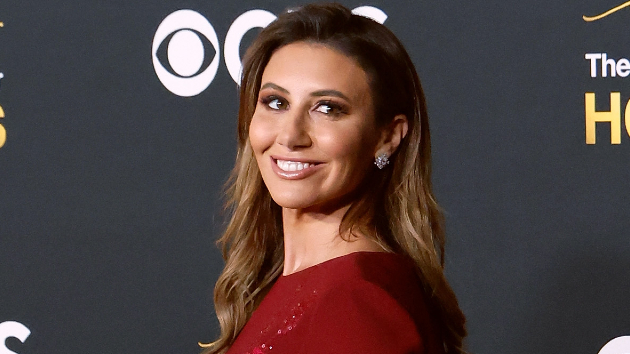
(NEW YORK) — After a three-month battle over the legality of her appointment, Alina Habba has resigned from her position as the Acting U.S. attorney for the District of New Jersey.
She announced her resignation as U.S. attorney in a social media post on Monday. She will remain serving as “Senior Adviser to the Attorney General for U.S. Attorneys.”
The resignation comes after a protracted legal fight about whether she could serve in the U.S. attorney role without Senate confirmation.
In August, a federal judge ruled that she was serving in the position “without lawful authority” and disqualified her as New Jersey’s top federal law enforcement officer. A federal appeals court unanimously upheld that decision last week, and the Department of Justice has not appealed that decision.
“As a result of the Third Circuit’s ruling, and to protect the stability and integrity of the office which I love, I have decided to step down in my role as the U.S. Attorney for the District of New Jersey,” Habba said in her statement. “But do not mistake compliance for surrender. This decision will not weaken the Justice Department and it will not weaken me.”“Following the flawed Third Circuit decision disqualifying Alina Habba from performing her duties in the U.S. Attorney’s office for the District of New Jersey, I am saddened to accept Alina’s resignation.
“Following the flawed Third Circuit decision disqualifying Alina Habba from performing her duties in the U.S. Attorney’s office for the District of New Jersey, I am saddened to accept Alina’s resignation,” Attorney General Pam Bondi said in a statement. “The Department of Justice will seek further review of this decision, and we are confident it will be reversed. Alina intends to return to lead the U.S. Attorney’s Office for the District of New Jersey if this occurs.”
Despite the rulings, Habba remained in the position after Attorney General Pam Bondi named her a “Special Attorney to the Attorney General,” though several judges delayed proceedings to consider the legality of her position.
Before she was appointed as U.S. attorney, Habba served as a personal defense attorney for President Donald Trump in his New York civil fraud case and defamation trials. Last month, a federal appeals court upheld a $1 million penalty against Habba and Trump for bringing a frivolous lawsuit against former FBI Director James Comey and Hillary Clinton.
The Trump administration has faced growing headwinds over its efforts to install Trump loyalists as top prosecutors in U.S. attorneys’ offices across the country, suffering a string of court defeats as judges raise concerns they’re actively disregarding the law.
Last month, a judge threw out both criminal cases against Comey and New York Attorney General Letitia James after determining that Lindsey Halligan, a former insurance lawyer and White House aide with no prosecutorial experience, was unlawfully appointed to lead the Eastern District of Virginia U.S. Attorney’s Office.
While Bondi previously said the administration would appeal that ruling, as of Monday, no appeal has been filed, and last week, a grand jury rejected an effort by the administration to revive its case against James.
A growing chorus of judges for the Eastern District of Virginia has raised concerns that the administration appears to be defying the order that disqualified Halligan by continuing to include her signature and title on legal filings.
On Monday morning, Attorney General Bondi and Deputy Attorney General Todd Blanche issued a joint statement attacking judges for questioning Halligan’s legitimacy in the role, and accused them of “engaging in an unconscionable campaign of bias and hostility.”
“Lindsey and our attorneys are simply doing their jobs: advocating for the Department of Justice’s positions while following guidance from the Office of Legal Counsel,” the statement said. “They do not deserve to have their reputations questioned in court for ethically advocating on behalf of their client. This Department of Justice has no tolerance for undemocratic judicial activism.”
(PORT ST. LUCIE, Fla.) — A 6-year-old girl died after she was injured at a trampoline adventure park in Florida, police said.
First responders were dispatched to an Urban Air Trampoline and Adventure Park in Port St. Lucie on Saturday for a “medical run” involving the child, according to local police.
The girl died from her injuries on Sunday, according to the Port St. Lucie Police Department.
“The investigation is still active and ongoing at this time and is pending the medical examiner’s findings,” a police department spokesperson said in a statement.
Police did not release any details on the incident or the nature of the injuries.
ABC News has reached out to the franchise location for comment but did not immediately receive a response.
The Port St. Lucie location includes a number of attractions in addition to trampolines, including go karts, bumper cars, a zip line and laser tag.
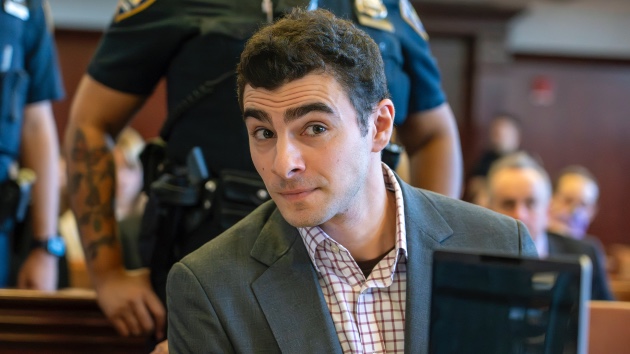
Luigi Mangione appears for a suppression of evidence hearing in the killing of UnitedHealthcare CEO Brian Thompson in Manhattan Criminal Court on December 01, 2025 in New York City. (Photo by Steven Hirsch-Pool/Getty Images)
(NEW YORK) — A police officer who searched accused CEO killer Luigi Mangione’s backpack when he was apprehended at an Pennsylvania McDonald’s took the stand on Monday for the fourth day of a crucial pretrial hearing in which Mangione’s defense lawyers are trying to exclude from trial critical evidence that they say was illegally seized from his backpack without a warrant.
“Holly Jolly Christmas” was playing in the Altoona McDonald’s on Dec. 9, 2024, when officer Christy Wasser — a 19-year Altoona Police Department veteran — searched Mangione’s backpack, immediately pulling out a pocketknife and a loaf of bread, five days after Mangione allegedly gunned down UnitedHealthcare CEO Brian Thompson on a Manhattan sidewalk.
When Mangione was formally placed under arrest at 9:58 a.m., Wasser testified that she “walked over and picked up his backpack.”
Two minutes into the search, Wasser was seen on body camera video extracting “wet, grey underwear” from the backpack. “And when I opened it up, it was a magazine,” she testified.
Prosecutor Joel Seidemann asked it was “fully loaded,” and Wasser responded, “Yes.”
Wasser also said she discovered a phone in a Faraday bag, designed to conceal its signal.
An officer was heard suggesting that the bag be brought to the police station to check for bombs. Wasser was heard joking that she preferred to check it at the McDonald’s because she “didn’t want to pull a Moser” — a sarcastic reference, she said, to a former Altoona officer who brought a bomb to the police station.
At 10:03 a.m. an officer was heard on the camera footage mentioning a search warrant. A different officer was heard saying that one was not needed at that stage.
Defense lawyers have argued Wasser’s actions violated Mangione’s constitutional rights and should justify excluding any of the evidence found in the bag, including the alleged murder weapon and writings that prosecutors say amount to a confession.
“[The officer] did not search the bag because she reasonably thought there might be a bomb, but rather this was an excuse designed to cover up an illegal warrantless search of the backpack,” defense attorneys argued in a court filing. “This made-up bomb claim further shows that even she believed at the time that there were constitutional issues with her search, forcing her to attempt to salvage this debacle by making this spurious claim.”
Although Wasser’s initial search of the backpack uncovered the magazine, she missed the loaded handgun, silencer, and journal that were buried deeper in the bag, she testified.
Wasser testified that she only discovered the two items about 15 minutes later, when she conducted a further search after driving from the McDonald’s to the Altoona police station.
“There’s a weapon!” she’s heard shouting on the video footage to the other officers in the intake area, as Mangione was being searched just feet away with his ankles shackled.
“Is that the first time you opened that zipper section on the side?” Seidemann asked Wasser on the witness stand.
“Yes, sir,” she affirmed.
With Mangione just feet away from her in the station’s intake area, she testified it would be “unwise” to continue the search near Mangione.
“Were the defendant’s hands free at the time you took out the gun?” asked Seidemann.
“Yes,” she testified.
Body camera footage showed Wasser and Deputy Chief Derek Swope take the weapon over to a nearby hallway — behind a locked door — where she cleared the gun. She mumbled — at times inaudibly — when she explained the situation to Swope on the video.
“We just checked the bag … to make sure there were no bombs or anything,” she said on the body camera footage.
As the search continued, Wasser quickly uncovered a silencer buried beneath other items in the bag. She also found a journal allegedly belonging to Mangione.
“Holy s—,” Swope can be heard saying in the body camera footage.
Wasser testified that she was cautious when checking the back because the nature of Mangione’s alleged crime “greatened [her] concern.”
“I just wanted to make sure there was nothing that could harm anybody,” she testified.
“Did any of your supervisors say, ‘Stop — go get a search warrant?'” asked Seidermann.
“No,” she said.
The stationhouse backpack search also turned up a slip of paper with a crude, handwritten map of Pittsburgh, Wasser testified, as well as what Seidemann described as possible escape routes.
The note said, “Keep momentum, FBI slower overnight” and “Break CAM continuity.” Another line read, “3+ hrs off cam, exit diff method (ex: megabus, rail)” and a note saying “check reports for current situation.” The note also said, “bus to Penn station,” “change hat” and “either taxi … or cross river.”
Wasser was also heard on body camera footage saying she pulled hair clippers from Mangione’s bag.
Earlier in the body camera video — when she was still searching the bag at the McDonald’s while “The Twelve Days of Christmas” blared in the background — prosecutors highlighted an exchange between officers and a supervisor about whether a warrant was necessary. One officer remarked that a warrant might be needed “because of the severity of the case,” but their supervisor interjected to say that no warrant was required because the incident was a “search incident to arrest” — a warrantless search conducted of an area within the arrestee’s immediate surroundings.
Prosecutor Nichole Smith of Pennsylvania’s Blair County District Attorney’s office also testified, outlining the chain of custody of items seized from Mangione after he was apprehended.
Smith recalled a lieutenant from the Altoona Police Department calling her at 9:53 a.m. to advise her “that he had the individual responsible for the CEO shooting” at McDonald’s. Smith said she was in court at the time and interrupted the proceeding to inform her boss, Blair County District Attorney Peter Weeks.
Smith said she and Weeks advised Altoona police to charge Mangione with forgery, carrying a firearm without a license, tampering with records for identification, possessing instruments of a crime and providing false identification to law enforcement.
Smith described a search warrant that obtained a court’s permission to seize Mangione’s belongings, including items in his backpack, and transfer them to the NYPD.
“Certain items in that bag were not inherently contraband, so we wanted to ensure that the court had approved,” Smith testified. “When they search the bag and they discover, for instance, the firearm, the ammunition and the suppressor, when he does not have a valid permit to carry those items concealed, they become contraband.”
Handwritten notes that police said they also discovered in Mangione’s backpack were not relevant to the local charges in Pennsylvania. Ordinarily, they would have been put aside and saved. The warrant allowed those items to be transferred as possible evidence in the New York case.
Defense attorney Karen Friedman Agnifilo objected to Seidemann referring to the writings as an alleged “manifesto” and Thompson’s killing as an “execution.” Judge Gregory Carro said it was fine for the ongoing suppression hearing but said, “You’re certainly not going to do that at trial.”
Last week, during the first week of the hearing, prosecutors called six witnesses, including the police officers who first confronted Mangione and the corrections officers who were tasked with constantly monitoring him before his transfer from a cell in Pennsylvania to New York.
Last week’s testimony shed new light on the events leading up to and following Mangione’s arrest, with the two officers who initially confronted Mangione recounting their experiences for the first time.
“It’s him. I have been seeing all the pictures. He is nervous as hell. I ask him, ‘Have you been in New York,’ he’s all quiet,” Altoona police officer Joseph Detwiler testified on Tuesday.
Prosecutors also showed in court never-before-seen security camera footage that captured the chilling moments after Mangione allegedly shot and killed Thompson in the predawn cold of New York City’s early winter. The videos provided the public with a clearer picture of the shooting and emergency response, as well as clues about the case prosecutors have built against the alleged killer.
At least three people were in the immediate vicinity of the shooting, including a woman just feet away from the suspect. The woman’s identity and whether she has spoken with police are not known.
The video also shows the suspect — after firing multiple shots — walk toward the victim, glance down at him, cross the street, then run toward a nearby alleyway. A woman holding a cup of coffee outside the famed New York Hilton on Sixth Avenue is seen flinching after hearing the first gunshot, after which she sees Thompson stumble, then appears to look straight at the gunman before running off.
Seconds later, a man inside the hotel exits, sees Thompson on the ground, then appears to point to a nearby alleyway where the suspect fled.
Luigi Mangione appears for a suppression of evidence hearing in the killing of UnitedHealthcare CEO Brian Thompson in Manhattan Criminal Court on December 01, 2025 in New York City. (Photo by Steven Hirsch-Pool/Getty Images)
(NEW YORK) – A police officer who searched accused CEO killer Luigi Mangione’s backpack when he was apprehended at an Pennsylvania McDonald’s took the stand on Monday for the fourth day of a crucial pretrial hearing in which Mangione’s defense lawyers are trying to exclude from trial critical evidence that they say was illegally seized from his backpack without a warrant.
“Holly Jolly Christmas” was playing in the Altoona McDonald’s on Dec. 9, 2024, when officer Christy Wasser — a 19-year Altoona Police Department veteran — searched Mangione’s backpack, immediately pulling a pocketknife and a loaf of bread.
When Mangione was formally placed under arrest at 9:58 a.m., Wasser testified that she “walked over and picked up his backpack.”
Two minutes into the search, Wasser was seen on body camera video extracting “wet, grey underwear” from the backpack. “And when I opened it up, it was a magazine,” she testified.
Prosecutor Joel Seidemann asked it was “fully loaded,” and Wasser responded, “Yes.”
Wasser also said she discovered a phone in a Faraday bag, designed to conceal its signal.
An officer was heard suggesting that the bag be brought to the police station to check for bombs. Wasser was heard joking that she preferred to check it at the McDonald’s because she “didn’t want to pull a Moser” — a sarcastic reference, she said, to a former Altoona officer who brought a bomb to the police station.
At 10:03 a.m. an officer was heard on the camera footage mentioning a search warrant. A different officer was heard saying that one was not needed at that stage.
Defense lawyers have argued Wasser’s actions violated Mangione’s constitutional rights and should justify excluding any of the evidence found in the bag, including the alleged murder weapon and writings that prosecutors say amount to a confession.
“[The officer] did not search the bag because she reasonably thought there might be a bomb, but rather this was an excuse designed to cover up an illegal warrantless search of the backpack,” defense attorneys argued in a court filing. “This made-up bomb claim further shows that even she believed at the time that there were constitutional issues with her search, forcing her to attempt to salvage this debacle by making this spurious claim.”
Prosecutor Nichole Smith of Pennsylvania’s Blair County District Attorney’s office also testified, outlining the chain of custody of items seized from Mangione, who was apprehended five days after he allegedly gunned down UnitedHealthcare CEO Brian Thompson on a Manhattan sidewalk.
Smith recalled a lieutenant from the Altoona Police Department calling her at 9:53 a.m. to advise her “that he had the individual responsible for the CEO shooting” at McDonald’s. Smith said she was in court at the time and interrupted the proceeding to inform her boss, Blair County District Attorney Peter Weeks.
Smith said she and Weeks advised Altoona police to charge Mangione with forgery, carrying a firearm without a license, tampering with records for identification, possessing instruments of a crime and providing false identification to law enforcement.
Smith described a search warrant that obtained a court’s permission to seize Mangione’s belongings, including items in his backpack, and transfer them to the NYPD.
“Certain items in that bag were not inherently contraband, so we wanted to ensure that the court had approved,” Smith testified. “When they search the bag and they discover, for instance, the firearm, the ammunition and the suppressor, when he does not have a valid permit to carry those items concealed, they become contraband.”
Handwritten notes that police said they also discovered in Mangione’s backpack were not relevant to the local charges in Pennsylvania. Ordinarily, they would have been put aside and saved. The warrant allowed those items to be transferred as possible evidence in the New York case.
Defense attorney Karen Friedman Agnifilo objected to Seidemann referring to the writings as an alleged “manifesto” and Thompson’s killing as an “execution.” Judge Gregory Carro said it was fine for the ongoing suppression hearing but said, “You’re certainly not going to do that at trial.”
Last week, during the first week of the hearing, prosecutors called six witnesses, including the police officers who first confronted Mangione and the corrections officers who were tasked with constantly monitoring him before his transfer from a cell in Pennsylvania to New York.
Last week’s testimony shed new light on the events leading up to and following Mangione’s arrest, with the two officers who initially confronted Mangione recounting their experiences for the first time.
“It’s him. I have been seeing all the pictures. He is nervous as hell. I ask him, ‘Have you been in New York,’ he’s all quiet,” Altoona police officer Joseph Detwiler testified on Tuesday.
Prosecutors also showed in court never-before-seen security camera footage that captured the chilling moments after Mangione allegedly shot and killed Thompson in the predawn cold of New York City’s early winter. The videos provided the public with a clearer picture of the shooting and emergency response, as well as clues about the case prosecutors have built against the alleged killer.
At least three people were in the immediate vicinity of the shooting, including a woman just feet away from the suspect. The woman’s identity and whether she has spoken with police are not known.
The video also shows the suspect — after firing multiple shots — walk toward the victim, glance down at him, cross the street, then run toward a nearby alleyway. A woman holding a cup of coffee outside the famed New York Hilton on Sixth Avenue is seen flinching after hearing the first gunshot, after which she sees Thompson stumble, then appears to look straight at the gunman before running off.
Seconds later, a man inside the hotel exits, sees Thompson on the ground, then appears to point to a nearby alleyway where the suspect fled.
Luigi Mangione appears for a suppression of evidence hearing in the killing of UnitedHealthcare CEO Brian Thompson in Manhattan Criminal Court on December 01, 2025 in New York City. (Photo by Steven Hirsch-Pool/Getty Images)
(NEW YORK) – Accused CEO killer Luigi Mangione gave a quick pose for photographers when he returned to court Monday for the fourth day of a crucial pretrial hearing in which his defense lawyers are trying to exclude from trial critical evidence that they say was illegally seized from his backpack without a warrant.
One year after Mangione allegedly gunned down United Healthcare CEO Brian Thompson on a Manhattan sidewalk, the hearing has put the 27-year-old face-to-face with the police officers who arrested him in an Altoona, Pennsylvania, McDonald’s after a five-day manhunt.
“Holly Jolly Christmas” was playing in the McDonald’s on Dec. 9, 2024, when officer Christy Wasser — a 19-year Altoona Police Department veteran — searched Mangione’s backpack, immediately pulling a pocketknife and a loaf of bread.
When Mangione was formally placed under arrest at 9:58 a.m., Wasser testified that she “walked over and picked up his backpack.”
“When I opened it up, it was a magazine,” she testified Monday.
Prosecutor Joel Seidemann asked it was “fully loaded,” and Wasser responded, “Yes.”
Wasser also said she discovered a phone in a Faraday bag, designed to conceal its signal.
An officer was heard on body camera video suggesting that the bag be brought to the police station to check for bombs. Wasser was heard joking that she preferred to check it at the McDonald’s because she “didn’t want to pull a Moser” — a sarcastic reference, she said, to a former Altoona officer who brought a bomb to the police station.
At 10:03 a.m. an officer was heard on the camera footage mentioning a search warrant. A different officer was heard saying that one was not needed at that stage.
Defense lawyers have argued Wasser’s actions violated Mangione’s constitutional rights and should justify excluding any of the evidence found in the bag, including the alleged murder weapon and writings that prosecutors say amount to a confession.
“[The officer] did not search the bag because she reasonably thought there might be a bomb, but rather this was an excuse designed to cover up an illegal warrantless search of the backpack,” defense attorneys argued in a court filing. “This made-up bomb claim further shows that even she believed at the time that there were constitutional issues with her search, forcing her to attempt to salvage this debacle by making this spurious claim.”
Prosecutor Nichole Smith of Pennsylvania’s Blair County District Attorney’s office also testified, outlining the chain of custody of items seized from Mangione.
Smith recalled a lieutenant from the Altoona Police Department calling her at 9:53 a.m. to advise her “that he had the individual responsible for the CEO shooting” at McDonald’s. Smith said she was in court at the time and interrupted the proceeding to inform her boss, Blair County District Attorney Peter Weeks.
Smith said she and Weeks advised Altoona police to charge Mangione with forgery, carrying a firearm without a license, tampering with records for identification, possessing instruments of a crime and providing false identification to law enforcement.
Smith described a search warrant that obtained a court’s permission to seize Mangione’s belongings, including items in his backpack, and transfer them to the NYPD.
“Certain items in that bag were not inherently contraband, so we wanted to ensure that the court had approved,” Smith testified. “When they search the bag and they discover, for instance, the firearm, the ammunition and the suppressor, when he does not have a valid permit to carry those items concealed, they become contraband.”
Handwritten notes that police said they also discovered in Mangione’s backpack were not relevant to the local charges in Pennsylvania. Ordinarily, they would have been put aside and saved. The warrant allowed those items to be transferred as possible evidence in the New York case.
Defense attorney Karen Friedman Agnifilo objected to Seidemann referring to the writings as an alleged “manifesto” and Thompson’s killing as an “execution.” Judge Gregory Carro said it was fine for the ongoing suppression hearing but said, “You’re certainly not going to do that at trial.”
Last week, during the first week of the hearing, prosecutors called six witnesses, including the police officers who first confronted Mangione and the corrections officers who were tasked with constantly monitoring him before his transfer from a cell in Pennsylvania to New York.
Last week’s testimony shed new light on the events leading up to and following Mangione’s arrest, with the two officers who initially confronted Mangione recounting their experiences for the first time.
“It’s him. I have been seeing all the pictures. He is nervous as hell. I ask him, ‘Have you been in New York,’ he’s all quiet,” Altoona police officer Joseph Detwiler testified on Tuesday.
Prosecutors also showed in court never-before-seen security camera footage that captured the chilling moments after Mangione allegedly shot and killed Thompson in the predawn cold of New York City’s early winter. The videos provided the public with a clearer picture of the shooting and emergency response, as well as clues about the case prosecutors have built against the alleged killer.
At least three people were in the immediate vicinity of the shooting, including a woman just feet away from the suspect. The woman’s identity and whether she has spoken with police are not known.
The video also shows the suspect — after firing multiple shots — walk toward the victim, glance down at him, cross the street, then run toward a nearby alleyway. A woman holding a cup of coffee outside the famed New York Hilton on Sixth Avenue is seen flinching after hearing the first gunshot, after which she sees Thompson stumble, then appears to look straight at the gunman before running off.
Seconds later, a man inside the hotel exits, sees Thompson on the ground, then appears to point to a nearby alleyway where the suspect fled.
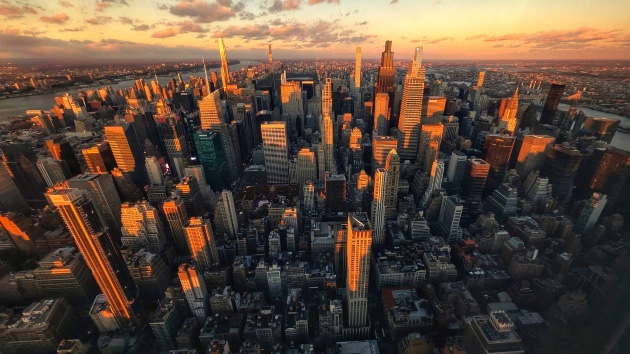
The sun sets on midtown Manhattan in New York City, Nov. 28, 2025. (Gary Hershorn/ABC News)
(NEW YORK) — New York City has tied its record for the longest stretch without a homicide in recorded history.
The city went 12 calendar days — Nov. 25 to Dec. 7 — without a homicide, according to New York Police Department data.
That stretch — which ties a record set in 2015 — was ended when a 38-year-old man was shot and killed in the stairwell of a city-run apartment building in the Bronx on Sunday night.
During the first 11 months of the year, New York City saw its lowest number of shooting incidents (652) and shooting victims (812) in recorded history, according to NYPD data.
For the month of November, murders were also at the lowest level ever, with 16 murders, tying the previous record set in 2018.
“Right strategy. Great execution. That’s how you set record after record,” NYPD Police Commissioner Jessica Tisch said in a statement. “Thank you to the members of the NYPD who have sacrificed so much this year to drive down violent crime to record lows.”
The record-tying milestone comes after the Trump administration considered sending members of the National Guard to New York City streets.
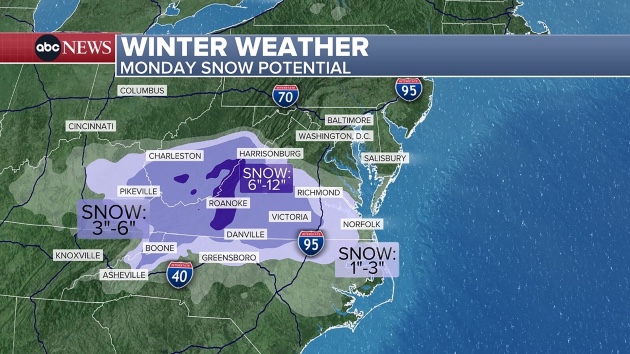
(NEW YORK) — After a weekend of snow in the Midwest, the winter weather is focused farther south on Monday, with snow hitting Virginia, West Virginia and North Carolina. Meanwhile, the Pacific Northwest is bracing for an atmospheric river set to bring dangerous flooding.
Here’s the latest forecast:
Chicago saw 4.6 inches of snow on Sunday, with areas north of the city getting 6 inches.
Parts of Iowa and South Dakota saw more than 9 inches of snow over the weekend.
On Monday morning, the snow is focused farther east, falling from Kentucky to North Carolina.
A winter storm warning is in place for parts of Virginia, with 2 to 5 inches of snow possible from Roanoke to Richmond.
Norfolk, Virginia, could see up to 2 inches; up to 1 inch is possible for eastern Kentucky and the Raleigh-Durham area of North Carolina; and 1 to 3 inches of snow could hit western Virginia and southern West Virginia.
The snow will end Monday evening, but residents across the region should brace for a potentially dangerous evening commute.
Meanwhile, in the Pacific Northwest, an atmospheric river is set to bring days of heavy rain to Washington, Oregon and Idaho.
A flood watch is in effect for more than 9 million people, and landslides and debris flows are also possible.
More than 10 inches of rain is possible just from Monday through Wednesday across parts of western Washington and Oregon.
River levels may reach major flood stage by Wednesday, and the rain will continue through the week and into the weekend.
Luigi Mangione appears for a suppression of evidence hearing in the killing of UnitedHealthcare CEO Brian Thompson in Manhattan Criminal Court on December 01, 2025 in New York City. (Photo by Steven Hirsch-Pool/Getty Images)
(NEW YORK) – Accused CEO killer Luigi Mangione returns to court Monday for the fourth day of a crucial pretrial hearing as his defense lawyers attempt to exclude from trial critical evidence that they say was illegally seized from his backpack without a warrant.
One year after Mangione allegedly gunned down United Healthcare CEO Brian Thompson on a Manhattan sidewalk, the hearing has put the 27-year-old face-to-face with the police officers who arrested him in a Pennsylvania McDonald’s after a five-day manhunt.
The testimony and evidence have also given the public the clearest picture to date of the case against Mangione that prosecutors plan to bring to a jury — potentially sometime in 2026.
Prosecutors in lower Manhattan plan to call two more police officers on Monday, including the officer who allegedly searched Mangione’s backpack without a warrant by claiming it was an emergency and that she needed to check if there was a “bomb” in the bag.
Defense lawyers have argued her actions violated Mangione’s constitutional rights and should justify excluding any of the evidence found in the bag, including the alleged murder weapon and writings that prosecutors say amount to a confession.
“[The officer] did not search the bag because she reasonably thought there might be a bomb, but rather this was an excuse designed to cover up an illegal warrantless search of the backpack,” defense attorneys argued in a court filing. “This made-up bomb claim further shows that even she believed at the time that there were constitutional issues with her search, forcing her to attempt to salvage this debacle by making this spurious claim.”
Prosecutors have so far called six witnesses during the first week of the hearing, including the police officers who first confronted Mangione and the corrections officers who were tasked with constantly monitoring him before his transfer from a cell in Pennsylvania to New York.
What was to have been the hearing’s fourth day on Friday was postponed after the judge said Mangione was ill. No additional information was given.
Last week’s testimony shed new light on the events leading up to and following Mangione’s arrest last December, with the two officers who initially confronted Mangione recounting their experiences for the first time.
“It’s him. I have been seeing all the pictures. He is nervous as hell. I ask him, ‘Have you been in New York,’ he’s all quiet,” Altoona police officer Joseph Detwiler told the courtroom on Tuesday.
Prosecutors also showed in court never-before-seen security camera footage that captured the chilling moments after Mangione allegedly shot and killed Thompson in the predawn cold of New York City’s early winter. The videos provided the public with a clearer picture of the shooting and emergency response, as well as clues about the case prosecutors have built against the alleged killer.
At least three people were in the immediate vicinity of the shooting, including a woman just feet away from the suspect. The woman’s identity and whether she has spoken with police are not known.
The video also shows the suspect — after firing multiple shots — walk toward the victim, glance down at him, cross the street, then run toward a nearby alleyway. A woman holding a cup of coffee outside the famed New York Hilton on Sixth Avenue is seen flinching after hearing the first gunshot, after which she sees Thompson stumble, then appears to look straight at the gunman before running off.
Seconds later, a man inside the hotel exits, sees Thompson on the ground, then appears to point to a nearby alleyway where the suspect fled.
Police arrived at the incident three minutes after the shooting. Officers attended to Thompson before an ambulance arrived eight minutes later.
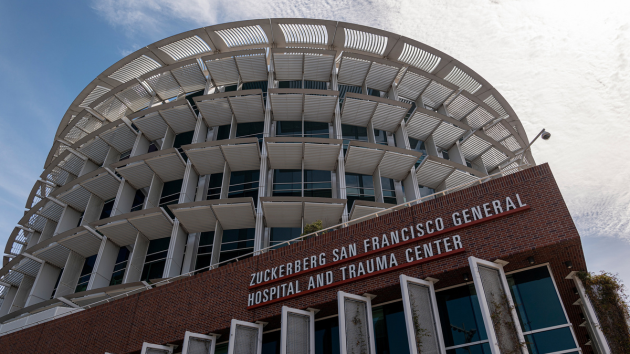
A man is facing murder charges after a social worker he allegedly attacked and stabbed repeatedly in a ward at Zuckerberg San Francisco General Hospital and Trauma Center died from her injuries, Dec. 6, 2025, according to police. (Bloomberg via Getty Images)
(LOS ANGELES) — A social worker, described by colleagues as “remarkable” and “compassionate,” has died from stab wounds she suffered when a patient armed with a steak knife allegedly attacked her inside a San Francisco hospital, according to authorities.
The victim, whose name has not been released, was pronounced dead on Saturday, two days after she was stabbed repeatedly inside Zuckerberg San Francisco General Hospital and Trauma Center, according to the San Francisco Sheriff’s Office.
The victim was described by the sheriff’s office as a 51-year-old University of California, San Francisco, social worker. The victim’s age was initially reported by police as 31.
The suspect was identified as 34-year-old Wilfredo Tortolero Arriechi, according to the San Francisco Police Department, whose officers also responded to the hospital and took the suspect into custody.
Arriechi was initially arrested on charges of attempted murder, assault with a deadly weapon, mayhem, and being armed during the commission of a felony.
The attack unfolded around 1:39 p.m. local time on Thursday in the hospital’s Ward 86, which, according to the medical facility’s website, is an HIV/AIDS clinic on the facility’s sixth floor.
Before the attack, a sheriff’s deputy was called to the hospital after the suspect, who was at the hospital for a scheduled appointment, allegedly threatened a doctor, according to a sheriff’s department statement.
“While providing security for the doctor, our sheriff’s deputy heard a disturbance unfolding in the hallway involving the suspect, who was attacking a social worker,” according to the sheriff’s office statement. “The deputy intervened immediately, restraining the suspect and securing the scene.”
The victim, according to he sheriff’s office, suffered multiple stab wounds to the neck and shoulder.
A five-inch kitchen knife believed to have been used in the attack was recovered at the scene, according to the sheriff’s office.
UPTE-CWA 9119, the union representing professional and technical employees at the University of California, released a statement on social media demanding a “full investigation and reliable, consistent, and transparent safety protocols that ensure every worker comes home safely at the end of their shift.”
“We at UPTE-CWA 9119 are devastated to learn of the death of a remarkable, compassionate, and dedicated social worker, who was beloved by their family, friends, colleagues, and fellow union members,” Dan Russell, UPTE president, said in a statement.
The San Francisco Deputy Sheriff’s Association union also released a statement, criticizing the San Francisco Department of Public Health (DPH), which runs the hospital, for recently reducing the number of deputy sheriffs assigned to the hospital and shifting to a “response-only” security model.
“This was not a random unforeseeable incident,” Ken Lomba, president of the deputy sheriff’s union, said in a statement.
Lomba added that the hospital’s own data shows “years of serious assaults and weapons on campus.”
In a statement to ABC News on Sunday, the San Francisco Department of Public Health said, “Keeping our staff, patients, and community safe is our highest priority.”
DPH said it has taken steps to bolster security at the hospital, including adding more security officers, limiting access points and speeding up the installation of weapons detection systems.
“We are also conducting a full investigation and are committed to making both immediate and long-term safety improvements at all our facilities,” DPH said. “This tragic event underscores the urgency of our ongoing efforts to strengthen protections for every member of our workforce.”
The agency added, “We are committed to doing everything necessary to ensure that no one fears for their safety while providing care to the people of San Francisco.”
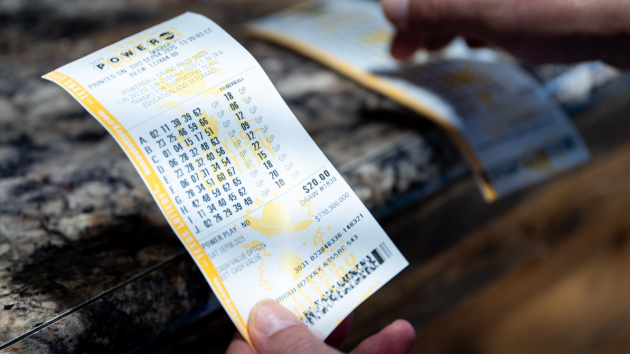
A person holds Powerball lottery tickets they purchased. (Brandon Bell/Getty Images)
(NEW YORK) — The Powerball jackpot has soared to an estimated $875 million — the second biggest prize this year and one of the biggest in the game’s history.
The estimated prize grew after no one claimed the jackpot in Saturday night’s drawing, according to a notice on the Powerball website. The winning numbers were 13, 14, 26, 28, 44 with Powerball 7.
The next drawing is set for Monday, Dec. 8.
The jackpot is the game’s biggest prize this year after a massive $1.787 billion jackpot that was won in September, split between two tickets in Missouri and Texas.
Overall, it’s the seventh-biggest jackpot in the game’s history, according to Powerball.
The odds of winning are 1 in over 292 million, according to Powerball.
Winners will have a choice between a lump sum cash payment of $403.6 million or an annuitized prize, paid out in annual payments. Both amounts are before taxes.
To play, customers must purchase a $2 Powerball ticket and select five white numbers between 1 and 69 and one red number between 1 and 26 for the Powerball. The prize grows until it is won by a player with the corresponding five white numbers in any order with the matching red Powerball.
An estimated $36 billion for charitable causes has been generated from Powerball since the lottery began in 1992, according to Powerball.
Top 10 Powerball jackpots and their winning states: