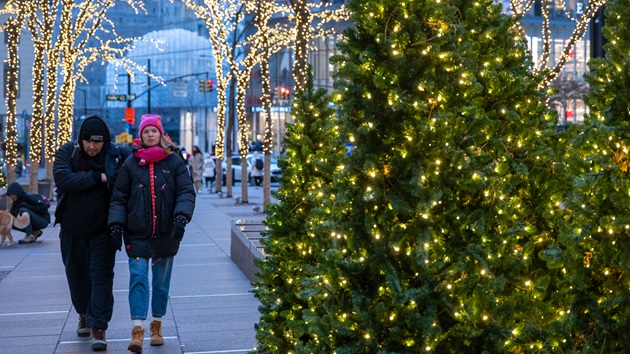
People walk bundled up in winter clothing in Manhattan on December 08, 2025 in New York City. Spencer Platt/Getty Images
(NEW YORK) — Traveling for the holidays Friday may be turbulent, as gusts and widespread rain move into the Northeast, fire warnings persist in the West and storms linger on the West Coast until the end of the year.
Here is a look at the weather forecast for Friday.
Rain and wind in the Northeast
As a large cross-country storm moves east, the system is moving through over the northern Great Lakes region and stretching down to the Southeast where wind gusts could reach 60 mph in some areas.
Areas across Appalachia, New England and coastal Maine will be affected by the strongest gusts, while rain and wind will persist from D.C. to Boston until the evening.
In the Northeast, airport delays are possible due to the inclement weather, as lake-effect snow will begin in the region before things start drying out in the evening.
The weekend will be milder with the exception of some lingering gusts and snow around the Great Lakes region.
Fire danger out West
Parts of Colorado and Wyoming are experiencing extreme and dangerous fire weather Friday, as dry and windy conditions persist across the Rockies.
In particular, the area around Denver is under a rare “Particularly Dangerous Situation” Red Flag Warning for winds between 45-55 mph and gusts up to 80-110 mph, making conditions extremely favorable for rapid fire spread.
Parts of the Texas panhandle, west-central Nebraska and other parts of Colorado and Wyoming are also under Red Flag Warnings for fire, as wind gusts may reach up to 50 mph with the dry conditions out West.
Rain, wind and some snow will rock the Northwest Friday, as a lingering system on the West Coast starts to shift south, dropping an additional 1 to 4 inches of rain across western Oregon, southwest Washington and northwest California.
A Flood Watch remains in effect across coastal Oregon and Washington until 4 a.m. Saturday, as rivers and streams will continue to rise to potentially record levels.
Some mountain resorts in California, such as Boreal Mountain and Soda Springs Mountain Resort, have paused operations into next week due to the weather and will reopen when weather permits.
“While it’s never easy to pause early in the season, this storm is expected to help build our snowpack and set us up for an exciting stretch of winter riding ahead,” the Boreal Mountain resort wrote in a Facebook post. “Our teams will be working throughout the storm to protect terrain and prepare for reopening as soon as conditions allow.”
Over the weekend, 2 to 6 more inches of rain will hit Washington down to California, and a coastal storm will gift nearly all of the West Coast with rain and wind for Christmas.
The holiday week will be much mild and warmer for the rest of the country.
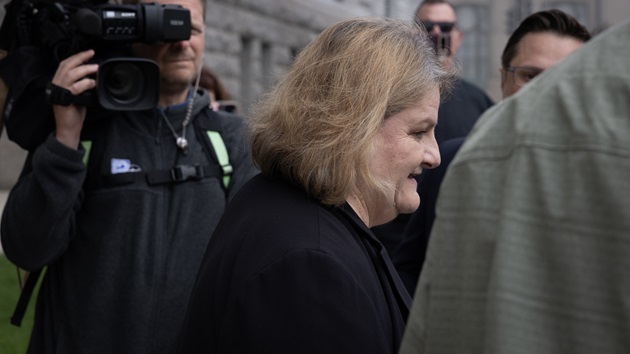
Milwaukee County Circuit Judge Hannah Dugan leaves the Milwaukee Federal Courthouse on May 15, 2025 in Milwaukee, Wisconsin. Scott Olson/Getty Images
(MILWAUKEE) — A Wisconsin judge accused of concealing an undocumented man to prevent his arrest by immigration authorities was found guilty of felony obstruction, according to ABC Milwaukee affiliate WISN, which was in the courtroom for the trial.
Milwaukee County Circuit Court Judge Hannah Dugan was charged in a two-count federal indictment that alleges she obstructed official Department of Homeland Security removal proceedings and knowingly concealed the man from immigration authorities at a courthouse in April.
Dugan was found guilty of obstructing federal agents and not guilty of concealing an undocumented immigrant from arrest during the courthouse incident.
The jury reached the mixed verdict after deliberating for approximately six hours on Thursday, according to WISN.
Dugan, who pleaded not guilty, faces a maximum penalty of five years in prison. The judge has not yet set a sentencing date.
One of Dugan’s attorneys, Steve Biskupic, said they are “obviously disappointed” in the outcome. The mixed verdict is “the big thing from the defense perspective,” he told reporters Thursday night.
“The same elements of count one are in count two. In count two — how can you find guilty there and not guilty on the first,” Biskupic said. “But that’s why we asked for a post-trial briefing.”
“The case is a long way from over,” he added.
According to federal prosecutors, Dugan encountered federal agents who were at the Milwaukee County Circuit Court on April 18 to arrest Eduardo Flores-Ruiz, who was appearing in her courtroom on a battery charge.
Prosecutors say that after speaking to the agents, Dugan directed them to the chief judge’s office down the hall and then sent Flores-Ruiz and his attorney out a non-public door in an alleged attempt to help him evade arrest on immigration violations.
Flores-Ruiz was ultimately captured outside the court building after a brief foot chase.
During closing arguments on Thursday, the government portrayed Dugan as a frustrated and angry judge and asked the jurors to hold her accountable for the alleged criminal conduct, according to ABC Milwaukee affiliate WISN.
The defense, meanwhile, argued that the case is an “unjust prosecution” that is “riddled with doubts” and based on “assumptions,” according to WISN. The defense also questioned the veracity of the audio evidence, according to WISN.
During the nearly weeklong trial, prosecutors produced transcripts and audio recordings that they said showed Dugan telling her court reporter that she would “get the heat” for showing Flores-Ruiz and his lawyer the side exit, WISN reported.
Dugan did not testify during the trial.
The defense witnesses included former Milwaukee Mayor Tom Barrett, who was not at the courthouse that day but testified as a character witness, according to WISN.
After the defense rested on Thursday, Judge Lynn Adelman denied their request to dismiss the case, according to WISN.
The Wisconsin Supreme Court suspended Dugan in the wake of her arrest, stating in an order that it was “in the public interest that she be temporarily relieved of her official duties.”
Flores-Ruiz, a native of Mexico, was charged with unlawful reentry into the U.S. He was sentenced to time served earlier this month after pleading guilty to the charge, federal court records show. DHS said last month he had been deported.
Milwaukee County Circuit Judge Hannah Dugan leaves the Milwaukee Federal Courthouse on May 15, 2025 in Milwaukee, Wisconsin. Scott Olson/Getty Images
(MILWAUKEE) — A Wisconsin judge accused of concealing an undocumented man to prevent his arrest by immigration authorities was found guilty of felony obstruction, according to ABC Milwaukee affiliate WISN, which was in the courtroom for the trial.
Milwaukee County Circuit Court Judge Hannah Dugan was charged in a two-count federal indictment that alleges she obstructed official Department of Homeland Security removal proceedings and knowingly concealed the man from immigration authorities at a courthouse in April.
Dugan was found guilty of obstructing federal agents and not guilty of concealing an undocumented immigrant from arrest during the courthouse incident.
The jury reached the mixed verdict after deliberating for approximately six hours on Thursday, according to WISN.
Dugan, who pleaded not guilty, faces a maximum penalty of five years in prison. The judge has not yet set a sentencing date.
One of Dugan’s attorneys, Steve Biskupic, said they are “obviously disappointed” in the outcome. The mixed verdict is “the big thing from the defense perspective,” he told reporters Thursday night.
“The same elements of count one are in count two. In count two — how can you find guilty there and not guilty on the first,” Biskupic said. “But that’s why we asked for a post-trial briefing.”
“The case is a long way from over,” he added.
According to federal prosecutors, Dugan encountered federal agents who were at the Milwaukee County Circuit Court on April 18 to arrest Eduardo Flores-Ruiz, who was appearing in her courtroom on a battery charge.
Prosecutors say that after speaking to the agents, Dugan directed them to the chief judge’s office down the hall and then sent Flores-Ruiz and his attorney out a non-public door in an alleged attempt to help him evade arrest on immigration violations.
Flores-Ruiz was ultimately captured outside the court building after a brief foot chase.
During closing arguments on Thursday, the government portrayed Dugan as a frustrated and angry judge and asked the jurors to hold her accountable for the alleged criminal conduct, according to ABC Milwaukee affiliate WISN.
The defense, meanwhile, argued that the case is an “unjust prosecution” that is “riddled with doubts” and based on “assumptions,” according to WISN. The defense also questioned the veracity of the audio evidence, according to WISN.
During the nearly weeklong trial, prosecutors produced transcripts and audio recordings that they said showed Dugan telling her court reporter that she would “get the heat” for showing Flores-Ruiz and his lawyer the side exit, WISN reported.
Dugan did not testify during the trial.
The defense witnesses included former Milwaukee Mayor Tom Barrett, who was not at the courthouse that day but testified as a character witness, according to WISN.
After the defense rested on Thursday, Judge Lynn Adelman denied their request to dismiss the case, according to WISN.
The Wisconsin Supreme Court suspended Dugan in the wake of her arrest, stating in an order that it was “in the public interest that she be temporarily relieved of her official duties.”
Flores-Ruiz, a native of Mexico, was charged with unlawful reentry into the U.S. He was sentenced to time served earlier this month after pleading guilty to the charge, federal court records show. DHS said last month he had been deported.
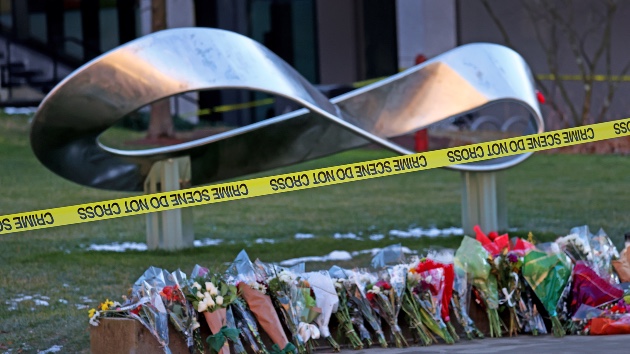
A memorial set up by Brown University outside of the Barus and Holley building on December 18, 2025. (Photo by David L. Ryan/The Boston Globe via Getty Images)
(NEW YORK) — New details about how police caught up to Claudio Manuel Neves Valente, the 48-year-old former Brown graduate student who allegedly perpetrated a mass shooting at Brown University and killed an MIT professor, have emerged after a dayslong manhunt where he made a series of moves designed to evade authorities.
Providence Police Chief Oscar Perez said local police helped track down Valente, who was found dead in a New Hampshire storage unit, thanks, in part, to surveillance video and a detailed tip about a vehicle being driven by a person who noted odd behavior by the suspect.
“I’m being dead serious. Police need to look into a grey Nissan with Florida plates, possibly a rental,” the tipster told police, according to a complaint released by Rhode Island authorities. “That was the car he was driving.”
The tip and surveillance video, along with the use of license-plate reader technology led investigators to a car rental agency in Massachusetts.
There, police obtained a copy of the rental agreement with the suspect’s name, as well as video of the suspect that matched the videos of the person of interest seen on the Brown University campus on the day of the shooting, the complaint said.
That discovery ultimately led investigators to a storage facility in Salem, New Hampshire, where the suspect was found dead, officials said.
Financial records and video evidence confirmed that the storage unit belonged to the alleged suspect and that the rental vehicle was connected to both the Rhode Island and Massachusetts cases.
Authorities identified the suspect as Valente, a Portuguese national and former Brown University student whose last known address was in Miami, Florida. Officials said Valente died by suicide Thursday evening.
Officials confirmed that Valente was found with a satchel containing two firearms, and evidence recovered from the vehicle matched what was found at the Providence crime scene.
Federal authorities confirmed that shortly before 9 p.m. on Thursday, FBI SWAT teams executed court-authorized search warrants at a storage facility in Salem, which is where they found Valente’s body.
Portugal’s Instituto Superior Técnico (IST) confirmed to ABC News that Cláudio Manuel Neves Valente studied between 1995 and 2000 in the school’s physics engineering program, the same one attended at the time by slain MIT professor Nuno F.G. Loureiro.
A 1998 announcement in Portugal’s official Diario da República referred to Valente’s appointment as a teaching assistant at IST and a 2000 notice in the same publication mentions his termination from the role.
A spokesperson for IST declined to comment further on Valente’s history at the institution, due to the ongoing investigation and out of respect for the friends and family of Loureiro.
Brown officials confirmed that Valente was enrolled at the university from the fall of 2000 through the spring of 2001 as a graduate student in physics, entering Brown’s graduate program in September 2000 before taking a leave of absence in April 2001 and formally withdrawing in 2003.
“He was not a current student, was not an employee and did not receive a degree from the University, attending for only three semesters as a graduate student until taking a leave in 2001 and formally withdrawing effective July 31, 2003,” Brown University President Christina Paxson wrote in a letter to students and faculty Thursday.
During his time at Brown, he was enrolled only in physics courses, which were typically held in the Barus & Holley building. University records indicate he has had no active affiliation with Brown for more than two decades.
Police said the suspect acted alone and that there is no indication, at this time, of additional planned attacks. Investigators have not identified any writings, known criminal history or clear motive.
Officials said forensic teams are still processing evidence recovered in New Hampshire, including firearms, and will compare it with ballistic and DNA evidence from the Providence crime scene.
Paxson said the university is still reviewing how the suspect gained access to the building. She said the building was unlocked that day because exams were being held, and the university will examine security procedures moving forward.
Investigators said Valente obtained lawful permanency in April 2017 and was issued a green card.
Secretary of Homeland Security Kristi Noem said in an X post that Valente received his visa through the diversity visa lottery program, and announced that, at President Donald Trump’s direction, she was pausing the program.
Each year, the State Department awards up to 50,000 immigrant visas to “winners” of the diversity visa lottery. The program was created by Congress in 1990 to allow applicants from countries with low rates of immigration into the U.S. to come here.
The winners are selected at random, but they must still go through a lengthy application process, which includes submitting criminal records, being interviewed at an embassy or consulate, and meeting other requirements, such as having a High School Diploma or two years of work experience. Applicants are then allowed to apply for lawful permanent resident status.
Investigators said they identified Valente by name late Wednesday night and weighed whether releasing his identity could cause him to flee or take further action.
Officials said they believed he might return the rental car in Boston or attempt to leave the area, and they wanted the opportunity to arrest him without alerting him that police were closing in.
Officials said it remains unclear exactly when the suspect took his own life, but noted that he signed into the storage facility but was never seen leaving.
The site was secured by federal agents, and investigators said an autopsy will help determine the timing of his death.
ABC News’ Armando Garcia and Christopher Looft contributed to this report.
he Robert F. Kennedy Department of Justice Building on December 19, 2025 in Washington, DC. The U.S. Department of Justice is required by the Epstein Files Transparency Act to release files related to convicted sex offender Jeffrey Epstein today. (Photo by Andrew Harnik/Getty Images)
(WASHINGTON) — After years of legal battles and online speculation, the Justice Department on Friday is set to release what a top DOJ official says are “several hundred thousand” documents from the investigations into the convicted sex offender Jeffrey Epstein, whose connection to the rich and powerful and 2019 death by suicide has generated scores of conspiracy theories.
The DOJ faces a Friday deadline for the release of all remaining Epstein files after Congress last month passed the Epstein Files Transparency Act following the blowback the administration received seeking the release of the materials.
Deputy Attorney General Todd Blanche, in an interview Friday morning on Fox and Friends, said, “I expect that we’re going to release several hundred thousand documents today … and then over the next couple of weeks I expect several hundred thousand more.”
“The most important thing that the attorney general has talked about, that [FBI] Director [Kash] Patel has talked about, is that we protect victims, and so what we’re doing is we are looking at every single piece of paper that we are going to produce, making sure that every victim, their name, their identity, their story, to the extent it needs to be protected, is completely protected,” Blanche said. “Those documents will come in all different forms, photographs and other materials associated with all of the investigations into Mr. Epstein.”
The Epstein Files Act says the Justice Department “may withhold or redact” the identities of Epstein’s victims, and contains exemptions that would allow the DOJ to withhold records that “would jeopardize an active federal investigation or ongoing prosecution.”
Blanche said “there’s a lot of eyes” looking over the documents to ensure victim identities have been redacted. The Justice Department in recent weeks has enlisted scores of attorneys from the National Security Division to conduct the review, according to sources familiar with the matter.
He further suggested in the interview that the administration’s review has been partially hamstrung by a ruling from a judge in the Southern District of New York that demanded the administration verify that its review is fully protecting the identities of victims.
When asked whether the American public should expect any additional criminal cases to come in the wake of the release of the files, Blanche said, “Look, as the president directed, it’s still being investigated, and I expect that will continue to happen. So we, as of today, there’s no new charges coming but, but we are investigating.”
President Donald Trump recently directed the Justice Department to investigate high-profile Democrats associated with Epstein, a task that Attorney General Pam Bondi then referred to the U.S. Attorney for the Southern District of New York.
The Justice Department and FBI announced in July that they would be releasing no additional Epstein files, after several top officials — including Patel and outgoing FBI Deputy Director Dan Bongino — had, prior to joining the administration, accused the government of shielding information regarding the Epstein case.
The Senate subsequently voted to approved the Epstein transparency bill passed by the House, after which President Donald Trump signed it into law.
Critics of Trump have speculated about the degree to which the president, who had a friendship with Epstein until they had a falling out around 2004, appears in the Epstein files, while Trump has accused several well-known Democrats of having ties to the disgraced financier.
“Perhaps the truth about these Democrats, and their associations with Jeffrey Epstein, will soon be revealed, because I HAVE JUST SIGNED THE BILL TO RELEASE THE EPSTEIN FILES!” Trump wrote on social media after signing the bill.
Epstein owned two private islands in the Virgin Islands and large properties in New York City, New Mexico and Palm Beach, Florida, where he came under investigation for allegedly luring minor girls to his seaside home for massages that turned sexual. He served 13 months of an 18-month sentence for sex crimes charges after reaching a controversial non-prosecution agreement with the U.S. attorney’s office in Miami.
In 2019, prosecutors with the U.S. Attorney’s Office for the Southern District of New York indicted Epstein on charges that he “sexually exploited and abused dozens of minor girls at his homes in Manhattan, New York, and Palm Beach, Florida, among other locations,” using cash payments to recruit a “vast network of underage victims,” some of whom were as young as 14 years old.
Epstein died by suicide in a New York jail in 2019 while awaiting trial.
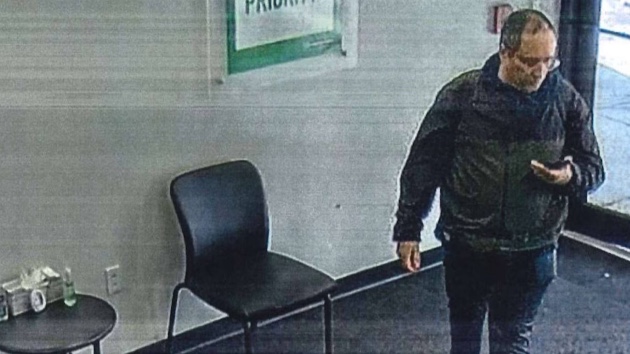
Claudio Manuel Neves Valente, 48, seen inside a car rental facility. (New Hampshire attorney general)
(NEW YORK) — The suspect in last weekend’s mass shooting at Brown University that left two students dead and nine others wounded was found dead Thursday — and authorities said he is the same man who gunned down an MIT professor two days after the Rhode Island campus shooting.
During a news conference Thursday, authorities identified the suspect as Claudio Manuel Neves Valente, a 48-year-old former Brown graduate student, who attended the school some 25 years ago.
Officials said he took his own life. His body was discovered in a New Hampshire storage unit following an intense, multi-state manhunt that had stretched on for days.
“Tonight our Providence neighbors can finally breathe a little easier,” Mayor Brett Smiley told reporters at at news conference Thursday night.
Officials said there is no evidence Valente was working with anyone else, describing in detail his movements leading up to and after the shooting, including steps he took to conceal himself from authorities.
Officials have not yet provided a motive for the back-to-back shootings that left residents of parts of New England on edge for days.
Former Ph.D student who spent time in engineering building
Brown University President Christina Paxson said Neves Valente had enrolled as a Ph.D student in Brown’s physics program in 2000 and attended for less than a year, before going on a leave of absence and then withdrawing. She said it was believed, as a physics student, he spent considerable time in the Barus & Holley engineering building that was targeted in the shooting on Saturday.
Valente, who entered the U.S. in 2000 on a student visa, obtained lawful permanency in April 2017, authorities said.
Secretary of Homeland Security Kristi Noem said the suspect was granted a visa through the diversity lottery program in 2017 and said that DHS would be pausing the program immediately “to ensure no more Americans are harmed,” according to a statement posted on X early Friday morning.
“This heinous individual should never have been allowed in our country. In 2017,” said Noem.
He had no current affiliation with the school, according to officials.
How 2 puzzling crimes were linked
Authorities in Massachusetts confirmed Valente is also the suspected gunman in the death of MIT professor Nuno F.G. Loureiro in Brookline, who was fatally shot on Monday night in the foyer of his building in Brookline, Massachusetts.
Both men were natives of Portugal, and U.S. Attorney for Massachusetts Leah Foley told reporters at a news conference late Thursday night it’s believed Valente and Loureiro studied in the same academic program in Portugal in the 1990s.
It was only the past day or two that the “link began to be established,” between the two puzzling crimes, Foley told reporters as authorities.
Valente’s last known address was in Miami, but he had rented a hotel room in Boston in late November, Foley said. On Dec. 1, he rented a gray Nissan Sentra, which was later observed intermittently in the campus area over the next 12 days leading up to the shooting, she said.
How investigators tracked suspect down
Providence Police Chief Oscar Perez said local police helped tracked down Valente thanks, in part, to surveillance video and a detailed tip about a vehicle being driven by a person who noted odd behavior by the suspect.
“I’m being dead serious. Police need to look into a grey Nissan with Florida plates, possibly a rental,” the tipster told police, according to a complaint released by Rhode Island authorities. “That was the car he was driving.”
The tip and surveillance video, along with the use of license-plate reader technology led investigators to a car rental agency in Massachusetts. There, police obtained a copy of the rental agreement with the suspect’s name, as well as video of the suspect that matched the videos of the person of interest seen on the Brown University campus on the day of the shooting.
What happened at New Hampshire storage facility
Authorities said that discovery ultimately led them to a storage facility in Salem, New Hampshire, on the border with Massachusetts, where Valente had rented a unit. Foley, the U.S. attorney, said investigators believe Valente had fled to the storage facility shortly after the shooting of the MIT professor on Monday night.
By Thursday night, investigators were closing in on the storage facility, obtaining a search warrant, which FBI SWAT teams executed shortly before 9 p.m.
Authorities said Valente’s body was found in a storage unit next to the one he had rented. He was found with a satchel containing two firearms.
The two Brown students who were killed were identified as 19-year-old Ella Cook and 18-year-old MukhammadAziz Umurzokov. They were both fatally struck by gunfire when the shooter burst into the first-floor auditorium where a review session for an economics course was taking place.
The building was unlocked for exams being held in the building at the time of the shooting, the university president said.
Authorities also said Thursday someone confronted the gunman in a bathroom in the building and said he felt like he didn’t belong there.
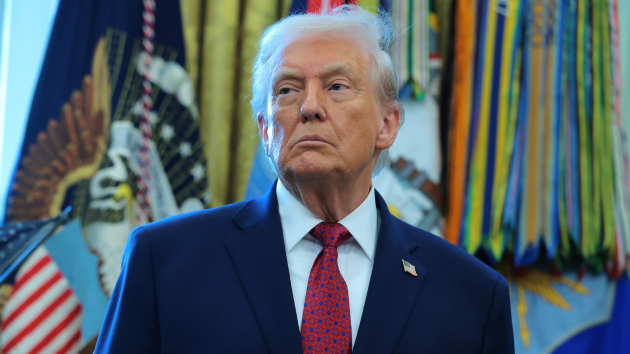
U.S. President Donald Trump listens during a ceremony for the presentation of the Mexican Border Defense Medal in the Oval Office of the White House on December 15, 2025 in Washington, DC. (Photo by Anna Moneymaker/Getty Images)
(WASHINGTON) — President Donald Trump signed an executive order on Thursday reclassifying marijuana as a less dangerous drug.
Currently, cannabis is classified as a Schedule I drug, the most restrictive federal category that includes heroin and LSD.
Under this change, it moves to a Schedule III drug, putting it in the same group as some common prescription painkillers such as Tylenol with codeine.
The White House is stressing that this change makes it easier for scientists to study marijuana, especially around its potential to treat chronic pain and other conditions
“The executive order the President will sign today is focused on increasing medical research for medical marijuana and CBD,” a senior administration official told ABC News ahead the signing.
“The President is very focused on the potential medical benefits, and he has directed a commonsense approach that will automatically start working to improve the medical marijuana and CBD research to better inform patients and doctors. That’s the primary goal,” the official added.
The order directs Attorney General Pam Bondi to expedite the completion of the process of rescheduling marijuana, according to a senior White House official, who outlined the order on a background call with reporters on Thursday.
“Nearly one in four U.S. adults have chronic pain; more than one in three U.S. seniors and six of 10 people that use medical marijuana report doing so to manage pain,” the official said.
By making medical marijuana more accessible, healthcare providers are also hopeful that patients will discuss the risks and benefits and especially what is known about how marijuana may interact with other medications or supplements.
“It’s very important for seniors, especially many of them are on multiple medications, and only 56% of seniors that are using medical marijuana have ever discussed it with their doctor, highlighting a big gap in the quality of care for patients.”
For the first time at the federal level, the order means the government formally recognizes that marijuana could have medical value.
“His intent is to remove barriers to research. The president has heard from so many people who have talked about the potential benefits of medical marijuana and CBD use, but he’s also heard from patients and from doctors that there’s not enough research to inform medical guidelines that many patients are using these products without talking to their doctor about them,” the White House official said.
While this move does not fully legalize marijuana, it could mean some important practical changes, including easier medical access and fewer legal gray areas for consumers and businesses.
The officials said that this executive order makes good on Trump’s campaign promise. Trump first announced his support for this change in federal policy back on the 2024 campaign trail as he tried to win over young voters.
Trump has said he’d support research on the medical benefits of marijuana and that individuals should not be arrested or incarcerated for small amounts of marijuana for personal use.
However, this change still means that marijuana is illegal to possess under federal law, the senior official clarified. Changing the federal law would require Congressional approval.
“Anyone possessing marijuana would be in violation of the CSA (Controlled Substances Act) and still remain subject to arrest under federal law. The schedule III change is not changing federal policy regarding that,” the official said.
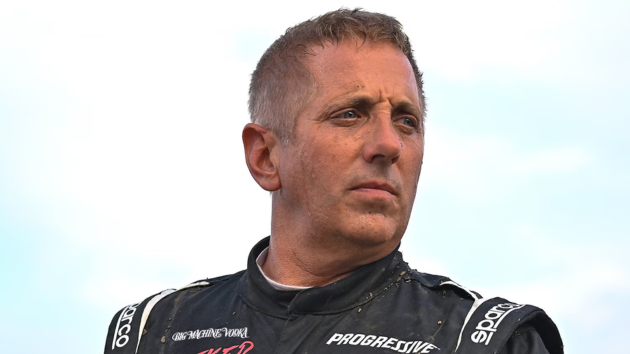
In this July 9, 2022, file photo, Greg Biffle looks on during a heat race at a Camping World Superstar Racing Experience at I-55 Raceway, in Pevely, Missouri. Jeff Curry/SRX via Getty Images, FILE
(NORTH CAROLINA) — Former NASCAR driver Greg Biffle and members of his family died when a small plane crashed and caught fire during landing at the Statesville Regional Airport in North Carolina on Thursday, according to the family and officials.
The North Carolina Highway Patrol said it is awaiting confirmation from the medical examiner, but “it is believed that Mr. Gregory Biffle and members of his immediate family were occupants of the airplane.”
Iredell County Sheriff Darren Campbell told ABC News five adults and two children died on the Cessna C550.
“This tragedy has left all of our families heartbroken beyond words,” the Biffle, Grossu, Dutton and Lunders families said in a statement.
“Greg and Cristine were devoted parents and active philanthropists whose lives were centered around their young son Ryder and Greg’s daughter Emma,” the statement said. “Emma was a wonderful human being with a kind soul who was loved by many people. Ryder was an active, curious and infinitely joyful child.”
“Dennis Dutton and his son Jack were deeply loved as well, and their loss is felt by all who knew them,” the statement continued. “Craig Wadsworth was beloved by many in the NASCAR community and will be missed by those who knew him.”
NASCAR said in a statement that it is “devastated by the tragic loss of Greg Biffle, his wife Cristina, daughter Emma, son Ryder, Craig Wadsworth and Dennis and Jack Dutton.”
“Greg was more than a champion driver, he was a beloved member of the NASCAR community, a fierce competitor, and a friend to so many,” NASCAR said. “His passion for racing, his integrity, and his commitment to fans and fellow competitors alike made a lasting impact on the sport.”
“Heartbreaking news out of Statesville,” North Carolina Gov. Josh Stein wrote on social media. “Beyond his success as a NASCAR driver, Greg Biffle lived a life of courage and compassion and stepped up for western North Carolina after Hurricane Helene. My heart goes out to all those who lost a loved one in this tragic crash.”
The cause of the crash is not known, said John Ferguson, manager of the airport in Statesville, about 50 miles north of Charlotte.
The airport is closed for further notice, Ferguson said, noting that it will take time to get the debris off the runway. The Federal Aviation Administration and National Transportation Safety Board are investigating.
This is a developing story. Please check back for updates.
LONDON — U.S. Southern Command announced on Wednesday that American forces struck another alleged drug vessel in the Eastern Pacific, killing four people the command described as “narco-terrorists.”
Wednesday’s strike was the 26th since such operations began on Sept. 2. The total death toll as reported by the Pentagon now stands at 99 people.
SOUTHCOM said the “lethal kinetic strike” was launched at the direction of Secretary of Defense Pete Hegseth and Joint Task Force Southern Spear.
“Intelligence confirmed that the vessel was transiting along a known narco-trafficking route in the Eastern Pacific and was engaged in narco-trafficking operations,” the statement added. “A total of four male narco-terrorists were killed, and no U.S. military forces were harmed.”
A video posted alongside the statement showed a vessel in motion before it was hit by an explosion. The video then cut to show a stationary vessel on fire.
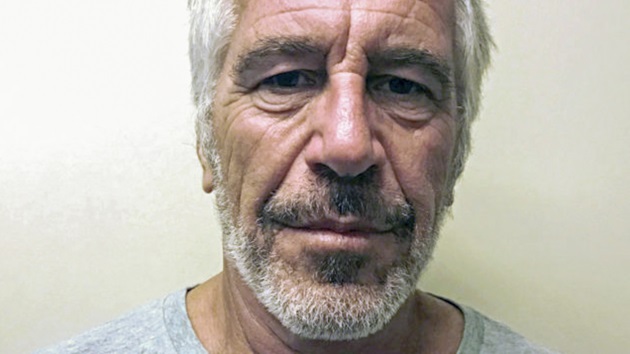
In this handout, the mug shot of Jeffrey Epstein, 2019. Kypros/Getty Images
(WASHINGTON) — One day before the deadline for the Justice Department to release its files on convicted sex offender Jeffrey Epstein, Democrats on the House Oversight Committee on Thursday publicly disclosed another batch of photographs provided by the late financier’s estate in response to Congressional subpoenas.
The cache of about 70 photos includes include heavily redacted photos of women’s passports, images of famous men who associated with Epstein, and “concerning text messages about recruiting women for Jeffrey Epstein,” according to a statement from Rep. Robert Garcia, D-Calif., the ranking Democrat on the committee.
“Oversight Democrats will continue to release photographs and documents from the Epstein estate to provide transparency for the American people,” Garcia said in the statement. “As we approach the deadline for the Epstein Files Transparency Act, these new images raise more questions about what exactly the Department of Justice has in its possession. We must end this White House cover-up, and the DOJ must release the Epstein files now.”
The photos released Thursday are from a larger batch of more than 95,000 images turned over last week by the Epstein estate. The photos were provided to Congress without context, timing, or locations. The images are therefore “presented as received,” the Democrats said.
One image shows billionaire Bill Gates standing with a woman — whose face is concealed — in what appears to be a hotel lobby. Another shows the philosopher and activist Noam Chomsky aboard an airplane chatting with Epstein.
The appearance of the men in the photos is not evidence of wrongdoing.
Another photo shows a woman’s lower leg and foot on what looks like a bed, with a paperback copy of Vladimir Nabokov’s “Lolita” in the background. On the woman’s foot is a handwritten quote from the controversial 1955 novel about a professor’s obsession with a young girl.
“She was Lo, plain Lo, in the morning, standing four feet ten in one sock,” the quote reads.
Other images include a heavily redacted Ukrainian passport of a woman, with all the identifying information covered with black boxes to protect her identify. After Epstein’s 2006 arrest and jail sentence in Florida for solicitation of a minor, he was alleged to have turned his focus to recruiting young women from Eastern European countries.
A screenshot released Thursday of a text message chat — whose participants are not revealed — seems to involve a discussion about recruiting an 18-year-old woman to meet Epstein.
“I will send u girls now,” the message says. “Maybe someone will be good for J?”
A redacted description lists the woman’s name, age, height, weight and physical measurements. The message indicates the woman would be traveling from Russia.
The House Oversight Committee is conducting a broad inquiry into the federal government’s handling of investigations into Epstein and his associate Ghislaine Maxwell. The committee’s efforts are separate from — though at times overlapping — the new law that requires the DOJ to make public its files on Epstein by Friday.