(NEW YORK) — A man was arrested after he was accused of raping a woman on a United flight.
Police at London’s Heathrow Airport were alerted to “an incident” on an inbound trans-Atlantic flight from Newark, New Jersey, on the morning of Jan. 31.
“Officers met the aircraft on arrival and arrested a 40-year-old man on suspicion of rape,” London’s Metropolitan Police said in a statement to ABC News. “He has been released under investigation.”
The woman is “being supported by specialist offers and enquiries are ongoing,” officials explained.
United Airlines said their crew “called ahead and notified the local authorities as soon as they became aware of these allegations” adding they “will cooperate with law enforcement on any investigation.”
Both individuals were sitting in the business class cabin and other passengers were sleeping when the alleged rape occurred, according to the Sun.
ABC News’ Sam Sweeney and Mike Trew contributed to this report.
(NEW YORK) — Thousands of public employees from across Puerto Rico took to the streets Wednesday to demand higher salaries and better pensions.
The demonstration followed a protest by teachers on Friday demanding a temporary increase of $1,000 per month for public educators. Gov. Pedro Pierluisi announced this week that funds from the U.S. Department of Education would be used to provide the wage boost.
But at a press conference Monday, Pierluisi raised eyebrows when he said being a teacher, firefighter or any other public employee was not an obligation.
“No one here is forced to be a police officer or a firefighter, but those who decide towards that calling will have to assume that huge responsibility and if for any reason they question if they should continue to do so amid the salary or work conditions, they are not obligated to remain in their role,” said Pierluisi.
The comment caused outrage among many public employees and other residents on the island.
“It’s disrespectful,” Spanish teacher Leny Colón told ABC News. Colón traveled to the protest from Coamo, located about 60 miles away from San Juan. She said she attended the protest because she is a teacher, but also supports other public employees.
“We are here because we have a calling but this calling shouldn’t be punished… this is a community fight,” Colón said.
For Carlos Torres, a teacher from San Juan, the government’s comments were “insensible”.
“If we wouldn’t have pressured him and we wouldn’t have marched Friday he wouldn’t have done anything,” Torres told ABC News, referring to a new temporary salary increase that goes into effect on July 1.
“Our team has made the necessary calculations and has consulted the federal government, and we’ve been able to identify ESSER funds to provide incentives for teachers,” Pierluisi announced in a press release Feb. 7.
According to the U.S. Department of Education, The Elementary and Secondary School Emergency Relief Fund (ESSER) is part of the Education Stabilization budget. Congress allocated $13.2 billion from the $30.7 billion to address the COVID-19 impact on schools across the nation.
Although the raise was praised by many, the wave of negative response from Puerto Ricans in response to the governor’s other comments keeps growing — and the leader says he has nothing to apologize for.
“Apologize for what? I did a lot of comments in solidarity with all the claims being made by the people,” Pierluisi said at a press conference on Tuesday.
As for the dispute over salaries, work conditions and retirement plans, many public employees say they will not stop fighting until they see a change.
“Education, safety and health is very important,” Colón said. “It’s time to make justice for all Puerto Ricans.”
(NEW YORK) — A South Carolina police officer has been charged with voluntary manslaughter after fatally shooting an unarmed man who led her on a high-speed pursuit, authorities said.
The incident began early Sunday, when Hemingway Police Officer Cassandra Dollard, 52, attempted to pull over 46-year-old Robert Langley for “disregarding a stop sign” in Williamsburg County at 1:24 a.m., according to an arrest warrant.
Langley “failed to stop” and a chase ensued, according to the warrant. After allegedly traveling over 100 mph, Langley crashed his car into a ditch in neighboring Georgetown County at around 1:30 a.m., according to the warrant.
Langley attempted to exit the car through the front passenger door and Dollard fired her gun once, striking him in the chest, according to the warrant.
Dollard reportedly told investigators she fired her gun because she was “in fear for her safety,” according to the warrant.
“Dollard stated she did not identify a weapon in Langley’s hands, nor was a weapon recovered at the scene,” South Carolina Law Enforcement Division Special Agent Ashley Jolda said in the arrest warrant affidavit, which noted that Dollard had no authority to arrest Langley outside of Williamsburg County.
Langley was transported to a local hospital, where he died from his injuries, authorities said. An autopsy is scheduled for Friday morning, the Georgetown County Coroner’s Office said.
Dollard was arrested Wednesday afternoon by SLED agents and booked into the Georgetown County Detention Center. Her bond hearing has been scheduled for Thursday, according to Charleston, South Carolina, ABC affiliate WCIV. It is unclear if she has an attorney.
SLED agents are seeking to conduct interviews with potential witnesses and are collecting evidence as part of their investigation into the shooting, the agency said.
The Hemingway Police Department said following the shooting that it is in “full cooperation with SLED” during the investigation and referred all questions to the agency.
SLED said it is not releasing any additional information on the case at this time.
An attorney for Langley’s family said prosecutors showed them dashcam video of the deadly encounter Wednesday morning.
“We do know that Robert Langley should be alive today,” attorney Bakari Sellers said during a press conference held hours before Dollard’s arrest. “We do know that he was taken from us in a cruel fashion, in an unjust fashion.”
Langley, a father of 10 and a new grandfather, “posed no threat” to the officer, according to Sellers.
“I don’t know if she was having a bad day or what, but murder should not have been on the menu,” Sellers said.
(NEW YORK) — A juror was dismissed Wednesday in the federal trial of three former Minneapolis police officers charged with violating George Floyd’s civil rights during the 2020 fatal arrest.
The juror was let go after informing the court he is coping with mental health issues going on with his son.
The panelist — a maintenance and facilities manager and Army veteran — was replaced by one of six alternate jurors. The replacement juror is a man who works at a data company and has two children.
The trial in U.S. District Court in St. Paul, Minnesota, began on Jan. 24 with opening statements. The prosecution is nearing the end of presenting its evidence in the case against J. Alexander Kueng, 28, Thomas Lane, 38, and Tou Thao, 35.
All three are charged with using the “color of the law,” or their positions as police officers, to deprive Floyd of his civil rights by allegedly showing deliberate indifference to his medical needs when their senior officer, Derek Chauvin, kneeled on the back of the handcuffed man’s neck for more than nine minutes, ultimately killing him.
Kueng and Thao both face an additional charge alleging they knew Chauvin was kneeling on Floyd’s neck but did nothing to stop him. Lane, who appeared to express concern for Floyd’s well-being during the encounter, does not face the additional charge.
They have all pleaded not guilty.
Chauvin was convicted in Minnesota state court in April of second-degree unintentional murder, third-degree murder and second-degree manslaughter. He was sentenced to 22 1/2 years in prison.
Chauvin, 45, also pleaded guilty to federal civil rights charges stemming from Floyd’s death and the abuse of a 14-year-old boy he bashed in the head with a flashlight in 2017. He admitted in the signed plea agreement with federal prosecutors that he knelt on the back of Floyd’s neck even as Floyd complained he could not breathe, fell unconscious and lost a pulse.
ABC News’ Whitney Lloyd contributed to this report.
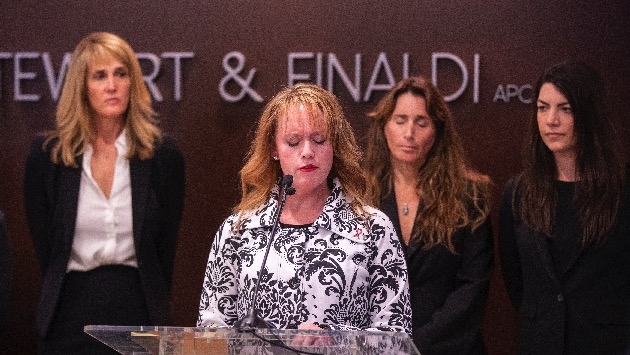
Survivor Kara Cagle speaks during a news conference to announce a $243-million settlement in the UCLA sex abuse case of former UCLA gynecologist/oncologist James Heaps in Irvine, Calif., Feb. 8, 2022. – Allen J. Schaben / Los Angeles Times via Getty Images
(IRVINE, Calif.) — The University of California announced on Tuesday that it reached an agreement to pay $243.6 million to 203 women, settling lawsuits alleging sexual misconduct by former UCLA Health physician James Heaps.
The women filed a lawsuit against the university in California state court, according to UCLA.
“The conduct alleged to have been committed by Heaps is reprehensible and contrary to the university’s values. We express our gratitude to the brave individuals who came forward, and hope this settlement is one step toward providing healing and closure for the plaintiffs involved,” UCLA said in a statement to ABC News.
The settlement comes after the university agreed in December to pay $73 million in the settlement of a class-action lawsuit filed by seven women, on behalf of 5,500 women who were patients of the former UCLA gynecologist, court records show.
Heaps faces 21 charges in an ongoing criminal case brought against him in a Los Angeles County Superior Court, according to court records.
In addition to UCLA Health, the University of California’s Arthur Ashe Student Health & Wellness Center was also named in the litigation. The university had called for an independent review by a special committee to look into UCLA Health’s as well as the Arthur Ashe Student Health & Wellness Center’s responses to allegations of sexual misconduct by medical professionals, according to UCLA.
UCLA Health and the Arthur Ashe Student Health & Wellness Center representatives say they have taken substantial action to address the issues alleged in the litigation.
The report was completed and released publicly in June 2020, recommending additional policies and procedures to prevent, identify and address sexual misconduct, all of which are being adopted and implemented, according to UCLA.
“In light of this settlement and these changes at UCLA, we reiterate our ongoing commitment to never tolerate sexual violence or harassment in any form. Allegations of sexual misconduct by any health care provider will be promptly addressed, and appropriate actions will be taken to ensure our patients are safe, protected and respected,” UCLA said in a statement.
“As we move forward, we remain committed to providing top quality care that respects the dignity of every patient, and we remain dedicated to taking all necessary steps to ensure our patients’ well-being and to maintain the public’s confidence and trust,” UCLA said.
(GRAND RAPIDS, Mich.) — A second man charged in a bizarre plot to kidnap Michigan Gov. Gretchen Whitmer pleaded guilty Wednesday and has agreed to testify for the prosecution at the federal trial of four other defendants.
Kaleb Franks, 27, of Waterford, Michigan, admitted in U.S. District in Grand Rapids that he and other members of the Wolverine Watchmen, a Michigan-based self-styled “militia” group, hatched the plot to abduct Whitmer at her summer home in 2020 because they were upset by the state’s COVID-19 restrictions.
The plot, which allegedly included plans to use semiautomatic assault-type weapons and to bomb a bridge near Whitmer’s vacation home, was foiled by undercover law enforcement officers who infiltrated the group.
“Did any law enforcement officers suggest kidnapping the governor?” U.S. Magistrate Judge Phillip Green asked Franks during Wednesday’s hearing.
Franks replied, “No sir.”
Franks admitted in court that the kidnapping plan originated solely with him and the others charged in the conspiracy.
Lawyers for the other men facing trial in March filed a motion to dismiss the charges, arguing they were entrapped. The judge rejected that motion.
Franks’ guilty plea comes after another man charged in the case, Ty Garbin, 25, pleaded guilty last year to firearms charges and conspiracy charges of providing material support for terrorists. Garbin was sentenced in August to 75 months in prison.
Garbin is also expected to testify for the prosecution in the upcoming federal trial for Adam Fox, 40, Barry Croft Jr., 45, Daniel Harris, 24, and Brandon Caserta, 33. Eight other men face charges in state court stemming from the kidnap plot.
Franks admitted being deeply involved in the kidnap plot, participating in meetings and training sessions, and surveillance conducted on Whitmer’s vacation home in his signed plea agreement.
After the plot was thwarted, Whitmer alleged in an interview with ABC’s Good Morning America that the plan included more than kidnaping her.
“This was a very serious thought-out plot to kill police officers, to bomb our capitol, killing Democrats and Republicans alike, and to kidnap and ultimately put me on trial and kill me as well,” Whitmer said on GMA. “These are the types of things you hear from groups like ISIS. This is not a militia; it is a domestic terror organization.”
(HOUSTON) — A 9-year-old girl is in critical condition after she was hurt in an apparent road rage shooting in Houston, police said.
The suspect, believed to be in a white GMC Denali pickup truck, apparently cut off the girl’s family several times on the Southwest Freeway Tuesday night, Houston police said.
At about 9:10 p.m., the pickup truck pulled behind the family’s vehicle and someone in the pickup truck fired shots, hitting the 9-year-old, police said.
No arrests have been made. Police ask anyone to call the police department at 713-308-8800 or Crime Stoppers at 713-222-TIPS.
(NEW YORK) — As the COVID-19 pandemic has swept the globe, more than 5.7 million people have died from the disease worldwide, including over 909,000 Americans, according to real-time data compiled by Johns Hopkins University’s Center for Systems Science and Engineering.
About 64.2% of the population in the United States is fully vaccinated against COVID-19, according to data from the Centers for Disease Control and Prevention.
Here’s how the news is developing. All times Eastern:
Feb 09, 11:01 am
Massachusetts lifts statewide school mask mandate
Massachusetts is lifting its statewide school mask mandate effective Feb. 28, Gov. Charlie Baker announced Wednesday.
“Everyone now has the tools and the knowledge to stay safe,” Baker said, citing availability of vaccines, distribution of tests and the relative lack of serious illness among kids. “It’s time to give our kids a sense of normalcy.”
Baker said the state fully supports an individual’s decision to continue to wear a mask and he asked school districts to do the same, echoing New Jersey Gov. Phil Murphy, who told school districts to crack down on any bullying that results from continued mask wearing.
Baker said Massachusetts ranks 2nd in the nation for the highest number of vaccinated kids.
-ABC News’ Aaron Katersky
Feb 09, 8:29 am
England to lift all COVID-19 restrictions a month early
British Prime Minister Boris Johnson announced Wednesday his plans to lift all remaining pandemic-related restrictions in England in less than two weeks.
Addressing lawmakers in the United Kingdom’s House of Commons, Johnson said he hopes to scrap England’s COVID-19 restrictions as soon as Parliament returns from its upcoming recess on Feb. 21.
“I can tell the House today that it is my intention to return on the first day after the half-term recess to present our strategy for living with COVID,” Johnson told lawmakers. “Provided the current encouraging trends in the data continue, it is my expectation that we will be able to end the last domestic restrictions, including the legal requirement to self-isolate if you test positive, a full month early.”
Johnson first announced his plans to end all of the so-called Plan B measures last month, starting with mask mandates. He told lawmakers at the time that the legal requirement for people with COVID-19 to self-isolate would be allowed to expire when the regulations lapsed on March 24, but that the date could be brought forward.
Although Johnson is the U.K. prime minister, his government is only responsible for COVID-19 restrictions in England because public health legislation is devolved to national governments within the U.K., meaning that Scotland, Wales and Northern Ireland are responsible for their own pandemic-related policies.
Feb 09, 7:55 am
US reported more cases, deaths than any country last week, WHO says
The United States reported the highest number of newly confirmed COVID-19 cases and deaths from the disease last week out of any country in the world, according to a weekly epidemiological update released Tuesday by the World Health Organization.
More than 1.8 million new cases were reported in the U.S. during the week of Jan. 31 to Feb. 6, a 50% decrease compared to the previous week. Over 14,000 new fatalities were also reported, a 15% decrease, the WHO said.
France had the second-highest number of new cases with more than 1.7 million, a 26% decrease, while India had the second-highest number of new deaths with nearly 8,000, a 69% increase, according to the WHO.
Meanwhile, the global number of new cases during that same period decreased by 17% compared to the previous week, while fatalities increased by 7%, the WHO said.
(NEW YORK) — As the COVID-19 pandemic has swept the globe, more than 5.7 million people have died from the disease worldwide, including over 909,000 Americans, according to real-time data compiled by Johns Hopkins University’s Center for Systems Science and Engineering.
About 64.2% of the population in the United States is fully vaccinated against COVID-19, according to data from the Centers for Disease Control and Prevention.
Here’s how the news is developing Wednesday. All times Eastern:
Feb 09, 8:29 am
England to lift all COVID-19 restrictions a month early
British Prime Minister Boris Johnson announced Wednesday his plans to lift all remaining pandemic-related restrictions in England in less than two weeks.
Addressing lawmakers in the United Kingdom’s House of Commons, Johnson said he hopes to scrap England’s COVID-19 restrictions as soon as Parliament returns from its upcoming recess on Feb. 21.
“I can tell the House today that it is my intention to return on the first day after the half-term recess to present our strategy for living with COVID,” Johnson told lawmakers. “Provided the current encouraging trends in the data continue, it is my expectation that we will be able to end the last domestic restrictions, including the legal requirement to self-isolate if you test positive, a full month early.”
Johnson first announced his plans to end all of the so-called Plan B measures last month, starting with mask mandates. He told lawmakers at the time that the legal requirement for people with COVID-19 to self-isolate would be allowed to expire when the regulations lapsed on March 24, but that the date could be brought forward.
Although Johnson is the U.K. prime minister, his government is only responsible for COVID-19 restrictions in England because public health legislation is devolved to national governments within the U.K., meaning that Scotland, Wales and Northern Ireland are responsible for their own pandemic-related policies.
Feb 09, 7:55 am
US reported more cases, deaths than any country last week, WHO says
The United States reported the highest number of newly confirmed COVID-19 cases and deaths from the disease last week out of any country in the world, according to a weekly epidemiological update released Tuesday by the World Health Organization.
More than 1.8 million new cases were reported in the U.S. during the week of Jan. 31 to Feb. 6, a 50% decrease compared to the previous week. Over 14,000 new fatalities were also reported, a 15% decrease, the WHO said.
France had the second-highest number of new cases with more than 1.7 million, a 26% decrease, while India had the second-highest number of new deaths with nearly 8,000, a 69% increase, according to the WHO.
Meanwhile, the global number of new cases during that same period decreased by 17% compared to the previous week, while fatalities increased by 7%, the WHO said.
(NEW YORK) — Milwaukee resident Exie Tatum III grew up in heart of the city and still lives there. The African American father owns a home in a predominantly Black neighborhood but has been house-hunting in pricey, majority-white suburbs, searching for an affordable home that he might someday pass along to his young son Charles through inheritance.
“It would really change the game,” Tatum said of owning a suburban Milwaukee home.
But statistics suggest he’s fighting an uphill battle.
Despite 50 years of federal oversight under the landmark Fair Housing Act of 1968, housing segregation persists in America’s largest cities and urban centers — and an exclusive ABC News analysis of mortgage-lending data shows a pattern of racial isolation remains consistent following decades of failed initiatives.
The analysis shows that 20 of the nation’s top 100 metropolitan areas have an “extreme dissimilarity index” of 50 or higher — meaning at least half of the population would have had to move to another neighborhood in the area to achieve total integration in 2019.
The Milwaukee metro area is at the top of ABC News’ “extreme” segregation list, but that list also includes America’s largest metro areas — New York, Los Angeles, Philadelphia and Chicago.
Also on the top 20 “extreme” list: Cleveland, Ohio; Buffalo, New York, Detroit, Michigan; St. Louis, Missouri; Memphis, Tennessee; Birmingham, Alabama; Jackson, Mississippi; Springfield, Massachusetts; New Orleans, Louisiana; Miami, Florida; Bridgeport, Connecticut; Baltimore, Maryland; Cincinnati, Ohio; Baton Rouge, Louisiana; and Providence, Rhode Island.
ABC News’ analysis of segregation and home lending patterns across America used data from the Federal Financial Institutions Examination Council’s Home Mortgage Disclosure Act (HMDA) and the U.S. Census American Community Survey.
Race and ethnicity information in the home lending data is collected voluntarily from the loan applicant or through visual observation by the lender, and by self-identification in the census data.
The data were used by ABC’s Owned Television Stations to compile the Equity Report, which allows readers to track and measure quality of life and equality in America’s 100 largest metro areas in five categories: housing, health, education, policing, and the environment.
Using the home lending and census datasets, ABC News calculated a dissimilarity index for metropolitan areas and census tract neighborhoods across the U.S.
Indexes like the ones used by ABC News are often used by researchers to measure residential segregation between two racial or ethnic groups within a geographic region. It is based on a 0-100 scale, with “0” being total integration and “100” being total segregation.
The ABC News analysis found that segregation persists across the nation, and that there is no indication that the racial composition of neighborhoods is rapidly changing in the nation’s most segregated metropolitan areas.
In 19 of those 20 extremely segregated metro areas, at least 40% of the homeowners who got a mortgage loan in 2019 — white or non-white — would have had to buy a house in a different neighborhood to create a naturally integrated pool of new homeowners.
In eight of those metro areas with extreme segregation, at least half the new homebuyers would have had to settle into a new neighborhood in 2019 to make an integrated pool of new neighbors.
Even in neighborhoods where some racial evolution is taking place, the analysis shows an overall disparity: It’s easier for whites to buy homes in majority non-white neighborhoods than for non-whites to buy in mostly white sections of a metro area.
In 2019, nearly two-thirds of the 347,000 white homebuyers (64.8%) who applied for mortgages in mostly non-white neighborhoods in America’s largest metro areas got a loan approval — an indicator of what many urban planners and demographers see as a continued pattern of gentrification in urban areas across the nation.
Meanwhile, about 56% of the 715,000 non-white applicants got a loan in 2019 in those same majority non-white neighborhoods.
In mostly white neighborhoods, the same pattern exists in the largest metro areas. About 69% of the 1.9 million loan requests from white applicants were approved, compared to about 55.8% of 613,000 applications from non-whites.
The ABC analysis shows disparities were similar for applicants in the same income range ($50,000 – $100,000) who sought mortgage loans of $50,000 to $250,000.
In majority-white neighborhoods, white applicants in those categories had a 67% approval rate, compared to 52% for non-white applicants.
In mostly non-white neighborhoods, white applicants with similar incomes and loan amounts had a 63% approval rate, while the approval rate for similar non-white applicants was 55%.
In some cities, the gentrification process is forcing more non-white residents out of urban neighborhoods, along with the small minority-owned businesses, cultural enterprises and institutions — barbershops, hair salons, and churches — that have catered to those residents for decades.
Milwaukee under the microscope
The ABC News analysis shows just how mortgage lending disparities in wealthy suburbs and poorer urban neighborhoods play out in the Milwaukee metro area.
Overall, in 2019, whites filed four times more mortgage loan applications than non-whites, and had 73% of those loans approved, compared to 49% for non-whites.
In Milwaukee’s majority non-white neighborhoods — mainly urban areas where gentrification was taking place — non-white home seekers filed twice as many applications as whites, but had a lower approval rate — 55% compared to 64% for whites.
Meanwhile, in majority white neighborhoods, white home seekers filed seven times as many mortgage applications — and the 73% approval rate among white applicants was higher than the non-white approval rate of 47%.
For Milwaukee metro applicants with similar income and loan requests, the analysis shows the white approval rate in both mostly non-white and mostly-white neighborhoods was 1.5 times higher than the non-white approval rate.
Tatum says he has seen and experienced the suburban housing disparities that the data seem to support — and how they affect people of color.
Demographically, Tatum has seen Milwaukee change dramatically over the years. But when it comes to segregated neighborhoods, he’s seen some things stubbornly stay the same.
“If you look at the north side of Milwaukee, you’re going to see African-Americans,” Tatum explained. “As soon as you cross the bridge to the south side, that’s where the Latino community begins.”
By buying a suburban home that he could pass on to his son, Tatum would love to help break that decades-old pattern of segregation.
National studies suggest that homeownership is a key factor in building generational wealth within families. A 2017 Federal Reserve study shows the average homeowner had a household wealth of $231,400 in 2016, compared to the average renter having a household wealth of $5,200.
But U.S. Census data show that homeownership rates among non-white households — particularly Black households — falls far short of the white homeowner rate of 76%.
For Tatum and other non-white city residents wanting to relocate to Milwaukee’s suburbs, there’s reason for optimism: The latest census data show that, for the first time, two suburban communities — West Milwaukee and Brown Deer — reported majority-minority population counts.
Those communities are outliers, however. Other suburban neighborhoods in the Milwaukee metro area remain at least 73% white.
For Black residents, the data is even more dismal: Less than 9% in the Milwaukee metro area live in the suburbs.
A “baked” lending system
Tatum and other non-white home seekers across the U.S. blame a financial lending system — developed and regulated by the federal government — that for decades has systematically kept people of color from getting home loans, particularly in suburban neighborhoods.
“I still feel like my bankers always have to go to the underwriters and fight for me. They literally tell me, ‘I’m going to fight for you,'” Tatum said. “Why do you have to fight for me when I’m meeting all the criteria that you told me I needed?”
In San Francisco, 30-year resident Boris Quinonez has had his own experience with lenders.
Around 2010, Quinonez tried purchasing a single-family home in the city’s Mission District, but was denied a loan at least three times by a lender.
Property records show the house eventually sold — to Quinonez’s best friend.
Quinonez said he and his friend had the same job, the same down payment, a similar credit score, and lived in the same neighborhood.
The only difference?
“He was white and I wasn’t,” Quinonez said. “Everything else was the same.”
Rochelle Sparko, the director of North Carolina Policy at the Centers for Responsible Lending, points to historical real estate practices and longstanding racial wealth gaps as barriers that communities of color are still combating.
“It is baked into the system that it is difficult for … Black people who want to take on home mortgages to have difficulty doing that,” Sparko said. “It is possible that some of that is about overt discrimination, but a lot of it is sort of all of these impacts coming together.”
Sparko said that obstacles to getting a home loan for people of color include student loan debt and loss of family wealth during the last foreclosure crisis.
“There are any number of reasons why we see this difference in homeownership rates, and I think what we are beginning to recognize and talk about more is the need for targeted interventions to address that,” Sparko said.
But targeted interventions of the past, like the GI Bill, proved to be little more than an illusion for many Black Americans.
The GI Bill was supposed to guarantee low-interest mortgages and other loans to veterans returning home from World War II. While it generally helped white American veterans prosper and accumulate wealth in the postwar years, it failed to deliver for many veterans of color — primarily because white-run financial institutions had the power and incentive to refuse mortgages and loans to Blacks and other veterans of color.
In Milwaukee and other cities across the U.S., restrictive housing covenants — some dating back 100 years — helped lay the foundation for America’s segregation problem.
Those covenants, written by local housing authorities and developers, and sanctioned by the federal government, prohibited anyone but whites from owning or leasing property in specific sections of a community.
“People who were living in these covenant neighborhoods knew that this meant, ‘OK, this is an all-white community,'” said Reggie Jackson, an educator, consultant, and member of the City of Milwaukee’s Equal Rights Commission.
“They kept neighborhoods all white for decades,” Jackson said.
The covenants led to “redlining” practices in many cities, where federally-insured mortgages, loans and private residential insurance were withheld from non-white homeowners who were pigeonholed into non-covenant neighborhoods considered “investment risks.”
The term comes from lenders and other institutions literally drawing red lines around high-risk neighborhoods considered undesirable for business purposes. Redlining thwarted growth and redevelopment in many urban neighborhoods, leading to inner-city ghettos.
Those decades-long practices ended, in theory, with the passage of the Fair Housing Act of 1968, which prohibited discrimination concerning the sale, rental or financing of housing based on race, religion, national origin, gender, disability or family status.
But the legacy — and patterns — of segregation left by covenants and redlining still linger.
A demographic analysis by ABC News partner FiveThirtyEight of 138 metropolitan areas where redline maps were drawn found that nearly all the former redlined zones are still disproportionately Black, Hispanic or Asian, compared with their surrounding areas.
In comparison, the FiveThirtyEight analysis found that two-thirds of “greenlined” zones — neighborhoods deemed by insurers and lenders to be the best for mortgage lending — are still overwhelmingly white.
Going “all in” on fair housing
U.S. Senator Sherrod Brown (D-Ohio), chairperson of the Senate Committee on Banking, Housing and Urban Affairs, which is charged with overseeing the Fair Housing Act, believes the housing act has fallen short in its intent to “address both discrimination in housing and increase integration.”
In a March, 2020 letter to the general counsel of The Department of Housing and Urban Development, Brown points the blame at HUD, which he says has “failed for decades to fully implement (fair housing).”
“Sadly, half a century later, our nation has failed to achieve that goal of ‘truly integrated and balanced living patterns,'” Brown wrote, quoting the act’s original sponsor, former senator and Vice President Walter F. Mondale.
“We have never, as a nation, gone ‘all in’ on fair housing,” Brown told ABC News in December. “We’ve never, as a nation, tried to close that gap … that gap between black and white ownership.”
HUD Secretary Marcia L. Fudge believes the regulatory agency is on a path toward fulfilling the original promise of the Fair Housing Act. One of the first steps taken by Fudge in her initial year of leadership was to overturn a decision by the previous administration that suspended a rule requiring local communities to identify fair housing issues and commit to solving them.
HUD will be reviewing the assessments coming from local governments that receive federal funding under the Fair Housing Act.
“More than 50 years since the Fair Housing Act’s passage, inequities in our communities remain that block families from moving into neighborhoods with greater opportunities,” Fudge said in a June 2021 press release. “Today, HUD is taking a critical step to affirm that a child’s future should never be limited by the ZIP code where they are born.”
Linda McCoy, president of the National Association of Mortgage Professionals (NAMB), believes the way to bridge racial gaps in loan approval ratings is through education and government action.
“You know, I wish I could … wave a magic wand and make it (housing discrimination and segregation) go away,” said McCoy, who’s group represents nearly a million mortgage brokers across the U.S.
McCoy noted that NAMB is working with “10 or 12” members of Congress to create legislation that would help mortgage brokers — particularly those lending in majority non-white communities — compete with big banks and lending institutions.
“I’m not sure what the solution is going to be, but I know that we’re doing all that we can do to help,” she said.
Gentrification: The urban neighborhood “makeover”
In the heart of Milwaukee sits a mostly-Black subdivision filled with tidy bungalows, ranch houses and bi-level homes sitting on manicured grass lots.
Halyard Park emits a suburban vibe, even though it’s surrounded by decaying, urban neighborhoods and sits in the shadow of Fiserv Forum, home to the NBA champion Milwaukee Bucks.
Established in 1976 with vacant land from the I-43 freeway expansion in the 1960s, Halyard Park was set up as a neighborhood for middle-class Black residents.
It is named for Ardie Clark Halyard and her husband, Wilbur, two Black community activists who saw Black homeownership being stymied by redlining and institutional racism.
The Halyards started Columbia Savings & Loan, the city’s first Black-owned bank, and one of only a few that offered home loans to Blacks moving into the subdivision and other urban neighborhoods.
“You had a group of folks that came up with this brilliant idea,” said Jackson. “If we can’t get these middle-class and upper middle-class black people out to our suburbs, why don’t we build a suburb in the city?
“And that’s what they did,” Jackson said. “It’s a hidden gem.”
Halyard Park has remained a gem over the past 40 years — but it’s no longer hidden.
The neighborhood’s proximity to the arena and other downtown development makes it attractive to developers and wealthy white homebuyers, which has driven up property values and property taxes.
Halyard Park is a real-time example of the urban gentrification taking place in cities across the U.S. — a profit-driven race and class “makeover” of a neighborhood that historically has been deprived of investment opportunities.
Since 2018, the ABC News analysis shows lenders have approved 62% of the home loans in census tracts that comprise the Halyard Park neighborhood. But the lenders have approved 76% of the loans for white applicants, compared to only 53% of non-white applicants.
Yet it’s not the changing demographics that concern longtime Black Halyard Park residents like Clara Smith. It’s the changing economics.
“I have seen my taxes go from $1,500 to over $4,000,” said Smith, a retiree who’s lived 38 years in Halyard Park. “It’s going to be a disaster for everybody. I do not want to be taxed out of my home.”
Chris Neilsen, one of Halyard Park’s newest white residents, says he was drawn to the neighborhood by its diverse environment. But he realizes there’s a difference between integration and gentrification that pushes people out.
“Looking to the future, I think it is a concern, and something that we need to be aware of, if we’re going to keep a diverse atmosphere,” said Neilsen, who bought a house in Halyard Park nearly four years ago with his wife Avery.
Jackson, the Milwaukee equal rights commissioner, agrees.
“Gentrification’s like a slow moving freight train,” he said. “You see it coming, but you’re not going to do anything to stop it from moving.”
Meanwhile, just a few blocks from Halyard Park, Exie Tatum still dreams of owning a suburban home someday.
For now, he’s considering a different strategy: buying a foreclosed property in a rundown neighborhood at a cost of only $1,000 for the house and an adjoining parcel of land. Maybe, says Tatum, he can improve the property then resell it for a handsome return.
But Tatum knows all too well the risks of trying to “flip” a house in an area that isn’t being gentrified. His current home, which he owns in a predominantly Black neighborhood, is a transitional home that he had hoped to “put a little income into, take a little equity, turn it over, and move out a little further (into the suburbs).”
The problem, says Tatum, is that after the house was originally appraised for about $110,000, it dropped to only $25,000 by the time he was ready to sell — all because of the neighborhood where it’s located.
“I’m jumping through multiple hoops just to stay somewhere where I really don’t want to stay,” he said.
ABC News Senior Investigative Correspondent David Scott, San Francisco ABC7’s Stephanie Sierra and Lindsey Feingold, and Raleigh ABC11’s Akilah Davis, Samantha Kummerer and Maggie Green contributed to this report.