(NEW YORK) — The New York Attorney General’s office is urging an appellate court to enforce a subpoena that requires former President Donald Trump and his two eldest children to testify in a civil investigation that’s examining whether there has been fraud within the Trump family real estate business, according to a new court filing.
The former president and his eldest children, Donald Trump Jr. and Ivanka Trump, have asked the Appellate Division’s First Department to quash the subpoenas, arguing they became improper once the Manhattan District Attorney’s office opened a parallel criminal investigation.
“Nothing in the law supports that outcome, which would impermissibly constrain the discretion of the Attorney General, New York’s chief law enforcement officer, to select from among the investigative tools and remedies conferred on her by statute,” Eric Del Pozo, the deputy solicitor general, wrote in a motion filed Tuesday. “Civil subpoenas do not compel appellants to provide information that may be used against them in a future criminal case.”
The Trumps have also argued the subpoenas result from an investigation driven by the political animus of New York Attorney General Letitia James, which her office rejected.
“Office of Attorney General’s civil investigation began after a corporate insider gave sworn testimony that the Trump Organization had engaged in widespread fraud,” the filing Tuesday said. “That fact, along with the substantial evidence collected to date of possible business fraud, amply supports Supreme Court’s finding that the civil subpoenas are part of a valid and well-founded investigation rather than a product of political animus.”
Michael Cohen, Trump’s former personal attorney, testified to Congress in 2019 that the former president valued his real estate holdings differently depending on whether he was seeking loans or tax deductions.
Cohen provided Congress with copies of Trump’s financial statements that he said misrepresented the values of Trump assets to obtain favorable terms for loans and insurance.
“So far, the investigation has uncovered significant evidence potentially indicating that, for more than a decade, these financial statements relied on misleading asset valuations and other misrepresentations to secure economic benefits—including loans, insurance coverage, and tax deductions—on terms more favorable than the true facts warranted,” according to the filing Tuesday.
Trump, in a statement last month, blasted the probe following a ruling by Judge Arthur Engoron of the New York State Supreme Court that the Trumps must testify.
“She is doing everything within their corrupt discretion to interfere with my business relationships, and with the political process,” he said of James. “It is a continuation of the greatest Witch Hunt in history — and remember, I can’t get a fair hearing in New York because of the hatred of me by Judges and the judiciary. It is not possible!”
(BALTIMORE) — The family of 18-year-old Donnell Rochester, who was fatally shot by Baltimore police on Feb. 19, is calling for accountability and answers in a case that has sparked outrage.
Rochester was shot and killed while being pursued in his car over an outstanding bench warrant after failing to appear in court for a carjacking charge, police said.
Protesters spoke out during a “Justice for Donnell Rochester” rally Friday, where they were joined by family and friends of the teenager. They marched to City Hall and urged Baltimore Mayor Brandon Scott to take action.
“My son didn’t deserve it at all. Like, not at all,” Rochester’s mother, Danielle Brown, said at the rally, according to Baltimore ABC affiliate WMAR. “He wasn’t a bad person and to not have him here no more with me, it’s like a nightmare. They killed him for nothing.”
Rochester’s family and friends gathered at Baltimore police headquarters on March 8, where they called for criminal charges against the officers, according to the Baltimore Sun.
Public outcry over Rochester’s death comes amid an investigation into the incident by the Baltimore Police Department and the investigation division of the Maryland Attorney General’s Office. The investigation was announced by Baltimore Police Commissioner Michael Harrison on the evening of the incident.
Body camera videos from the four officers involved in the incident released by the Baltimore Police Department on Feb. 25 show that two of the officers fired at Rochester’s vehicle.
Videos show police calling for Rochester to exit the car and he drove away as they continued to run after him on foot.
Body camera video from officer Connor Murray shows police running up to Rochester’s Honda Accord from various directions, while Murray runs toward the car as it drives in his direction.
“Stop it, stop the car,” Murray can be heard saying in the video before firing several shots at the vehicle.
Murray then drops to the ground and can be heard shouting, “Shots fired, shots fired.”
Those shots can be heard in body camera video from officer Robert Mauri, who was running toward the scene and fired at the vehicle seconds later.
Two other body camera videos show officers Antoine Galloway and Joshua Lutz responding to the scene.
After the two officers fired shots, Rochester stops the car after driving a short distance up the street and gets out, immediately dropping to the ground on his knees with his hands up as officers push him to the ground and handcuff him.
As blood starts to pool around him, officers note that Rochester was injured and call for medics, who arrived at the scene shortly after.
Fatal police shootings remain at past years’ levels amid calls for reform
“Where are you hit at?” one officer repeatedly asks as officers take off Rochester’s shirt, attempting to find his wound.
Rochester, who tries to respond, appears to have trouble speaking.
“Are you OK?” an officer asks moments later.
“No,” Rochester appears to respond.
Police said that medics who arrived at the scene transported Rochester to an area hospital where he later died.
A spokesperson for the Independent Investigations Division of the Maryland Attorney General’s Office told ABC News on Tuesday the results of Rochester’s autopsy, including ballistic evidence, will be included in the investigation’s final report to the Baltimore State’s Attorney’s Office.
Harrison initially said on the evening of the incident that Murray “fired his weapon prior to being struck” by Rochester’s car. It is unclear if Murray claimed that he was struck.
“Our officer that was struck by the vehicle is in good condition, doesn’t have any real injuries,” he said.
But during a press conference Feb. 25 in which the body camera footage was released, Deputy Police Commissioner Brian Nadeau told reporters that from the video, police “cannot tell” if Murray was struck by Rochester’s car.
“Donnell then starts to drive towards officer Murray, who discharges his weapon and officer Murray falls to the ground. At this time, on video, we cannot tell whether or not officer Murray was struck by the vehicle. That is certainly under investigation,” Nadeau, who heads the department’s Public Integrity Bureau, said.
Asked if the investigation has determined whether Murray was struck with Rochester’s car, the spokesperson for the Attorney General’s Office of Independent Investigations told ABC News Tuesday that “events leading up to the shooting remain under investigation.”
A spokesperson for the Baltimore Police Department told ABC News Tuesday that the investigation is ongoing and all four officers involved in the incident have been “assigned to administrative duties pending the outcome of the investigation.”
ABC News has reached out to attorneys for Rochester’s family but a request for comment was not immediately returned.
(SACRAMENTO, Calif.) — Students in the Sacramento City Unified School District are still out of class on Tuesday, as a standoff between teachers’ and workers’ unions continues against the district.
Teachers and classified employees, of the Sacramento City Teachers Association and the Service Employees International Union, began their strike on March 23, but the SEIU said they have been bargaining with the district since October.
“We want equity across the district. And so far they’re just playing games, and they’re not responding seriously to our proposals. They are not showing any urgency about ending the strike or ending the staffing crisis,” Jennie Smith-Camejo, a spokesperson for the SEIU, said of the school district in an interview with ABC News.
According to the SCTA, teachers and school workers began their strike last week due to the “severe staffing crisis” in the district.
“Every single day 3,000 SCUSD students go without even a substitute teacher and nearly 600 students go without any instruction due to a lack of independent study instructors,” the SCTA claimed on its website.
Both unions say the shortage is taking a toll on students and their education.
“Kids are waiting at bus stops and getting school like an hour, two hours late, because there aren’t enough bus drivers, and they’re having to do one route and go back and pick up another route,” Smith-Camejo said.
“We have instructional aides who are being left alone with whole classrooms full of kids, which that’s not what they’re supposed to do, they’re supposed to work one on one with special needs kids,” Smith-Camejo said. She said they are having to write curricula when they aren’t certificated teachers, and that isn’t their job.
According to Smith-Camejo, the transportation department lost 25% of its staff in the last six months.
“Of course, the reasons for this is because the job is very high stress, the working conditions aren’t good right now and it doesn’t pay enough. So people are finding better jobs either in neighboring school districts or in the private sector and they’re leaving, and they’re not able to replace those people,” Smith-Camejo said.
The problem doesn’t stop there, according to the teacher’s union. Teacher shortages are forcing some schools to combine classes.
“Some students, like at John F. Kennedy High School on certain days, they would pack 13 classes into an auditorium because they didn’t even have substitute teachers, let alone regular teachers,” a spokesperson for the SCTA, Jamie Horwitz, told ABC News in an interview.
Horwitz told ABC News the district is short 250 regular teachers and 100 substitute teachers.
Because the district is short 15 independent study teachers, prior to the strike 571 students who applied for independent study, because they are unable to return to in-person school for health or other reasons, have received no instruction, according to Horwitz.
The SCUSD admits it has a staffing crisis, “but so do most other school districts in the state. This problem predated these negotiations and will exist after this contract is settled. Public schools, and especially SCUSD, do not have sufficient qualified teachers and substitutes entering the profession to fill vacant positions,” the district says on its website.
“Despite offering the most generous total compensation in the region, SCUSD is still struggling to attract qualified teachers and substitutes to fill vacant positions,” the district said.
The SCUSD said its current offer to the SCTA “would help address the staffing crisis, with recruitment bonus incentives and increases in compensation to strengthen retention. We want to reach an agreement with SCTA, and urge SCTA to end the strike, so we can work together to address our district’s staffing problem.”
The district said it has taken “meaningful steps” since 2017 to address understaffing and said its COVID proposals would have addressed these issues.
“The district’s previous COVID-related proposals, which SCTA did not agree to, would work toward alleviating some staffing issues and toward compensating employees for their extra workload,” SCUSD said on its website. “The lack of agreement over these COVID-related issues has prevented staff from benefiting from extra pay for taking on extra work related to COVID. Without an agreement, the district cannot assign district training specialists who usually work at the district office to cover classes when there is a vacancy at a school site.”
SCTA claims the district can afford to recruit and retain educators and is in “the best financial position in its history.”
The SCTA claims the district has hundreds of millions of dollars in federal funds and has had budget surpluses in 11 of the last 12 years, and yet the district has still demanded cuts in the average educator’s take-home pay of $10,000 per year, which SCTA believes will only worsen the crisis.
“The district’s narrative has been that they have financial problems and historically, they did, if you went back like a dozen years. But [now] primarily, they have really bad accounting,” Horwitz said.
The district denies it is proposing pay cuts and said it is proposing 100% health coverage for SCTA represented staff and their families on a new health plan or 80% coverage on the more expensive old health plan.
Horwitz said in the past the district has said they do not have enough funds and sent pink slips to teachers, then later in the year claim they made a mistake and have a surplus of funds.
According to Horwitz, the SCUSD has $123 million in its reserves and it has received over $320 million from the state and federal government.
The district says it cannot make long-term promises based on one-time grants.
“The district cannot make ongoing financial commitments with one-time money. The district has received COVID-relief funds from the state and federal governments in the form of one-time funding designed to address pressing student needs as a result of the pandemic. We cannot spend one-time money on ongoing financial commitments like salaries and benefits,” SCUSD said on its website.
While the district on Saturday offered the SEIU a 2% pay increase for workers, Smith-Camejo said this is “really unacceptable.”
“Our folks are the lowest paid employees in the district. A lot of them make minimum wage are just barely above, even when they’ve been there for decades. And they haven’t had a cost of living adjustment in six years. The superintendent, who’s making over $400,000 a year and just got about 10% [adjustment] this year, is saying that all they deserve is 2%,” Smith-Camejo said.
A fact-finding report between the teacher’s union and the district recommended that the district “provide an across-the-board salary increase retroactive to the beginning the 2021-22 school year, in an amount equal to the cost-of-living increase provided to the Superintendent for this school year,” records show. This kind of report is initiated when workers and management cannot resolve a dispute and one or both sides ask the state for help.
The SCUSD claims, on its website, that total compensation for SCUSD teachers is the highest in Sacramento County, and among the highest in the region and the state.
Horwitz said the district should not be holding on to this money if it can solve this issue.
“Sacramento’s the litmus test, are people going to allow school districts to just say we want to make sure that we’re kind of wealthy here, we’re just gonna hang on to our cash,” Horwitz said. “This is why there’s so much unity in the strike people feel that this is totally dereliction of their duty, the school board and the superintendent.”
“Our members believe that the only way they’re going to get a teacher in front of the classroom is by walking out of the classrooms,” Horwitz said.
Smith-Camejo said the strike is hard on its workers and the union is “so disappointed and outraged that the district is not doing as part.”
“We are so ready for it to to end, our members really want to go back to work. We know that parents want kids back in class, we want the kids back in class, but unfortunately, the district is just not engaging,” Smith-Camejo said.
(NEW YORK) — In March 2020, COVID-19 shut down the world. The global pandemic would force people everywhere to face the challenge of change: two years of saying goodbye to loved ones, businesses closing and waiting to reopen, doctors waging battles against new variants and striving to develop effective vaccines.
A 20/20 special, “24 Months That Changed the World,” airing March 30 on ABC at 10 pm ET, explores how COVID-19 disrupted lives and created lasting change across all aspects of human life.
The question remains: How do we live now?
Watch the full story on “20/20” on March 30 at 10 p.m. ET on ABC.
Three families spoke to ABC News about their experiences with changing the way they lived during the pandemic and what the future looks like for their households.
The McDowell Family
Talib McDowell, a hotel manager from Tampa, Florida, was furloughed at the beginning of the pandemic.
“It was the first time that I ever personally worried about the future of our family and how we were gonna get through the disaster,” said McDowell.
The McDowell family decided to temporarily reimagine their living situation and moved three generations under one roof. McDowell said the purpose was to pool the family’s resources and get through the pandemic together.
“If we don’t think outside the box, if we don’t really rely on each other to help us through, something’s gonna fall,” said McDowell. “We can really kind of pool our resources together and figure out how to get through this thing, because we don’t know how long it’s gonna be.”
Grandparents Janice and Wade McDowell pitched in to help take care of the kids, including helping the family adopt a healthier lifestyle.
“I didn’t expect them to tell on us when we would sneak snacks at night out of the pantry,” said Janice McDowell.
For the McDowell family, a virus that kept people apart — brought them closer together. The family now has plans to build a new home with a grandparents’ wing.
“The past 24 months has shown truly, truly what family can do for you, what we can do for each other, what we can bring to the table and make things work,” said Talib’s wife, Joan McDowell.
The Irby Vu Family
Alison Irby Vu is a financial planner and single mother who lived outside Washington, D.C.
When COVID-19 swept across the world, she was the sole provider for her 3-year-old son Enzo and quickly realized she needed to add the role of “teacher” to her resume. “He was going to virtual school, and when he’d go to bed, I’d go to sleep, too, because I was exhausted,” said Irby Vu. “But then I’d get up at like one or two in the morning and work until he woke up.”
The family fell into a routine that oscillated between remote work and remote school. Vu said she realized at one point that the family’s new life didn’t have to be in Washington, D.C. — it could be anywhere.
“All we did was I worked, he played. We weren’t connecting with friends and family, and I realized I could do that anywhere,” said Irby Vu.
With so many folks working remotely, smaller and more affordable cities used the opportunity to lure new residents with incentives. Irby Vu decided to take advantage of the incentivized relocation program, Tulsa Remote, and moved to Tulsa, Oklahoma.
“It’s $10,000 to move to Tulsa and be a part of the program. You have to live in proper, within the city limits, for a year,” said Irby Vu. “I’ve always wanted to move to another place that I didn’t know and just see what would happen. When else would we do this?”
Irby Vu said since moving to Tulsa, she has no plans on returning to Washington, D.C.
“To be a present mother, creative in my work and to be able to do all of those things and not be depleted at the end of the day; it’s a big shift,” said Irby Vu. “I think a lot of people have had that taste of it and aren’t going to want to let it go.”
The Hyatt Family
Rather than move out or switch careers, Emily Hyatt, a rabbi from Denver, adjusted her living situation to stay connected to her synagogue congregation.
She said she knew that in such challenging times, they needed her now more than ever.
Hyatt, who is a single mother, decided to bring the congregation into her small apartment, virtually.
“My desk is in my room right next to the bed. And so I would put my son in the bed with snacks and Legos, said Hyatt.
For her, and many other religious leaders across the country, it was a paradigm shift.
“We figured out how to do it differently, how to connect differently, how to recommit to the community that we’re a part of and we stopped being unrooted,” said Hyatt, who would perform virtual weddings and memorials from her bedroom.
Hyatt said that by inviting the congregation into her own home, she was able to see the vulnerability and humanity of its members.
“When they come to sit in my office, they’re buttoned up, they’re on their best behavior. When they’re at home, they are their real selves,” said Hyatt.
Despite the congregation returning to in-person services, Hyatt said that the online services have become an integral part of the community.
“We have people that participate in our online services from all over the country,” said Hyatt.
She added that change in the face of adversity is central to living now.
“A word that has come up over the past few years has been the word resilience. Resilience is not about being impacted. Resilience is not about hurting,” said Hyatt. “It’s not about reacting or suffering. It’s about how we come back.”
Pavlo Gonchar/SOPA Images/LightRocket via Getty Images
(ATLANTA) — The Centers for Disease Control and Prevention released an online calculator Thursday to help people determine if they should isolate or quarantine after contracting COVID-19 or being exposed to someone with the virus.
The tool can be accessed on a desktop or on a mobile device.
Once a person answers a few questions, the calculator will help discern how long one should isolate or quarantine, whether they should get tested, and how long they should take precautions, such as wearing a mask around others in public.
Those who are up to date on their COVID-19 vaccines will have different recommendations than those who are not up to date or not vaccinated at all.
There is a distinct difference between isolating and quarantining, with isolation being for people who have mild symptoms or no symptoms at all but have tested positive for the virus.
People who need to quarantine are those who have come in close contact with someone who has COVID-19, but have not tested positive.
Want to know when you can safely leave home if you tested positive for #COVID19? Or what to do when you find out a close contact has COVID-19? Try CDC’s new Quarantine and Isolation (Q&I) Calculator: https://t.co/U8CA3JmzOU. pic.twitter.com/xYOGKxoehJ
For example, according to the calculator, someone who has come into contact with a COVID-19 patient, is up to date on their vaccinations and has not tested positive themselves do not need to stay home unless they develop symptoms.
However, the tool does recommend the user get tested five days after exposure and to wear a mask around others for 10 days.
But someone who is not vaccinated or not up to date with their vaccines is recommended to quarantine for five days — starting the day after exposure — to get tested at the end of the quarantine period and to wear a mask for 10 days as well.
If a user tests positive and doesn’t have symptoms — regardless of vaccination status — they are recommended to isolate for five days and can then leave their home if they continue to not develop symptoms.
If the person has symptoms, they can end isolation after five days of no fever without the use of medication and they are recommended to wear a mask for 10 days around others.
The CDC said the guidance from its tool does not apply to Americans who have weakened immune systems or to people who test positive or are close contacts in high-risk settings.
In December 2021, the CDC shortened its isolation guidance for asymptomatic COVID-19 patients from 10 days to five days as well as the quarantine guidance for close contacts who don’t develop symptoms.
The federal health agency said the change was due to a growing body of evidence that showed most COVID-19 patients were not contagious five days after testing positive or developing symptoms.
The tool comes as the U.S. sees COVID-19 hospitalization rates plateauing and death rates declining.
CDC data shows the daily average is hovering just below 700 virus-related fatalities every day, a steep decline from the more than 2,600 deaths reported per day during the omicron peak in early February.
ABC News’ Arielle Mitropoulos contributed to this report.
(NEW YORK) — A cold blast continued through Tuesday morning in the Northeast and eastern Great Lakes as the late season arctic air mass moved through the region with the wind chill hovering in the teens and singles digits. This airmass was so unseasonably cold for this time of the year that on Monday there were dozens of record cold high temperatures from New York City to Boston.
The arctic air mass sparked very intense lake effect snow squalls reducing visibility to less than a quarter of a mile with gusty winds and whiteout conditions. Some areas in western Pennsylvania and New York got 10 to 12 inches of snow from the lake effect snow.
Tuesday morning could potentially be the last cold morning for the Northeast, as a major warm up is expected with temperatures rebounding into the 60’s and near 70 by Thursday for most.
A new storm coming out of the West with severe weather outbreak is to be expected within the next several days across the South and into the Northeast and Mid-Atlantic states. This storm already brought heavy rain and minor flooding to southern California with heavy snow to the mountains.
Severe weather begins in the Plains Tuesday night from Dallas to Oklahoma City, Kansas City, Missouri, and Des Moines, Iowa. Damaging winds will be the biggest threat for these cities but a few tornadoes cannot be ruled out.
Wednesday afternoon, the second highest risk for severe weather has been issued across the South including Alexandria, Louisiana; Jackson, Mississippi; and Memphis, Tennessee, with a possibility of strong tornadoes and damaging winds in excess of 75 mph.
Severe weather on Thursday moves into the I-95 corridor from Washington, D.C., to Philadelphia and just south of New York City, where damaging winds are expected, but an isolated tornado cannot be ruled out.
(SAN FRANCISCO) — A Princess Cruises ship arrived in California Sunday with multiple passengers and crew members aboard who tested positive for COVID-19.
The company’s ship, the Ruby Princess, docked in San Francisco after a 15-day Panama Canal cruise.
The cruise sailed from Fort Lauderdale, Florida, to Cartagena, Columbia; Puerto Amador and Puntarenas, Panama; and Cabo San Lucas, Mexico, before arriving in San Francisco, a spokesperson for Princess Cruises told ABC News.
Everybody aboard the ship was fully vaccinated and had to provide proof of a negative COVID test before boarding.
The spokesperson would not disclose how many guests and staff tested positive but said all the cases were either mild or asymptomatic.
“As with all Princess itineraries, this cruise is operated as a vaccinated cruise, as defined by the Centers for Disease Control and Prevention. Guests and crew vaccination rates were at 100%,” a statement read. “During the cruise we identified some positive COVID-19 cases amongst our guests and crew members. They were all asymptomatic or only mildly symptomatic and were isolated and quarantined while monitored and cared for by our shipboard Medical team.”
The cruise line said guests who tested positive and did not complete the isolation period by the time the ship docked would “either return home via private transportation or were provided with accommodations ashore to hotels coordinated in advance for isolation and quarantine.”
Later on Sunday, the ship departed on its following voyage, a 15-day cruise to Hawaii, the spokesperson said.
The outbreak comes just two weeks after the CDC lowered the COVID-19 Travel Health Notice for cruise ships from Level 3, meaning “high” health risk, to Level 2, or “moderate” health risk.
During the height of the omicron wave, the CDC classified cruise ships as Level 4, the highest level and meaning “very high” health risk.
On the CDC’s Cruise Ship Status Dashboard, it states the federal health agency has started an investigation of the Ruby Princess due to the number of reported cases and that the ship “remains under observation.”
The dashboard did not state how many cases were reported on the shop and the CDC did not return ABC News’ request for comment.
However, the ship was color-coded orange on the CDC dashboard, meaning at least 0.3% of total passengers and/or crew tested positive for the virus.
The San Francisco Health Department and the Port of San Francisco also did not respond to requests for comment.
This is the second time since the beginning of 2022 that the Ruby Princess has docked in San Francisco with COVD-infected passengers aboard.
In early January, the ship arrived in The Golden City from a 10-day Mexico cruise with 12 cases of COVID-19 among passengers.
The cases were found after a quarter of the passengers were randomly tested for the virus.
The cruise industry was badly hit when the COVID-19 pandemic first struck. Destinations closed ports to ships and passengers were not able to leave once for several days after ships docked.
Two of Princess Cruises’ ships experienced some of the first known outbreaks. In February 2020, the Diamond Princess reported an outbreak as it docked in Yokohama, Japan.
A few weeks later, in March 2020, passengers tested positive on the Grand Princess ship as it traveled between California, Mexico and Hawaii.
(ATLANTA) — The highly contagious omicron subvariant BA.2 is now the dominant COVID-19 strain in the United States, according to data released by the Centers for Disease Control and Prevention on Tuesday.
As of March 26, BA.2 is projected to account for nearly 55% of new COVID-19 cases in the U.S., estimates show. The predominance of BA.2 comes as some parts of the country begin to see an uptick in new COVID-19 infections.
In particular, in recent weeks, the Northeast has seen an increase in its reported infection rate. In the New York-New Jersey region, where BA.2 is estimated to account for more than 70% of new cases, infections are up by nearly 47% in the last two weeks.
Similarly, wastewater surveillance indicates upticks in the New England area, where BA.2 is also projected to account for more than 70% of new cases.
The signs of a resurgence come after dozens of states have moved to shutter public testing sites. With more at-home COVID-19 tests now available, most Americans are not reporting their results to officials, and thus, experts said infection totals are likely significantly undercounted.
The presence of BA.2 has not only been growing domestically, but also globally. Last week, the World Health Organization reported that worldwide, BA.2 accounted for 86% of sequences from the last four weeks.
“Omicron is sweeping the globe,” WHO technical director Dr. Maria Van Kerkhove reported last week. “Whether or not we will see BA.2 sweep the world — we’re seeing that happen right now. This is not a theoretical. Omicron is a highly transmissible variant of concern. BA.2 is more transmissible than BA.1, and what we are starting to see in some regions of the world, and in some countries, [is] an uptick in cases again.”
Scientists believe BA.2 is more transmissible than the original omicron strain, BA.1, though at this time, it is not believed to cause more severe disease.
Initial estimates show that BA.2’s transmissibility may range between 30% and 80%, and preliminary research suggests that if you were recently infected with the original omicron strain, BA.1, it is rare to get reinfected with BA.2.
Although the increase is partially due to BA.2’s increased transmissibility, Van Kerkhove added that the decision by many countries to lift public health and mitigation measures has also played a role in the upsurge.
“We certainly, will be seeing increase in cases,” Dr. Anthony Fauci, the nation’s top infectious disease expert, said during an appearance on BBC’s Sunday Morning, this week, further warning that it may be necessary to adopt some mitigation and masking measures should the nation see a resurgence in hospitalizations.
“We need to be prepared for the possibility that would have another variant that would come along,” Fauci said. “If things change, and we do get a variant that does give us an uptick in cases of hospitalization, we should be prepared and flexible enough to pivot towards going back at least temporarily to a more rigid type of restrictions such as requiring masks indoors.”
ABC News’ Sony Salzman and Eric Strauss contributed to this report.
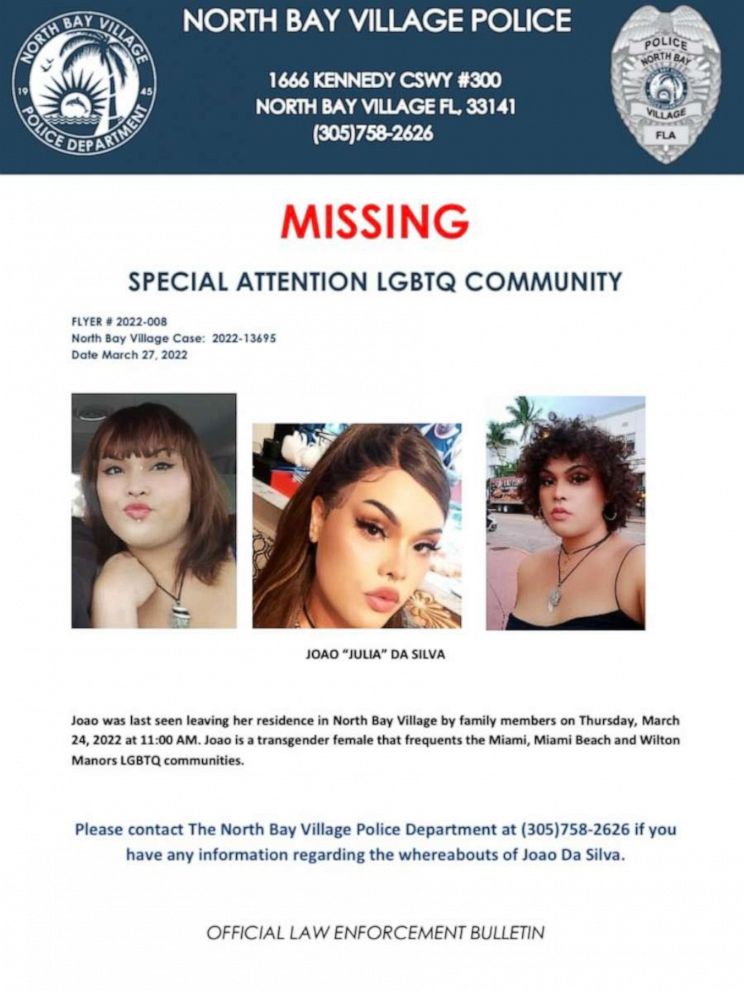
(NORTH BAY VILLAGE, Fla.) — Joao “Julia” da Silva, a 23-year-old trans woman, has been missing since Thursday, March 24, when she was last seen by family members leaving her residence in North Bay Village, Florida.
Authorities say da Silva frequents the Miami, Miami Beach, and Wilton Manors LGBTQ communities. She was last seen in newly uncovered video surveillance at a gas station on Monday night in the South Miami area near Homestead.
“With this video footage, what concerns us is that she did appear disoriented,” said Paul Battaglia, the LGBT liaison officer at the North Bay Village Police Department. “She also did appear alone, which is unusual for her.”
She was wearing a black tank top, skirt, and pearl necklace with curly hair when she was last seen.
Transgender people are over four times more likely than cisgender people to be victims of violence, according to a study by the Williams Institute at UCLA School of Law.
The department says they are taking the heightened risks against this population into account.
“We understand the statistics. They’re are at a higher probability for violence, self-harm,” Battaglia said. “So we did ask those pertinent questions at the initial intake. She does not suffer from any previous mental health history, no depression, no self-harm, because that’s very important to us.”
The investigation is ongoing. If anyone has information on Da Silva’s whereabouts, the North Bay Village Police Department urges them to reach out.
“That’s all we want, to make sure she is okay,” her best friend, Tatiana, told ABC-affiliate WPLG. They also reported that da Silva’s mother is flying in from Japan to help in the search.
(BLOOMINGTON, Minn.) — Americans returning from trips overseas are often greeted by border officers with a “welcome home.” But Abdirahman Aden Kariye, a Muslim American imam living in Bloomington, Minnesota, says there have been no such greetings for him.
Kariye, a son of refugees who came to the U.S. from Somalia, told ABC News that his airport experiences are defined by a deep sense of anxiety. He claims he is often “singled out” and taken into private rooms for hours-long interrogations by U.S. border officers.
“I’ve been stopped many times, almost 90 percent of the time,” Kariye said, recounting his experience traveling domestically and internationally.
But over the past few years, he alleges these additional screenings upon his return from international trips were coupled with a barrage of questions scrutinizing his religious beliefs and practices.
“Those experiences made me feel that I had to make myself less visible as a Muslim,” Kariye said, claiming that the questioning brought on so much anxiety that while traveling he stopped praying at the airport, stopped carrying religious texts written in Arabic and even stopped wearing his kufi, a brimless cap that some Muslim men wear around the world.
“I feel like I don’t have the freedom to be a Muslim in America,” he added.
Some of the questions asked by U.S. border officers, according to Kariye, included what type of Muslim he is, whether he’s Sunni or Shia, how many times a day he prays, what mosque he attends, his views on a particular Muslim scholar, whether he listens to music, whether he studies Islam and where he studied Islam.
“When you ask these types of questions about my personal beliefs … you’re telling me that you have a suspicion about Muslims, that they are, you know, inherently a threat to national security,” Kariye said.
The American Civil Liberties Union filed a federal lawsuit on Thursday on behalf of Kariye and two other Muslim Americans who allegedly experienced similar religious questioning at the border.
The lawsuit was filed against the Department of Homeland Security and U.S. border officials in the United States District Court for the Central District of California on behalf of Kariye, Mohamad Mouslli and Hameem Shah, who allege that they were subjected on multiple occasions to detailed questions about their religion by border officers.
Shah is a U.S. citizen who lives in Plano, Texas and works in financial services, while Mouslli works in commercial real estate and lives in Gilbert, Arizona, with his wife and three children, according to the lawsuit.
The lawsuit contends that the questions violated the plaintiff’s constitutional rights by violating their First Amendment right to freedom of religion, as well as the Religious Freedom Restoration Act (RFRA), a law passed by Congress in 1993.
“Because this questioning imposes substantial pressure on the plaintiffs to hide their religious expression when they’re traveling – to alter it at the airport, and because it serves no legitimate law enforcement purpose, it violates the [RFRA], and it also violates the Constitution,” Ashley Gorski, a senior staff attorney with the ACLU’s National Security Project, told ABC News.
ABC News reached out to DHS and CBP but requests for comment were not returned.
Kariye said that he was questioned about his religious beliefs and practices during at least five separate incidents at various airports upon returning to the U.S. from trips and vacations overseas between Sept. 12, 2017, to Jan. 1, 2022.
“By asking intrusive questions about Islamic religious beliefs, practices, and associations, the U.S. government is conveying disapproval of Islam,” Gorski said. “It is conveying a stigmatizing message; it’s saying that it views adherence to these religious beliefs and practices as inherently suspicious.”
According to the lawsuit, Kariye has been experiencing “travel issues consistent with placement on a U.S. government watchlist” since 2013.
When traveling for vacation or to visit family overseas, Kariye said that he frequently can’t print his boarding pass at the self-service kiosk until an airline employee makes a call to obtain clearance from a supervisor or government agency – a process that has taken up to two hours, the lawsuit alleges. And upon receiving his boarding pass, the travel document is marked “SSSS,” which stands for “Secondary Security Screening Selection.”
Kariye said that he doesn’t know why he might have been placed on this list.
Gorski said that Mouslli, one of the two other plaintiffs in the lawsuit, has also had similar travel issues and while “the government doesn’t confirm or deny someone’s placement on a watch list,” both men had “a series of repeated experiences that are consistent with placement on the watch list.”
Kariye said that some of those experiences in a post-9/11 America have made him feel that, as a Muslim, he is seen as “less American.” He said that he hopes by speaking out he can empower others who have had similar experiences.
“The important thing is that we want to change the condition of our Muslim community here in America. We are American, we are here to live here and be part of this American experience,” Kariye said.
“For me, I see this as part of my service as an imam – to be a voice for those who don’t have one and advocate for justice.”
ABC News’ Luke Barr and Quinn Owen contributed to this report.