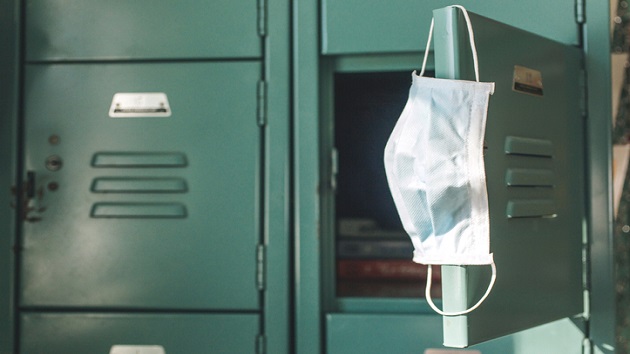
(SAN DIEGO) — Indoor mask mandates returned Monday for the San Diego Unified School District schools and offices as COVID-19 cases and hospitalizations tick up in the county.
Mandatory masking in indoor public spaces will be required for all students, teachers and staff at least through the end of summer school.
“As a district, since the start of the COVID-19 pandemic, we have been intentional in implementing strategies to keep our community safe and reduce absences due to illness — all in service of our students, staff and community,” the district said in a letter sent to staff, parents and students Friday.
“If your student is participating in summer school or other summer enrichment program, please send them to school or their program with a mask. If they do not have one, masks will be provided. Students and staff will be required to wear their masks while indoors only,” the letter said.
The district added in the letter it will continue to monitor data from the Centers for Disease Control and Prevention and the county over the next two weeks and let the community know if there are any changes.
SDUSD dropped its mask mandate in April following a decrease in COVID-19 cases, hospitalization and deaths. However, in May, the district said the mandate would return as long as the county was classified by the CDC as having high transmission levels of COVID, which is determined by case counts and hospital admissions.
Over the last seven days, San Diego has recorded 383.01 new cases per 100,000, a nearly 5% jump from the previous week, according to CDC data. Additionally, the county has seen a hospital admission rate of 11.8 per 100,000 over the last seven days, which is a 31% spike compared to the previous seven days.
The district has not stated whether the indoor mask mandate will continue into the fall semester. District officials did not immediately return ABC News’ request for comment.
Schools in San Diego are not the only locations seeing the return of masks. Naval Base Coronado and Naval Base San Diego both announced on social media that mask mandates will go into effect Monday.
“Effective TODAY, mask wearing is required indoors on all Naval Base Coronado Installations and training sites until further notice,” the base wrote in a Facebook post. “Please do your part to reduce the spread by wearing a mask, maintaining social distancing, increased hygiene practices and vaccinations.”
(NEW YORK) — A jury will soon determine if confessed Parkland school shooter Nikolas Cruz will be sentenced to death.
Opening arguments begin Monday in the penalty phase of Cruz’s trial. The trial is expected to take several months. At the conclusion, the jury’s decision must be unanimous to sentence him to death.
On Feb. 14, 2018, Cruz, then 19, gunned down 14 students and three staff members at his former school, Marjory Stoneman Douglas High School, in South Florida. He was taken into custody that day.
Cruz pleaded guilty in October 2021 to 17 counts of first-degree murder and 17 counts of attempted first-degree murder.
Cruz said in court last year, “I am very sorry for what I did and I have to live with it every day. … It brings me nightmares and I can’t live with myself sometimes.”
Cruz, the deadliest mass shooter to go before a jury, said in court he believes the victims’ families should be the ones to decide whether he gets the death penalty.
Cameron Kasky, a Parkland student in 2018 and now a gun-reform activist, called the death penalty “barbaric” in a tweet Sunday.
The death penalty “will not bring any of the victims back” and will “create a false sense of Justice, which will only come when the gun manufacturers and the politicians who support them are held accountable,” Kasky wrote.
The “shooter does not deserve to live, but the U.S. government and our ‘justice’ system is incapable of responsibly wielding the power to determine value in life,” he wrote. “It’s the politicians who support the gun lobby that should be held accountable.”
Manuel Oliver, whose 17-year-old son Joaquin died in Parkland, told Miami ABC affiliate WPLG, “I think he should die and I think that is not enough. … Not even the death penalty is enough.”
Fred Guttenberg, who has been fighting for gun reform since his 14-year-old daughter Jaime was killed in Parkland, tweeted Monday, “One week ago today I was at the @WhiteHouse to celebrate @POTUS signing gun safety legislation. Today, I am at the Courthouse for the start of the penalty phase of the criminal trial of the person who murdered my daughter with an AR 15. This is the reality of gun violence.”
“Jaime, I miss you beyond words,” he added in another tweet.
Max Schachter, whose 14-year-old son Alex was killed, tweeted Monday morning, “I love you Alex.”
(INDIANAPOLIS) — At least three people were killed and two others were injured in a shooting at an Indianapolis-area shopping mall on Sunday evening, police said.
Multiple people called 911 at around 6:05 p.m. local time to report an active shooter at the Greenwood Park Mall in Greenwood, Indiana, some 14 miles south of Indianapolis. An unidentified gunman had walked into the mall’s food court and opened fire, according to Greenwood Police Chief Jim Ison.
Olivia Harding said she was at the Old Navy in the mall with her mom when they heard four gunshots and initially thought the nearby carousel was breaking down. But then they heard six more shots.
“I told my mom instantly to get down,” Harding recalled in an interview with ABC News on Sunday night.
A person who was lawfully armed — identified as a 22-year-old man from Bartholomew County — shot and killed the gunman, according to Ison.
“The real hero of the day is the citizen that was lawfully carrying a firearm in that food court and was able to stop that shooter almost as soon as he began,” Ison told reporters during a press conference on Sunday night.
Greenwood Mayor Mark Myers also confirmed that the suspect was “shot by an armed individual,” whom he called a “good Samaritan.”
“This person saved lives tonight,” Myers said in a statement late Sunday. “On behalf of the City of Greenwood, I am grateful for his quick action and heroism in this situation.”
The victims include four females and one male. Among the injured is a 12-year-old girl whose parents brought her to the hospital with minor injuries after the shooting. The second injured victim was hospitalized and in stable condition as of Sunday evening, according to the police chief.
The suspect, who appears to have used a long-gun rifle with several magazines of ammunition, has not yet been identified, nor has a motive been determined, Ison said.
While the deadly shooting remains under investigation, Ison said there is currently no ongoing threat and SWAT teams have cleared the mall.
Indiana Gov. Eric Holcomb said Indiana State Police are assisting local authorities in the incident.
“Lives were lost today, and I’m thinking about all the victims of this horrible incident, now and in the days and weeks to come,” Holcomb said in a statement via Twitter late Sunday.
ABC News’ Ebony Peeples and Darren Reynolds contributed to this report.
(UVALDE, Texas) — The loved ones of those killed in a mass shooting in Uvalde, Texas, are reacting with anger and disappointment Sunday after a committee of state lawmakers investigating the massacre released a 77-page report that said law enforcement officers who responded to the rampage “failed to prioritize saving the lives of innocent victims over their own safety.”
The public release of the report came as the joint committee of the Texas Legislature met Sunday afternoon with the families of the victims and just days after security video footage from inside Robb Elementary School showing the delayed police response to the attack was leaked and obtained by two Texas news outlets.
The committee’s report laid out in detail the lapses in preparation, training and judgment in connection with the police response to one of the deadliest school shootings in U.S. history.
“It’s a joke. Texas failed the students. Law enforcement failed the students. Our government failed the students. What else do you want me to say? The truth is out there. Everybody saw the truth,” Vincent Salazar, whose 11-year-old granddaughter, Layla Salazar, was killed in the attack, told ABC News.
Salazar said he wasn’t going to attend the meeting with the committee at Uvalde Junior College and was only there to pick up a copy of the report to take home and read through it thoroughly.
He said he believes the killer should have never made it into the school, let alone been allowed nearly 77 minutes to kill as numerous state, federal and local law enforcement officers waited in the hallway outside the classrooms where the shooter was holed up.
“If I were these officers, I would leave town,” Salazar said. “They don’t deserve to be here.”
Sergio Garcia, whose 10-year-old son, Uziyah Sergio Garcia, was also killed in the mass shooting, agreed.
“I get paid at my job to do my job. If I didn’t do my job, I wouldn’t be working,” Garcia said told reporters Sunday. “Now, they took an oath, had a badge, they had unlimited resources and they need to pay for what they did not do.”
Garcia said he was “mad at everybody” who appeared to do nothing to save the 19 children and two teachers from being killed.
“In certain schools, they have police, sheriffs in the front. Why don’t they protect our kids like they protect money in a vault at a bank?” Garcia said. “Our kids are more valuable than that money. This is not the first time a school has been shot up and kids have lost their lives. This need to be the last time this happens. It shouldn’t happen anymore. Nobody should ever go through this.”
The report paints the most complete portrait to date of the massacre, which was described a series of “shortcomings and failures of the Uvalde Consolidated Independent School District and of various agencies and officers of law enforcement.”
But committee members said they do not know whether a faster or more competent response could have saved lives in the face of a heavily armed gunman who appeared bent on killing everybody in his sight with a high-powered assault rifle.
In addition to making its report public, the committee released video that captured the police response inside the schools.
The official release of the video comes after footage from inside the school as the attack was unfolding was leaked and obtained by Austin ABC affiliate KVUE and the Austin American-Statesman newspaper.
KVUE released a statement, saying, it and the Austin-Statesman elected to publish that footage “to provide transparency to the community, showing what happened as officials waited to enter that classroom.”
KVUE and the American-Statesman both published an edited portion of the never-before-seen footage on Tuesday, ahead of Sunday’s planned release of the video by state lawmakers. The outlets also published the unedited 77-minute version footage online.
Uvalde:365 is a continuing ABC News series reported from Uvalde and focused on the Texas community and how it forges on in the shadow of tragedy.
Uvalde Mayor Don McLaughlin, who expressed anger over the video being leaked and aired before the families first had a chance to review it.
Following Sunday’s meeting, committee members are expected to hold a news conference and make the video public along with its report on the shooting.
Rep. Dustin Burrows, the committee chairman, said the committee had planned to give the families the opportunity to see the video in private before it was released to the public and expressed disappointment that the two media outlets preempted those plans.
The leak of the video infuriated some of the victim’s family members. Some saw it as the latest source of frustration with the investigation that has included inaccurate information from investigators and elected leaders, including an initial statement from Texas Gov. Greg Abbott that the school’s police immediately engaged the gunman before he got into the school. Abbott later said he was “misled” about the circumstances of the shooting.
“They weren’t supposed to do it without our consent,” Javier Cazares, whose 9-year-old daughter, Jackie, was killed in the attack, told ABC News after the video was leaked.
Several of the families were meeting with lawmakers in Washington, D.C., Tuesday, when the video was aired on television and online. Despite the family members and some elected leaders, including Abbott, repeatedly calling for the video’s release, the local district attorney denied the requests.
“We’ve been asking the DA for this video for a while and she refused to let us see it,” Nikki Cross, the aunt of 10-year-old Uziyah Garcia, who was killed in the rampage, told ABC News. “So once again, the world got to see it before us. Just like the day of the shooting when Gov. Abbott announced to you all that our children are dead and we have no idea. It’s like reliving that day all over again.”
Christina Mitchell Busbee — the 38th Judicial District Attorney, whose jurisdiction includes Uvalde County — defended her now overridden decision not to release the video in an interview over the weekend with the Uvalde Leader-News, saying the move threatens to jeopardize the investigation, which she said is ongoing and could lead to possible criminal charges if anyone is found to have aided the suspect in planning the attack.
“My goal is to secure justice for the victims, their families, and the citizens of the 38th Judicial District,” Busbee told the newspaper. “This goal cannot be accomplished unless there is a thorough investigation buttressed by fairness, integrity and impartiality free from political and media pressures.”
Burrows said the committee’s release of the video and report are intended to provide transparency to the families of those killed despite guidance from the local district attorney that the footage remain under wraps.
The video published by the news outlets and now released by the committee, including police body-camera video and footage from a surveillance camera mounted in a hallway of the school, shows dozens of law enforcement officers waiting in the hallway outside the adjoined classrooms where the gunman was committing the mass shooting. The officers — including some with protective shields, wearing tactical armor and armed with high-powered rifles — didn’t breach the classroom for more than 70 minutes, even as additional volleys of gunfire could be heard on the video from the classrooms 45 minutes after police arrived on the scene, the footage released by the news organizations shows.
The video began by showing the 18-year-old suspect, wearing tactical gear and wielding a high-powered AR-15 style weapon, entering the school unabated at 11:33 a.m. on May 24 and walking down the hallway to the classrooms. A barrage of gunfire could be heard on the footage soon after the gunman entered the school.
Three minutes after the killer entered the school, three police officers, wearing bullet-proof vests and guns drawn, are seen running down the hallway toward the classrooms where the gunman was holed up, while at least four other officers entered the school and took cover, the video shows. Moments later, the three officers who charged down the hallway are seen in the video retreating after coming under fire.
Police eventually breached the classroom and killed the gunman 77 minutes after he entered the school, authorities said.
(LAS VEGAS, N.M.) — Four people aboard a sheriff’s department helicopter have died following a crash Saturday night near Las Vegas, New Mexico, according to the Bernalillo County Sheriff’s Department.
Three members of the Bernalillo County Sheriff’s Office and one member of the Bernalillo County Fire Department were in the helicopter known as Metro 2 at the time of the crash, officials said.
The first responders were on their way back to Albuquerque after assisting fire crews with the East Mesa Fire, according to the sheriff’s department.
New Mexico State Police said they had arrived at the scene, which is about 120 miles northeast of Albuquerque. Both the Federal Aviation Administration and National Transportation Safety Board were expected to investigate the crash, the state police said.
“At this time the investigation into this incident is in its preliminary stages. As we learn further details, we will provide them through official press releases like this one,” the sheriff’s office said in a statement. “Please keep these individuals and their families in your thoughts and prayers tonight.”
(UVALDE, Texas) — Lawmakers in Texas on Sunday unveiled the first detailed investigative report into the May 24 mass shooting at Robb Elementary School, laying out the lapses in preparation, training and judgment in connection with one of the deadliest school shootings in U.S. history.
Their report, which painted the most complete portrait to date of the massacre, described a series of “shortcomings and failures of the Uvalde Consolidated Independent School District and of various agencies and officers of law enforcement.”
Members of a special committee of the Texas state legislature met Sunday with family members of the victims to present their findings and field questions from a community still seeking answers nearly two months after a gunman killed 19 students and two teachers.
Family members of the victims say the anguish of losing their loved ones has been compounded by a failure on the part of state and local leaders to articulate what took police officers nearly 77 minutes to confront and kill the 18-year-old gunman.
Senior law enforcement and elected officials have repeatedly shared misleading or contradictory information about the police response, testing the community’s faith in leadership. Texas Gov. Greg Abbott said he had been “misled” by authorities after conveying inaccurate information to the public days after the shooting — a blunder that he said left him “livid.”
In those first hours, officials painted a picture of heroism and fast action by police — but in the days and weeks since, that portrait has been turned on its head.
“There are people who deserve answers the most, and those are the families whose lives have been destroyed,” Abbott said. “They need answers that are accurate, and it is inexcusable that they may have suffered from any inaccurate information whatsoever.”
Last month, at a hearing before a state Senate panel, Texas Department of Public Safety Director Steven McCraw called the police response an “abject failure” and claimed that enough officers and equipment arrived on the scene within three minutes to “neutralize” the shooter.
Surveillance video of the shooting obtained and published last week by ABC affiliate KVUE and the Austin-American Statesman showed dozens of officers congregating outside the adjoined classrooms where the gunman had fired indiscriminately on students and teachers.
Lawmakers had planned to release the surveillance video on Sunday after meeting with the families, but were preempted earlier this week when media outlets broadcast the footage — enraging some family members of the victims, who said they felt blindsided by how things were handled.
During his testimony last month, McCraw reserved his harshest criticism for Uvalde ISD Police Chief Pete Arredondo, who he accused of “[deciding] to place the lives of officers before the lives of children.” Arredondo, who has not responded to multiple interview requests from ABC News, told the Texas Tribune last month that he did not know he was the on-scene commander during the shooting.
ABC News’ Alexandra Dukakis contributed to this report.
(ENGLEWOOD, Fla.) — An elderly woman was killed after she fell into a pond along a Florida golf course and was attacked by two alligators, authorities said.
The incident occurred shortly before 8 p.m. Friday at the Boca Royale Golf and Country Club in Englewood, about 30 miles south of Sarasota.
The woman fell into a pond along the course near her home “and struggled to stay afloat,” the Sarasota County Sheriff’s Office said in a statement.
“While in the water two alligators were observed near the victim and ultimately grabbed her while in the water,” the sheriff’s office said.
The woman, who has not been identified by authorities, was pronounced dead at the scene.
An alligator trapper from the Florida Fish and Wildlife Conservation Commission responded and removed the alligators as part of the investigation, the sheriff’s office said.
The Florida Fish and Wildlife Conservation Commission said an 8′ 10” alligator and a 7′ 7″ alligator seen near the pond were removed. The agency said it is unknown at this time if the alligators were involved in the incident, but that it doesn’t plan to remove any additional alligators from the area at this time.
“The FWC and Sarasota County Sheriff’s Office will be working jointly on this investigation until cause of death is determined by the Sarasota County Medical Examiner’s Office,” the agency said in a statement.
No further information was released by the sheriff’s office amid the investigation.
The Boca Royale Golf and Country Club told ABC News it doesn’t have a comment at this time.
The country club is located in a 1,000-acre private gated community that features lakes and nature preserves, according to its website.
Fatal alligator bites are rare. From 1948 to 2021, Florida reported 442 unprovoked bite incidents from alligators, 26 of which resulted in fatalities, according to the Florida Fish and Wildlife Conservation Commission. In the last 10 years, the state has averaged eight unprovoked bites a year that require medical treatment, the agency said.
The likelihood of someone being seriously injured during an unprovoked alligator incident in Florida is roughly one in 3.1 million, according to the Florida Fish and Wildlife Conservation Commission.
A man believed to be looking for Frisbees in a lake was killed in a suspected alligator attack in late May in Largo, a city in the Tampa Bay area, police said.
(INDIANAPOLIS) — The attorney for an Indiana physician who performed an abortion for a 10-year-old girl from Ohio has sent a cease and desist letter to the Indiana attorney general over “false” and “defamatory” statements made about the doctor.
The cease and desist letter, which was sent Friday and obtained by ABC News, is the latest development stemming from the unsettling case, which has become a flash point in the national debate on abortion post-Roe v. Wade.
The incident first came to light in a July 1 report by the Indianapolis Star. Dr. Caitlin Bernard, an OB-GYN at Indiana University Health Medical Center in Indianapolis, recounted to the publication that she had a 10-year-old patient from Ohio who, at over 6 weeks pregnant, traveled to Indianapolis for an abortion after her state’s so-called heartbeat law banning most abortions went into effect after the Supreme Court overturned Roe.
The report gained national attention, with President Joe Biden referencing the IndyStar report during remarks made while signing an executive order on abortion access last week.
Meanwhile, some Republican leaders, including the Ohio attorney general, doubted the veracity of the report. The Wall Street Journal editorial board said it was “too good to confirm.”
On Tuesday, Columbus police arrested a 27-year-old suspect who allegedly confessed to raping the 10-year-old victim, who police said had traveled to Indianapolis to obtain a medical abortion on June 30. The suspect was ordered held on $2 million bond on Wednesday.
After the suspect was arraigned on the felony rape charge, Indiana Attorney General Todd Rokita, a Republican, said his office was investigating Bernard “to prove if the abortion and/or the abuse were reported,” as is required under Indiana law.
“The failure to do so constitutes a crime in Indiana, and her behavior could also affect her licensure,” he said in a statement. “Additionally, if a HIPAA violation did occur, that may affect next steps as well. I will not relent in the pursuit of the truth.”
A termination of pregnancy report filed with the Indiana Department of Health obtained by ABC News shows that Bernard did report the abortion within three days of the procedure, as required by state law. Indiana University Health also released a statement Friday that an investigation has found Bernard to be in compliance with privacy laws.
The Columbus Division of Police, which was alerted to the girl’s pregnancy on June 22, was already investigating the rape case by the time the abortion was performed.
The cease and desist from Bernard’s attorney, Kathleen DeLaney, cites “false and defamatory statements” Rokita made to Fox News on Wednesday that “cast Dr. Bernard in a false light and allege misconduct in her profession.”
While appearing on Fox News Wednesday night, Rokita claimed that Bernard was an “activist acting as a doctor with a history of failing to report.”
“So, we’re gathering the information, we’re gathering the evidence as we speak and we’re going to fight this to the end, including looking at her licensure, if she failed to report,” he said. “And in Indiana it’s a crime to not report to intentionally not report.”
The cease and desist states that Rokita continued to make statements that “further cast Dr. Bernard in a false light and mislead consumers and patients,” even after the release of the termination of pregnancy report showed she complied with reporting laws.
“We are especially concerned that, given the controversial political context of the statements, such inflammatory accusations have the potential to incite harassment or violence from the public which could prevent Dr. Bernard, an Indiana licensed physician, from providing care to her patients safely,” DeLaney stated.
“Moreover, to the extent that any statement you make exceeds the general scope of your authority as Indiana’s Attorney General, such a statement forms the basis of an actionable defamation claim,” she continued.
The cease and desist comes a day after DeLaney said they were considering legal action “against those who have smeared my client, including Indiana Attorney General Todd Rokita.”
In a statement to ABC News, a spokesperson for Rokita’s office said it will review the cease and desist “if and when it arrives.”
“Regardless, no false or misleading statements have been made,” the spokesperson said.
On Friday, Bernard’s colleague, Dr. Tracey Wilkinson, detailed in a guest essay in the New York Times how Bernard “became a target of a national smear campaign for speaking out about her 10-year-old patient.”
Bernard was supposed to co-write the essay, about the “chilling effect” the Supreme Court’s decision has had on medicine, until Rokita said his office will be investigating her, according to Wilkinson, an assistant professor of pediatrics at Indiana University School of Medicine.
“So I’m writing this essay myself, not only to bring attention to the chilling effect on medicine we’re seeing at this moment — but also because I’m terrified that I or any one of our colleagues could soon face what Dr. Bernard is going through after delivering care to our patients,” Wilkinson wrote.
After news broke of the arrest in the rape case, Bernard commented on Twitter Wednesday that her “heart breaks for all survivors of sexual assault and abuse.”
“I am so sad that our country is failing them when they need us most,” she said. “Doctors must be able to give people the medical care they need, when and where they need it.”
ABC News’ Will McDuffie and Kevin Kraus contributed to this report.
(NEWARK, N.J.) — If you travel more than a mile to a supermarket, supercenter, or large grocery store with affordable and healthy food options in an urban area, and more than 20 miles in a rural area, you live in what’s considered the definition of a food desert by the U.S Department of Agriculture.
This lack of access impacts roughly 17 million Americans according to the Food Access Research Atlas. The data also shows people who live a half mile or more from food options in urban areas, or 10 miles in rural areas, increases that number to more than 53 million Americans, including those in New Jersey.
In January 2021, New Jersey Governor, Phil Murphy, signed into law the Food Desert Relief Act, part of the Economic Recovery Act, which will provide about $240 million in funding to combat this issue in the state.
The Food Desert Relief Act provides tax breaks to stores that open in under-served areas, grants loans and other assistance for stores of all types to operate in food deserts.
The Community Food Bank of New Jersey estimates that 800,000 New Jersey residents are dealing with food insecurity, and almost 200,000 of them are children.
53-year-old Robert Brown from Newark, NJ, makes a two-mile commute from his home to a ShopRite, without a car, telling ABC News that pricing and options are a factor “I live like 20 blocks away, but we have a store downstairs, where I live at, but they’re so high, I come here. There’s no need in spending my money there, and I’m getting a little bit of nothing when I can get everything I need.”
45-year-old Katrina Moseley must take it a step farther, as the two-mile journey to ShopRite, is her second grocery shopping trip of the day, “I started at 8oclock this morning, I went to Walmart, got back home like 1130, rest for a little bit, caught the bus what time is it, I got here like 12 something, 12 or one something. Shopped. I take my time in the store to go thru stuff, and now I’m waiting for transportation to go home.”
Moseley depends on two different bus lines, taxis, and relatives to pick her up, as she spends her day-off from work to feed her family of four, including a daughter with a baby on the way, “So I go to Walmart to get the bulk of the meat because it lasts, you can make like… One of their packets of meat you can make like 2-3 meals out of it, all depends on how you do it.”
Transportation back is also an issue for Brown, knowing some options are not practical, “f I would’ve tried to get on the bus with this, it would be too much, it would be too much.”
Tara Colton, the Executive Vice President for Economic Security for New Jersey’s Economic Development Authority, says that addressing food deserts, a product of structural racism, neighborhood redlining, and disinvestment, is not as simple as building a supermarket, “You can live next door to the most amazing market or farmer’s market but if you can’t afford to buy
the food that’s in there, or they don’t accept federal nutrition programs like snap, then its inaccessible to you.”
Sustain & Serve NJ initially began as a $2million pilot program to help with food security, in conjunction with supporting the states restaurant industry in 2020. The program has evolved into a $45 million initiative, paying restaurants to deliver ready to eat meals directly to those in need. Colton told ABC News, “I often say it isn’t about bringing people to food, it’s about bringing food to people. And there’s a lot of ways to do that. They can go into a big building, and buy it put it into the truck of a car, but you can also bring it to them more centrally.”
Colton touts the program, “That one dollar you’re spending is keeping the restaurant open, the workers employed and is giving people who often can’t access this kind of food, a healthy fresh nutritious homemade meal.”
For those like Moseley who prefer to cook their own meals, despite the miles long odyssey to multiple supermarkets, the focus isn’t on feeling disenfranchised, but doing what’s necessary for her family, “Those who I gotta worry about, so this is what I do for them, shop. Getting it done, out of the way.”
(CHEYENNE, Wyo.) — Lyle Neiberger would have turned 33 this year. But he is forever 17, frozen in his father Lance’s memory.
“I’ve never been angry at my son. I’ve always been angry at me. Why didn’t I see it? What if I would have done something different?” he lamented, while sitting in his woodshop at his home in central Wyoming.
It’s been 16 years since Lyle died by suicide. Lance Neiberger had no idea his son was contemplating suicide and Lyle left no note behind.
Memories of Lyle line the walls of Neiberger’s woodshop – a hobby father and son bonded over. “We’re all in the cowboy-up attitude, you know. Real men don’t cry. Real men don’t have problems,” he said.
Here in Wyoming, nicknamed the Cowboy State, “real men” are taught that when they have a problem, they pick up and fix it without looking back, Neiberger said.
“We all have something go wrong, and we all need help at times. And when you learn that you don’t need help and you just go on, maybe that makes life a lot tougher,” Neiberger said.
U.S. suicide rates are the highest they’ve been since World War II. At 30.5 per 100,000 persons in 2020, Wyoming’s rate is more than double that of the national average and the highest rate per capita in the nation, according to the Wyoming Department of Health.
At 71, Neiberger has taken on the responsibility of helping to curb Wyoming’s high suicide rate by telling Lyle’s story to schools in the surrounding area and by heading the Natrona County Suicide Prevention Task Force. He hopes he can save at least one life.
The task force meets once a month in Casper, Wyoming, to plan events, pool resources and keep track of the lives lost.
At nearly 60,000 residents, Casper is Wyoming’s second largest city. Casper Police Chief Keith McPheeters told ABC News that his officers respond to suicide calls twice as often as they do for shoplifting.
“I just want to go over the statistics that we are showing. Year to date last year, my officers had responded to 256 persons who were considering suicide and, this year, we have seen an absolute negligible change; so, year to date from May 15, 253,” he said at a recent task force meeting.
Sixteen years ago, one of those calls came from Lance Neiberger – when he found Lyle at home. Neiberger said he had no idea his son was suicidal.
“There isn’t a day that goes by that I don’t think about him. Now, after his death, it was horrible. It was just miserable. It was crying. It was the whys, the kicking yourself, everything. Today, I can often think about Lyle just with a smile on my face. I came to a point where I realized that it was Lyle’s decision and his decision only,” he said.
When asked why he thinks the suicide rate in Wyoming is so high, he had many reasons, one of them the state’s rural landscape.
Wyoming, accounting for its land mass, is the tenth largest state in the country; by population, it’s the smallest. So, even if you wanted help – help might be a long way from you.
Andrea Summerville, the executive director of the Wyoming Association of Mental Health & Substance Abuse Centers, showed ABC News’ Trevor Ault the area right outside of Casper. She pointed out miles and miles of sweeping plains with very few people in sight.
“You’ll hit a major town about every hundred miles. And when I say a town, I mean a town of 5,000 people,” she said. “You might get a call from somebody that’s 100 miles away from the nearest town, but you might also just not have the mental health professionals. Wyoming has been a mental health professional shortage area, always, designated by the Rural Health Agency. The entire state. Not just an area, not just a town, but the entire state.”
Now federal legislation to help any American in crisis reach a counselor by phone is set to launch July 16. It will transition the ten-digit suicide hotline into a three-digit number, 988. But in Wyoming, even that will be an uphill climb to adopt.
“There are some logistics tied with 988, specifically things like geo location. So with 911, everybody knows if you call 911 they know where you’re at to locate your cellphone. You’re not going to find a cell tower every 50 miles or so here. And so making sure that we are meeting those infrastructure challenges is probably going to be our biggest, most expensive long-term project,” Summerville said.
The 988 hotline is being touted as a one stop shop for anyone experiencing a mental health crisis, but funding the project so that health care providers are ready for the influx of calls is proving to be challenging.
Similarly to 911, 988 will be funded by a monthly fee on all phone lines. The fee is determined by each state.
The Department of Health and Human Services expects the volume of calls to double within the first year. However, according to the National Alliance on Mental Illness, only Colorado, Nevada, Washington, and Virginia have enacted a comprehensive plan for funding.
The Central Wyoming Counseling Center is one of two suicide hotlines centers already up and running in Wyoming. It opened two years ago.
The workers know this state’s layout, its culture, its resources or lack thereof– which is essential in a crisis.
They’ve secured $2.1 million to expand the suicide hotline to a 24-hour service, most of it federal money from the American Rescue Plan Act that Wisconsin Gov. Mark Gordon appropriated, but with the state legislature refusing to expand Medicaid, federal funding will soon run out.
Summerville told ABC News they currently only have the funding to continue 988 for two more years. “In terms of putting it into operation in Wyoming, It’s going to take a lot of work. We only have four crisis stabilization centers across the state. So how do we move people across the state?”
According to the Centers for Disease Control and Prevention, of the 45,979 who died by suicide in the United States in 2020, nearly 70% were white men. Men are less likely to reach out for help, a fact that Dr. Amanda DeDiego, an Assistant Professor at the University of Wyoming, is all too aware of.
“There’s that heavy, heavy stigma about help seeking behavior. And then there’s not a lot of options for you to be able to seek care in these rural communities and have your confidentiality. It’s not that your provider is not honoring the confidentiality. It’s just that everybody knows everything,” DeDeigo said.
Along with Lisa Scroggins, the Executive Director of the Natrona County Library, she is spearheading a new project to create spaces that sidestep the issue of stigma. It’s called Wyoming Public Access to Telehealth Services or WyPATHS. It will be a booth placed in local libraries that is soundproof and provides a space for people to be able to connect through telehealth to their health care providers.
They plan on training library staff across Wyoming in suicide prevention.
“A big part of the training is being empathetic to your fellow citizen or resident. So seeing the person who walks into the door and realizing their situation may be different than yours and looking for signs that a person may be needing help and then saying, ‘Hey, right here, here’s your help,’” said Scroggins.
Lance Neiberger still thinks about how Lyle didn’t come to him about his negative thoughts when he reflects on the loss of his son.
“He didn’t feel comfortable enough to come to me and say, ‘Dad, life’s kicking my butt. I’m really struggling here.’ So, I think what he was doing was acting up and as his drama increased, I got angry. I didn’t like the drama. We weren’t communicating about the problem. So he took his drama to another level and I took my anger to another level. And at the time of his death and when he needed me the most, I wasn’t there for him because we were going in opposite directions instead of working together,” he said.
Neiberger said he considered taking his own life during the six months after Lyle died. “It wasn’t until our daughter gave birth to our granddaughter that I really realized what I would have missed had I not lived back then.”
As Neiberger stared at Lyle’s gravestone, decorated with mementos from friends and family, he couldn’t help but wonder what his son’s life would have been like had he lived past 17. But he is determined to keep having these very uncomfortable conversations in the hopes that Lyle’s death will not be in vain.
“That’s what keeps me going. My faith in the fact that I truly believe I’ll see him again someday. I’ll be with him. That’s what’s given me the hope to continue,” he said.
If you are struggling with thoughts of suicide or worried about a friend or loved one, help is available. Call the National Suicide Prevention Lifeline at 1-800-273-8255 [TALK] for free, confidential emotional support 24 hours a day, 7 days a week. The rollout of the national 988 mental health hotline is expected on July 16.