(NEW YORK) — New York lawmakers introduced legislation Friday that would ban the concealed carry of guns in a “sensitive location,” including Times Square and all mass public transportation, according to a draft of the bill.
The bill comes after a Supreme Court ruling overturned a state law that limited who could get concealed carry permits to people who had “proper cause.”
Sensitive places where guns cannot be carried include the subway, trains, buses and ferries, as well as government buildings, houses of worship, schools, libraries, public playgrounds, public parks, zoos, homeless shelters and polling places, according to the legislation.
New York Gov. Kathy Hochul announced lawmakers’ intent to establish “sensitive places” legislation on Wednesday. The legislation was introduced in the state Senate during a special session called by Hochul that began Thursday.
The bill also seeks to ban the carry of guns on all private property by default, unless the owner of the property has signage permitting guns or has otherwise expressed consent to guns being permitted.
The law makes exceptions for law enforcement, peace officers, active duty military personnel and security, who would be allowed to carry guns in sensitive places. Those engaging in lawful hunting are also allowed to carry guns in sensitive locations.
The law would make carrying guns in the banned areas a felony offense.
A state-wide license and record database created and maintained by police will be checked on a monthly basis to determine continued accuracy and whether a person is no longer a valid license holder. The records are to be checked against records for criminal convictions, criminal indictments, mental health, extreme risk protection orders and orders of protections.
Another database would be created and maintained by police for ammunition sales.
Gun and ammunition sellers and dealers will also have to keep a record of all their transactions involving guns and ammunition.
The bill will also add a vehicle requirement to existing safe storage laws, requiring gun owners to lock up their guns in an appropriate safe storage depository out of sight from outside the vehicle and remove ammunition from the gun. Otherwise, gun owners would not be allowed to leave their firearm out of their immediate possession or in a car.
Hochul, in introducing the legislation on Wednesday, said this measure is meant to cut down on gun thefts from cars.
Currently, New York law requires gun owners to get safe storage for their guns, keeping them locked up, if they have children at home aged 16 or younger. The new legislation lifts that age requirement to 18 years old.
(NEW YORK) — A suspect has been identified in the 1990 cold case murder of a Seattle teenager through the investigative tool of genetic genealogy, Washington state officials announced.
But the suspect, Robert Brooks, won’t stand trial, because he died in 2016 from natural causes, the Snohomish County Sheriff’s Office said Thursday.
Brooks has now been linked to the sexual assault and murder of 17-year-old Michelle Koski, who was found dead on Aug. 25, 1990 in Snohomish, the sheriff’s office said.
Brooks, then 22, had been released from prison four months before the killing, the sheriff’s office said. He was staying with family just a few blocks from where Koski lived, the sheriff’s office said.
Koski’s case had already been unsolved for 15 years when it was picked up by the cold case team in 2005, the sheriff’s office said. There wasn’t a DNA match from the crime scene to anyone in the CODIS law enforcement database, officials said, and over the next 10 years, several suspects were ruled by testing their DNA.
The case finally identified Brooks as a suspect by using genetic genealogy, which takes an unknown suspect’s DNA left at a crime scene and identifies it using his or her family members who voluntarily submit their DNA samples to a DNA database. This allows police to create a much larger family tree compared with using only databases like CODIS.
A forensic genealogist spent about one year building family trees using the unknown suspect’s DNA, which she eventually narrowed down to two brothers, officials said. Brooks’ DNA was then matched to DNA at the crime scene, officials said.
“After more than 30 years of searching for answers following this terrible murder, we can finally provide Michelle’s family with some answers,” Snohomish County Sheriff Adam Fortney said in a statement.
“I have been praying for this day for a very long time,” Koski’s friend, Melissa Johnson, said at a news conference Thursday, as she thanked the officers and genealogists who worked on the case.
“Michelle and I met when we were just 10 years old,” Johnson said.
“I often wonder what she would’ve been like had she still been alive, and how different my life would be, as well. … I now pray that Michelle can finally rest in peace,” Johnson said.
(NEW YORK) — Rain, heat and fire are all in the forecast this 4th of July weekend.
Here’s what to know:
South
Heavy rain is pounding the Texas coast and western Louisiana on Friday.
The heaviest rain will be from Beaumont, Texas, to Lake Charles, Louisiana, where up to 6 inches of rain is possible.
Rainfall rates could reach 2 to 4 inches per hour on Friday.
A flood watch has been issued for Houston, Galveston, Texas, and Lake Charles through Friday evening.
Northeast
In the Northeast, it’ll be a scorcher on Friday. Temperatures are forecast to reach 91 degrees in Boston; 92 in New York City; 94 in Philadelphia and 93 in Washington, D.C.
Factoring in humidity, the heat index (what temperature it feels like) could be close to 100 degrees from New Jersey to Virginia.
Then a cold front will move into the Northeast on Saturday, bringing severe weather threat for the Interstate 95 corridor from D.C. to Boston. Damaging winds and some hail are possible.
In the West, fire danger will be high Saturday through Monday due to dry and windy conditions expected in Nevada, Arizona and Utah.
The strongest wind gusts will be on Sunday when they could approach 45 mph.
Alderwoman Jeanette Taylor is pictured with Chicago youth attending the 20th ward’s annual youth forum. – Courtesy Alderwoman Jeanette Taylor
(CHICAGO) — As a 19-year-old, Jeanette Taylor was a single mother raising three children inside a one-bedroom apartment she shared with her mother, brother, sister and her niece. She knew they needed their own space, and fast, so she turned to the Chicago Housing Authority for housing assistance.
She was left on the waiting list for 29 years.
Taylor, now a Chicago alderwoman, said her story is indicative of the housing crisis people continue to face, so she’s taking legislative action to address the housing crisis and the system that keeps change from happening.
“I paid taxes, I worked, I volunteered at the kids’ school,” Taylor told ABC News. “I was doing what they say you’re supposed to do and when I reached out to the institutions, and my city that was supposed to help me, I didn’t get the help that I needed.”
Accessibility to affordable housing for low-income households is an issue plaguing the nation, Taylor said.
In Chicago, before the COVID-19 outbreak, the Chicago Coalition for Homelessness reported that “an estimated 58,273 people” were experiencing homelessness in 2019. In one night alone, over 326,000 people experienced sheltered homelessness in the United States, according to the 2021 Annual Homeless Assessment Report (AHAR) to Congress.
Having struggled with navigating the housing system in her own city, she made it her priority to reach out to the Chicago Housing Authority upon taking office in 2019 to address the city’s high rates of homelessness.
With decadeslong waitlists and the livelihoods of thousands of families hanging in the balance of housing voucher rotations, Taylor knew the city lacked a substantial commitment to change.
“We know sending them into shelters, and transitional housing is horrible,” Taylor said. “We got a real opportunity to talk about how do we help the homeless population in the city.”
The director of public affairs of the Chicago Department of housing, Eugenia Orr, told ABC News the city is taking steps to combat the issue.
Orr said the City Lots for Working Families (CL4WF) program is an effort to promote the development of affordable housing on vacant lots throughout the Chicago area. In addition, the program works to “incentivize home builders” and provide vacant lots to affordable housing developers.
“Homes must be made available to qualified buyers with incomes up to 140% of area median income,” Orr said.
Although the program repurposes the land, the link between the vacant buildings and accessibility for low-income households is part of Taylor’s proposed Accountable Housing and Transparency ordinance.
Taylor introduced the ordinance in April this year to centralize efforts in housing the homeless and those in need. Other key features of the ordinance include prioritizing the displaced and disabled, centralizing leasing, a single waitlist, “interagency coordination” among all Chicago-based public health and housing institutions, and a requirement for each affordable housing unit to “achieve and maintain 97% occupancy rate.”
By consolidating the separate platforms of applying to affordable housing created by different agencies, Taylor said the ordinance aims to simplify the process so that more people and families can obtain safe housing in a reasonable amount of time.
Taylor, who shared her story last month about finally being added to the top of the housing waitlist, said she did so to open a larger discussion on the national issue of accessibility to affordable housing.
“The system should be ashamed, not me,” Taylor said.
Soon after Taylor’s post went viral, the CHA released a statement addressing news reports highlighting their long wait times.
“CHA’s public housing and project-based voucher waitlists are always open and have wait times that range from as little as six months, to as much as 25 years,” the CHA said in a statement going on to explain its system of recycling the 47,000 vouchers that the federal government grants to the CHA.
“The number allotted has not increased in years,” the CHA said. “A voucher only becomes available to a new family on the waitlist after it is no longer being used by an existing voucher holder.”
Taylor said she knows of the wait pains families go through. When she finally got a call saying they had found her an apartment, they said her son could not live there because he had just graduated and turned 18.
“After completing my application, the young lady told me that I wasn’t gonna be able to put him on my lease,” Taylor said. “She was like, ‘if we find him in your unit, you will lose your CHA housing.'”
Taylor had to either rejoin the waitlist, or move without her son.
“I’ll be homeless before I put my 18-year-old son out,” Taylor said.
As years passed, Taylor said she’d received a letter assuring her that her number was getting closer to the point of selection. Finally, after meeting with the head of the Chicago Housing Authority 2019 Taylor said she received a letter on May 20 notifying her that she made it to the top of the waitlist and could begin the application process.
“I just sat on the bed,” Taylor said. “The kid that handed me the mail, is the kid that I just had when I applied for this, who will be 29.”
The U.S. Department of Housing and Urban Development reports that there are over 970,000 households residing in public housing units across the nation, a number that fluctuates daily.
For many families like Taylor’s, she said many feel like “there’s no choice” except just to continue fighting.
According to a 2021 point-in-time count conducted by HUD, 122,849 African Americans experienced sheltered homelessness compared to 3,055 Asians, 6,460 American Indian/Alaska Natives, 3,785 Native Hawaiian/other Pacific Islanders, and 113,294 white people.
By taking the opportunity to fix a persistent housing issue in her ward, she hopes the housing crisis and racial housing disparities can be transparently addressed by the federal government.
“Black women, you figure it out, and I had to,” Taylor said.
(KEATON BEACH, Fla.) — A teenage girl was seriously injured in a shark attack at a Florida beach on Thursday, authorities said.
The attack happened at Keaton Beach in northwestern Florida’s Taylor County. The unidentified girl was scalloping in water approximately 5 feet deep near Grassy Island, just of Keaton Beach, when she was bitten by a shark, according to the Taylor County Sheriff’s Office.
“A family member reportedly jumped in the water and beat the shark until the juvenile was free,” the sheriff’s office said in a statement.
The girl suffered “serious injuries” and had to be airlifted to a hospital in Tallahassee, about 80 miles northwest of Keaton Beach, according to the sheriff’s office.
The sheriff’s office said the type of shark that attacked was unclear but it was described as approximately 9 feet long.
“Swimmers and scallopers are cautioned to be alert, vigilant, and practice shark safety,” the sheriff’s office added. “Some rules to follow are: never swim alone, do not enter the water near fishermen, avoid areas such as sandbars (where sharks like to congregate), do not swim near large schools of fish, and avoid erratic movements while in the water.”
Shark attacks increased worldwide in 2021 after three consecutive years of decline, though the previous year’s significantly low numbers were attributed to lockdowns and restrictions associated with the COVID-19 pandemic, according to yearly research conducted by the Florida Museum of Natural History’s International Shark Attack File.
Florida has topped the global charts in the number of shark bites for decades, and the trend continued in 2021, researchers said. Out of 73 unprovoked incidents recorded around the world last year, 28 were in Florida, representing 60% of the total cases in the United States and 38% of cases worldwide. That number was consistent with Florida’s most recent five-year annual average of 25 shark attacks, according to researchers.
(UVALDE, Texas) — More than one month since the massacre at Robb Elementary School that killed 19 children and two teachers in Uvalde, Texas, families of victims demanded answers from city leaders during a special council meeting on Thursday.
Frustrated by the lack of information from the ongoing state investigation, families turned to the council for answers — but they got none.
“We’re not trying to hide anything from you,” said Uvalde Mayor Don McLaughlin on Thursday. “We don’t have anything.”
After returning from discussing the shooting behind closed doors, McLaughlin told the assembled family members and media that they had no more information to share than they did two hours earlier when they went behind closed doors.
But families pressed the mayor for details and complained about the lack of transparency.
“We’re looking for some answers that nobody seems to be getting and it’s just making Uvalde PD and everybody else look even more guilty,” said Berlinda Arreola, grandmother of Amerie Jo Garza, one of the students who died.
“Look at this as a dad, as a parent,” said Garza’s dad who was also at the meeting. “What if it was your kid?”
“You’re in charge of this city,” one parent yelled.
During the meeting, the sister of Irma Garcia, one of the fourth-grade teachers who died, demanded answers from the mayor and blamed the Uvalde County District Attorney Christina Mitchell Busbee for how the investigation has been handled.
The families complained the district attorney has dodged their questions and has refused to release evidence including 911 calls and surveillance footage.
“No one should have much power,” Irma Garcia’s sister, Velma Lisa Duran, said of the district attorney.
“My sister was obliterated,” Duran added before breaking down in tears. “I couldn’t hug her. I couldn’t say my last goodbye.”
In response to the family’s complains and demands for more information, McLaughlin showed the room two letters he says he received in response to his requests for information. One, from Busbee, said, “any release of records to that incident at this time would interfere with said ongoing investigation” referring to the school shooting.
The other letter McLaughlin showed during the meeting was from the Texas Department of Public Safety saying, “release of records related to that incident at this time would interfere with the ongoing investigation.”
The anger in the room was met with frustration from the mayor as well. He told the parents that the issue was beyond his reach, and that he has tried to get answers.
McLaughlin added that if they didn’t have confidence in him, he would step down.
Notably, embattled Police Chief Pete Arredondo was a no-show — his third absence at a meeting since he was sworn in as councilman last month.
Last week, Arredondo was placed on administrative leave by the school district.
Uvalde:365 is a continuing ABC News series reported from Uvalde and focused on the Texas community and how it forges on in the shadow of tragedy.
(WASHINGTON) — A former White House aide’s stunning testimony before the House panel investigating the Capitol attack indicated that the U.S. Secret Service may have had advanced warning of the potential for violence at the Capitol, raising new questions about the agency’s planning ahead of the riot and actions taken by agents on Jan. 6.
Cassidy Hutchinson, a top deputy to then-White House Chief of Staff Mark Meadows, told lawmakers on Tuesday that the security team guarding then-President Donald Trump and senior White House officials were aware there was a serious threat posed by some descending on Washington, D.C., on Jan. 6, when Trump was planning to address a rally to support his baseless accusations that the 2020 presidential election was stolen from him.
In Hutchinson’s telling, the agency famous for its teams of bodyguards, sharpshooters and hyper-skilled drivers was aware that among the throngs headed to Washington were some who were planning to carry a variety of weapons and military gear, and were seeking to target members of Congress and breach the Capitol building.
If so, the Secret Service apparently failed to coordinate effectively with law enforcement partners, the public, or congressional leaders to strengthen the security posture — and instead ferried a number of people under their protection to the Capitol complex with little more than their personal security details.
The Secret Service declined to answer questions from ABC News.
If true, the lapse in security — laid out on national television during a committee session Tuesday — represents perhaps the most glaring evidence to date that the Secret Service, responsible for guarding key political figures and their families, failed at its most basic responsibilities in how it dealt with Trump’s rally and the meetings of the House and Senate on Jan. 6, according to John Cohen, a former ranking Department of Homeland Security official who is now an ABC News contributor.
“It appears that senior officials at the White House were not only aware of plans to march on the U.S. Capitol, but also appeared to be planning for the president to join,” Cohen said, citing another of Hutchinson’s allegations. “This testimony raises highly disconcerting questions about what the Secret Service knew about this event and why more wasn’t done to prepare.”
Notoriously tight-lipped about their job and how they do it, the Secret Service is under renewed focus this week after Hutchison, 26, alleged shocking new details about the president’s interactions with his security agents on Jan. 6 and how they were so concerned about possible violence at the Capitol that they refused Trump’s directive to drive him there.
“The president said something to the effect of, ‘I’m the effing president, take me up to the Capitol now’ — to which Bobby [Engel, the head of Trump’s security detail], responded, ‘Sir, we have to go back to the West Wing,'” Hutchinson testified she was told by Tony Ornato, a senior Secret Service official who was at the time White House deputy chief of staff for operations.
Trump, responding to Hutchinson’s testimony, said, “I hardly know who this person, Cassidy Hutchinson, is, other than I heard very negative things about her (a total phony and ‘leaker’).”
Hutchinson also testified that in the days leading up to Jan. 6, Meadows at one point said, “Things might get real, real bad on Jan. 6.”
And on the morning of Trump’s planned speech at the Ellipse, just south of the White House grounds, Hutchinson said, Trump was made aware of individuals with weapons seeking to attend his rally and that many of them declined to pass through security checkpoints because they would have needed to surrender their weapons. Frustrated that those requirements were suppressing the size of the crowd, Trump suggested that the metal detectors be removed, Hutchinson testified.
Cohen said that, as concerned as he was about those developments, he was most troubled by the picture Hutchinson’s testimony painted of possible failures on the part of the Secret Service, an agency Cohen has worked closely with since it was folded in to DHS after the 9/11 terror attacks.
“Hutchinson’s testimony raises serious questions regarding security planning by the Secret Service on Jan 6. that will need to be answered,” Cohen said. “Did the Service leadership have advanced notice of the planned march on the Capitol? Did they have advanced notice of the president’s intent to join the crowd?”
Hutchinson said that Ornato, whom she described as “the conduit for security protocol between White House staff and the United States Secret Service,” was aware of possible violence planned for Jan. 6 in the preceding days — and alerted Meadows and Trump on the morning of Jan. 6.
Even with this information allegedly circulating among senior White House staff, the Secret Service ferried at least three of its protectees to travel to the Capitol — Vice President Mike Pence, Second Lady Karen Pence, and incoming Vice President Kamala Harris, who was still a senator from California — without supplementing their details with additional agents or coordinating with other agencies to shore up protection.
Ornato, a longtime Secret Service employee, currently serves as a senior official in the agency’s training branch. The Jan. 6 committee has expressed interest in interviewing him, and the Secret Service has said he is available to testify under oath, but did not provide further details.
Law enforcement officials have broadly characterized Jan. 6 as an intelligence failure, claiming that Washington’s myriad of law enforcement agencies did not fully grasp the threat landscape — despite warnings that appeared on social media in the weeks leading up the rally.
Secret Service officials have also said that local officials did not ask DHS to establish a special national security designation for the Jan. 6 sessions of Congress, so their hands were tied — though Cohen said DHS and the Secret Service don’t have to wait for local officials to reach out if they are aware of active threats.
Hutchinson’s testimony indicated that the Secret Service either had advanced warning of the threats and failed to notify others and formulate an appropriate response plan — or they were misled by White House officials who had a clearer understanding of the potential for violence and neglected to alert the appropriate agencies, Cohen said.
“These security lapses may not have been a result of incompetence, but instead due to deliberate actions taken by senior White House officials,” Cohen said. “If this information was not provided to the Secret Service, or if it was and the Secret Service failed to expand security operations, that would be highly disconcerting.”
Don Mihalek, a former senior Secret Service agent who is now an ABC News contributor, said the “interplay of information” among senior White House staff and protective agents about possible threats happens regularly — but that agents are limited in how they can implement plans if senior officials fail to heed warnings or cooperate with them.
Mihalek said he believes the breakdown in communication between agencies handicapped the Secret Service’s planning and response as protesters marched on the Capitol building. He defended agents’ decision to allow Pence, his wife, and Harris travel freely to the Capitol, despite possibly knowing the risk in advance.
“Nobody has a crystal ball,” Mihalek said. “There’s always a threat environment, and the Secret Service’s job is to mitigate threats as much as possible — and they don’t have the authority to override a protectee’s movement, outside of citing a credible and specific threat.”
In the wake of her appearance on Capitol Hill, Hutchinson has faced a deluge of criticism from Trump associates and supporters who have questioned her credibility. Republican Rep. Liz Cheney told “This Week” co-anchor Jonathan Karl in an exclusive interview that she has full faith and confidence in Hutchinson’s word.
“I am absolutely confident in her testimony,” Cheney told Karl in a wide-ranging interview set to air in full on ABC’s “This Week with George Stephanopoulos” this Sunday. “The Committee is not going to stand by and watch her character be assassinated by anonymous sources, and by men who are claiming executive privilege.”
(NEW YORK) — A 71-year-old woman was gored by a bull bison at Yellowstone National Park, making her the third person attacked by a bison at the park this year.
A park official said that the Pennsylvania woman and her daughter were headed back to their vehicle at Storm Point at Yellowstone Lake on Wednesday when they inadvertently approached the bison, causing it to charge at them.
The woman sustained non-life-threatening injuries and was sent to West Park Hospital in Cody, Wyoming.
Earlier this week, a 34-year-old Colorado man was walking with his family near Giant Geyser at Old Faithful in Yellowstone when a bull bison attacked him.
On May 30, a 25-year-old woman was gored by a bison after approaching the animal near a boardwalk at Black Sand Basin.
Yellowstone officials warned that people should stay over 25 yards away from bison and other large animals at the park and give them space near campsites, trails and boardwalks.
“Though bison are generally more intent on grazing, mother bison are extremely protective of their calves in spring and bulls can be more aggressive in July and August during the rut when they are competing for the attention of females,” Dennis Jorgensen, the bison program manager at World Wildlife Fund, told ABC News in a statement.
Bison are threatened when approached and may issue warnings, such as head bobbing, pawing and snorting, when you’re too close. Officials add that people should not hold their ground and should run away from bison immediately.
“Bison have injured more people in Yellowstone than any other animal,” the park says on its website. “Bison are unpredictable and can run three times faster than humans.”
Yellowstone National Park is reopening part of its north loop on Saturday, weeks after severe flooding forced people to flee, left some stranded and damaged roads and bridges, forcing the park to shut down.
“We’re pleased to reopen the north loop of Yellowstone to the visiting public less than three weeks after this major flood event,” Cam Sholly, the park’s superintendent, said in a press release Thursday.
(SAN ANTONIO) — Bexar County Sheriff Javier Salazar has written a letter to President Joe Biden, asking to meet with him to address migration issues “as the humanitarian crisis it truly is.”
“We just don’t see it slowing down,” Salazar told ABC News’ Linsey Davis Wednesday during an interview for “ABC News Live Prime.”
“I attribute that to what I would call a perceived lack of action on the part of the federal government that’s allowing the state of Texas to do what they’re doing, which is quite frankly, causing a whole lot of heartache for other agencies, and I don’t see a whole lot of benefit from it… we’re dealing with big rescues of groups of undocumented immigrants every day.”
Salazar has called for action from the federal government in his most recent letter to Biden stating how “angry he is.”
“I’m angry that I could not stop this massive loss of life in my county. I’m angry that despite my best efforts to appeal to your administration, I have not received a response. I’m disappointed that a perceived lack of action on the part of the US government has allowed the governor of my state to use this issue as one big campaigns done,” Salazar wrote and also alleged that Texas Gov. Greg Abbott used the situation “as some sort of enemy invasion.”
This comes after 53 people lost their lives during a suspected migrant smuggling operation Monday, and and increasing migration at the border.
This is, however, not the first time he has reached out to Biden asking for assistance as a spokesperson for Salazar told ABC News he has written three letters to Biden and has also reached out to Homeland Security Secretary Alejandro Mayorkas.
While he is hoping to have resources from the federal government and meet with Biden, Salazar who is a Democrat, also puts blame on Abbott’s migrant arrest program. Under this program, state law enforcement agencies are authorized to arrest migrants on criminal charges. This is something Salazar said he is not going to enforce, that he has not seen to be beneficial, and referred to as a “campaign stunt.”
“We have not experienced any change. In fact, it seems to be picking up steam. To me, it just seems like a big campaigns stunt, that billions of billions of dollars are being poured into it, And for what?…We’re sleeping out here in the in the desert, watching for this enemy invasion that never truly seems to come,” Salazar said.
Abbott’s program has faced severe backlash including from members of the Texas National Guard who have been tasked with enforcing the measure.
Salazar’s most recent letter, he said, has received “some response” from the White House, but he still hopes to meet to discuss solutions.
“I’m not just going to come to the table and present problems. I’m hoping to present some solutions. I’ve been in talks with other urban county sheriff’s in the state of Texas…so we’re prepared to come present some possible solutions as we see it. But we just need the audience,” Salazar said.
And is hopeful of a solution.
“We may not have all the answers, but I think between those of us that are here, with eyes on the problem every day, and those in D.C. that are the top decision makers, I think we can reach some sort of an understanding to try to truly make a difference in this issue,” Salazar said.
ABC News Victoria Moll-Ramirez contributed to this report
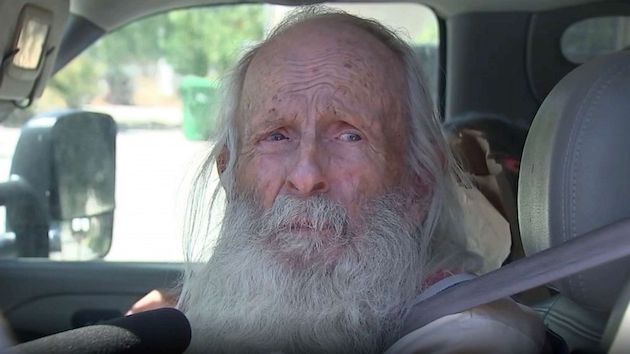
(LOS ANGELES) — A 93-year-old suburban Los Angeles homeowner, who a relative said was frustrated over being the victim of numerous home break-ins, shot and critically wounded a burglar and scared off the would-be thief’s accomplices, according to authorities.
The retired plumber, identified as Joe Howard Teague by the Riverside County Sheriff’s Department, turned the tables on the group of home invaders early Wednesday when he grabbed his gun and confronted them inside his house in Moreno Valley, the sheriff’s office said.
“I approached them to put them under citizen’s arrest. They wouldn’t adhere to that and then one of them came at me with a fishing pole,” Teague told reporters outside his home Thursday.
He said the suspects, who entered his home after kicking open his door, began throwing things at him as he tried to hold them at gunpoint.
“It was just like somebody comes to a gunfight with a pocketknife, you know,” Teague said.
Teague called 911 at about 12:30 p.m. and reported a burglary in progress at his home, the sheriff’s office said in a statement. As deputies responded, Teague told a dispatcher he was holding several suspects, according to the sheriff’s department.
Teague said the suspects included at least one woman.
When deputies arrived at Teague’s home, they found one of the suspected burglars suffering from a gunshot wound.
A witness told deputies that several people were seen fleeing Teague’s home on foot prior to the arrival of deputies.
The wounded suspect, identified as Joseph A. Ortega, 33, of Moreno Valley, was hospitalized in critical condition, according to the sheriff’s department.
“Investigators have established that several individuals, including Ortega, were inside Teague’s property when a shooting occurred,” the sheriff’s department said.
93-year-old homeowner takes matters into his own hands and shoots suspect who authorities say broke into home in Moreno Valley https://t.co/IkpQrbOowu
Teague was not injured. He was taken to a sheriff’s department station, questioned and released, authorities said.
Sheriff’s department officials said it appears the shooting was justified, but added that the investigation is ongoing.
“Based on the severity of Ortega’s medical condition, the Central Homicide Unit responded to the scene and assumed the investigation,” the sheriff’s department said.
Investigators are working to identify the other assailants. No arrests have been announced.
Oscar Malma, whose wife is related to Teague, told ABC station KABC in Los Angeles that Teague had been the victim of a string of recent break-ins, including one that occurred on Friday.
Malma said the elderly man had grown increasingly frustrated over his home being targeted by thieves and the response from local police.
“He was tired because every time he calls the police, the police were taking forever to come and assist him,” Malma said.
He said a burglary Friday at the man’s home occurred in broad daylight.
“And now this happened in the middle of the night,” Malma said. “He was defending his property. That happened inside of his home. So, I don’t think there would be any reason for him to be arrested.”