(EVANSVILLE, Ind.) — Three people are dead after a house exploded Wednesday in southern Indiana, officials said.
Dozens of firefighters responded to the scene in Evansville, after the blast occurred Wednesday afternoon on the 1000 block of North Weinbach Avenue, officials said.
So far three deaths have been reported to the Vanderburgh County Coroner’s Office as a result of the explosion, chief deputy coroner David Anson said in a statement. The victims’ names will be released pending family notification, he said.
The home where the explosion occurred was destroyed and 39 other structures were “damaged severely or suffered minor damage,” Evansville Fire Chief Mike Connelly told reporters Wednesday evening. The Knight Township Trustee’s Office was among the buildings damaged and will be closed for the foreseeable future, officials said.
Some 60 firefighters were on the scene assisting, Connelly said.
A 100-foot radius around the blast is not searchable and some buildings are not safe to enter, Connelly said, noting that there could be other victims.
The cause of the explosion is under investigation.
CenterPoint Energy arrived following the blast and “made the scene safe,” Connelly said. “There was no detection of gas and they’re restoring service now.”
Evansville Mayor Lloyd Winnecke was on-site surveilling the damage.
“There’s a big investigation and cleanup effort underway,” Winnecke told ABC Evansville affiliate WEHT.
An off-duty Evansville police officer reported the explosion, the mayor said.
The block where the incident occurred “will be shut down for the foreseeable future,” the Evansville Police Department said.
“As more information becomes available, the respective agencies investigating will be able to provide more information,” the department said.
This is a developing story. Please check back for updates.
(NEW YORK) — Donald Trump on Wednesday invoked his Fifth Amendment protection against testifying against himself during an hours-long deposition as part of the New York attorney general’s civil investigation into his family real estate business.
The former president was seen arriving at the attorney general’s office in New York City around 9 a.m. local time and left about six hours later.
A source with knowledge of the matter confirmed to ABC News that Trump declined to answer questions from investigators in the deposition and, the source said, it is unlikely he will return for any additional questions.
A spokesperson for Attorney General Letitia James declined to comment.
Sources said the only question Trump answered was when Kevin Wallace, a lawyer in James’ office who has been leading the investigation, asked his name. Otherwise he invoked the Fifth each time.
In an emailed statement to reporters while he was in the deposition, Trump said, in part, “Under the advice of my counsel … I declined to answer the questions under the rights and privileges afforded to every citizen under the United States Constitution.”
His statement also included lengthy attacks on the James’ investigation.
The attorney general’s office where Trump appeared is across the street from one of the Trump-branded buildings included in the civil investigation.
The attorney general herself began Trump’s deposition, sources familiar said — kicking off the six-hour exchange, including breaks.
Trump also read into the record a statement that echoed the one released by his office as the deposition began. He sat directly across from James as he accused her of political motivation. She did not react, the sources said.
As he left Wednesday afternoon, his motorcade drove by a number of onlookers and Trump was seen waving from the window.
The deposition in the civil case follows an escalation in a separate federal investigation into Trump’s handling of classified material. On Monday, the FBI searched Trump’s residence in Palm Beach, Florida.
Wednesday’s deposition, which had been delayed from July due to the death of Trump’s ex-wife Ivana, came after a months-long court fight during which Trump was held in contempt as he fought the attorney general’s subpoena.
Trump has denied any wrongdoing and called the investigation politically motivated.
“My great company, and myself, are being attacked from all sides. Banana Republic!” he said in a statement on his social media outlet, Truth Social, shortly before Wednesday’s deposition.
Two of his grown children, Donald Trump Jr. and Ivanka Trump, have already been deposed as part of the civil probe, sources said.
Trump argued unsuccessfully that he should not have to sit for a deposition while the Manhattan District Attorney’s Office was conducting a parallel criminal investigation. While the Manhattan DA’s case remains active, two senior prosecutors who had been leading it resigned earlier this year over the lack of an indictment.
James has said her office uncovered evidence of potentially fraudulent conduct in the way the Trump Organization valued its real estate holdings when seeking loans and when asking for tax breaks.
Lawyers in her office have said in court that the office is nearing a decision on an enforcement action.
ABC News’ Will Steakin contributed to this report.
(NEW YORK) — The New Mexico Environment Department filed an administrative complaint against Rust Movie Productions, after the production company had contested citations issued in April alleging hazards on the set that may have led to the death of cinematographer Halyna Hutchins on the “Rust” movie set last October.
The contested citations also included a fine of $136,793, making for the highest level of citation and maximum fine allowable by law in New Mexico.
Hutchins died and the film’s director, Joel Souza, was hospitalized after a gun held by Alec Baldwin as a prop fired a live round.
NMED issued the citations following a six-month investigation into workplace safety conditions after the shooting. During its investigation, NMED conducted interviews with 14 employees, requested information and documentation from Rust Movie Productions, and communicated with the production company via email to address the work-related fatality and injury.
Rust Movie Productions then contested the citations in May and an informal administrative review was started.
NMED and the production company were unable to reach a settlement of the citations during a 90-day administrative review period. NMED was then required to file a complaint with the Occupational Health and Safety Review Commission.
Rust Movie Productions now has 15 days to submit a response with the commission, before it schedules a hearing.
When it issued the citations, the New Mexico Environment Department’s Occupational Health and Safety Bureau called Hutchins’ death “avoidable.”
The administrative complaint alleges that Rust Movie Productions did not create a workplace free from recognized hazards that were causing or likely to cause “death or serious physical harm to employees in that employees were exposed to being struck by discharged rounds or projectiles when firearms were used on the set of the motion picture production.”
(PALO ALTO, Calif.) — Forty years after a 15-year-old girl was stabbed to death in Northern California, DNA has led to the arrest of her suspected killer, prosecutors announced.
Karen Stitt was last seen on the night of Sept. 2, 1982, heading toward a Sunnyvale bus stop after spending time with her boyfriend, the Santa Clara County District Attorney’s Office said.
The next morning, her naked body was found about 100 yards from the bus stop, according to prosecutors.
The Palo Alto teen had been sexually assaulted and stabbed 59 times, prosecutors said.
Stitt’s boyfriend was cleared based on the DNA evidence left behind at the scene, prosecutors said.
Decades went by without a major lead, prosecutors said, until investigators turned to genetic genealogy, which uses an unknown suspect’s DNA to trace his or her family tree.
Genetic genealogy made headlines in 2018 when the novel investigative tool was used to find the Golden State Killer. Genetic genealogy takes an unknown suspect’s DNA left at a crime scene and identifies it using family members who voluntarily submit DNA samples to a DNA database; this allows police to create a much larger family tree than if they only used law enforcement databases like CODIS.
Through genetic genealogy, the search for Stitt’s killer last year narrowed to four brothers from Fresno, California, including 75-year-old Gary Ramirez, prosecutors said.
Investigators then “used traditional investigative techniques to start eliminating the brothers one-by-one,” Santa Clara County Deputy District Attorney Rob Baker told ABC News via email Wednesday. “After extensive investigation, we felt confident Gary was the source of the crime scene evidence.”
Last week, the district attorney’s crime lab confirmed Ramirez’s DNA matched the sample at the murder scene, prosecutors said.
On Aug. 2, Ramirez was arrested at his home in Maui, Hawaii, prosecutors announced Tuesday.
Baker said he’s surprised Ramirez’s DNA was not in CODIS, adding that Ramirez has no criminal record at all.
Gary Ramirez served in the U.S. Air Force in the early 1970s after which he spent time in Northern California, Southern California, Colorado and Hawaii, according to prosecutors.
Ramirez is due in court in Hawaii on Wednesday for extradition proceedings, prosecutors said. Once in California, he will be arraigned on murder, rape and kidnapping charges, prosecutors said.
Information on an attorney for Ramirez was not immediately available.
(NEW YORK) — Three towns on Maryland’s Eastern Shore will pay $5 million to the family of a Black teenager who was killed in an encounter with police officers almost four years ago, according to the attorneys for the family.
Anton Black, a 19-year-old former star high school athlete, died on Sept. 15, 2018, after being restrained by three officers from the Centreville, Greensboro and Ridgley police departments who held him face down for about six minutes, pinning his shoulders, legs and arms, according to a lawsuit filed in federal district court in Baltimore in late 2020.
“I had to watch those police officers kill my son, while he pleaded for his life and called out to me. There are no words to describe the immense hurt that I will always feel when I think back on that tragic day, when I think of my son,” Black’s mother, Janell Black, said in a statement Monday.
Under the settlement, the three towns have also agreed to make changes in their police departments’ training of officers in order to avoid future deaths of this nature, according to the family’s lawyers.
The changes include an overhaul in “use of force” policies for the three Eastern Shore municipalities, more resources for police confronting mental health emergencies and mandated officer training in de-escalation, intervention and implicit bias, the lawyers say. The policy changes also strengthen hiring transparency and public complaint reporting.
The federal lawsuit was filed after local prosecutors declined to pursue charges over Black’s death. The police officers involved argued that they did not use excessive force and that drug use or Black’s mental illness instead contributed to the cardiac arrest that ended his life.
On the night of his killing, a woman called 911 claiming that Black was fighting with another boy, according to the lawsuit. Another witness said the boys were engaged in “ordinary roughhousing,” according to the lawsuit.
Black had been diagnosed with severe bipolar disorder just months before the incident, the lawsuit said. At the time of the 911 call and police response, Black was enduring a mental health crisis, according to the lawsuit.
Black ran when confronted by a responding police officer, the lawsuit said. The other officers and a bystander then chased him, according to the lawsuit. The lawsuit said that the officers used a taser to get him on the ground, where he was pinned face-down until he went unconscious.
One of the officers wrote in a court affidavit that he and another officer had to struggle with Black in order to keep him restrained and handcuffed.
That lawsuit argued that the officers involved used excessive force and then tried to cover up the killing by using false claims that Black was under the influence of marijuana that was laced with another drug, leading to the officers accusing Black of demonstrating “superhuman” strength.
A toxicology report released months after Black’s death showed no drugs in his system, according to the lawsuit.
David Fowler, the state medical examiner at the time, released an autopsy four months after the incident that instead blamed congenital heart abnormalities for Black’s death, classifying the death as an accident. Fowler said there was no evidence that the police officer’s actions had caused the death.
Black’s family is still pursuing litigation against the medical examiner’s office and Fowler, who have been linked to the cover-up of Black’s killing, according to the family’s lawyers.
Lawyers representing Fowler and the medical examiner’s office have not yet responded to ABC News’ request for comment. A response from Fowler to the family’s lawsuit said that his and his office’s actions were “reasonable and legally justified.” The response stated that Fowler is not liable for Black’s death and neither are the officers involved.
“No one deserves to be killed like this,” Black’s sister, LaToya Holley, said in a statement Monday. “Anton Black did not deserve this. He will never be forgotten. He was such a sweet, nice, and loving person. There will always be a part of him in my heart.”
The settlement reached with the towns also covered the family’s claims against individuals involved in Black’s death, including Thomas Webster IV, a former Greensboro police officer; Michael Petyo, the former chief of the Greensboro Police Department; Gary Manos, the former chief of the Ridgely Police Department; and Dennis Lannon, a former Centreville police officer.
Lawyers representing the defendants, and the three towns, did not immediately respond to ABC News’ requests for comment.
“Today, we are hopeful that by reforming these local police departments, we will start to move a little closer in the right direction, away from white supremacy and closer to a nation of true equality and justice,” Richard Potter, a member of the Coalition for Justice for Anton Black which joined the lawsuit against the three towns, said in a statement Monday.
(NEW YORK) — Donald Trump on Wednesday indicated he invoked his Fifth Amendment protection against testifying against himself during a scheduled deposition that day as part of the New York attorney general’s civil investigation into his family real estate business.
The former president was seen arriving at the attorney general’s office in New York City around 9 a.m. local time.
In an emailed statement to reporters about an hour and a half later, Trump said, in part, “Under the advice of my counsel … I declined to answer the questions under the rights and privileges afforded to every citizen under the United States Constitution.” His statement also included lengthy attacks on the state attorney general’s investigation.
A source with knowledge of the matter subsequently confirmed to ABC News that Trump was declining to answer questions from investigators.
As of early Wednesday afternoon, Trump remained at the attorney general’s office — across the street from one of the Trump-branded buildings included in the civil investigation.
A spokesperson for New York Attorney General Letitia James declined to comment.
The deposition in the civil case follows an escalation in a separate federal investigation into Trump’s handling of classified material. On Monday, the FBI searched Trump’s residence in Palm Beach, Florida.
Wednesday’s deposition, which had been delayed from July due to the death of Trump’s ex-wife Ivana, comes after a months-long court fight during which Trump was held in contempt as he fought the attorney general’s subpoena.
Trump has denied any wrongdoing and has called the investigation politically motivated.
“My great company, and myself, are being attacked from all sides. Banana Republic!” he said in a statement on his social media outlet, Truth Social, shortly before Wednesday’s deposition.
Two of his grown children, Donald Trump Jr. and Ivanka Trump, have already been deposed as part of the civil probe, sources said.
Trump argued unsuccessfully that he should not have to sit for a deposition while the Manhattan District Attorney’s Office was conducting a parallel criminal investigation. While the Manhattan DA’s case remains active, two senior prosecutors who had been leading it resigned earlier this year over the lack of an indictment.
James has said her office uncovered evidence of potentially fraudulent conduct in the way the Trump Organization valued its real estate holdings when seeking loans and when asking for tax breaks.
Lawyers in her office have said in court that the office is nearing a decision on an enforcement action.
ABC News’ Will Steakin contributed to this report.
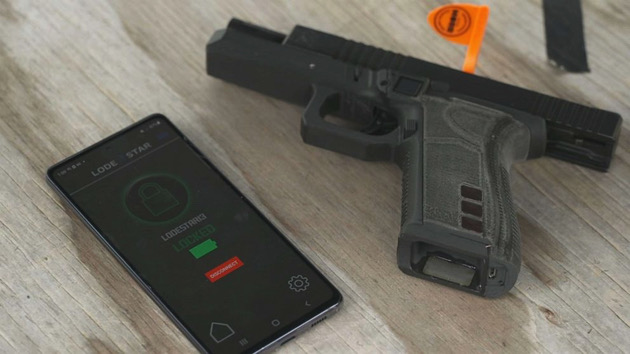
(CHATTANOOGA, Tenn.) — One manufacturer believes it has a solution to the gun violence plaguing the United States – a personalized smart gun that uses fingerprint technology to make firearms safer.
Ginger Chandler is the co-founder of LodeStar Works in Chattanooga, Tennessee. She said she believes her company’s smart gun can be a solution to the rising gun-related deaths in the country.
Chandler said the smart gun can only be fired by an authenticated user; in this case, verified by his or her fingerprint.
“What we know is if an unauthorized person picks up that firearm in a time of stress or they’re going to do something quick, they’re not going to be able to do it,” said Chandler.
According to the Centers for Disease Control and Prevention’s most recently published data, overall firearm-related deaths increased by 15% in 2020, to over 45,000 deaths, the highest number ever recorded by the CDC since it began tracking firearm deaths in 1968.
Daniel Webster is the co-director of Johns Hopkins Center for Gun Violence Solutions. He has been researching approaches to reduce gun violence through a public health lens rather than solely a criminal justice approach.
“By thinking about this as a public health problem, you really expand how you think about it and the potential solutions that you have to address it…[For example] reducing unintentional shootings involving young people, teen suicides and juvenile perpetrated homicides,” said Webster.
An analysis from the New England Journal of Medicine labeled the increasing firearm-related mortality rates as a “preventable cause of death.”
Chandler said that the three fail-safes — an app, a pin-pad and a fingerprint — manufactured into the smart gun can help combat some of those preventable deaths.
“First, there’s an app on the phone… The other way to unlock it is just a pin-pad on the side,” said Chandler. “And then if you put your fingerprint on that pad.”
Not all are convinced. Webster said that, despite “some really big safety gains” from smart guns, it is “not realistic” that the guns will help lower the homicide rate.
In the past, the National Rifle Association has supported smart guns, but raised concerns about the tech becoming mandatory for all firearms sold in the United States.
But many Americans favor gun control laws. An ABC News IPSOS poll found 89% of Americans support background checks for all buyers.
Chandler said that making guns safer is a “net positive” — without taking away guns from Americans.
“I’m a shooter. I hunt. It is something I am involved in. It’s a passion. I enjoy it,” said Chandler. “I absolutely respect the person who says we should not have any more guns… I respect that and I just want the same respect.”
(NEW YORK) — One person is dead and five others seriously injured after a bus overturned on the New Jersey Turnpike Tuesday, according to state police.
The fatal accident took place around 6:53 p.m. on the southbound Turnpike just before the Grover Cleveland Service Area, when a double-decker bus overturned and came to a stop on the entrance ramp to the service area, New Jersey State Police Sgt. Lawrence Peele told reporters Tuesday night.
During the collision, the bus hit a Ford F-150 pickup truck, Peele said. No one in the truck was injured.
The bus in the accident is a Megabus. The company told ABC News New York station WABC-TV there were 19 passengers and a driver on board from New York to Philadelphia. It did not provide additional details.
The entrance ramp near the crash is still shut down, N.J. State Police told ABC News.
The service area is located in Woodbridge, about 22 miles outside of New York City.
(NEW YORK) — Former President Donald Trump is expected to sit for a deposition Wednesday as part of the New York attorney general’s civil investigation into his family real estate business, sources familiar with the matter told ABC News.
The deposition in the New York civil case follows an escalation in the federal investigation into Trump’s handling of classified material. On Monday, the FBI searched Trump’s residence in Palm Beach, Florida.
Wednesday’s expected testimony, which had been delayed from July due to the death of Trump’s ex-wife Ivana, comes after a months-long court fight during which Trump was held in contempt as he fought the attorney general’s subpoena.
Trump has denied any wrongdoing and has called the investigation politically motivated.
A spokesperson for New York Attorney General Letitia James declined to comment when contacted by ABC News.
Trump himself appeared to confirm his deposition in a post on his social media outlet, Truth Social, saying: “In New York City tonight. Seeing racist N.Y.S. Attorney General tomorrow, for a continuation of the greatest Witch Hunt in U.S. history! My great company, and myself, are being attacked from all sides. Banana Republic!”
Two of the former president’s grown children, Donald Trump Jr. and Ivanka Trump, have already been deposed as part of the civil probe, the sources said.
Trump argued unsuccessfully that he should not have to sit for a deposition while the Manhattan District Attorney’s Office was conducting a parallel criminal investigation. While the Manhattan DA’s case remains active, two senior prosecutors who had been leading it resigned earlier this year over the lack of an indictment.
James has said her office has uncovered evidence of potentially fraudulent conduct in the way the Trump Organization valued its real estate holdings when seeking loans and when asking for tax breaks.
Lawyers in her office have said in court that the office is nearing a decision on an enforcement action.
(NEW YORK) — Two soldiers from Fort Benning have died and three others were injured in a weather-related event in northern Georgia, an official said Tuesday.
The incident took place at Yonah Mountain, located near Dahlonega, a spokesperson for the Army’s Maneuver Center of Excellence and Fort Benning Public Affairs Office said in a statement.
The three injured soldiers were treated by an Army medic on the scene before being transferred to a local hospital, the spokesperson said, where they remain under the care of hospital staff.
Their names are being withheld pending notification of next of kin.
This is the second event involving weather and Army fatalities in Georgia in three weeks.
On July 20, a U.S. Army Reserve soldier was killed and another nine were injured following a lightning strike while training at Fort Gordon.