Emilee McGovern/SOPA Images/LightRocket via Getty Images
(UVALDE, Texas) — Several Texas school districts are requiring students to use clear backpacks in the wake of last month’s deadly shooting at an elementary school in Uvalde.
Ingleside Independent School District, near Corpus Christi, became one of the latest to announce the new policy this week, after its board of trustees unanimously approved updating the district’s dress code policy to require clear backpacks starting in the 2022-2023 school year.
“Safety is a top priority for Ingleside ISD and is on the forefront of concern for school districts across Texas and our nation,” the district said in a statement Tuesday.
The policy is also expected to aid in processing students through metal detector lines at its secondary campuses, the district said.
Several other school districts have also implemented clear backpack policies in the wake of the May 24 shooting, in which 19 students and two teachers at Robb Elementary School were killed.
Harper ISD, about 90 miles northwest of San Antonio, announced earlier this month that it will implement a clear backpack policy for students starting in the fall “in light of the recent school shooting, and in an effort to do everything we can to increase safety for our students and staff.”
Two local businesses donated a backpack for every student in the district.
Greenville ISD, located about 45 miles northeast of the Dallas-Fort Worth metropolitan area, also said it will require clear backpacks starting in the fall, among other safety measures. The policy is a “common-sense measure is becoming more common at both school and public events,” the district said.
Additional security measures announced this month include having one front access point for entry and requiring that all classroom doors remain locked at all times, the district said.
The new measures also came a month after a fake pipe bomb was found at the district’s high school. The school was evacuated and a juvenile was taken into custody over the incident, school officials said.
Clear backpacks have become common in the wake of school shootings. Several other Texas school districts already require them among their security measures.
Marjory Stoneman Douglas High School in Parkland, Florida, temporarily required its students to use clear backpacks after a deadly 2018 shooting on campus. Some students questioned the policy’s effectiveness and raised privacy concerns at the time.
Oxford Community Schools in Michigan also required clear backpacks after four students were fatally shot in a mass shooting at Oxford High School last year.
Following the massacre at Uvalde, in which the shooter entered the school through an unlocked door, Texas Gov. Greg Abbott suggested that schools conduct weekly door checks, among other security measures. He also requested that state lawmakers convene special legislative committees to make recommendations on school safety, among other areas.
Lowell Police Department via John Guilfoil Public Relations
(LOWELL, Mass.) — The search for a missing 3-year-old Massachusetts boy who vanished from his babysitter’s backyard ended Wednesday afternoon with the grim discovery of the child’s body in a pond, authorities said.
The body of the toddler, identified by authorities as Harry Kkonde, was found in a pond at a Christmas tree farm 650 feet from the babysitter’s home in Lowell, about 30 miles northwest of Boston, Middlesex County District Attorney Marian Ryan said at news conference.
“I want to be clear that we have no idea how Harry came to reach that pond, where he might have been or how long it might have taken him to reach that pond,” Ryan said.
The child was reported missing at about 9:30 a.m. on Tuesday. Police said a search for the boy was immediately launched.
Lowell Police Acting Superintendent Barry Golner said earlier Wednesday that investigators had found no evidence suggesting foul play in the boy’s disappearance.
About 200 law enforcement officers were involved in the search Wednesday, including K-9 units, divers, drone operators, helicopter crews and officers on horseback and all-terrain vehicles, police said.
“This is obviously every parents’ worst nightmare: a child who disappears for a very short period of time, the excruciating hours of the search and then the recovery of his body,” Ryan said.
The boy was found in roughly 5-feet of water near the edge of the murky pond that divers searched on Tuesday, ABC affiliate station WCVB in Boston reported.
Volunteer searcher Kylie Bouley told WCVB that she was looking for Harry in a cornfield near the pond when the boy’s body was discovered.
“I was looking for him in the cornfield and all I heard is, ‘He’s gone. He’s in the pond. We’re going to take him out. Please get out of the cornfield,'” Bouley said.
Harry was last seen wearing a long-sleeve maroon shirt and gray pants with a white stripe, police said.
“He’s active. He likes going outside. When he’s at home, he goes to the yard and plays. He’s a healthy kid but he can’t speak. He’s trying to learn how to speak, but he can’t talk,” Harry’s father told WCVB in a phone interview prior to his son’s body being discovered.
Upon getting the call of the missing child, officers went to the babysitter’s home in the Pawtucketville section of northwest Lowell and immediately began searching the neighborhood. When they found no sign of the boy, they expanded the search to the nearby Lowell-Dracut-Tyngsboro State Forest and the Merrimack River.
The child’s parents dropped him off at his babysitter’s house at about 7 a.m. Tuesday, police said. At least one neighbor saw the child playing in his babysitter’s backyard around 9:15 a.m., police said.
Lowell police notified the community of the missing boy on Tuesday by using a reverse 911 system to contact residents and asked them to call the police immediately if they believe they had seen the boy or had information about his whereabouts.
(NEW YORK) — Down a dirt road, inside a church in Dallas, Texas, the cellphone of Zuleka Edwards buzzes constantly.
“I was just trying to seek termination of a pregnancy,” one caller tells Edwards, abortion coordinator for The Afiya Center, the only Black-women-led abortion fund in North Texas. “I just need some assistance, OK, if that’s possible.”
Edwards gives the caller information about scheduling an appointment at an abortion clinic, explaining that even though she has already had an ultrasound, she’ll be required to get another under Texas law.
“If you have any questions, just reach out and I’ll be able to assist you,” Edwards ends the call.
It’s a conversation Edwards says she has multiple times a day with women throughout Texas who are trying to access abortion care in a state with one of the most extreme abortion laws in the country.
The phone calls, according to Edwards, have come with increasing frequency and urgency since September, when that law, Senate Bill 8, took effect in Texas, banning nearly all abortions after six weeks of pregnancy. Before the law, abortions up to 22 weeks of pregnancy were allowed in Texas, with restrictions.
“Sometimes there’s just not enough time in the day,” said Edwards, whom ABC News saw taking calls from women in need while doing laundry at home and caring for her three kids.
Edwards, 35, said she never turns down a woman’s request for help because she knows personally what they are going through. The Texas native got her first abortion at the age of 17, a decision she said she felt “forced” into by her mom and one she said for years filled her with shame.
After going on to give birth to three children and get married, Edwards had a second abortion in Dallas.
At the time, Edwards said she was suffering from postpartum depression after the birth of her third child and knew she and her husband did not have the financial resources to raise a fourth.
“I knew for sure that whatever I was going to do, it was going to be what I needed to do,” Edwards said. “It wasn’t going to be from shame.”
‘Texas is already a post-Roe world’
Texas is known for doing everything bigger, and that has included the fight over abortion.
“We do the bad, the wrong stuff better. We do the great stuff better,” said Marsha Jones, founder of The Afiya Center, which helps provide women with funding and logistics for abortion care. “So there’s nothing bigger than here.”
After years of chipping away at abortion rights, Texas in 2013 enacted strict requirements on abortion clinics, including that abortion providers have admitting privileges at a nearby hospital. By the time the measure was struck down by the Supreme Court in 2016, the number of abortion clinics in the state had shrunk from around 40 to 19.
Since last year, when SB8 went into effect, those remaining clinics have only been allowed to provide abortions before “cardiac activity or the steady and repetitive rhythmic contraction of the fetal heart” can be detected, which can be as early as six weeks into a pregnancy. The law includes an exception for medical emergencies but makes no exceptions for pregnancies due to rape or incest.
The result of SB8, according to abortion rights advocates on the ground, is that Texas for nearly the past year has been operating as a sort of test case for a post-Roe America, a version of the country if Roe v. Wade — the landmark 1973 Supreme Court decision that declared abortion a protected right — is overturned, as is expected to happen based on a draft court opinion leaked in early May.
If the Supreme Court rules, as expected, in favor of a Mississippi law that bans abortions after 15 weeks, abortion will go from being a federally protected right to one decided by each state.
“For those of us here in Texas, that’s already been our reality,” said Paige Alexandria, an Austin-based hotline intake counselor for the National Abortion Federation. “We’re already living in a time where most people can’t access the care they need in their own city, where they have to travel out of state.”
Each month since SB8 went into effect, around 1,400 Texans have gone to another state for abortion care, according to Dr. Kari White, lead investigator of the Texas Policy Project at the University of Texas at Austin.
“Given what we’ve been seeing in Texas, I think it’s safe to say we’re already living in a post-Roe world,” said Sarah Lopez, client coordinator for Jane’s Due Process, an Austin-based abortion fund that helps kids under the age of 18 who need access to abortion care. “Not just with all the restrictions, but really the impact that those restrictions have on people, forcing them to flee their state to access abortion care.”
‘Feels like everything is on fire every single day’
With nearly all abortions banned after six weeks of pregnancy, the demand for abortions has not decreased in Texas, according to Alexandria, Lopez and nearly one dozen other abortion rights advocates ABC News spoke to in the state.
“Regardless of circumstance or zip code or income, people are always going to need abortions,” said Lopez, who herself had an abortion in her home state of Texas after graduating college. “Whichever ban is in place, I think it just makes the process more risky, more arduous, you know, it makes it far more confusing, far more stigmatizing.”
She said being an abortion rights advocate in Texas often feels “like everything is on fire every single day.” In Austin, Alexandria said her day is consumed by an endless stream of calls from women in Texas seeking financial or logistical help for an abortion.
“Most of the people that I’m speaking to on the hotline are already parents, just like most people who have abortions,” said Alexandria, who was a mom of two when she got an abortion. “They’re struggling to find child care and the time to take off of work without making it more difficult financially to afford the procedure that they need.”
In the U.S., nearly 60% of all women who obtain abortions are already mothers, according to the Guttmacher Institute, a reproductive rights research organization.
Qiana Lewis-Arnold, a birth justice associate with The Afiya Center, described the center’s workload as having “quadrupled” in the wake of SB8.
“The obstacles are just overwhelming, not just for the folks who are seeking abortions, but for the folks like us who are working with them,” she said. “This has created more obstacles, more stigma surrounding abortion and a lot of unnecessary fear.”
The anecdotal evidence of this is backed by data showing that with SB8 in place, the number of abortions has not dropped dramatically, according to White’s research. Instead, many women have resorted to traveling hundreds of miles out of state — as far as Maryland, Illinois and Washington state — or to ordering abortion pills online, if they are able to do so.
With increasingly limited access, a network of abortion funds — nonprofit organizations that provide funding and support to those seeking an abortion — has stepped in to fill the void.
The funds often cover a portion or all of the cost of the abortion itself — which can be hundreds of dollars in some cases — as well as practical care, including things like translation services, gas, hotel stays and child care.
“Texas is huge and there are abortion funds in basically every region of Texas,” said Lopez. “So there’s just been a lot of really cross-regional support that’s had to happen, and a lot of collaboration, a lot of creativity.”
Across the country, there are 92 abortion funds — as of October 2021 — that are members of the National Network of Abortion Funds, which helps connect organizations nationwide.
In the 72 hours after the Supreme Court draft opinion leaked in May, the network reported receiving more than $1.5 million in donations.
“The collaboration and the interconnectedness of abortion funds, I think that is a future of reproductive justice,” said Lopez. “It’s where we all work together and make sure that people have what they need.”
Who gets abortions with restricted access, and how
If Roe v. Wade is overturned by the Supreme Court, nearly half of the nation’s 50 states are prepared to ban all or nearly all abortions, according to the Guttmacher Institute.
Texas is one of 13 states that put a so-called trigger law in place to immediately ban abortion if the Supreme Court allows it. So if the court overturns Roe in its upcoming ruling, performing an abortion at any time after conception in Texas would be a felony.
With that ban in place, the distance women in Texas would have to travel to access abortion care would increase by 3,017%, according to the Guttmacher Institute. While New Mexico and Kansas would become the closest states that allow abortion, many Texans would likely have to travel even further because of the increased demand and wait times at abortion clinics in those states.
Already under SB8, abortion clinics in states surrounding Texas, including New Mexico, Kansas and Oklahoma — which has since enacted its own abortion ban — have reported being overwhelmed with patients.
In Kansas — where the state capital is nearly 700 miles away from Texas’ capital — residents will vote in August on an amendment to change Kansas’ constitution to remove abortion as a protected right.
Abortion restrictions’ impact on maternal mortality
With increasing restrictions in states and the prospect of Roe being overturned, abortion is likely to be accessible only in certain regions of the country, meaning people seeking abortions will have to travel further for care, at a greater cost and very possibly at a later stage in pregnancy due to both travel and wait times at a limited number of abortion clinics, according to White, of the University of Texas at Austin.
With abortion funds’ limited financial resources to help women as well as the inability of all women to travel, the impact, according to those on the ground in Texas who say they have already seen it happen, is that abortion becomes even more unequally accessible.
“The people who suffer the worst from abortion bans are the people who are always the most impacted,” said Alexandria. “Black and brown folks, indigenous folks, trans and queer communities, immigrants, children, parents, students, all of these people are the first to feel the impact of these restrictions.”
At The Afiya Center, which offers doula services in addition to abortion support, the residual impacts of abortion restrictions they see include high maternal mortality rates, high levels of childhood poverty and poor health rates, especially for Black women.
Texas has one of the worst maternal mortality rates in the country and Black women in the state are “disproportionately” affected, accounting for 11% of live births but 31% of maternal deaths, according to a 2020 report from the state’s Maternal Mortality and Morbidity Review Committee.
“It’s actually safer to have an abortion in Texas than to have a baby,” said D’andra Willis, doula services coordinator for The Afiya Center.
In the U.S., two women were reported to have died following complications from legal-induced abortions in 2018, the latest year for which data is available. That same year, 658 women were reported to have died due to complications from pregnancy or childbirth, according to the Centers for Disease Control and Prevention (CDC).
Willis said that for Black women like herself, the right to abortion means the right to make a life-saving decision for themselves.
“It’s just more than ‘my body, my choice,’ when it’s my life. My life is on the line,” said Willis, adding, “To be faced with Roe v. Wade being overturned, it’s just going to increase maternal mortality. It’s going to further perpetuate generational poverty. Access to health care is going to get even worse than it already is.”
‘Our work here becomes even more important’
Around 200 miles away from The Afiya Center, in Pflugerville, a city outside of Austin, Brittany Green, executive director of the Pflugerville Pregnancy Resource Center, stands in the center’s baby boutique, which provides clothes and baby supplies for moms who have decided to carry their pregnancies to term.
Across the country, pregnancy resource centers — nonprofit organizations that aim to support women on the path to parenthood — outnumber abortion clinics three to one, data shows.
In Texas, which has more pregnancy resource centers than any other state, the Pflugerville center is one of around 200 such centers.
“The vast majority of the activity in the pro-life movement is really these hundreds of pro-life pregnancy centers and maternity homes who are designed to help women, and help them long after the baby is born,” said Joe Pojman, executive director of Texas Alliance for Life, an Austin-based organization that opposes abortion, adding that he hopes Texas serves as an “example for the rest of the country.”
“For those women who seek abortion out of state in border states or beyond, it breaks my heart,” said Pojman. “It breaks all our hearts in the pro-life movement because Texas has such vast resources for women with unplanned pregnancies.”
Last year, the Texas Legislature directed $100 million in state funding over two years to Alternative to Abortions, a state-run program that was launched nearly 20 years ago with the purpose of “promoting childbirth” and providing support to pregnant women, according to the state’s health department.
The program, which provides funding to local pregnancy resource centers and subcontractors, served over 126,000 clients in 2021, according to Texas Health and Human Services.
Pflugerville’s pregnancy resource center, based in a small house down a side street, is privately funded, relying primarily on donations from individuals and local churches, according to Green.
The mostly volunteer-run center hums with a sense of urgency as they await the Supreme Court’s ruling.
“Power will come back to Texas and we’ll be able to eliminate abortion here,” Green said of what she believes will happen if Roe is overturned. “But women are still going to feel ashamed. They’re still going to need help and they’re still going to need resources, so our work here becomes even more important.”
Green said the center has experienced an increase of what she calls “abortion-minded” women since SB8 went into effect in Texas.
“The good thing with the bill is it actually slows down their decision-making time,” said Green. “So now that women are having to go outside of Texas to seek an abortion, it actually opens up the doors for us to talk about how desperate are you to terminate this pregnancy. And is it worth going the extra miles, is it worth paying additional money to have an abortion?”
According to Tere Grace, the center’s sonographer, women are coming in earlier and earlier in their pregnancies.
“Before SB8, we were seeing people that were coming in at 12 weeks, 14 weeks, 18 weeks, pretty much when women had the window for legal abortion and still hadn’t processed how they wanted to do it,” said Grace. “Now we’re seeing babies much much younger than that, sometimes 4 or 5, 6 weeks old because they want to beat that ‘deadline’ of the heartbeat.”
She continued, “Finding the heartbeat is really important to us because we want to speak truth, ‘There’s a heartbeat here.'”
Supporters of SB8, including Texas Gov. Greg Abbott, call SB8 the “heartbeat bill.” Medical doctors say using the word heartbeat is “clinically inaccurate.”
According to the American College of Obstetricians and Gynecologists (ACOG), there cannot be a heartbeat at an early stage of pregnancy because the chambers of the heart are not developed. Instead, the sound is what ACOG describes as the “ultrasound machine translating electronic impulses that signify fetal cardiac activity.”
Like most pregnancy resource centers across the country, Green says the one in Pflugerville does not “ever encourage a woman to seek abortion.”
“Our goal is to help them choose life,” she said of the center, which offers free sonogram services and pregnancy tests as well as education classes expectant women can take to earn points that they can then spend as money in the center’s baby boutique.
Tiffany Turner, a single mom of two from Round Rock, Texas, came to the Pflugerville Pregnancy Resource Center last year when she became pregnant while finishing graduate school to become a physician assistant.
“I didn’t have much support at all,” Turner said while holding her infant daughter, River, adding that she found the support she needed as soon as she walked into the center, which she said she found by searching for help online.
“They started giving me diapers from the week that I came,” said Turner. “And every week I would come and do Bible studies and classes, and they helped me through delivering her, and then three weeks postpartum, they started again.”
Turner said she continues to come to the resource center for clothes for River and supplies like diapers. According to Green, the center helps women through a child’s second birthday.
“We want our parents to leave feeling successful and that they can parent without support after us,” said Green. “If it is a situation where they still need continuing support, we’re actually going to refer them to another pregnancy center that can meet the need up until the child is 5.”
If Roe v. Wade is overturned and abortion becomes even harder to access across the country, abortion rights advocates say they fear there will not be enough support for women and children in the long-term.
Advocates like Edwards, of The Afiya Center, said they see their work post-Roe being even more focused on what they see as the root causes of the need for abortion, addressing issues like poverty, domestic violence and lack of access to health care and contraception.
“If you really want to help people, then find out what the underlying issues are,” said Edwards. “Help people get out of that predicament, and it’ll prevent people from being in this predicament.”
(BALTIMORE) — Authorities are investigating potential arsons in Baltimore where, in the same area, four homes and an LGBTQ Pride flag were all on fire Wednesday morning.
Baltimore Mayor Brandon Scott’s office said in a news release that the pre-dawn incidents were separate, clarifying early reports that they were linked. A Baltimore Police spokesperson initially told ABC News that “officers were informed that the Pride flag was set on fire at the location.”
The mayor’s office said later Wednesday that firefighters found the house fires and the Pride flag fire separately — across the street from each other.
Three people were injured: a 74-year-old man, a 57-year-old man and 30-year-old woman. As of Wednesday afternoon, according to the mayor’s statement, the woman had been released from the hospital while the two men remained hospitalized in critical condition.
Officials have not commented on any potential suspects or potential motive.
“At this point, we cannot confirm that this was a hate crime,” Scott said in his statement Wednesday afternoon. “However, my agencies will bring every appropriate resource to bear to get to the bottom of this tragic event. Regardless, I continue to stand in solidarity with our LGBTQ+ community.”
Scott also announced a joint investigation by the fire and police departments along with the Bureau of Alcohol, Tobacco, Firearms and Explosives and the FBI.
Residents of the area told ABC News affiliate WMAR that they believed one of the homes may have been targeted because of a Pride banner on its porch.
The fires come during the middle of Pride Month.
ABC News’ Davone Morales, Leonardo Mayorga, and Lauren Minore contributed to this report.
(GRAND RAPIDS, Mich.) — A Michigan police officer charged with second-degree murder in the fatal shooting of Patrick Lyoya during a traffic stop in April has been fired, city officials said.
Christopher Schurr was terminated after waiving his right to a discharge hearing, Grand Rapids city manager Mark Washington said in a statement Wednesday. The termination was effective June 10.
The Grand Rapids Police Department chief and the city’s Labor Relations Office had recommended Schurr’s termination, Washington said.
“Due to the on-going criminal matter and the potential for civil litigation, I will not be providing any additional comment concerning Mr. Schurr at this time,” Washington said.
The termination comes about two months after Schurr fatally shot Lyoya, 26, a native of the Democratic Republic of the Congo, in the back of the head after pulling him over on April 4 for an unregistered license plate.
Body-worn camera footage of the traffic stop released by the police department showed Schurr struggling with Lyoya, eventually forcing him to the ground and shouting “Stop resisting,” “Let go” and “Drop the Taser,” before shooting him.
Lyoya was shot in the back of the head, according to both an independent autopsy report backed by Lyoya’s family and the Kent County medical examiner.
The shooting prompted protests throughout Grand Rapids, and the Kent County prosecutor charged Schurr with second-degree murder in connection with Lyoya’s death last week.
Schurr, a seven-year veteran of the Grand Rapids Police Department, pleaded not guilty during his arraignment on Friday. If found guilty, he could face up to life in prison.
Schurr’s lawyers, Mark Dodge and Matthew Borgula, said in a statement to Grand Rapids ABC affiliate WZZM that Lyoya’s death “was not murder but an unfortunate tragedy, resulting from a highly volatile situation.”
The Grand Rapids Police Officer’s Association has defended Schurr in the wake of the shooting.
“As tragic as this case is all the way around, we feel a thorough review of this entire situation will show that a police officer has the legal right to protect themselves and community in a volatile dangerous situation such as this, in order to return to his/her family at the end of their shift,” the association said in a statement in April.
Civil rights attorney Ben Crump, who is representing the Lyoya family, had called for the officer’s prosecution and termination.
“Officer Schurr must be held accountable for his decision to pursue an unarmed Patrick, ultimately shooting him in the back of the head and killing him — for nothing more than a traffic stop,” Crump said in a statement to ABC News following the charging decision.
ABC News’ Nadine El-bawab contributed to this report.
(CHESTERFIELD, Va.) — Fifteen kids and one adult were taken to the hospital on Wednesday after a hazmat incident at a neighborhood pool in Chesterfield, Virginia.
Emergency crews initially responded to reports that children were experiencing nausea and respiratory issues, a Chesterfield Fire and EMS official told ABC affiliate WRIC.
Four kids and one adult were reportedly transported by ambulance, while the remaining kids were driven to the hospital by their parents.
First responders sprayed down 25 people at the scene, took their blood pressure and monitored their breathing.
The Chesterfield Fire Department did not immediately respond to an ABC News request for comment on what may have caused the hazmat incident.
An emergency vehicle responding to the hazmat incident at the pool also crashed into a pickup truck. No injuries were reported in the crash.
(WASHINGTON) — The United States is facing the most “complex” threat landscape in quite some time, a top Justice Department official told a conference in Washington, D.C., Wednesday.
Lone-wolf actors, and their access to high-capacity firearms — like what allegedly occurred in Buffalo, New York — are very difficult for law enforcement to combat, Assistant Attorney General for the National Security Division Matthew Olsen told attendees at the George Washington University Program on Extremism symposium.
Attorney General Merrick Garland announced hate crime charges Wednesday morning against the alleged shooter accused of storming a Tops grocery store on May 14 and gunning down 10 people, all of whom were Black.
“Once these individuals decide to carry out an act of violence, once they’ve moved on that path from being radicalized to being mobilized to violence, they pose significant challenges to law enforcement,” Olsen said.
Encrypted planning communications and access to high-capacity firearms are two of the most pertinent issues that work against law enforcement, he said.
“There are fewer opportunities for us to detect and disrupt their plots before they happen,” Olsen explained. “The ability to gain access to military-grade weapons makes the job of law enforcement very hard when it comes to violent extremists.”
The threat of domestic violent extremists is not new: the Biden administration has focused on combatting DVEs by establishing a unit at the DOJ and providing grant money through the Department of Homeland Security.
The assistant attorney general said it is “beyond dispute” that the ability to get military-grade weapons gives DVEs the ability to “carry out attacks on a scale that they couldn’t otherwise carry out and that we don’t see in other countries.”
Olsen said his newly established domestic violent extremist unit at the Justice Department, which he announced in January and was stood up a month ago, will not only be prosecuting domestic violent extremist cases, but also training others in identifying DVEs.
“This unit can be a critical safeguard because domestic terrorism cases raise issues about First Amendment and some difficult legal judgements and policy judgements,” Olsen said.
Olsen said attorneys have come in from around the country to work on the unit.
He said the DOJ is well-versed in prosecuting extremist cases given their experience in fighting the war on terror.
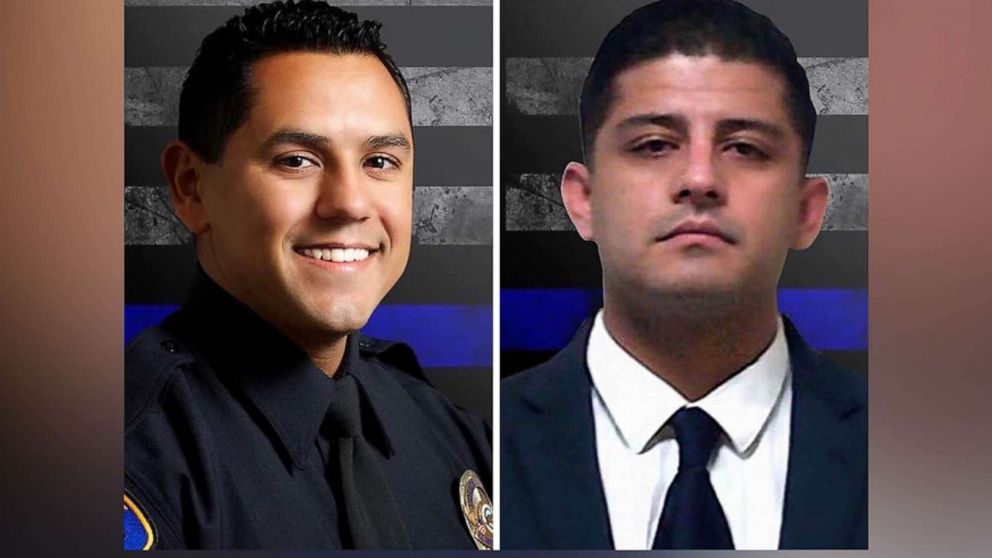
(EL MONTE, Calif.) — Two police officers have died after being shot in El Monte, California, Tuesday while responding to a possible stabbing at a motel, authorities said.
The El Monte Police Department said two officers “immediately took gunfire upon arrival” at the Siesta Inn.
The officers were taken to LAC-USC Medical Center, where they died of their injuries, ABC News Los Angeles station KABC reported.
The suspect was also shot and died at the scene, according to KABC.
Investigators believe the suspect, whom authorities have identified, was on probation for gun possession and had been arrested last year for possessing a gun and drugs, multiple law enforcement sources with knowledge of the investigation told ABC News.
Dozens of evidence markers at the scene showed numerous shots were fired during the shootout, sources said. The suspect’s girlfriend was not stabbed, as the initial 911 domestic violence call indicated, and was uninjured during the incident, sources said.
The El Monte Police Department on Wednesday identified the officers who were killed as Cpl. Michael Paredes and officer Joseph Santana.
“Corporal Paredes and Officer Santana were raised in the city of El Monte and had a strong connection to the community they served,” the police department said in a statement.
Paredes had served more than 20 years on the force and is survived by his wife, daughter and son. Santana previously was a deputy with the San Bernardino County Sheriff’s Department for three years before joining the El Monte Police Department. He is survived by his wife, daughter and twin boys.
“There are no words to describe our grief and devastation by this senseless act as we learned about the passing of two of our police officers,” the city, police department and El Monte Police Officers Association said in a statement. “It weighs heavy on our hearts and we are sending our support to their families. We would also like to thank the El Monte community and our surrounding government agencies for the outpouring [of] support we have received in the last few hours.”
The Los Angeles County Sheriff’s Department has taken over the investigation, the El Monte Police Department said.
El Monte is east of Los Angeles.
ABC News’ Alex Stone and Josh Margolin contributed to this report.
Stephen Maturen/Chicago Tribune/Tribune News Service via Getty Images
(MINNEAPOLIS, Minn.) — A renowned American Indigenous restaurant took home one of the top honors at the prestigious James Beard Awards this week.
The Minneapolis, Minnesota-based Owamni was named best new restaurant of 2022 at the awards ceremony, which was held in Chicago on Monday night.
The event is sometimes referred to as the Oscars of the food world.
“Our ancestors are proud tonight because we’re doing something different. We’re putting health on the table, we’re putting culture on the table, and we’re putting our stories on the table,” chef and restaurant owner Sean Sherman said during his acceptance speech. “And we hope that one day we can find Native American restaurants in every single city.”
The chef, who previously won a James Beard award for best American cookbook with “The Sioux Chef’s Indigenous Kitchen,” first opened the Minnesota hotspot in summer 2021 with co-owner Dana Thompson, to mass acclaim.
“People of color everywhere have been affected by colonialism,” Sherman said Monday, adding that they had endured “centuries” of racism. “This is showing that we can get through that, that we’re still here. Our people are here.”
Owamni’s menu celebrates “the true flavors of North America” using decolonized ingredients such as bison and wild rice purchased from Indigenous food producers locally and nationally.
“We have removed colonial ingredients such as wheat flour, cane sugar and dairy. We are proud to present a decolonized dining experience,” the restaurant states on its website.
The awards ceremony, which recognizes talent around the culinary and food media industries, resumed in person this year following a two year hiatus amid the pandemic, during which the organization said it “underwent a full audit of its policies and procedures” to address and remove bias.
Clare Reichenbach, CEO of the James Beard Foundation, which runs the event, said this year was “a momentous turning point” after “major changes were made to better align the Awards with the Foundation’s mission and values to ensure we are a force for good in our country’s food culture, and more representative of the communities we serve.”
“In the spirit of Gather for Good, this weekend was a true celebration of our industry, as we recognize outstanding leaders making our country’s food culture more delicious, diverse, and sustainable for all,” she added, referencing the theme of the night.
(NEW YORK) — More than 20 states are seeing dangerously hot temperatures this week, impacting nearly 100 million Americans, according to the National Weather Service.
The heat index will be over 100 degrees from the Plains to the Southeast with little relief at night.
An excessive heat warning has been issued from southern inland California to Arizona. Temperatures in this region could reach 110 degrees over the next few days.
Record temperatures also continue in the Midwest, South and the Carolinas.
In Nashville, the recorded high was 97 degrees on Tuesday. In Fayetteville, North Carolina, the mercury hit 100 degrees.
Chicago on Tuesday experienced its warmest weather since 2012, with temps reaching 98 degrees.
The temperature stayed at and above 80 degrees for 48 hours in Kansas City.
If the temperature in Detroit reaches 97 degrees on Wednesday, it will be the hottest recorded June temperature in the city since 2012.
Other cities seeing high temps are Charleston, Columbus and Pittsburgh as the heat wave continues to creep east.
A red flag warning continues in Nevada, where dry conditions and extreme heat perpetuates the opportunity for wildfires.
The National Weather Service said much of the Midwest will continue to remain above normal temperatures into the end of the week.
Such heat is dangerous and abnormal for even the hottest regions in the country.
As the heat wave continues, schools are shutting down to protect students and staff.
Five school districts in southeast Michigan are canceling classes or adjusting dismissal times as the Detroit area braces for Wednesday’s heat.
David Mustonen, director of communications and marketing for Dearborn Public Schools in Michigan, told ABC News the district will be closed for Wednesday. He said the decision to close was necessary.
“It really had to do with the heat index being so high,” Mustonen said. “It’s just not the best condition for learning.”
Mustonen said the district’s protocol is to close if the heat index reaches 105, which will likely happen on Wednesday.
“For the students and our staff, this was just the right decision,” Mustonen added.
Schools in other metropolitan areas are adjusting their schedules amid the heat.
Pittsburgh Public Schools will only be open for half days on Wednesday and Thursday, according to the district’s website. School lunches will still be provided at Pittsburgh Public Schools during the half days.
The American Heart Association has warned that temperatures over 100 degrees can be dangerous; high temperatures cause dehydration and increase stress on the heart.
The association recommends that individuals stay hydrated, avoid caffeinated or alcoholic beverages and avoid the outdoors during the peak sun hours of about 12 p.m. to 3 p.m.