
1 month after the Uvalde shooting, here are 5 questions that are still unanswered

1 month after the Uvalde shooting, here are 5 questions that are still unanswered
Brandon Bell/Getty Images

(UVALDE, Texas) — ABC News pieced together what happened the day Salvador Ramos allegedly killed 21 people at Robb Elementary School, using maps, video evidence and information from law enforcement.
Nearly a month after a gunman killed 19 students and two teachers inside Robb Elementary School, shattering a West Texas community, a litany of key questions about the police response remain unanswered — and some experts say the shifting narrative from state and local leaders in the massacre’s aftermath could threaten to exacerbate the trauma for those affected.

“These types of tragedies can tear communities apart,” said John Cohen, a former senior Homeland Security official who is now an ABC News contributor. “One of the ways the healing process can begin is for the community to have a clear understanding of what happened, and of what will be done to prevent something similar from happening again.”

As families of the victims lay their loved ones to rest, residents of Uvalde continue to hope for answers. They may start to get some on Tuesday, when a Texas House panel convenes to hear testimony regarding the shooting.

Here are five questions that remain unanswered:

1) Was the door to the classroom locked?

Since the very first days after the attack, law enforcement officials have said their response was stymied by the very measure enacted to keep children safe during an active shooter event: a locked door. Officials have said that the gunman entered into the classroom and immediately locked the door behind him, keeping officers outside of the room while they waited for backup, supplies, and a key that could open the “hardened” door that was unable to be kicked in.

The gunman was left inside the classroom for 77 minutes as 19 officers waited in the hallway — and many more waited outside the building — after the incident commander wrongly believed the situation had transitioned from an active shooter to a barricaded subject, law enforcement has said.

The incident commander, Uvalde School District Police Chief Pete Arredondo, said in an interview that he waited in the hallway as a janitor brought dozens of keys, which he tried on an adjacent classroom door in search of a master key — but none worked. Eventually a working one came.

But now surveillance video shows that police never tried to open the door to the classroom the gunman was in, according to a report from the San Antonio Express News that has been confirmed by sources to ABC News, although ABC News did not review the footage. While the classroom doors at the school are designed to lock automatically when they close, according to the report, new evidence suggests that the door may have been unlocked the entire time, despite the police assuming it was locked.

Officers in the hallway also had access to a “crowbar-like tool” which could have opened the door regardless of whether it was locked or not, the report said.

2) Did an active shooter alert reach the Robb community?

In recent decades, with mass shootings on the rise and advances being made in technology, school administrators and law enforcement across the country have scrambled to put in place safety protocols meant to alert staff and students in real time to a possible threat.

At Robb Elementary, shortly before the gunman entered the building on the day of the shooting, a teacher used their smart phone to trigger an alert through the school’s emergency response app — called Raptor — according to the company that makes the alert system.

But whether the alert successfully reached the Robb community remains unclear. Arnulfo Reyes, a teacher inside one of the classrooms attacked by the gunman, said sometimes his Raptor app pings with alerts about nearby incidents — but that no alert came on the day of the attack.

“You could hear the gunshots, but there was no announcement,” Reyes told ABC News in an exclusive interview this month. “I didn’t get anything, and I didn’t hear anything.”

At 11:43 a.m. — ten minutes after the rampage began — Robb Elementary School posted to Facebook that the campus had gone under lockdown “due to gunshots in the area.”

3) Were officers informed of the 911 calls coming from children inside the classroom?

While officers waited outside of the classroom for 77 minutes, children who were still alive inside the adjoining classrooms the gunman had attacked were repeatedly calling 911 pleading for help, officials have said. There were multiple 911 calls made from children inside, officials have said, including one plea to “please send police now.”

Texas Department of Public Safety Director Steven McGraw said it appeared that information may not have been relayed to officers on the ground, and Arredondo said in an interview that he was not aware of 911 calls while he waited in the hallway outside the classroom because he did not have his radio — which he said he intentionally left behind because he thought it would slow him down.

“That question will be answered,” McGraw said in the days after the shooting when asked directly if the incident commander on the ground received the 911 information. “I’m not going to share the information we have right now. Because I don’t have — I don’t have the detailed interview right now.”

Video obtained by ABC News last month taken outside Robb Elementary School as the massacre was unfolding appeared to capture a 911 dispatcher alerting officers on scene of 911 calls they had received from children inside the classroom.

4) Were responding officers appropriately trained?

Seventy-seven minutes passed from the time the gunman entered Robb Elementary until officers breached the classroom and ended his deadly siege. Law enforcement officials have since faced intense scrutiny for their failure to act faster, prompting questions about their level of preparedness.

Two months before the mass shooting, the Uvalde school district hosted an all-day training session for local police and other school-based law enforcement officers that was focused on “active shooter response.” But basic training protocols — including those involving communication channels and chain of command — went unheeded, law enforcement officials later said. A failure to secure important equipment, including shields and high-powered weapons, may have also contributed to delays.

Eventually, officers on the scene used a key retrieved from a janitor to unlock the door to the classroom where the gunman had barricaded himself. Cohen, the former Homeland Security official, said the fact that officers had to resort to such a simple method of breaching the classroom after such a long period of time reflects poorly on the officers’ planning.

“When developing an emergency response plan, it is deeply troubling that basic equipment — such as keys or other breaching devices — seemed to be unavailable,” Cohen said.

5) Are law enforcement officials cooperating with the investigation?

As the probes into the police response continue, questions have arisen about whether or not Arredondo — who has emerged as a key figure in the police response — is cooperating.

Texas House Committee chair Dustin Burrows said on Friday that Arredondo had not yet agreed to testify before the committee, but on Monday he said that all law enforcement agencies have been cooperating.

“The Uvalde Police Department has been cooperative,” said Burrows. Regarding Tuesday’s hearing, he said, “We’re going to hear from another officer with the Uvalde ISD [school district]. We’re going to hear from a member of the Department of Public Safety on the ground.”

“I want to at least compliment all the law enforcement agencies for being cooperative and providing witnesses that we have asked for,” Burrows said.

On May 31, in the immediate aftermath of the shooting, The Texas Department of Public Safety said that Arredondo had not responded “for days to a request for a follow up interview” as part of that agency’s investigation into police response to the massacre.

Arredondo’s attorney disputed that characterization, telling the Texas Tribune that Arredondo had participated in multiple interviews with DPS in the days following the shooting, but could not come in for another interview when they requested because he was covering shifts for other officers.

“At no time did he communicate his unwillingness to cooperate with the investigation,” Hyde said in the interview with the Texas Tribune. “His phone was flooded with calls and messages from numbers he didn’t recognize, and it’s possible he missed calls from DPS, but still maintained daily interaction by phone with DPS assisting with logistics as requested.”

Copyright © 2022, ABC Audio. All rights reserved.

Human rights attorney’s worst fears realized in Operation Lone Star arrest

Human rights attorney’s worst fears realized in Operation Lone Star arrest
Brandon Bell/Getty Images

(EL PASO, Texas) — Gaston spent years as a human rights lawyer in Venezuela defending the political opponents of Nicholas Maduro’s regime — mostly students jailed for speaking out against the government plagued by corruption.

Gaston was worried it was only a matter of time before he ended up in a cell himself, so he fled the country and made his way to the U.S.-Mexico border, swimming across the Rio Grande.

Gaston, whose full name is being withheld over fears for his safety, planned to surrender to border officials and seek asylum in the United States. Instead, he was arrested by troopers with the Texas Department of Public Safety upon his arrival and sent to an immigration detention center.

“I presented him with my credentials. ‘Look, I’m a lawyer, a human rights defender. Here’s my badge,’” Gaston recounted in Spanish, speaking with ABC News. “And all he said to me was, ‘I have to stop you. Put your hands behind your back.’”

Gaston spent five weeks imprisoned in the detention center.

He is just one of thousands of migrants detained through Operation Lone Star, a Texas-run border security initiative created by Gov. Greg Abbott in March 2021 to stem the influx of migrant traffic in the state.

The program authorizes the deployment of an estimated 10,000 soldiers from the Texas National Guard and Department of Public Safety, in addition to federal agents, to handle immigration patrol.

The operation’s goal is “to prevent the criminal activity along the border,” according to the Texas government website. But since only the federal government has the power to enforce immigration law, Texas troopers and state guardsman can only make arrests if migrants trespass onto private property.

“There wasn’t any there. No notice that said that was private property, or what,” Gaston said. “Neither that I have knocked down a wall nor that I have even penetrated a fence.”

“I can tell you that this is the most terrible discrimination that a human being deprived of his liberty can suffer,” he added.

Kristin Etter, an attorney who represented Gaston’s case against the state once he was detained, said he is one of many clients who were arrested “without probable cause,” some of whom have spent months in prisons awaiting trials, unable to afford bond.

“Texas has essentially militarized the border to make apprehensions and arrests primarily of migrants for criminal trespass offenses,” Etter said.

To date, the program has made just over 4,100 total trespassing arrests, according to the Texas Department of Criminal Justice.

The strategy of expelling migrants does not appear to have curtailed immigration — but the price tag of funding the operation continues to go up with Texas taxpayers footing the bill.

Etter said Texas has spent more than $4 billion on Operation Lone Star, diverting funds from other areas in the state. And in late April, nearly $500 million in additional funding was approved by Abbott and state leadership for the program.

As Gaston’s asylum case moves through the federal courts, he said he hopes he can one day make a living for himself in the U.S. and support his family back home in Venezuela.

“It was through God’s Grace, he wanted my life to continue and help mine, to help my family, to help my country, and to stay here in the United States one way or another,” he said. “In spite of all that difference and all those events that have happened, thank God it didn’t go bad for me.”

ABC News’ Abby Cruz and Thomas Brooksbank contributed to this report.

Copyright © 2022, ABC Audio. All rights reserved.

Wildfire in southern New Jersey forces closure of trails, campgrounds

Wildfire in southern New Jersey forces closure of trails, campgrounds
WPVI

(TRENTON, N.J.) — A wildfire in southern New Jersey has scorched at least 7,200 acres as of Monday morning, the New Jersey Forest Fire Service said.

New Jersey Forest Fire Service crews will continue to conduct backfiring operations throughout the day to aid in containment, according to a statement from the service posted on Facebook. The fire is 45% contained, authorities said.

There are no reported injuries at this time.

The fire spread through Wharton State Forest, leaving several trails, campgrounds and roads closed.

Eighteen structures have been threatened as of Monday morning, with local volunteer fire departments from Atlantic, Burlington and Ocean Counties performing structure protection, authorities said.

As of Sunday evening, only six structures were reported as threatened and the Paradise Lake campground was evacuated.

The wildfire has affected the Washington, Shamong, Hammonton and Mullica Townships, and has been fueled by dry and breezy conditions, New Jersey Forest Fire Service said.

The National Weather Service in the Philadelphia/Mount Holly area said the gusty conditions are expected to subside.

Batsto Village and all of its trails continue to be closed to all visitors.

Boat launches along the Mullica River, the Mullica River Trail, the Mullica River campground and the Lower Forde campground are closed.

Pinelands Adventures said it has suspended kayak and canoe trips in the area.

Route 206 from Chew Road to Stokes Road and Route 542 from Green Bank Road to Columbia Road are also closed.

Authorities first addressed the growing fire midday Sunday, where it began in a remote section of Wharton State Forest along the Mullica River.

By 7:20 p.m., the fire had expanded to 600 acres and was 10% contained.

At 10:56 p.m., authorities said the fire had reached 2,100 acres and was at 20% containment.

An average of 1,500 wildfires damage or destroy 7,000 acres of the state’s forests each year, according to the New Jersey Forest Fire Service.

Copyright © 2022, ABC Audio. All rights reserved.

No arrests made yet in attack on Louisville mayor

No arrests made yet in attack on Louisville mayor
Jon Cherry/Getty Images

(LOUISVILLE, Ky.) — According to surveillance video obtained by ABC News Louisville affiliate WHAS, the mayor of Louisville, Kentucky, Greg Fischer, appears to fall to the ground after being hit.
The mayor of Louisville, Kentucky, was assaulted over the weekend while out attending community events when he was punched by the assailant. Police are still investigating and have yet to make any arrests.

Mayor Greg Fischer was attacked while visiting Fourth Street Live, celebrating Kentuckiana Pride and Juneteenth over the busy weekend.

According to surveillance video obtained by ABC News Louisville affiliate WHAS, the mayor appears to fall to the ground after being hit. The assailant was caught fleeing in surveillance footage.

According to police, and Fischer himself, he is doing fine following the assault.

“My son, who is 30 said, ‘Dad you’re not quite an old geezer yet, but it is good to see you can still take a punch,'” Fischer said on Sunday at the Louisville Central Community Center’s Juneteenth gala. “It is an unfortunate thing. We’re living in weird times these days, so it’s just another day in the life of the mayor.”

Anyone with information can call the Louisville Metro Police Department anonymous tip line at 502-574-5673.

Copyright © 2022, ABC Audio. All rights reserved.

Heat wave brings new round of dangerous temps to millions this week

Heat wave brings new round of dangerous temps to millions this week
Chris Sweda/Chicago Tribune/Tribune News Service via Getty Images

(NEW YORK) — Millions of Americans will face dangerous heat this week, as a new heat wave is expected to bring near triple-digit temperatures to the South.

The Southeast and the Plains will experience temperatures between 10 and 20 degrees above average with humid conditions, according to the National Weather Service.
Heat wave continues in 27 states across the country

While the Northeast felt a reprieve from the heat this weekend, heat alerts were in effect on Sunday in the Upper Midwest, as temperatures in the Plains hit 100 degrees and higher.

Temperatures in Fargo, North Dakota, hit 102 degrees on Sunday, while North Platte, Nebraska, reached 100 degrees. Low humidity has kept heat indexes low in the Midwest, a far cry from last week’s “heat dome,” which caused the heat index in the region to reach 115 degrees.

Midwestern cities could hit their daily record highs by Monday afternoon.

The Central U.S. region will see highs in the 90s as the heat travels east but won’t see high heat index values because it won’t be very humid.

Millions of people in the Midwest will eventually see a break this week as the heat moves into the South, where cities such as Atlanta, Memphis and New Orleans will see temperatures hit close to 100 degrees.

Summer officially begins on Tuesday, and for the rest of the month, swaths of Central and southern parts of the U.S. are expected to see above-average temperatures.

More than 1,300 people die every year in the U.S because of extreme heat, according to the Environmental Protection Agency.

The excessive heat, coupled with strong winds and arid conditions, has sparked fears of wildfires in the West. The National Weather Service issued “red flag” warnings in Flagstaff, Arizona, and Price, Utah.

According to the NWS, “red flag” warnings occur when “warm temperatures, very low humidities and stronger winds are expected to combine to produce an increased risk of fire danger.”

While the potential for wildfires will dwindle in the next few days, the conditions will make it harder for firefighters to battle existing wildfires in the Southwest.

Due to the monsoon season, rain is expected over the next day in parts of the country that have experienced widespread drought and wildfires, such as Texas, New Mexico and Colorado, making the areas more susceptible to flash floods.
Historic flooding emergency in the Northern Rockies, high temperatures

Last week, Yellowstone National Park closed after historic flooding destroyed homes, washed out roads and left many people stranded.

ABC News’ Dan Peck contributed to this report.

Copyright © 2022, ABC Audio. All rights reserved.

One dead and three others, including cop, injured in DC shooting: Police

One dead and three others, including cop, injured in DC shooting: Police
kali9/Getty Images

(WASHINGTON) — A 15-year-old boy has died and three adults, including a police officer, were injured in a shooting in Washington, D.C., Sunday night, officials said.

The shooting took place near 14th and U streets Northwest, in a popular area filled with stores, restaurants and bars. The area played host to “Moechella,” a free concert celebrating Juneteenth.

The Metropolitan Police Department had reported an earlier, separate incident at the concert, when a fight was broken up, MPD Chief Robert Contee said.

Shortly after that, there was a secondary incident, Contee said, during which “people started to scatter” and some were “being trampled.” The MPD shut down the concert because it appeared it was “unsafe,” police said.

The incidents happened between 6:30 and 8:30 p.m., police said, at an unpermitted event associated with Moechella. Police said “hundreds of people” had gathered on the block, and the MPD assisted in containing the crowd to the sidewalk.

While rendering aid to people caught in the stampede, a firearm was recovered, Contee said.

According to the MPD, several people were shot in the wake of the previous incidents.

Police said the firearm used in the shooting has not been recovered, and there is no suspect in custody at this time.

The two adult victims and the police officer are recovering at an area hospital, police said.

The D.C. Police Union tweeted that one of its members had been shot, was transported to the hospital “and is in stable condition.”

The Bureau of Alcohol, Tobacco, Firearms and Explosives Washington Field Division said it was assisting the MPD.

ABC News’ Ben Siu contributed to this report.

This is a developing story. Please check back for updates.

Copyright © 2022, ABC Audio. All rights reserved.

Police didn’t try to open doors to Uvalde classrooms with shooter inside: Source

Police didn’t try to open doors to Uvalde classrooms with shooter inside: Source
KSAT

(NEW YORK) — In a new twist in the Uvalde elementary school mass shooting, a source has confirmed to ABC News that as police waited for more than an hour in a hallway outside the classrooms where a gunman killed 19 students and two teachers, none of the officers checked to see if the doors to the classrooms were locked.

The new development in the investigation of the shooting came just days after Chief Pete Arredondo of the Uvalde Consolidated Independent School District Police, the incident commander during the May 24 mass shooting at Robb Elementary School, defended his actions and claimed the delay in breaching connecting classrooms 111 and 112, where the gunman was holed up was because he was waiting for a janitor to get the key to the door.

But surveillance footage showed that neither Arredondo nor any other officers taking cover in the hallway outside the classrooms ever attempted to open the door before receiving the keys to the two connecting classrooms. That means there were 77 minutes between when the alleged 18-year-old gunman entered the school through an unlocked door and when police fatally shot him, a source with knowledge of the investigation told ABC News.

The San Antonio Express News was the first to report on Saturday that Arredondo and his team allegedly never check the classroom doors to determine if they were unlocked.

The sources confirmed to ABC News that investigators now believe the alleged gunman, Salvador Ramos, could not have locked the doors to the classrooms from inside as officials first suspected. In the surveillance footage, the sources said, it appears Ramos, 18, was able to open the door to classroom 111 from the outside, the source said. That classroom is connected to the adjacent classroom 112 by a short corridor where a restroom is located, officials have previously said.

Whether the doors to the classrooms where the slayings occurred were unlocked through the entire episode remains under investigation.

In a June 6 interview with ABC News’ Amy Robach, Robb Elementary School teacher Arnulfo Reyes, who was wounded in the shooting that killed 11 of his students, said that prior to the rampage he complained to the school’s principal that the door to his room, 111, did not latch properly during security checks. He said the door was supposed to remain shut and lock automatically.

“When that would happen, I would tell my principal, ‘Hey, I’m going to get in trouble again, they’re going to come and tell you that I left my door unlocked, which I didn’t,'” Reyes said in the interview. “But the latch was stuck. So, it was just an easy fix.”

In an interview with the Texas Tribune published June 9, Arredondo, who was recently sworn in as a Uvalde City Council member, said he spent more than an hour in the school hallway calling for tactical gear, a sniper and keys to get inside the classroom.

He claimed he and multiple officers with him in the hallway took cover away from the classroom doors for 40 minutes to avoid being struck by bullets the suspect, armed with an AR-15 style rifle and hundreds of rounds of ammunition, fired through the door.

The Texas Department of Public Safety said three Uvalde police officers who initially ran into the school to confront the gunman were fired on through the door and two suffered graze wounds.

Law enforcement officers from multiple agencies in the area converged on the school and began evacuating children from other classrooms and away from the two rooms where the gunman was holed up. Video and photos from the scene, showed children being pulled through broken windows and running out of harm’s way.

Arredondo claimed in the interview with the Texas Tribune that a custodian finally brought him a large key ring with dozens of the keys attached but none worked. Sources familiar with the investigation claimed that while searching for a master key, Arredondo tried the janitor’s keys on a door out of harm’s way on a nearby classroom.

While Arredondo waited for the keys and a tactical team to gear up and reach the scene, students and teachers trapped in the classrooms with the gunman made at least seven desperate 911 calls asking for help.

Arredondo told the Texas Tribune that he didn’t bring his radios with him to the scene, claiming time was of the essence and that he wanted to have his hands free.

“The only thing that was important to me at this time was to save as many teachers and children as possible,” Arredondo told the Texas Tribune.

Sources told ABC News that Arredondo is not cooperating with investigators probing the shooting. Arredondo has denied he has been uncooperative.

Arredondo and police involved in the response to the deadly emergency have come under intense scrutiny as the investigation has unfolded and video surfaced showing panicked parents being held back by police officers from entering the school to take matters into their own hands, including a father who officers deployed a stun gun on and a mother who was handcuffed.

Police investigators and elected leaders, including Texas Gov. Greg Abbott, have also been the subject of scorn over how the official narrative of the rampage has dramatically changed as the investigation has unfolded.

In the immediate aftermath of the Uvalde rampage, Abbott praised the “amazing courage” of law enforcement, saying the incident “could have been worse” if the officers hadn’t run toward the gunfire and eliminated the shooter. But one day later, Victor Escalon, the South Texas regional director of the Texas Department of Public Safety, contradicted Abbott’s statement, saying, no schools officer was at the campus when the gunman, who had already shot and wounded his grandmother, crashed a truck in front of the school and entered the school buildings unabated through an unlocked door after getting onto campus by climbing a fence.

Abbott later said he was misled on the police response.

Col. Steven McCraw, director of the Texas Department of Public Safety, initially said the door the gunman used to access the school building was left propped open by a teacher. But officials later said the investigation showed the teacher closed the door, but the door did not automatically lock as it was supposed to.

The timeline on how quickly police responded to the shooting has also changed several times, from a rapid response to about 40 minutes, to eventually 77 minutes before a SWAT team entered the classroom where the shooter was located and killed him, authorities said.

The New York Times reported on Friday that a Uvalde police officer responding to initial reports of a shooting was armed with an AR-15 style rifle and had an opportunity to shoot the gunman outside the school but hesitated out of concern he could have hit a student with an errant shot. Law enforcement sources have confirmed that scenario to ABC News.

Copyright © 2022, ABC Audio. All rights reserved.
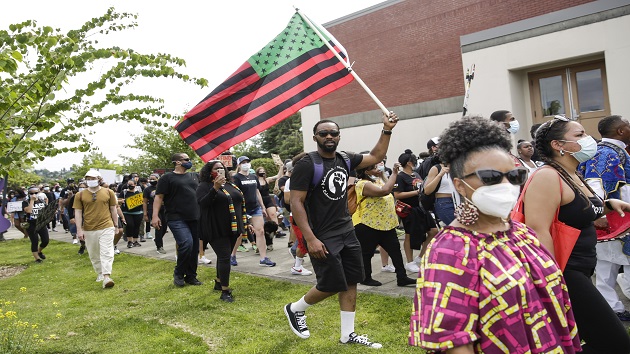
Why Black joy on Juneteenth is an act of resistance against racism

Why Black joy on Juneteenth is an act of resistance against racism
JASON REDMOND/Getty Images

(NEW YORK) — Opal Lee, 95, has spent much of her life advocating for civil rights. When she was just 12, her family home was vandalized and set ablaze by white supremacists, none of whom were arrested.

It led her down a lifetime of trying to force the nation to pay respect to those impacted, oppressed or killed by racism throughout U.S. history. Each year on Juneteenth, she and her family in Texas go on a picnic and celebrate the day in 1865 when enslaved Black people in Galveston, Texas, learned they had been freed over two years after the Emancipation Proclamation took effect.

In 2016, Lee went to Washington, D.C., and led a 2.5-mile march to symbolize the 2.5 years it took for the Emancipation Proclamation to be enforced in Texas, and to free the final enslaved Black people.

The joyous day, filled with love and comradery in the Black community, was one she wanted to turn into a federal holiday.

Social activism can take many forms: protests, petitions, boycotts — but for some, joy can be also a revolutionary tool against systems of oppression. Black joy, as an act of resistance against white supremacy, takes center stage on Juneteenth.

Lee’s grandaughter, Dione Sims, who is also a civil rights advocate, has been helping her in the fight and says joy is key to bringing the movement forward.

“Folks usually think that to be an activist, you have to be negative in protesting and marching and, but when you come together and you celebrate and you commemorate Juneteenth, it is a form of social awareness,” Sims told ABC News.

“It is a show of support, not just for the African American community, but the fact that Juneteenth represents freedom for all,” she said.

In 2021, Lee and Sims stood with President Joe Biden when he officially made the commemorative day a federally recognized holiday.

“You know when you smile a lot and your cheekbones hurt? That’s how it was that day, because I’m just smiling, seeing her having a dream fulfilled,” Sims said. “A lot of times we have dreams, and we don’t get to see the culmination of it until maybe after a person has passed on.”

Shaonta’ Allen, a sociology professor at Dartmouth University, says that joy is the opposition to widespread anti-Blackness and racism seen in the U.S. It’s inherently resistant to oppressive forces, she says.

“When Black communities and Black individuals decide to identify for themselves and provide value in Blackness, when everything around them tells them that they should not value blackness – That’s where we see that opposition to this widespread racism and inequality,” Allen said.

She said Juneteenth, as well as June’s Pride month and other heritage month celebrations, are great examples of celebrating as a form of protest.

“We see other communities, intentionally drawing on self validation, self valuation, self definition, rather than more dominant notions of what their community is and how their communities should be viewed,” Allen said.

In celebrating the vibrancy and comradery of Juneteenth, Black communities refuse to accept suffering against oppression.

For Sims, joy has been a motivating factor in continuing Lee’s legacy. She said it’s what helps keep activists going.

“Black freedom and Black emancipation in America is definitely something that Black communities are excited about and have been, but we also celebrate with caution, because we know that there’s still a lot of work to do to,” Lee said.

Copyright © 2022, ABC Audio. All rights reserved.

Juneteenth offers message of hope, resiliency

Juneteenth offers message of hope, resiliency
Alexi Rosenfeld/Getty Images

(NEW YORK) — While most Americans prepare to celebrate the country’s freedom on July 4, many Black people in the United States recognize June 19 as their Independence Day.

The day widely known as Juneteenth, and referred to as Jubilee Day or Black Independence Day, is a significant date in Black history. It marks the day when the last enslaved African Americans found out about their freedom.

The news was delivered to Black people in Galveston, Texas, on June 19, 1865, two years after President Abraham Lincoln issued the Emancipation Proclamation, which lawfully marked the end of slavery for those of the Southern Confederate states.

ABC News caught up with prominent African Americans in the fields of film, music and media during the Bounce Trumpet Awards on April 23, 2022, and asked about how Juneteenth has played a role in their lives. The awards telecast will air on June 19.

“Our people are great and we started with nothing and came into something,” Emmy Award-winning actor Courtney B. Vance told ABC News. “Yes, things may be difficult now, but when you go past the first Google page and just look and see what our people had to deal with and still they rose. Everywhere they looked was a no. Everywhere they looked was darkness.”

The “61st Street” actor, who has also won a Tony Award, said he appreciates the opportunity to educate, especially young children, about his ancestors’ greatness and adversity. “It’s a message for us all that sometimes life is difficult and it’s going to be trial. But if we just press on, there will be a victory.”

With Vice President Kamala Harris, the first Black woman to hold the second-highest office in the executive branch, by his side, President Joe Biden signed the Juneteenth National Independence Day Act into law last year, on June 17, 2021. But the African American community had been celebrating long before Juneteenth was made a federal holiday.

Essence Magazine CEO Caroline Wanga, a woman of Kenyan descent, emphasized the creation of Juneteenth as a celebration borne out of the struggle Black people face. During the Bounce Trumpet Awards celebrating Black humanitarians, she posed a question of reflection to the Black community.

“If you think about how long it took for Juneteenth to happen, then what are the things that you currently aren’t celebrating that you should be that are already yours, that you don’t know about?”

In addition to the usual music and food festivals and gatherings, Wanga suggests a different way to celebrate.

“That’s what I would love people to spend Juneteenth doing, is recognizing that that holiday was about the last of us finding out that we were freer than we thought,” she said. “What I want us to do is never have to do Juneteenth again and celebrate all the things that are true about us that are already here right now that we just don’t know about. Go Google something and celebrate that on Juneteenth.”

The country’s delayed acknowledgement of what has long been an erased part of American history encourages Black people to research and educate themselves on unknown facts about their ancestry.

Naomi Raine, a member of the Grammy-winning gospel group Maverick City Music, plans to commemorate the holiday by opening up honest conversations with her children.

“I think everybody’s kind of evolving how they’re celebrating this holiday because some of it is just coming to light for many of us,” Raine told ABC News. “Now, it’s more about educating my children and letting them know the roots of our nation and talking about how freedom is for everybody.”

With the many in-person celebrations taking place all across the country this year, some artists do plan to go out and take part in traditional festivities. Rising soul singer Jordan Hawkins, a North Carolina native, says he looks forward to attending the Juneteenth music and arts festival in Los Angeles’ Leimert Park on June 18, which will feature more than 300 Black-owned businesses.

Juneteenth serves as a reminder of the decades-long fight for equity and equality of African Americans. And while the fight to fulfill America’s promise to all continues, Vance offers another message of hope: “I think we’re going to succeed. We’re going to push through.”

Copyright © 2022, ABC Audio. All rights reserved.

Killer Mike calls for protection of Black art amid Young Thug and Gunna indictment

Killer Mike calls for protection of Black art amid Young Thug and Gunna indictment
ABC News

(ATLANTA) — Atlanta rappers Young Thug and Gunna were hit with gang-related charges in a case that sent shock waves through the music industry and spotlighted the controversial use of rap lyrics as evidence in court.

“[Young Thug] came out of a very desperate situation,” Atlanta rapper and activist Killer Mike told “Good Morning America.”

“The side of town he comes from — Cleveland Avenue, southeast Atlanta — has been wrought with poverty forever … he managed to escape the streets using rap lyrics, and he’s managed to help people change their lives.”

But now some of those lyrics have been named in a sweeping 56-count grand jury indictment in Fulton County, Georgia.

Young Thug, whose legal name is Jeffrey Williams, and Gunna, who name is Sergio Kitchens, were each charged with one count of conspiring to violate the state’s Racketeer Influenced and Corrupt Organizations (RICO) act and have entered not guilty pleas.

Young Thug is also charged with an additional count of participating in street gang activity, according to charging documents obtained by ABC News.

Top music executives launched a Change.org petition this week, calling for the protection of Black art and legislation that addresses the criminalization of rap lyrics.

“Today in courtrooms across America, Black creativity and artistry is being criminalized,” wrote 300 Entertainment CEO Kevin Liles. “With increasing and troubling frequency, prosecutors are attempting to use rap lyrics as confessions. This practice isn’t just a violation of First Amendment protections for speech and creative expression. It punishes already marginalized communities and silences their stories of family, struggle, survival, and triumph.”

Killer Mike, whose real name is Michael Render, is a longtime advocate against the use of rap lyrics in court. He said it’s important to remember that hip-hop is a form of entertainment and artists are performers who play characters.

“Young Thug — that’s a character that Jeffrey Williams created … but Jeffrey Williams is a father,” he said. “He’s a human being that’s capable of love, care and compassion.”

Erik Nielson, the author of “Rap on Trial,” told “GMA” he has advised and testified in close to 100 cases around the country in which rap lyrics were used as evidence in court — a practice that often targets amateur local rappers.

“I was surprised that prosecutors were brazen enough to go after somebody as well known as Young Thug,” Nielson said.” “But I was also surprised at the extent to which lyrics seem to be part of the prosecution as part of their early argument that he is involved in criminal activity.” .

Young Thug was among 28 people listed allegedly associated with the Atlanta-based Young Slime Life (YSL) gang, which authorities say he co-founded in 2012. YSL is also the name of Young Thug’s record label, Young Stoner Life, to which Gunna is also signed. It is an imprint of 300 Entertainment and is not named in the indictment.

Court documents detail instances where individuals allegedly associated with the YSL gang wore or displayed symbols of “YSL” in music videos posted on social media between 2016 and 2021 and rapped lyrics that mention “YSL” and/or various descriptions of criminal activity.

“These lyrics are no more than braggadocio rap lyrics,” Killer Mike said. “It is no more than Killer Mike saying I’m a killer on the mic.”

Prosecutors allege that YSL is responsible for three murders, including the 2015 killing of Donovan Thomas — an incident that they claimed “triggered” additional gang-related killings in the city.

Young Thug, a Grammy-winning rapper, is accused of various crimes, including theft and possession of illicit drugs with intent to distribute.

“Mr. Williams has committed no violation of law, whatsoever. We will fight this case ethically, legally and zealously. Mr. Williams will be cleared,” Young Thug’s attorney Brian Steel told ABC News.

“Mr. Sergio Kitchens, known as Gunna, is innocent. The indictment falsely portrays his music as part of criminal conspiracy,” the rapper’s attorneys, Steve Sadow and Don Samuel, told ABC News.

“It is intensely problematic that the State relies on song lyrics as part of its allegations. These lyrics are an artist’s creative expression and not a literal recounting of facts and circumstances,” the attorneys said in a court filing obtained by ABC News.

Fulton County District Attorney Fani Willis defended including the lyrics in the indictment.

“The First Amendment does not protect people from prosecutors using [lyrics] as evidence,” she said at a May 10 press conference when asked about First Amendment concerns. “We put it as overt within the RICO count because we believe that’s exactly what it is.” ABC News has reached out to the DA’s office for further comment.

Nielson, a liberal arts professor at the University of Richmond, claims hip-hop music is the only genre that is targeted in courtrooms in this way.

“Rap music is the only fictional form — musical or otherwise, that is targeted this way in the courts,” Nielson said.

“It’s absolutely racist,” he added. “… essentially what’s happening is rap music is being denied the status of art.”

Killer Mike, who wrote the foreword to “Rap on Trial,” said that targeting Black art speaks to the dehumanization of Black people in America.

“Hip hop is not respected as an art because Black people in this country are not recognized as full human beings,” he said.

“… If we allow the courts to prosecute these men based on characters they created and stories of pretend that they tell in rhyme then next, they’ll be at your door.”

Young Thug and Gunna were both denied bond and their trials are set for January 2023.

Copyright © 2022, ABC Audio. All rights reserved.