
New 988 number for National Suicide Prevention Lifeline launches Saturday, expanding access amid funding concerns

New 988 number for National Suicide Prevention Lifeline launches Saturday, expanding access amid funding concerns
Substance Abuse and Mental Health Services Administration

(NEW YORK) — As the National Suicide Prevention Lifeline prepared for the launch of a nationwide three-digit number on Saturday, local, state and federal government officials gathered in Philadelphia Friday to discuss the effort to get the new nationwide 988 calling code.

“There’s been a lot of work to get to this day,” Jessica Rosenworcel, chairwoman of the Federal Communications Commission, said. “But what we’ve done is we’ve made it easy. 988 is easy to remember. Now we have to make it clear to the entire country that it is a sign of strength to call it and use it, and not a sign of weakness.”

The Lifeline has been in operation at a ten-digit number (1-800-283-TALK) since 2005, has taken over 20 million calls in that time, and that number will continue to route callers to the Lifeline following the launch of 988. However, the Substance Abuse and Mental Health Services Administration (a division of HHS) anticipates the increased ease of use for the three-digit number will dramatically increase calls to the service.

Tim Jansen, chief executive officer of Community Crisis Services Inc. in Hyattsville, Maryland, told ABC News that call volume at his facility has gone up over the last few years, and he expects the increase will continue amid the launch of 988.

“I think we’re going to see a significant uptick in calls,” Jansen said, adding that his facility has been working to increase their staff over the last six months in preparation. “I think the big thing is [988 will] make the number much easier to remember.”

The Biden administration has put an unprecedented amount of funding toward launching the new number for the Lifeline. Following the addition of $150 million for the Lifeline as part of the recently passed gun safety legislation, the federal investment in 988 stands at $432 million.

Jansen says that funding, along with about $5 million in funding from Maryland that will be distributed across the state this fiscal year, has helped his facility increase the salary of existing staff and hire about 150 new employees. CCSI now has about 225 employees available to answer calls, chats and texts for the Lifeline in its capacity as both a local center and one of the national backup call centers.

Experts say that, ideally, Lifeline calls should be answered at the local level so callers can be more easily connected with follow-up resources in their area, but there are several national backup centers (such as CCSI) that can field calls from anywhere in the country if a particular center is unable to answer.

Jansen explained that local centers have about 30 seconds to answer a call before it is forwarded to the next nearest local or regional call center. If it is not answered by that center within about three minutes, he added, it then goes to the national backup network.

Nationwide, HHS officials say, the influx of federal funding for the Lifeline has enabled call centers to field 17,000 more calls, 37,000 more chats and 3,000 more texts in June of this year, compared to 2021.

While the federal funding has increased the ability of the Lifeline to respond nationwide, answer rates still vary from state to state, as much of the funding for these call centers happens at the state level.

When Congress designated 988 as the new number for the Lifeline in 2020, it gave states the authority to levy fees on cell phone bills to help sustainably fund the service, similar to how 911 call centers are funded.

So far, only four states have passed that legislation. Some others, like Maryland, have allocated some funding for the launch. Experts worry, however, that many states will not be able to accommodate the volume of calls anticipated after the new number launches.

HHS officials continue to emphasize the need for state-level investment for this system to be built out long-term and able to handle the volume of calls.

“Failure is not an option,” HHS Secretary Xavier Becerra said at the launch news conference on Friday.

“988 is a three digit number, but it really is more.” Becerra said. “It’s a message — when you need someone, we will be there.”

The transition to a fully reimagined mental health crisis care system — the ultimate goal of 988 — will take time, officials say.

While most of the callers reaching out to the Lifeline during a mental health crisis can be deescalated over the phone, some require additional care, which can include a visit from a mobile crisis response team, a trip to a crisis stabilization unit or in some cases, inpatient hospitalization.

Those additional elements of what experts call the “crisis care continuum” are currently available in some cities across the country, but that portion of the crisis care system will take additional time to build out, they say.

“One of the challenges with 988 is it’s going to expose the fact that there are not enough vendors, not enough therapists, not enough counselors,” Jansen said.

Despite the expected hiccups in the overall nationwide rollout, he said, “To me, one life saved is success,” adding, “But I think that the ultimate gauge of what makes [988] successful is if we ultimately see a reduction in the rates of suicide. That’s going to take some time.”

An employee for nearly 26 years at the center he now runs, Jansen said, “It’s one call, one text, one chat at a time … [Every day] You can walk out of here knowing that I helped somebody with a safety plan. Somebody said that their only option was dying and now they have other options.”

If you are experiencing suicidal, substance use or other mental health crises please call or text the new three digit code at 9-8-8. You will reach a trained crisis counselor for free, 24 hours a day, seven days a week. You can also go to 988lifeline.org or dial the current toll free number 800-273-8255 [TALK].

Copyright © 2022, ABC Audio. All rights reserved.

Pilot who landed small plane on highway arrested under suspicion of intoxication

Pilot who landed small plane on highway arrested under suspicion of intoxication
Getty Images/pawel.gaul/Stock

(KANSAS CITY, Mo.) — A pilot who landed his plane on a Missouri highway early Friday after running out of fuel was arrested for allegedly flying while intoxicated, authorities said.

Troopers responded to reports of a small plane blocking the westbound lanes of I-70 near the Kansas City suburb of Grain Valley around 3 a.m. local time.

“Interstate 70 (westbound lanes) BLOCKED by an AIRCRAFT!” Missouri State Highway Patrol tweeted while warning commuters to expect delays.

The plane managed to avoid hitting any vehicles but had a “minor collision” with a guardrail, Missouri State Highway Patrol said. The pilot, who was the only person on board, suffered minor injuries, it said.

Authorities determined that the plane had run out of fuel when the pilot radioed in and made an emergency landing on the highway.

The pilot, identified by authorities as 35-year-old John Seesing was arrested after he was “found to be intoxicated,” Missouri State Highway Patrol said.

Sgt. Andy Bell, a public information officer for Missouri State Highway Patrol, said troopers suspected impairment by a combination of alcohol and drugs.

Missouri State Highway Patrol records show that Seesing, of Prairie Village, Kanas, was arrested on charges including DWI, careless and imprudent driving involving a crash, felony possession of a controlled substance, felony unlawful possession of a firearm, possession of less than 10 grams of marijuana and unlawful possession of drug paraphernalia.

Seesing was treated at a local hospital for his injuries and underwent blood testing in connection with the charges, Bell said. He has since been released, he said.

It is unclear if Seesing has an attorney.

The single-engine Piper plane was towed from the scene and all lanes on the highway had reopened by 5:30 a.m.

Troopers believe the pilot was flying from Florida to the Kansas City Downtown Airport.

Flight Aware records show the plane left the Kansas City area early Thursday morning before arriving in Daytona Beach, Florida, then started making its way back toward the Kansas City area later that night.

The Federal Aviation Administration is also investigating the incident.

Copyright © 2022, ABC Audio. All rights reserved.

City to meet with advocacy groups over police reform demands following Jayland Walker’s death

City to meet with advocacy groups over police reform demands following Jayland Walker’s death
Angelo Merendino/Getty Images

(AKRON, Ohio) — Tensions between protesters and law enforcement have persisted amid weekslong demonstrations following the fatal police shooting of 25-year-old Jayland Walker.

As protesters seek accountability from police in Walker’s death, local and national advocacy groups have released lists of demands for the mayor and local law enforcement.

“Without a new approach to policing and public safety broadly, policymakers keep taking us through the same cycle of violence; more militarization and surveillance, more prisons, and more Black people murdered by police,” said Sakira Cook, of the social justice organization Color Of Change. “Yet, we are not deterred. Together, alongside our members and partners, we’ll continue to work to end our violent policing system, redefine public safety, and invest in Black communities.”

Akron Mayor Dan Horrigan has offered to sit down and have meetings with the various advocacy groups, according to a statement from the mayor’s office.

Walker was unarmed when he was fatally shot in Akron, Ohio, by police on June 27 after a traffic stop turned into a pursuit. He was running away when eight officers opened fire on him, body-camera footage released by the city showed.

Officials said they attempted to pull over Walker for a traffic violation and an equipment violation with his car. He allegedly refused to stop, which set off a chase that ended in his death.

Officials said a flash of light seen in body camera footage appeared to be the muzzle flash of a gun coming from the driver’s side of Walker’s car.

In a second body camera video, officers are heard radioing that they heard a shot being fired from Walker’s car. The footage shows the officer following Walker’s Buick off Route 8 and continuing the pursuit on side streets.

At one point, Walker slowed down and jumped out of the passenger side door before it came to a full stop. As Walker ran away from police, several officers simultaneously fired several bullets, fatally shooting him.

A gun was later recovered inside the car, but Walker was unarmed when he was shot.

The officers involved in the shooting are on paid administrative leave and have not been named.

The incident is under investigation by the Ohio Bureau of Criminal Investigation.

“When an officer makes the most critical decision in his or her life as a police officer, it doesn’t matter where in the country this happens, when they make that most critical decision to point their firearm at another human being and pull the trigger, they’ve got to be ready to explain why they did what they did,” Police Chief Steve Mylett said in a July 3 press conference, as the department released body camera footage.

A list of demands from Color Of Change and social advocacy group The Freedom BLOC for Akron officials has already received more than 3,000 signatures.

It calls for the abolition of the use of tear gas, pepper spray and rubber bullets, the release of all protesters from jail with charges dropped and records expunged, as well as an order for police to stop arresting protesters.

The demands also include funding an unarmed traffic enforcement unit for routine traffic stops, as well as a unit to respond to mental health calls and anti-violence community programs.

Demonstrators also demand the city create a citizen-led commission to reallocate money from the police department to other community programs that invest in housing, public transportation, health care and more.

The Department of Justice Community Relations Service has offered to be mediators in these conversations between officials and the organizations, and “we believe this is the best path forward for our community,” a spokesperson from the mayor’s office told ABC News.

Akron officials have implemented a curfew to quell protests, saying that the nationwide outrage about Walker’s death has put the city on edge.

Two relatives of police shooting victims – Jacob Blake Sr., the father of Jacob Blake, and Bianca Austin, an aunt of Breonna Taylor – were arrested on rioting charges while protesting the police shooting in the city.

According to local reports from WKYC, demonstrators claimed to have been tear-gassed while protesting.

The Akron Police Department did not respond to ABC News’ request for comment on the allegations.

Ohio officials called for protesters to pause demonstrations on July 8, after two people were killed in unrelated gun violence in other parts of Akron.

“This has been a very difficult week for Akron, almost two weeks for Akron. The heat is very very high, tensions are running high in this city,” Akron Police Chief Steve Mylett said at a press briefing that night. “We’re asking for people to stand down for at least 48 hours, let the temperature come down.”

Both the family and police have called for peaceful demonstrations after officials said some protests turned violent. Some officers also claim to have received threats due to their involvement in the department.

“So long as the participants are non-violent, we are going to give them space,” said Lt. Michael Miller in a July 11 press conference.

Following that press conference, the legal team representing Walker’s family held a press conference in response.

“We don’t stand for any violence towards anyone, whether it be a police officer or a citizen but here’s the fact of the matter: the police are in control here, aren’t they?,” attorney Bobby DiCello said. “When the community is hurting, they need to let that hurt out and not take it personally.”

The city officially declared July 13 a day of mourning in Walker’s name in a new resolution to quell the tension.

In it, officials call for peaceful protesting and healing throughout the community. “The City urges that the friends and family of Jayland Walker, and the entire Akron community, be surrounded with love and peace, and that the City would begin to heal,” the city said.

ABC News’ Amanda Su contributed to this report.

Copyright © 2022, ABC Audio. All rights reserved.

25-year-old rescues kids from house fire: ‘I knew the next second it could be my life, but every second counted’

25-year-old rescues kids from house fire: ‘I knew the next second it could be my life, but every second counted’
Lafayette Police

(LAFAYETTE, Ind.) — An Indiana police department is praising a “heroic” 25-year-old Good Samaritan who rescued five children from a massive house fire.

Nicholas Bostic saved an 18-year-old who was home with her siblings, ages 2, 6 and 13, Lafayette Police Lt. Randy Sherer said. Bostic also rescued a friend of the 13-year-old who was there spending the night, Sherer said. The siblings’ parents weren’t home, Sherer said.

The blaze broke out around 12:30 a.m. Monday, Sherer said. Bostic was driving by when he spotted the house fully engulfed in flames and pulled over, he told ABC News, beating first responders to the scene.

Bostic didn’t have his phone to call 911, so he ran to the back of the house to see if he could spot anyone, he said.

Bostic went inside and raced upstairs, where he found the 18-year-old, 2-year-old and two 13-year-olds, and he led them down the stairs and outside, Bostic said.

“I asked them if anybody was left in there — and that’s when they told me that the 6-year-old was,” Bostic said.

Bostic said he ran back inside to look for the 6-year-old girl, but the thick smoke made it hard to see and the overwhelming heat scared him.

That’s when he heard the little girl whimper, which he said gave him the courage to keep going. All the while, he was terrified the house would explode.

“The last thing I could do was waste a second panicking,” he said.

Once Bostic found the 6-year-old, he punched through a window so they could escape, he said.
Bostic was hospitalized for severe smoke inhalation and a serious cut to his arm, police said. He has since been released.

All of the children are doing well, Sherer said.

Sherer called Bostic’s actions “heroic. The city in a statement said Bostic has “impressed many with his courage, tenacity, and steadfast calmness.”

Bostic said he’s spoken with the children’s parents.

“The dad said he’d love to take me out for a dinner,” he said. “They have wide-open arms welcoming me as a part of their family.”

“I’m glad I was there at the right time, the right place,” Bostic added.

And Bostic, still recovering, said he wouldn’t hesitate to race into another house fire.

“If opportunity came again and I had to do it, I would do it,” he said. “I knew what I was risking. I knew the next second it could be my life. But every second counted.”

Copyright © 2022, ABC Audio. All rights reserved.

Yosemite’s Washburn Fire continues growing, threatening sequoia trees

Yosemite’s Washburn Fire continues growing, threatening sequoia trees
Neal Waters/Anadolu Agency via Getty Images

(OAKHURST, Calif.) — The Washburn Fire in central California has now scorched 4,700 acres across Yosemite National Park to Sierra National Forest as of Friday morning, officials said, growing over 300 acres overnight.

According to park officials, the fire is 27% contained, with more than 1,500 firefighters assigned to it.

The persisting fire began near the Mariposa Grove of Giant Sequoias and now is claiming parts of Sierra National Forest, park officials said.

Since its first few days, when the fire measured 1,591 acres with 0% containment and 360 firefighters assigned to the fire, the threat to the area’s famous sequoia trees remains a major concern.

As climate change effects worsen, such fires become an increasing threat to the durable, celebrated sequoia trees, and measures continue to be taken to protect the area.

Some of the tree trunks were wrapped in fire-resistant foil, a technique used in September to protect trees in Sequoia National Park’s Giant Forest from fire.

A sprinkler system has also been set up within the grove to keep the sequoias’ trunks moist, officials said.

The continued spread has led to further road closures, including Forest Routes 5S43, 5S06 (Mt. Raymond Rd.), 5S22 and 5S37.

The closures are intended to assist firefighters in getting resources to and from the fire and to keep the public out of harm’s way, officials said.

The cause of the fire is still said to be under investigation. However, at a public meeting on Monday night, Yosemite’s park superintendent said it appears to have been started by people.

The fire is expected to take weeks for the fire to be fully extinguished, as it is happening in “difficult terrain” due to heavy fuel lingering nearby after a significant tree mortality event from 2013 to 2015, according to Yosemite Fire and Aviation Management.

The fuel, consisting of both standing trees and those that have fallen to the ground, is presenting safety hazards to firefighters, officials said.

Further closures due to the fire include the Highway 41 entrance to Yosemite National Park, meaning that visitors will need to use Highway 120 or 140 to access the Yosemite Valley.

However, the remainder of the park remains open, despite heavy smoke on Sunday that affected air quality in the area and obstructed the park’s views.

The Tenaya Lodge, just south of Yosemite, remains open.

The community of Wawona and the Wawona Campground continue to be under a mandatory evacuation order, according to officials.

An evacuation shelter is available at the Mariposa New Life Church, located at 5089 Cole Road.

Copyright © 2022, ABC Audio. All rights reserved.

Co-ed sex ed classes prompt protests in Virginia

Co-ed sex ed classes prompt protests in Virginia
Willie B. Thomas/Getty Images

(FAIRFAX, Va.) — Students in Virginia are calling on school administrators to combine genders in their Family Life Education, or sex education, courses.

Members of the Pride Liberation Project, a student-led LGBTQIA+ advocacy group in Fairfax County, protested on Thursday ahead of the Fairfax County School Board’s meeting.

The group’s leader, Rivka Vizcardo-Lichter, told ABC affiliate WLJA that the recent Supreme Court decision on Roe v. Wade galvanized students to protest.

Vizcardo-Lichter said a decision to create co-ed sex education courses would be a “step forward” for advancing the inclusivity of transgender and non-binary people in schools and in recognizing that “queer people need to learn about their sexual health in a safe way.”

“We’re not asking anyone to take on any crazy reforms,” Vizcardo-Lichter added.

Fairfax County schools currently hold sex education classes that separate students into two genders during the fourth through eighth grades.

The Family Life Education Curriculum Advisory Committee issued a number of recommendations in May, including a mix in genders in sex education classes during grades four through eighth.

“The main criticism is that it makes students uncomfortable. We have to ask ourselves, ‘Why are students uncomfortable learning about their bodies?’ People who are afraid of FLE [family life education] have the option to opt their children out,” Willow Woycke, president of the Transgender Education Association, said at a May school board meeting in favor of the recommendations.

Nearby schools have implemented mostly gender-combined sex education, including Virginia’s Arlington County and Alexandria City, as well as Maryland’s Prince George’s County. Some Metro D.C. districts have also adopted the practice of combining genders in such courses.

Several other districts in the region continue to separate genders in sex education classes.

It’s not yet clear if the Fairfax County School Board will make a decision on changes to sex education classes.

“All advisory groups outline recommendations at the end of each school year,” Julie Moult, a spokesperson for the FCSB, told ABC News. “Some are acted on and some are not. The board may choose to review this recommendation at some point this coming school year.”

Kathleen Mallard, a Fairfax County resident, told ABC affiliate WLJA that a move to combine genders for students in grades four through eight would be wrong.

“Some of the discussions are about activities I think almost are sexualizing our children to some extent, up to the point of almost grooming them,” said Mallard. “I think this is not a good idea to have them both all in the same class, boys and girls.”

No changes came at Thursday’s board meeting but newly appointed superintendent Michelle Reid did acknowledge that new members would be appointed to the advisory committee.

Copyright © 2022, ABC Audio. All rights reserved.

Maryland man indicted for allegedly targeting gay men

Maryland man indicted for allegedly targeting gay men
Jahi Chikwendiu/The Washington Post via Getty Images

(WASHINGTON) — A Maryland man faces federal hate crime charges for allegedly posing as a federal officer and targeting gay men in a series of attacks at a Washington, D.C., park, the Department of Justice announced Thursday.

Federal prosecutors allege that Michael Thomas Pruden, 48, assaulted five men with a “chemical irritant” at Meridian Hill Park on five separate occasions between 2018 and 2021.

A federal grand jury indicted Pruden last month on five counts of assault on federal land, one count of impersonating a federal officer and a hate crimes sentencing enhancement “alleging that Pruden assaulted four of the victims because of their perceived sexual orientation,” the Justice Department said.

Meridian Hill Park is informally known in the D.C. community as “cruising” spot for gay men, according to the indictment. Pruden allegedly frequented the park at night on multiple occasions and assaulted men “by approaching them with a flashlight, giving police-style commands, and spraying them with a chemical irritant,” the indictment states.

Pruden was arrested on Thursday in Norfolk, Virginia. He faces a maximum sentence of 10 years for each assault count — which could be increased by the hate crimes sentencing enhancement — and a three-year maximum sentence for impersonating a federal officer, the Justice Department said.

Court records do not list any attorney information for the suspect.

Pruden was arrested last year in connection with a similar attack at a federal park in Alexandria, Virginia, in March 2021.

Prosecutors allege that Pruden falsely presented himself as a police officer and sprayed victims with pepper spray at Daingerfield Island, also informally known as a cruising spot for gay men.

Pruden was indicted in a Virginia district court on a charge of assault with a dangerous weapon and acquitted in August 2021.

Copyright © 2022, ABC Audio. All rights reserved.
Jewish community in Highland Park grieves, takes action after mass shooting

Jewish community in Highland Park grieves, takes action after mass shooting
Demetrius Freeman/The Washington Post via Getty Images

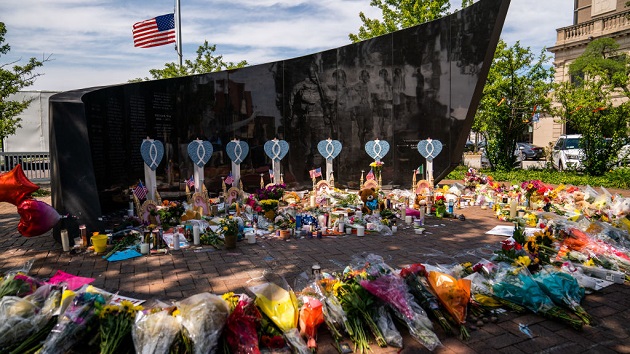
(HIGHLAND PARK, Ill.) — Rabbi Michael Sommer’s congregation has been “in a state of shock” ever since seven people were killed in a mass shooting during a July Fourth parade in Highland Park, Illinois.

Sommer, the leader of the Har Shalom congregation, told ABC News that both he and the majority of his congregants are from Highland Park. The congregation meets in nearby Northbrook.

Many of his congregants were at the suburb’s Fourth of July parade where a shooter opened fire from a rooftop.

“Everyone is in a state of grief. Everyone is looking how lucky they were to have their family safe… So everyone is trying to pull together, we hope; we all know each other here. It’s a very warm community,” Sommer said.

Highland Park is among a group of suburbs north of Chicago, including Skokie, Glencoe, and Deerfield, that have large Jewish communities and a constellation of synagogues, Kosher and Jewish restaurants, and organizations serving the Jewish community.

In the aftermath of the shooting, the Jewish community there is trying to grieve and find meaning through Jewish institutions and practice, even though leaders say that it is too soon to truly be healing.

Jewish news outlet The Forward reported that five of the seven victims were either Jewish or members of Jewish families.

One of them was Katherine Goldstein, who was a mother to two adult daughters, an avid bird watcher, and a lover of travel, according to a friend of hers who spoke with ABC News. She was 64.

Her synagogue’s rabbi, Ike Serotta, described her and her family as “just remarkable people.”

“All of them are the most incredible, gentle, kind, caring people that you could ever want to meet,” said Serotta, who leads the Makom Solel Lakeside congregation in Highland Park, told ABC News. “And Katie was just a delightful, funny, vibrant person who was really just one of the kindest people you could ever expect to meet in this world.”

While authorities have not said what motivated the suspect, investigative groups have pointed to the suspect’s social media posts as gravitating towards far-right ideas. The suspect also reportedly visited the Central Avenue Synagogue, a Chabad Jewish center in Highland Park, around Passover, leaving on his own after his presence raised concerns.

Michla Tzipporah Schanowitz, who runs the Central Avenue Synagogue with her husband Rabbi Yosef Schanowitz, described dealing with the events of July 4 as “kind of overload, trying to process the sorrow and the pain of what happened, and the shock. But also at the same time, knowing that we can do so much to bring so much light and goodness into the world.”

In the immediate aftermath of the shooting, Jewish leaders in the community scrambled to provide support to their congregants and to the broader community.

For Sommer, that meant helping out with social services at the local high school, as well as calling congregants to check in with them to see how they are doing. “I dread the phone calls I miss, or the phone number I don’t have, or who I should have called that I didn’t,” Sommer said.

And for Rabbi Yosef Schanowitz, that meant rushing to Highland Park’s hospital, where he regularly volunteers as a chaplain. He went from door to door, with “no time for small talk… I didn’t even ask people their names. They urged me to go from from door to door, and it was [for people of] all faiths,” Schanowitz said.

“I just poked my head into the door and just being introduced as I’m clergy and I just want to wish you all the best; our prayers are with you and God give you strength and bless you, and went on to the next room unless somebody needed to talk,” he added. “But in most cases, they were all traumatized, and there wasn’t a lot of back and forth discussion.”

The Jewish Sabbath, which runs from Friday night at sundown to Saturday night at sundown, exemplifies rest and joy in Jewish tradition.

“We’re supposed to celebrate Shabbat with with song and joy, and it was very subdued. And I added some outside readings to express our pain… and God’s presence in our lives to help us on this journey of healing and through our grief,” Sommer said.

Michla Tzippora Schanowitz said that ahead of the Shabbat, she worked with others to give out Shabbat candlestick kits, used for the ritual lighting of Shabbat candles at sundown on Friday. “And people were very receptive… it felt like it was able to channel their feeling of yes, bring light, spiritual light” after such a dark week.

Rabbi Yosef Schanowitz said that at the Seudah Shlishit, a third meal of the Sabbath that is usually held in synagogue between afternoon and evening services on Saturday, the congregation took some time to reflect.

“We also went around the table, and people had an opportunity to express themselves–where they had been [during the shooting], and the effect that it had on them, and who they knew that may have been hurt, and so on,” Rabbi Yosef Schanowitz said.

Serotta cautioned against speaking about the Jewish community being ready to heal so soon after the shooting.

“When something as evil and unnatural as this, I can’t say how long it will be until people are ready to start talking about the word healing,” he said.

Looking ahead, some of leaders emphasized discussions around enhancing synagogue security in light of the shooting, staying connected and finding strength with the broader community.

“We’ve always felt a responsibility one for another as a Jewish community, and also responsibility to other people who live in our community,” Michla Tzippora Schanowitz told ABC News. “We always rise to the occasion and support each other. And we’re doing that here and we’ll continue to do that.”

ABC News’ Will McDuffie and Aaron Katersky contributed to this report.

Copyright © 2022, ABC Audio. All rights reserved.
Jayland Walker had 46 gunshot wounds in his body, autopsy report reveals

Jayland Walker had 46 gunshot wounds in his body, autopsy report reveals
Angelo Merendino/Getty Images

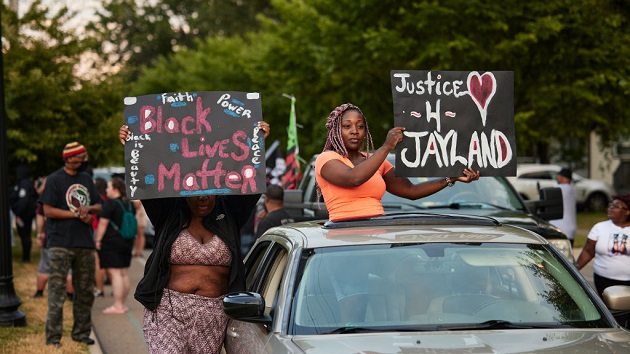
(AKRON, Ohio) — Jayland Walker, the 25-year-old Black man who was fatally shot by police in Akron, Ohio, had 46 gunshot wounds on his body, according to an autopsy report conducted by the Summit Co. Medical Examiner’s Office.

“The autopsy determined that Jayland had 46 gunshot wound entrances or graze injuries,” chief medical examiner Lisa Kohler said at a Friday press conference. She later added, “The photographic record shows more than 46 labeled wounds because there are exit wounds, bullets beneath the skin and abrasions that were numbered for the purpose of identifying specific injuries.”

Walker also had injuries to his face, heart, both lungs, liver, spleen, left kidney, intestines, pelvis, iliac artery and several bones in his legs, according to Kohler

His manner of death has been ruled homicide and the toxicology report showed no use of drugs nor alcohol by Walker at the time of the incident.

“The family is devastated by the findings of the report and still await a public apology from the police department,” the Walker family’s legal team said in a statement to ABC News.

Walker was unarmed when he was fatally shot by police on June 27 after a traffic stop turned into a pursuit. He was running away when eight officers opened fire on him, body camera footage released by the city showed.

Officials said they attempted to pull Walker over for a traffic violation and an equipment violation with his car. He allegedly refused to stop, which set off a chase that ended in his death.

Officials said a flash of light seen in body camera footage appeared to be the muzzle flash of a gun coming from the driver’s side of Walker’s car.

In a second body camera video, officers are heard radioing that a shot was being fired from Walker’s car. The footage shows an officer following Walker’s Buick off Route 8 and continuing the pursuit on side streets.

At one point, Walker slowed down and jumped out of the passenger side door before it came to a full stop, according to the footage. As Walker ran away from police, several officers simultaneously fired several bullets, fatally shooting him.

A gun was later recovered inside the car, but Walker was unarmed when he was shot.

The officers involved in the shooting are on paid administrative leave and have not been named.

The incident is under investigation by the Ohio Bureau of Criminal Investigation. The United Nations has joined, offering help via a task force designed to address racial injustice and inequity in law enforcement.

The national civil rights group NAACP has called upon the Department of Justice to investigate Walker’s death.

“We are urging you and your Department of Justice to conduct a thorough investigation into the murder of Jayland Walker, and – if what we all saw with our own eyes is true – federally charge the officers responsible for his gruesome assassination,” NAACP President Derrick Johnson said.

Walker’s funeral was held just days before the autopsy report, where he was described by family and friends as “kind” and “gentle.”

ABC News’ Amanda Su contributed to this report.

Copyright © 2022, ABC Audio. All rights reserved.

1 million fentanyl pills linked to Sinaloa Cartel seized in record-breaking drug bust

1 million fentanyl pills linked to Sinaloa Cartel seized in record-breaking drug bust
U.S. Drug Enforcement Administration

(INGLEWOOD, Calif.) — The U.S. Drug Enforcement Administration (DEA) has seized approximately one million pills laced with fentanyl allegedly linked to the Sinaloa Cartel in what authorities say is the biggest bust for the drug in California history.

The seizure happened earlier this month in Inglewood, California, after the DEA’s Los Angeles Field Division High Intensity Drug Trafficking Area (HIDTA) Group 48, along with the DEA New York Division Tactical Diversion Squad and Hawthorne Police Department, had been investigating a Los Angeles-area drug trafficking organization since May that authorities believed was linked to the Sinaloa Cartel.

“DEA agents identified Southern California narcotic couriers and stash house managers who were responsible for distributing narcotics to other drug distributors in the area,” the DEA said in a press release regarding the seizure.

Authorities subsequently obtained a federal search warrant and executed the drug bust on July 5 at a residence in Inglewood which resulted in the seizure of approximately one million fake pills laced with fentanyl that were intended for retail distribution with an estimated street value of between $15 to $20 million.

“This massive seizure disrupted the flow of dangerous amounts of fentanyl into our streets and probably saved many lives,” said DEA Special Agent in Charge Bill Bodner. “The deceptive marketing coupled with the ease of accessibility makes these small and seemingly innocuous pills a significant threat to the health and safety of all our communities. A staggering number of teens and young adults are unaware that they are ingesting fentanyl in these fake pills and are being poisoned.”

According to the Centers for Disease Control and Prevention, fentanyl is 50 to 100 times more potent than morphine and is a synthetic opioid that is approved for treating severe pain but can often be diverted for abuse and misuse.

“Most recent cases of fentanyl-related harm, overdose, and death in the U.S. are linked to illegally made fentanyl,” the CDC warns on their website. “It is sold through illegal drug markets for its heroin-like effect. It is often mixed with heroin and/or cocaine as a combination product — with or without the user’s knowledge — to increase its euphoric effects.”

More than 107,000 Americans have died as a result of fentanyl overdose or poisoning, according to the CDC.

“Criminal drug networks in Mexico are mass-producing illicit fentanyl and fake pills pressed with fentanyl in filthy, clandestine, unregulated labs,” the DEA warned in their statement. “These fake pills are designed to look like real prescription pills right down to the size, shape, color and stamping. These fake pills typically replicate real prescription opioid medications such as oxycodone (Oxycontin, Percocet), hydrocodone (Vicodin), and alprazolam (Xanax); or stimulants like amphetamines (Adderall).”

According to the DEA, Los Angeles is a major transport and shipment hub for illegal drugs coming from the U.S.-Mexico border and are often stored in warehouses, storage units and residential properties in the region.

“The bulk shipments of drugs are usually broken down into smaller quantities and transported to other states or distributed to local dealers,” the DEA said. “The greater Los Angeles area has many international airports, freeways, and bus and train lines that make it easy for shipments to be smuggled to other destinations.

The DEA, however, has been getting more successful year on year at stopping and seizing drug shipments. The DEA offices in Los Angeles seized approximately three million fentanyl pills in 2021 — close to three times the amount seized in 2020. And, in the first four months alone of 2022, DEA Los Angeles have seized an estimated 1.5 million of the pills — a 64% increase over the same period in 2021.

This investigation into the drug trafficking organization is ongoing.

Copyright © 2022, ABC Audio. All rights reserved.