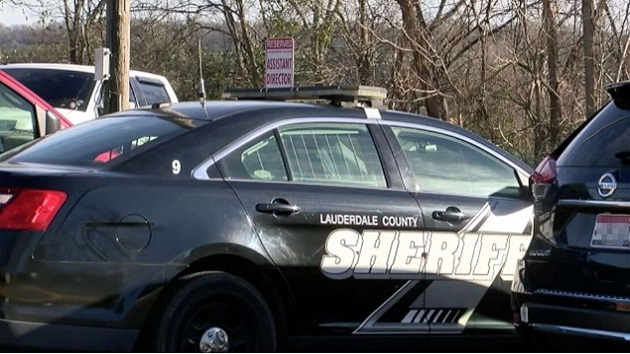
(OKMULGEE, Okla.) — Four close friends who mysteriously disappeared in Oklahoma were killed in a “violent” shooting at a scrapyard, dismembered and thrown in a river, according to police.
The owner of the scrapyard, Joe Kennedy, is a person of interest in the quadruple murder, Okmulgee Police Chief Joe Prentice said at a news conference Monday.
Prentice said authorities want to speak to Kennedy, who is missing, and stressed that he has not been named a suspect.
The victims, Mark Chastain, 32, Billy Chastain, 30, Mike Sparks, 32, and Alex Stevens, 29, were last seen leaving one of their homes in Okmulgee on the night of Oct. 9, reportedly riding bicycles, according to Okmulgee police.
“I’ve worked over 80 murders in my career … but this case involves the highest number of victims and it’s a very violent event,” the chief said.
The victims planned to commit a crime that night, Prentice said Monday, citing an individual who had been asked to participate but declined. Police do not know what the alleged planned crime involved.
Their four dismembered bodies were found in a river on Friday.
There’s nothing to indicate any relationship between Kennedy and the victims, Prentice said. Kennedy has denied knowing them, he added.
The victims’ bicycles remain missing, police said.
ABC News’ Nadine El-Bawab and Irving Last contributed to this report.
(NEW YORK) — The East Coast of the U.S. will need to brace for more devastating storms like hurricanes Fiona and Ian should the global reliance on fossil fuels remain business as usual, scientists are warning.
Warming temperatures around the world are the root contributor that will cause more storm systems to behave like Fiona and Ian, with increased moisture and the likelihood of rapid intensification as they head toward land, according to a study published in Geophysical Research Letters on Monday.
This will make the Atlantic Coast of the U.S. a “breeding ground” for rapidly intensifying hurricanes, the researchers said.
Scientists at the Department of Energy’s Pacific Northwest National Laboratory studied data over the past four decades of hurricane activity and the conditions that shaped them and found that the rates at which hurricanes strengthen near the U.S. Atlantic Coasthave significantly climbed since 1979.
The direct observations made by the researchers showed that the increase was “very likely due to climate change,” Karthik Balaguru, a climate scientist at the Pacific Northwest National Laboratory and author of the study, told ABC News.
The trend will likely continue if the current level of greenhouse gas emissions continues around the world, according to the study.
A mix of environmental conditions caused by a unique phenomenon along the Atlantic Coast makes it more conducive to hurricane development, Balaguru said.
Land is already generally warmer than ocean waters. Still, as greenhouse gases build and global temperatures rise, land is heating up much more rapidly, and the ocean and the difference in temperature between land and ocean continue to grow, Balaguru said. The increase in the temperature difference between the land and the sea can create stronger storms, he added.
“Unlike the ocean with unlimited water supply, there’s much less water in soil,” Ruby Leung, an atmospheric scientist at the Pacific Northwest National Laboratory, said in a statement. “That means the land can’t evaporate as much as water, so it can’t get rid of the extra heat trapped by greenhouse gases as quickly as the ocean.”
The same mix of hurricane-favoring conditions doesn’t appear in the Gulf of Mexico but could form in other regions, including those near the East Asian coastline and the northwest Arabian Sea, the researchers said.
Combined with warmer ocean waters and greater atmospheric humidity, these conditions allow the storm systems to jump multiple storm categories in a short amount of time, according to the study. And because of the speed of the strengthening, the storms can often elude meteorological predictions, even with modern-day technology, the researchers said.
Last month, Hurricane Fiona caused widespread destruction in Puerto Rico — five years after Hurricane Maria wiped out much of the island’s infrastructure. Just 10 days later, Hurricane Ian did the same to southwest Florida, completely decimating Sanibel Island and Fort Myers Beach with deadly storm surge and catastrophic winds. Both storm systems strengthened into powerful Category 4 hurricanes before landfall.
Damage from weather and climate disasters could exceed $100 billion by the time 2022 comes to a close, the National Oceanic and Atmospheric Administration announced last week.
A study published in Nature in January found that annual costs of flooding alone in the U.S. could climb by 26% to $40.6 billion by 2050 as a result of climate change.
(HARRISONBURG, Va.) — A 20-year-old man was arrested Sunday on suspicion of shooting eight people at an outdoor gathering near the campus of James Madison University in Harrisonburg, Virginia, police said.
The suspect was identified as Tyreaf Isaiah Fleming of Harrisonburg, according to a statement the Harrisonburg Police Department posted on Twitter Sunday afternoon, about 15 hours after the gunfire erupted at a gathering outside an off-campus apartment complex.
Fleming is facing charges of attempted murder, aggravated malicious wounding, possession of a firearm by a convicted felon and the use of a firearm during the commission of a felony, according to police. Additional charges are expected as the investigation continues.
The gunfire broke out at about 2:20 a.m. Sunday in a neighborhood southwest of the James Madison University campus, police said. Police initially said at least one gunman “fired multiple times into a crowd at an outdoor gathering.”
Police are also investigating if more suspects were involved in the shooting, authorities said.
All of the victims suffered non-life-threatening gunshot wounds, according to police. Five of the victims were taken to nearby Sentara RMH Medical Center and three others were treated at the University of Virginia Medical Center, authorities said.
The victims ranged in age from 18 to 27. It was not immediately clear if any students from James Madison University were among those injured.
“The incident occurred at 2:20 a.m., when an unknown individual or individuals fired multiple times into a crowd at an outdoor gathering,” Harrisonburg police said in a statement.
No suspects were at the scene when officers arrived and began administering aid to those injured, police said.
While the circumstances of the shooting remain under investigation, police officials said it appeared to be an isolated incident and said, “there is not believed to be any threat to the greater community at this time.”
Police said anyone with information about the shooting can call the agency’s tip line at (540) 574-5050.
(NEW YORK) — One of the winning tickets to Friday’s Mega Millions jackpot was sold in Fort Myers, Florida, weeks after Hurricane Ian devastated the area.
Ticket holders in California and Florida matched all six numbers on Friday night, winning $494 million on Friday, lottery officials said in a news release.
Friday’s jackpot was the 11th largest in the game’s history, according to the game’s officials.
The winning ticket in Fort Myers comes at a critical time for the Florida city.
Last month, Hurricane Ian struck Florida’s west coast as a Category 4 hurricane, destroying homes and businesses with winds that topped 150 mph, particularly in Lee County, Florida, where Fort Myers is located.
At least 127 people in the state have died due to Hurricane Ian, local officials said.
As for the winning ticket, it’s the first Mega Millions jackpot win since two people won the $1.337 billion prize in Illinois on July 29, officials said.
The winning numbers were 9, 22, 26, 41 and 44, plus the gold Mega Ball 19.
(RALEIGH, N.C.) — The teenager suspected in the fatal shootings of five people in Raleigh, North Carolina, is still in “grave” condition, a law enforcement official briefed on the investigation into the mass shooting told ABC News.
The 15-year-old was taken into custody with life-threatening injuries following a standoff with police last Thursday after the shootings occurred, according to a memo issued by the Department of Homeland Security and obtained by ABC News. It’s not clear whether the suspect’s injuries were self-inflicted, the memo said.
The teen, who has not been named, is still in the hospital in critical condition with life-threatening injuries, the official said on Sunday. While the investigation into whether the suspect’s injuries are the result of a self-inflicted gunshot wound, detectives believe responding police fired at the suspect, so officer-involved-shooting protocols are being followed, the official said.
Raleigh Police Chief Estella Patterson will file a five-day report to the Raleigh city manager on Oct. 20, which will include a detailed outline of the events during the shooting, Julia Milstead, public information officer for the city of Raleigh, told ABC News.
The report will include details on the suspect’s injuries and the type of weapon that was used in the shooting, Milstead said.
Five people were killed and two injured during the shooting, which took place in the vicinity of the Neuse River Greenway Trail in Raleigh, authorities said.
The crime scene spans over 2 miles, Patterson said. Among the victims were an off-duty police officer and a relative of the suspect, the official said. A police dog was also injured but is expected to recover, the official said.
The suspect first shot two people in the streets of the neighborhood before fleeing toward the nature trail, where he opened fire, killing three more people and wounding two others, Patterson told reporters during a news conference on Thursday.
Detectives are continuing their effort to piece together a possible motive for the shooting, the official told ABC News. A search of his juvenile records has not revealed a criminal history, the official added.
Officers searched the suspect’s home on Friday and so far have not found any social media footprint for the suspect, the official said, adding that investigators are going through handwritten material.
ABC News’ Meredith Ferrell, Elwyn Lopez, Josh Margolin, Emily Shapiro and Morgan Winsor contributed to this report.
(CHICAGO) — A 13-year-old boy was among five people killed in unrelated shootings across Chicago over the weekend, which also left 20 others injured, according to police.
The violent weekend in the nation’s third largest city erupted despite a 20% drop in shootings in Chicago through the end of summer, according to Chicago police crime statistics. Homicides have also plummeted 16% from last year, according to the statistics.
Despite recent efforts by police to curb shootings, at least 25 people were shot in Chicago between Friday evening and Sunday afternoon, according to a review of weekend crime incidents by ABC News.
Last weekend, 30 people were shot, two fatally, in gun violence across the Chicago, police said.
Boy sitting on park bench killed
The youngest victim shot to death over the weekend was identified as 13-year-old Lavel Winslow, according to the Cook County Medical Examiner’s Office. The boy was fatally shot while attending a friend’s birthday party at Lerner Park on the city’s North Side.
The shooting unfolded around 10 p.m. Friday, according to police.
“Witnesses heard loud pops followed by multiple people fleeing the area on foot,” police said in an incident report.
Winslow was found sitting on a park bench with a bullet wound to the head, according to police. He was taken to St. Francis Hospital in Chicago, where he was pronounced dead.
The shooter fled the scene on foot, police said. No arrests were announced as of Sunday afternoon.
The victim was an eighth-grader at West Ridge Elementary School in Chicago and had just been moved into an advanced math class, his mother told the Chicago Tribune.
“I’m just going to miss him coming in and talking to me, laying his head on my shoulder,” Vanessa Winslow said of her son, describing him as “extremely smart” and a “social, kind, just a lovable young man.”
At least 283 juveniles have been shot, 33 fatally, in Chicago this year, according to crime data analyzed by ABC station WLS-TV in Chicago.
Teenager found dead outside home
A 17-year-old boy was shot to death in the Back of the Yards neighborhood of Chicago South Side, according to police.
The teenager, whose name has not been released, was found shot multiple times just after midnight Saturday, police said. He was taken to the University of Chicago Medical Center, where he was pronounced dead.
A resident of the area found the teenager unresponsive after hearing multiple gunshots outside his home, police said.
Detectives were working Sunday to identify the killer. No arrests were announced.
Hotel lounge killing
A fight that erupted inside a hotel lounge in the Old Town Triangle neighborhood of Chicago ended in a shooting that left a 35-year-old man dead and his killer on the run, according to police.
The shooting occurred around 1:21 a.m. Sunday. Police said the victim was shot in the chest during a physical altercation.
The victim, whose name was not immediately released, was pronounced dead at Masonic Medical Center in Chicago.
The suspected gunman fled the hotel lounge and police were working Sunday to identify him. No arrests were announced.
Fatally shot in the back
Two people were shot, one fatally, when gunfire broke out in a third-floor hallway of a building on Chicago’s South Side, police said. The shooting unfolded around 11 p.m. Saturday, police said.
A 27-year-old man, whose name was not immediately released, died at the scene from a gunshot wound to the back, authorities said. A 25-year-old woman was shot in the left leg during the incident, according to police.
No arrests have been made.
Fatal home invasion
A 22-year-old man was shot to death when a gunman forced his way into the victim’s apartment and shot him multiple times, according to police.
The shooting occurred just after 5 p.m. on Saturday at a home in the North Lawndale section of Chicago’s West Side.
The victim was pronounced dead at the scene from gunshot wounds to his back and chest, according to police.
No arrests were announced.
60-year-old man shot on a train
Among 20 people wounded in shootings over the weekend was a 60-year-old man, who was shot multiple times while riding on a Red Line train early Saturday, according to police.
The victim, whose name was not released, was taken to the University of Chicago Medical Center in critical condition, authorities said.
The suspected gunman remained at large on Sunday. The suspect fled the train when it stopped at the 87th Street Station in the Chatham neighborhood of the city’s South Side.
The shooting unfolded just after 6 a.m. when the victim and the suspect got into an argument, according to police.
Among the other non-fatal shootings over the weekend, a 62-year-old man police alleged was attacking a woman with a knife was shot by a woman who intervened.
The incident occurred just after 8 p.m. on Friday in the Humboldt Park neighborhood in the northwest area of the city. Police said a 33-year-old woman was attempting to enter a residential building when she was attacked by the knife-wielding assailant, who stabbed her in the hand and leg, police said.
An armed 54-year-old woman interrupted the attack and shot the assailant in the chest, police said. The alleged perpetrator was taken to Mount Sinai Hospital in critical condition.
The woman who shot the suspect was taken to a police station for questioning. No charges were announced and the incident remains under investigation.
(HARRISONBURG, Va.) — At least eight people were injured early Sunday near the campus of James Madison University in Harrisonburg, Virginia, when gunshots were fired into a crowd gathered outside an off-campus apartment complex, police said.
The gunfire broke out in a neighborhood southwest of the university, police said.
No arrests were announced as investigators were working to identify a suspect or suspects in the shooting, according to the Harrisonburg Police Department.
All of the victims suffered non-life-threatening gunshot wounds, according to police. Five of the victims were taken to nearby Sentara RMH Medical Center and three others were treated at the University of Virginia Medical Center, authorities said.
The victims ranged in age from 18 to 27. It was not immediately clear if any students from James Madison University were among those injured.
“The incident occurred at 2:20 a.m., when an unknown individual or individuals fired multiple times into a crowd at an outdoor gathering,” Harrisonburg police said in a statement.
No suspects were at the scene when officers arrived and began administering aid to those injured, police said.
While the circumstances of the shooting remain under investigation, police officials said it appeared to be an isolated incident and said, “there is not believed to be any threat to the greater community at this time.”
Police said anyone with information about the shooting can call the agency’s tip line at (540) 574-5050.
(LOS ANGELES) — In Los Angeles, the county sheriff says local residents are in danger because “defunding has consequences” — even though his agency’s budget is up more than $250 million since 2019.
Sheriff Alex Villanueva is not alone in suggesting to voters that crime is up because Democrats defunded police agencies after nationwide protests following the 2020 murder of George Floyd by a Minneapolis police officer.
Politicians, pundits and police leaders across the country are repeating the accusation as they address concerns about crime heading toward Election Day.
Yet in many communities, defunding never happened.
ABC Owned Television Stations examined the budgets of more than 100 cities and counties and found that 83% are spending at least 2% more on police in 2022 than in 2019.
Of the 109 budgets analyzed, only eight agencies cut police funds by more than 2%, while 91 agencies increased law enforcement funding by at least 2%.
In 49 cities or counties, police funding has increased by more than 10%.
An ‘outbreak of crime’
Despite what the public record shows, an analysis of broadcast transcripts shows that candidates, law enforcement leaders and television hosts discussed the impact of “defunding the police” more than 10,000 times over the last two years, according to the Internet Archive’s TV news transcripts dating back to June 2020 — and the mentions aren’t subsiding during this campaign season.
“In communities across the country, like in Los Angeles, San Francisco, New York, Chicago, so many other places, it is this remarkable, incredible, outbreak of crime,” Texas Gov. Greg Abbott said in a video posted on Twitter in August by the Republican Governors Association.
“You typically see where these crimes are taking place, there has been a de-emphasis of the role that law enforcement plays. It could be defunding law enforcement. It could be a reduction in law enforcement,” Abbott said.
Dr. Rashawn Ray, a sociologist and senior fellow at the Brookings Institution, told KABC in Los Angeles that this false narrative has persisted due to repetition by public officials.
“Overwhelmingly, cities, counties, police departments across the country are not being defunded in any way,” Ray said. “In fact, many of them have increased their budgets. Part of the reason why the ‘defund the police’ narrative has stayed around is because police officers say it and elected officials say it.”
ABC’s analysis of police budget data shows police spending has increased in some of the very cities frequently cited by conservative politicians and pundits as places where Democrats’ defunding has fueled violent crime waves.
The Los Angeles Police Department’s budget is up by 9.4% since 2019. San Francisco’s police budget is up by 4% and Philadelphia’s is up by 3%.
In Chicago, police spending is up 15%, representing almost a quarter billion dollars in new police spending since 2019.
In Houston, where the homicide rate nearly doubled in both 2020 and 2021 before starting to subside this year, local government officials have increased police spending by nearly 9% — almost $80 million — from 2019 to 2022.
President Joe Biden heralded this movement in his 2022 State of the Union address, saying, “The answer is not to defund the police. It’s to fund the police. Fund them!” — a line that drew bipartisan applause.
Perception versus reality
A few cities did try to reallocate police spending following concerns from advocacy groups in the wake of the George Floyd protests.
In Austin, Texas, leaders cut the police budget by about 30% in 2021, proposing to instead spend that money on programs like family violence prevention, mental health responders, and police oversight.
But that lasted only one year. The Texas legislature voted to bar cities in the state from decreasing police budgets, so Austin boosted police spending by 50% in 2022.
In Los Angeles County, where Sheriff Villanueva is engaged in a tight re-election battle, he’s been outspoken for months about the impacts of what he describes as the defunding of his agency, claiming that his budget is being “cannibalized.”
Yet records show his agency’s budget is up about 8% percent — more than $259 million — from 2019 to 2022.
“While the perception may be that defunding is taking place, in fact, the sheriff’s budget has increased,” County Supervisor Kathryn Barger said.
When asked by KABC about his defunding claims, Villanueva acknowledged that his budget is higher — but not enough to cover rising costs. He said that if day-to-day costs grow faster than his budget, that is “direct defunding, of course.”
Barger, in response, said that cost increases impact many county departments and are not unique to the sheriff’s department.
“He plays as though he’s being targeted,” Barger said of Villanueva. “And he’s not.”
In fact, Los Angeles County’s 2023 budget will increase the sheriff’s department budget by another quarter of a billion dollars.
An ‘impossible environment’
Some in law enforcement say that even more than budget cuts, what’s really hurt police departments is anti-police rhetoric.
Following Floyd’s murder in 2020, protesters in New York clashed with NYPD officers for days on end. Officers arrested hundreds of protesters each night, and the department says more than 300 officers were among those hurt.
Seeking accountability, some politicians called for $1 billion to be cut from the NYPD’s budget.
But the billion-dollar cut never happened. The NYPD’s budget fell by just 2.8%, dropping from $5.6 billion in 2019 to $5.4 billion in 2022.
Nevertheless, Police Benevolent Association President Patrick Lynch said the defund movement hurt officer morale.
“More than any budget cut, the greatest damage from the ‘Defund the Police’ movement was done by its anti-police, anti-public safety message,” Lynch told WABC in New York. “It has created an impossible environment on the streets, one where even the simplest interactions turn into a confrontation.”
The result was a massive NYPD exodus. Retirements in 2020 skyrocketed 72% from the previous year, and this year the NYPD lost more employees through the month of August than it had during that same time period in any previous year.
“As more cops quit, the workload becomes more crushing for those who remain,” Lynch said. “Public safety ultimately suffers.”
Being ‘all things to everybody’
Criminal justice experts say that even if the cuts were real, the premise that lower police spending leads to increased crime — or vice versa — is counter to decades of evidence, according to public data.
An ABC analysis of state and local police funding and overall violent crime data in the U.S. between 1985 and 2020 found no relationship between year-to-year police spending and crime rates. An analysis by the Washington Post found similar results from 1960 to 2018.
Further ABC analysis of Los Angeles County’s own crime data shows that, over the last decade, violent crime numbers haven’t moved up or down in relation to the amount of money spent on law enforcement or the number of officers on patrol.
Kimberly Dodson, a retired law enforcement officer who is now a criminologist at the University of Houston-Clear Lake, said that’s because police largely respond to crime instead of deter it.
“Crime happens. Somebody calls the police, and they come and take a report. Then they try to solve the crime after the fact,” Dodson told KTRK in Houston. “So saying that the police deter crime is not actually accurate, because they’re more of a reactive agency.”
Dodson said one reason police agencies feel stretched is because communities have been asking them to “be all things to everybody — and that doesn’t seem fair.”
For example, said Dodson, police these days are asked to respond to problems caused by longstanding mental health issues, family conflicts, or issues related to entrenched poverty that’s taken hold over decades.
“We always talked about, as police officers, we go out for 10 minutes and we fix something that’s been wrong and put a Band-Aid on it, something that’s been wrong for 10 years — and it’s just an impossible task,” said the former officer.
Changing that would mean changing the way emergency calls get handled, says Ray.
The Brookings Institution senior fellow is researching ways to narrow the mission of police so they only handle crime and safety, allowing government resources to be reallocated so problems not requiring police intervention could be handled by others.
“Are there better ways by which to think about calls for service, whether that be with mental health responses, whether that be with different sort of traffic officers handling those particular issues?” he said.
Such an arrangement could provide police even more time to focus on solving crimes and protecting people.
“It could actually free them up,” said Ray.
ABC’s John Kelly, Mark Nichols, Maia Rosenfeld, Lindsey Feingold, Nick Natario, Maggie Green, Lisa Bartley, Carlos Granda, Jared Kofsky and Tonya Simpson contributed to this report.
(STOCKTON, Calif.) — A suspected serial killer in the California city of Stockton was arrested Saturday and police say they believe he was “out hunting” when he was nabbed.
“We are sure we stopped another killing,” Chief Stanley McFadden, of the Stockton Police Department, said at a news conference Saturday.
Wesley Brownlee, 43, was arrested in connection with six unprovoked murders of men ages 21 to 54 over the last few months. He was booked on a homicide charge Saturday.
Police said that surveillance teams followed Brownlee while he was driving, and stopped in area of Village Green Drive and Winslow Avenue around 2 a.m. Saturday morning.
“Our surveillance team followed this person while he was driving. We watched his patterns and determined early this morning; he was on a mission to kill. He was out hunting,” McFadden said.
McFadden added, “As officers made contact with him, he was wearing dark clothing and a mask around his neck. He was also armed with a firearm when he was taken into custody.”
Brown will be arraigned Tuesday and more charges are likely, police said.
The San Joaquin County’s Office of the Medical Examiner identified the victims. Paul Yaw, 35, was killed on July 8; Salvador Debudey Jr., 43, died on Aug. 11; Jonathan Hernandez Rodriguez, 21, was killed on Aug. 30; Juan Cruz, 52, was the Sept. 21 victim; and Lawrence Lopez Sr., 54, was slain on Sept. 27.
The men were alone at the time when they were fatally shot, officials said. All of the killings took place at night or in the early morning hours, police said.
Another shooting, of a 46-year-old Black woman at Park Street and Union Street in Stockton at 3:20 a.m. on April 16, 2021, was also linked to the investigation, police said earlier this month. The woman survived her injuries in that shooting, they said.
Police said that a motive is not known for the killings but it is believed to have been intentional.
ABC News’ Mark Osborne and Emily Shapiro contributed to this report.
(NEW YORK) — Rap lyrics have been used by prosecutors in the U.S. for decades as alleged evidence in criminal cases, helping put rappers behind bars. But it wasn’t until lyrics were used in the indictment of hip-hop stars Young Thug and Gunna on gang-related charges that the controversial practice sparked a movement in the music industry and fueled a wave of support for legislation seeking to limit the practice.
“I will protect Black art like it’s my family because it’s my family,” Kevin Liles, the former president of Def Jam Recordings, told “Nightline,” adding that to him, this is not just about the lyrics – “our culture is on trial.”
Liles is backing federal legislation that would limit the use of rap lyrics in court and is joined by the top power players in the music industry, including the Recording Academy, the Recording Industry Association of America, Universal Music Group, Sony Music Group, Warner Records, Atlantic Records, Warner Music Group and the Black Music Action Coalition.
TONIGHT ON NIGHTLINE: R&B/Hip-Hop executive and activist @KevinLiles1 discusses rap music as it finds itself in the crosshairs of the justice system pic.twitter.com/oDJsqaAPQT
“I’m proud that the Recording Academy … that many of my friends – rock friends, pop friends, country friends, alternative friends, and jazz friends have joined the movement of protecting Black art,” Liles said.
The music industry also backed a California bill that was signed into law by Gov. Gavin Newsom earlier this month that limits the use of rap lyrics as evidence in court. A bill banning the practice is being proposed in New Jersey and one that limits the practice stalled in the New York state assembly last year.
Hip-hop artist Fat Joe, who is advocating for such legislation, told “Nightline” that the practice is “unfortunate.”
Referencing lyrics from rapper Rakim, “we like to exaggerate, dream and imaginate,” the Grammy-winning New York rapper said. “This is all art, and to actually use something that was just made up and use it against you in a trial, it’s very dangerous.”
TONIGHT ON NIGHTLINE: Rapper @FatJoe on his fight to get prosecutors banned from using hip hop lyrics against artists in court. pic.twitter.com/HIWrJIXnRn
Hip-hop artist E-40 backed the legislation in his home state of California and spoke with Newsom about the importance of the bill.
“Just like people write books, we write lyrics and make music and songs,” he told “Nightline. “Music is our art…and the goal is to protect our heart and our creative expression.”
TONIGHT ON NIGHTLINE: Rapper @E40 on his fight to stop hip hop lyrics from being used in court against the artists behind them. pic.twitter.com/cGoKu5ccjB
Attorney Areva Martin told “Nightline” that the growing movement could lead to change on the legislative front.
“As rappers become businessmen and as they become involved in social justice and social action movements, I think we are going to see some changes, at least in liberal states and liberal counties,” she said.
Referencing the lyrics of hip-hop artists in criminal charges – some of which mention acts of violence or criminal activity – is a practice that has drawn criticism from both freedom-of-speech advocates and the musicians themselves, who argue that introducing lyrics into case with the implication that they are reflections of reality, discounts rap as a form of artistic expression.
“Violence in music is nothing new. Whether it’s outlaw country music or rap music. But what I saw in my childhood is that rap was treated radically different,” said Atlanta hip-hop artist Killer Mike, who has been advocating against the practice for years.
According to Erik Nielson, the co-author of the 2019 book “Rap on Trial: Race, Lyrics, and Guilt in America,” rap lyrics used by prosecutors in court usually lack a factual connection to an alleged crime and are often used as a form of character evidence that could prejudice a jury and prevent a defendant from getting a fair trial.
“It’s absolutely racist,” Nielson said. “Rap music is the only art form that’s targeted this way.”
Nielson, who has served as an expert witness in close to 100 cases across the country in which rap lyrics were used as alleged evidence in court, has been advocating against the use of rap lyrics in court for years. He said that the indictment of Young Thug brought national attention to the controversial practice.
“This practice targets amateurs, up-and-coming artists who don’t have name recognition and who typically don’t have the resources to mount a vigorous defense,” Nielson said. “Young Thug is one of the most prominent artists to be caught in this web.”
Young Thug, whose legal name is Jeffrey Lamar Williams, was initially charged with one count of conspiring to violate the state’s Racketeer Influenced and Corrupt Organizations (RICO) Act and one count of participating in street gang activity, according to charging documents obtained by ABC News. He now also faces six additional drugs and weapons charges after law enforcement searched his home following his arrest.
“Mr. Williams has committed no violation of law, whatsoever. We will fight this case ethically, legally and zealously. Mr. Williams will be cleared,” Young Thug’s attorney Brian Steel told ABC News.
Meanwhile, Grammy-nominated rapper Gunna, whose real name is Sergio Kitchens, was charged with one count of conspiring to violate the RICO Act.
“Mr. Sergio Kitchens, known as Gunna, is innocent. The indictment falsely portrays his music as part of criminal conspiracy,” the rapper’s attorneys, Steve Sadow and Don Samuel, told ABC News.
Both rappers pleaded not guilty and were repeatedly denied bond.
Their trials were scheduled for January 2023, Fulton County District Attorney Fani Willis requested a 2-month delay.
Although the scope of the indictment, which names 28 individuals, goes far beyond the lyrics, the use of rappers’ lyrics as part of the alleged evidence is what has drawn pushback from the music industry.
“We gotta stop somewhere,” Liles said. “… that next kid that’s coming up on YouTube, that next kid that’s thinking about being creative, I’m fighting for them too.”
But Willis argued that Young Thug is the ringleader of the YSL gang and his lyrics are fair game.
The district attorney defended the use of lyrics as alleged evidence in the YSL indictment, saying in a May 10 press conference, “the First Amendment does not protect people from prosecutors using it as evidence.”
“We put it as overt within the RICO count because we believe that’s exactly what it is,” she added.
The DA’s office did not immediately reply to ABC News’ request for comment.