(LOS ANGELES) — A hospital in California is experiencing a baby boom of multiples in its neonatal intensive care unit.
Cedars-Sinai Guerin Children’s hospital in Los Angeles is currently caring for one set of quadruplets in its NICU, as well as eight sets of twins.
The quadruplets were born on July 4, a hospital spokeswoman told ABC News’ Good Morning America.
Prior to that, the NICU had been caring for 10 sets of twins, but two sets were recently discharged, according to Bevin Merideth, R.N., the NICU’s associate director of nursing.
“We’re used to having multiples in the NICU. It’s not uncommon for multiples to not be able to carry to term,” Merideth told GMA. “It’s not something that’s uncommon in the NICU, but it was like four twins, five twins, six twins, and once we got to 10, we realized this is a record.”
“It’s almost half our unit,” Merideth added, noting the hospital’s NICU has 45 beds total.
Caring for a record number of twins in the NICU is especially poignant for Merideth, who was a teenager when her twin sisters were born at Cedars-Sinai Guerin Children’s and cared for in the same NICU where she now works.
“They were my first preemie babies, I call them,” said Merideth, who noted seeing her twin sisters cared for so well helped inspire her career choice. “I immediately was like, ‘I want to be a NICU nurse,’ and have never left the NICU. I started in the NICU and have been here 25 years.”
Merideth said some of the twins currently in the NICU have been there for as long as six or seven weeks, while others entered more recently. She noted there is no explanation for the multiples baby boom, saying, “It just happened.”
Merideth said she’s watched as the newborns’ parents have bonded over being the new parents of multiples as they pass the time in the NICU.
“Just walking, you see them talking to each other,” Merideth said. “Just having something in common, they’ve bonded over it.”
Samantha Pearlman’s twin daughters have been in the NICU for six weeks, a time during which she said she’s connected with many of the other parents of twins.
“I love that there are multiple twins in the NICU with us. I found out just by being in the same bay with them or getting to know some of the parents and exchanging numbers,” Pearlman said in a video shared by Cedars-Sinai Guerin Children’s. “We’ve been keeping in touch, which is really wonderful.”
“I was surprised there were two, let alone 10 sets of twins, but it’s been great to connect with other parents and see their journey,” added Jordan Edelstein, whose twin daughter and son are also being treated at the hospital. “It’s comforting to see so many other families experiencing the same thing.”
Merideth said she and her fellow nurses are already looking forward to keeping in touch with the record-breaking sets of twins as they get older.
“It’s always nice to see how they’re growing and thriving at home,” she said. “That’s why we do what we do, to see them being toddlers and kids and graduating. It’s very hopeful.”
(NEW YORK) — By the end of 2022, about one in four American adults and older teenagers still hadn’t contracted COVID-19, according to new federal data.
The Centers for Disease Control and Prevention has been tracking seroprevalence — antibodies in the blood — by collecting samples nationwide from blood donors between January and December 2022
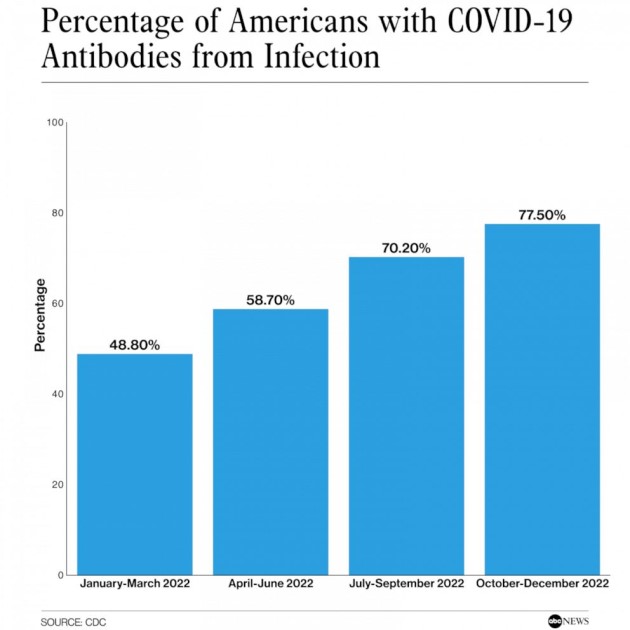
The data suggests 77.5% of those aged 16 and older had antibodies from COVID-19 infection by the time 2022 ended, according to the agency’s final estimates, which is up from the 48.8% estimate at the beginning of the year.
Meanwhile, when including people who had antibodies either from infection, by getting vaccinated or from a combination of the two, the CDC estimated that’s about 96.7% of the population.
When it came to age groups, seniors aged 65 and older had the lowest estimated percentage of people with antibodies from prior infection at 56.5% and teens and young adults aged 16 to 29 had the highest percentage at 87.1%.
CDC
Only 47 states and the District of Columbia had seroprevalence data, which showed Vermont had the lowest percentage of estimated residents with infection-induced antibodies at 64.4% and Iowa had the highest at 90.6%.
There were no major differences between men and women with 79.3% and 75.7%, respectively, estimated to have antibodies from infection.
Among racial/ethnic groups, Asian Americans had the lowest estimated percentage of infection-induced antibodies at 66.1% and Hispanic Americans had the highest percentage at 80.6%.
“Despite the fact that the various COVID variants are so very contagious, isn’t it remarkable that, by the end of last year, only three-quarters — plus a little bit — of our population had had an infection and that may be a little but surprising,” Dr. William Schaffner, a professor of preventive medicine and infectious diseases at Vanderbilt University Medical Center, told ABC News.
Experts said there are a few reasons why Americans may have yet to contract COVID-19 including living being more diligent about mitigation measures such as mask-wearing and living in a more rural area.
“We have a large rural population in the United States, and it may be that this virus has not reached everyone who lives in a more sparsely populated part of the country,” Schaffner said. “Obviously, if you live in big cities where you encounter people, there are going to be many more opportunities for transmission.”
Experts added it’s also a reminder of the importance of vaccination and that it’s not too late to get a shot for those who have yet to do so.
In April, the CDC and Food and Drug Administration simplified the vaccine schedule to recommend everyone aged 6 and older receive an updated bivalent COVID-19 vaccine, regardless of whether they previously completed their monovalent primary series.
Additionally, the FDA’s vaccine advisory committee recommended in June that vaccine manufacturers update their COVID booster shots to target XBB.1.5, which is the most common strain in the U.S.
Dr. Peter Chin-Hong, an infectious diseases specialist at the University of California, San Francisco, told ABC News the simplified schedule is especially important as we approach fall and colder weather, when cases typically tend to rise.
“It’s not too late to still be open-minded about protection, particularly since one in four is not a small number,” he said. “Many people have already been exposed naturally but we know that [antibodies] will wane over time, and it’s probably a good idea to get at least one recent shot…Simplification is the name of the game.”
(NEW YORK) — By the end of 2022, about one in four American adults and older teenagers still hadn’t contracted COVID-19, according to new federal data.
The Centers for Disease Control and Prevention has been tracking seroprevalence — antibodies in the blood — by collecting samples nationwide from blood donors between January and December 2022
The data suggests 77.5% of those aged 16 and older had antibodies from COVID-19 infection by the time 2022 ended, according to the agency’s final estimates, which is up from the 48.8% estimate at the beginning of the year.
Meanwhile, when including people who had antibodies either from infection, by getting vaccinated or from a combination of the two, the CDC estimated that’s about 96.7% of the population.
When it came to age groups, seniors aged 65 and older had the lowest estimated percentage of people with antibodies from prior infection at 56.5% and teens and young adults aged 16 to 29 had the highest percentage at 87.1%.
CDC
Only 47 states and the District of Columbia had seroprevalence data, which showed Vermont had the lowest percentage of estimated residents with infection-induced antibodies at 64.4% and Iowa had the highest at 90.6%.
There were no major differences between men and women with 79.3% and 75.7%, respectively, estimated to have antibodies from infection.
Among racial/ethnic groups, Asian Americans had the lowest estimated percentage of infection-induced antibodies at 66.1% and Hispanic Americans had the highest percentage at 80.6%.
“Despite the fact that the various COVID variants are so very contagious, isn’t it remarkable that, by the end of last year, only three-quarters — plus a little bit — of our population had had an infection and that may be a little but surprising,” Dr. William Schaffner, a professor of preventive medicine and infectious diseases at Vanderbilt University Medical Center, told ABC News.
Experts said there are a few reasons why Americans may have yet to contract COVID-19 including living being more diligent about mitigation measures such as mask-wearing and living in a more rural area.
“We have a large rural population in the United States, and it may be that this virus has not reached everyone who lives in a more sparsely populated part of the country,” Schaffner said. “Obviously, if you live in big cities where you encounter people, there are going to be many more opportunities for transmission.”
Experts added it’s also a reminder of the importance of vaccination and that it’s not too late to get a shot for those who have yet to do so.
In April, the CDC and Food and Drug Administration simplified the vaccine schedule to recommend everyone aged 6 and older receive an updated bivalent COVID-19 vaccine, regardless of whether they previously completed their monovalent primary series.
Additionally, the FDA’s vaccine advisory committee recommended in June that vaccine manufacturers update their COVID booster shots to target XBB.1.5, which is the most common strain in the U.S.
Dr. Peter Chin-Hong, an infectious diseases specialist at the University of California, San Francisco, told ABC News the simplified schedule is especially important as we approach fall and colder weather, when cases typically tend to rise.
“It’s not too late to still be open-minded about protection, particularly since one in four is not a small number,” he said. “Many people have already been exposed naturally but we know that [antibodies] will wane over time, and it’s probably a good idea to get at least one recent shot…Simplification is the name of the game.”
(NEW YORK) — Maternal mortality rates doubled for every race and ethnicity in the past two decades, according to a new modeling study.
Researchers estimated maternal mortality rates — which includes the death of women occurring up to one year after the end of pregnancy per 100,000 live births — from 1999 to 2019.
The current study estimated that Black women experienced more than double the rate of maternal death compared to their white counterparts, and almost triple the rate compared to Hispanics.
American Indian and Alaska Native women were also at some of the highest risk and experienced the greatest increase over the 20-year study.
“Maternal mortality persists as a source of worsening disparities in many U.S. states and prevention efforts during this study period appear to have had a limited impact in addressing this health crisis,” the authors wrote in the new analysis.
The findings largely support those seen from other data, that pregnancy-related death rates are increasing in the United States, with the highest burden on Black women. In 2021, the maternal mortality rate in the U.S. was 32.9 deaths per 100,000 live births, according to a Centers for Disease Control and Prevention report. However, the rate for Black women was 69.9 deaths per 100,000 live births.
The majority of pregnancy-related deaths take place between a week and a year after delivery, CDC data shows. Most pregnancy-related deaths are preventable, according to the CDC.
Experts aren’t entirely sure why maternal mortality rates have risen so dramatically.
“That is the million-dollar question…why in a country that spends so much money on health care, do we still see these devastating outcomes, particularly when we compare our outcomes to similarly wealthy nations?” Dr. Elizabeth Langen, associate clinical professor of obstetrics and gynecology at the University of Michigan, told ABC News.
A myriad of issues could contribute to the alarming rates, including underlying health conditions people have going into pregnancy.
“It’s a form of structural racism. But when we look specifically at why this happened, there are multiple layers to it,” Dr. Jessica Shepherd, chief medical officer at Verywell Health, told ABC News.
“If you just look at health outcomes in America, you know that most chronic diseases are seen in African American communities and so when you have some of these diseases, namely hypertension, diabetes and obesity, that are present before pregnancy, those are also going to be, what we would say comorbidities, that are going to impact the maternal mortality rate,” she added.
There also isn’t enough structural support given to people during and after pregnancy.
“We are often struggling with helping people have appropriate time off work for health care, appropriate considerations for pregnancy, so that people can either see their doctor or take breaks when needed,” Langen said.
Providers and hospital systems as a whole may also need to adapt in order to enforce a change. The “Hear Her” campaign launched by the CDC aims to increase awareness of pregnancy-related complications for patients and to encourage people who are pregnant to advocate for themselves in health care settings. It’s important for providers to take concerns seriously, especially from Black women.
“We have implicit bias that’s going to impact a patient to provider interaction,” Shepherd said.
“And that is going to cause maybe mistrust or people missing appointments or not going to their appointments or maybe even the messaging and what’s going on with management,” she added.
Expectant mothers may benefit from maintaining a healthy diet and weight, being physically active, quitting substance use and preventing injuries, according to the CDC. Staying in contact with a health care provider may also reduce the risk of complications.
“I think optimizing your personal health, if you have the privilege to be able to do that, is a great first step. If pregnant people start a pregnancy healthy, that certainly gives them the best chance for having a healthy pregnancy outcome,“ Langen said.
(NEW YORK) — Jackie Miller James, a beauty influencer who suffered a brain aneurysm while nine months pregnant, has woken up from a coma and reunited with her baby, according to her family.
“We are beyond thrilled to share that your loving prayers for Jackie have been working!” James’ family wrote in an Instagram post Sunday. “Jackie is awake and was recently transferred to one of the best neurological rehabilitation hospitals in the country.”
James’ family had confirmed in a June 8 Instagram post that she had “suffered an aneurysm rupture one week from her due date” in May and had been placed in a medically induced coma.
James had severe brain bleeding and injury after the aneurysm rupture and underwent an emergency cesarean section and brain surgery, a spokesperson for the family told ABC News in early June. Her story highlighted the risks of a potential stroke during pregnancy, a condition the Centers for Disease Control and Prevention note can be more likely to occur since pregnancy can make the blood clot more, potentially causing a blood vessel obstruction.
After birth, James’ baby spent time in a hospital neonatal intensive care unit, but the baby was discharged home in early June, James’ sisters said.
In their latest update, James’ family said, “Doctors have been pleased upon her latest tests, numbers, and evaluations, noting that Jackie is performing above expectations at this stage of her recovery and is progressing more with every passing day.”
The family said James has a “long road to recovery,” but that her baby girl “is a constant source of light for the entire family.”
“Jackie has also recently been reunited with her baby, and spends a great deal of each day with her entire family while in the hospital,” the family wrote.
James, a California-based influencer, is popular among her social media fans, with over 81,000 Instagram followers and over 5,000 TikTok followers. She shared posts throughout her pregnancy, giving her followers updates into her third trimester.
James’ family added in their update that with James now awake, any subsequent new posts will be from James “if and when she is ready.”
(NEW YORK) — Five-year-old Penelope Sapia was diagnosed with a rare disease at birth. Ever since then, her mother, Gillian Sapia, has had to become well-versed in the complex world of Medicaid enrollment — the only way the family affords the constant brain scans, kidney tests and seizure medications that Penelope needs to treat her classic galactosemia, a genetic metabolic disorder.
That’s why Gillian Sapia, a former nurse turned full-time caretaker for her daughter, was stunned when she received a text from Penelope’s occupational therapist in May. Penelope no longer had Medicaid, the therapist texted, and she wouldn’t be able to get treatment again until she did.
“I was crying all day,” said Sapia, who wasn’t sure if she’d made a mistake renewing her daughter’s Medicaid or if there had been a mistake in the system. “It was just so overwhelming and so defeating because I really do — my whole life is taking care of her. I’m her caretaker. And I felt like a bad mom.”
Sapia knew that their home state of Florida, along with a handful of other states, had begun combing through Medicaid rolls to make sure everyone was still eligible — as required with the end this year of the federal government’s public health emergency for COVID-19.
Nonetheless, Sapia had expected to remain enrolled because, she said, she applied for renewal and hadn’t heard otherwise from the state Medicaid office.
Instead, Sapia said that text from her daughter’s occupational therapist kicked off a three-week period of daily calls, often with hourslong hold times, to reach agents with the Florida Department of Children and Families (DCF). When she couldn’t get answers there, she turned to health advocates and lawyers who took up her case.
In that time, the Sapias said, they spent about $1,000 a week to keep up with Penelope’s health care needs as they struggled to find out why she lost her Medicaid coverage — and how to get it back.
Three weeks later, after working with lawyers and a health advocacy group called the Florida Health Justice Project, Sapia said she got a call carrying good news: Penelope was back on Medicaid.
But the Sapias say they still don’t have a clear answer for why they were suddenly removed in the first place.
DCF declined to comment to ABC News on Penelope’s case, citing privacy concerns, and a spokesperson did not respond to a detailed list of questions for this story. But the spokesperson maintained that “everyone that is removed from Medicaid receives a final notice informing them of the reason for termination.”
Sapia said that wasn’t her experience.
“They didn’t even tell me that I was dropped. And I went through all of my letters to see where I was dropped, and there was absolutely not a single letter in my profile online,” she said. “No answers whatsoever.”
In May, the same month the Sapias were removed from Medicaid, Florida removed around 250,000 other enrollees — and nationwide, more than 1.5 million Americans have lost coverage in the last four months, according to an analysis of available data from at least 25 states by the nonpartisan health policy center KFF.
Why Medicaid is undergoing a huge review
The massive shift in health care coverage — potentially the biggest since the country implemented the Affordable Care Act 10 years ago, experts have said — started in the spring, when the country officially moved out of the pandemic’s emergency phase, first declared by the federal government in 2020.
States had been given additional federal funding for the last three years to provide continuous Medicaid coverage, ensuring no one lost health care amid the throes of COVID-19.
The end of the emergency, in May, also meant the end of the federal money and states could once again begin reviewing their Medicaid rolls, asking people to renew their coverage and prove they’re still eligible for government-funded health care. Florida began redetermining Medicaid eligibility on May 1 and will be updating the coverage rolls each month through March 2024.
In Arkansas, where at least 110,000 people have lost coverage so far, according to KFF, Republican Gov. Sarah Huckabee Sanders has pledged to carry out the process in half the time the federal government called for states to use. Huckabee has called the Medicaid rollbacks “necessary” to help get the program “back to normal.”
“We’re simply removing ineligible participants from the program to reserve resources for those who need them and follow the law,” she wrote in an op-ed for The Wall Street Journal in May.
Nearly all states will have begun their redetermination processes by July, and about half the country already has.
In all, 15 million people could get removed from the Medicaid rolls during the redetermination process, the U.S. Centers for Medicare and Medicaid Services (CMS) estimates.
Up to 7M Americans may lose coverage unnecessarily
The concern of health advocates, though, is for people like the Sapias, who seemingly slip through the cracks of bureaucracy.
With such a big undertaking after three years, Medicaid officials estimate that there could be roughly 7 million people who are still eligible but lose their coverage anyway.
“That is of paramount concern to us,” Dan Tsai, who oversees federal Medicaid efforts for CMS, told ABC News in an interview.
The estimate comes from historical data, Tsai said, which shows that before the pandemic, people struggled to keep up with regular reapplications for Medicaid coverage. Procedural errors, missed notices and confusion are known factors in part to blame for eligible recipients losing coverage, he said.
“Because of the Medicaid renewal process, which is often very paper-based, you have individuals in the program — kids, families, parents — losing coverage for a period of time and often not knowing it until they show back up at the doctor’s office,” he said.
Referring to the 15 million expected to lose Medicaid coverage with the end of COVID-19 funding, Tsai said, “We know and have estimated that roughly half of that … will be people that are still eligible and lose coverage. Not because their income has changed but because of red tape, of not getting a piece of paper in the mail or knowing that they were up for renewal and needing to submit and return a form to the state.”
In Florida, for example, 82% of those removed from the Medicaid rolls in May lost coverage because of “procedural reasons,” according to a KFF analysis of the Florida redetermination data from May. That meant people didn’t fill out a form correctly or submit it in time, or perhaps moved homes and missed a letter notifying them of the change in the mail.
By contrast, 18% of the 250,000 people in Florida were removed in May because they were ineligible, KFF found, usually meaning they’d found employer-sponsored health care or they now made too much money to qualify for the low-income program and were transferred over to coverage through the ACA, also known as “Obamacare.”
DCF did not respond to ABC News’ multiple requests for comment regarding KFF’s findings.
While it’s still unclear why Penelope Sapia was temporarily removed from Medicaid coverage, experts who reviewed her case pointed out that Florida’s plan pledges to keep children with medically complex conditions enrolled until the end of the redetermination process.
Because of that, the Sapias expect her to have coverage until they go through the renewal again in March 2024 — but her story raises concern about the state’s process, said Joan Alker, executive director of the Center for Children and Families at Georgetown University.
Across the country, Alker said, it will be a challenge to navigate such a far-reaching process without dropping people from coverage unnecessarily.
“This is a really heavy lift. We see mistakes are made. Families don’t get the letter, they don’t understand the letter, they have a hard time getting help,” she said.
While the DCF wouldn’t comment on Penelope Sapia, the department’s deputy chief of staff, Mallory McManus said they are “utilizing an aggressive text and email effort in addition to traditional mail.”
“If all of those efforts are unsuccessful, we are calling recipients to inform them that their redetermination is past due and to encourage them to respond to the Department,” McManus told ABC News.
Tsai, at CMS, said his department has been working for two years to get states to streamline their processes in order to lessen the blow when redeterminations inevitably began again.
“So much of the work and the strategies we put on the table, the all-hands-on-deck moment now, is to help make sure that everybody eligible is aware of what’s happening, has a chance to update their contact information with the state and really is able to return the renewal form to keep their coverage,” he said.
“There’s more to do,” he acknowledged. “And indeed, some states have taken us up on every option and strategy that we’ve put on the table. Some states have taken up fewer of those.”
But the “bottom line” is this, he said. “We’re really encouraging and urging our state partners and others to really adopt, take up, do everything in your power, to do everything to keep people covered.”
ABC News’ Eric Fayeulle and Benjamin Siegel contributed to this report.
(NEW YORK) — Madonna is “home and feeling better” after her recent hospitalization, a source close to the pop star’s camp told ABC News on Thursday.
The “Material Girl” singer’s manager, Guy Oseary, had initially shared in a statement posted to Instagram on Wednesday that she was recovering after a stay in the intensive care unit with a “serious bacterial infection.”
“Her health is improving, however she is still under medical care,” Oseary said at the time, noting that she was first hospitalized on June 24. “A full recovery is expected.”
Oseary also said Wednesday that Madonna was postponing her upcoming Celebration tour due to the hospital stay. The global tour was set to begin July 15 in Vancouver.
“At this time we will need to pause all commitments, which includes the tour,” Oseary wrote. “We will share more details with you soon as we have them, including a new start date for the tour and for rescheduled shows.”
In January, the 64-year-old singer announced the tour with a video, which featured Jack Black, Judd Apatow, Lil Wayne, Amy Schumer and more.
The video ended with Schumer daring Madonna to go on a world tour and perform all her biggest hits.
The 35-city world tour included stops in Europe with a final show in Amsterdam on Dec. 1.
Following the announcement of her world tour, Madonna took to Instagram to thank her fans for the “love and support.”
“I don’t take any of this for granted,” she said. “I feel like the luckiest girl in the world and I’m so grateful for all your support. And I can’t wait to put this show together and have a moment with each and every one of you on the stage to celebrate the last four decades of my journey. I don’t take any of this for granted.”
This article was originally published on June 28, 2023.
(NEW YORK) — Madonna has been discharged after several days from a hospital intensive care unit and is now recovering from a “serious bacterial infection,” according to her manager Guy Oseary.
The iconic singer has also postponed her world tour, named “Celebration,” amid the health scare, which shines a spotlight on bacterial infections.
Although it isn’t clear what type of bacterial infection sent Madonna to the ICU, there are different types of bacterial infections that could require medical care.
ABC News chief medical correspondent Dr. Jen Ashton said bacterial infections can be caused by different sources.
“We can get infections caused by parasites, fungus, viruses and bacteria,” Ashton explained on Good Morning America Thursday.
Types of bacterial infections
Bacterial infections vary and can range from food poisoning and pneumonia to a urinary tract infection or UTI.
Some complications from bacterial infections, such as bacterial meningitis or sepsis, can be life-threatening medical emergencies. For bacterial meningitis, one may experience symptoms such as a sudden fever, stiff neck or nausea while for sepsis, where the infection spreads throughout the blood, symptoms may include a high heart rate, sudden fever or confusion.
If a bacterial infection requires an ICU stay, recovery depends on multiple factors.
“When you talk about someone who has been in an intensive care unit setting [where] they’ve been intubated with a breathing tube down their throat, their recovery depends on a number of factors — their baseline medical condition before they became sick, how long they were in the unit and intubated, whether other organs like lungs, brain, heart, or kidneys were affected,” Ashton said.
“So it’s very, very variable. And that recovery period can go from days to weeks to months in some cases,” Ashton explained.
Reducing the risk of a bacterial infection
Ashton said you can take preventative action to lower your risk of getting a bacterial infection, adding that one should also stay at home if they feel sick.
To prevent food-borne infections, Ashton recommended making sure to prepare and store foods properly and clean any commonly used surfaces that are subject to frequent contact.
(NEW YORK) — Researchers in Australia have found that for low back pain sufferers in their mid-40s, opioids don’t mitigate pain any better than a placebo. Among the study’s participants, the placebo gave slightly more positive results in helping manage pain.
Close to 350 participants – 51% male and 49% female, and with a median age of 44 – were enrolled in the study led by researchers at the University of Sydney, and shared by medical journal The Lancet. Recruited through primary care clinics and emergency departments, the study participants were randomly assigned either an opioid or placebo to treat lower back pain or neck pain.
Across the six-week treatment period, there was no difference in the pain levels reported by the participants. Although the scientists noted the disparity was not statistically significant, the placebo group reported a slightly lower pain intensity at 2.25, while the opioid group reported 2.75. Physical functioning and quality of life – other metrics used in the study – also trended in favor of the placebo group, but the difference was not significant, the study noted.
Participants recruited did not have medical problems of greater severity, such as a fracture, and they also did not previously suffer from back pain.
Both the placebo and opioid treatment groups were permitted to receive additional non-opioid treatments like non-prescription pain medicines during the study. However, only 58% of the participants adhered to taking the opiate or placebo.
Patients that did not provide adequate follow-up results were excluded from the analysis.
Professor Andrew McLachlan, dean of Sydney Pharmacy School and a co-author of the research, told ABC News that with opioids not recommended, other courses of treatment should be the focus.
“Managing low back pain requires careful assessment to check for serious causes and reassurance that most people will recover if they can stay active,” he said via email. “Treatments such as the application of heat and also anti-inflammatory medicines may be help[ful] in people who can take these medicines.”
He also advised that anyone currently using opioids for pain management should consult their doctor or pharmacist before abruptly stopping those medications.
“Stopping opioid medicines may require a gradual reduction in dose to avoid some of the harmful and unpleasant withdrawal effects of these medicines,” he added.
The findings of the study were particularly relevant in light of the continuing opioid crisis in the U.S., with the drugs becoming the leading cause of overdose deaths among all ages since 2016, according to the National Institute on Drug Abuse.
(WASHINGTON) — The White House revealed on Wednesday that President Joe Biden has begun using a CPAP machine to deal with longstanding sleep apnea.
“Since 2008, the President has disclosed his history with sleep apnea in thorough medical reports. He used a CPAP machine last night, which is common for people with that history,” deputy press secretary Andrew Bates said in a statement.
Here what the condition is and how it can be treated:
What is sleep apnea?
Sleep apnea is a sleep condition in which breathing suddenly stops and starts repeatedly while a person is sleeping.
There are two main types of sleep apnea. The first is obstructive sleep apnea (OSA), which is the most common form and occurs when throat muscles relax and block air flow to the lungs, according to the National Heart Lung and Blood Institute.
The second form, central sleep apnea (CSA), occurs when the brain doesn’t properly send signals to the muscles that control breathing.
Other symptoms include frequent loud snoring and gasping for air during sleep. While awake, a person may notice symptoms including fatigue, dry mouth and headaches, waking up to urinate at night and sexual dysfunction or lower libido.
How is sleep apnea diagnosed?
If a person is believed to be suffering from sleep apnea, their health care provider may refer them to a sleep disorder center to run tests and monitor patients overnight.
One test, known as a nocturnal polysomnography, involves hooking a patient up to equipment that monitors heart, lung and brain activity; blood oxygen levels; breathing patterns; and arm and leg movements during sleep, according to the Mayo Clinic.
Home sleep tests can also be performed, which involve measuring a patient’s heart rate, airflow, blood oxygen levels and breathing patterns during sleep but at home rather than at a clinic.
The American Medical Association estimates about 30 million people in the United States have sleep apnea, but only six million are diagnosed with the condition.
Is sleep apnea serious?
Millions of people may suffer from sleep apnea, making the condition seem harmless, but it can be serious.
Complications of OSA include heart issues, high blood pressure, type 2 diabetes or liver problems while CSA can lead to cardiovascular complications, the Mayo Clinic said.
Both types of sleep apnea can cause daytime drowsiness or tiredness, which can lead to trouble focusing or concentrating.
What is a CPAP machine?
A CPAP, or continuous positive airway pressure machine, is a common form of treatment for sleep apnea.
CPAP machines keep the airways open so people can receive oxygen while they’re sleeping. They can not only improve sleep quality but reduce the risk of health issues including heart attack and stroke, according to the Cleveland Clinic.
Different types of masks are available including one that just covers the nostril area, one that covers the nose, and a full mask that covers the nose and mouth.