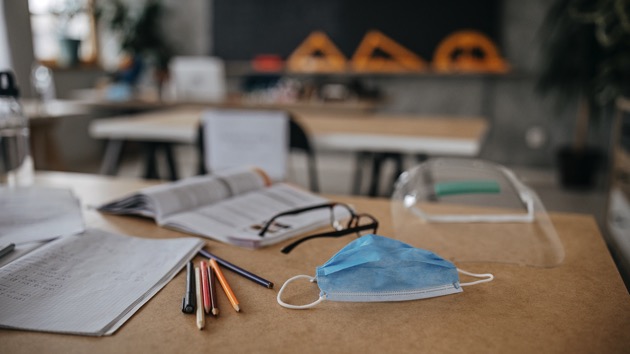
(NEW YORK) — As students across the country head back to school, a top priority for many educators and parents is how to help students who have experienced “learning loss” during the COVID-19 pandemic.
With kids leaning remotely since early 2020, “learning loss” — or gaps in understanding and skill knowledge that prevent academic progress — has been a natural worry for many parents.
But instead of dwelling on how much students may have fallen behind during their time away from school, some educators are focusing on meeting students where they are rather than focusing on what they’ve “lost.”
“Sometimes the phrase ‘learning loss’ doesn’t value and uphold all of the hard work that teachers, students and families did over the last year and a half to really try to stay the course and really keep their students learning,” Juliana Urtubey, the Council of Chief State School Officers’ 2021 national teacher of the year, told Good Morning America.
“One of the things that I like to tell families and my students is that we’re going to be OK. We’re going to work really hard to catch all the kids up,” Urtubey said. “But what we want to focus on is the future and how to meet all the needs of all of our students instead of working, fixating on the pressure of catching up.”
Urtubey, who is a special education teacher at Kermit Booker Elementary School in Las Vegas, said that even if the COVID-19 pandemic didn’t exist, teachers still assess where students stand academically each year. But if learning loss is the main focus this school year, Urtubey said it could put a lot of pressure on students.
“I think that one of the biggest things we can do is really be critical about how we think about this concept and push back on the idea that our students are going to have to be running the whole year to catch up,” said Urtubey.
Urtubey said that in-person learning will provide a support system for students as they return to school and teachers will meet their needs to help them stay engaged and help them get to where they need to be academically.
“We’re going to work really hard to make sure all of our students have the foundational knowledge they need to be able to apply critical thinking,” Urtubey added. “Each student benefits and thrives in different ways, which is why it’s so important for us to have community within our learning spaces no matter what grade you’re in. Students do better when they know that they’re part of a community and that there’s lots of support for them.”
Ahead of the upcoming school year, Urtubey shared some advice for parents to help their kids feel supported as they transition back to in-person learning.
Co-write a letter with your child to the teacher
Urtubey said co-writing a letter with your child to their teacher is a good way for teachers to get to know students, but also a good way for students to introduce themselves to their teacher. Students can talk about anything from their family to their favorite activities. It can also include what they struggle with in school or what they’re excited to learn. Parents can also include their concerns in the letter.
“As a teacher, I loved getting these letters at the beginning of the year,” Urtubey said. “They made me feel like I already knew the child and I already had a first step in terms of building this kind of trust with families.”
Do activities that are both academic and of interest to your child
If your child expresses an interest in certain subjects like art or reading, Urtubey said it’s good to push them to explore the topics more. For example, if a child is interested in space, Urtubey said a trip to the library can help get your child reading books about space.
“You’re carving out time at home for them to read, so that learning is enjoyable, so that learning is self-guided and self-motivated and that the child has some kind of way to share the learning at home,” Urtubey said. “I think that especially during this last year, we have to make sure that all students feel joy in what they’re learning.”
Visit school before the year begins
For big transition years, like kindergarten or the start of middle school, one way to help prepare students for the upcoming year is to visit the school before the year begins. That way students know where they’re having lunch, where their classroom is, who their teacher is and more.
“A lot of schools will already schedule this,” said Urtubey. “I know that this is really helpful in reducing stress before the first days of school.”
Help students practice introductory questions
Urtubey said when she taught fifth grade students, one way to help them prepare for middle school was spend time with them on things like switching classes or practicing opening a locker. Another way they prepared for the school year was to practice social skills to make new friends.
Urtubey suggested practicing different conversations for different scenarios with your student to help them take the stress or anxiety out of forming friendships or meeting new people.
Encourage deeper conversations about school
At the end of each day, Urtubey suggested asking your child questions beyond “How was your day?” since that doesn’t necessarily start a conversation with them about what happened during school.
Instead, Urtubey suggested questions such as, “Tell me about a time that you felt really happy today,” “Tell me about a time you felt challenged today,” or “Tell me a bit about what you learned today,” will help foster more discussions about what they’re feeling.
(NEW YORK) — Time to take stock of what’s in your freezer after a major frozen shrimp producer issued an expanded recall on a range of products due to salmonella concerns.
Avanti Frozen Foods Pvt. Ltd, expanded a voluntarily recall that was first issued June 25, 2021 to now include “certain consignments of various sizes of frozen cooked, peeled, deveined, shrimp (with some packaged with cocktail sauce) sold in various unit sizes, because it has the potential to be contaminated with Salmonella.”
Avanti sells its shrimp under a range of labels. Initially, the recall included frozen shrimp from Censea, CWNO, Chicken of the Sea, Honest Catch, Hannaford, Waterfront Bistro, Open Acres, 365 (Whole Foods), and Meijer. Now it has expanded to include new brands and additional SKUs from the previous brands listed.
Click here for full details on the affected products, codes and labels from the FDA.
The affected frozen raw and cooked shrimp products were distributed nationwide from November 2020 to May 2021, according to the Food and Drug Administration.
According to the recall, there have been nine reports of salmonella-related illness to date associated with these shrimp distributions. Avanti has taken several preventive steps and initiatives to eliminate potential for future contaminations.
Salmonella is an organism that can cause serious illness, especially in young children, elderly people and others with weakened immune systems. Healthy individuals infected with salmonella often experience fever, diarrhea, nausea, vomiting and abdominal pain.
Although a number of product included in the recall has not been associated with any illness, according to Avanti Frozen Foods, this expansion was initiated out of an abundance of precaution after discussions with FDA and CDC.
Consumers who purchased any of the products in question are urged not to eat it and return them to the place of purchase or contact the company by phone with questions.
(MISSISSIPPI) — More than 20,000 students across Mississippi are in quarantine after the first week of in-person classes.
Mississippi, which has the lowest vaccination rate among all states — about 34%, according to state data — is reeling from rising COVID-19 cases and the highly transmissible delta variant. Last week, a 13-year-old eighth grader died after testing positive — the fifth Mississippi child to die during the pandemic.
Some schools reopened last week, and so far 4,521 students have tested positive for COVID-19 and 20,334 have been quarantined due to exposure — about 5% of the state’s public school students, according to data compiled by the state Aug. 9 to Aug. 13 from over 800 schools.
Additionally, 948 teachers or staffers tested positive last week and 1,463 were quarantined due to exposure, according to state data.
Dr. Paul Byers, the state epidemiologist, painted a somber picture of the crisis unfolding in real time during a call with state pediatricians on Wednesday.
“These are dramatic numbers,” he added. “We are clearly at the worst part of the pandemic that we’ve seen throughout, and it’s continuing to worsen.”
Gov. Tate Reeves has not mandated masks in schools, instead letting districts decide for themselves.
About 600 schools have implemented universal masking for indoor settings following the recent spike in cases and isolations, Mississippi newspaper The Clarion-Ledger reported. The Biloxi school board, and the Gulfport and Hancock districts are among those requiring students to wear masks.
Governors and school districts throughout the U.S. have sparred over mandating masks in classrooms even as children younger than 12 still can’t be vaccinated.
New COVID-19 infections among 5-to-17-year-olds in Mississippi have risen steadily since March, accounting for about 20% of new cases through July, according to state data.
On Saturday, 13-year-old Mkayla Robinson died in Smith County, according to ABC Jackson affiliate WAPT.
“She was loved by all of her teachers,” Smith County Schools Superintendent Nick Hillman told WAPT. “She was an honor student, a band student. Everybody says if they had 30 kids in the classroom like her, they have the perfect classroom.”
(NEW YORK) — When Tina Sherman, a mom of four sons in Wake County, North Carolina, thinks of sending her children back to school later this month, she can sum up the emotion of it all in two sentences.
“They are excited,” Sherman said of her sons, who span from first grade to high school. “I am exhausted.”
For nearly two years, Sherman has been at home working a full-time job while overseeing virtual learning for her son in high school, leading home schooling for her twin sons in middle school and adjusting back and forth between in-person and virtual learning for her youngest son, who is now entering first grade.
All four of her sons will be attending in-person school this year, but Sherman said she feels a dreaded sense of “deja vu” with COVID-19 cases on the rise in the United States.
Amid a COVID-19 surge brought on by the more contagious delta variant and low vaccination rates, the number of pediatric cases of COVID-19 in the United States is rising, just as the school year begins.
In one Florida school district where there are no mask requirements, over 8,000 students have been isolated or quarantined just days into the new school year.
“I felt like I was barely hanging on by a thread at the end of school last year and now I’m thinking I don’t know what I’m going to do,” said Sherman, who added she feels lucky to be able to work from home with her job at MomsRising, an advocacy organization. “I’m thinking of all the plans for ‘what if.’ There’s everything from a seven-day quarantine to [my kids] could be out of school for 24 days.”
“I don’t feel like the alarms are going off in the way that they should be,” she said.
While Sherman feels the nation’s leaders are not thinking as much as they should be about moms trying to balance their careers and their kids, it is all she and fellow moms talk about.
“At work, the conversation, no matter the meeting topic, goes to, ‘Are your kids back in school? How’s that going?'” she said. “I don’t know a mom who’s not experiencing it right now.”
MacKenzie Nicholson, a mom of a son entering third grade and daughter entering pre-K, lost her job with a nonprofit organization early in the pandemic. She spent the past year looking for a job while helping her son with virtual learning and caring for her daughter, whom she and her husband pulled from child care due to COVID-19 concerns and financial reasons.
“It was the most stressful time of my entire life,” said Nicholson. “I recall taking interviews locked in my office while my two kids sat downstairs fighting with each other. My last job interview ended with my 4-year-old on my lap because she fell and was upset.”
Nicholson landed a new job in July but now describes feeling whiplash as the delta variant takes hold and the school year remains in flux.
“I remember that call from my son’s school that they were sending kids home for a week and I remember saying to my husband after two days, ‘I can’t do this,’ and now it’s extended into a multiyear thing,” she said. “Now we’re thinking about the year going forward and I’m like, I don’t know if I can do it again.”
Describing the conversations she has with other moms, Nicholson added, “We’re still all on edge and everything we’re talking about to each other is, ‘Are you OK?'”
Nicholson is one of around 3.5 million moms of school-age children who left active work during the pandemic, shifting into paid or unpaid leave, losing their job or exiting the labor market all together, according to the U.S. Census Bureau.
As of January 2021, around 10 million U.S. mothers with school-age children were not actively working — 1.4 million more than during the same period in 2020.
Among them, more than 700,000 moms have given up on work outside the home entirely and some may not return, according to Census Bureau data.
Karen Shrimpton, a mom of 12- and 8-year-old sons in San Francisco, quit her job last year after it became too much to balance her role at a small family business that had to suddenly go remote and change its business model and oversee virtual learning for her sons.
It was a hard decision for Shrimpton, who had just been able to rejoin the workforce after moving multiple times to support her husband’s career and then becoming a mom.
“I had been pretty unhappy as a stay-at-home mom and so then having had the opportunity to do something for myself, I knew what a backslide this was going to be,” Shrimpton said of exiting the workforce. “I don’t think I was naïve or ignorant about the decision. I made it with my back against the wall.”
With the prospect of both her sons back at in-person schooling this fall, Shrimpton said she has spent the past several months searching for a job, but now is slowing her search, realizing that her sons could be back home at any point.
“It’s just shock,” she said. “It’s like I can’t believe we haven’t managed to get to a better place than where we are.”
Working moms worked two full-time jobs
Economists say the two main reasons so many women have been forced out of the workforce over the past nearly two years are pandemic-related job loss in women-heavy industries and, not surprisingly, the burden of child care.
Child care was a second full-time job for moms of young kids during the pandemic, data shows.
Moms with children ages 12 and under spent, on average, eight hours a day on child care, while at the same time working an average of six hours per day in their jobs, according to a Brookings Institution analysis of data from the Bureau of Labor Statistics.
Moms have spent about three hours more per day than fathers on child care during the pandemic, and reduced their time spent working by 4 to 4.5 times more than fathers did because of child care, according to the analysis.
“What we know is that we were not doing a great job of supporting women and mothers with kids before the pandemic,” said Lauren Bauer, a fellow in economic studies at the Brookings Institution and the mother of a 9-year-old son. “The loss of child care didn’t actually affect most of the people with the youngest kids because it was already keeping people out of the labor market because it was unaffordable.”
“But the loss of elementary schools [that switched to virtual learning] was really consequential,” she added. “In places with higher levels of elementary school closures, moms were exiting the labor market. They couldn’t hold on, and they just left.”
Among working moms, single mothers, who typically have the highest level of employment, have suffered the most during the pandemic, according to Bauer.
“Single mothers were the breadwinners prior to the pandemic and they currently have the lowest rates of employment and they see the least recovery,” she said. “They’re struggling financially and have high rates of food insecurity. They’re having a hard time feeding their kids.”
Tina Carroll, a single mom in Denver, sent her 7-year-old son to Georgia the past two summers to stay with relatives because she lacked child care resources at home.
During the school year, she relied on a village of college students and a neighbor to help her son with remote learning as she worked in person at a local university.
Her son is now attending second grade in person, but Carroll said she is already bracing for him to be sent home at some point due to COVID exposure at school.
“I’m probably even more worried now because I don’t have an infrastructure set up for the instances when he has to come home,” she said. “I feel like I’m in the ring with COVID and I throw punches every day and I’m drained. I’m literally drained.”
Moms say they are not only feeling exhausted but also frustrated that they are facing the prospect of a third school year upended by COVID-19 with marginally more support in place than when the pandemic began.
When the U.S. Senate passed a $1.1 trillion bipartisan infrastructure bill earlier this month, absent were programs that would benefit working families, things like paid family leave and child care benefits.
Child care benefits, specifically subsidies, are included in a $3.5 trillion “human infrastructure” package, which could pass Congress with only Democratic support. But the process is complicated, and could take weeks or even months to complete.
And while moms say the additional Child Tax Credit benefits delivered in President Joe Biden’s $1.9 trillion American Rescue Plan have helped, they are not a permanent solution to families’ financial and child care needs.
“There’s been no investment in real short-term relief, because this [Child Tax Credit] money is not enough for mothers and families, and there’s also been no investment in long-term relief,” said Katherine Goldstein, a mother of three, journalist and host and creator of “The Double Shift,” a podcast that focuses on moms and work. “Building up our child care infrastructure, making family life much more affordable, more substantively better workplace policies, none of that has happened yet.”
“It’s kind of like we haven’t even accounted for the damage that has been done, and we’re being ask to go in for another round,” she said of moms. “Before COVID it was exhausting and overwhelming to be a parent in America, and now it’s just untenable.”
Bracing for a ‘second wave’ of women leaving the workforce
Last summer, as the economy began to reopen, women’s employment levels rose, but then as kids went back to school in September, the numbers dropped sharply again.
In September 2020, 865,000 women dropped out of the workforce, compared to 216,000 men, according to BLS data.
While moms are currently working at nearly the same rate as women without kids, economists say they fear another exodus of women from the workforce as the school year begins.
“Here we are on the cusp of another school year and we have the delta variant rising; we have kids under 12 who cannot even be vaccinated; and at the same time we have companies saying, ‘Everybody back in the office,’ and also schools saying, ‘Everybody back to school,'” said Alicia Sasser Modestino, an economist and associate professor at Northeastern University, who predicted in an op-ed last year that the pandemic would “set women back a generation.”
“I would call this the ‘second wave’ [of women leaving the workforce] where women who previously were able to hold onto their jobs working from home and maybe sleeping less or cutting corners and supervising kids while working from home, they no longer have that option at the same time that we’re probably going to see a lot of school disruption,” she said. “It’s going to be very difficult for moms to maintain any kind of continuity in the workplace.”
Sara Perschino, of New Hampshire, worked full-time from home while taking care of her daughters until November, when she lost her job. She has taken on only freelance work since then with her daughters’ school schedules still in flux.
Though her daughters, ages 4 and 7, will start in-person school later this month, Perschino said she, like so many other moms, is uncertain about the future as the full-time caregiving falls on her.
“I’ve had a lot of conversations with my friends and other people in the community about how this [pandemic] has highlighted that women are still doing the bulk of caregiving responsibilities,” she said. “We’re having these conversations more globally now, so I think it’s reassuring for families to see they weren’t the only ones struggling with this, and to see that it’s not just them, that there are systemic barriers to be able to have thriving careers and successful families.”
“I’m exhausted,” she added. “I think every working mom is exhausted right now.”
The “great resignation,” as Sasser Modestino calls the exit of women from the workforce during the pandemic, came just after women hit a historic milestone in the U.S.
In January 2020, women held over half of all jobs in America for just the second time in history.
Helping women reach that level again in the workforce will take months of record job gains and, according to Sasser Modestino, will require help from employers, the government and women’s loved ones at home.
“We know that the longer you take out of the labor market, your skills depreciate and the harder it is to get back in down the road,” she said. “If you think that talent is distributed equally across men and women, then we should really be concerned that we’re seeing women leave the labor force in droves because we’re losing that talent now.”
Kate Dando Doran, a mom of two in Colorado, said that in addition to exhaustion and stress, one of the most frustrating things of working full time while also caregiving has been watching her career be unwittingly disrupted.
“I’ve worked very hard to get where I am and want very much to do a good job,” said Dando Doran, who has spent the 17 months working at her dining room table alongside her 3- and 5-year-old kids. “I work early in the mornings and late at night to make up time. You don’t want it to ever be, ‘Oh, she’s busy, she’s focusing on her kids.'”
At the same time, Dando Doran said she constantly worries about the impact the pandemic is having on her children, describing one particular moment in the past year that she said nearly crushed her.
“At one point I was pushing my daughter on the swing while answering email and she said, ‘Mommy, can you please put your phone away and be with me?'” Dando Doran recalled. “This has been exhausting and hard for everyone.”
(LAS VEGAS) — For some patients, it’s the little things.
Brooke Johns, 40, is an emergency room nurse at Southern Hills Hospital in Las Vegas. On her days off, she heads back to the hospital to provide patients with some genuine human connection, brushing out their hair and just talking with them.
“I feel like there’s something very special about brushing somebody’s hair,” Johns told “Good Morning America.” “It’s something just relaxing and very connecting.”
Johns started these acts of kindness earlier this year, when a friend of hers was in the hospital with COVID-19, she said. The hospital didn’t allow patients with the virus to have any visitors, so all of their human contact came from staff.
“Her hair was very matted in the back,” Johns said of her friend. “She was so weak, and wasn’t able to brush it out herself, so I just said, ‘Do you want me to brush your hair?'”
As patients are usually laying on their backs in their hospital beds, Johns said their movements can easily snarl their hair.
“It took me an hour and a half to brush out her hair,” she said. “Then I asked her, ‘Do you want me to braid it so that it doesn’t get like that again?’ And she said, ‘Yes.'”
Afterward, Johns said she noticed a change in her friend’s demeanor.
“She was a different person when I left,” Johns said. “The thought just popped into my head that if my friend benefitted so much from this, I bet there’s a hospital full of people that need some sort of human connection.
“We’re all hard-wired for connection. We’re social beings and we need that.”
Sierra Stein, 24, knows all too well how important it is to have genuine connections and distractions in the hospital. She said she contracted COVID-19 last summer and became paralyzed in her legs, which required her to stay in the hospital for a few months as she received treatment.
“It was miserable because you couldn’t have anyone there,” Stein said. “You’re isolated, you’re lonely. It’s a really dark place.”
Stein was later released and regained the ability to walk, but more pain in her legs again required an emergency room visit in July 2021, she said.
Based on her previous experiences, she tried to avoid a longer hospital stay but her attending nurse, Johns, sat with her for over 10 minutes, soothed her worries and convinced her to go.
While Stein was receiving treatment, she said staff mentioned that there was a nurse going around and braiding patients’ hair.
“They were like, ‘Do you want to get your hair braided?’ and I said, ‘Oh yeah, of course,'” Stein said. “That’s when I saw Brooke again.”
According to Johns, ER nurses see a high volume of people and and often don’t know what happens after they leave the ER.
To find patients, Johns goes to her director and sends out a broadcast to staff asking if they have any patients who want to get their hair braided. Johns’ colleagues then text her with patients’ room numbers, and she goes to them one by one.
“We never get to see the end of the story, which is why Sierra was such a special situation — that never happens,” Johns said. “We either help people to the point where they get to go home or we help people to the point where they need to be admitted to the hospital, and that’s where our access to them stops.”
The human contact from a person who cared made a world of difference to Stein.
“It’s such a nice distraction from your illness,” Stein said. “When you’re in the hospital your mental health kind of gets shut down.”
She continued, “It’s really just amazing that there are fairy godmothers going around in the hospital who actually care and take the time to sprinkle a little sunshine on you. … It makes you feel like you’re at home again.”
Beyond providing an important level of connection for patients, Johns said she does this because we don’t know what a person may be going through and wants to make people feel like they’re loved.
“Everybody has a story that will bring you to your knees,” Johns said. “Life is hard and that’s why I think it’s so important to be kind and patient and spend time with people.”
Alexis Mussi, Southern Hills’ CEO, told “GMA” that other nurses were inspired by Johns and are now giving back in a similar manner.
“This past year our care team became the spouse, the family member, the friend, the everything for our patients,” Mussi said. “When there isn’t someone here holding that hand at the bedside, it really became our team doing that, so having people like Brooke really helped.”
(FREMONT, Calif.) — When students return to Erin Castillo’s classroom Wednesday, their first day of in-person school in over a year, the high school teacher will be paying attention to more than just how they are doing academically.
Castillo, an English and peer counseling teacher at John F. Kennedy High School in Fremont, California, said she will be focusing more attention than ever this year to her students’ mental health.
“I think there’s a big emphasis [among educators and parents] on learning loss and the academic side, but I don’t think any kids are concerned about that,” Castillo told Good Morning America. “The kids that I’ve talked to, what they’re concerned about, and what I’m concerned about, is the social side of things … their health [amid the coronavirus pandemic] … and just the discomfort of going back to school.”
Her post inspired teachers around the world to make their own versions of the chart for their classrooms. The chart is hanging in Castillo’s own classroom still today as students return.
When using the check-in chart, students are encouraged to grab a post-it, write their name on the back and place it next to the statement that best matches their feelings for the day. The options are, “I’m great,” “I’m okay,” “I’m meh,” “I’m struggling,” “I’m having a hard time and wouldn’t mind a check-in” or “I’m in a really dark place.”
The last two statements merit a check-in with Castillo and a follow-up conversation with the counselor or the school psychologist on campus.
“When I created the chart, I wanted mental health to become part of the school conversation and to be tied into how we do things,” Castillo said. “Students can’t learn nearly as well when they’re struggling with something.”
Students across the United States are entering school this year amid not only their own anxiety and uncertainty but also uncertainty on a national scale amid rising numbers of COVID-19 cases, including among children, and angry debates among adults on whether students should wear masks.
Some school districts have recognized the mental health challenges facing students and have added resources for the new school year. In Castillo’s district, more mental health counselors have been deployed to schools and each school now has a designated mental health lead who receives additional mental health training to take back to their school’s teachers and staff.
“I’m sad that this is the way it finally came up but we’re seeing that shift now of, okay, we really do need to have these [mental health] conversations and we really do need to talk about coping strategies in the classroom,” said Castillo. “I’m definitely seeing it more.”
In addition to the mental health check-in chart in her classroom, Castillo has also created an “affirmation station” for students to recognize each others’ good works.
Each student in Castillo’s classroom has an envelope posted on a board in the “affirmation station.” When students recognize things another student is doing well, they can grab a notecard, write them an affirmation and stick it in their envelope, according to Castillo. Students keep them in their binders. They’ve told me they hang them up in their rooms.
Other mental health tools Castillo said she plans to use this year include giving students mental health-focused prompts to focus on each week, making use of the mini-shredder in her classroom for students to shred negative thoughts and encouraging students to set and reach small, attainable goals focused on self-care and self-love.
And while remote learning was difficult for students and teachers alike, one thing Castillo will miss is being able to use the chat and breakout room functions on Zoom that allowed her to communicate with students one-on-one.
She said her goal is to find ways to help incorporate that anonymity and directness in her in-person classroom.
“I saw a huge uptick in kids asking questions that they wouldn’t normally have asked because they may not have been comfortable,” said Castillo. “Whatever gives students the voice to communicate that they need help or support, I’m all for it.”
Another lesson Castillo said she learned from remote learning is that teachers themselves can set the best mental health example for students.
“We can’t be telling kids, ‘Take time to breathe and take time to focus on yourself, and it’s okay, if you need to ask for help,’ if we’re not doing any of that ourselves,” she said. “I think the more that we take care of ourselves and the more that we’re showing students that we’re doing that the smoother this school year is going to go.”
Castillo and a fellow teacher, Molly Jackson-Schultz, created a free, month-long mental health challenge for teachers to help prepare them for the year ahead.
“It’s a challenge specifically for teachers about focusing on themselves so we can better serve our students,” said Castillo, who noted that the challenge can be done any month. “As teachers, we have a hard time like putting ourselves first, but that’s the way we survive.”
If you are struggling with mental health or know someone in crisis, call the National Suicide Prevention Lifeline at 1-800-273-TALK (8255) or contact the Crisis Text Line by texting HOME to 741741. You can reach Trans Lifeline at 877-565-8860 (U.S.) or 877-330-6366 (Canada) and The Trevor Project at 866-488-7386.
(BALTIMORE) — With the delta variant surging, and new data indicating young people can spread COVID more readily than previously thought, many parents with infants and toddlers are now left with questions about how to best protect their child.
Children who are less than two years old cannot safely wear a mask and do not have an option to receive a vaccine against COVID-19 yet. They can’t decide for themselves where they go, who they are around or what is in their environment — that is left up to a parent or caretaker to decide for them.
Scientists are still learning more about COVID-19 risk and transmission among young children under two. The good news is that even when they do get COVID, they seem less likely to become severely sick compared to adults. And there are several concrete steps parents can take to procreate a safe environment for young children.
1. Get vaccinated
Three vaccines, Pfizer, Moderna and Johnson and Johnson, are authorized by the Food and Drug Administration for use for anyone who is 18 years old. Pfizer is authorized for anyone over the age of 12. All three have proved to be safe and effective. Even as the new delta variant takes over as the dominant variant in the United States, these vaccines can still work against it.
Very often, children who are hospitalized with COVID-19 are living in households in which parents are not vaccinated, said Dr. Paul Offit, director of the Vaccine Education Center and professor of pediatrics in the Division of Infectious Diseases at Children’s Hospital of Philadelphia.
“It’s always tragic when children fall sick with COVID-19,” Offit told ABC News. “This year, these stories are more tragic because they’re preventable.”
2. Make sure everyone around your child is vaccinated
Young children aren’t yet eligible for vaccination, but if every person around them was vaccinated, this creates protection against the virus. Limiting the number of people you encounter who are unvaccinated can help create a safer environment for you and your family that will then offer some protection for your unvaccinated child.
This can be a very hard thing to do, especially if you live in a largely unvaccinated community, but weighing the risk COVID-19 can pose to your child is worth it. It may also be the push some people need to get vaccinated, too.
3. Get vaccinated if you are pregnant or breastfeeding
Vaccines are now recommended for people who are pregnant after a study showed taking a COVID-19 vaccine during pregnancy is safe for parent and child. Meanwhile, new research indicates mothers may be able to pass along antibodies against COVID-19 to your baby.
Antibodies are a part of our immune systems that help recognize and fight off infections. When a woman is pregnant, some antibodies can cross through the placenta and are found in babies’ blood up to a few months after they are born. Antibodies can also be passed through breastmilk.
This type of antibody protection for babies is called “passive immunity.” Your baby’s immune system will not be able to make their own antibodies from what is passed through the placenta or breastmilk, but experts say every bit counts, and some protection is likely better than nothing.
4. Social distancing and masking in public
When you and your young child are in public, it may be impossible to know if those around you are vaccinated. Try to maintain a safe distance away from others and wear a mask, especially in indoor areas where there may be many unvaccinated people.
If your infant is in a carrier, a blanket can be draped over the carrier, but make sure that’s only done when the carrier is in your view and the blanket should not be touching the baby. If you can, find a trusted, vaccinated babysitter if you need a night or day out, so you don’t have to bring your more vulnerable baby with you, especially to activities such as indoor dining that carry a higher risk of COVID-19 exposure.
5. Everyone should wash their hands
Every time someone visits your home from outside, make sure the first thing they touch is soap and water to wash their hands, especially before touching your child. In fact, pediatricians recommend this all year round, with or without a pandemic in any home that has a child less than two years old. It is an easy way to prevent the spread of many infectious diseases that can be tough on young children.
Dr. Jade A. Cobern, a pediatric resident in Baltimore entering the field of preventive medicine, is a contributor to the ABC News Medical Unit.
(WASHINGTON) — The Biden administration is expected to announce, as soon as this week, a plan to roll out booster shots for all Americans who got Pfizer or Moderna COVID vaccines more than eight months ago.
Any plan would be contingent upon getting a green light from federal agencies who say they are still reviewing the data.
Here are five things to know about boosters:
Booster shots could begin as early as mid-September
The first vaccine shots in the U.S. were given out last December — exactly eight months ago — to health care workers and nursing home residents.
It’s expected these same high-risk, high-priority groups would be first in line for booster shots come September, assuming federal regulators agree to sign off.
The U.S. Food and Drug Administration has already given the green light for a third shot for people who are severely immunocompromised. But this group — patients getting treated for cancer or having experienced an organ transplant, for example — was considered less likely to have developed an immune response in the first place.
Booster shots for the broader public would only be called for if the FDA agrees with vaccine makers and independent studies that immunity is indeed waning.
8 months isn’t a precise measure of when immunity wanes
A person’s immune system is a complicated puzzle, with antibodies in a person’s blood stream as only one piece.
Scientists said they are looking at other clues too, including closely watching COVID-related hospitalizations involving vaccinated people.
Pfizer and BioNTech, which partnered to develop the nation’s first vaccine, said it has early data suggesting that a booster dose anywhere from six to 12 months after the initial vaccination will help maintain a high level of protection. Their data have not been shared publicly yet.
In particular, the company said a person getting a booster between eight and nine months after their primary shot showed higher neutralizing antibody levels against the delta variant, compared to people who received the original two doses.
But Pfizer and BioNTech also said in a joint statement that they are waiting for more data before officially submitting a request to allow for booster shots.
New hospitalization data might hold more clues on vaccine immunity
The number of vaccinated people winding up in the hospital with COVID-related complications is an important clue to how well the vaccines are working.
If a vaccinated person becomes infected with the virus but does not become seriously ill or transmit the virus to others, then the vaccine is still working well. But if health officials start reporting a rising number of hospitalizations involving vaccinated patients, that could signal that immunity among vaccinated populations is beginning to wane.
So far, the Centers for Disease Control and Prevention has said boosters aren’t needed, estimating that 97% of people hospitalized with COVID-19 are unvaccinated.
But that estimate was based on hospital-reported data from spring, before the delta variant began spreading wildly. The CDC said it’s not ready to release updated numbers yet, but is working on getting a clearer picture of delta’s impact on the vaccines.
The FDA and CDC still have to sign off
Pfizer and BioNTech have submitted early data to the FDA, but are still tracking people who got the vaccine. When those results are finalized, the companies are expected to ask the FDA to green light the third shots.
If the FDA signs off, an independent advisory panel to the CDC will likely convene to discuss what exactly should be recommended to Americans. That would then pave the way for an official recommendation by the CDC, along with advice to doctors and patients on getting a booster.
The FDA and CDC have said previously that booster shots for broader populations aren’t needed yet. But Dr. Anthony Fauci, the top medical adviser to President Joe Biden, has called the possibility inevitable because of the likelihood that protection would diminish over time.
Less is known about people who got the Johnson & Johnson vaccine
So far, the plan to roll out boosters is focused on Pfizer and Moderna vaccines, which rely on similar technology.
Less is known about the Johnson & Johnson vaccine, which rolled out later than Pfizer and Moderna and has been given to considerably fewer people.
Government officials say more data are expected in coming weeks on precisely how much protection J&J allows — information that will be critical in determining whether J&J recipients might need a boost.
ABC News’ Cheyenne Haslett, Molly Nagle, Sarah Kolinovsky, Sony Salzman and Eric Strauss contributed to this report.
(CHICAGO) — The Justice Department has arrested a Chicago pharmacist who allegedly sold 125 real CDC COVID-19 vaccination cards on EBay.
According to charging documents, 34-year-old Tangtang Zhao is said to have sold the cards to 11 different buyers for $10 each.
He is the second person to face federal charges for selling vaccination cards. Federal authorities are working to put a stop to this trend as more companies require proof of vaccination.
Zhao is charged with 12 counts of theft of government property. A conviction means he could face a max sentence of 10 years per count.
What is still unclear is the position the DOJ may take against Americans who are trying to purchase vaccination cards as a way of falsely claiming vaccination status.
(NEW YORK) — Throughout much of 2020, parents took comfort in a single silver lining the pandemic: The virus seemed to spare young people, particularly children and toddlers, whose symptoms were considerably milder than the adults around them.
The precise reason for this was never quite clear. One theory was that children had fewer “receptors” that could become infected with the virus. Some wondered if kids had better immunity because of frequent exposure to other coronaviruses. Children also were less likely to be burdened by the kind of underlying health conditions plaguing older adults, according to health experts.
But the arrival of the delta variant seems to have changed that equation in just a matter of months. Health officials are warning of the steepest surge in COVID hospitalizations among children since the pandemic began, with rates 4.6 times higher than it was just five weeks ago. Those rates now put pediatric hospitalizations on par with the height of the pandemic.
But are children now at greater risk than they were last year?
Health experts said the research on the impact of delta isn’t solid yet. It’s possible the delta variant is so wildly transmissible that children are facing repeated exposure. It’s also possible that people have grown more careless — abandoning masks and social distancing, with much of the country itching to return to normal.
Dr. Edward Behrens, chief of the division of rheumatology at Children’s Hospital of Philadelphia, said a big issue is that people wrongly assumed children were never at risk in the first place.
“It was a comforting narrative that was never true. They [children] always had the potential to be a reservoir for virus,” he said.
While hospitals continue to collect the data, others say they remain alarmed by what they are seeing. According to the Centers for Disease Control and Prevention, COVID deaths among children this year were twice as high as flu deaths.
“Many of us (in pediatrics) around the country are struck by the fact that we’re seeing otherwise healthy kids are getting sick and requiring oxygen, ending up in the ICU,” Dr. Andrew Pavia, chief of Pediatric Infectious Diseases at the University of Utah, told ABC News.
So while the studies may be inconclusive, “our clinical impression is that (delta) may actually be worse, and that it’s not just a very larger number of kids are getting infected,” Pavia said.
“This summer we’ve seen many more kids with severe symptoms of COVID compared to what we saw last year and then more concerning what we’ve seen this summer is really young children,” Dr. Kenneth Paris, associate professor of pediatrics at LSU Health Sciences Center in New Orleans, told ABC News.
In Dallas, that sudden spike meant the city ran out of intensive care beds for children last Friday.
“That means if your child’s in a car wreck, or more likely if they have COVID and need an ICU bed, we don’t have one,” Dallas County Judge Clay Jenkins said in a news conference Friday.
“Your child will wait for another child to die. Your child will just not get on the ventilator,” he added.
Dr. Cindy Bowens, medical director of the pediatric ICU at Children’s Medical Center in Dallas, said they are still encouraging parents to bring their children to the hospital if they are sick.
“We will find care for every kid who comes to the hospital,” she said.
Overall, children are still considered significantly less likely than adults to experience bad outcomes from COVID-19. According to an estimate by the American Academy of Pediatrics and the Children’s Hospital Association, less than 2% of all child COVID-19 cases resulted in hospitalization.
Deaths are even more rare — almost extraordinarily so — with less than .03% of cases involving children.
Still, health experts say it’s the wrong approach to assume risk to children is minimal because it’s so much lower than the risk to older adults. That goes for teens and young adults who qualify for the vaccine, too.
“If you are young and healthy, should you be super worried that you’re going to die of this disease? No,” said Dr. David Dowdy, associate professor of epidemiology at the Johns Hopkins Bloomberg School of Public Health. “But if your goal is to be reasonably healthy and to avoid the potential for symptoms that could last for weeks or months, it’s definitely a better idea to get the vaccine.”
In other words, “just because it’s not going to kill you, doesn’t mean that you can’t get really sick,” he said.
Dowdy said he’s also not convinced delta’s superpowers are behind the sudden surge in kids getting sick either. He points to the widespread change in behaviors this spring when vaccinations became widely available and people dropped their masks and began gathering again in large groups whether they were vaccinated or not.
Dr. Anthony Fauci, the nation’s top infectious disease expert and President Joe Biden’s chief medical adviser, told ABC News anchor David Muir last week: “What is absolutely clear is that more children are getting infected. And as more children get infected, you will naturally see more children get hospitalized.”
Dr. Mark Kline, physician-in-chief of Children’s Hospital New Orleans, said he is alarmed at the number of critically ill children, including infants and toddlers, in his care who are struggling with COVID-19. He said children have become the “collateral damage” of adults who are refusing to wear masks or get vaccinated.
“Children currently have no way out of this pandemic other than through the advocacy and personal responsibility of their parents and all adults,” he said. “So far, we are failing them miserably.”