(NEW YORK) — COVID-19 cases may be increasing again in New York City, new wastewater data hints.
Nearly all of the 14 wastewater treatments plants in the city are currently in the “high” detection level category, meaning likely 50 or more cases per 100,000 people, according to the NYS Wastewater Surveillance Network dashboard, which was updated Friday.
What’s more, two-week trend data shows that just three of the plants are seeing decreases in virus detection.
Reported case numbers have not jumped. But fewer people are getting tested than earlier in the pandemic, so case numbers are a less reliable indicator of COVID-19 spread.
Health experts told ABC News that wastewater tracking is a good early detection tool for monitoring potential future upticks, but it’s too early to determine what it means.
“Wastewater data can be a very helpful indicator of what is taking place,” said Dr. John Brownstein, an epidemiologist and chief innovation office at Boston Children’s Hospital and an ABC News contributor. “Now, it’s an indication of the level of virus that people might be shedding, but it’s not 100% related to the amount of illness people are experiencing.”
He continued, “Because with the significant amount of immunity from previous infections, from vaccination, there may be community transmission, but it may be asymptomatic and so what wastewater can’t tell you is actually the severity of the cases in the community.”‘
Wastewater surveillance checks for the virus in sewage — from households and buildings — that contains human fecal matter.
Because at least half of COVID-19 patients shed genetic material from the virus, or viral RNA, in their feces, the same tests that can determine if someone is positive can also detect the virus in wastewater samples.
When people shed the virus in their stool, they are often in the early stages of the infection, meanings levels of the virus in wastewater samples will often occur before the number of cases rise.
Reported COVID-19 cases have remained relatively flat since mid-April at about 270 cases for a seven-day rolling average, according to data from the city’s Department of Health and Mental Hygiene. Hospitalizations and deaths have also remained relatively flat.
“Wastewater data is…unbiased,” Dr. Peter Chin-Hong, an infectious diseases specialist at the University of California, San Francisco, told ABC News. “It just depends on the amount of virus circulating in the community, so although the absolute number might be debatable, that trend is always something that makes us pay attention.”
However, he cautioned not to panic and said just because there are areas of the city in the “high” category, that does not mean a surge is imminent.
While the end of mitigation measures such as masking and some waning immunity may play a role if cases increase, Chin-Hong said the U.S. is in a much better position than it was in years past.
“In the old days, we just kind of had to be subject to the whims of the virus, but now we have weapons to fight back,” he said. “And even if vulnerable populations are infected, they could avert or prevent hospitalization and death by taking advantage of these early, antivirals taken early in the course of disease, like Paxlovid and remdesivir and molnupiravir.”
The experts said it’s natural that wastewater data is going to ebb and flow and it is not going to stay low all the time. However, because everyone has a different risk tolerance, the data can help people decide if they want to modify their behavior.
“Knowing that viruses circulating may inform people about the kinds of activities you want to take part in,” Brownstein said. “So just like you bring an umbrella for rain, you may change your behavior if you know that viruses are circulating. This is not a reason to panic. But more information can help empower people to make their own decisions.”
(NEW YORK) — A breast cancer drug already on the market has been found to lower the chances of breast cancer recurring, an advancement that could open the drug to a broader range of patients.
The pharmaceutical company Novartis announced the findings Friday about its breast cancer treatment Kisqali, a drug already approved by the U.S. Food and Drug Administration for people with more advanced stages of breast cancer.
The vast majority of breast cancer patients are diagnosed in the early stages of disease. Right now, many are treated with chemotherapy and endocrine therapy.
The new data shows that adding Kisqali after primary treatment will reduce the risk of the cancer coming back.
This finding could be good news specifically for women who are diagnosed in the earlier stages of the disease and those who are hormone-receptor positive, and HER2 negative, who make up 70% of the breast cancer population, according to the National Cancer Institute.
“Women who have this subtype can have recurrences even 20 to 25 years after their initial diagnosis,” Dr. Dennis Slamon, director of the Revlon/UCLA Women’s Cancer Research Program and lead investigator of the Kisqali clinical trial, told ” Good Morning America.” “We found that adding this drug to the best available standard therapy will decrease the recurrence rate by as much as 25%.”
Suzanne Garner, 45, participated in the clinical trial for Kisqali after being diagnosed with Stage 2 cancer five years ago.
She said she was treated with chemotherapy and endocrine therapy, but the potential outcome of the treatments “didn’t feel right.”
“I felt that my risk of recurrence was still too high,” Garner told “GMA.” “I have a young daughter who needs her mom around for as long as possible and I would absolutely do anything to reduce my risk of recurrence so I can be her mom for as long as she needs me.”
Novartis announced the findings on Kisqali at the 2023 annual meeting of the American Society of Clinical Oncology.
The company said it plans to submit the data to “regulatory authorities in the U.S. and Europe before end of year.”
“Patients diagnosed with HR+/HER2- early breast cancer remain at risk of cancer recurrence, given that one-third of patients diagnosed with stage II and more than half of those diagnosed with stage III will unfortunately experience a return of their cancer,” Dr. Shreeram Aradhye, chief medical officer of Novartis, said in a statement. “The compelling data from NATALEE [the clinical trial] highlight the potential of Kisqali to reduce the risk of cancer recurrence in this at-risk population, including node-negative patients, while maintaining a favorable safety profile. These potentially practice-changing results reinforce the unique and well-established profile of Kisqali as a proven treatment in HR+/HER2- metastatic breast cancer.”
(NEW YORK) — Just six weeks ago, Greg DeStefano began a new chemotherapy combination. The 50-year-old, from Northbrook, Illinois, had recently been diagnosed with his fourth round of cancer and doctors were hopeful the medication would treat the tumors growing in his neck.
DeStefano was responding well, but then, in late May, he got a call from his doctor and was told one of the three drugs he was receiving — carboplatin — was under a global shortage and because of the way the hospital had to prioritize treatments, he wouldn’t be qualified to receive it anymore.
“We’re frustrated because not only are we dealing with cancer, now we have to deal with a drug shortage of a pretty critical drug,” DeStefano told ABC News.
DeStefano’s experience is similar to thousands across the United States of patients either having delayed treatment or being unable to receive treatment because of cancer drug shortages.
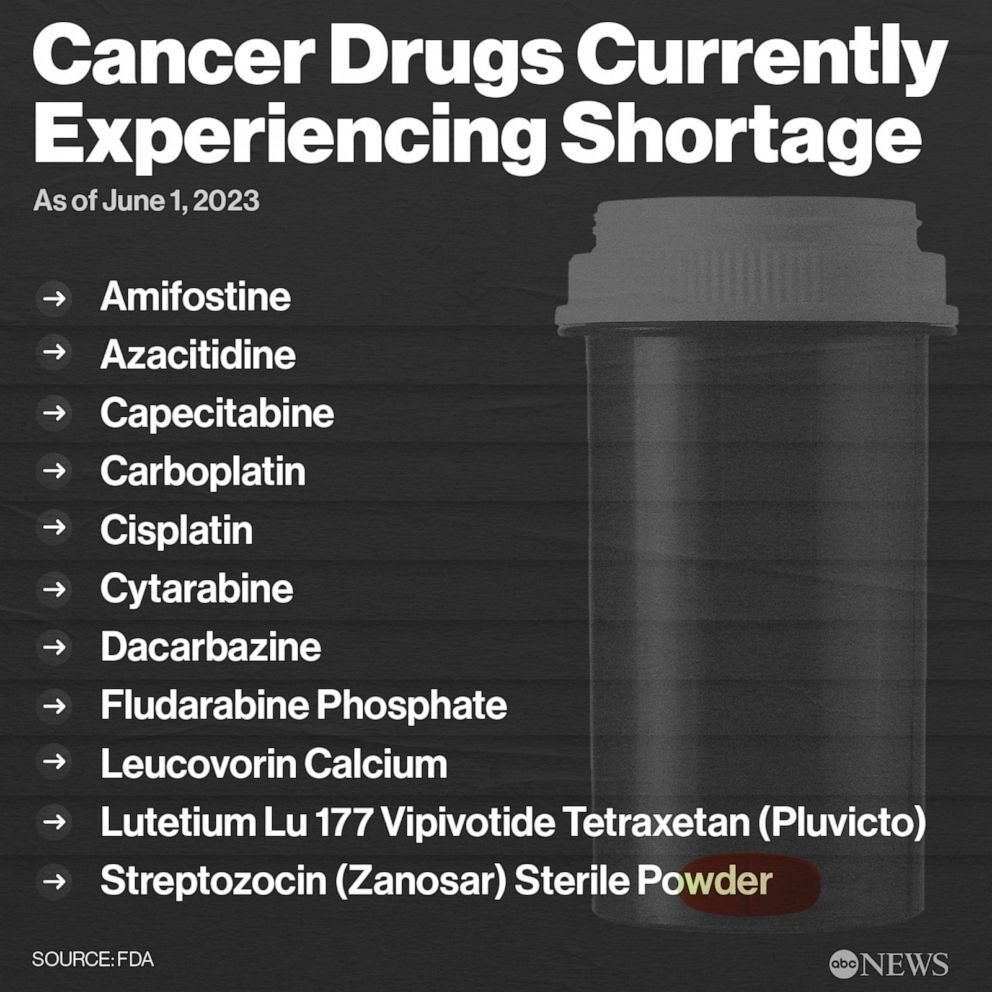
Among them are carboplatin, used to treat ovarian and head and neck cancer; azacytidine, which treats a form of leukemia; and dacarbazine, used to treat skin cancer.
“We’ve experienced drug shortages, intermittency, my entire career, it has always been a challenge,” Julie Kennerly-Shah, associate director of pharmacy at The Ohio State University Comprehensive Cancer Center, told ABC News. “The past six months have been the most challenging in my career for managing drug shortages in the cancer population.”
She continued, “As you can imagine, it’s extremely frustrating to know that you have a medication that can potentially cure a patient of cancer or extend their life and to know that you may not have enough to treat that patient.”
Last month, the American Cancer Society issued a warning that chemotherapy drugs had returned to the list of the top-five drug classes affected by shortages and warned this could have a devastating effect on patients.
Some hospitals and clinics are completely out of the medications. In others, doctors are being forced to either ration cancer drugs or triage which patients receive the drugs first.
“We’re sort of on life support, whether or not we’re going to have enough drugs and we have internally operationalized various ways to prioritize who gets which drugs,” Dr. Mark Einstein, a gynecologic oncologist at University Hospital in Newark, New Jersey, told ABC News. “Especially when there are limited or no other alternatives.”
DeStefano said this shortage means that unless he chooses a different course of treatment — which involves chemotherapy and then a resection or a removal of the tumor — he will be ineligible to receive the drug.
However, because he’s had multiple surgeries in the past due to previous bouts of cancer, surgery has more risks for him, his wife, Mindy DeStefano, told ABC News.
“This is the crux of our frustration, that he has a therapy and treatment that’s working and now because of the way they have to categorize and prioritize patients, he is now not able to access this drug any longer,” she said.
Doctors say there are a number of factors behind the nationwide shortage including low profit margins for generic versions of these drugs as well as labor and supply chain issues.
“All these drugs that we have shortages in, they’re all generic, old chemotherapy drugs that are fairly cheap as it relates to cancer drugs,” Dr. Hanna Sanoff, a gastrointestinal medical oncologist at the University of North Carolina’s Lineberger Comprehensive Cancer Center, told ABC News. “And so, the economic margin here is just much smaller for the drug manufacturers.”
She continued, “A lot of our supply comes from India and China, and there have been some recent shutdowns of a couple of major suppliers of generic drugs and so it was already sort of a tenuous supply chain that then got disrupted by plant closures.”
For short-term solutions, the Society of Gynecologic Oncology currently recommends minimizing ordering the drugs under shortage if there is another medication available with comparable efficacy and safety and using the lowest dose possible and the longest interval between doses that is acceptable.
Kennerly-Shah said at her center, patients have either been switched to alternative medications or there have been operational changes.
“Dose rounding is a frequent practice, so rounding to the nearest vial size, within typically a 10% range, so that we’re not wasting additional medication leftover by opening an additional vial,” she said.
For long-term solutions, doctors are calling for more transparency from companies on when additional shipments can be expected, potentially giving incentives for generic drugmakers or even seeing if the FDA can come up with ways to potentially extend the shelf life of critical medications.
Greg DeStefano and Mindy DeStefano said they have potentially found another local hospital in Chicago with supply of carboplatin, but need to have more conversations to see if he qualifies for treatment.
“This is life and death,” she said. “This not like symptom relief; it’s life and death. And it’s really frustrating that in this country, we have to be scrambling to try and find a drug that technically should be available. I mean, it is a life and death drug.”
(NEW YORK) — Teenage birth rates have fallen to their lowest levels ever, new provisional federal data published Thursday found.
The report, from the Centers for Disease Control and Prevention’s National Center for Health Statistics, showed the birth rate among 15- to 19-year-olds in 2022 was 13.5 per 1,000 females.
That’s a 3% drop from the rate of 13.9 per 1,000 in 2021 and a record low in the United States.
Aside from an increase in 2006 and 2007, the teen birth rate in the U.S. has been continuously declining since 1991.
“I’m excited the U.S. has made significant progress in reducing pregnancies among youth,” Dr. Vincent Guilamo-Ramos, dean of the Duke University School of Nursing and whose research interests include teen sexual and reproductive health, told ABC News. “The all-time low should be an indication that we’re continuing to move in the right direction.”
For the report, the authors looked at birth certificate data received and processed by the NCHS.
They found that birth rates declined not just across all teens, but for both younger (ages 15–17) and older (ages 18–19) groups as well.
There was a small drop among 15- to 17-year-olds from 5.6 per 1,000 in 2021 to 5.5 per 1,000 in 2022 but a larger drop among 18- to 19-year-olds from 26.6 per 1,000 to 25.6 per 1,000.
The report did not discuss reasons behind the drop, but experts told ABC News it’s a combination of factors including more teens abstaining from sex, contraceptives becoming more easily available to teens and more pregnancy prevention programs aimed at teenagers.
Dr. Monica Woll Rosen, an assistant professor of obstetrics and gynecology at Michigan Medicine who specializes in pediatric and adolescent gynecology, said there’s also been an increase in popularity among teens for long-acting reversible contraception, like intrauterine devices (IUDs).
“In fact, the American Academy of Pediatrics came out and said that it should be used as first line for birth control,” she told ABC News. “And sort of the marketing around that has caused a lot of teens in this age group to get the IUD and therefore not become pregnant.”
Guilamo-Ramos said these decreases are encouraging to see but said it’s important to keep an eye on the data to make sure birth rates among teens are not slowing down.
“From 2007 to 2021, on average, the sort of reduction in the teen birth rate was about 8%,” he said. “And if you look at the more recent data that was released in the report, it’s 3%. Something kind of to keep an eye on and that it appears like that rate could be slowing down in terms of the progress.”
Rosen added there is more work to be done when it comes to reducing the number of teen pregnancies.
“The number is not zero and teens get pregnant all the time, who may not want to be pregnant but may not be aware of contraceptive options or options for emergency contraception and so [people should] still consider education necessary and at the forefront and the birth rate can still improve even though it’s at an all-time low right now,” she said.
The report also looked at other provisional data and found that overall births did fall to 3,661,220 in 2022 from 3,664,292 in 2021, but it was described by the authors as a nonsignificant decline.
Additionally, the general fertility rate among women aged 15 to 44 declined, but by less than 1% from 56.3 per 1,000 to 56.1 per 1,000.
Among race/ethnicity between 2021 and 2022, the provisional number of births declined 3% for American Indian/Alaska Native and white women and by 1% for Black women from 2021 to 2022.
However, birth rates rose 2% for Asian women and 6% for Native Hawaiian/Pacific Islander and Hispanic women.
The report also focused on pre-term births and found the rate declined 1% in 2022 to 10.38%, from 10.49% in 2021.
Jeffrey Greenberg/Universal Images Group via Getty Images
(NEW YORK) — Digital mental health company BetterHelp is facing multiple potential class action lawsuits over claims from patients that it shared their personal information to advertisers — including Facebook. The lawsuits came soon after BetterHelp agreed in March to pay $7.8 million over charges from the Federal Trade Commission that it revealed sensitive patient data.
“When a person struggling with mental health issues reaches out for help, they do so in a moment of vulnerability and with an expectation that professional counseling services will protect their privacy,” said Samuel Levine, director of the FTC’s Bureau of Consumer Protection, in a statement. “Instead, BetterHelp betrayed consumers’ most personal health information for profit.”
This isn’t the first time a digital mental health service — which could include apps that connect you with a therapist, chatbots, meditation apps, and others — has come under fire for privacy violations. These products market themselves as useful resources for people struggling to navigate mental health care. They’re also more accessible at times than traditional therapists and easier to use from home.
But many of these mental health tools have privacy risks that you won’t find with a traditional, in-person therapist. Mozilla’s Privacy Not Included project says that mental health apps, as a category, have some of the worst privacy protections of any apps on the market.
However, digital mental health tools might still be a good option for some people, but it’s important to check beforehand if you can trust the privacy protections offered by the service you’re using, says Dr. Rebecca Brendel, president of the American Psychiatric Association.
Here are some things to think about when you sign up.
Don’t assume your information will be private
Many digital mental health tools are not governed by the medical privacy law HIPAA. That law protects data collected by health care professionals or hospitals — but not always by apps or websites. An app could, for example, legally share the fact that you signed up for its service with third-party advertisers.
That’s why it’s so important to do your due diligence before using a service, Brendel says. “Entering into mental health treatment is something that’s deeply private and personal for so many of us. And so being sure ahead of time that you can trust that your treatment is actually private and protected is critical,” she says.
Check the privacy policy
Read the privacy policy of any mental health tool closely before you use it, Brendel says. Check if it will be sharing data and what kind of data it will be sharing. Find out if any information will be used for research — either medical research or to improve the app.
“What are some of the guarantees that are being made and what isn’t being made?” she added. Make sure you’re comfortable with the policy, and that you know your rights.
Ask questions during your first visit
People should also ask questions about privacy during their first visit with a provider through the app, Brendel says.
“Asking direct questions at the beginning of a first session is a really important way to ensure that there is integrity in the treatment, and that it protects privacy in a way that makes treatment possible and trustworthy,” she says.
That should include asking if there have been any data breaches at the company, where data is stored, and if there are any reasons to worry about data privacy.
“If there are any red flags or any concerns, it might not be the best option or it might require a little more investigation, Brendel says.
Consider using a virtual service through a hospital rather than a tech company
It can be hard to track down all the information about privacy on an app or website, Brendel notes. If you want to have a higher level of certainty, you may consider accessing a virtual mental health service that’s connected to a hospital or a health care system — rather than a startup or app-based platform.
“Think about systems that really are behind medical firewalls,” she says.
If you’re really worried about privacy, those might be able to give you more peace of mind.
“That can be very, very helpful and reassuring so that you can enter into treatment and focus on getting better and getting the help you need, rather than whether you’re going to be exposed or others are going to find out about it,” Brendel says.
If you are struggling with suicidal thoughts, substance use, or other mental health crises please call or text 988. Trained crisis counselors are available for free, 24 hours a day, seven days a week.
(NEW YORK) — If you’re a female who loves fitness you may have heard the term “cycle syncing,” the idea that you should change up your workouts based on where you are in your menstrual cycle.
The impact of the menstrual cycle in women’s sports has been prominent among professional athletes over the last few years with the U.S. Women’s National Soccer Team tracking their periods ahead of their 2018 World Cup win as a strategy to maximize performance. This year, Orlando Pride, a National Women’s Soccer League team based in Florida, changed their uniforms from white shorts to black shorts to help players feel more “comfortable and confident” while playing on their periods.
Now, curiosity over how the menstrual cycle impacts performance has gone mainstream. The hashtag #cyclesyncing has been used more than 280 million times on TikTok with millions of women sharing how changing their workouts each month based on where they are in their menstrual cycle has benefited their personal health.
Cycle syncing focuses on four main phases of the menstrual cycle: the menstrual phase, follicular phase, ovulatory phase and luteal phase. This training regimen recommends doing different types of workouts for the four different stages of your cycle.
The breakdown of the average cycle syncing training regimen, according to Nike trainer Lauren Schramm, looks like this:
Menstrual phase: Lasts three to seven days. Rest on days one and two of your period, then use optimal movement for when energy levels are low and rest needed is high with activities such as yoga, walking, and barre.
Follicular phase: Lasts around seven days. Focus on speed, power and optimal movement for when energy levels are low to moderate and rest needed is moderate with activities such as heavy lifting, HIIT, boxing, dance and track workouts.
Ovulatory phase: Lasts around three to seven days. Focus on aerobic, endurance and optimal movement for when energy levels are the highest and rest needed is low with activities such as a group fitness classes, long runs, cycling and hot yoga.
Luteal phase: Lasts around seven days. Focus on mobility, recovery and optimal moment for when energy levels are low to moderate and rest needed is moderate to high. Activities can include mobility training, stretching, breath work, yoga and massage.
Does cycle syncing your workouts really help your performance? How can you effectively track your cycle? Is it one size fits all? We asked the experts.
What experts know about cycle syncing
Dr. Ellen Casey, a sports medicine physician from the Department of Physiatry and the Women’s Sports Medicine Center at the Hospital for Special Surgery in New York City, spoke with ABC News’ Good Morning America about her thoughts on the science of cycle syncing.
While your menstrual cycle will impact your physical performance and energy levels, Casey, who has been researching this topic since 2009, says there are benefits for female athletes to track their cycles, but adds there is not enough scientific evidence to show this structured “cycle syncing” method works for everyone.
“I do think it’s very important for female athletes to track their cycles,” Casey says. “It’s when you try to give a sort of group recommendation that I think [is] where we’re falling short to date in the literature, and where I worry that there may be some overselling of cycle tracking and conforming that to your workouts, because we don’t have the data to support that as a group effect at this time.”
Casey said that everyone’s cycle is different — things like the length of phases and estrogen levels vary for every person. This makes it difficult to track the change in phases without using an ovulation stick every morning, which she said can be expensive and time consuming.
“Even if we know exactly that everybody’s on day 10 of their follicular phase, it’s still going to be different, because my level of estrogen might be totally different than yours,” Casey said.
While the cycle syncing method can be used as a baseline, Casey said without proper equipment, like using an ovulation stick each day, there is no sure, scientific way to tell what phase of your cycle your body is in.
“What would be nice is for everybody to be like, ‘Cool, this is where I’m really going to push my strength gains, and this is where I’m going to do endurance work.’ I think at some point you know, when we can check these markers in saliva or whatever … [but] we’re not there yet with the science,” she said.
How tracking your period can influence your workouts
While Casey said the science is not there for a one size fits all cycle syncing program just yet, she does recommend tracking your cycle to figure out how to get best results for yourself.
“I do think there’s value in individual following,” she said.
Referring to cycle syncing, she added, “I think it’s such a fascinating area and I love that people are thinking of it. So, embrace that interest.”
Schramm said she began tracking her cycles when she noticed she wasn’t able to train in the same way and get the same consistent results that her male coworkers and clients were getting.
“I believe cycle-syncing is something that can be taken as far as you desire, and if it’s of interest to begin experimenting with yourself, after clearance from your doctor is obtained, then I think it’s an ideal approach to movement as someone with monthly hormonal fluctuations,” Schramm said.
Schramm said she has seen improvements in her own training by tracking her cycle and following the cycle syncing method of training.
“Understanding the hormonal fluctuations … has clarified why some days I feel my strongest, have unlimited energy and could workout for hours and then the following week, it’s a struggle to get through my warmup,” Schramm said.
Where to start
If you’d like to start monitoring your cycle in relation to your workouts, here several ways you can get started:
Consult with a doctor or trainer: If you are looking to begin a cycle syncing-type process, start by making observations regarding your own menstrual cycle, then consult with a trainer or doctor about the best ways to be active while still respecting your body’s needs for rest and energy.
Track your cycle with apps: Start tracking your cycles. The FitrWoman app, designed by Dr. Georgie Bruinvels, breaks down the four phases of the menstrual cycle and uses evidence-based research to match symptoms and solutions to each phase. This app was used by the U.S. Women’s National Team when training for the World Cup. Other period tracking apps such as MyFlo, Cycles and Period Tracker Lite will help you track your cycle and follow how you feel turning workouts at different points of your cycle.
Use cycle-friendly training tools: More and more fitness brands are adding cycle syncing training as an option in their training programs. Nike has started a “NikeSync” training program with physiologist Stacy Sims, Ph.D., which includes training plans and nutrition suggestions for every phase of the menstrual cycle. Fitness membership program Les Mills + contains a cyclical training guide that includes four workouts to match each week of cycle. Adidas also offer a free “PE(riod)” lesson plan online developed by Buinvels that helps you better understand working out during your menstrual cycle and gives recommendations for each of the four phases.
(NEW YORK) — Mayron Hollis said she had just started taking contraceptives when she found out she was pregnant again a few months after giving birth in February 2022. Despite the surprise, Hollis and her husband say they were excited about the pregnancy and eager to add another child to their growing family.
Hollis, 32, had no idea the excitement would turn into a fight for her baby’s life and her own.
The Tennessee woman would end up needing a lifesaving emergency hysterectomy, ending her opportunity to give birth to more children, after she says she was denied medically necessary abortion care at a hospital in her home state for life-threatening complications earlier in her pregnancy.
“[My doctor] told me I needed to do the surgery. If I didn’t, I could die; the baby could die,” Hollis said.
Because she had delivered by cesarean section and the two pregnancies were so close together, Hollis’ OB-GYN was worried she could develop a cesarean scar pregnancy, a type of ectopic pregnancy where the fertilized egg is implanted in the cesarean scar after a previous C-section, which can cause the uterus to rupture, leading to excessive bleeding and even death, according to the National Institutes of Health.
In August, Hollis found out that she did have a cesarean scar pregnancy, with the pregnancy bulging out of her uterus, and a placenta accreta — a serious pregnancy complication in which the placenta grows too deeply into the uterine wall and part or all of the placenta then remains attached to the uterine wall during delivery. The condition can cause severe blood loss after delivery, according to the Mayo Clinic.
“I [could] hemorrhage, because that was already bulging out,” Hollis said. “It was scary.”
Hollis was eight weeks pregnant when she met with a maternal fetal medicine specialist, who confirmed that she had a cesarean scar pregnancy and sent her back to Vanderbilt University Medical Center for care.
Vanderbilt University Medical Center said it would not comment on the case.
Because she wanted the baby, Hollis said it took her and her husband time before they were able to decide that they wanted to end the pregnancy because the risk it posed to her life was too high.
Hollis said she was unaware of the changing landscape in Tennessee after the U.S. Supreme Court overturned Roe v. Wade, ending federal protections for abortion rights. A trigger ban prohibiting nearly all abortions went into effect in Tennessee on Aug. 24, 2022.
Hollis said her doctor did not explain to her that there was a narrow window in which she could receive care before the ban went into effect.
One day before the ban went into effect, medical records show that in the early weeks of her pregnancy, Hollis’ placenta accreta had progressed and was “concerning,” according to her medical records. She was 11 weeks pregnant at the time.
“It was a hard pregnancy. It was scary the whole time,” Hollis said.
“They thought they were gonna have to reconstruct my bladder. They didn’t know if it was gonna touch any other organs — if they could even stop the bleeding if I did start to hemorrhage,” Hollis said.
When the couple realized how big the risk was to Hollis’ life, they decided it was best to end the pregnancy.
Hollis had been offered abortion care since the ban had not yet gone into effect. But when she reached out to her OB-GYN to ask for the care on Aug. 24, it was too late. That was the day Tennessee’s trigger ban prohibiting all abortions went into effect.
The ban criminalizes performing an abortion, making it a felony. An exception to save the life of the mother or prevent serious and permanent bodily injury only comes into play when a physician is defending themselves in court after they have been charged with the felony. A separate so-called “heartbeat ban” that prohibited all abortions after fetal cardiac activity is detected was also in effect.
Physicians told ABC News the exception is unclear and many worry about the consequences they could face for providing essential care.
The procedure Hollis needed was complex and required a number of physicians from different specialties to perform. Not enough physicians were willing to provide the care with the ban in effect, according to Hollis.
A specialist would have needed to inject the pregnancy with something to stop the heart before physicians from other specialties could provide abortion care that would preserve Hollis’ fertility, Dr. Sarah Osmundson, a maternal fetal medicine specialist in Tennessee who treated Hollis later in her pregnancy, told ABC News.
There is a very narrow window in which pregnancies with placenta accreta can be terminated without the need for a hysterectomy, due to the excessive bleeding that the condition causes, according to Osmundson. The window generally closes at around 12 weeks of pregnancy, Osmundson said.
Few facilities would have been able provide the complex care needed to preserve her fertility, according to Osmundson.
Hollis was recommended a facility in Pittsburgh, but she said traveling for care wasn’t an option because Hollis and her husband both needed to work and couldn’t afford to take time off.
Under the ban, Hollis was told the only way doctors could intervene was if her life was in danger, so she had to continue her pregnancy.
“Because of everything that was going on, they didn’t know what was the right thing to do was. So the only way to save me was for something bad to happen to me,” Hollis said. “That’s how it felt anyways.”
“They really had no answer for me the whole time I was pregnant. It was the scariest thing I ever did. [Doctors were] telling me that my pregnancy wasn’t viable, but we can’t send you anywhere and we can’t do anything to help you. So it’s just a lot of prayers for me. Reading up and just having a lot of faith,” Hollis said.
Procedure to deliver and save her life
As her pregnancy progressed, it had gradually attached to her bladder and her accreta progressed to placenta percreta — meaning her placenta grew through the uterine wall and attached to surrounding organs, Hollis said.
At one point she had to be put on bedrest because doctors were worried her uterus could rupture, Hollis said.
Hollis was admitted to the hospital at 25 weeks pregnant after she began excessively bleeding, according to medical records. After staying in the hospital for four days, Hollis said she went home. It was almost Christmas.
One day after returning home, Hollis was taken back to the hospital after she began significantly bleeding again, according to medical records.
Before she had the hysterectomy, Hollis said she had to write a will and tell doctors whose life to prioritize if they could only save her or the baby.
She had a cesarean delivery and an emergency hysterectomy in one procedure, according to medical records.
“I didn’t want the hysterectomy. But they said that was the only way that they could stop the bleeding to help me, so I didn’t have a choice,” Hollis said.
Hollis said she lost so much blood that doctors set up IV lines in both arms, both legs and her neck, allowing for a large transfusion of blood. Medical records show she was given eight units of packed red blood cells and six units of fresh frozen plasma. Hollis probably lost at least 2 liters of blood, Osmundson said.
“She could have easily died at another institution,” Osmundson said.
By the time Hollis was 26 weeks along, there was no other option than to perform an emergency hysterectomy to be able to stop the bleeding, Osmundson said.
An amendment was recently added to the Tennessee ban allowing abortions for ectopic pregnancies, so physicians are now able to treat patients with complications similar to Hollis, but Osmundson said there are still other cases where doctors are unsure how to act.
“So much of medicine is gray areas,” Osmundson said. “Regulating these complex decisions will result in people getting hurt and will result in people dying.”
Hollis’ baby, whom she named Alayna, was delivered so premature she was in an incubator for a month, Hollis said. She slowly graduated to different beds at the hospital. The baby was delivered on Dec. 13, but she was only able to go home on Feb. 23, needing oxygen and other interventions at the hospital.
Since the newborn returned home in February, she has been taken back to the hospital five times, Hollis said. The longest she has been at home since February was for two weeks.
“I thought I lost her one time for like five minutes. She turned colors and I had to wait on the ambulance to get here, doing CPR and an off-duty cop showed up,” Hollis said. “He did CPR on the hood of his car and saved her life.”
Hollis said the baby’s lungs are not fully formed and she is not growing as fast as she could be. She had only been eating through a feeding tube through her nose, but just started taking food by mouth, according to Hollis.
“[I’ve] just been stressed out a little bit not knowing what’s going to go on with my daughter, how I’m gonna get her what she needs and what’s gonna happen next. So I’m just trying to hang in there,” Hollis said.
“I’m very adamant to make sure that I’m on top of her care,” Hollis said. “It’s been really hard to go back to work because I don’t have the means to pay for the adequate care that she needs. So I’ve been trying to get help.”
(NEW YORK) — While cases of COVID-19 and RSV were decreasing across the United States this spring, infections linked to another lesser-known respiratory virus were increasing.
The percent of tests positive for human metapneumovirus (hMPV) surged to 19.6% for antigen tests and 10.9% percent for PCR tests at the beginning of March, according to data from the Centers for Disease Control and Prevention.
During the four years before the pandemic, the weekly percentage of positive tests never reached higher than 7.7%, data shows.
Meanwhile, during the beginning of March, the percentage of tests positive for COVID and RSV were at 7% and 2%, respectively, according to the CDC.
The virus causes mild symptoms for most people and typically goes away on its own, but health experts say the data is a reminder about staying vigilant regarding all types of respiratory infections and not just the ones getting the most attention.
“There’s a number of different respiratory viruses that haven’t gotten much attention and human metapneumovirus is one of them,” Dr. Bruce Y. Lee, a professor of health policy and management at City University of New York School of Public Health, told ABC News.
What is hMPV?
HMPV was discovered in 2001 and is in the same family of viruses as RSV, according to the CDC. It can cause upper and lower respiratory infections, but younger children, older adults and immunocompromised people are at higher risk of severe disease.
The virus is most commonly spread from person to person and can be transmitted through droplets from coughing and sneezing, personal contact such as shaking hands and or touching surfaces with the virus on them and then touching the eyes, nose or mouth, the CDC said.
What are the symptoms?
Symptoms can take between three to six days to appear after infection and resemble those of the common cold and include cough, nasal congestion, fever and shortness of breath.
Surveillance data shows that it tends to be more active in the late winter and spring, similar to other seasonal viruses like the flu, but has surged this year.
“That peak itself is about 36% higher than what is normally seen before the pandemic,” Lee said. “So, it’s an indirect way of getting a sense of the prevalence of hMPV infections out there. It does suggest that there is at least significant activity.”
Lee says that although testing for hMPV has become broader, people are not routinely tested for it, so the true percentage could be even higher than what is reported.
How is hMPV treated and prevented?
There are no antiviral therapies to treat hMPV so those infected can treat their disease with over-the-counter medications including pain relievers or decongestants.
No vaccines are available to prevent the disease so prevention measures including washing hands with warm soap and water, cleaning surfaces and staying home when ill, according to the CDC.
Lee said the lessons learned from the pandemic about the importance of mitigation can be applied here as well.
“Early on [in the pandemic] there was a lot of realization that a lot of the precautions that you should normally take to prevent the transmission of respiratory viruses weren’t in place,” he said. “So the best way to really constructively move from the pandemic is to think about what are some of the precautions that we should be putting in place just in general to prevent the spread of these respiratory viruses.”
(ATLANTA) — Sick workers were behind a plurality of foodborne illness outbreaks and caterers in the U.S., new federal data shows.
In a report published Tuesday afternoon, the Centers for Disease Control and Prevention looked at outbreaks across 25 state and local health departments from 2017 to 2019.
They found that among outbreaks where a contributing factor was identified, four in 10 — or 41% — were caused by food contamination from ill or infectious employees.
This included handlers, workers or preparers making either gloved or barehanded contact with food.
“If a food worker stays on the job while sick and does not wash his or her hands carefully after using the toilet, the food worker can spread germs by touching food,’ the CDC writes on its website.
Of managers who were interviewed, 91.7% said their restaurant or establishment had policies requiring food workers to notify their manager when they were ill.
However, “often these policies were missing components intended to reduce foodborne illness risk,” the CDC said.
For example, 66% of managers said they had a written policy about workers notifying superiors regarding illness.
Only 69.5% specifies symptoms that would lead to restricting or excluding ill workers from working. But just 23% said their policy specified the five symptoms of foodborne illness workers needed to report to their manager including vomiting, diarrhea, jaundice, sore throat with fever and lesions with pus.
The report also found that under half — 43.6% — of managers interview said their establishments provided paid sick leave to any workers.
“Contamination of food by ill food workers is a top contributing factor to foodborne outbreaks in retail food establishments; therefore, identifying gaps in these establishments’ ill worker policies is important to outbreak prevention,” the authors wrote in the report.
“Health departments responsible for ensuring food safety in retail food establishments can use the findings in this report to assess their food safety priorities and guide their outbreak investigations and routine (i.e., preventive) inspections,” they continued.
The report also found that 17.6% was caused by contaminated food that was meant to be consumed raw, undercooked or underprocessed.
Another 10.6% of outbreaks were caused by improper or slow cooling of food and 6.6% were caused by either insufficient time, temperature or both during the cooking or heating process.
What’s more, when it came to what bacteria or viruses led to the outbreaks, norovirus was the most commonly identified cause at 47%.
Norovirus is a highly contagious virus that is the most common cause of viral gastroenteritis, which is an inflammation of the inside lining of the gastrointestinal tract. In fact, it is the leading cause of foodborne illness in the United States, causing 58% of foodborne illnesses each year, according to the CDC.
This was followed by salmonella — a bacteria that lives in the intestinal tract of animals — accounting for 18.6% of outbreaks.
(NEW YORK) — At least two Americans have died and 17 have suspected or probable cases of a potentially deadly infection linked to an outbreak at cosmetic surgery clinics in Mexico.
The infected patients contracted fungal meningitis after having procedures under epidural anesthesia in Matamoros, Mexico — just across the border from Brownsville, Texas — according to the state’s Department of Health Services.
More than 200 people across the U.S. who underwent operations between Jan. 1 and May 13 of this year may be at risk, according to the Centers for Disease Control and Prevention.
Despite the closure of River Side Surgical Center and K3 Clinica, people developed symptoms of fungal meningitis weeks later.
Here are the signs to look for and how the infection can be treated before it’s too late:
What is fungal meningitis?
Meningitis is a type of infection and inflammation affecting the fluid and three meninges — or membranes — that protect the brain and spinal cord.
Fungal meningitis specifically occurs after someone contracts a fungal infection that spreads to the brain or spinal cord, according to the CDC.
Signs and symptoms can appear weeks after initially developing the infection and include headache, fever, nausea, vomiting, stiff neck, sensitivity to light and an altered mental state.
How do people contract fungal meningitis?
Many fungi are too small to see with the naked eye so it’s easy for people to breathe in or ingest microscopic spores, the CDC says.
Fungal meningitis is not contagious and cannot spread from person to person.
“While rare, outbreaks of fungal meningitis following medical and surgical procedures have occurred,” the CDC says on its website. “Healthcare providers can find information on testing and treatment options for patients with suspected or confirmed fungal meningitis. These options are applicable to patients regardless of where exposure occurred.”
How is fungal meningitis treated?
To be diagnosed with fungal meningitis, a patient gives samples of blood or cerebrospinal fluid that are tested for the presence of fungi.
If results are positive, patients are then given high doses of antifungal medications intravenously, according to the CDC, which may include amphotericin B — a medication that stops the growth of fungi.
Next, patients are given antifungal medications by mouth, the health agency said, which may include itraconazole or fluconazole.
There is no specific timeline for how long a patient takes these medications; it will depend on the patient’s immune system. For example, those with underlying conditions weakening the ability of the body to fight infections, including cancer or HIV/AIDS, may have a longer course of treatment.
Is fungal meningitis deadly?
There is no data on the number of deaths per year from fungal meningitis but public health experts say it can turn deadly if not identified and treated quickly.
A 2017 study on an outbreak in Virginia found that 9.678% of the people who developed fungal meningitis died even after receiving treatment and 100% with fungal meningitis who did not receive treatment died.
One of the two patients who died in this current outbreak is Shyanne Medrano, a 31-year-old mother from Houston, according to local ABC affiliate KRGV-TV.
She began to feel sick not long after visiting K3 Clinica in March to receive a Brazilian butt lift.
Weeks later, Medrano was admitted to a hospital with symptoms of the infection. She later developed a blood clot, a family member told KRGV. On May 16, two months after the procedure, Medrano died.
Can I prevent fungal meningitis?
There are no vaccines that protect against fungal meningitis. The CDC does recommend several prevention measures.
These include avoiding areas that contain a lot of dust, staying inside during dust storms, avoiding activities that involve close contact to dirt and cleaning skin injuries with warm water and soap to avoid the odds of developing an infection.