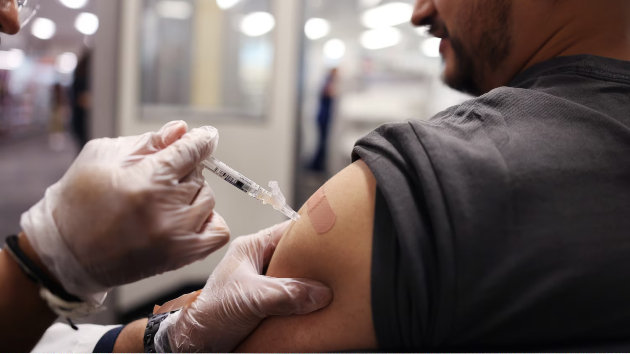
Detail of vials and syringe containing a COVID-19 vaccination by Pfizer at Kaiser Permanente Venice Medical Office Building in Culver City Tuesday, Sept. 23, 2025. (Allen J. Schaben / Los Angeles Times via Getty Images)
(NEW YORK) — The Centers for Disease Control and Prevention (CDC) updated its immunization schedule on Monday, dropping the universal COVID-19 vaccine recommendation and recommending that toddlers receive the chickenpox shot separately from the measles, mumps and rubella (MMR) shot.
Acting Director and Deputy Secretary of Health and Human Services Jim O’Neill signed off on the recommendations, which were made by the CDC’s Advisory Committee on Immunization Practices (ACIP) last month.
“Informed consent is back,” O’Neill said in a statement. “CDC’s 2022 blanket recommendation for perpetual COVID-19 boosters deterred health care providers from talking about the risks and benefits of vaccination for the individual patient or parent. That changes today.”
Last month, the ACIP voted to abandon its previous universal recommendation for annual COVID-19 vaccine shots for anyone aged 6 months and older, instead suggesting that Americans can get the vaccine “based on individual-based decision-making,” or a personal choice.
The panel also voted to no longer recommended children around 12 months old receive the first dose of the combined measles, mumps, rubella and varicella (MMRV) vaccine.
Instead, the committee recommended that children receive two separate shots, one for the combined MMR shot and a second shot for chickenpox. The MMRV shot will be recommended as an option for a child’s second dose, typically given at around 4 to 6 years old.
This is a developing story. Please check back for updates.
(NEW YORK) — During a speech earlier this week, Secretary of Defense Pete Hegseth announced the implementation of new fitness standards for the military.
In addition to the newly proposed annual fitness exam, Hegseth’s speech emphasized “gender-neutral” testing with men and women required to meet the same minimum physical performance benchmarks.
Speaking to hundreds of high-ranking military officials in Quantico, Virginia, Hegseth said it was important that certain combat positions return “to the highest male standard,” acknowledging that it may lead to fewer women serving in combat roles.
The current training is not different for male and female servicemembers.
“If women can make it, excellent. If not, it is what it is,” he said on Tuesday. “If that means no women qualify for some combat jobs, so be it. That is not the intent, but it could be the result.”
“I don’t want my son serving alongside troops who are out of shape or in [a] combat unit with females who can’t meet the same combat arms physical standards as men,” Hegseth added.
Before becoming secretary, Hegseth had spoken out against women in combat roles, but softened his stance during his confirmation hearings, saying he supports women serving in combat roles so long as they meet the same standards as men — an approach the military says has been in place for nearly a decade.
Some experts in exercise science and in the history of women’s service in the military told ABC News that while there is room for improvement in military fitness, they are concerned there’s a false narrative that female servicemembers are the only ones not meeting certain fitness standards.
“To me, Hegseth wants a military that looks a certain way … which [is] definitely male and muscular,” Jill Hasday, a professor at the University of Minnesota Law School with expertise in sex discrimination in the military, told ABC News. “It seems like his expectation is that once they enforce more ‘rigorous standards,’ more women will be pushed out.”
In response to a request for comment, a spokesperson for the Department of Defense said they did not “have anything to provide beyond Secretary Hegseth’s remarks.”
President Donald Trump also addressed officials at the Tuesday meeting, saying that “together, we’re reawakening the warrior spirit.”
Combat roles for women
In 2016, when the military opened certain high-intensity combat jobs to women, including the special operations forces, then-Secretary Ash Carter stated the importance of making sure female servicemembers “qualify and meet the standards.”
However, during his speech, Hegseth said the Department was issuing a directive that each military branch would ensure each requirement for “every designated combat arms position returns to the highest male standard only.”
In a follow-up memo from Hegseth, he stated the annual service test will require a passing grade of 70% and will be “sex-neutral” and “male standard.”
Additionally, beginning in 2026, the U.S. Army’s new fitness standards will require both male and female soldiers to meet the same minimum physical performance benchmarks for the demands of the battlefield.
Shawn Arent, a professor and chair in the department of exercise science at the University of South Carolina’s Arnold School of Public Health, said there’s nothing wrong with enforcing standards, but that there is a contradiction in Hegseth saying the tests will be “sex-normed” and also “male standard for combat roles.”
“I think we need to get away from referencing ‘male standards,'” Arent told ABC News. “They’re either standards or they’re a sex-specific standard. … I think there’s one really important caveat to this: those standards then need to make sense. In other words, what are they based on? And, if they’re arbitrary standards, then that feels certainly discriminatory.”
Arent said the standards need to be evidence-based and that it is possible the current standards need to be lowered or raised.
“It makes it sound like there’s this dramatic change, and that everything’s based on what a male can accomplish,” he said. “It should be what a combat soldier, Marine, sailor, airman, whatever, what they can accomplish in that particular role, male or female.”
Stewart Smith, a former Navy SEAL and current fitness trainer, including for those looking to enter the military, agreed, saying gender-neutral doesn’t equate to male standards.
“I don’t want to singularly say women can’t do these because there will be women that can, but I don’t think it’s a necessary focus,” Smith told ABC News. “Should [all servicemembers] be in shape and healthy and look good in a uniform? 100%. But … statistically speaking, these [maximum] standards are at a level that most men aren’t getting.”
He went on, “Saying something is gender-neutral doesn’t mean it’s the maximum male standard, right? Because, once again, if that’s the case, most males aren’t reaching that maximum male standard.”
What it would take to improve standards, according to experts
Smith and Arent said they are in favor of improving fitness standards across the military, but that Hegseth’s speech did not take into account all of the additional steps it would take to improve physical performance.
For example, Smith said improving fitness standards needs to come with improving food quality and sleep quality in the military.
“There’s a lot more problems than just high fitness standards,” he said. “Nutrition and sleep are required for that level of physical performance. … Those are the two biggest components to optimal performance that we’re stressing is you need to sleep well, you need to eat well, and you need time to train. All three are not a current priority in the military.”
Arent said this change in standards presents an opportunity for the military to examine how it can train people up to the new standards it will set.
He added that there’s a plethora of information on human performance and human optimization compared to even a decade ago
“As somebody who works with a lot of female athletes, there are ways to absolutely train them to be beasts,” Arent said. “Women are incredibly resilient, cognitively capable, and I think if you start thinking about combat roles, tactical decision-making, the ability to handle stress under these pressure situations — yes, physical fitness is a component to that, but what else are we assessing that goes with these roles?”
“We have a real opportunity here, if they lean into it to rather than setting these standards, like, ‘If you can’t meet it, too bad you suck. You’re out,'” he continued. “What are we going to do to modify how we’re approaching this to actually get more people to hit those standards?”
Too much focus on physical fitness and not other skills
The experts told ABC News that Hegseth’s speech did not focus on the other components that make people qualified to take on military combat roles.
“There’s more to leadership and service than the highest of [physical training] scores,” Smith said. “There’s learning tactics and leadership, and there’s more to leadership than great fitness tests.”
“Obviously, physical fitness can be important for many military roles, but it’s not the only thing that’s important. You don’t win a war through push-ups,” Hasday added. “Even when women were officially barred from combat, there were a lot of female troops that were essentially co-located with the troops, and they would go around with the combat troops.”
Hasday explained that in some countries where troops have been stationed, female civilians are not allowed to speak to men who are not members of their family. Having female service members with the male combat troops allowed the military to speak to female civilians to get information or to provide help.
“So, the idea, again, that you’re going to win a war by going outside someone’s house and doing push-ups, it just doesn’t seem realistic,” she said.
Female veterans hit back at Hegseth
Hegseth’s comments drew criticism from female veterans, particularly those who held combat roles.
Rep. Mikie Sherrill, a Democrat from New Jersey and a former Navy helicopter pilot, released a statement saying there is “no evidence that women cannot ably serve in combat positions.”
“Eliminating the current highly rigorous standards for women in combat positions has nothing to do with increasing lethality and everything to do with forcing women out of the Armed Forces,” she said.
Amy McGrath, a former Marine fighter pilot and Democratic Senate candidate in Kentucky, posted a video on Facebook stating there is no male standard or female standard for roles, including flying a fighter jet or being an artillery officer.
“Since combat roles have been open for qualified women, there have always been one standard for those jobs,” she said. “It’s a slap in the face and offensive to suggest otherwise.”
Arent said he can understand why this would be upsetting to former female servicemembers who held combat roles, particularly in reference to Hegseth’s comments about not wanting his son to be in a combat unit with women who weren’t meeting the same physical standards as men.
“Because of the way it [was] said, it makes it sound like it’s the females that are deficient,” he said. “But I would argue, by the same token, if they are physically capable, what if they’re more cognitively capable, more tactically capable, you would want them alongside your son, if that’s the case.”
Arent went on, “It’s not just women that aren’t meeting these standards. We have a whole lot of men that can’t meet some of these standards.”
While the rates of women diagnosed with breast cancer have increased, death rates have been declining, and five-year survival rates have risen.
Additionally, most breast cancer cases are being diagnosed in early stages before the disease has spread, making it easier to treat.
“It’s so exciting to be someone treating breast cancer because we can see that our treatments and improvements in treatments are actually making women live longer on average,” Dr. Julia McGuinness, an assistant professor of medicine within the division of hematology/oncology at Columbia University Irving Medical Center, told ABC News.
Here’s a look at the progress made in the fight against breast cancer.
Declining death rates
Breast cancer death rates were relatively steady during the late 1970s and throughout the 1980s, but have been steadily declining since 1989, aside from a few years with upticks.
In 1975, there were 31.45 breast cancer deaths per 100,000 women, according to data from the Surveillance, Epidemiology, and End Results Program under the National Cancer Institute (NCI).
By 2023, this had declined to 18.55 deaths per 100,000 women, the data shows.
McGuinness said that cancer being caught at earlier stages has led to more women receiving treatments such as surgery, chemotherapy and radiation sooner, which can reduce the chances of recurrence.
“It’s a very encouraging trend to see that even though more women are being diagnosed with breast cancer, on average, they’re living longer, and fewer women treated for early breast cancer will have their cancer recur,” she said.
Improving five-year survival rates
There have also been improvements in five-year relative survival percentages for breast cancer patients. This figure looks at the percentage of those who lived five years after they were diagnosed with or started treatment for a disease.
In 1975, the five-year relative survival percentage was 76.16%, according to data from the NCI’s SEER Program. In 2017, the latest year for which data is available, this improved to 93.2%.
“Our treatments have also improved dramatically and, even in the past decade, we’ve seen approvals for drugs that are making women with metastatic breast cancer live, on average, several years longer than they were even a decade ago,” McGuinness said.
These treatments include the introduction of anti-estrogen therapy several decades ago and more recent targeted therapies like immunotherapy, she said.
There have been “a lot of other new, exciting treatments — both in pill form and intravenous form — that have dramatically changed how we treat breast cancer at all stages, and also have prolonged the survival of women who have metastatic breast cancer,” McGuinness added.
Breast cancer cases being caught before spread
Recent data show that female breast cancer cases are being caught at early stages, before the disease has metastasized.
Between 2018 and 2022, two-thirds of female breast cancer cases were diagnosed at a localized stage, meaning the cancer was contained to the breast, according to data from the Centers for Disease Control and Prevention (CDC).
About 25% of female breast cancer cases were found at the regional stage, meaning the cancer had spread to nearby lymph nodes, tissues, or organs, and 6% were found at a distant stage, meaning the cancer had spread to distant parts of the body, CDC data shows.
McGuinness said that screening for breast cancer has dramatically improved over the past four decades.
“Mammography screening programs were introduced in the 1970s and, since then, more women are engaged in screening mammograms, which improves our chances of catching breast cancer at an early stage that is more easily treatable with a lower chance of coming back,” she said.
She added that she is hopeful improvements will continue to be made so more cases are being caught at earlier stages, leading to improved survival rates and lower death rates.
“We’re constantly — even every month, even every week — moving the needle towards better outcomes,” McGuinness said. “I think the really beautiful thing about treating breast cancer is that we have so many options, and it really becomes a discussion with patients about the right options for them. I know that we’ll continue to improve outcomes with ongoing research.”
(WASHINGTON) — As President Donald Trump rambled and ad-libbed through an announcement meant to caution pregnant women about the possible links between the use of Tylenol and autism in children, his comments went beyond the available scientific evidence, and even the language of his own health department.
He made clear he was aware he was, at times, speaking for himself.
“You know, I’m just making these statements from me,” he said at one point. “I’m not making them from these doctors, because when they talk about different results, different studies, I talk a lot about common sense.”
Trump’s remarks deviated from the more measured guidance offered by his health agencies in subsequent news releases and op-eds.
“Don’t take Tylenol,” he boomed multiple times during the hour-long event on Tuesday.
“You’ll be uncomfortable. It won’t be as easy, maybe. But don’t take it if you’re pregnant. Don’t take Tylenol,” he said.
In a statement from Kenvue, the maker of Tylenol, the company said it believes research shows that acetaminophen does not cause autism.
“We strongly disagree with any suggestion otherwise and are deeply concerned with the health risk this poses for expecting mothers,” the statement read. “Acetaminophen is the safest pain reliever option for pregnant women as needed throughout their entire pregnancy. Without it, women face dangerous choices: suffer through conditions like fever that are potentially harmful to both mom and baby or use riskier alternatives.”
Major medical groups immediately pushed back on Trump’s claims, pointing out Tylenol is considered the only safe painkiller during pregnancy, and pointing out the possible dangers of untreated pain and fever during pregnancy, including a higher risk of stillbirth.
Trump told pregnant women they should “fight like hell not to take” the drug, used to treat fevers in pregnant women, acknowledging that “there may be a point where you have to, and you’ll have to work that out with yourself.”
As blunt and simple as Trump made it sound, however, the evidence around Tylenol and autism is not yet fully formed, a fact stated by the Food and Drug Administration in a press release Tuesday.
“It is important to note that while an association between acetaminophen and neurological conditions has been described in many studies, a causal relationship has not been established and there are contrary studies in the scientific literature,” the agency said in the press release, which announced it would push for a label change for acetaminophen, Tylenol’s main ingredient.
Meanwhile, in a joint op-ed in Politico, the heads of the FDA, the National Institutes of Health and the Center for Medicare and Medicaid Services, wrote that they “recognize the literature continues to evolve and evidence from family control studies have failed to find a correlation.”
“Furthermore, acetaminophen is the only over-the-counter medication approved to treat fevers during pregnancy, and high fevers in pregnant moms can pose a risk to their unborn child as well, such as neural tube defects,” they added.
The American College of Obstetricians and Gynecologists (ACOG) warned the administration’s claims were “irresponsible” and could scare pregnant patients away from taking the drug, even when it’s medically prudent.
“Today’s announcement by HHS is not backed by the full body of scientific evidence and dangerously simplifies the many and complex causes of neurologic challenges in children. It is highly unsettling that our federal health agencies are willing to make an announcement that will affect the health and well-being of millions of people without the backing of reliable data,” said Dr. Steven J. Fleischman, ACOG president, in prepared remarks.
At times on Tuesday, Trump suggested that childhood vaccinations could contribute to autism, a theory long promoted by his health secretary, Robert F. Kennedy Jr, but which has been discredited by researchers.
“I’m not a doctor, but I’m giving my opinion,” he said.
“Vaccines do not cause autism,” read a statement from the American Academy of Family Physicians in the wake of Trump’s remarks. “Decades of rigorous research have failed to provide credible scientific evidence linking vaccines to autism. Vaccines are among the most effective tools we have to keep people, especially infants and children, healthy and out of hospitals. Continued claims about a vaccine-autism link risk public health by causing people to delay or defer vaccination out of fear.”
The CDC’s Advisory Committee on Immunization Practices is seen during a meeting on September 19, 2025 in Chamblee, Georgia. Elijah Nouvelage/Getty Images
(NEW YORK) — The Centers for Disease Control and Prevention’s vaccine advisory committee on Friday indefinitely postponed its planned vote on whether to stop recommending the hepatitis B vaccine for newborns.
The Advisory Committee on Immunization Practices, called ACIP, is expected to vote on the COVID-19 vaccine is still expected later Friday. It’s not clear exactly what the advisors will vote on, but the discussion may include the FDA’s recent narrowing of COVID-19 vaccine approvals to a smaller group of Americans — those over 65 or with underlying medical conditions.
A “yes” vote on the hepatitis B vaccine would have recommended that the first dose be delayed from birth and given at one month of life for babies born to moms who test negative in pregnancy.
Robert Malone, a panel member and vaccine critic, proposed tabling the vote out of concern that there had not been enough discussion about the safety of the hepatitis B vaccines.
Cody Meissner, a fellow panel member, argued that trying to “prove the absence of harm” is “simply not a practical objective.”
Presentations on Thursday by the CDC included data about the chances of side effects from the vaccine. For hepatitis B, the advisors are considering removing a universal recommendation for a shot in the hours after a baby is born, and instead only giving the shot if the mother tests positive for the infection during her pregnancy.
The birth dose of the hepatitis B vaccine for all babies ensures that all have the opportunity to get protected from a highly contagious virus that can cause lifelong chronic disease. A CDC recommendation isn’t a mandate but can eliminate barriers — like cost — for families so they don’t need to factor that into their choice for a shot or not.
Pediatrician medical groups argue delaying this birth dose until one month of life would leave the opportunity for babies to be missed if they are born to a mother infected with the virus or from a close contact soon after birth. It also may be difficult to guess who is at risk and should be tested — half of people living with Hepatitis B don’t know they are infected, according to the CDC.
When the U.S. had a risk-based approach to vaccination before 1991, it was estimated that 200,000 to 300,000 new hepatitis B infections occurred annually in the U.S. from 1980 to 1991 and over 1 million people were living with chronic hepatitis B infection, according to the CDC.
However, hepatitis B is still a huge problem among adults in the U.S. It’s estimated that up to 2.4 million people in the country are living with chronic hepatitis B, with many being asymptomatic and unaware of their diagnosis, according to the CDC.
Christina House/Los Angeles Times via Getty Images
(NEW YORK) — Four Western U.S. states have come together to issue unified vaccine recommendations for the upcoming respiratory illness season, and California has enacted a new law to base the state’s immunization guidance on independent medical organizations, rather than the U.S. Centers for Disease Control and Prevention.
The West Coast states including California, Washington, Oregon, and Hawaii — all led by Democratic governors — banded together earlier this month to create the West Coast Health Alliance (WCHA), citing what they called an erosion of trust in the CDC.
“The alliance represents a unified regional response to the Trump Administration’s destruction of the U.S. CDC’s credibility and scientific integrity,” stated a press release Wednesday from California Gov. Gavin Newsom.
Also on Wednesday, Newsom signed a new law, which will shift the immunization recommendations the state will recommend from the CDC to independent medical organizations that include the American Academy of Family Physicians (AAFP), American Academy of Pediatrics (AAP) and the American College of Obstetricians and Gynecologists (ACOG).
The recommendations issued by the West Coast states on Wednesday include guidance for receiving the COVID-19, flu and RSV vaccines.
“Science matters. We will ensure our policies are based on rigorous science. We stand united with our partner states and medical experts to put public health and safety before politics. I will continue to do everything in my power to protect Washingtonians,” said Washington Gov. Bob Ferguson.
The announcement came the day ahead of a two-day meeting of the CDC’s the Advisory Committee on Immunization Practices (ACIP), during which the panel of advisers recently picked by HHS Secretary Robert F. Kennedy is expected to vote Thursday on some vaccines on the CDC childhood immunization schedule and Friday on recommendations for COVID-19 vaccines.
The FDA has approved the new COVID-19 vaccines only for those at high risk for severe illness including those 65 and older. Anyone who falls out of those categories is allowed to get a prescription for the vaccine after discussing it with their doctor.
The association that represents many insurance companies (AHIP) pledged to cover the cost for any vaccine that is part of the current guidelines before the new ACIP makes their recommendations this week. The current guidelines suggest anyone older than 6 months should consider getting the COVID-19 and annual flu shot until at least the end of 2026.
Several states have also made rules that allow anyone who wants a vaccine to get one at their pharmacy.
In a statement earlier this month, a spokesperson for the U.S. Department of Health and Human Services blasted the West Coast states’ plans for a health alliance, criticizing COVID-era policies in “Democrat-run states.”
The statement added, “ACIP remains the scientific body guiding immunization recommendations in this country, and HHS will ensure policy is based on rigorous evidence and Gold Standard Science, not the failed politics of the pandemic.
(NEW YORK) — Ahead of a key meeting amongst the Centers for Disease Control and Prevention (CDC) vaccine advisors — now with 12 members hand-picked by health secretary Robert F Kennedy Jr. — doctors, health officials and advocates are raising alarms that the panel could reverse a decadeslong guideline of vaccinating infants against hepatitis B at birth.
On camera on Wednesday, Republican Sen. Bill Cassidy, a doctor specialized in treating liver diseases and chair of the Senate committee that oversees the Department of Health and Human Services (HHS), said the American people should not have confidence in the advisory panel’s decision if they recommend against the birth dose of the hepatitis B vaccine.
The Advisory Committee on Immunization Practices (ACIP) is scheduled to meet Thursday to discuss the hepatitis B vaccine recommended at birth, a shot that decades of research has shown is safe and has virtually eliminated hepatitis B among babies in the United States.
At the last ACIP meeting in June, the advisory panel casted doubt about the necessity of the hepatitis B shot recommended at birth to all babies, comments that sparked concern among physicians.
In testimony on Wednesday, ousted CDC Director Susan Monarez said she was fired because she refused to rubber-stamp future changes Kennedy wished to make to the childhood vaccine recommendations, without a careful review of the evidence herself.
On Thursday, ACIP plans to discuss the hepatitis B birth dose and is expected to vote on a new recommendation, according to a draft of the meeting agenda.
Doctors and advocates told ABC News that the hepatitis B birth dose is still an essential recommendation and delaying it may lead to gaps in insurance coverage, growing health disparities, confusion and an increase in preventable hepatitis B infections.
Doctors call the hepatitis B vaccine ‘one of the cornerstones’ of prevention In a Senate hearing on Wednesday, Republican Sen. Bill Cassidy praised the success of the recommendation to give babies a hepatitis B vaccine at birth.
“Before 1991, as many as 20,000 babies, babies, were infected with hepatitis B in the United States of America, and that changed when the hepatitis B vaccine was approved for newborns,” Cassidy said.
“Now fewer than 20 babies per year get hepatitis B from their mother. That is an accomplishment to make America healthy again, and we should stand up and salute the people that made that decision, because there’s people who would otherwise be dead if those mothers were not given that option to have their child vaccinated.”
“The hepatitis B birth dose is one of the cornerstones of our hepatitis B prevention policy,” Dr. Sean O’Leary, an infectious disease specialist and chair of the American Academy of Pediatrics committee on infectious diseases, said in a press briefing following the last ACIP meeting in June.
The CDC currently says a timely administration of a hepatitis B vaccine is essential to help prevent transmission of the virus from mother to child at birth. While efforts to test for this virus during pregnancy have improved detection, cases can still be missed, or documentation may be inaccurate or incomplete.
Doctors and public health experts said that the hepatitis B shot is currently recommended for all babies at birth because the risk if a baby is missed is too high.
“A child that is infected at birth has a 90% chance of going on to develop chronic active hepatitis B. Of those children, of those 90%, 25% of them will then go on to die of the disease,” O’Leary said.
The first hepatitis B vaccine was licensed in 1981, and the ACIP recommended a vaccine dose universally for all babies in 1991. The hepatitis B birth dose “acts as a safety net, reducing the risk for perinatal transmission when the [hepatitis B] status of the parent is either unknown or incorrectly documented at delivery,” the CDC said.
“Because the stakes were so high, because you’re so much more likely to get cirrhosis or liver cancer if you get this virus as a young child, that’s why [there’s a] birth dose,” Dr. Paul Offit, director of the Vaccine Education Center and professor of pediatrics in the Division of Infectious Diseases at Children’s Hospital of Philadelphia, told ABC News. “We did a dramatic job of virtually eliminating the disease in young kids.”
Doctors say a risk-based hepatitis B vaccine strategy didn’t work in the past Before 1991, hepatitis B shots were only given to infants considered high risk; however, this strategy missed many cases.
“Four to five decades of implementation science shows us that risk-based vaccine recommendations in this case, don’t work,” Chari Cohen, DrPH, MPH, president of the Hepatitis B Foundation, told ABC News.
“We were not very good at identifying all kids at high risk as there were other factors for which we were not accounting and because of imperfections in the system,” Dr. Gary Freed, a professor of pediatrics, health management and policy at the University of Michigan, told ABC News.
“To make sure no high-risk infants were missed, a universal hepatitis B vaccine strategy was adopted,” Freed told ABC News.
In 1999, there was a temporary pause in the universal recommendation, in favor of a risk-based recommendation for a brief period that year. At least one child in Michigan died of hepatitis B infection that year, who was missed, according to a CDC MMWR report, due to improper documentation.
Cohen said the birth dose doesn’t just protect babies from getting the virus from their mother but protects babies from getting it through close contacts who may not know they are infected.
“You only have 24 hours to save a baby from getting Hepatitis B if they’re born to a positive mom. However, you’re also trying, trying to prevent early childhood exposure, especially among families who don’t know that there’s a family member or a caregiver that has hepatitis B,” Cohen said.
Dr. Su Wang, a primary care doctor and person living with chronic hepatitis B who is a spokesperson for the Hepatitis B Foundation, knows how easily people can get missed from both sides of the healthcare system.
“We certainly cannot count on our system in the U.S., the way it is, our broken healthcare system to actually even identify those who are at risk, much less those who don’t have an identified risk. You just couldn’t imagine all the different ways that people can fall through the cracks,” Wang said.
“It’s a huge burden on somebody to have to have [hepatitis B] for the rest of their life, especially if it starts in childhood,” Wang said. “You could prevent all that with a simple vaccine.”
Wang learned she was living with hepatitis B when she tried to donate blood in college and later found out that she likely contracted the virus from a family member when she was a baby.
“This does happen, household transmission,” Wang said. “When I think about my case, I think the birth dose is something that would have helped me.”
Ending the recommendation may also worsen health disparities On Tuesday, American health insurers pledged to cover the cost of all vaccines based on previous recommendations by the ACIP that were in place as of Sept. 1. While this may protect access for many kids with private health insurance, it may leave a critical gap for kids who rely on no-cost vaccines through the Vaccines for Children Program (VFC), if the recommendation is reversed.
The CDC said over half of all American kids were eligible for shots through the VFC program in 2023. If ACIP no longer recommends a hepatitis B shot at birth, a majority of these kids may lose access.
“Fifty percent of newborns who are going to be eligible for Vaccines for Children may not have the vaccine any longer available to them,” Michaela Jackson, MS, program director of prevention policy for the Hepatitis B Foundation, told ABC News. “Policy changes can seem very, very small on the surface, but they have long-reaching impacts on the ground.”
Hepatitis B rates have improved but remain a ‘silent epidemic’ The recommendation for all babies to get the hepatitis B shot at birth has virtually eliminated this disease in young kids, but the virus still remains a “silent epidemic” in the U.S., Offit said.
Before universal vaccination at birth, it was estimated that 200,000-300,000 new hepatitis B infections occurred annually in the U.S. from 1980-1991 and over 1 million people were living with chronic hepatitis B infection, who were potentially infectious to others.
CDC data shows that there were at least 2,214 reports of acute hepatitis B cases in the U.S. in 2023, which corresponds to an estimated 14,400 acute infections with the virus, after adjusting for unrecognized or underreported infections. There were over 17,000 newly reported chronic hepatitis B cases and nearly 1,800 hepatitis B-related deaths that year.
It’s estimated that up to 2.4 million people are living with chronic hepatitis B in the U.S., many asymptomatic and unaware of their diagnosis.
“There’s a lot more hepatitis B in this country than we people realize. Risk is much higher than people know it is,” Cohen said.
The virus is contagious and spreads through contact with blood or body fluids from a person infected with the virus, according to the CDC. A person can be asymptomatic for many years and spread the infection.
There are medications people can take to slow down the virus, but there’s no cure.
“Until we have a cure for Hepatitis B, it is critically important to prevent it,” Cohen said.
The Hepatitis B Foundation has voiced grave concern that the recommendation for universal hepatitis B vaccination at birth will be reversed by the current ACIP.
“For decades, the birth dose recommendation has prevented thousands of Americans from a devastating and life-threatening illness. It is a critical part of our nation’s strategy to eliminate hepatitis B and protect the health of future generations,” the foundation said in a statement in June.
The organization called for a “zero-tolerance policy for perinatal hepatitis B transmission in the U.S.”
“We cannot allow a preventable, cancer-causing virus to destroy more lives. The health of our children and the integrity of our public health system deserve better,” the statement said.
In a letter to the ACIP ahead of Thursday’s meeting, the pharmaceutical company Merck, which makes one of the FDA-approved hepatitis B vaccines that can be given at birth, said 330 million doses of its shot have been distributed worldwide since its approval in 1986 and “have been evaluated in over 30 clinical studies enrolling approximately 13,000 participants.
Among these studies, 12 post-approval studies included 3,646 neonates, newborns, infants and children.”
“The safety profile of RECOMBIVAX HB has been well established and closely monitored for more than 35 years. Merck remains vigilant in monitoring scientific literature, healthcare reports and other data sources to ensure the continued safety of RECOMBIVAX HB,” Merck said.
Wang said $0.20 per shot could prevent a lifetime of suffering. “It’s not just a liver disease, you know, it affects your life completely.”
(NEW YORK) — The United States death rate decreased by 3.8% in 2024 as COVID fell out of the top 10 leading causes of death for the first time in four years, new provisional federal data shows.
The overall rate declined from 750.5 per 100,000 people in 2023 to 722 per 100,000, according to the report from the Centers for Disease Control and Prevention’s National Center for Health Statistics (NCHS).
This marks the lowest death rate recorded since 2020, during the first full year of the COVID-19 pandemic, and follows declines that began in 2022.
The report also found that overall deaths fell from 3.09 million in 2023 to 3.07 million in 2024.
Additionally, the report showed the three leading causes of death stayed the same from 2023 to 2024, with heart disease as the leading cause, followed by cancer and unintentional injury, respectively.
Suicide replaced COVID-19 as the 10th leading underlying cause of death, knocking the disease off the top 10 list for the first time since 2020.
“‘It’s pretty noteworthy that COVID-19 fell off the top 10 and suicide, which had been had fallen off in recent years, is … ranked again,” Farida Ahmad, corresponding author of the report and health scientist at NCHS, told ABC News. “I think that’s a pretty interesting finding given where we spent the last five years.”
Ahmad said fewer deaths from COVID in 2024 compared to 2023 may be a reason behind the 3.8% decline.
“Ever since it came onto the scene in 2020, COVID was one of the top 10 leading causes of death,” Ahmad said. “It started off as a third-leading cause and, in 2024, we see that it’s not ranked at all, actually. So, it’s still among the 15 leading causes, but not in the top 10.”
Dr. Sharonne Hayes, a professor of cardiovascular medicine at Mayo Clinic in Rochester, Minnesota, agreed that fewer cases of COVID-19 are likely driving the reduction in mortality.
“I think there’s a little less COVID, right? I mean, that’s part of it,” she told ABC News. “I think that the pandemic was such a time of both COVID-related deaths, but also just rising risk factors, particularly around cardiovascular disease, people’s lifestyles were less healthy. And maybe we are coming back to more of where we are before.”
Ahmad said another driver for the drop in deaths could be the decline in drug overdose deaths.
A CDC report published in May found that U.S. drug overdose deaths fell by nearly 27% in 2024 to the lowest levels seen in five years.
Dr. Katie Schmitz, a visiting professor of medicine in the department of medicine and cancer epidemiologist at the University of Pittsburgh, told ABC News that leading causes of death continue to be cardiac disease and cancer-related deaths due to an aging population, as well as underlying factors such as obesity.
Schmitz noted that we have an increase in proportion of the population with these co-morbidities and it’s important to highlight that access to health care can be limited, particularly for rural populations.
Other leading causes of death in the report included stroke, chronic lower respiratory disease, Alzheimer’s disease, diabetes, kidney disease and chronic liver disease and cirrhosis.
The report also found that death rates decreased from 2023 to 2024 among all racial/ethnic groups. Rates in 2024 were lowest for multiracial people at 332.3 per 100,000 and highest for the Black population at 884 per 100,000.
Death rates decreased from 2023 to 2024 for all age groups except infants younger than one year old, according to the report. Death rates in 2024 were lowest for children between ages 5 and 14 at 14.4 per 100,000 and highest for people age 85 and older at 13,835.5 per 100,000.
Schmitz said investments should be made that focus on prevention — such as addressing rising obesity rates — and early screenings, which can vary with socioeconomic status and geography.
Hayes said making lifestyle changes is hard, but it is one of the best ways to lower the risk of some of the leading causes of death, including heart disease and cancer.
“Whether it’s eating more vegetables, [decreasing] saturated fat, maintaining a healthy weight is going to help stroke, cancer, and heart disease risk as well as liver disease, kidney disease, and diabetes,” she said. “Aside from unintentional injury and suicide, virtually every other thing of that list would be impacted by lifestyle.”
Dr. Lisa Gwynn says Florida’s vaccine decision will create ‘perfect storm’ for diseases. ABC News.
(FLORIDA) — A top Florida pediatrician warned Thursday that the state’s plan to eliminate all vaccine mandates could lead to outbreaks of preventable diseases and put vulnerable populations at risk.
Dr. Lisa Gwynn, a former president of the American Academy of Pediatrics’ Florida chapter, told ABC News that removing vaccine requirements for public school children could endanger not just students, but also “newborn infants, elderly populations, and people with compromised immune systems, including those undergoing chemotherapy.”
The warning came a day after Florida Surgeon General Joseph Ladapo announced the state would become the first in the nation to remove all vaccine mandates, including those for common childhood diseases like polio, measles, chickenpox, and tetanus. Currently, all 50 states and Washington, D.C., require certain vaccinations for school attendance.
“It’s not just about parental choice,” Gwynn explained to ABC News. “When children are in close contact in classrooms, that’s a perfect storm for these types of diseases to spread.”
Gwynn argued that existing exemption policies already provide options for parents who oppose vaccination.
“There are other ways parents can achieve choice for their children,” she said. “As pediatricians, we work together with parents so they can make informed decisions.”
She also raised concerns about health equity, noting that removing mandates could create a “case of the haves and have-nots.” Children from under-resourced communities who lack access to regular medical care might enter school unvaccinated not by choice, but due to healthcare barriers, she explained.
School entry vaccination mandates are determined by each state. All states allow medical vaccine exemptions, and most states already have exemption policies in place for people with strong religious objections, in an effort to balance the need for public health with the ideal of individual freedom of choice. Some states allow exemption based on personal belief alone.
Florida’s decision to end vaccine mandates comes amid broader changes in national health policy. Health and Human Services Secretary Robert F. Kennedy Jr. appeared before the Senate Finance Committee Thursday to discuss the administration’s healthcare agenda, following recent shake-ups at both the FDA and CDC.
“These changes were absolutely necessary adjustments to restore the agency to its role as the world’s gold standard public health agency with the central mission of protecting Americans from infectious disease,” Kennedy said.
Ladapo defended the decision to end mandates on Wednesday, calling them “an immoral intrusion on people’s rights” during his announcement at Grace Christian School in Valrico, Florida.
Gwynn countered this view, pointing to decades of research supporting vaccination programs.
“Public health measures have saved millions of lives,” she told ABC News. “School vaccination requirements have been the best public health achievement of this century.”
A spokesperson for the Florida Surgeon General’s Office did not immediately respond to ABC News’ request for comment.
(NEW YORK) — People who use their smartphones while sitting on the toilet face are at higher risk for painful, itchy hemorrhoids, according to new research published in the journal PLOS One.
Researchers investigated the bathroom habits of 125 adults undergoing screening colonoscopies at Beth Israel Deaconess Medical Center in Boston. About two-thirds of participants reported scrolling through their smartphones while sitting on the toilet.
Those who were glued to their phone while using the bathroom were 46% more likely to have hemorrhoids compared to those who left their device in another room.
“The likely explanation is that prolonged sitting increases pressure in the veins around the rectum, which can contribute to hemorrhoids,” Dr. Ernesto Gonzaga, a gastroenterologist from the Hospital of the University of Pennsylvania and who did not contribute to the study, told ABC News.
Scrollers spent a longer time on the toilet, the researchers found — about five times as many smartphone users logged over five minutes of toilet time per visit. When researchers asked what they were doing on their phones while doing their business, people confessed to catching up on the news, cruising through their social media feeds, or sending emails and texts.
Gonzaga pointed out that phone users also reported getting less exercise than non-users, suggesting that their broader lifestyle patterns could also contribute to their risk of hemorrhoids.
Hemorrhoids are swollen blood vessels around the anus and rectum, according to the National Institutes of Health. They can cause itching, pain and discomfort, and in many cases, they can also lead to rectal bleeding. Studies show that they are common in both men and women and affect about 1 in 20 Americans and about half of adults over 50 years old have hemorrhoids.
They are mainly treated with more fiber and fluids, soothing creams or sitz baths, and in tougher cases, they may require surgery.
“In clinical practice, we still recognize the more classical risk factors for hemorrhoids, including constipation, straining, low fiber intake, prolonged toilet sitting, pregnancy, obesity, and sedentary lifestyle. Constipation and abnormal bowel habits are particularly strong risk factors, while high fiber intake is protective,” Gonzaga said.
Gonzaga noted that the study does have some limitations. It looked at a small number of subjects and relied on self-reporting, so it doesn’t necessarily prove that phone use on the toilet is a direct cause of hemorrhoids, he said. He called for more research to get to the bottom of it.
“Given that hemorrhoids already account for millions of outpatient visits and substantial healthcare costs, these findings raise a broader public health concern about a growing burden of disease, potentially extending into younger populations as smartphone use,” he added.
Noor Shaik, MD, PhD, is a neurology resident physician and a member of the ABC News Medical Unit.