
Hotel junk fees are still a thing: Here’s how to protect yourself

Hotel junk fees are still a thing: Here’s how to protect yourself
Nadija Pavlovic/Getty Images

(NEW YORK) — Junk, resort, destination, urban, and amenity fees are pseudonyms for the mandatory, often unexpected surcharges you might find tackled on your hotel bill. According to the Council of Economic Advisers (CEA), these fees cost Americans nearly $3.4 billion annually and despite recent bipartisan efforts by the Biden administration to combat junk fees entirely, they still seem to pop up when it’s time to pay for your stay.

“The consumer is the loser” when it comes to junk fees, Clint Henderson, managing editor at The Points Guy, told ABC News’ Good Morning America.

The value of what’s being delivered has fallen dramatically for consumers, who are now paying all-encompassing fees for erroneous line items such as Wi-Fi, phone calls, fax machines, towels, beach access, breakfast, parking, fitness centers and more — the list goes on, and “it’s getting hard to keep up,” Henderson said.

“The consumer can only take so much of these [fees] before they break,” said Henderson, adding that “spending hundreds of dollars more on a seven-day holiday can make the cost of travel out of reach for some people.”

Depending on the type of accommodation and length of stay, consumers can expect to pay an average of $38.82 more per night at hotels that charge resort fees, according to a 2024 analysis from NerdWallet.

The push to eliminate junk fees

Overwhelming ‘fee fatigue’ among Americans has led to increased regulatory scrutiny at the federal and state levels. The House of Representatives passed in June the No Hidden FEES Act, which would create federal guidelines for being transparent about hidden costs at stays and the Federal Trade Commission (FTC) would pursue those who are in violation.

“Americans are tired of being played for suckers,” said President Joe Biden during his February State of the Union address in which he announced his administration’s proposed Junk Fee Prevention Act aimed at eliminating hidden fees and encouraging customers to fight unfair charges.

In October, the FTC proposed a rule to prohibit hidden and bogus fees in all sectors of the U.S. economy, including hotels and short-term lodging.

At the state level, California’s SB 478 law, which went into effect July 1, requires businesses to advertise or list prices inclusive of all mandatory charges. At least 10 other states have followed suit by proposing or enacting junk fee statutes targeting increased fee transparency.

“While price clarity helps, hotels still have a vested interest in keeping these fees…it’s pure profit for them,” said Henderson. 

Critics argue that resort fees allow a hotel to effectively increase room rates without changing their advertised prices nor paying extra taxes.

“Whether hidden or not, [junk fees] contribute to these companies’ bottom lines and are still making their way into your bills,” said Henderson.

Protect yourself from junk fees

Henderson shared some tips to protect yourself from added junk fees when booking your next stay:

1. Search for places that don’t charge resort fees

The best way to avoid junk fees is by not being charged them in the first place. 

“Knowledge is power for consumers and the more you know, the more you can make smart decisions with your money,” said Henderson, who suggests using sites like Kill Resort Fees to locate high-fee hotels ahead of time.

Bonus: Henderson also advises to plan for tips in your calculations to make sure you’re choosing a destination that fits your budget. 

“Even in foreign countries, Americans are often expected to offer something,” he said.

2. Ask to remove resort fees

Speaking up can go a long way. When making your hotel reservation or when checking-in, Henderson recommends asking the hotel if they will simply remove the fee from your total. 

“Negotiating is an option, too,” he said.

3. Call your local congressperson and complain about junk fees

“The louder we are, the more political pressure there is on these companies to stop junk fees,” said Henderson, “we’re seeing some progress, but there is still a long way to go.”

Copyright © 2024, ABC Audio. All rights reserved.

Trump wants a role in setting interest rates. Some economists say it’s a bad idea

Trump wants a role in setting interest rates. Some economists say it’s a bad idea
Bloomberg Creative/Getty Images

(NEW YORK) — Former President Donald Trump recently said the president should have a role in setting interest rates that determine costs for everything from mortgages to credit card loans.

The proposal would mark a major shift from the longstanding norm of political independence at the Federal Reserve, which currently retains control over interest rate policy. The nation’s central bank is in the midst of a yearslong fight to dial back inflation.

“I feel the president should have at least [a] say in there,” Trump said during a press conference at his Mar-a-Lago resort in Florida last week. “I feel that strongly. I think that in my case, I made a lot of money, I was very successful, and I think I have a better instinct than, in many cases, people that would be on the Federal Reserve or the chairman.”

The policy idea elicited opposition from both liberal and conservative economists who spoke to ABC News.

They warned that any president, including Trump, would likely seek low interest rates in an effort to improve the nation’s short-term economic growth. That approach would risk runaway inflation that could wreak significant economic damage long after a given president has left office, they added.

“It’s an absolutely bad idea,” George Selgin, senior fellow and director emeritus of the Center for Monetary and Financial Alternatives at the libertarian Cato Institute, told ABC News.

“Presidents are known to be very shortsighted when it comes to monetary policy,” Selgin added. “They’re happy to try and take advantage of a temporary boost that easy money can give to economic activity and downplay or overlook the longer-run consequences, which can include inflation getting out of control.”

Paul Wachtel, a professor of economics at New York University who studies monetary policy, echoed that rebuke.

“I can’t think of anything that economists across the spectrum agree upon more than the importance of central bank independence,” Wachtel told ABC News.

In response to a request for comment from the Trump campaign, a representative of the Republican National Committee (RNC) faulted the Biden administration for a rise in inflation in recent years that prompted the Fed to raise interest rates.

“The president’s policies already affect interest rates — the failed Harris-Biden economic agenda has led to the fastest increase in mortgage rates since 1981,” RNC spokesperson Anna Kelly told ABC News. “As the deciding vote on the so-called ‘Inflation Reduction Act’ that actually spiked prices and made housing unaffordable for families across the country, Kamala Harris co-owns the disastrous impact of Bidenomics, and no one can afford another four years.”

The proposal from Trump arrives at a time when the Fed has held interest rates at their highest level in more than two decades. The central bank has helped bring inflation down significantly from its peak, but elevated interest rates risk tipping the U.S. into a recession.

Scrutiny over the Fed’s role in a potential economic downturn reached a fever pitch earlier this month when a weaker-than-expected jobs report showed that the economy may be slowing faster than previously known.

“It’s one of those occasions when people can second-guess the Fed and wonder whether Trump would’ve made a better decision, but one can’t just base a decision on who should govern monetary policy on a single event,” said Selgin.

Critics of an expanded role for the president point to a bout of high inflation in the 1970s and 1980s. Before the inflation took hold, President Richard Nixon had urged Fed Chair Arthur Burns to cut rates in the run-up to the 1972 presidential election.

Nixon’s advocacy is widely viewed as a contributing factor for lower-than-necessary interest rates that enabled inflation to get out of control, Mark Zandi, chief economist at Moody’s Analytics, told ABC News.

“Allowing the president, any president, to help set monetary policy would eventually wreck the U.S. economy,” Zandi said.

To be sure, the Fed does retain direct ties to the federal government. The Fed chair is appointed to a four-year term by the president and must receive confirmation from the Senate. Further, the general guidelines for interest rate policy are rooted in legislation approved by Congress.

Selgin, of the Cato Institute, acknowledged that the Fed doesn’t retain full political independence.

“The Fed’s independence is far from absolute,” Selgin said. “Precisely because it’s so limited, it’s important to keep as much of that independence as exists.”

Vice President Kamala Harris, the Democratic presidential nominee, said on Friday that she disagreed with the proposal voiced by Trump.

“The Fed is an independent entity and as president I would never interfere in the decisions that the Fed makes,” Harris told reporters in Phoenix, Arizona.

The Fed is guided by a dual mandate to keep inflation under control and maximize employment. In theory, low interest rates help stimulate economic activity and boost employment; high interest rates slow economic performance and ease inflation.

The chances of an interest rate cut at the Fed’s next meeting in September are all but certain, according to the CME FedWatch Tool, a measure of market sentiment. Market observers are split roughly down the middle about whether the Fed will impose its typical cut of a quarter of a percentage point or opt for a larger half-point cut.

An interest rate cut in September would arrive during the final months of the presidential campaign.

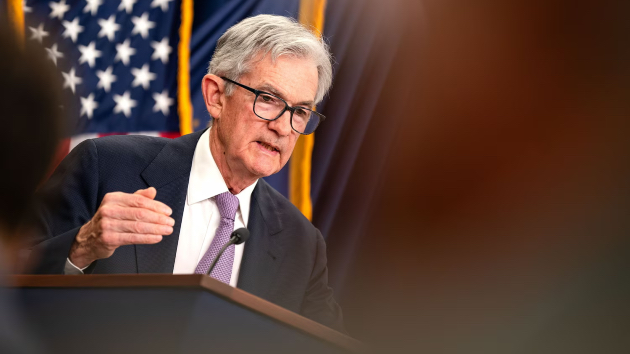
Last month, Fed Chair Jerome Powell said coming rate decisions would depend solely on economic conditions.

“Congress has, we believe, ordered us to conduct our business in a nonpolitical way at all times, not just some of the time,” Powell said at a press conference in Washington, D.C., last month.

“We never use our tools to support or oppose a political party, a politician, or any political outcome. The bottom line is, if we do our very best to do our part and we stick to our part, that will benefit all Americans,” Powell added.

Copyright © 2024, ABC Audio. All rights reserved.

How did the stock market bounce back from its worst day in years?

How did the stock market bounce back from its worst day in years?
Berkah/Getty Images

(NEW YORK) — Volatility overtook the stock market last week, amplifying worries about a possible recession and stoking panic among investors.

By the end of the week, however, the markets had almost fully recovered. Days after suffering its worst trading day since 2022, the S&P 500 rallied for its best trading session dating back to that same year. For the week, the S&P 500 ended nearly flat, inching downward 0.05%.

The rapid recovery is owed to a realization among traders that risk of an impending recession, as well as damage from a selloff on the Japanese stock market, had likely been overstated, experts told ABC News. The drop-off in stock prices transitioned quickly from an alarm blaring across Wall Street, to an opportunity for traders seeking newly discounted shares, they said.

“When we panic, we lower our expectations so far that any news short of disaster feels like rain in the desert. Then, people pile back in,” Callie Cox, chief market strategist at Ritholtz Wealth Management, said in a Monday blog post about the recovery.

“When lots of investors brace for a punch – or sell their stocks – they tend to discover that the actual punch doesn’t hurt as bad,” Cox added.

The stock market downswing was set off by a disappointing jobs report earlier this month. Employers hired 114,000 workers in July, falling well short of economist expectations of 185,000 jobs. Additionally, the unemployment rate climbed to 4.3%, the highest level since October 2021.

The lackluster jobs data fueled concern about a potential recession, as well as calls for an interest rate cut.

The heightened worry about an economic cooldown coincided with interest rate hikes imposed by Japan’s central bank. Those rising rates prompted an unwinding of a so-called “carry trade” in which investors borrowed Japanese yen at low interest rates and used it to purchase assets, including U.S. stocks.

When Japan then hiked interest rates, investors sold off some of those assets and sent stock prices falling. Japan’s main Nikkei 225 stock index last Monday dropped more than 12%, its worst trading session since 1987. The following day, however, the index soared 10%, then increased slightly over the remainder of the week.

The seesaw performance of the Nikkei 225 mirrored that of U.S. stocks, Avanidhar Subrahmanyam, a professor of finance at the University of California, Los Angeles, told ABC News.

“People saw a buying opportunity and stepped in,” Subrahmanyam said, noting that markets often recover quickly from a downturn. “The entire episode was simply a panic followed by a correction.”

Between 1980 and 2023, the S&P 500 posted a positive return over each calendar year 82% of the time, Wells Fargo Investment Institute told clients in a note last week. The market experienced a drop-off of at least 10% in nearly half of those years, Wells Fargo said, adding, “The data shows that a market downturn does not necessarily mean markets will perform poorly for the year.”

Prior to last week’s volatility, the stock market had displayed a banner performance in 2024. Before the weak jobs report on Aug. 2, the S&P 500 had climbed more than 14% this year.

In turn, some observers believed that stocks had become overpriced. While the prices reflected robust corporate profits, they also had soared on account of enthusiasm about artificial intelligence and optimism about the chances of an economic “soft landing,” some experts told ABC News.

The perception of overpriced stocks left the market vulnerable to a fit of bad news that could exacerbate those jitters, the experts added.

“When there’s a perception that things are overvalued, people are already nervous,” said Subrahmanyam, of the University of California, Los Angeles. “When any small precipitating factor occurs, the sellers panic.”

However, the price gains over the ensuing days suggested a view among some traders that such worries had gone too far, Jay Ritter, a professor of finance at the University of Florida, told ABC News. The rapid recovery, he added, appeared to indicate a recognition that strong stock performance this year had been fueled in part by one of the market’s most fundamental metrics: corporate profits.

“U.S. earnings have gone up so much more than the rest of the world,” Ritter told ABC News. “So the stock market has gone up a lot.”

Copyright © 2024, ABC Audio. All rights reserved.

Canceling subscriptions should be as easy as signing up, new federal rule says

Canceling subscriptions should be as easy as signing up, new federal rule says
Carol Yepes/Getty Images

(WASHINGTON) — In an effort to beef up protections for consumers against corporations, the Biden administration on Monday announced a handful of policies to crack down on “headaches and hassles that waste Americans’ time and money.”

Through the Federal Trade Commission (FTC) and the Federal Communications Commission (FCC), the administration will ask companies to make it as easy to cancel subscriptions and memberships as it is to sign up for them, and through the Consumer Financial Protection Bureau, a new rule will require companies to let customers cut through automated customer service “doom loops” by pressing a single button to reach a real person.

“For a lot of services, it takes one or two clicks on your phone to sign up. It should take one or two clicks on your phone to end the service,” White House Domestic Policy Advisor Neera Tanden said on a call with reporters to discuss the new policies.

Consumers could see the new rule applied to gym memberships or subscriptions with phone and internet companies.

The administration will also call on health insurance companies to allow claims to be submitted online, rather than requiring insured customers to print out and mail forms in for coverage.

“Essentially in all of these practices, the companies are delaying services to you or, really, trying to make it so difficult for you to cancel the service that they get to hold on to your money longer and longer,” Tanden said. “And what that means is, ultimately, consumers, the American public, is losing out.”

The new regulations were rolled out Monday but will be on varying timelines, with some taking weeks and others taking months to be implemented, administration officials said.

They target a range of industries and companies at a time when Americans feel strapped by high prices and stubborn inflation — an issue that has weighed on President Joe Biden and now Vice President Kamala Harris’ presidential campaign as voters continue to rank the economy among their top issues.

As part of an agenda centered around “lowering costs,” the administration has tried to improve voter confidence in the economy through consistent but piecemeal efforts to bring down daily costs, from lowering prescription drug prices to canceling student loan debt.

Volatility in the stock market last week after a lower-than-expected jobs report has increased the pressure for Democrats to prove their economic bonafides to voters. Experts urge caution before drawing any major conclusions from the week, remaining divided over whether the U.S. is headed for a downturn or still on a resilient path of growth.

Other efforts by the Biden administration to reduce daily bills and offset higher prices include targeting junk fees tacked onto tickets and hotel costs, requiring airlines to automatically refund passengers for delayed flights, and banning medical debts from credit reports.

The efforts have frequently pitted Biden and Harris against big companies, as they accuse them of “shrinkflation,” or delivering less product for the same price, and keeping their prices high even as inflation falls. The Biden administration has also been heralded by antitrust advocates for reviving enforcement on companies for the first time in a meaningful way in decades — including with lawsuits against companies like Google, Apple and LiveNation.

Tanden insisted that Monday’s efforts were about creating a better functioning market, not targeting any particular company or “shaming corporations writ large.”

“This is a broad initiative in which we are talking about a whole series of practices across multiple industries, and the real focus is ensuring that consumers and their choices are what is driving decision making in the market, not the practices of companies that make it hard for people to switch,” Tanden said.

“When they want to end one subscription, they can shop for another, but it’s their decision,” she said. “That’s what a free market is really about, empowering individuals to make the decisions they want to make without these practices that get in their way.”

Copyright © 2024, ABC Audio. All rights reserved.
HarrisWalz.com domain sells for $15,000

HarrisWalz.com domain sells for ,000
HarrisWalz.com domain sells for $15,000
Andrew Harnik/Getty Images

(NEW YORK) — This week, hours after Vice President Kamala Harris announced Minnesota Gov. Tim Walz as her running mate in the 2024 election, the website domain “HarrisWalz.com” sold for $15,000. It was a tidy profit for domain owner Jeremy Greene Eche, who bought it for around $9 in 2020.

Eche is what is known as a “domain squatter,” someone who buys up low-cost web addresses with the intention of flipping them for a profit. The New York City trademark lawyer purchased several domains around the time of the 2020 election, he told ABC Audio, specifically focusing on candidates who were likely to run in the future.

“So I just looked up every heartland governor and senator I could think of,” he said. “I got a bunch of midwestern politicians.”

In addition to the Harris/Walz domain, Eche also bought addresses that paired Harris’ name with Illinois Gov. JB Pritzger, and Pennsylvania Sen. John Fetterman. He tried to buy HarrisShapiro.com as well, he noted, in anticipation of Harris picking Pennsylvania Gov. Josh Shapiro, but it had already been registered and purchased.

“You just have to hope you hit the jackpot when you start buying those names,” he said.

In total, Eche owned more than a dozen domains related to the 2024 election cycle, each of which needed to be renewed yearly for a small fee.

Eche was also the owner of ClintonKaine.com in the runup to the 2016 election, in which Hillary Clinton ran alongside Virginia Sen. Tim Kaine. Once Clinton announced Kaine as her running mate, Eche sold the address for $15,000.

The buyer was Brad Parscale, senior adviser for data and digital operations for Donald Trump’s 2020 presidential campaign, who used the address to spread negative messaging about the Democratic ticket, Wired reported in 2016. At the time, Parscale told the tech magazine the site was the Trump campaign’s answer to what they said was the liberal mainstream media.

“It allows us a nice playing field to do some opposition research and let it show,” Parscale told Wired. “We want people to see all the truth, and not the sometimes one-sided truth that we get from the media.”

At the time of the sale, Eche wasn’t aware of the buyer’s identity, he said.

It wasn’t the first time a political domain name was used against a candidate. Visiting TedCruz.com in the run up to the 2016 Republican presidential primary didn’t bring users to the campaign website for Texas Sen. Ted Cruz.

Instead, the website, which was owned by an Arizona lawyer also named Ted Cruz, was used to promote the Republican’s potential Democratic political rival, then-President Obama. The campaign ended up using TedCruz.org, Politico reported.

The buyer of HarrisWalz.com wanted to remain anonymous, according to Eche. He acknowledged that he’s already sitting on domains looking ahead to future elections.

“I have a lot of Tim Walz domains because, like Harris was four years ago, Tim Walz now is an obvious candidate for eight years from now for the presidency.”

However, Eche admited that typing in a specific web address isn’t as common as it once was.

“Nobody just types in ‘HarrisWalz.com,’” Eche said. “They Google it.”

Copyright © 2024, ABC Audio. All rights reserved.

Here’s why mortgage rates dropped to their lowest level in more than a year

Here’s why mortgage rates dropped to their lowest level in more than a year
Thomas Northcut/Getty Images

(NEW YORK) — Mortgage rates this week dropped to their lowest level in more than a year, delivering some long-sought relief for homebuyers.

The average interest rate for a 30-year fixed mortgage stands at 6.47%, Freddie Mac said on Thursday. That figure marks a drop of more than a percentage point from a peak attained last year after the Federal Reserve hiked interest rates in an effort to fight inflation.

The Fed has held interest rates steady at their highest level in two decades, however. So, why are mortgage rates plummeting?

Experts who spoke to ABC News attributed the drop to a widely held expectation that the Fed will begin to cut interest rates at its next meeting in September. A weaker-than-expected jobs report last week bolstered those expectations, triggering a drop in yields for 10-year treasuries, which in turn sent mortgage rates plummeting, they added.

The yield on a 10-year Treasury bond, or the amount paid to a bondholder annually, fell sharply last week after the Fed signaled a coming interest rate cut and a disappointing jobs report days later appeared to affirm such expectations. Mortgage rates closely track the movement of 10-year treasuries.

“These 10-year treasury rates are going to directly translate into lower mortgage rates, part of which we’re observing in the recent data,” Julia Fonseca, a professor at the Gies College of Business at the University of Illinois at Urbana-Champaign, told ABC News.

The chances of an interest rate cut in September are all but certain, according to the CME FedWatch Tool, a measure of market sentiment. Market observers are split roughly down the middle about whether the Fed will impose its typical cut of a quarter of a percentage point or opt for a larger half-point cut.

“That jobs report made markets reevaluate the path of future interest rate cuts,” Lu Liu, a professor at the Wharton School at the University of Pennsylvania who studies real estate, told ABC News.

“Because the mortgage rates are priced off of current treasury rates, the treasury rates have already incorporated these expectations for future rate cuts,” Liu added.

Experts disagree about the outlook for mortgage rates, since the trajectory depends on future economic performance and the Fed’s response to it, which can prove difficult to predict, they said.

The economy has been gradually cooling for months, alongside falling inflation. The U.S. has repeatedly defied previous warnings of an impending recession, though economists disagree about whether current conditions pose an impending risk.

Stijn Van Nieuwerburgh, a professor of real estate at Columbia University Business School, said he expects the economic slowdown to continue. That will trigger interest rate cuts and falling mortgage rates, he added.

“We’ve reached peak interest rates,” Nieuwerburgh told ABC News. “Mortgage rates are likely to come back down for the next several years.”

However, he acknowledged the difficulty of predicting economic outcomes and the possibility of a reversal that could lead to interest rate hikes. “Never say never,” Nieuwerburgh said.

Liu, of the University of Pennsylvania, said market observers will closely watch incoming data to determine whether the recent jobs report is part of a larger trend indicating an accelerated economic slowdown.

For months, many observers have expected a “soft landing,” in which inflation returns to normal while the economy averts a recession. However, the steeper-than-expected cooldown of the labor market may indicate that the economy is headed toward a downturn after all, Liu said.

“People are concerned that the risk of a hard landing has increased,” Liu said. “Right now, it’s a wait-and-see moment.”

Still, the current drop in mortgage rates may not rekindle the housing market, experts said, citing a phenomenon known as the “lock-in effect.”

While mortgage rates have fallen, they remain well above the rates enjoyed by most current homeowners, who may be reluctant to put their homes on the market and risk a much higher rate on their next mortgage. In turn, the market could continue to suffer from a lack of supply, keeping home prices at elevated levels, said Fonseca, of the University of Illinois at Urbana-Champaign.

As of March, roughly 60% of homeowners carried a mortgage rate at or below 4%, Fonseca added.

“We still might see those borrowers reluctant to give up those mortgage rates,” she said. “If they’re locked in, we might not see very much movement.”

Copyright © 2024, ABC Audio. All rights reserved.
Costco adds membership scanners upon entry to crack down on customers sharing cards

Costco adds membership scanners upon entry to crack down on customers sharing cards
Customers wait in line to check out purchases at Costco store on June 28, 2023 in Teterboro, New Jersey. (Kena Betancur/VIEWpress/Corbis via Getty Images)

(NEW YORK) — When customers walk in to shop at Costco Wholesale, they flash a membership card to an employee who typically gives a smile and a nod before they can glide their XL cart into the big box retailer. But now, the warehouse store is cracking down on its entry parameters to avoid non-members from slipping inside under a false pretense.

The company has caught on to friends utilizing someone else’s membership card to access the big box store, so to combat the issue, its adding a new system upon arrival.

“Over the coming months, membership scanning devices will be used at the entrance door of your local warehouse. Once deployed, prior to entering, all members must scan their physical or digital membership card by placing the barcode or QR Code against the scanner,” Costco said in a statement online. “Guests must also be accompanied by a valid member for entry.”

The warehouse retailer said an attendant will be at the door to assist any customers with questions or concerns.

“If your membership is inactive, expired, or you would like to sign up for a new membership, the attendant will ask that you stop by the membership counter prior to entering the warehouse to shop,” the statement continued. “Additionally, if your membership card does not have a photo, please be prepared to show your valid photo ID.”

Members without a photo on their card can also go to the membership counter and get their photo taken to add to the card.

Copyright © 2024, ABC Audio. All rights reserved.

CosMc’s is officially open: What to know about the McDonald’s offshoot

CosMc’s is officially open: What to know about the McDonald’s offshoot
CosMc’s

(NEW YORK) — CosMc’s, a new small-format beverage-led concept from McDonald’s, has officially opened in San Antonio, Texas.

Starting Thursday, patrons in the Alamo City will be among the first to try the new “out-of-this-world beverage experience” from the McDonad’s universe.

“The extraterrestrial experience will continue August 10-11 for the CosMc’s San Antonio official grand opening from 10 am – 4 pm where fans will have the opportunity to try free samples of menu items and receive exclusive merch for the first 100 customers each day,” the company said in a press release.

The first CosMc’s restaurant features “an outdoor patio with eye-catching elements that come alive at dusk.”

There will be a CosMc’s drive thru, kiosks, counter service, walk-up and in-app ordering available to customers at the new location.

With four locations open at launch — in Bolingbrook, Illinois, and Arlington, Dallas and Watauga, Texas — another six are set to open across the Dallas and San Antonio metro areas in the coming months, according to the company.

The expansive menu of drink offerings, all of which can be personalized, includes the Sprite Moonsplash, a sparkling Sprite plus citrus and sweet vanilla flavors that’s served with dried blueberries and a lemon wheel over ice, as well as other items like the Sour Cherry Energy Burst and Churro Cold Brew Frappé.

Customers can opt for add-ons like fruity popping boba or energy shots to an array of menu items.

Other fan favorite options available at CosMc’s include Hazelnut Mocha Cold Brew, Popping Pear Slush, Sour Tango Lemonade and small bites.

Copyright © 2024, ABC Audio. All rights reserved.

Personal finances, net worth of Walz and Vance show stark differences

Personal finances, net worth of Walz and Vance show stark differences
Adam J. Dewey/Anadolu via Getty Images

(WASHINGTON) — The major party vice presidential nominees — Democrat Tim Walz and Republican JD Vance — sharply disagree on a range of issues. The differences in their personal finances are just as stark.

Minnesota Gov. Tim Walz, a former teacher and member of the U.S. House of Representatives, earns about $127,000 in salary per year, retains no stock holdings and relies on a pension account as his primary asset, financial disclosures show.

By contrast, Sen. JD Vance, R-Ohio, a former venture capitalist, brought in roughly $221,000 in 2022 from salary and book royalties, as well as hundreds of thousands in investment income, a U.S. Senate financial disclosure showed. He also held significant wealth in brokerage accounts and dozens of business investments, according to the financial disclosure.

Here’s what to know about the personal finances of Walz and Vance:

What are Tim Walz’s finances?

As governor, Walz earns an annual salary of $127,629.

In 2019, Walz reported a pension account worth as much as $100,000, as well as a life insurance plan with a value as high as $50,000, according to a financial disclosure that year.

Walz does not invest in any stocks, bonds or other securities, according to a U.S. House disclosure in 2019. As of January, Walz continued to forego ownership of any securities, a Minnesota financial form shows.

He does not invest in real estate, either. Walz and his wife, Gwen, appear to have sold their home in Mankato after gaining access to the governor’s mansion, the Minnesota form shows.

As of 2019, Gwen Walz earned income from a Minnesota public school and law firm Hogan Lovells, according to a U.S. House disclosure.

In all, the couple carried a net worth of between $112,000 and $330,000 in 2019, according to the disclosure. Tim Walz’s pension could add up to an additional $800,000 to the couple’s net worth, the Wall Street Journal estimated.

A disclosure filed in Minnesota in January offers little additional detail about Walz’s finances. Walz does not own a business, earn speaking fees or hold horse racing interests, the form said.

What are JD Vance’s personal finances?

Vance took in more than $1 million in 2022, according to a U.S. Senate financial disclosure form.

Those earnings included roughly $110,000 in salary at venture capital firm Narya Capital Management, as well as about $121,000 in royalty payments for sales of his book “Hillbilly Elegy.” Vance also made hundreds of thousands in investment income from holdings such as real estate rental fees and stock dividends.

Vance holds a host of assets, including brokerage accounts, cryptocurrency, real estate and investments in dozens of businesses.

In 2022, Vance valued his real estate holdings at between $500,000 and $1 million and declared possession of as much as $250,000 worth of bitcoin, the 2022 disclosure form said. A set of mutual and exchange-traded funds held by Vance was worth as much as $3.25 million combined, according to the disclosure form.

Vance’s wife, Usha Vance, earned more than $1,000 in salary from the Washington D.C.-based law firm Munger, Tolles & Olson in 2022, the disclosure form said.

In all, Vance and his wife boast a net worth of between $4 million and $10.4 million, excluding real estate, a Wall Street Journal analysis found.

Copyright © 2024, ABC Audio. All rights reserved.

What is Tim Walz’s record on the economy? Look at Minnesota

What is Tim Walz’s record on the economy? Look at Minnesota
Stephen Maturen/Getty Images

(Bloomington, Minn.) — Minnesota Gov. Tim Walz, the Democratic vice presidential nominee, has enacted economic policies in the state on key issues like job creation and taxes.

The track record, stretching back to 2018, indicates how he may approach such issues if granted the nation’s second-highest office.

His positions could also help shape perceptions of the Harris-Walz ticket on the economy, which ranks as one of the most important issues among voters.

Here’s what to know about where Walz stands on key economic issues:

Jobs

During his tenure, Walz has sought to boost employment in Minnesota.

In 2020, he enacted the $1.9 billion Local Jobs and Projects Plan, which invested in construction and renovation projects as a means of restoring employment after the onset of the COVID-19 pandemic.

Still, the state has lagged behind the nation as a whole in the number of jobs created since the outbreak of the pandemic. Total nonfarm payrolls in Minnesota have grown by just 0.5% since 2020, which lags far behind a rate of 5.8% nationwide over that period, according to a Reuters analysis of data released by the Bureau of Labor statistics.

Walz has signed into law a series of measures viewed as pro-worker. Last year, Minnesota established paid sick and medical leave, banned non-compete agreements and expanded protections for Amazon warehouse workers. In May, Minnesota enacted a measure providing a raise for Uber and Lyft drivers while averting a threat made by those companies to stop doing business in the state.

The AFL-CIO, the nation’s largest labor organization, praised the selection of Walz as vice presidential nominee. “We know that Gov. Walz will be a strong partner in the Harris White House, fighting every day to improve the lives of workers in communities across America,” AFL-CIO President Liz Schuler said in a statement on Tuesday.

Taxes

Last year, Walz enacted tax reform legislation that included a child tax credit worth up to $1,750 for each child 17 years old and younger in households earning up to about $96,000 a year

In addition, Walz expanded tax exemptions for social security payments as well as income resulting from student loan forgiveness.

To help offset these tax cuts, Walz enacted tax increases for some wealthy individuals and corporations. The state imposed a 1% surtax on capital gains, dividends, and other investment income that exceeds $1 million in a year. He also raised taxes for corporations that bring in a portion of their revenue abroad.

Minnesota is expected to end 2025 with a $3.7 billion budget surplus, according to a projection issued in February by the Minnesota Department of Management and Budget, a state agency.

“Minnesota stands apart from the pack with a moderately progressive tax system that asks slightly more of the rich than of low- and middle-income families,” the Institute on Taxation and Economic Policy, a non-partisan think tank, said on Tuesday.

Tax Foundation, a non-partisan advocacy group focused on tax reform, on Tuesday pointed to Walz’s record of supporting some tax increases.

“Gov. Walz’s tax policy record is notable because of how much it contrasts with broader national trends,” the organization said. “In recent years, most governors have championed tax cuts. Walz, rare among his peers, chose tax increases.”

Economic growth and inflation

In recent years, economic growth in Minnesota has trailed the rate of growth in the U.S. overall.

In 2023, inflation-adjusted gross domestic product in Minnesota grew 1.2%, less than half of the 2.5% expansion nationwide, U.S. Bureau of Economic Analysis data showed. The previous year, Minnesota’s inflation-adjusted GDP grew nearly one percentage point slower than the rate nationwide, according to BEA data.

Inflation in a key metropolitan area of Minnesota, meanwhile, is lower than the nationwide average.

As of May, prices in the Minneapolis-St. Paul-Bloomington area rose 2.6% over the previous year, U.S. Bureau of Labor Statistics data showed. Consumer prices increased 3.3% nationwide over that period, BLS found.

Copyright © 2024, ABC Audio. All rights reserved.