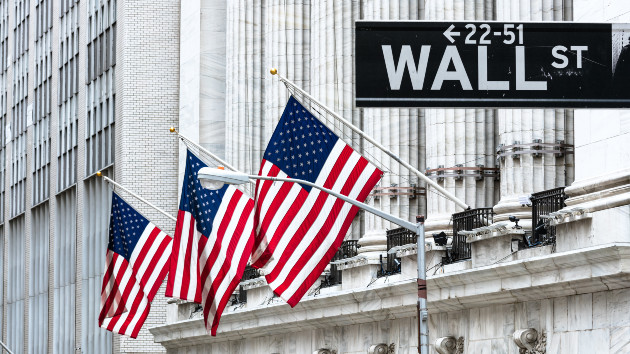
(SEOUL) — Asian markets opened up on Tuesday after posting significant losses on Monday driven by President Donald Trump’s global tariffs campaign, with U.S. futures also rising slightly after a day of turmoil on Wall Street.
As of early Tuesday morning, Dow Jones futures were up almost 2%, S&P 500 futures were up more than 1.5% and Nasdaq futures were up 1.3%.
Japan’s Nikkei index closed just over 6% up on Tuesday, recovering some of almost 8% of losses posted on Monday.
South Korea’s KOSPI index rose by 0.3%, Australia’s S&P/ASX 200 grew by 2.2% and India’s NIFTY 50 index climbed almost 2%.
Hong Kong’s Hang Seng index — which on Monday posted its worst day since 1997 losing 13% — rebounded with a 1% rise on Tuesday. Shanghai’s Composite Index grew 1.4%.
European markets also edged into the green after a tumultuous start to the week. The British FTSE 100 picked up 1.3% shortly after opening, Germany’s DAX gained 0.9% and France’s CAC 40 rose 1.3%.
Monday’s rollercoaster trading saw the Dow post its largest intraday point swing ever — falling more than 1,700 points during its Monday session low, then swinging up 2,595 points from the low.
The Dow dropped 349 points, or 0.91%, while the tech-heavy Nasdaq ticked up 0.1%. The S&P 500 closed down 0.23%. Its 8.5% high/low spread has only happened 20 other times since 1962, according to S&P Global.
The S&P 500 briefly entered bear market territory during the session but was last off nearly 18% from its recent high.
ABC News’ Max Zahn and Joe Simonetti contributed to this report.
(NEW YORK) — As the world reels from tariffs instituted by the Trump administration, stock markets are widely in decline.
On Friday, U.S. stock saw the worst decline since the COVID-19 pandemic began in 2020. But the declines last week did not rank among the worst crashes in the history of the U.S. stock markets.
President Donald Trump said Sunday, “I don’t want anything to go down, but sometimes you have to take medicine to fix something and we have such a horrible — we have been treated so badly by other countries because we had stupid leadership that allowed this to happen.”
Here are the worst declines in the history of the Dow Jones Industrial Average by percentage:
5.) March 12, 2020 (-2,352.60, -9.99%)
Four days before the worst COVID-related drop in stocks, the Dow slid 9.99%. Blue chip stocks also dropped 7.79% — the 14th-worst all-time — on March 9, the first day of the COVID-induced drops.
4.) Oct. 29, 1929 (-30.57, -11.73%)
The stock market crash of October 1929 signaled the end of the “Roaring Twenties” and the beginning of the Great Depression. This was the second day of the big drop, known as “Black Tuesday,” which began one day earlier and occupies the next spot on this list.
3.) Oct. 28, 1929 (-38.33, -12.82%)
The first Black Monday in the history of the Dow Jones, investors’ fortunes were wiped out in a major wake-up call for people who thought the the good times would last forever.
2.) March 16, 2020 (-2,997.10, -12.93%)
Many Americans can recall the crash that happened as the world was shutting down over the COVID-19 pandemic. The worldwide shutdowns and disruptions to the global supply chain caused investors to bail.
1.) Oct. 19, 1987 (-508, -22.61%)
Black Monday, or the first contemporary global financial crisis according to the Federal Reserve, followed seven months of explosive growth on Wall Street. Stocks had climbed 44% over those months, according to the Fed, before the U.S. announced a larger-than-expected trade deficit. After moderate losses in the week before, the global markets tanked and Monday opened to panic from U.S. investors as well.
Note: The Dow Jones officially considers Dec. 12, 1914, the worst day in trading history, but economists agree 1987’s Black Monday was the worst. The stock market closed in July 1914 due to the start of World War I, and wouldn’t open again until Dec. 12, 1914. Even then, it was on a limited basis, with the official return to full trading on April 1, 1915. Technically, the Dow actually went up on Dec. 12, 1914, but a retroactive correction makes it look like it went down.
(NEW YORK) — U.S. stocks tumbled at opening on Monday as President Donald Trump’s tariffs stoked fears of a wider global trade war and Wall Street firms sounded alarms about a possible recession. The sell-off hit U.S. firms hours after a historic rout in foreign markets.
The Dow Jones Industrial Average plummeted 1,600 points, or 4.3%, while the tech-heavy Nasdaq declined 5%.
The S&P 500 plunged 4.6%, tipping the index into bear market territory, a term used to designate a 20% drop below a previous peak.
The market downturn stretches back to Trump’s announcement of far-reaching tariffs last week. The Dow suffered its worst week since 2020, and the Nasdaq ended last week in a bear market.
Hong Kong leads Asian slide
Tokyo’s Nikkei 225 index lost nearly 9% shortly after the market opened on Monday, the steep decline triggering a circuit breaker that temporarily halted trading. Japan’s broader TOPIX index sank 8%.
In Taiwan, the Taiex lost 9.7%, while in Singapore the STI fell more than 8%.
South Korea’s KOSPI index fell more than 5.5% in Monday trading, with Australia’s S&P/ASX 200 sliding more than 6% before recovering slightly.
Hong Kong’s Hang Seng Index dropped 13.22% — its worst one-day performance since 1997 during the Asian Financial Crisis — with Chinese tech stocks like Alibaba and Baidu among the big losers.
On the mainland — where there are fewer international investors — the Shanghai Composite Index dropped more than 7%, despite being buoyed by state-owned investors known as the “National Team.”
India’s stock markets also struggled. The BSE’s Sensex dropped 5.19% while the broader Nifty tumbled 5%.
Asian markets collectively posted their worst day trading session since 2008.
Europe joins rout
European indexes followed suit on Monday morning.
The British FTSE 100 index fell 6% upon opening, while the pan-European Stoxx 600 index dropped more than 6%.
Germany’s DAX index fell 10%, France’s CAC lost 6.6% and Italy’s FTSE MIB slid 5.7%.
US braced for more losses
Investors expected continued market turmoil on Monday in response to Trump’s “Liberation Day” tariffs announced last week.
Speaking with reporters on Air Force One on Sunday, Trump addressed the recent market turbulence and subsequent fears of an imminent recession.
“Now what’s going to happen with the market? I can’t tell you, but I can tell you, our country has gotten a lot stronger, and eventually it’ll be a country like no other, it’ll be the most dominant country economically in the world,” Trump said.
“I don’t want anything to go down, but sometimes you have to take medicine to fix something and we have such a horrible — we have been treated so badly by other countries because we had stupid leadership that allowed this to happen,” the president added.
U.S. markets closed significantly down on Friday. The Dow Jones Industrial Average plummeted 2,230 points, or 5.5%, while the S&P 500 plunged 6%.
The tech-heavy Nasdaq declined 5.8%. The decline put the Nasdaq into bear market territory, meaning the index has fallen more than 20% from its recent peak.
The trading session on Friday marked the worst day for U.S. stocks since 2020. The second-worst day for U.S. stocks since 2020 happened on Thursday, a day earlier.
ABC News’ Ellie Kaufman, Karson Yiu, Zunaira Zaki, Max Zahn and Hannah Demissie contributed to this report.
(HONG KONG) — Key global stock markets tumbled upon opening on Monday as the world’s reaction to President Donald Trump’s tariffs campaign continued — and as U.S. futures signaled more turmoil for American markets.
In the U.S., Dow Jones futures were down about 1,200 points or 3.33% on Monday morning. S&P 500 and NASDAQ futures were down about 3.5%. A drop of 7% on the S&P 500 before 3:35pm ET will trigger a market-wide circuit breaker that will halt trading for 15 minutes.
Hong Kong leads Asian slide
Tokyo’s Nikkei 225 index lost nearly 9% shortly after the market opened on Monday, the steep decline triggering a circuit breaker that temporarily halted trading. Japan’s broader TOPIX index sank 8%.
In Taiwan, the Taiex lost 9.7%, while in Singapore the STI fell more than 8%.
South Korea’s KOSPI index fell more than 5.5% in Monday trading, with Australia’s S&P/ASX 200 sliding more than 6% before recovering slightly.
Hong Kong’s Hang Seng Index dropped 13.22% — its worst one-day performance since 1997 during the Asian Financial Crisis — with Chinese tech stocks like Alibaba and Baidu among the big losers.
On the mainland — where there are fewer international investors — the Shanghai Composite Index dropped more than 7%, despite being buoyed by state-owned investors known as the “National Team.”
India’s stock markets also struggled. The BSE’s Sensex dropped 5.19% while the broader Nifty tumbled 5%.
Asian markets collectively posted their worst day trading session since 2008.
Europe joins rout
European indexes followed suit on Monday morning.
The British FTSE 100 index fell 6% upon opening, while the pan-European Stoxx 600 index dropped more than 6%.
Germany’s DAX index fell 10%, France’s CAC lost 6.6% and Italy’s FTSE MIB slid 5.7%.
US braced for more losses
Investors are bracing for continued market turmoil on Monday in response to Trump’s “Liberation Day” tariffs announced last week.
Speaking with reporters on Air Force One on Sunday, Trump addressed the recent market turbulence and subsequent fears of an imminent recession.
“Now what’s going to happen with the market? I can’t tell you, but I can tell you, our country has gotten a lot stronger, and eventually it’ll be a country like no other, it’ll be the most dominant country economically in the world,” Trump said.
“I don’t want anything to go down, but sometimes you have to take medicine to fix something and we have such a horrible — we have been treated so badly by other countries because we had stupid leadership that allowed this to happen,” the president added.
U.S. markets closed significantly down on Friday. The Dow Jones Industrial Average plummeted 2,230 points, or 5.5%, while the S&P 500 plunged 6%.
The tech-heavy Nasdaq declined 5.8%. The decline put the Nasdaq into bear market territory, meaning the index has fallen more than 20% from its recent peak.
The trading session on Friday marked the worst day for U.S. stocks since 2020. The second-worst day for U.S. stocks since 2020 happened on Thursday, a day earlier.
ABC News’ Ellie Kaufman, Karson Yiu, Zunaira Zaki, Max Zahn and Hannah Demissie contributed to this report.
(NEW YORK) — U.S. consumers are going on a tariff-induced shopping spree. From furniture, to appliances, to alcohol, Americans are rushing to buy before President Donald Trump’s sweeping tariffs are felt at the checkout counter.
Economists say the tariffs are expected to increase prices for everyday items and many are now raising the likelihood that the economy will fall into a recession.
Auto sales surged 11.2% in March as car buyers flocked to dealerships to beat the 25% tariffs on all imported cars, which went into effect April 3.
Once Noel Peguero heard about the wider tariff announcements, he said he hit the stores. The 50-year old school worker from Queens, New York, says he spent about $3,500 this past week on car parts, gardening supplies and electronics, including a 40″ Hisense television and Macbook laptop for his son.
“Now is the time to buy,” he told ABC News, adding they were items he was planning to purchase anyway but decided to buy sooner rather than later to avoid any potential price increases.
While stocking up on some items now may make sense, experts caution consumers to buy only what they can afford and not go into debt to get ahead of the “tariff effect.”
“A lot of people are dealing with diminished savings and rising debt, so they may not be in a position to make a big purchase or put together a large stockpile,” Ted Rossman, a senior industry analyst at Bankrate, tells ABC News. “Take the long view. It might make more sense to drive your existing car for a bit longer or live with the old kitchen cabinets another year or two.”
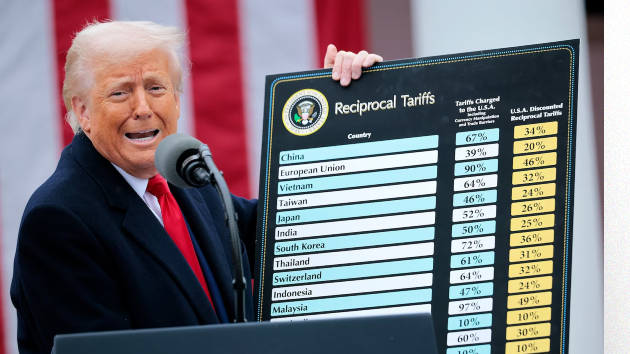
With nearly all U.S. trading partners now subject to a 10% tariff and even higher “reciprocal tariffs” to come April 9 for about 60 trading partners that have a high trade deficit with the United States, some consumers worry that everyday items may soon not only be more expensive, but harder to find.
The mere thought conjures images of empty store shelves during the height of the COVID-19 pandemic, when Americans were scrambling for everything from toilet paper to baking flour.
Billionaire entrepreneur Mark Cuban added to those worries this week, posting on the social-media platform BlueSky that people should “buy lots of consumables” now before prices go up.
“From toothpaste to soap, anything you can find storage space for, buy before they have to replenish inventory,” Cuban said. “Even if it’s made in the USA, they will jack up the price and blame it on tariffs.”
Experts say they don’t anticipate any shortages.
“Of course, if everyone heeded [Cuban’s] advice, there probably would be some issues, but we’re not seeing evidence this is happening at scale,” Rossman said. “Thankfully the supply chain is in much better shape than it was during the pandemic.”
With the average American household carrying about $6,600 in debt, according to TransUnion, experts say it’s important to take a measured approach and consider your long-term financial situation and goals.
“I realize sometimes people need to carry debt for various reasons,” said Rossman, “but don’t make it worse by panic buying. Rushing to make a big purchase often doesn’t end well.”
(NEW YORK) — U.S. stocks closed down significantly on Friday after a continued selloff amid fallout from President Donald Trump’s “Liberation Day” tariffs.
The Dow Jones Industrial Average plummeted 2,230 points, or 5.5%, while the S&P 500 plunged 6%.
The tech-heavy Nasdaq declined 5.8%. The decline put the Nasdaq into bear market territory, meaning the index has fallen more than 20% from its recent peak.
The trading session on Friday marked the worst day for U.S. stocks since 2020. The second-worst day for U.S. stocks since that year happened on Thursday, a day earlier. Over the past two days, the S&P 500 dropped more than 10%.
Corporate giants that rely on supply chains abroad were among the firms that continued to see shares fall. Apple fell 7% and e-commerce firm Amazon slid 4%.
Shares fell for each of the so-called “Magnificent Seven,” a group of large tech firms that helped drive stock market gains in recent years.
Meta, the parent company of Facebook and Instagram, dropped 5%. Chipmaker Nvidia slid 7%.
Tesla, the electric carmaker led by Trump-advisor Elon Musk, declined more than 10%.
On Friday, China said it will impose 34% tariffs on U.S. goods in response to the levies issued by Trump earlier this week.
In a social media post hours later, Trump signaled a commitment to the tariff policy.
“TO THE MANY INVESTORS COMING INTO THE UNITED STATES AND INVESTING MASSIVE AMOUNTS OF MONEY, MY POLICIES WILL NEVER CHANGE,” Trump said on Truth Social.
Trump later criticized China in a different social media post, saying, “CHINA PLAYED IT WRONG, THEY PANICKED – THE ONE THING THEY CANNOT AFFORD TO DO!”
All three major American stock markets closed down on Thursday, marking their worst day since June 2020 during the COVID-19 pandemic.
The NASDAQ fell 6%, the S&P 500 4.8% and the Dow Jones nearly 4%
Global markets gave early signals of the difficulty to come on Friday. Japan’s Nikkei index lost 3.5% on Friday, while the broader Japanese Topix index fell 4.45%.
In South Korea, the KOSPI index was down 1.7%, with the country grappling with both Trump’s tariffs and the news that South Korea’s Constitutional Court upheld the impeachment of President Yoon Suk Yeol.
Indian investors joined the sell-off on Friday, with the Nifty 50 and BSE Sensex indexes both falling more than 1%. India’s stock markets had previously performed better than others thanks to lower tariffs than competitors like China, Indonesia and Vietnam.
Australia’s S&P/ASX, meanwhile, continued its slide into Friday with another 2% drop taking the index to an 8-month low.
In Europe, too, stock markets fell upon opening. Britain’s FTSE 100 index dropped more than 1%, Germany’s DAX fell 0.75%, France’s CAC lost 0.9% and Spain’s IBEX slipped 1.4%.
ABC News’ Leah Sarnoff, Max Zahn, Victor Ordoñez and Zunaira Zaki contributed to this report.
(NEW YORK) — President Donald Trump on Friday said he is extending the deadline for TikTok to be banned or sold off by its Chinese-owned parent company, ByteDance.
The previous April 5 deadline will be pushed 75 days, Trump said in a post to his social media platform. It’s the second time he has pushed the deadline since taking office.
“My Administration has been working very hard on a Deal to SAVE TIKTOK, and we have made tremendous progress. The Deal requires more work to ensure all necessary approvals are signed, which is why I am signing an Executive Order to keep TikTok up and running for an additional 75 days,” Trump wrote.
The move comes as Walmart is actively considering joining a group of investors to buy TikTok, according to sources close to the deal, who say Walmart’s interest was triggered by Amazon throwing their hat into the ring.
Back in 2020, Walmart said it was teaming up with Microsoft to make a bid for TikTok. The app would give the retail giant access to hundreds of millions of consumers who could become their customers and audiences for their advertisements, in a boost to their e-commerce business.
The Trump administration is considering a deal to save TikTok that would have China maintaining control of the algorithm that will be leased to a U.S. company, with a minority ownership stake, a source close to the deal told ABC News.
It’s unclear if that proposal follows the bipartisan law that Congress passed, which forces TikTok’s Chinese parent company to sell the wildly popular social media platform or face a ban in the U.S.
Sources say there are several investors interested in jumping in to purchase TikTok, including Amazon, Oracle and Applovin. A source close to the deal also says that Tim Stokely, the founder of the adult website OnlyFans, has also made a late-stage bid for TikTok.
The White House and Walmart have not immediately responded to requests for comment.
On Thursday, Trump hinted that his recently announced tariffs on China could be a negotiating tactic to achieve a deal on a TikTok sale.
“If somebody said that we’re going to give you something that’s so phenomenal, as long as they’re giving us something, that’s good,” he told reporters aboard Air Force One.
“We have a situation with TikTok where China will probably say, ‘We’ll approve a deal, but will you do something on the tariff?'” he said. “The tariffs give us great power to negotiate.”
Even if Trump approves a deal, China will still need to sign off on it. U.S.-China relations are tense, with the US about to hit China with a whopping 54% tariff. China is now retaliating with its own 34% tariffs on imports from the U.S.
“We hope to continue working in Good Faith with China, who I understand are not very happy about our Reciprocal Tariffs,” Trump wrote in his social media post on Friday.
“We do not want TikTok to ‘go dark.’ We look forward to working with TikTok and China to close the Deal,” he added.
(WASHINGTON) — Federal Reserve Chair Jerome Powell said Friday he expects President Donald Trump’s tariff policy will hike prices and slow economic growth, while noting that key indicators “still show a solid economy.”
Policy changes implemented by the White House have contributed to a “highly uncertain outlook,” Powell said, making the remarks as stocks plummeted amid an escalating global trade war.
Despite the murky outlook, Powell said Trump’s tariffs would likely increase consumer prices.
“While tariffs are highly likely to generate at least a temporary rise in inflation, it’s also possible the effects will be more persistent,” Powell told the audience at the Society for Advancing Business Editing and Writing conference in Washington, D.C.
Minutes before Powell was set to speak, Trump sharply criticized the Fed chair, calling on him to reduce interest rates.
“This would be a PERFECT time for Fed Chairman Jerome Powell to cut Interest Rates,” Trump said in a post on Truth Social.
Trump also claimed without evidence that political considerations have played a role in Powell’s decision-making on interest-rate policy.
On Friday, Powell declined to directly respond to Trump. Still, Powell strongly rebuked any concern about his political independence.
“I don’t respond to political remarks,” Powell said, adding that it would be inappropriate for the central bank to comment on U.S. trade policy.
“We try to stay as far as we can from the political process,” Powell said. “That’s what people expect from us.”
This is a developing story. Please check back for updates.
(NEW YORK) — U.S. stocks continued their slide in early trading on Friday, just hours after China announced retaliatory tariffs in response to President Donald Trump’s “Liberation Day” levies.
The Dow Jones Industrial Average plummeted 925 points, or 2.25%, while the S&P 500 dropped 2.4%. The tech-heavy Nasdaq declined 3%.
On Friday, China said it will impose 34% tariffs in response to the levies issued by Trump earlier this week.
In a social media post hours later, Trump signaled a commitment to the tariff policy.
“TO THE MANY INVESTORS COMING INTO THE UNITED STATES AND INVESTING MASSIVE AMOUNTS OF MONEY, MY POLICIES WILL NEVER CHANGE,” Trump said on Truth Social.
All three major American stock markets closed down on Thursday, marking their worst day since June 2020 during the COVID-19 pandemic.
The NASDAQ fell 6%, the S&P 500 4.8% and the Dow Jones nearly 4%
Global markets gave early signals of the difficulty to come on Friday. Japan’s Nikkei index lost 3.5% on Friday, while the broader Japanese Topix index fell 4.45%.
In South Korea, the KOSPI index was down 1.7%, with the country grappling with both Trump’s tariffs and the news that South Korea’s Constitutional Court upheld the impeachment of President Yoon Suk Yeol.
Indian investors joined the sell-off on Friday, with the Nifty 50 and BSE Sensex indexes both falling more than 1%. India’s stock markets had previously performed better than others thanks to lower tariffs than competitors like China, Indonesia and Vietnam.
Australia’s S&P/ASX, meanwhile, continued its slide into Friday with another 2% drop taking the index to an 8-month low.
In Europe, too, stock markets fell upon opening. Britain’s FTSE 100 index dropped more than 1%, Germany’s DAX fell 0.75%, France’s CAC lost 0.9% and Spain’s IBEX slipped 1.4%.
Trump’s Wednesday announcement of tariffs on nearly all American trade partners sent U.S. and foreign markets alike into a tailspin.
ABC News’ Leah Sarnoff, Max Zahn, Victor Ordoñez and Zunaira Zaki contributed to this report.
(NEW YORK) — U.S. hiring surged in March, blowing past economists’ expectations and defying concern on Wall Street about a possible economic recession, government data on Friday showed.
The fresh data offered news of an upsurge in employer activity as stocks suffered a second day of selloffs over sweeping new tariffs announced by President Donald Trump earlier this week.
The U.S. added 228,000 jobs in March, according to data from the U.S. Bureau of Labor Statistics. That figure amounted to robust hiring and marked a major increase from 151,000 jobs added in the previous month.
The unemployment rate ticked up slightly to 4.2%, but it remains historically low.
The uptick in hiring last month came despite staff cuts imposed by the federal government amid cost-cutting efforts undertaken by the Department of Government Efficiency.
Federal government employment declined by 4,000 jobs in March, following a dropoff of 11,000 jobs the previous month.
The job gains came primarily in health care, transportation and warehousing.
Average hourly wages climbed 3.8% over the year ending in March, indicating that pay increases outpaced the inflation rate over that period.
Despite escalating trade tensions and market turbulence since Trump took office in January, the economy remains in solid shape by several key measures.
The unemployment rate stands at a historically low level. Meanwhile, inflation sits well below a peak attained in 2022, though price increases register nearly a percentage point higher than the Fed’s goal of 2%.
“The economy is strong,” Fed Chair Jerome Powell said at a press conference in Washington, D.C., last month.
Tariffs announced earlier this week, however, threaten to derail hiring and worsen inflation, multiple analysts previously told ABC News.
The far-reaching levies increase the likelihood of a recession by driving up prices, sapping consumer spending, slowing business activity and risking layoffs, they said.
The White House plans to slap a 10% tax on all imported products and place additional duties on items from some of the largest U.S. trading partners, including China and the European Union.
“These policies, if sustained, would likely push the U.S. and global economy into recession this year,” J.P. Morgan said in a note to clients after the tariff announcement.
“Recession risks will likely rise,” Deutsche Bank added.
U.S. stocks plunged on Thursday in the first trading session after Trump unveiled the new tariffs.
The Dow Jones Industrial Average plummeted 1,679 points, or nearly 4%, while the tech-heavy Nasdaq declined almost 6%.
The S&P 500 tumbled 4.8%, marking its worst trading day since 2020.