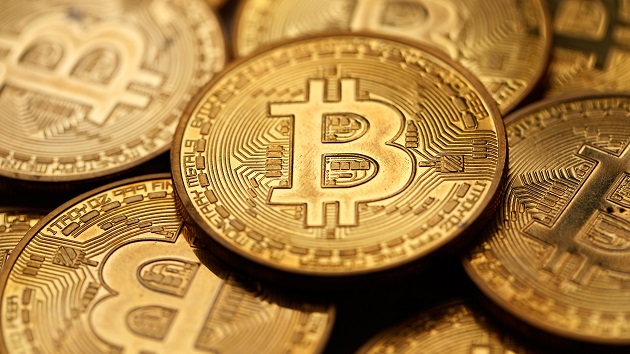
(NEW YORK) — Bitcoin surged to a record high on Thursday, vaulting more than 3% in early trading and hurtling past $110,000 for the first time.
The price of bitcoin stood at $111,385 on Thursday, extending a sharp rise that stretches back to the November election of President Donald Trump, a cryptocurrency supporter and investor.
Ether, the second-largest cryptocurrency, jumped 6%. The $TRUMP memecoin, a crypto coin launched by the president in January, increased nearly 6%.
A surge in the value of some cryptocurrencies in recent days followed a Senate vote to advance the GENIUS Act, an industry-backed bill that aims to regulate some digital currency.
The measure establishes rules targeting stablecoins, a type of cryptocurrency pegged to the value of another asset, often the U.S. dollar.
If enacted, the bill could allow such crypto coins to become a mainstream tool for digital payments and other financial instruments, setting the stage for an influx of investment in digital currency.
Critics say the measure fails to address conflict-of-interest concerns exemplified by Trump, and it risks endangering consumers and the wider economy with a weak set of restrictions.
Trump, who also backs a cryptocurrency firm World Liberty Financial, has denied any wrongdoing involving his crypto ventures.
The record high for bitcoin also coincides with a spike in Treasury yields amid deficit concerns centered on a domestic policy bill passed by the U.S. House on Thursday.
The nonpartisan Congressional Budget Office on Tuesday found the tax policies backed by Trump would add $3.8 trillion to the national debt. The finding comes days after a U.S. credit downgrade at Moody’s in part due to the country’s deficit.
Higher yields increase the cost of U.S. borrowing and add strain to the nation’s finances. In theory, investors may seek out alternatives to the U.S. dollar as debit yields face upward pressure.
Bryan Armour, the director of passive strategies research at financial firm Morningstar, attributed the recent rise in the price of bitcoin to both industry regulation and bond market fears.
“I suspect it’s a mix of regulatory adoption and fear for the dollar given the expectation of high government spending,” Armour said.
The price of bitcoin has surged about 40% since the presidential election. Over that period, the S&P 500 has declined 2%, while the tech-heavy Nasdaq has dropped 3%.
In July, Trump told the audience at a cryptocurrency conference in Nashville, Tennessee, that he wanted to turn the U.S. into the “crypto capital of the planet.”
Trump promised to weaken federal oversight of cryptocurrency and establish the federal government’s first strategic bitcoin reserve.
In March, Trump signed an executive order establishing the reserve of digital currencies, saying the move would position the U.S. “as a leader among nations in government digital asset strategy.”
On Thursday, Trump is set to attend a gala with hundreds of top investors in his memecoin, which an announcement described as an “intimate private dinner.”
The move elicited concern among some critics as a possible means of exchanging access to the president for financial gain.
(NEW YORK) — Stocks closed down significantly on Wednesday as bond yields spiked amid deficit concerns centered on a tax cut measure under consideration in the U.S. House as part of a megabill supporting President Donald Trump’s second-term agenda.
The Dow Jones Industrial Average closed down 817 points, or 1.9%, while the S&P 500 declined 1.6%. The tech-heavy Nasdaq dropped 1.4%.
The sell-off on Wall Street coincided with a surge in bond yields, which in turn raised the cost of U.S. borrowing and stoked investor fears about the wider impact across the economy.
The 10-year Treasury yield jumped from 4.48% to 4.58%, reaching its highest level since February.
The nonpartisan Congressional Budget Office on Tuesday found the tax policies backed by Trump would add $3.8 trillion to the national debt.
The bond sell-off arrives at a moment of heightened volatility in Treasury markets. Long-term bond yields soared last month in the immediate aftermath of Trump’s “Liberation Day” tariffs.
A U.S. credit downgrade at Moody’s last week further roiled debt markets.
Bond yields rise as bond prices fall. When a sell-off hits and demand for bonds dries up, it sends bond prices lower. In turn, bond yields move higher.
The yield for long-term Treasury bonds helps set interest rates for a host of consumer loans, including mortgages and credit cards.
When interest rates rise, businesses also face higher borrowing costs, making it less likely that firms would move forward with an office expansion or round of hiring, analysts previously told ABC News. In turn, such conditions risk an economic slowdown.
(WASHINGTON) — If this past weekend in European politics is an indicator of anything, it’s that the “Trump effect” is real, and its reverberations are unpredictable.
Three European Union countries held elections on Sunday — Romania, Poland and Portugal — with the results failing to show any clear trend for the future of European politics. The elections did, however, indicate the American president’s growing influence on the continent.
The disparate responses from voters in all three countries — and the lack of any decisive victory for any one party or candidate in Portugal or Poland — hint that the political polarization that has roiled the U.S. over the past decade is a global trend, not merely an American one.
As to whether President Donald Trump and the “Make America Great Again” movement swirling around him can establish European avatars, the question remains an open one.
“I don’t know if I have a firm answer,” Celia Belin, a senior policy fellow at the European Council on Foreign Relations and head of its Paris office, told ABC News. “At the moment, we are all monitoring what is happening and how this influence can establish itself.”
“It’s very early,” Belin added. “This is an ongoing phenomenon.”
While it’s unclear what the extent of Trump’s impact on European politics will ultimately be, Belin said the impact is “stronger” than it was two years ago.
Trump’s influence — indirect and direct — has given populist movements like Germany’s Alternative for Germany party, Poland’s nationalist Law and Justice (PiS) party and Portugal’s far-right Chega party a clear boost, evident in recent elections in each country.
“If I am to compare with two years ago, for example, it is stronger, it is more united, it gives inspiration to a ton of populist nationalist leaders in Europe,” Belin said. “It’s getting stronger. That’s the direction it’s going in right now.”
The groundswell of grievances that carried Trump to the Oval Office twice is not merely an American phenomenon and manifests differently in individual nations. Concerns over globalization, immigration, inequality, the cost of living, low rates of economic growth, progressivism and national identity are near-universal in the Western democratic world.
Trump seized upon those conditions in the U.S. and right-wing leaders in Europe are seeking to do the same.
Election week in Europe
This week’s election results in Romania, Poland and Portugal, however, suggest the translation of Trumpism into European political languages remains incomplete.
In Romania, voters opted for Bucharest Mayor Nicusor Dan’s pro-Europe, pro-NATO, pro-Ukraine platform. Dan won with around 54% of the vote.
Dan’s opponent — Trump supporter George Simion, who courted the MAGA movement and even visited the U.S. during his campaign — came up short, though he vowed to continue “our fight for freedom and our great values along with other patriots, sovereignists and conservatives all over the world.”
In Poland, the presidential election saw liberal Warsaw Mayor Rafal Trzaskowski secure an unexpectedly tight victory in the first round of voting with around 31% of the vote, beating out right-wing rival Karol Nawrocki — who was personally endorsed by Trump — who had 29.5% of the vote.
The two men will go into the second round of voting on June 1, hoping to draw voters from other minor candidates, among them a significant bloc which voted for far-right firebrand Slawomir Mentzen, who came third with 14.8%.
Piotr Buras, a senior policy fellow at ECFR at the head of its Warsaw office, told ABC News that Trump has loomed large over the election.
Nawrocki framed himself as the Trump-friendly candidate, along with his backers in the Law and Justice party, criticizing Trzaskowski’s Civic Platform party and Prime Minister Donald Tusk for allegedly undermining Polish-American relations.
“We used to have a nationwide consensus on America,” Buras said, with voters generally warm to the idea of close ties with Washington, D.C. “Now, because of this ideological divide in Poland, because of the U.S. and because of Trump’s approach to Europe, Poland is suddenly divided on how to go about America,” he added.
In Portugal, meanwhile, the far-right Chega party gained a record 22.6% share of the vote, blowing open the long-standing two-party domination of the country’s political scene even though it was unable to overhaul the ruling center-right Democratic Alliance.
“I am not going to stop until I become the prime minister of Portugal,” Chega leader Andre Ventura — who was among the foreign politicians invited to Trump’s second inauguration — said.
Making Europe great again?
Such confidence in defeat may be buoyed by the strong foundations populist parties and candidates are putting down in Europe. Across the continent, far-right groups are winning historically large chunks of the electorate and dominating political debates, even without securing the reins of power.
In the U.K., the right-wing Reform party recorded a stunning performance in the May local elections, winning hundreds of council seats and leaving leader Nigel Farage — well-known for his cozy relationship with Trump and the MAGA movement — to declare an end to the traditional dominance of Britain’s two major parties.
In Germany’s February parliamentary election, the far-right Alternative for Germany (AfD) party converted years of growing popularity to win around 21% of the vote and become the second-largest party in the Bundestag.
U.S. Vice President JD Vance conducted his first foreign trip in his new position to Germany in February, shortly before the election, speaking at the Munich Security Conference on February 14.
In his speech addressing the annual security conference, Vance criticized Europe for hindering free speech, suggesting the conference’s decision to ban AfD members from attending was a form of censorship.
“In Britain, and across Europe, free speech, I fear, is in retreat,” Vance said. “I believe that dismissing people, dismissing their concerns, or, worse yet, shutting down media, shutting down elections, or shutting people out of the political process protects nothing. In fact, it is the most surefire way to destroy democracy.” Many political analysts considered Vance’s remarks to be a tacit endorsement of AfD from the Trump administration.
And in France, President Emmanuel Macron has thus far held off the persistent challenge for the presidency from far-right leader Marine Le Pen and the National Rally, but he was unable to stop the party from becoming the largest in the National Assembly in 2024. Only a shaky minority government has kept the party out of the prime minister’s office.
The insurgent parties are coordinating. Leaders have increasingly been drawn to American conservative events, such as the Conservative Political Action Conference — the first-ever European installment of which was held in Budapest, Hungary, in 2022.
And this year, right-wingers gathered for the Make Europe Great Again conference in Madrid in February, organized by Spain’s far-right VOX party.
Buras noted rumors that Vice President JD Vance may even attend a planned CPAC event in Poland in late May, in what could only be interpreted as a show of support for Nawrocki. The event raises the prospect of American “interference almost, or at least influence, from the U.S.,” Buras said.
MAGA blowback
Trump is just as divisive abroad as he is at home. Indeed, polls consistently indicate that many European voters are skeptical of, unsettled by or outright hostile to the American president.
There is, then, no guarantee that a MAGA association will put foreign populists in power. Recent elections in Canada and Australia, for example, saw center-left establishment parties secure victory against conservative opponents they sought to smear as Trumpian.
Trump’s return to the White House “has woken up the anti-populist or anti-nationalist movements,” Belin said. “It gives them a foil. … You want to mobilize your electorate and use the U.S. of Donald Trump as a sort of scarecrow — the mobilization effect goes in two directions.”
“It fuels the extremist base and so it excites a lot of people, but it also fuels the other side and it also frightens the middle,” Belin said.
(NEW YORK) — Stocks slumped at the open of trading on Monday after a downgrade of U.S. credit triggered a spike in debt yields that threatened to raise borrowing costs throughout the nation’s economy.
The Dow Jones Industrial Average dropped 295 points, or 0.7%, while the S&P 500 fell 0.9%. The tech-heavy Nasdaq plunged 1.2%.
Moody’s, a top ratings agency, cut the U.S. credit rating on Friday, dropping it one notch from the top rating of Aaa to a lower classification of Aa1.
The credit downgrade unleashed a selloff of U.S. debt, sending Treasury yields higher, which in turn raised the cost of U.S. borrowing and stoked investor fears about wider impact across the economy.
“This is a major symbolic move as Moody’s were the last of the major rating agencies to have the U.S. at the top rating,” a Deutsche Bank analyst said in a client note shared with ABC News.
The Treasury selloff sent long-term yields soaring above the level attained in the immediate aftermath of President Donald Trump’s “Liberation Day” tariffs. That spike in yields helped persuade Trump to suspend a major swathe of the tariffs, Trump later said.
The current spike in debt yields coincides with U.S. House Republicans’ push to pass a domestic policy bill that includes broad tax cuts. The nonpartisan Congressional Budget Office warned last month that the bill would raise the nation’s debt, which now stands at about $36 trillion.
(NEW YORK) — Consumer attitudes soured in May for the fourth consecutive month, even as President Donald Trump dialed back some tariffs. The reading came in below the level economists expected.
Shopper sentiment now hovers near its lowest level since a severe bout of inflation three years ago, University of Michigan survey data on Friday showed. Before that, the measure of consumer attitudes hadn’t ever fallen this low.
The monthslong decline in consumer sentiment traces back to inflation fears and recession warnings set off by Trump’s initial rollout of levies.
A trade agreement between the U.S. and China this week slashed tit-for-tat tariffs between the world’s two largest economies and triggered a surge in the stock market. Within days, Wall Street firms softened their forecasts of a recession.
The U.S.-China accord marked the latest softening of Trump’s levies, coming weeks after the White House paused far-reaching “reciprocal tariffs” on dozens of countries. Trump also eased sector-specific tariffs targeting autos, and rolled back duties on some goods from Mexico and Canada.
The drawdown of tariffs coincided with data suggesting the economy remains in solid shape.
Inflation eased slightly last month, dropping to its lowest level since 2021, government data this week showed. Plus, the economy continues to add jobs at a solid pace.
Still, uncertainty looms over the economic outlook.
An array of tariffs remain in place, including an across-the-board 10% levy that applies to imports from nearly all countries. Additional tariffs have hit auto parts, as well as steel and aluminum.
Even after the pullback, a 30% tariff on China far exceeds the level before Trump took office, posing a risk of price increases for a large swathe of products that includes apparel, toys and some electronics.
Walmart executives on Thursday warned of tariff-driven price increases for perishable imports such as coffee, avocados, bananas and roses, as well as toys and electronics.
Consumers showed signs of weakness last month as retail sales slowed, indicating shoppers may be pulling back as they await possible fallout from tariffs. The trend poses a risk for the wider economy, since consumer spending accounts for roughly two-thirds of economic activity.
The U.S. economy shrank at the outset of this year, registering a sharp drop-off from robust growth over the final months of 2024.
But a surge of imports ahead of Trump’s tariffs likely clouded the figure, since the calculation subtracts imports in an effort to exclude foreign production from the calculation of gross domestic product. Analysts cautioned that a lowering of GDP on account of this trend would not reflect economic weakness.
(NEW YORK) — Inflation cooled in the aftermath of President Donald Trump’s “Liberation Day” levies last month, dropping to a four-year low and defying fears of tariff-driven price hikes, government data this week showed.
Even egg prices — a symbol of rising costs — fell about 10% in April compared to the previous month.
Still, prices for some products continued to soar, including everyday items such as coffee and beef.
It’s normal for some prices to rise at a much faster pace than overall inflation, said Omar Sharif, founder and president of research firm Inflation Insights. The impact, he added, depends on the role such items play in a given person’s finances.
“At the end of the day, what’s important is the weight of the price change in your budget,” Sharif said, noting stubborn price hikes for some goods may be offset by price drops for others.
Here’s what to know about which prices are still climbing and what’s behind the trend:
Coffee
Coffee prices soared 9.6% in April compared to a year ago, marking inflation four times higher than the overall rate. Instant coffee prices climbed even faster, jumping 13.5% over the past year.
The spike in coffee prices comes down to a dearth of supply alongside robust demand, meaning too many dollars are chasing after too few coffee beans, David Ortega, a food economist at Michigan State University, told ABC News.
Recent droughts in Vietnam and Brazil — two of the world’s largest coffee producers — have restricted global output, Ortega said.
“These price increases are primarily driven by weather shocks,” Ortega added.
Meanwhile, coffee drinkers avail themselves of few alternatives, resulting in consistent demand for the product.
Beef
A spike in beef prices also stems from a supply shortage that traces back to drought conditions, Ortega said.
Ground beef prices soared 10% in April compared to a year ago, while the costs of beef steaks increased 7% over that period, government data showed.
In 2022, a major drought in the beef-producing regions of the U.S. forced cattle herders to sell off more animals than usual, since the drought raised costs for cattle feed, which in turn made it more expensive for ranchers to maintain their herds, Ortega said.
Many of those ranchers, he added, sold off cattle necessary to produce future beef supply.
“The national beef herd is at its lowest level in decades – and demand is strong,” Ortega said. “When those two things meet each other, you get this big rise in prices.”
Car repairs
Car repair prices soared 7.6% in April compared to a year earlier, amounting to inflation three times higher than the overall rate.
The trend owes in large part to the rise of high-tech cars, equipped with features like rearview cameras and traffic sensors, which have added cost to even some routine repairs, Brian Moody, executive editor at Autotrader, told ABC News.
A shortage of workers has exacerbated the cost woes for repair companies as they bolster compensation to attract and retain employees, sending prices higher, Moody added.
“More people want technology in their cars,” Moody said. “That technology requires greater skill to manage and fix, but at the same time, there’s a shortage of technicians and workers.”
Men’s and women’s outerwear Overall apparel prices dropped slightly over the year ending in April, but some items may still deliver sticker shock for spring shoppers.
Prices for men’s outerwear, including suits and sports coats, climbed 5.3% over the year ending in April, which amounts to inflation more than double the overall rate.
Women’s outerwear costs — which include jackets, coats and vests — surged even faster, climbing 6.2%.
Sharif, of Inflation Insights, said the reason for these price increases is murky since they have coincided with a much slower rise in costs for producers of men’s outerwear and an outright drop in production costs for women’s outerwear.
The ample supply of such products means the price hikes likely result from quirks in consumer taste, potentially resulting from the prices commanded by specialty brands, Sharif added.
“Shifting trends in demand may be pushing prices higher,” Sharif said.
(WASHINGTON) — The race to win tickets to an exclusive crypto dinner gala with President Donald Trump at his private golf club in Virginia on May 22 ended with top 220 holders of the Trump meme coin winning invitations to the black tie gala, the coin’s official X account announced Monday.
A “leaderboard” of the top 220 holders appearing on the website did not display the identities of the winners, but it listed numerous wallets that some crypto experts have linked to possible foreign individuals and entities, heightening concerns about potential conflicts of interest arising from the Trump family’s businesses and foreign interests.
According to the meme coin’s website, the top 25 “VIP holders” were also invited to what it described as an “Exclusive Reception before Dinner” and a “Special VIP Tour.”
As the Trump family stands to potentially take in tens of millions of dollars from the coin’s transactions and possibly even more from its ownership of the coin, the price of Trump’s meme coin has been in constant fluctuation over the past three weeks, with numerous supporters and crypto enthusiasts flocking to purchase the coin to secure a seat at the gala while numerous others sell the coin to profit off the hype.
The coin’s price dropped rapidly on Monday as the competition ended, and was priced at $12.59 as of 4 p.m. ET. When the gala competition was first announced last year, the coin’s price jumped by more than 55% and later reached a high of nearly $16.42, according to Coinbase.com.
While fluctuations in the Trump coin’s price have resulted in massive profits for a fortunate few, hundreds of thousands of investors have reportedly lost money on the coin. According to CNBC’s reporting of blockchain analytics firm Chainalysis’ data, roughly 764,000 crypto wallets have lost money on Trump meme coin investments, while 58 wallets have made millions from their Trump coin investments.
A White House spokesperson did not immediately respond to a request for comment from ABC News.
Although the coin’s website had earlier advertised a “Special VIP White House tour” for the top 25 coin holders, as of Monday afternoon it simply said “Special VIP tour,” without mentioning the White House. Additionally, the website included a disclaimer saying the tour is being arranged by the Fight Fight Fight LLC, and that the president himself is appearing as a “guest.”
In its social media announcement about the conclusion of the contest, the post also announced a “rewards points program” and the awarding of “exclusive NFTs” for the winners.
According to crypto experts, the wallet of the top coin holder — nicknamed “Sun” and currently holding roughly $16.6 million worth of the Trump meme coin — is owned by a foreign crypto exchange advised by Chinese billionaire Justin Sun, who recently moderated a panel discussion between Eric Trump and Zack Witkoff at a crypto conference in Dubai, where Witkoff announced the other Trump family crypto venture, World Liberty Financial, had partnered in a $2 billion business deal with an Abu Dahbi state-backed investment firm. Justin Sun did not immediately respond to a request for comment from ABC News.
Sun is also one of World Liberty Financials’ biggest investors, purchasing $75 million worth of its coin the day before Trump’s inauguration earlier this year. A month after that investment, SEC lawyers under the Trump administration moved to halt an alleged fraud case against Sun, who along with his companies has denied wrongdoing.
The second top holder, a Singaporean entity identified by crypto experts as likely being MemeCore, and nicknamed “MeCo,” has been more vocal about their race to secure a VIP ticket — publicly soliciting followers to send Trump coin to their wallet so they can achieve “#1 on the $TRUMP leaderboard” and “conquer the entire meme space,” with the promise of returning the tokens after the event.
In all, the top 220 folders hold a total of 13.7 million Trump coins, valued at nearly $14 million as of 4 p.m. ET Monday, according to Coinbase.com.
Notably, 17 out of the top 220 coin holders on the leaderboard, including one in the top 25, appeared to hold zero Trump coin as of Monday afternoon — possibly meaning that they sold their holdings before the contest ended.
Experts say this is possible because the top 220 holders were chosen based on “time weighted holdings,” which were calculated based on “both the amount and duration” of one’s holdings from April 23 through May 12. “The longer you hold, the higher your weighted score becomes,” the website says.
It’s not clear if the zero Trump coin holders will get invited to the event.
(WASHINGTON) — This week’s inflation report will offer a first look at how President Donald Trump’s “Liberation Day” tariff announcement has impacted pricing across the United States.
Trump’s tariff escalation, announced April 2, set off fears among economists and consumers about a possible burst of inflation, since importers typically pass along a share of such taxes in the form of price hikes.
Government data, which will be published Tuesday, is expected to show that pricing has defied such worries – at least for now.
Economists expect prices to have increased 2.3% over the year ending in April, which would mark a slight cooldown from the prior month.
However, many analysts anticipate a rekindling of inflation over the coming months as retailers begin to replenish inventory with goods imported after the tariffs took effect.
Even so, a rollback of some levies since “Liberation Day” may reduce the impact on inflation.
Trump paused a large swath of so-called “reciprocal tariffs” within days of the announcement.
On Monday, Trump temporarily slashed tariffs on China from 145% to 30%.
Levies on China will remain at the reduced rate for 90 days while the two sides negotiate a wider trade agreement, a joint U.S.-China statement said on Monday. China also agreed to temporarily cut its tariffs on U.S. goods from 125% to 10%.
The rollback of levies on Chinese goods is expected to reduce the average cost of tariffs per household this year from $4,900 to $2,800, the Yale Budget Lab found.
Still, the U.S. continues to impose an array of levies that have been issued since Trump took office.
An across-the-board 10% tariff applies to imports from nearly all countries. Additional tariffs have hit auto parts, as well as steel and aluminum. Duties remain for some goods from Mexico and Canada.
Speaking last week before the rollback of tariffs on China, Federal Reserve Chair Jerome Powell said the economy remains in “solid shape” but warned Trump’s tariff policy could cause higher inflation and an economic slowdown.
“If the large increase in tariffs that have been announced are sustained, they’re likely to generate a rise in inflation and a slowdown of economic growth,” Powell said.
“All of these policies are evolving, however, and their effects on the economy remain highly uncertain,” he added.
Inflation levels are nowhere near 2022’s peak of more than 9% — though it remains slightly higher than the Federal Reserve’s target rate of 2%.
The Fed last week opted to leave interest rates unchanged, keeping borrowing costs elevated as policymakers await the impact of tariffs.
Central bankers will announce their next interest rate decision on June 18. Investors peg an 88% chance of the Fed maintaining interest rates at current levels, according to the CME FedWatch Tool, a measure of market sentiment.
(NEW YORK) — U.S. stocks soared at the open of trading on Monday, just hours after the U.S. and China announced an agreement to slash tariffs for 90 days as the world’s two largest economies negotiate a wider trade deal.
The Dow Jones Industrial Average climbed 1,005 points, or 2.4%, while the S&P 500 jumped 2.7%. The tech-heavy Nasdaq increased 3.8%.
Best Buy, an electronics retailer that previously warned of tariff-induced price hikes, saw shares surge more than 10%.
Tesla, the electric carmaker led by White House advisor Elon Musk, jumped more than 5%.
The U.S. agreed to cut tariffs on Chinese goods from 145% to 30%, while China committed to reduce tariffs on U.S. products from 125% to 10%.
The previous set of sky-high tariffs had threatened a surge in prices and a possible U.S. recession, experts told ABC News.
The move marks the latest rollback of far-reaching tariffs initiated by President Trump during a Rose Garden ceremony on April 2 that the president dubbed “Liberation Day.”
Days after the announcement, Trump suspended so-called “reciprocal tariffs” on dozens of countries.
“Increasingly, it’s as if the last 6 weeks have been a bad dream and never actually happened,” Deutsche Bank told clients on Monday in a memo shared with ABC News.
The U.S.-China accord came two days after an hours-long discussion between U.S. and Chinese officials in Geneva, Switzerland on Saturday.
Jonathan Pingle, chief U.S. economist at Swiss investment bank UBS, on Monday estimated the reduction in U.S. levies on China would bring average U.S. tariffs down from 24% to 14%.
In a statement to ABC News, Pingle described the agreement between the U.S. and China as a “cooling off.”
This is a developing story. Please check back for updates.
(NEW YORK) — A carousel ride and 12 flavors of fudge await shoppers at LARK Toys, a family-owned toy shop outside Minneapolis, Minnesota.
The glee on offer belies the stress behind the counter as President Donald Trump’s 145% tariffs on China, which are set to trigger price increases and product shortages within a matter of a few months, co-owner Kathy Gray told ABC News.
The store imports four out of every five of its products from China, Gray said. A flurry of orders helped amass inventory before the tariffs, Gray added, but the shop lacks the funds and storage space to build up a major stockpile.
“It’s threatening,” Gray said. “This administration isn’t operating with the best intentions of small businesses and regular folks.”
LARK Toys is hardly the only small business that said it’s under strain as a result of Trump’s tariff policy.
Such concern is well-founded, analysts told ABC News, since small businesses typically lack the financial buffer, supply-chain flexibility and political influence of their larger counterparts.
Small businesses make up 99.9% of all U.S. firms, and account for more than two-fifths of the nation’s gross domestic product, according to the U.S. Small Business Administration.
“Many small businesses are quite vulnerable and exposed to changes in trade policy,” Ebehi Iyoha, a professor of business administration at Harvard University, who co-authored the study of small business sentiment, told ABC News.
The Trump administration has touted its achievements in support of small business, citing a cooldown of inflation and robust job growth.
“President Trump has restored optimism and opportunity for our job creators with a pro-growth economic agenda that has already slashed inflation, driven job creation, and delivered record investment,” Kelly Loeffler, Administrator of the Small Business Administration, said in a statement late last month.
Trump last month paused a far-reaching set of so-called “reciprocal tariffs” targeting about 75 countries. At the same time, however, Trump hiked tariffs on China. Additional levies have hit autos, steel and aluminum.
U.S. importers face an average effective tariff rate of 25.2%, the highest since 1909, the Yale Budget Lab found last month.
The rapid shift in trade policy poses an acute risk for small businesses in part because they usually lack a large rainy-day fund, Jane Liu, a professor of economics at the University of Nebraska, Omaha, told ABC News.
A typical small business holds enough cash reserves to last 27 days, a JPMorgan Chase Institute study found in 2020.
“The larger firms have a better cushion,” Liu said.
Small businesses also often face more pressure to raise prices for consumers, which can put them at a disadvantage with large competitors, some analysts said.
Tariffs raise prices for consumers if importers fail to swallow the tax burden by eating into their profits or requesting that a supplier sell the product at a lower rate in order to offset a share of the cost.
Small firms typically retain less capacity to eat profits or make price requests of suppliers, putting them at greater risk of losing out on shoppers due to tariff-related price hikes, Iyoha said.
“If you have a lot of bargaining power with suppliers, you can essentially say, ‘If you don’t eat some of these tariff costs and lower prices, I won’t buy from you,'” Iyoha said. “If you had to guess who has more bargaining power with suppliers, I’m sure you’d guess large businesses.”
In some cases, the Trump administration has granted relief from some tariffs.
Last month, the White House announced an exemption from China tariffs for a range of electronic devices. Days later, Trump said he had “helped” Apple CEO Tim Cook. Trump issued a one-month delay of auto tariffs after pressure from the Big 3 U.S. automakers: Ford, General Motors and Stellantis.
Small businesses typically lack the political influence of their larger counterparts, analysts said.
“Most small businesses don’t have the money or access to the best, most savvy folks able to do this,” Iyoha said.