Budrul Chukrut/SOPA Images/LightRocket via Getty Images
(NEW YORK) — Meta, the parent company of Facebook, reported a second consecutive quarter of declining sales on Wednesday, as the company contends with a widespread drop in online ad spending and rising competition from TikTok.
In addition, an Apple iOS privacy update last year, which limits the capability of advertisers to target users, has continued to weigh on ad sales at the heart of Meta’s business.
Revenue declined 4% year-over-year, the earnings report showed. That slump exceeded the 1% year-over-year decline during the previous quarter.
Shares of Meta were down more than 10% in after-hours trading immediately after the announcement.
Meanwhile, the company reported 2.93 billion daily active users on its family of apps, which includes Facebook, Instagram, WhatsApp and Messenger. That figure comprises 4% year-over-year growth, which matches the rise in daily users reported over the prior quarter.
The company’s stock price has fallen roughly 60% in 2022, more than double the decline experienced by the tech-heavy NASDAQ.
The continued revenue decline marks the latest in a series of challenges for Meta this year, including the announcement in June that Chief Operating Officer Sheryl Sandberg would depart the company as well as difficulty yielding revenue from its multi-billion-dollar investment in its metaverse project.
Meta declined to respond to a request for comment.
The company has drawn criticism from some investors lately over its large investment in its metaverse project, which has yet to deliver significant returns.
Brad Gerstner, whose fund Altimeter Capital holds hundreds of millions of dollars worth of Meta stock, sharply criticized the company’s strategy in an open letter this week.
“Meta has drifted into the land of excess – too many people, too many ideas, too little urgency,” Gerstner wrote. “This lack of focus and fitness is obscured when growth is easy but deadly when growth slows and technology changes.”
Gerstner called on the company to cut staffing costs by 20% and limit spending on its metaverse project to $5 billion per year.
“Meta needs to get its mojo back,” he wrote.
The report from Meta arrives a day after Microsoft and Google-parent Alphabet announced lackluster quarterly earnings.
Microsoft’s revenue grew at its slowest pace in five years, sending shares in the company tumbling 6%. Alphabet, meanwhile, said its advertising sales rose at its lowest rate in nearly a decade.
(NEW YORK) — As the midterm elections approach, sky-high prices for essentials like gas and groceries continue to weigh on U.S. consumers. The price of eggs stands about 30% higher than it did a year ago, while the cost at the pump has spiked 11% over that same period.
In turn, polls show economic concerns remain top of mind for voters, who on this issue tend to distrust the Democratic Party, which has held the White House and Congress as inflation has spiked.
The share of likely voters who say economic issues are the most important concerns facing America stands at 44%, a jump from 36% who said so in July, according to a New York Times/Siena poll released last week. Those economy-focused voters overwhelmingly preferred Republicans, by more than a two-to-one margin, the poll said.
In a similar poll, released by NBC News last month, voters favored Republicans by nearly 20 percentage points on the issue of the economy.
While eye-popping price hikes appear a key driver behind voter preferences for Republicans, the party’s proposals for how to address the rising costs have garnered less attention.
Republican policy ideas for attacking inflation — such as a spending cut and an increase of U.S. oil output — could help reduce inflation, but face difficulty doing so in the short term, economists told ABC News. In some cases, the proposals do not differ significantly from solutions put forward by Democrats, the economists added.
The Federal Reserve, the economists said, plays a more immediate role than Congress in addressing inflation. They also noted that price hikes have pummeled countries across the world, even as they have pursued different policy measures.
Here’s what Republicans say they will do to address inflation, and how economists assess the proposals:
Slash spending
On the campaign trail, many Republican candidates have criticized President Joe Biden and Congressional Democrats for expansive spending, which Republicans say directly led to the spike in prices. Specifically, the Democrats have faced criticism for the American Rescue Plan, a $1.9 trillion economic stimulus measure signed into law by Biden in March 2021 in response to the pandemic.
While the Biden measure comprised a major spending package, former President Donald Trump backed even greater coronavirus-related spending, signing into law a package in December 2020 worth $2.3 trillion.
Pandemic-era spending likely did contribute to the current price spike, juicing demand for goods and services while the country faced a shortage of supply, economists said. A spending cut could alleviate some of the pressure on prices and help ensure that it doesn’t get worse, they added.
Democratic leaders have warned that Republican spending cuts could shrink social welfare programs like Medicare and Social Security, which Biden has vowed to preserve.
Maya MacGuineas, the president of the nonprofit Committee for a Responsible Federal Budget, said the government’s borrowing to pay for the spending increase made up the key driver of inflation.
“We’re spending so much and not paying for it — that additional money in the economy has driven inflation,” she said. “Cutting spending is a very desirable way to improve the inflation government that we’re currently in.”
While the Republican Party traditionally touts fiscal responsibility, its recent record on the issue belies that reputation, economists said.
The federal debt grew by almost $7.8 trillion over the course of the Trump administration, the third-largest increase, relative to the size of the economy, of any U.S. presidential administration, according to a calculation by Eugene Steuerle, co-founder of the Urban-Brookings Tax Policy Center, ProPublica reported.
As of last month, Biden had added $4.8 trillion to the federal debt, which outpaces the $2.5 trillion that Trump had incurred at this point in his term, according to the Committee for a Responsible Federal Budget.
Ease supply chain bottleneck
In addition to federal spending that has bolstered consumer demand, Republican candidates have targeted a supply chain bottleneck that has curtailed supply.
During the pandemic, COVID-related bottlenecks slowed delivery times and infection fears kept workers on the sidelines, leading to a shortage of goods and workers.
Commitment to America, a plan put forward by Republican House Minority Leader Kevin McCarthy, laments the “broken supply chain that has increased costs and left store shelves empty.” The plan vows to fix the supply chain issues, including a transfer of additional productive capacity to the U.S. in order to alleviate reliance on China.
The supply chain bottleneck has improved since the height of the pandemic, but remains a driver of high costs, economists said.
Efforts to ease the supply chain blockage and bring more production to the U.S. — which have drawn support from Democrats and Republicans alike — could help lower prices, though in the short term progress on the issue will depend in part on decisions made in other countries, the economists added.
Giacomo Santangelo, an economist at Fordham University, compared the supply chain bottleneck to an air bubble that blocks water from flowing through a pipe. Initially, the blockage stood close to the source of goods, effectively halting the freight ships that transport products, the port workers and truckers who deliver them, and the retail stores that sell them.
Now, that air bubble has moved closer to the mouth of the pipe, as shipping wait times have decreased and retail stores have reopened, Santangelo added.
But ongoing coronavirus-related shutdowns in China remain a key sticking point for the supply chain, spurring bipartisan calls for more production on U.S. soil, the economists said. The CHIPS and Science Act, a measure supported by members of both parties and signed by Biden in August, provides funding for domestic semiconductor manufacturing.
Additional measures pushed by a Republican Congress could help alleviate inflation in the long term, but will not address the role that supply chain bottlenecks in China have played in elevating current prices, John Horn, a professor of practice in economics at Washington University in St. Louis, told ABC News.
“Those changes take a long time to put in place,” Horn said. “To change China’s COVID policy to ramp up production in China — a Republican Congress won’t help with that.”
“A lot of these supply chain bottlenecks elsewhere in the world won’t be able to be affected by Congress,” he added.
Expand U.S. oil and gas production
A major source of frustration over inflation centers on gas prices, which crunch budgets and appear on roadside signs nationwide.
The high prices are due to a shortage of crude oil supply amid the Russian invasion of Ukraine, as well as a cut in production imposed by an alliance of oil-producing countries called OPEC+. Meanwhile, a longstanding oil supply shortage endures from a pandemic-induced production slowdown that hasn’t caught up with a bounce back in demand.
For context, the world consumed nearly 100 million barrels of oil each day in August, the most recent month on record, according to the EIA.
The U.S. is set to produce an average of 11.8 million barrels oil per day in 2022, which stands 500,000 barrels short of a record set in 2019, EIA data showed.
“We can attempt to influence gas prices, but gas prices are determined by global markets, which are affected by geopolitical changes,” Santangelo said.
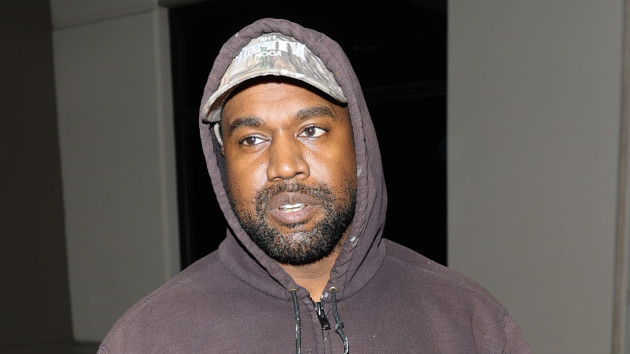
(NEW YORK) — When Adidas announced on Tuesday that it had terminated its relationship with Ye, the rapper formerly known as Kanye West, the company put a price tag on how much the move would cost: Up to $246 million in profits this year.
Yeezy, a footwear and apparel partnership between Ye and Adidas that launched in 2015, will end its business immediately over hateful speech and actions undertaken by the rapper, Adidas said in a statement on Tuesday. The company will stop production of all Adidas Yeezy products and halt payments to Ye, the statement added.
The costs could reach in the hundreds of millions in part because Adidas could pull Yeezy products from shelves in brick-and-mortar stores and online, losing revenue from potential sales, apparel industry experts told ABC News.
Moreover, the severing of ties coincides with the holiday season, when companies carry a large amount of inventory in anticipation of busy end-of-year traffic, Bob Antoshak, a consultant and 30-year industry veteran, told ABC News.
“If they pull products from shelves, they’ll have a lot more product to write off than they would for other quarters,” he said “If it was the first quarter of next year, it wouldn’t be anywhere near that.”
Adidas faced increasing pressure to cut ties with Ye in recent weeks after the rapper made antisemitic comments on Twitter, podcasts and interviews.
Earlier this month, Ye also stoked controversy after appearing at a surprise show in Paris wearing a T-shirt bearing the phrase “White Lives Matter,” which the Anti-Defamation League has labeled as hate speech and has been promoted by white supremacist groups.
“Adidas does not tolerate antisemitism and any other sort of hate speech,” the company said in a press release. “Ye’s recent comments and actions have been unacceptable, hateful and dangerous, and they violate the company’s values of diversity and inclusion, mutual respect and fairness.”
The company declined to respond to ABC News’ request for more details about costs incurred by the business split.
Clothing retailer Gap, which also retained a partnership with Yeezy, ended that arrangement in September, the company said in a statement on Tuesday, adding that it is taking immediate steps to remove Yeezy Gap products from its stores.
“Antisemitism, racism and hate in any form are inexcusable and not tolerated in accordance with our values,” Gap said in the statement.
Last year, Yeezy was valued at between $3.2 billion and $4.7 billion by Switzerland-based investment bank UBS, Bloomberg reported.
The Yeezy line accounts for roughly $1 billion to $2 billion in annual sales for Adidas, according to Evercore ISI analyst Omar Saad.
The financial losses incurred by Adidas also owe to ongoing projects that must be scrapped, which likely include arrangements already established with manufacturers, Saheli Goswami, a professor of textiles, fashion merchandising and design at Rhode Island University, told ABC News.
“If Adidas was working with a supplier to get products developed for next season, now that existing business tie needs to be stopped,” she said. “The question becomes: Who will bear the cost?”
Despite the financial hit incurred by a potential loss of merchandise, Adidas minimized the damage to its reputation by severing ties with Ye, said Antoshak, the industry consultant.
“From the business perspective, the longer the relationship continued — and it was a toxic relationship — it would end up costing the company more,” he said.
Adidas, a German company, faced added scrutiny because of heightened concern over antisemitism in its home country, Goswami said. In Germany, individuals who make antisemitic comments online can face prosecution.
Goswami applauded the move by Adidas but said the company shouldn’t expect consumers to grant the decision similar acclaim.
“You don’t get a medal for doing the right thing but you can be harshly criticized if you don’t,” she said. “It matters to your future business relationship around how consumers perceive you.”
(NEW YORK) — More than half of Americans are considering taking on extra jobs to be able to pay for everyday expenses and meet the rising cost of living as inflation remains high.
Employees in the U.S. are combating the soaring prices of essentials like groceries, housing, and gas by looking for ways to increase their incomes and cut down on expenses, according to a new study by Qualtrics, a software technology company. The survey of more than 1,000 full-time employees found that 38% of workers have looked for a second job, while another 14% are planning to do so.
“With budgets tightening, workers are searching for ways to meet the rising cost of living, including finding new jobs,” said Qualtrics Chief Workplace Psychologist Dr. Benjamin Granger.
Working parents are especially pinched as nearly 70% said their pay isn’t keeping up with costs, the poll states. About 47% of employees with children have looked for a second job, higher than the rate of workers overall. The cost of raising a child through high school has surged to more than $300,000, up roughly $26,000 from two years ago, according to a recent Brookings Institution estimate.
It’s not unusual for American workers to have multiple jobs, especially with more people tapping into the gig economy and doing independently-managed work like freelancing or growing a side hustle. As of September, 7.8 million Americans are working more than one job, making up 4.9% of the total workforce, the Bureau of Labor Statistics reports. A record 440,000 Americans were working two full-time positions in August, compared to 308,000 in February 2020.
The holiday hiring season could offer job-seekers opportunities to boost their incomes. Searches for seasonal positions on Indeed are at the highest level since 2019. In contrast, demand for holiday workers has cooled down from last year as retailers anticipate weaker sales, but still remains above pre-pandemic levels. Walmart, the nation’s largest private employer, is one of several companies that have announced cuts to its holiday payroll in anticipation of weaker sales.
“High inflation and easing COVID-19 concerns may be prompting more people to look for seasonal work this winter. At the same time, employers are pulling back from 2021’s hot holiday hiring levels and offering fewer incentives to prospective workers — perhaps due to recession concerns,” Indeed’s statement reads.
Tiffany Perkins, a marketing professional at a Brooklyn private school, decided to take on a part-time job in September as a restaurant hostess. While she has always done side gigs like offering doula services, selling homemade beauty products, and participating in focus groups for extra money, it isn’t enough to cover her bills as the price of food and utilities rises.
“I budget to zero, I have a very tight paycheck to paycheck lifestyle. I’ve gotten used to it. I can do odd jobs, get a little extra money and be fine,” said Perkins. “Saving has always been difficult for me, I am a single mom so I’ve always been hand to mouth in prioritizing a certain lifestyle for my child and his future. As opposed to securing my immediate financial goals I always think more long term. I feel like I’ve always been in survival mode, but lately it’s survival times 10 because it just seems almost impossible.”
With the new commitment, she now works seven days a week and admits to being exhausted, but she’s glad to be able to catch up on necessary expenses and afford to buy her son a gift for his birthday.
“That weekly pay can really fill the gap for those weeks when I don’t get a paycheck from my full time job and is helping me to be able to stay afloat and really catch up on some things that have been backed up for so long,” said Perkins. “I may not be able to get ahead, but at least I can cover what needs to be covered without robbing Peter to pay Paul and make things stretch.”
(NEW YORK) — The U.S. Consumer Product Safety Commission announced Clorox is issuing a recall Tuesday of roughly 37 million Pine-Sol products over a possible bacteria contamination.
The recall affects “Pine-Sol Scented Multi-Surface Cleaners in “Lavender Clean,” “Sparkling Wave,” and “Lemon Fresh” scents; “CloroxPro Pine-Sol All Purpose Cleaners” in “Lavender Clean,” “Sparkling Wave,” “Lemon Fresh” and “Orange Energy” scents; and “Clorox Professional Pine-Sol Lemon Fresh” cleaners.
Original Pine-Sol (Pine scent) is not included in this recall, according to officials.
The recall affects 37 million products that were sold between January 2021 and September 2022, which may contain the bacteria Pseudomonas aeruginosa, according to the CPSC.
“People with weakened immune systems or external medical devices who are exposed to Pseudomonas aeruginosa face a risk of serious infection that may require medical treatment. The bacteria can enter the body if inhaled, through the eyes, or through a break in the skin. People with healthy immune systems are usually not affected by the bacteria,” the agency said in a statement.
Customers can identify the affected products by looking for date codes that are printed on the bottles. Customers with products with date codes labeled “A4” and followed by a five-digit number less than 22249 should dispose of the product in its container with household trash and contact Pine-Sol for a full refund of the purchase price, with receipt, or of the manufacturer’s suggested retail price, without receipt, according to the CPSC.
Affected customers can get more information by calling Pine-Sol toll-free at (855) 378-4982, by email at PineSolRecalls@inmar.com, or online at pinesolrecall.com and Pinesol.com by clicking on “Recall Information.”
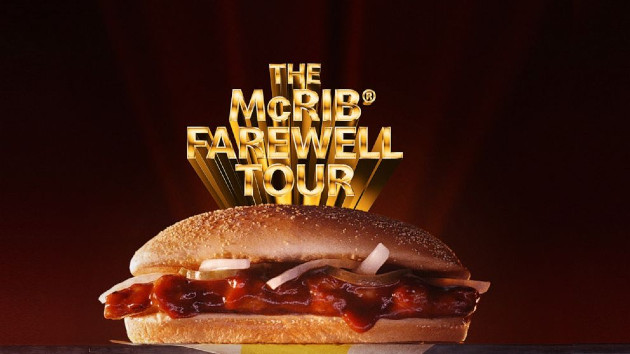
(NEW YORK) — This could be the last chance for fast food fans to get their hands on a McDonald’s McRib as the golden arches prepares to say goodbye to the saucy sandwich.
Starting Oct. 31, the seasoned, boneless pork sensation that’s slathered in tangy barbecue sauce and topped with slivered onions and pickles, will be back on menus for a limited time.
“We can’t say for certain what the future holds. But for now, fans should enjoy the McRib while they can, because it won’t be returning nationwide anytime soon,” a spokesperson for McDonald’s said in a statement to ABC News’ Good Morning America.
“After three straight years headlining McDonald’s nationwide menu each fall, the iconic sandwich is embarking on a ‘Farewell Tour,'” McDonald’s said in a press release. “Like any true farewell tour, we’re hoping this isn’t a ‘goodbye’ … because as our McRib stans have experienced time and time again: you never know when – or if – the McRib is coming back.”
The now-famous sandwich first hit menus in 1980, got a mini version in 2003 and prompted a McRib locator in 2008 so fans could track down which locations had it available. In 2021, McDonald’s USA created it’s first NFT offering a digital version of the McRib.
The sandwich may be gone, but for superfans who hope to enjoy more of the McRib legacy, McDonald’s is launching a line of merch.
(NEW YORK) — Adidas on Tuesday said it has terminated its relationship with Ye, the rapper formerly known as Kanye West, immediately and will cease production of Yeezy branded products.
“Adidas does not tolerate antisemitism and any other sort of hate speech,” the company said in a press release. “Ye’s recent comments and actions have been unacceptable, hateful and dangerous, and they violate the company’s values of diversity and inclusion, mutual respect and fairness.”
There has been growing pressure on big-name brands to cut ties with the rapper after he made antisemitic remarks on Twitter a few weeks ago.
The rapper later followed with more offensive comments against the Jewish community on Revolt TV’s Drink Champs in a since-deleted interview.
Ye’s comments against the Jewish community were also referenced over the weekend by a group of Los Angeles neo-Nazis who hung antisemitic flyers on a 405 freeway overpass.
In addition to Ye’s remarks against the Jewish community, another recent controversy has seen the Donda rapper sporting a “White Lives Matter” T-shirt during his surprise Yeezy Season 9 show in Paris along with conservative political commentator Candace Owens.
The phrase has been described by the Anti-Defamation League and Southern Poverty Law Center as a white supremacist hate slogan that originated in 2015 as a response to the civil rights movement Black Lives Matter. The groups note that the phrase has been commonly used by white supremacist groups such as the Aryan Renaissance Society and the Ku Klux Klan on everything from promotional materials to campaigns.
Responding to the backlash over the T-shirts, Ye wrote in a since-deleted Instagram post, “Here’s my latest response when people ask me why I made a tee that says white lives matter… THEY DO.”
Hollywood talent agency Creative Artists Agency, also known as CAA, announced Monday that it would no longer represent the rapper. Film and television studio MRC also said it would be shelving a documentary on West, saying in a statement that it “cannot support any content that amplifies his platform.”
Several reports have also stated that brands such as Balenciaga will no longer work with Ye.
Ye’s ex-wife, Kim Kardashian, along with many other public figures have stood in solidarity with the Jewish community following his antisemitic remarks.
“Hate speech is never OK or excusable,” Kardashian tweeted on Monday. “I stand together with the Jewish community and call on the terrible violence and hateful rhetoric towards them to come to an immediate end.”
Kendall Jenner, Reese Witherspoon, Amy Schumer, John Legend and others have also spoken out against Ye’s comments aimed at the Jewish community.
(NEW YORK) — Unilever recently announced a voluntary recall of 19 popular dry shampoo aerosol products sold in the United States due to concerns about benzene, a chemical known to cause cancer.
Exposure to benzene, which is classified as a human carcinogen, can occur through inhalation, ingestion, or through skin contact and can result in cancers including leukemia and blood cancers, according to the U.S. Department of Health and Human Services.
Humans are exposed to benzene daily through things like tobacco smoke and detergents, but exposure can be considered dangerous depending on the dose and duration of contact, according to the Centers for Disease Control and Prevention.
Unilever said that it is pulling the products “out of an abundance of caution” and that the company has not yet received any reports of adverse event relating to the recall to date.
The recalled products were produced before October 2021 and retailers have been notified to pull the affected products from shelves.
A complete list of the affected products and consumer codes can be found here. No other products from Unilever or its brands are impacted by this recall, the company stated in a press release.
The list of affected products include:
Dove
Dove Dry Shampoo Volume and Dullness
Dove Dry Shampoo Fresh Coconut
Dove Dry Shampoo Fresh and Floral
Dove Dry Shampoo Ultra Clean
Dove Dry Shampoo Invisible
Dove Dry Shampoo Detox and Purify
Dove Dry Shampoo Clarifying Charcoal
Dove Dry Shampoo Go Active
Nexxus
Nexxus Dry Shampoo Refreshing Mist
Nexxus Inergy Foam Shampoo
Suave
Suave Dry Shampoo Hair Refresher
Suave Professionals Dry Shampoo Refresh and Revive
TRESemmé
TRESemmé Dry Shampoo Volumizing
TRESemmé Dry Shampoo Fresh and Clean
TRESemmé Pro Pure Dry Shampoo
Bed Head
Bed Head Oh Bee Hive Dry Shampoo
Bed Head Oh Bee Hive Volumizing Dry Shampoo
Bed Head Dirty Secret Dry Shampoo
Rockaholic
Bed Head Rockaholic Dirty Secret Dry Shampoo
The recall is being conducted with the knowledge of the U.S. Food and Drug Administration. Unilever urged consumers to stop using the affected aerosol dry shampoo products immediately and visit the company website for eligible product reimbursements.
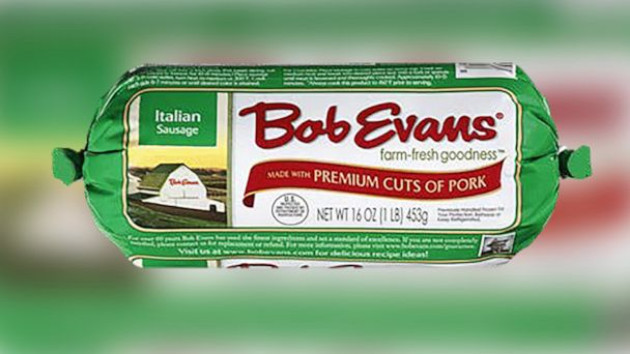
(NEW YORK) — The U.S. Department of Agriculture’s Food Safety and Inspection Service announced on Friday that 7,560 pounds of Italian pork sausage products from Bob Evans Farms Foods, Inc. were being recalled over potential contamination with extraneous materials, specifically thin blue rubber.
The raw Italian pork sausage impacted by the recall was produced Sept. 8, 2022, with a use or freeze by date of Nov. 26, 2022.
Click here to view the recalled labels of the 1-pound containers.
The affected Bob Evans Italian Sausage is labeled with lot code XEN3663466 and has a time stamp between 14:43 and 15:25, the FSIS stated. The products also bear establishment number “EST. 6785” inside the USDA mark of inspection.
“The problem was discovered after the firm notified FSIS it had received consumer complaints reporting thin blue pieces of rubber in the product,” the recall notice stated. “There have been no confirmed reports of adverse reactions due to consumption of these products. Anyone concerned about an injury or illness should contact a healthcare provider.”
The FSIS added that it is “concerned that some product may be in consumers’ refrigerators or freezers” and advised anyone who’s purchased the products “not to consume them.”
Consumers should throw out or return the products to the original place of purchase.
“FSIS routinely conducts recall effectiveness checks to verify recalling firms notify their customers of the recall and that steps are taken to make certain that the product is no longer available to consumers,” the agency said.
Bob Evans Foods, Inc. did not immediately respond to a request for comment on the recall.
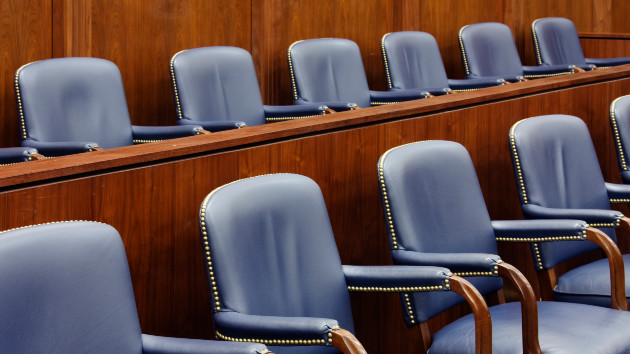
(NEW YORK) — Jury selection is set to begin Monday in the criminal trial of former President Donald Trump’s namesake family real-estate business, which was charged last year by prosecutors in Manhattan, New York with orchestrating a years-long scheme to evade taxes.
The Trump Organization compensated certain executives with off-the-book perks — including rent, utilities and garage expenses at a luxury apartment building, private school tuition and leases for luxury cars — that were never accounted for on the company’s payroll taxes, according to the Manhattan district attorney’s office.
“This was a 15-year-long tax fraud scheme,” Carey Dunn, then-general counsel at the Manhattan DA’s office, said when the indictment was unsealed last summer. “It was orchestrated by the most senior executives.”
The company has pleaded not guilty and Trump has dismissed the investigation as a “hoax.” A spokesperson for the Trump Organization previously said in a statement that the company will “look forward to having our day in court.”
A corporate defendant cannot serve prison time. A conviction could require the Trump Organization to pay a maximum fine of $10,000 and, potentially, the taxes allegedly skirted.
More significant, according to authorities, are the potential collateral consequences that could come with a conviction. Existing contracts could be voided if a counterparty has rules against doing business with felons, and banks could consider calling in loans or altogether terminating their relationship with the Trump Organization.
“One major issue when considering a corporate conviction is reputational harm,” said Daniel R. Alonso, a partner in Buckley’s New York office and formerly the chief assistant district attorney in the Manhattan district attorney’s office.
On the other hand, said Alonso, “In this case, I’m not sure the Trump Organization’s reputation could be harmed much more than it has been.”
The trial, which is expected to last into early December, comes as Trump faces a half-dozen other investigations into his business practices, his efforts to overturn the Georgia vote, his alleged role in the Jan. 6 attack, and the removal of documents with classification markings from the White House.
Among those testifying in the Trump Organization trial will be the company’s longtime chief financial officer Allen Weisselberg, who pleaded guilty last month after being charged as part of the alleged scheme.
The longtime CFO pleaded guilty to all 15 counts he faced, including conspiracy, criminal tax fraud, grand larceny and falsifying business records. He conceded that he skirted taxes on nearly $2 million in income, including fringe benefits like rent, luxury cars and private school tuition for his grandchildren.
Weisselberg, who first met Trump in the 1970s when he began working for his father, was required to testify against the Trump Organization as part of his plea deal, and to serve five months in jail.
“The case against [the Trump Organization] is dramatically strengthened,” prosecutor Josh Steinglass said of Weisselberg’s guilty plea at a hearing in the case in September.
“During the operation of the scheme, the defendants arranged for Weisselberg to receive indirect employee compensation from the Trump Organization in the approximate amount of $1.76 million … in ways that enabled the corporate defendants to avoid reporting it to the tax authorities,” the indictment against Weisselberg said.
The charges are a “disgrace” and “shameful,” Trump told ABC News last year after the indictment was unsealed, calling Weisselberg “a tremendous person.”
The indictment said that, beginning in 2005, Weisselberg used the corporation’s bank account to pay the rent for his apartment, and he and others paid their utility bills using the corporation’s account. The indictment also accused Weisselberg of concealing “indirect compensation” by using payments from the Trump Organization to cover nearly $360,000 in upscale private school payments for his family, and for nearly $200,000 in luxury car leases.
“Weisselberg intentionally caused the indirect compensation payments to be omitted from his personal tax returns, despite knowing that those payments represented taxable income and were treated as compensation by the Trump Corporation in internal records,” the indictment said.
The rest of the case against the Trump Organization is based largely on documents, including spreadsheets and charts, along with other accounting materials. Prosecutors say their challenge will be to spin a compelling narrative for the jury to follow.
The prosecution will be led by Steinglass, who joined the prosecution team from the district attorney’s violent crime division, and Susan Hoffinger, the head of the DA’s investigation division.
A corporate tax fraud case was not what prosecutors were after when they first filed charges against Weisselberg last summer. Sources have told ABC News that prosecutors had hoped Weisselberg would turn on Trump as part of a larger criminal investigation into the former president’s business practices that remains ongoing.
But the plea deal that Weisselberg agreed to contains no requirement that he cooperate in the criminal case against Trump himself, which centers on whether Trump knowingly misled tax authorities, lenders and insurance brokers by providing inaccurate financial statements about the value of his real estate portfolio.
Trump, who has denied all wrongdoing, has decried the investigation as politically motivated.