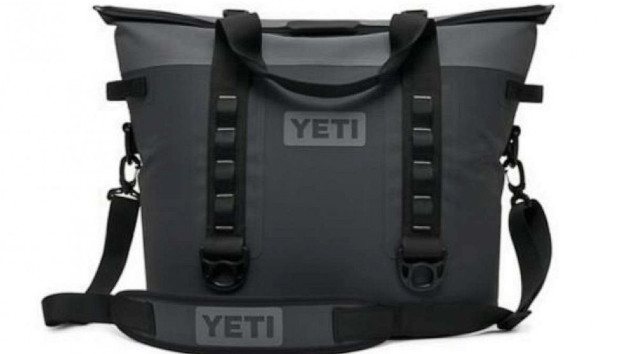
(NEW YORK) — The U.S. Consumer Product Safety Commission on Thursday announced a recall of 1.9 million YETI cooler products.
The recall impacts four of YETI’s products: the Hopper M20 backpack cooler, the Hopper M30 1.0 and 2.0 soft coolers, and the SideKick Dry gear case.
According to the CPSC, the magnet-lined closures on the products “can fail and result in detached magnets, posing a risk of serious injury or death if ingested.”
“When two or more high-powered magnets are swallowed, the ingested magnets can attract to each other, or to another metal object, and become lodged in the digestive system,” the agency said in a recall statement. “This can result in perforations, twisting and/or blockage of the intestines, infection, blood poisoning and death.”
The Austin, Texas-based cooler company issued the voluntary recall in cooperation with the CPSC.
“We are voluntarily recalling the Hopper M20, Hopper M30 1.0 and 2.0, and SideKick Dry products sold between March 2018 and January 2023,” YETI said in a statement on its website. “We ask all customers currently in possession of the Hopper M20, Hopper M30 and SideKick Dry to immediately stop use of these products.”
According to Thursday’s CPSC announcement, there have so far been “1,399 reports of the magnet-lined closures degrading or failing, including reports of missing or detached magnets.”
“No magnet ingestions or injuries have been reported,” the CPSC added.
Both YETI and the CPSC have urged consumers in possession of any of the affected products to immediately stop using them and contact YETI for a “full refund in the form of a YETI gift card with an additional $25 value.”
YETI customers can also visit the brand’s site directly for more information on “returning the product free of charge for the choice of a suggested replacement product of equal or greater value,” according to the company.
The four products in the recall were sold nationwide at Dick’s Sporting Goods, ACE Hardware, Academy Sports + Outdoors, YETI and other retailers, as well as online and on Amazon from March 2018 to January 2023.
(NEW YORK) — Dorel Juvenile Group announced a voluntary recall of 59,450 rear-facing infant car seats due to concerns over the seat anchoring system that “fails to conform” to safety standards for some models, according to a release from Maxi-Cosi on Mar. 3.
The recalls include certain Safety 1st onBoard 35 Secure Tech, Maxi-Cosi Coral XP, Maxi-Cosi Mico XP Max, Maxi-Cosi Mico XP, Maxi-Cosi Mico Luxe+, and Maxi-Cosi Infant Base child car seats, according to the release.
The recall was also reported by the National Highway Traffic Safety Administration (NHSA.)
“A detached child seat may not properly restrain the occupant, increasing the risk of injury in a crash,” the NHSA said in part of a statement, adding that “the lower seat anchors used to secure the child seat base may fail, allowing the child seat to detach” in the recalled units.
The NHSA, as well as Dorel, advise consumers to “only secure their child seat with the vehicle belt restraint system” until a free replacement base is sent to owners.
Consumers who own an affected product are urged to contact Dorel customer service or email retractablelatchrecall@djgusa.com to be sent a free replacement.
(NEW YORK) — The maker behind the popular Calico Critter toys said Thursday that it is recalling millions of toys with parts that may pose a choking hazard for children.
Epoch Everlasting Play LLC made the announcement in cooperation with the Consumer Product Safety Commision.
The recall impacts more than 3.2 million units of the company’s Calico Critters flocked animal figures and sets that include bottle and pacifier accessories.
The Pine Brook, New Jersey-based company said it knew of three reported incidents involving the pacifier accessories specifically, two of which resulted in fatalities, including a 2-year-old in New Mexico in 2018 and a 9-month-old in Japan in 2015.
The impacted bottle and pacifier accessories were manufactured in China, imported by Epoch Everlasting Play LLC and sold between January 2000 and December 2021 at major retailers such as Meijer and Walmart and online on the Calico Critters website and on Amazon, according to a CPSC recall announcement. They were sold in multiple colors, according to the company.
“The bottle accessories were sold in yellow, pink, blue and orange colors. One style of the bottle has two yellow handles. The pacifier accessories were sold in yellow, orange, pink, dark pink, blue and teal colors,” Epoch said on its official recall website.
Epoch and the CPSC have advised anyone in possession of a recalled accessory to “please immediately take them away from children” and destroy them.
In order to properly destroy the accessories, the company stated, adults should use scissors to “cut the top off of the bottle and cut the handle [off] the pacifier.”
The toy company has a full list of recalled products and associated item numbers on its recall website and has created a request form for impacted individuals to register, submit a photo of the destroyed recalled item and request a free replacement accessory.
Consumers who wish to contact Epoch can also call (800) 631-1272 Mondays through Fridays between the hours of 9 a.m. and 5 p.m. ET, or email productsafety@epocheverlastingplay.com.
(WASHINGTON) — Oil spills along the Keystone pipeline that runs from Canada to Texas have become more frequent and severe, prompting stricter regulations for a 1,200-mile stretch of the pipeline, a federal agency said on Tuesday.
TC Energy, the company that operates the Keystone pipeline, must lower the operating pressure for crude oil on the targeted stretch, which makes up nearly half of the pipeline, the agency said.
“We are currently reviewing the Amended Corrective Action Order (ACAO) issued by the Pipeline and Hazardous Materials Safety Administration,” TC Energy said in a statement to ABC News. “Our commitment to the safe operations of our system is unwavering, and we will comply with the ACAO. The Keystone Pipeline System has been operating under operational mitigations, within the pressure restrictions applied in the PHMSA ACAO, since it was returned to service.”
The federal order follows a major pipeline rupture on Dec. 7 near Washington, Kansas, a town at the state’s northern border with Nebraska, where about 13,000 barrels or 550,000 gallons of crude oil spilled from the Keystone pipeline, the Pipeline and Hazardous Materials Safety Administration said.
The pipeline failure occurred at a girth weld, a point that adjoins two pipes, the agency said.
Since 2009, the Keystone pipeline has experienced three failures at girth welds and at least three additional accidents that occurred for other reasons, the agency said. In all, those accidents resulted in spills totaling about 25,200 barrels of crude oil, the agency said.
Operation of the pipeline under current procedures “is or would be hazardous to life, property, or the environment,” the agency said.
In a statement to ABC News, TC Energy said it is investigating and addressing the issues with the pipeline following the accident in December.
“We continue to progress our remediation and the root cause investigation at our Keystone Milepost-14 incident site in Washington County, Kansas,” the company said. “Our commitment to the safe operations of our system is unwavering.”
The Keystone pipeline runs from oil sand fields in Alberta, Canada through the midwestern U.S. to oil refineries in Texas.
The Keystone XL pipeline, a proposed 1,179-mile pipeline mirroring the Keystone pipeline, shuttered after President Joe Biden canceled the pipeline’s border crossing permit in January 2021, days after taking office.
The move was applauded by environmental groups but drew sharp criticism from some Republican lawmakers, who decried the move for placing an unnecessary restriction on the U.S. oil supply.
Oil production in the U.S. in 2021 was nearly identical to that seen over the final year of the Trump administration, in 2020, and greater than the amount produced in 2017 or 2018, according to data from the Energy Information Administration, a federal agency.
(NEW YORK) — When Pat Clynes pushed down the gas pedal on his Ford Explorer during a drive in Houston, Texas, in July 2022, an otherwise routine day became the start of what he later described as a nightmare.
The car failed to accelerate like it usually did, triggering immediate concern that something was wrong, Clynes said.
Since he thought the car was under warranty, Clynes brought it to a Ford dealership, where an employee later told Clynes it would cost nearly $1,400 just to identify the problem.
Weeks later, the dealership identified the problem as engine failure and said it would cost another $10,000 to fix, due partly to pandemic-induced supply chain snags that made car parts more expensive, he said.
Making matters worse, the company ultimately voided his warranty, determining the cause was maintenance-related, he said.
After balking at the repair prices, Clynes instead sold the car back to Ford last October for $8,000, less than a quarter of what he paid when he bought it used three years earlier.
“It was crazy,” Clynes said. “It just wore me down.”
Clynes is hardly the only car owner encountering high auto repair prices. Motor vehicle repair prices have jumped a staggering 23% over the last year, an inflation rate nearly four times higher than overall price increases, government data showed.
The price hikes stem from a shortage of workers and car parts that has sent costs soaring for auto shops, industry experts said. On top of that, the rise of high-tech cars, equipped with features like rearview cameras and traffic sensors, has added cost to even some routine repairs, they added.
“It’s a perfect storm because everything is coming together at once,” Tara Topel, the owner of Topel’s Service Center, a car repair shop in Lake Mills, Wisconsin, told ABC News. “The pandemic exacerbated what was already an issue.”
The high prices that weigh on the economy trace back to pandemic-induced supply bottlenecks that made it harder to access a slew of goods, including essentials like gas and food.
The pandemic also caused a shortage of workers, as mass layoffs at the outset of the pandemic diminished the workforce and coronavirus fears slowed the return of some workers. In turn, companies raised wages to attract workers, passing along some of those costs to customers and pushing prices higher.
These supply shocks pummeled the auto repair industry immediately, but the worst effects took time to emerge as repair shops slowly exhausted inventory on hand, said Brian Moody, executive editor at Autotrader.
“Manufacturing stopped or slowed down because of COVID restrictions or people didn’t come to work or they couldn’t find the right people,” Moody told ABC News. “In 2022, we [saw] the delayed reaction where there isn’t the same supply of stuff that there was.”
Meanwhile, a shortage of car repair technicians has deepened. The industry will stand 642,000 workers short of capacity by 2024, a TechForce report showed.
“There’s a scarcity of technicians,” David Whiston, an auto industry analyst at Morningstar, told ABC News. “This was a problem before the pandemic and it just gets worse.”
In turn, the U.S. hosts fewer car repair shops. In 2016, there were 225 cars and trucks on the road for every active service bay; five years later, there were 246 cars and trucks per service bay, according to a study from industry outlet Aftermarket Matters.
The lack of supply has coincided with another trend driving up repair prices: high-tech cars.
Cars contain more sophisticated materials and features, such as cameras and sensors, said Moody, of Autotrader.
“Let’s say someone has a 2020 model car and they back into a pole – something pretty simple,” Moody said. “You have to replace the bumper.”
“In that bumper can be sensors that house blind-spot monitoring or rear-park alert,” he added. “All of those live in the bumper.”
Topel, the repair shop owner, said the company’s prices have gone up as much as 20% over the last year.
To attract workers amid the shortage, the company has raised hourly pay by $5 per hour over the past two years, which amounts to a 20% increase in the base pay for entry-level technicians, she said.
Meanwhile, the repair shop faces added costs as it purchases big-ticket items that allow it to fix high-tech cars, she said. The company recently spent $38,000 for a machine that allows for the calibration of advanced driver-assistance systems, a set of technologies that help drivers navigate.
“More and more new technology comes into our shop,” she said. “It becomes a bigger deal by the month.”
As repair prices rise, Topel notices customers opting for basic repairs rather than more comprehensive ones, she said, noting that customers and shops alike are trying to weather elevated costs.
“All of these I call opportunities, but they really are challenges for the industry in how we solve for them and how people will make it through,” she said.
(NEW YORK) — The Biden administration is moving to implement a new national security strategy focused on stopping hackers, as buzz around artificial intelligence tools raises concern among some experts that criminals may try to exploit AI capabilities.
One aim of the administration strategy is to shift the focus of blame away from the victims of cybercrime, U.S. security officials said. After-the-fact assessments often focus on the target for being vulnerable enough to hack — but if that target is a rural hospital, for example, limitations might exists on what that hospital can do to protect against bad actors, especially those backed by foreign governments.
Instead, the new plan focuses on strengthening the public-private partnerships that encourage security firms to share what they know about hacker networks in order to bring them to justice.
Emerging technology will test the viability of the strategy going forward, experts told ABC News, especially with AI posing new security challenges.
The same advantages seen in AI tools like ChatGPT from research lab OpenAI, which formulates human-like responses to questions posed by a user, are vulnerable to nefarious use, according to Ari Jacoby, a tech executive who has focused on using AI to fight fraud.
Given the volumes of publicly available information on software engineering, hackers could use the chat bots to generate or enhance malicious computer code, Jacoby said.
According to OpenAI’s user policy, using ChatGPT to write malware, generate hateful or harmful content or engage in fraudulent activity is explicitly prohibited. The question is whether tech firms are capable of enforcing such rules as AI technology spreads.
“The ChatGPTs of the world — who do way more good than harm — make available tools that can write software code in less than a minute that would have taken a bad actor or a bad network potentially days or weeks to run,” Jacoby said.
Instead of using ChatGPT to source ideas for recipes or write basic work emails, bad actors could attempt to write large volumes of phishing emails that trick recipients into downloading malware or giving up personal financial information.
Alternatively, similar tools used to analyze and assess trends in large sets of data can potentially be used to fight fraud, Jacoby said. Credit card companies, for example, could benefit from being able to detect anomalies in a customer’s behavior to determine if purchases are authentic.
Meanwhile, the U.S. is facing a daily onslaught of cybersecurity breaches from Russian, Chinese and North Korea-backed groups, according to recent U.S. government assessments and private cyber intelligence firms. Experts expect those efforts will test the resilience of the administration’s new cyber strategy.
“They’re unbelievably sophisticated and they’re unbelievably well-funded and well-tooled,” Jacoby said. “They have plenty of AI tools at their disposal.”
A recent analysis of underground hacking communities by the cyber firm Check Point Research found online forums where new approaches to hacking tools were discussed, including one discussion thread called “ChatGPT – Benefits of Malware.”
The author wrote they were attempting to use ChatGPT to recreate malicious computer code based on research papers about hacking.
While the Biden administration’s strategy does not delve into the specifics of emerging technology, such as AI, it’s designed to be nimble enough to account for new developments in the rapidly changing cybersecurity landscape.
“These are multi-year efforts where we are going to find gaps and where Congress will then need to lean in to help us get to where we need to go,” acting National Cyber Director Kemba Walden said at a forum discussion of the strategy last week. “It’s a symphony, not a single movement.”
“This is an ongoing process,” she added.
Walden emphasized the important role that cloud computing service providers play in securing data as a “force multiplier” for cyber threat first responders.
Google Cloud, for example, provides a variety of data storage and website hosting services. The company’s ability to defend its systems was bolstered by its acquisition of the cybersecurity firm Mandiant last year.
“Everyone has a shared responsibility here,” said Stacy O’Mara, who leads government strategy and partnership at Mandiant. “I think that’s the purpose of the strategy — to reinforce this concept of a shared defense.”
“We’ve got a long process ahead of us,” O’Mara said, ” but I’m encouraged by the administration’s efforts.”
(NEW YORK) — Locked out of his work computer for more than a week, a two-year Twitter employee didn’t know whether he’d been laid off. So he asked CEO Elon Musk in a message on Twitter.
“Maybe if enough people retweet you’ll answer me here?” Haraldur Thorleifsson, who joined the company after it acquired his startup Ueno, tweeted on Monday.
Musk, who has nearly 131 million followers on the platform, responded on Tuesday.
“What work have you been doing,” he asked.
In an ensuing exchange, Musk volleyed questions at Thorleifsson about his work and voiced skepticism about limitations caused by a disability. Thorleifsson, a design manager, has muscular dystrophy and uses a wheelchair.
In a post, Musk said Thorleifsson “did no actual work, claimed as his excuse that he had a disability that prevented him from typing, yet was simultaneously tweeting up a storm.”
In response, Thorleifsson tweeted: “This wasn’t a problem in Twitter 1.0 since I was a senior director and my job was mostly to help teams move forward, give them strategic and tactical guidance.”
“I’m typing this on my phone btw,” Throleifsson, who goes by “Halli,” later added. “It’s easier for [sic] because I only need to use one finger.”
Musk – the second-richest person in the world, according to Fortune – has faced scrutiny over job cuts at the company in recent months.
Days after Musk acquired Twitter in October, the company began layoffs that ultimately cut more than half of its 7,500-person workforce, raising concerns about Twitter’s capacity to maintain its platform.
In a memo to employees in November, Musk asked workers to commit to being “extremely hardcore” or accept three months of severance upon their exit from the company. Many chose to leave.
For his part, Musk defended his actions at Twitter as part of an aggressive effort to rescue the company from financial peril, which he described in a Twitter Spaces interview in December as an “emergency fire drill.”
“That’s the reason for my actions,” he added. “They may seem sometimes spurious or odd or whatever.”
Musk previously said he overpaid for the platform at the purchasing price of $44 billion.
Twitter did not respond to a request for comment.
Ultimately, Thorleifsson said on Monday that he received a message from Twitter saying that he no longer worked for the company.
However, later on Monday, Musk said he held a video call with Thorleifsson to “figure out what’s real vs what I was told.”
“Better to talk to people than communicate via tweet,” he added.
By Monday evening, Musk issued an apology and indicated that Thorleifsson had been offered to return to Twitter.
“I would like to apologize to Halli for my misunderstanding of his situation,” Musk tweeted. “It was based on things I was told that were untrue or, in some cases, true, but not meaningful.”
“He is considering remaining at Twitter,” Musk added.
Thorleifsson, a philanthropist in his home country of Iceland, has led an effort to build 1,500 wheelchair ramps across the nation to improve accessibility.
He did not appear to indicate whether he intends to return to the company.
In a final post on Tuesday, Thorleifsson told his 200,000 followers: “Anyway, that’s enough about me.”
(NEW YORK) — For nearly four years, Arizona realtor Courtney Van Cott has been consumed by a legal battle involving a noncompete agreement.
“You just have this cloud over you every single day,” she told ABC News in an exclusive interview.
In 2019, Van Cott’s former employer sued her for nearly $200,000, alleging multiple breaches of her contract, including a competitive clause. The contract required her to pay the old firm a 75 percent cut of homes she sold at her new job for three years.
“I definitely read it and I saw that it was not something I was comfortable with,” Van Cott said.
In a statement to ABC News, Van Cott’s former employer denied it forced her to sign the contract, saying it is “not a noncompete” but rather a “shared referral agreement” applying to both the company and Van Cott. The statement added Van Cott was an “independent contractor” who engaged in “unethical behavior,” a claim she denied.
Noncompete agreements are clauses in employment contracts that bar an employee from working at a rival company, usually within a certain geographic area or for a certain amount of time.
In a sweeping step earlier this year, the Federal Trade Commission (FTC) proposed a rule that would void noncompete clauses and ban their use in future contracts. The agency said the move would affect 30 million Americans, roughly one out of every five workers.
“This would say not only are all of those clauses unenforceable, but employers have to tell their workers, you no longer have a noncompete, you’re free to leave,” FTC Director of Policy Planning Elizabeth Wilkins told ABC News. “Effectively, that would mean that all of a sudden those 30 million workers could leave their jobs and find a better one for them tomorrow.”
Wilkins said the rule would boost wages and promote competition by allowing workers to move more freely between jobs, pointing to the widespread use of the agreements in low-wage service industries.
“People think this is about folks in the boardroom, but it’s not,” she said. “It’s also about hairstylists. It’s about security guards. It’s about journalists. People all across the income spectrum, all kinds of job descriptions have noncompetes.”
At Man & Machine, a small business that manufactures keyboards in Maryland, some employees have signed noncompete agreements.
But CEO Clifton Broumand said he supports the FTC’s proposed rule, saying it would allow him to recruit from a bigger pool of workers without fearing legal action from their employers.
“I think businesses will become more efficient when they’re not afraid of being sued, when they can innovate and focus on their businesses rather than focus on the possibility of legal action against them,” Broumand said in an interview with ABC News.
Critics accuse the FTC of overstepping its authority to enact such a sweeping change to the American workforce.
Neil Bradley, the executive vice president and chief policy officer at the U.S. Chamber of Commerce, which represents businesses across the nation, called the proposed rule “regulatory overreach.”
“If this rule comes to fruition, the U.S. Chamber will sue,” Bradley told ABC News. “If the FTC can wake up one day, [if] three unelected individuals can wake up one day, and decide that we think this business practice, that we think this employment practice is uncompetitive, therefore we are going to ban it, then there actually is no limit to what the FTC can do.”
He added noncompete agreements are an essential tool to protect trade secrets and retain workers in a highly competitive age of information.
“Employees today are often exposed to things that, while may not be technically trade secrets, really are kind of the ‘secret sauce’ for how a company’s going to operate,” Bradley said.
The public comment period for the FTC’s proposed rule is set to end on April 19 and the final rule could be issued by the agency in the coming months.
(NEW YORK) — Chocolate lovers who can’t eat dairy are now in luck when it comes to two beloved milk chocolate treats from Hershey’s.
As more people trend toward plant-based snacks, Hershey’s launched two treats to satiate the appetite for a milk chocolate alternative with Reese’s Plant Based Peanut Butter Cups and Hershey’s Plant Based Extra Creamy with Almonds and Sea Salt.
The iconic candy confectioner said its new additions are made with oat instead of milk.
“Our purpose is to create more moments of goodness for consumers. Those moments are now more accessible for chocolate lovers looking for plant-based alternatives,” Teal Liu, brand manager of Better For You with The Hershey Company, said in a statement.
Both new plant-based additions will hit retail shelves nationwide this spring with Reese’s available in March, followed by the Hershey’s extra creamy with almonds and sea salt in April.
(WASHINGTON) — The U.S. Department of Transportation introduced a new online tool for airline customers on Monday — a dashboard that aims to cut down on and ultimately eliminate extra fees families often pay for young children to sit with an adult family member, relative or caregiver on a flight.
The Airline Family Seating Dashboard lets potential passengers see which airlines guarantee free family seating.
“To receive a green check on the dashboard, an airline must guarantee that parents can sit next to children age 13 and younger for free if adjacent seats are available when they book. And they must include that guarantee as part of their customer service plan so that it is backstopped by USDOT enforcement if they fail to deliver,” the DOT explained in a news release.
Other features include viewing which airlines charge for rebooking or meal vouchers in the event of a flight cancellation that is “controllable” by an air carrier, as well as links to carriers’ customer service plans.
“Parents traveling with young kids should be able to sit together without an airline forcing them to pay junk fees,” U.S. Transportation Secretary Pete Buttigieg said in a statement. “We have been pressing airlines to guarantee family seating without tacking on extra charges, and now we’re seeing some airlines start to make this common-sense change. All airlines should do this promptly, even as we move forward to develop a rule establishing this as a requirement across the board.”
So far, Alaska Airlines, American Airlines and Frontier Airlines have voluntarily announced they would guarantee families sit together on flights with no extra charges. In a Feb. 21 notice, Frontier said at least one family member would be able to sit and fly together with a child 14 and under. American updated its customer service plan in February as well to make similar accommodations across all flight fare types — including Basic Economy tickets.
Alaska made an announcement last Friday and said it would guarantee kids 13 and under would get to sit with at least one accompanying adult passenger.
“As a dad of eight, I understand the challenges that come with taking a family vacation. Traveling with kids is stressful enough — you shouldn’t have to worry about being separated from them on your flight. All of us at Alaska take pride in caring for your family, which is why we guarantee that children under 13 are always seated with you. It’s the way we’ve operated for years because it’s just the right thing to do,” Andrew Harrison, executive vice president and chief commercial officer of Alaska Airlines, said in a statement.
The DOT previously released the Airline Customer Service Dashboard online tool in September 2022 to provide information to passengers about flight cancellations and delays.