(NEW YORK) — Nishad Singh, former director of engineering at FTX, the bankrupt cryptocurrency exchange founded by Sam Bankman-Fried, agreed Tuesday to plead guilty to criminal charges, according to his lawyers and federal prosecutors in New York.
Singh agreed to plead guilty to six counts of fraud and conspiracy contained in information unsealed Tuesday, becoming the third member of Bankman-Fried’s inner circle to admit guilt and cooperate with federal prosecutors as they build a case against those believed responsible for what U.S. Attorney Damian Williams has called one of the biggest financial frauds in American history.
“Today’s guilty plea underscores once again that the crimes at FTX were vast in scope and consequence,” Williams said in a statement. “They rocked our financial markets with a multibillion dollar fraud. And they corrupted our politics with tens of millions of dollars in illegal straw campaign contributions. These crimes demand swift and certain justice and that is exactly what we are seeking in the Southern District of New York.”
Caroline Ellison, former CEO of Alameda Research, Bankman-Fried’s privately controlled hedge fund, and Gary Wang, co-founder of FTX, have also pleaded guilty to criminal charges and agreed to assist the government’s prosecution. Bankman-Fried has pleaded not guilty to eight criminal counts and prosecutors recently added an additional four counts.
Singh contributed to the fraud that led to the $32 billion bankruptcy of FTX by providing “misleading information to auditors about FTX’s revenue,” knowing that information would be given to prospective investors, according to the information.
Singh was also part of the conspiracy to make political contributions to candidates and committees that were paid for using funds from Bankman-Fried’s privately controlled hedge fund, Alameda Research, but reported to the Federal Election Commission under different names, the information said.
“Nishad is deeply sorry for his role in this and has accepted responsibility for his actions,” Singh’s lawyers, Andrew D. Goldstein and Russell Capone, said in a statement to ABC News. “He wants to do everything he can to make things right for victims, including by assisting the government to the best of his ability in this case.”
In exchange for his cooperation, federal prosecutors agreed to recommend a sentence below the 75-year maximum attached to the charges, according to the plea agreement also unsealed Tuesday.
Prosecutors agreed to Singh’s release on a $250,000 personal recognizance bond.
(BELVIDERE, Ill.) — Over a thousand automotive workers in Illinois will clock out of a Jeep assembly plant for the last time Tuesday, stopping what a local union president described as the “heartbeat” of the small city.
In December, multinational automotive giant Stellantis announced that they would be “idling” their Belvidere, Illinois, assembly plant on Feb. 28, indefinitely laying off 1,350 employees. The factory, which had served as an economic engine for the town of Belvidere since the 1960s, also spawned thousands of local jobs; according to a union official, 400 additional jobs for different companies supplying the plant have also been cut due to the factory’s idling.
“It’s like living a nightmare every day,” said Kevin Logan, the president of Belvidere-based United Auto Workers Local 1268.
Stellantis’ decision to leave Belvidere leaves many of the city’s 25,000 residents with an uncertain future, with some former employees driven to relocate to fully obtain benefits and those left behind unsure about the long-term viability of their community without the factory that served as the town’s economic anchor.
“You’re either forced to take a pay cut or uproot your entire family,” said Jeremy Snow, co-owner of an auto-repair shop in Belvidere. He later added, “I just feel like there’s definitely a million ways they could have done better, and they didn’t care.”
Stellantis, which recorded $17.8 billion in net profit in 2022, said it would idle the facility in part because of the increased cost of “the electrification of the automotive market,” in addition to the pandemic and the global microchip shortage. In a statement to ABC News, a company spokesperson said they would make “every effort to place indefinitely laid off employees in open full-time positions as they become available.”
The plant — associated with Chrysler for decades — churned out millions of vehicles, including the Dodge Dart and Chrysler New Yorker. Before its idling, the plant was most recently used to assemble the Jeep Cherokee. According to Logan, the final decision to idle the factory follows a slow bleed of layoffs in the last four years, including the loss of about 1,500 workers in 2019, 1,200 in 2021 and 500 in 2022.
Logan said the “nightmare” began on Dec. 9, when he received a phone call from a Stellantis representative who informed him that in fifteen minutes, an announcement would be made on the plant’s floor telling the employees about the fate of the factory. Since then, Logan said local management has primarily been “kept in the dark” about the factory’s future.
Logan said he was given the same reasons for the factory closure – a combination of the cost of electrification, COVID, and the chip shortage – though he said he struggles to rationalize how such a profitable company, along with the tax incentives for American manufacturing, would still decide to shutter a state-of-the-art facility.
“It really pisses me off that they’re not going to keep it here at this facility,” he said, adding. “They’re turning profits with these companies, yet they aren’t making enough profit to sustain the product here and keep people working.”
In a statement to ABC News, Stellantis said that they have not yet announced the next production location for the next-generation Jeep Cherokee; however, citing internal discussion at the factory, Logan expressed concern that production might move to Stellanti’s 1.6 million-square-foot Toluca, Mexico, assembly plant, where Jeep already produces their Compass compact SUV.
A Stellantis spokesperson said that “government regulations and societal pressure” have led to the push for electrification, which she said is 40 percent more expensive to implement.
“This means we will need to rethink and restructure our operations everywhere in the world, including in North America,” she wrote.
The decision to shutter the factory is also expected to impact suppliers in the town and region, including seven union-staffed facilities that supply tires, headliners, shocks, seats and engines, as well as clean facilities and transport cars. Across these facilities, Logan cited an additional 400 layoffs.
A spokesperson for the Illinois Department of Commerce and Economic Opportunity said the state government is working to assist furloughed workers and identify new opportunities for the Belvidere plant. Stellantis could not provide any details about plans to repurpose the facility.
While the town has other employment opportunities, such as a large General Mills facility, the Stellantis plant’s loss leaves employees and residents with an unstable future, local business owners said.
Some employees could move to another Stellantis plant in neighboring states so they can complete the years of work required to obtain full benefits, as those opportunities become available. The move comes with a relocation bonus, Logan said. But, for many, the prospect of moving their family is a high cost, Snow said.
“Can you imagine an option where you’ve worked for a company for, let’s say, 17, 18 years, when you’re two years away from a pension … and your only option to keep your pension is to move to Toledo, Ohio, 600 miles away, to try to just keep your job,” Snow said.
Snow also cited concerns about property values, arguing that many people originally moved to Belvidere because of the plant. He added that residents have been more reluctant to spend money following the announcement.
“If nothing else, we’re losing long-term relationships with clients because they’ve got to move out of state to find work,” said Joe Santiago, another Belvidere small business owner.
When looking for someone to blame for the plant’s demise, some look directly at Stellantis.
“It feels like we had oil underneath the town, and now the oil is gone, so now they’ve just gonna leave their equipment and leave,” Snow said. “And that’s sort of what it feels like, they’ve drained us, they’re done with us, they don’t care what happens to our market, our families, our children, our schools.”
However, Santiago pointed more toward the high taxes in Illinois, the influence of unions, and the lack of overall business competitiveness in the state, though he added that Stellantis’ moves over the last year have been “haphazard, to say the least.”
“I hear more people who want to move out of state than I see people wanting to come to Illinois to work, which is unfortunate,” he said.
The plant’s closure may serve to further weaken the concept among locals that members of the working class, many of whom don’t have specialized training or a college degree, could rely on a stable manufacturing job as a gateway to a stable life.
“When you grew up in a plant town or around the plant town, everybody always says, ‘Man, if you can get into there, you’re set for life,'” Snow said.
(NEW YORK) — Prepackaged shrimp that was distributed to retailers across four states has been recalled due to a possible health risk.
Kawasho Foods USA Inc. initiatied a voluntary recall of its 4-ounce canned GEISHA Medium Shrimp on Sunday over reports of “swelling, leaking, or bursting cans,” according to an announcement posted on the U.S. Food and Drug Administration website.
“There is a possibility that the product has been under processed, which could lead to the potential for spoilage organisms or pathogens,” the New York based food manufacturer said in its announcement.
The affected products are marked with the UPC number 071140003909 and were distributed in California, Utah, Arizona and Colorado, according to the company. The products were sold at Walmart, Associated Food Stores, Stater Bros Markets, Safeway and Albertsons.
The recalled product lot number is LGC12W12E22 and the “best by” code date, found on the bottom of the can is “MAY/12/2026,” according to the recall announcement.
Kawasho Foods USA Inc. urged consumers on Sunday not to use this product, “even if it does not look or smell spoiled.”
As of the time of publication, no illnesses or other adverse consequences have been reported in connection with the recall.
Shoppers who may have purchased the canned shrimp are urged to return the product to the place of purchase for a full refund.
(NEW YORK) — Airlines around the world are changing flight schedules for thousands of upcoming summer flights.
If you’ve already booked a flight for May, June, July or August, there is a chance your departure time or day of travel has changed.
Airlines publish schedules about a year out from departure and as the flight date gets closer, airlines often need to change the departure time or scrap the flight altogether. Since travel rebounded following COVID-19 lockdowns, airlines have struggled to accurately predict demand.
Before the pandemic, airlines used historical data and trends to make flight schedules. As travel trends and days of travel have radically shifted in the post-lockdown era, it has become much more difficult to accurately predict exactly where and when travelers will want to go.
“For flights 100 plus days in advance, airlines are using new tools and more up-to-date information to help them schedule flights as efficiently as possible. They are looking at the future demand curves — the volume of passengers purchasing certain flights — to help them understand where the demand is, where passengers want to go,” Jeff Pelletier, managing director of Airline Data Inc. explained to ABC News. “Higher-demand destinations may see increases in flight frequency or larger aircraft that are being reallocated from other destinations that may be seeing softer demand.”
Oftentimes, the schedule change might only be a few minutes, but in many cases it could be hours. In the most extreme situations, your flight could change to a new day. That extreme scenario is rare and will likely only happen on a foreign carrier with limited flights or a low-cost carrier that doesn’t service a particular city every day.
American Airlines has changed or cut roughly 60,000 flights between May 1 and Sept. 1, the most of all the major carriers, according to Airline Data Inc.
“By doing this, they are aiming to provide the ‘right number’ of seats at a price that is as attractive as possible to the traveling public. This is to try and avoid selling out flights completely in high-demand markets and sending out half-empty planes in low demand markets,” Pelletier said.
Flight changes can work to the advantage of passengers. If an airline makes a significant change to your flight and you find a more convenient flight like a nonstop on the same airline, you can usually switch to the better flight free of charge.
Experts recommend downloading your airline’s app and regularly checking your itinerary to see if anything has changed. Oftentimes, airlines will notify passengers of changes, though not all the time.
(NEW YORK) — JP Morgan Chase faced new accusations from Charlie Javice, the young entrepreneur behind the student financial aid startup Frank, which the bank acquired in a $175 million transaction chief executive Jamie Dimon has since called “a huge mistake.”
Javice fired back on Monday, formally denying the bank’s fraud allegations and accusing JP Morgan of trying “to shift the blame for a failed and now-regretted acquisition to someone they view as an easy target: its young female founder.”
JP Morgan sued Javice in December alleging she “decided to lie” about how many customers Frank actually had and how successful it actually was in order to convince the bank to pay such a high price.
According to the lawsuit, Javice claimed more than 4.25 million students had created accounts to apply for federal student aid using Frank’s application tool. When the bank sought proof, the lawsuit claimed Javice fabricated a list of fake customers who did not actually exist.
“In reality, Frank was nearly 4 million short of its representations to JPMC,” the complaint said.
Javice has denied fabricating customer lists of knowingly submitting material false information. In her counterclaim, she called it “implausible” JP Morgan was led to believe Frank had 4.25 million registered users when its website publicly claimed the company had helped more than 350,000 people access financial aid.
The counterclaim also alleges that due diligence materials and readily available valuation data show the sophisticated bank could not have been misled about the value of the business.
“No one wanted to be held accountable,” Javice’s counterclaim filing said. “They needed someone else to point the finger at. And they found that person in Ms. Javice: an outsider whose youth and lack of institutional longevity made her an easy target.”
The counterclaim also alleges that, after changes in student aid rules made the business less viable, JP Morgan initiated pretextual investigations into her conduct and wrongly used false claims to terminate her for cause on the eve of the date on which she was due a significant payment under the terms of the acquisition deal.
Questioned about the Frank deal during an earnings call last month JP Morgan’s chief, Jamie Dimon, conceded it was “a huge mistake” but declined to elaborate during the ongoing lawsuit.
“I’ll tell you the lessons learned here when this thing is out of litigation,” Dimon said on the call.
JP Morgan accused Javice of enlisting a data science professor to fabricate a customer account list, an allegation she denied.
“JPMC cannot prove its outlandish claims, and Ms. Javice is confident she will prevail in this litigation. In the meantime, however, JPMC has compromised her reputation and wrongfully withheld $20 million in retention payments and approximately $7.9 million in an equity hold out from the Merger Agreement,” her filing said.
(NEW YORK) — Deanna Hardy of Marshfield, Wisconsin, is stocking up on pricier food items like meat, eggs and salmon before her family’s monthly food stamp benefits are drastically reduced.
“We’re really going to struggle,” the mom of two told ABC News. “We’re going to have to end up going back to cheaper items like noodles and processed stuff because the meat, the dairy, fruits and veggies. It’s expensive.”
Hardy is one of nearly 30 million Americans bracing for a significant cut in their monthly food assistance. After nearly three years, the federal government is ending pandemic-era payments on March 1 for low-income families on the Supplemental Nutrition Assistance Program, or SNAP.
Eighteen states have already ended the extra SNAP benefits, impacting some 12 million Americans. The remaining 32 states and the jurisdictions of Washington, D.C., Guam and the U.S. Virgin Islands follow suit on March 1.
The average household will lose $95 a month for groceries, according to a study from the Center on Budget and Policy Priorities. Depending on other factors, including family size and income, some recipients will lose hundreds of dollars a month in food assistance.
Hardy and her husband Ben are both on disability and rely on a fixed-income to provide for their two young sons. After the special benefit allotment goes away, the Hardys’ monthly SNAP benefit will plummet from $960 to $200 a month.
“I don’t think the cuts could have happened at a worse time,” Deanna Hardy said. “When the extra payments began, food prices were nowhere near where they are now.”
The elimination of the extra SNAP benefits comes as wages fail to keep up with stubbornly high inflation. Food prices alone are up 10.1% from a year ago, according to the U.S. Bureau of Labor Statistics, with staples like butter up 31% and breakfast cereals and bread each up 15%.
The boost in benefits has been a lifeline for many Americans and is credited with keeping 4.2 million people out of poverty since the fourth quarter of 2021, according to a study from the Urban Institute.
The extra money was always temporary and intended to stop once the Biden administration declared an end to the COVID-19 pandemic, which it plans to do in May. Congress traded the extra “temporary” benefits for a new “permanent” program to replace school meals during the summer for low-income families.
The cuts are putting a strain on families like Jamillah Smith and her 9-year-old niece. Already struggling to make ends meet in Charlotte, North Carolina, they will now have $250 less to spend on groceries each month.
“It’s going to send me probably to a food pantry a couple of times a month. There’s going to be a lot of coupon cutting going on, a lot of food saving apps or grocery store apps,” Smith said.
Food banks across the country are now racing to meet increased demand and fill the gap created by the elimination of the extra benefits. The Atlanta Community Food Bank, which serves 600,000 people in 29 counties, has seen a 30% increase in visits since Georgia ended the extra SNAP benefits in May.
“Many of those folks are accessing our network for the first time in their lives. That’s because they’re facing economic challenges that they just haven’t faced before,” said Kyle Waide, president and CEO of the Atlanta Community Food Bank.
He said his food bank is now spending a record $2 million a month to provide for its clients and is asking lawmakers to make the SNAP program more “robust.”
Deanna Hardy said she worries about the future.
“If prices keep going the way they’re going and we can’t even make it work now, what is it going to be like six months from now?” she said.
Some SNAP recipients are appealing to their states to fill the gap from the loss in federal funding. So far, only New Jersey has agreed to extend the extra SNAP benefits.
(NEW YORK) — The job market is booming, despite headline-grabbing layoffs at tech behemoths like Amazon and Google.
As illustrated by that contrast in fortunes, however, the hiring surge hasn’t been distributed equally. For waiters and bartenders, job boards are lighting up; for computer programmers, they’re relatively dim.
The strong job market stems from an easing of pandemic fears among consumers and workers alike, allowing employers in person-to-person industries to meet growing demand with the expanded payrolls necessary to serve it, experts and business owners told ABC News.
The growth should continue in sectors like leisure and hospitality as well as health care, since they have yet to catch up to where employment stood before the pandemic or where growth would have sent employment if not for the coronavirus interruption, the experts and business owners added.
“It’s really in-person services that are the strength of the U.S. labor market right now,” Nick Bunker, head of economic research at the Indeed Hiring Lab, told ABC News. “The areas of the economy that got hit really hard by the initial shock of the pandemic.”
“We’re seeing a rebalancing of the economy back toward them,” he added. “That’s where most of the momentum is.”
Here’s which jobs are growing the most and why:
Leisure and hospitality
The economy added a staggering 517,000 jobs last month, well above the breakneck pace of some 400,000 monthly jobs added on average last year, according to government data.
Nearly a quarter of the new jobs last month came in leisure and hospitality, making the current hottest job sector a category that comprises restaurants, bars and hotels, among other related businesses.
The surge in hiring in the leisure and hospitality industry owes to a growing shift among consumers back toward a pre-pandemic lifestyle of traveling, eating out and attending events, Wayne Cascio, an industrial-organizational psychologist at the University of Colorado, told ABC News.
“People were stuck for so long during the pandemic and there’s this pent up demand,” Cascio said. “That demand is fueling employers’ needs to hire more people.”
Alongside heightened demand, the industry has benefited from workers willing to take jobs that previously posed a grave health threat when the pandemic was raging, he added.
“People didn’t want to get into hospitality and serving customers because of the possible exposure to the virus,” Cascio said.
Juiceland, a chain of 33 smoothie shops in Texas with 600 employees, hired more than a quarter of those workers over the past month as the company ramps up for higher demand in the spring and summer, CEO Matt Shook told ABC News.
However, the seasonal surge makes up only part of the story, he added, noting that sales have soared about 20% compared to the same period last year, in part because the return of many office workers has helped business recover at stores in metropolitan downtown areas.
“We’re seeing more traffic these days,” Shook said. “We’re back to being busy for sure.”
Helping Juiceland stand out in a tight job market, the company guarantees entry-level pay of $15 per hour, including tips, and provides every employee with at least three days of paid time off annually as well as an $11 store credit each day, Shook said.
“Some of our best new hires are our regular customers,” he added.
Meanwhile, in response to a spike in travel, the accommodations sector added 15,000 jobs last month, government data showed.
Still, nearly 80% of hotels say they’re facing a staffing shortage, according to a survey released on Monday by the American Hotel and Lodging Association, which found that the position in highest demand is housekeeping.
Health care
The health care industry has marked another major source of job increases, especially ambulance and nursing home workers, government data last month showed. Overall, the sector accounted for more than 10% of the jobs added last month.
The hiring bump in the industry arrives at the convergence of a long-term rise in health care employment as well as a short-term recovery after a pandemic drawdown in some jobs, said Bunker, of the Indeed Hiring Lab.
While the pandemic brought heightened demand for jobs directly related to the coronavirus fight, it caused a drop in health care employment in areas without direct connection to the outbreak, Bunker said.
The number of employees nationwide in nursing homes and other facilities fell by about 410,000 between February 2020 and November 2021, a Wisconsin Watch analysis of government data showed. Since then, the industry has only recovered about 103,000 jobs, according to the data.
“Some people might say, ‘How does that sector of all sectors lose jobs during the pandemic?'” Bunker said. “Health care services that are not directly related to pandemic care ended due to the pandemic itself.”
Meanwhile, as the baby boom generation has aged in recent years, a greater share of the U.S. population has risen above the age of 65, in turn requiring more medical care. Currently, nearly 17% of the U.S. population is of retirement age; by 2030, that share is expected to reach 20%, according to the United Health Foundation.
“The demographics are baked in here,” Bunker said. “This will continue to fuel strong growth in the health care sector.”
Retail
The pandemic-induced rise of e-commerce brought a rise in warehouse employment and a decline in retail workers — but the retail sector has rebounded lately.
The sector added 30,000 jobs last month, including more than half of those at general merchandise retailers, government data showed.
Twin Liquors, a Texas-based chain of about 100 liquor stores, has had a much easier time hiring and retaining workers this year than it did during the early months of 2022, David Jabour, the company’s president, told ABC News.
Last year it took about a month to fill an open position, while this year it has taken about half as long, Jabour said. Meanwhile, the company has retained 50% of seasonal workers brought in during the peak holiday season as permanent employees, an unusually large share, he added.
After the outbreak of the coronavirus, the company avoided job cuts that pummeled much of the retail sector, Jabour said, noting that Twin Liquors had grown its employees throughout the pandemic.
He said he expects that hiring to continue, despite evidence that U.S. consumption has weakened in recent months.
“The consumer will continue to spend,” he said. “They may spend a little less on that bottle of single malt scotch or tequila.”
(NEW YORK) — A recent viral food trend has not only grabbed the attention of TikTok viewers, it’s landed a spot on the menu at Chipotle Mexican Grill as well.
Chipotle announced the new Fajita Quesadilla will be hitting digital-only menus nationwide on March 2, thanks to popular social media personalities Keith Lee and Alexis Frost.
Frost, a creator who regularly shares videos of everything she tried at fast food restaurants, and Lee, who helps struggling local businesses get a boost of customers by trying and reviewing their food himself, went viral late last year after sharing a secret menu tip at Chipotle.
Frost’s initial review of the Chipotle steak quesadilla with fajita veggies was dubbed a perfect “10” to her 2.4 million followers.
Lee later stitched Frost’s video with one of himself trying her order for the first time, and created a DIY vinaigrette hack that combines chipotle-honey vinaigrette dressing and sour cream. His stamp of approval then flooded the feeds of his 10.7 million followers — and counting.
Lee’s order, soon to be known as the “Keithadilla,” is a quesadilla with fajita veggies and steak and sides of roasted chili-corn salsa, sour cream and chipotle honey vinaigrette. Frost’s “Fajita Quesadilla Hack” starts the same with a steak fajita quesadilla and similar sides, but instead of chipotle honey vinaigrette, her third option is the tomatillo red chili salsa.
Now for the first time, customers who order on the app or online can add fresh fajita veggies to any quesadilla order, plus the chipotle-honey vinaigrette dressing will now be available as a side option with quesadillas.
Despite mass appeal, the viral menu “hack” initially made things difficult for Chipotle employees because it was not an official offering on the restaurant’s typical digital ordering platforms. The company subsequently worked quickly on technology updates for nearly 3,200 restaurant locations and conducted training for over 100,000 employees to ensure a seamless experience for all.
“TikTok has not only changed the way we communicate with Gen-Z, but it’s proven it can identify areas of opportunity within our business,” Chipotle’s chief marketing officer Chris Brandt said in a statement. “With the launch of the Fajita Quesadilla, we are celebrating Keith, Alexis, and all our superfans who were craving this delicious customization while prioritizing support for our employees.”
The five new quesadilla options include steak, chicken, barbacoa, carnitas or sofritas — all with fresh fajita vegetables (sauteed bell peppers and onions).
Later next month, Chipotle will bring the two TikTokers together in Las Vegas — where Lee currently lives — to surprise select lucky fans with the new quesadillas.
(NEW YORK) — Buzzy catchphrases like “Quiet Quitting” and “Great Resignation” have captured frustration among some employees as the pandemic has upended their workplace routines and called into question work as a lifestyle priority.
Now there is a new viral trend: “Bare minimum Monday.”
Marisa Jo, who boasts 154,000 followers on TikTok, popularized the phrase with a series of posts that criticize angst-filled preparation for the workweek and ambition-fueled exhaustion brought about by overactivity on the first of five consecutive work days.
Instead, Jo encourages workers to do as little as possible at work on Mondays, restoring their energy and focusing on other interests.
In a post last month, Jo said she lamented her previous approach to Mondays.
“You’d make a to-do list that was way too long thinking you could over-achieve your way out of the stress — but you never did,” she said in the post. “You’ve always put more pressure on yourself than any boss, so you started to wonder why,” she added. “You knew it was time for something new.”
That video garnered 145,000 views and 18,000 likes. A separate viral post from Jo on the topic yielded 1.8 million views, Forbes reported.
“Bare minimum Monday” marks a convergence of pandemic-era trends: a blurring of the boundary between work and leisure amid the rise of work from home, a tight labor market that has afforded leverage to employees and social media content creators who’ve found a wide audience for workplace frustration, experts told ABC News.
“It’s a perfect storm of the type of expression and dissatisfaction we’re seeing put on these platforms in a very public way,” Brooke Duffy, a professor of communication at Cornell University who studies the impact of new technology on labor, told ABC News. “It isn’t just being posted, but it’s gaining traction.”
The new catchphrase has emerged as the job market is booming, despite high-profile layoffs at companies like Amazon and Twitter.
Last month’s unemployment rate fell to 3.4%, the lowest figure since 1969. Further, as of December, the economy had 11 million job openings, federal data this month showed.
In a tight labor market, workers typically wield greater leverage over an employer since they retain more latitude to seek a job elsewhere, experts said.
Meanwhile, some indicators of job dissatisfaction have emerged.
Last year, labor unions reached their highest level of approval in the U.S. since 1965, a Gallup poll showed.
The number of workplace strikes rose 52% in 2022 compared to the year prior, researchers at Cornell University found.
Meanwhile, workers at Amazon and Starbucks astonished allies and adversaries last year, delivering landmark labor victories. Starbucks workers unionized more than 260 stores last year, according to federal data.
“People have been annoyed with their work for a long time, and now all of a sudden there’s a lot of media attention to worker organizing and strikes, and it has made a lot of workers say, ‘Oh, gee, maybe that would be better for me than putting up with this,'” Ileen DeVault, a professor of labor history at Cornell University, told ABC News.
“That’s certainly tied to the tight labor market,” she added. “Workers are much more likely to quit their jobs than get fired right now, and their employers panic if they even make noises about quitting.”
(NEW YORK) — YouTube personality Steve Hammes leased a Hyundai Kona Electric sport utility vehicle for his 17-year-old daughter Maddie for three reasons: it was affordable, practical and allowed Maddie to put her cash toward college, not fuel. Now, the upstate New York resident has a dilemma many EV owners can relate to: finding available charging stations far away from home.
“We’re going through the planning process of how easily Maddie can get from Albany to Gettysburg [College] and where she can charge the car,” Hammes told ABC News. “It makes me a little nervous. We want fast chargers that take 30 to 40 minutes — it would not make sense to sit at a Level 2 charger for hours. There isn’t a good software tool that helps EV owners plan their trips.”
Last week the Biden administration said Tesla would open its Supercharger network to non-Tesla owners by the end of 2024. The plan includes 3,500 Tesla fast chargers and 4,000 of its slower, Level 2 chargers — a small number in Tesla’s sprawling network. Setting up an account on Tesla’s app is also required for access.
John Voelcker, an industry expert on EVs and the former editor of Green Car Reports, said this arrangement will allow Tesla to learn a lot about U.S. drivers — “how you charge, where you drive and what car you have.” He does not expect Tesla to commit to additional charging stations.
“Tesla does not want its highly reliable and tightly integrated charging network to be clogged with people whose cars can’t charge as fast as Teslas,” he told ABC News.
President Joe Biden prioritized emissions-free vehicles in the 2021 infrastructure law, vowing to increase the number of green vehicles on America’s highways and local roads. The president’s goals include installing 500,000 new chargers across the U.S. and dramatically boosting EV sales by 2030.
Voelcker said he’s seen little improvement in the nation’s charging infrastructure in the last four years and frequently hears complaints of dead chargers and sticky cables.
“The incentive right now is to get stations in the ground,” he said. “It’s not making sure they actually work.”
Tony Quiroga, editor-in-chief of Car and Driver, has been forced to wander the aisles of a Walmart in Burbank, California, while the EV he’s testing that day sits and charges. He’s become a familiar face at a Mexican restaurant in Mohave, California, where a Tesla charger is located. A coffee shop recently opened nearby that caters specifically to EV drivers.
“I imagine an ecosystem will be built around charging stations eventually,” he told ABC News. “Longer trips bring up flaws with EVs. People are leery of taking them on long trips — that’s why older EVs don’t have 40,000 miles on them.”
Sandwich chain Subway announced Wednesday it was partnering with GenZ EV Solutions to build “Oasis Parks” at select dining locations. EV customers can expect charging canopies with multiple ports, picnic tables, Wi-Fi, restrooms, green space and playgrounds to make the charging experience more “seamless,” Subway said.
Last March Swedish automaker Volvo and Starbucks said they were teaming up to install as many as 60 DC fast chargers at 15 Starbucks stores along a 1,350-mile route that spans from Seattle to Denver.
Quiroga’s sister, who lives in Northern California, takes her internal combustion car — not her Tesla Model S — when she needs to drive across the state. Even Quiroga’s team of reporters has to carefully plan and calculate how far EV charging stations are when they conduct comparison tests among manufacturers.
“These comparisons tests are a logistical nightmare. We plan meals around recharging the vehicles,” he said. “We need to have the battery at 100% or close to it to test a vehicle’s performance. We have to time everything — it requires more work.”
In December, Quiroga was in Florida driving BMW’s luxury i7 all-electric sedan. He watched as its range dropped from 240 miles to 220 as soon as he turned on the heat.
“You use the luxuries … and the range plummets,” he said.
Sharon Bragg of Clifton Park, New York, has to charge her Ford Mustang Mach-E GT more frequently in the winter months. The GT’s EPA rating is 270 miles on a full charge. Bragg said it’s closer to 200 in the colder weather. Last December a Level 2 charging plug got stuck in her Mach-E and would not budge. After multiple failed attempts by bystanders, she called an electrician, who blew hot air on the plug for 20 minutes to release it.
“The whole process took two hours,” she told ABC News. “I was in the parking lot from 5 p.m. to 7 p.m. It was a cold day.”
Bragg said her parents, who also bought a Mach-E, have complained of broken public chargers and endless lines. Sometimes they drive for miles before they can find a public charger that’s working properly, she said. Bragg, a former minivan owner, is still enamored with her electric SUV despite the winter challenges.
“I love the tech and the giant screen [inside] won me over,” she said. “The only time I go to a gas station now is to buy coffee.”
Quiroga of Car and Driver said the “teething pains” EV owners previously experienced have greatly improved.
“Where we are now versus 10 years ago — it’s radically different,” he said. “Range has tripled, even quintupled. Look at the Lucid Air — it gets over 500 miles of range in a single charge.”
Voelcker pointed out that the bulk of charging for EV owners takes place at home, not on the road. The majority of owners use public chargers two or three times a year, he said.
“The more you live with an EV, you don’t have to take every last opportunity to charge it,” he said. “It’s rare that you cover 250 miles in a day.”
Florida resident Jared Rosenholtz, editor at large at CarBuzz, has downloaded at least eight apps on his phone from companies like EVgo, Electrify America, ChargePoint and Shell Recharge so he can “juice up” the EVs he’s tasked with reviewing. The apps clutter his phone — and even worse — require an outstanding balance to use.
“It’s like having an E-ZPass account,” Rosenholtz, an apartment dweller, told ABC News. “If your account balance gets low, the app pulls from your credit card on file and charges another $10.”
He added, “I probably have $8 to $10 in each of these apps, just sitting there.”
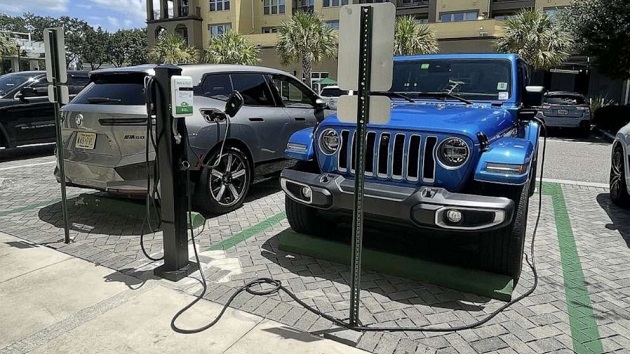
Parking spots at EV chargers are sometimes occupied by gas-powered vehicles, Rosenholtz said. Or a charging cord is too short and won’t connect to the vehicle. Then there are times when the charger is dead … or the wait time is more than an hour. The bad experiences are frustrating, he said. The one upside? Meeting fellow EV drivers.
“I can meet a lot of cool people at these stations,” he said. “I always ask them how their EV experience has been. One Polestar owner helped me with a payment issue I had.”
Hammes said EV owners have also come up to him at public charging stations, knocking on the Kona’s window to say hello.
“It’s a social experience … EV owners love to talk about their cars and talk to other EV owners,” he noted. “It’s a new tech and everyone is learning at the same pace and sharing their experiences.”
Hammes, a first-time EV owner, said his experience overall with the Kona Electric has been positive. He installed a 240-volt Level 2 charger in his garage last December and has only praise for the Hyundai Home system. His one gripe? The sales associates at his local Hyundai dealership were unknowledgeable and poorly trained about the intricacies of EV ownership, he explained.
“The dealership experience is so far behind. I get solicitations for oil changes. The staff is so disconnected from the product they’re selling,” he said.
Hammes said he will likely choose another EV when his lease is up next spring — only this time he’s adding more range.
“For me personally the new threshold would be 300 [miles]. That number makes me feel more comfortable,” he said. “That’s what I am aiming for in our next EV.”