It’s been 20 years since Mandy Moore starred in the coming of age film, A Walk to Remember,which begs the question — how would she feel about a reboot?
The This Is Us star, who starred in the early aught’s movie alongside Shane West, also revealed who she could see taking over her role as Jamie Sullivan telling the outlet, “I don’t know, Olivia Rodrigo or something like that.”
“Someone could redo this film. I would love to see it,” she adds. “It’s been long enough that, yeah, I feel like we’ve earned our place in cinematic history for a reboot at this point.”
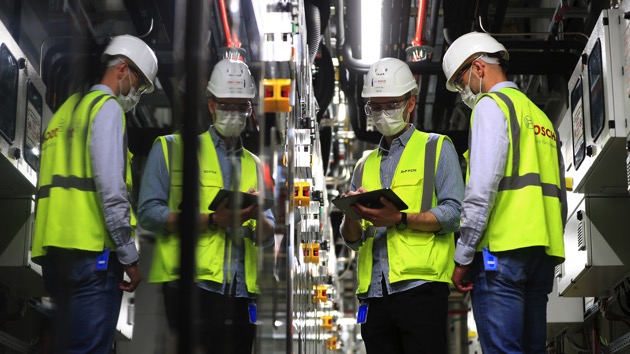
(NEW YORK) — In an increasingly digitized world, almost no industry has been left unscathed by the global shortage of electronic chips.
Demand for these dime-sized building blocks needed to make cars, computers, smartphones and much more was growing even before reaching a fever pitch as the COVID-19 pandemic forced swaths of the globe to rely on tech tools for work or school. The shortage also clobbered the auto industry with disproportionate furor, leading to skyrocketing new and used vehicle prices — which in turn drove one-third of all of the painful inflation Americans saw in 2021, according to the Bureau of Labor Statistics.
The crisis has exposed just how bedeviling the pandemic has been for policymakers and business leaders who failed to foresee the fallout from this shortage coming, as well as exposed the risks for U.S. business that results from a majority of the world’s chip supply being produced in Asia — and more specifically, political tripwire-ridden Taiwan.
“It is both an economic and national security imperative to solve this crisis,” Secretary of Commerce Gina M. Raimondo said in a blogpost Tuesday, sharing fresh data on the fragility of the semiconductor supply chain and calling on Congress to approve $52 billion in chips funding “as soon as possible.”
As the scarcity of semiconductors continues to dominate headlines two years into the pandemic, here is what economists say Americans should know about the chip shortage, and what its implications are for the future.
‘An essential part of almost every product that we use’: What are semiconductors?
“Semiconductors, or chips as we call them, are sort of the building blocks of any computer system,” Morris Cohen, an emeritus professor of Manufacturing and Logistics in the Operations, Information and Decisions Department, at the University of Pennsylvania’s Wharton School, told ABC News.
“There’s been incredible advancements over the years in the capabilities of these chips, in reduction of their size and power requirements,” Cohen added. “And so we see them now embedded everywhere — in your cellphone and your computer, in your home appliances, and in your automobile.”
“These devices are used to monitor performance to control function, to capture data to send instructions and so on,” Cohen added. “They’ve become sort of an essential part of almost every product that we use.”
Awi Federgruen, a professor of management at Columbia Business School, told ABC News that the chip shortage “is being felt in no less than 169 industries.”
As the tech sector continues to expand at a rapid pace and a growing array of tools and gadgets become embedded in Americans’ daily life, an increasing number of products are becoming dependent on chips. The implications of this can be felt by consumers shopping for everything from portable gaming systems to smart kitchen appliances, and many have likely already noticed higher prices or longer wait times when searching for their products.
Meanwhile, a reliance on chips for critical medical devices, military applications, cybersecurity tools and other sectors can carry more serious ramifications for both individuals and governments.
One natural disaster away from hitting American jobs: How severe is the shortage?
The median inventory held by chip consumers (such as automakers or medical device manufacturers) has sunk from a 40-day supply in 2019 to a less than five-day supply in 2021, the Commerce Department said in an industry report released Tuesday.
This means that if a natural disaster, COVID-19 outbreak or political instability disrupts a semiconductor facility abroad for even just a few weeks, it has the potential to shut down a manufacturing facility in the U.S., the agency added, putting American workers at risk.
Moreover, median demand for chips from buyers was as much as 17% higher in 2021 than in 2019, according to the report, and the majority of semiconductor manufacturing facilities are operating at or above 90% utilization — meaning there is limited additional supply to bring online without the expensive and time-consuming process of building new facilities.
The majority of chip factories are currently based in Asia, which houses about 87% of the market share of semiconductor factories (with Taiwan alone accounting for some 63%), separate industry data indicates. The political climate in the region, and tensions between Taiwan and China, has come under renewed scrutiny as the shortage has exposed how much U.S. industry relies on these sources.
“Initially, when you go back to the origins of the industry, the majority of the capacity was in the U.S. and then it shifted outside,” Cohen told ABC News. “Now, there’s a big push to re-shore that manufacturing and bring it back, and it’s not just a business decision, it’s political, it’s a highly politicized decision.”
‘A perfect storm’: What is causing the shortage?
The supply-demand imbalances in the semiconductor industry were already fragile before the pandemic, and the Commerce Department noted in its report that underlying demand for semiconductors was already growing prior to 2020, propelled by industry shifts such as the onset of 5G and electric vehicles. The pandemic then exacerbated the crisis by causing a surge in demand for products that require semiconductors while simultaneously disrupting the supply.
Columbia’s Federgruen said the current shortage is the result of multiple factors creating “a perfect storm.”
Silicon, the raw material used in chips, became harder to come by for producers during the pandemic, according to Federgruen, because it is necessary for vaccine manufacturing.
“In addition, there was the shutdown or temporary shutdown of [semiconductor] manufacturing facilities in the Far East and elsewhere, as a direct result of the of the pandemic,” Federgruen said. “And then there is the fact that on the demand side, in many industries such as the automobile industry, there’s been an unusual ramp-up of the demand.”
“All those factors have come together and compounded upon each other to create a big, big shortage,” Federgruen said.
Why is it hitting the auto industry so hard?
Most Americans by now have heard of the shortage’s impacts on the auto industry, which has been among the most severely hit by the shortage as more cars today are being fuzed with additional electronic systems than in the past, Federgruen told ABC News.
The shortage was compounded in the auto industry because many carmakers initially thought the pandemic would crush demand and planned for this by reducing semiconductor orders. An apparent desire to avoid public transportation and plan getaways closer to home during the health crisis, however, ended up having the opposite effect on demand for autos. Chip manufacturers, already suffering from pandemic-related shocks, could not keep up with the new orders coming in from the auto industry that came as a simultaneous remote-work boom spurred demand for chips needed for computers and IT tools.
Raimondo said that the so-called legacy logic chips used in automobiles — as well as medical devices — are facing the most acute shortages.
“In 2021, auto prices drove one-third of all inflation, primarily because we don’t have enough chips,” Raimando wrote in her blogpost. “Automakers produced nearly 8 million fewer cars last year than expected, which some analysts believe resulted in more than $210 billion in lost revenue.”
Cohen, from the Wharton School, added that over the last decade or so, “the amount of computer systems that are put into a car has just increased enormously.” While carmakers have become big users of chips for managing vehicles’ entertainment, climate, fuel systems and more, they have continued to rely on outsourced production and suppliers for these parts.
Automakers historically did not consider producing chips to be their core competency, but many have come to the realization now that they can’t afford to be dependent on outside suppliers for chips if their absence can bring production and assembly lines to a screeching halt.
Raimondo called new partnerships with semiconductor producers recently announced by Ford and General Motors “encouraging” in her blogpost Tuesday, saying the announcements “demonstrate that chip consumers and producers are coming together to solve their supply chain issues.”
What is being done to address the shortage, and how long will it last?
The Commerce Department’s report said that industry players do not see the significant, persistent mismatch in the supply and demand for chips going away in the next six months.
The report identified the main issue as the need for additional semiconductor factories (also called semiconductor fabrication plants or fabs). Construction of new fabs, however, is expensive and can take years before making an impact in the supply.
In addition to the steps taken by players in the auto industry such as Ford and GM, some companies have also announced new and dramatic actions to ameliorate the crisis and bring semiconductor manufacturing back to the U.S.
Intel announced late last week that it was investing more than $20 billion to build two new chip factories in Ohio — a headline-grabbing announcement that came on the heels of the firm saying last October that it had began construction on two chip factories in Arizona. Samsung similarly announced plans late last year to build a $17 billion semiconductor factory near Austin, Texas.
“It’s great that they’re doing that but it’s not going to solve today’s problems, that’s for sure,” Cohen told ABC News of the recent announcements. “It’ll take years for this to take place, and in the interim, we’re still going to have to source these products from the places they come from now. We don’t have an alternative.”
The situation may improve slightly if demand cools off, Federgruen noted, but similarly said that it will take years for the “big change” to occur when these new U.S. facilities begin actually pumping out chips.
Why should Americans care and what does this mean looking ahead?
Cohen said that having studied the industry for a long time, a lot of what we’re seeing now could have been anticipated to some degree, especially among industry players.
“Companies who operate in this environment have been aware of these issues for a long time and have dealt with it,” he said. “This is just the nature of being competitive in those industries.”
If a new fab costs billions of dollars and takes years to construct, companies in an increasingly globalized world will likely turn to offshore suppliers for chips instead. Cohen said the pandemic, however, has made Americans more aware of risks and fragility of this dependence on outside suppliers.
“Most consumers didn’t know and didn’t care where their chips came from: ‘You turn the car on, it should go, I don’t really care who made the chip and what country it was built in,'” Cohen said. “But now, all of a sudden, these issues become really important, and so I think we become more sensitized to how dependent we are, how interdependent we are, how things can be disrupted.”
“We became a globalized economy because there were a lot of advantages,” Cohen added. “Because of that, we as consumers have enjoyed access to an amazing array of products and incredibly low prices, which has increased our standard of living.”
With chip supply now just one natural disaster or major disruption away from potentially impacting American livelihoods, Cohen predicts it is “going to be difficult to maintain the status quo.”
“We will have more expensive products, we’ll have things that will take longer,” he said. “Therefore, our standard of living to some extent will be lower. It’ll cost us more time and money to earn what it takes to buy a car, to buy a house.”
Federgruen added that he hopes policymakers and business leaders can learn from the lessons exposed by the crisis and make better decisions moving forward that don’t just take into account short-term profits.
“In general, there’s been the recognition that we need to make our supply chains much more resilient, and that we need to build in safety buffers on the supply side for situations like this,” Federgruen told ABC News. “That lesson comes up with every crisis and is then forgotten, unfortunately, but hopefully it will stick now.”
Sam Raimi, who directed Columbia Pictures original Spider-Man trilogy starring Tobey Maguire, recently discussed his reaction to seeing his original cast reprise their roles in Sony’s Spider-Man: No Way Home.
While promoting the horror film You’re Dead Hélène, Raimi told Variety “It was so much fun” watching Maguire, Willem Dafoe and Alfred Molina suit up as their respective characters Peter Parker/Spider-Man, Norman Osborn/Green Goblin and Otto Octavius/Doctor Octopus, once again.
“I love No Way Home and the audience I was with went crazy,” he says. “It was delightful to watch Alfred play his role, and Willem Dafoe, just seeing these guys take it to the next level. And Tobey was awesome as always. The best word I can say is it was refreshing for me.”
Spider-Man: No Way Home, which unites three movies’ worth of Peter Parkers — Maguire, Tom Holland and Andrew Garfield — has grossed $1.7 billion worldwide so far.
As for his next directorial project, Doctor Strange in the Multiverse of Madness, Raimi tells Variety, “I think we’re done, but we just cut everything. We’re just starting to test the picture and we’ll find out if there’s anything that’s got to be picked up. If something’s unclear or another improvement I can make in this short amount of time left, I’ll do it.”
“One thing I know about the Marvel team is they won’t stop,” he adds. “They’ll keep pushing it until it’s as close to being great as it could.”
Doctor Strange in the Multiverse of Madness — which is rumored to have some multiverse surprises of its own — is slated to hit theaters May 6, 2022 from Marvel Studios.
Marvel Studios is owned by Disney, the parent company of ABC News.
(GENEVA) — Even as the omicron COVID-19 variant continues to sweep the globe, scientists are now monitoring a new mutation of omicron, dubbed BA.2.
The World Health Organization maintains that BA.2 is not a “variant of concern,” meaning there is no current evidence to suggest this new subvariant will worsen COVID-19 transmission, illness severity, or efficacy of vaccines and public health efforts like masking and social distancing.
BA.2 numbers around the world are rising, with at least 40 countries reporting cases to a global variant tracking database, but the subvariant has spread rapidly in Denmark and the UK, with almost half of recent cases in Denmark attributed to BA.2.
The subvariant has already been detected in several U.S. states, with Washington State confirming two cases Monday.
While over 8,000 BA.2 cases have been identified since November 2021, it is unclear where BA.2 originated. Even though the first sequences were submitted from the Philippines, numerous cases have since been detected in various places, from Europe to South Asia.
Given the rising numbers, health care organizations, like the WHO, are asking scientists to watch and study the new subvariant separately from omicron, to see if it behaves differently.
“It is the nature of viruses to evolve and mutate, so it’s to be expected that we will continue to see new variants emerge as the pandemic goes on,” said Dr. Meera Chand, the COVID-19 incident director at the UK Health Security Agency, in prepared remarks. “So far, there is insufficient evidence to determine whether BA.2 causes more severe illness than Omicron BA.1, but data is limited.”
The evolution of COVID-19 subvariants is not new. The delta variant also had several subvariants, but scientists referred to all of them as delta. BA.2, however, has earned its own designation due to rising numbers across several nations.
Although it’s been called the “stealth” omicron variant, the new subvariant, “can absolutely be detected through traditional surveillance mechanisms whether through rapid testing or PCR,” said Dr. John Brownstein, chief innovation officer at Harvard University’s Boston Children’s Hospital and ABC Medical Correspondent.
Conventional COVID-19 tests can show a positive or a negative result, but they can’t determine specific variants. For that, scientists need to do additional genetic sequencing. Conveniently, the omicron variant has a particular genetic signature that allows scientists to quickly and easily determine if the sample is omicron or not.
The new BA.2 subvariant does not have that feature, meaning scientists can no longer use this shortcut — though they can still identify the subvariant using genetic sequencing technology. Because of this, the BA.2 subvariant has sometimes been referred to as the “stealth” variant. But for the general public, conventional COVID-19 tests will still work to detect the new subvariant.
Ultimately, while scientists and public health officials are urging continued research and surveillance, experts say there is little reason to worry.
“BA.2 is important from a public health perspective, but it doesn’t fundamentally change at this moment, how we think about the impact in the population,” Brownstein said. “A lot more work needs to be done to understand severity, breakthrough infections, and immunizations before you can make any statement about clinical relevance.”
“While it’s important to understand that in the family of omicron, there is a sub-lineage that is potentially more transmissible, it’s not necessarily a cause for panic,” Brownstein added.
Nitya Rajeshuni, M.D., M.S., a pediatrics resident at the Children’s Hospital of Philadelphia, University of Pennsylvania, is a contributor to the ABC News Medical Unit.
The Office alums Steve Carell and John Krasinski will reunite on-screen for Paramount’s new family movie If, according to Variety. Krasinski will write, direct and star in the film, along with Carell and An Officer and a Gentleman star Louis Gossett Jr., Minari‘s Alan Kim, and The Walking Dead actor Cailey Fleming, who have also been added to the cast. They join previously announced cast members Ryan Reynolds, Phoebe Waller-Bridge and Fiona Shaw. Details have yet to be revealed, but the story is reportedly based on Krasinski’s original idea about a child’s journey to rediscover their imagination. If is slated for a November 17, 2023 release…
The Righteous Gemstones has gotten an early third-season renewal from HBO. “After a season of literal fire and brimstone, blood, sand and rollerblading, who wouldn’t come back for more?” said HBO executive vice president of programming Amy Gravitt said in a statement on Tuesday. “The Gemstone family makes us laugh like nobody else.” The comedy series, which follows a fictional, world-famous televangelist family steeped in greed and charity work, stars Danny McBride, John Goodman, Edi Patterson and Adam Devine…
Jorja Fox has announced that she will not reprise her CSI: Vegas role as Sara Sidle for the show’s second season. “After much deliberating, I have decided not to ‘Sidle up’ for CSI Vegas,” she tweeted on Tuesday. “For me, CSI has always been a love story. The story that people can find love in the darkest of places and times.” Added Fox, “And the story that love, even in the darkest of places and times, can expand and grow roots and endure. I personally just can’t split Sara and Grissom up again. So goes Grissom…..So goes Sara. Wherever they go, they belong together.” CBS has already picked up a second season of the reboot, which reunited Fox with her longtime CSI co-star, William Petersen and introduced a brand new CSI team, played by Paula Newsom, Matt Lauria, Mandeep Dhillon and Mel Rodriguez…
Agents of S.H.I.E.L.D. actor Vachik Mangassarian, died Saturday of COVID-19 complications, his reps tell Deadline. The Armenian-born actor’s other well-known credits include NCIS and Curb Your Enthusiasm, as well as guest appearances on a number of popular series such as The Fall Guy, The A-Team, Murder, She Wrote, Murphy Brown, Falcon Crest, Jake and the Fatman, NYPD Blue and JAG, along with some TV movies. Mangassarian also anchored his own radio and later television show, The Armenian National Network for 10 years…
Peter Robbins, the voice of Charlie Brown in the classic Peanuts specials of the 1960s, died by suicide last week, his family told KSWB-TV on Tuesday. He was 65. Robbins voiced Charlie in six television specials, including the beloved holiday classics A Charlie Brown Christmas and It’s the Great Pumpkin, Charlie Brown, along with the 1969 feature film A Boy Named Charlie Brown. He also appeared as an actor on such ’60s TV series as Rawhide, The Donna Reed Show, The Munsters, F Troop, Get Smart and Blondie. He made his last appearance in 1972 on an episode of My Three Sons. Following his time in the spotlight, Robbins dealt with addiction issues and mental health struggles, including bipolar disorder. He also served four years in prison from 2015-2019 for making criminal threats…
If you are in crisis or know someone in crisis, call the National Suicide Prevention Lifeline at 1-800-273-TALK (8255) or contact the Crisis Text Line by texting HOME to 741741. You can reach Trans Lifeline at 877-565-8860 (U.S.) or 877-330-6366 (Canada) and The Trevor Project at 866-488-7386.
(LONDON) — Two men were arrested in England on Wednesday morning as part of an ongoing investigation into a hostage-taking incident at a synagogue in the United States, British authorities said.
Counterterrorism officers detained both men in Manchester. The pair “remain in custody for questioning,” according to a statement from the Greater Manchester Police.
Two other men were arrested in connection with the probe in Manchester and Birmingham, about 85 miles south of Manchester, on Jan. 20. They “remain in custody and officers have been granted an extension of custody to continue to question them further,” the Greater Manchester Police said.
Assistant Chief Constable Dominic Scally of the Greater Manchester Police has said that counterterrorism officers are assisting their U.S. counterparts in the investigation of an hourslong standoff between American authorities and a hostage-taker at the Congregation Beth Israel in Colleyville, Texas, about 27 miles northwest of Dallas.
An armed man claiming to have planted bombs in the synagogue interrupted Shabbat services on Jan. 15 just before 11 a.m. local time, taking a rabbi and three other people hostage, according to Colleyville Police Chief Michael Miller.
One hostage was released uninjured at around 5 p.m. CT, Miller told a press conference later that night. An elite hostage rescue team from the Federal Bureau of Investigation then breached the synagogue at about 9 p.m. CT, after hearing the hostage-taker say he had guns and bombs and was “not afraid to pull the strings,” according to a joint intelligence bulletin issued on Jan. 19 and obtained by ABC News.
“As a tactical team approached to make entry to the synagogue, the hostages escaped and were secured by tactical elements,” the bulletin said. “The assault team quickly breached the facility at a separate point of entry, and the subject was killed.”
No hostages were injured during the incident, according to Miller.
The slain suspect, identified by the FBI as 44-year-old British citizen Malik Faisal Akram, was from the Blackburn area of England’s Lancashire county, about 20 miles northwest of Manchester, according to Scally.
A motive for the Jan. 15 siege is under investigation. Matthew DeSarno, the special agent in charge of the FBI’s Dallas field office, said during a press briefing on Jan. 21 that the agency is treating the incident as an act of terrorism and a hate crime.
During the negotiations with authorities, Akram “spoke repeatedly about a convicted terrorist who is serving an 86-year prison sentence in the United States on terrorisms charges,” according to the FBI.
Multiple law enforcement sources told ABC News that the hostage-taker was demanding the release of Aafia Siddiqui, who is incarcerated at Carswell Air Force Base near Fort Worth, about 16 miles southwest of Colleyville. Siddiqui, who has alleged ties to al-Qaida, was sentenced to 86 years in prison after being convicted of assault as well as attempted murder of an American soldier in 2010.
Two teenagers were arrested in southern Manchester on Jan. 16 in connection with the synagogue attack. They were questioned and later released without being charged, Greater Manchester Police said in a statement on Jan. 18. Multiple law enforcement sources told ABC News that the teens are Akram’s children.
Akram has ancestral ties to Jandeela, a village in Pakistan’s Punjab province, the local police chief told ABC News. He visited Pakistan in 2020 and stayed for five months, the police chief said, a duration that may have been necessitated by COVID-19 restrictions.
Akram has been separated from his wife for two years and has five children, according to the police chief.
Law enforcement sources told ABC News that British authorities investigated Akram about a year ago and concluded he posed no threat that would have prohibited his travel from the United Kingdom to the U.S.
After arriving in the U.S. last month via a flight from London to New York City, Akram stayed at homeless shelters at various points and may have portrayed himself as experiencing homelessness in order to gain access to the Texas synagogue during Shabbat services, multiple law enforcement sources told ABC News.
U.S. President Joe Biden, who called the hostage-taking incident “an act of terror,” told reporters on Jan. 16 that investigators suspect Akram purchased a gun on the street. While Akram is alleged to have claimed he had bombs, investigators have found no evidence that he was in possession of explosives, according to Biden.
ABC News’ Luke Barr, Aaron Katersky, Habibullah Khan, Josh Margolin and Joseph Simonetti contributed to this report.
Could a Snoop Dogg and Sade collaboration be on the way? If it were up to the “Gin and Juice” rapper, the answer would most definitely be yes.
In a video clip shared by TMZ, Snoop revealed that he would love to link up with Nigerian-British singer for a song.
“Maybe Def Jam and Universal can hustle that. I didn’t think it could happen,” the 50-year-old Super Bowl headliner said.
He added, “Watch out. We’ll put it in the air. Put a bat signal up saying, ‘You can call me.'”
Snoop then recalled attending one of Sade’s concert’s and being “too nervous” to meet the singer-songwriter.
“I went to her concert, I went to see her perform on time. I went with Heavy D and LL Cool J. She had all these visual effects where she disappeared and she was in the top of the sky, she was [amazing],” he said. “They was like ‘Do you wanna go meet her?’ And I was like ‘[no].’ I was nervous as a motherf*****. Like, nah. I was too nervous!”
Instead of meeting the soul singer, Snoop told his crew that they needed to leave because “there’s going to be a lot of cars trying to get out of here.”
There’s no current plan for the two artists to collab, but never say never.
(TALLAHASSEE, Fla.) — A Florida bill that would limit classroom discussions on sexual orientation and gender identity and encourage parents to sue schools or teachers that engage in these topics is speeding through the state House and Senate.
It’s being called a “Don’t Say Gay” bill by LGBTQ advocates, who fear that if this bill is signed into law, it could act as a complete ban on the lessons on LGBTQ oppression, history and discussions about LGBTQ identities.
“This would erase LGBTQ+ history and culture from lesson plans and it sends a chilling message to LGBTQ+ young people and communities,” said Melanie Willingham-Jaggers, the executive director of the national LGBTQ youth advocacy group GLSEN.
Activists say that erasing LGBTQ presence from schools may imply to students that their gender identity or sexual orientation is something to be ashamed of or hidden.
“We have to create a learning environment where they feel safe and healthy, or it’s not an effective learning environment,” said Heather Wilkie of the Zebra Coalition, a Central Florida LGBTQ advocacy group.
“When you have laws like this, that directly attack our kids for who they are, it prevents them from learning,” she said. “It prevents them from being able to be healthy.”
The two bills in the state legislature, HB 1557 and SB 1834, state that a school district “may not encourage classroom discussion about sexual orientation or gender identity in primary grade levels or in a manner that is not age-appropriate or developmentally appropriate for students.”
The House Education & Employment Committee has moved the bill forward, handing it off to the Judiciary Committee.
It adds that parents who violate this rule can sue, seeking damages and reimbursement for attorney fees and court costs.
Rep. Joe Harding, who is the sponsor of the legislation, hopes it will “reinforce the fundamental right of parents to make decisions regarding upbringing & control of their children,” according to the bill’s text.
Harding did not respond to ABC News’ request for comment.
Chasten Buttigieg, activist and husband of U.S. Secretary of Transportation Pete Buttigieg, denounced Florida Gov. Ron DeSantis and the state legislature for the efforts.
LGBTQ advocacy organizations say these bills are reminiscent of the “no promo homo” laws of the 1990s that barred educators from discussing queer topics in schools, but with an added mandate on parent and family involvement.
“These mandates are harmful and risk carelessly outing LGBTQ+ young people to families who do not affirm their children’s identities,” Willingham-Jaggers said.
2021 was a record-breaking year for anti-LGBTQ legislation, according to the Human Rights Campaign. More than 250 of these bills were introduced and at least 17 were enacted into law.
Several states, including Arizona, Alabama, Florida, Indiana, Kentucky, Oklahoma, New Hampshire and South Dakota, have already introduced anti-LGBTQ legislation in 2022.
This Florida legislation follows similar bills that restrict educators from teaching about oppression in the U.S.
Wilkie said that queer issues and access to supportive resources have been the priority against anti-LGBTQ attacks in recent years, and this has been a heightened effort since the Pulse nightclub shooting in 2016.
LGBTQ youth in the state, who have a higher risk for suicidal ideation, depression and anxiety, have been struggling, but Wilkie says advocacy groups will continue to fight these bills.
“We will fight,” she said. “It’s so disheartening to think that they would not be able to freely talk about themselves, or learn anything about their history.”
Ellen Weintraub, Commissioner at US Federal Election Commission, addresses the audience during the Web Summit 2021. – Bruno de Carvalho/SOPA Images/LightRocket via Getty Images)
(NEW YORK) — With everyone from giant companies to celebrities embracing the cryptocurrency phenomenon known as NFTs, political candidates are now getting into the act — but some experts say that transparency concerns could affect their use as a political fundraising tool.
Non-fungible tokens — digital assets that cannot be replicated and can be used to represent real-world items — are slowly creeping into the political world, with a few candidates already using them to raise thousands of dollars.
“NFTs are bringing more people into our fold, into our movement,” said Max Rymer, a digital consultant for Minnesota Republican gubernatorial candidate Dr. Scott Jensen.
Jensen’s campaign saw an opportunity for NFTs to be a low-dollar way for people to become engaged with their candidate and receive something of value in return for their donations, Rymer told ABC News.
Through the sale of NFTs, “we’ve added 2,500 new people that are going to support our campaign going forward,” Rymer said.
Blake Masters, a Republican U.S. Senate candidate in Arizona, is also embracing NFTs.
“I was thinking of creative ways to raise money and I thought of NFTs because [they] can give people a sense of ownership,” said Masters, who is also the co-author of “Zero to One,” a bestselling business book published in 2014.
So Masters sold his supporters limited edition NFTs depicting the cover of his book — and raised nearly $575,000.
Like collectible artwork and rare baseball cards, the value of an NFT derives from it being unique — in this case, a unique digital token in a distributed database known as a blockchain. The digital tokens are stored in the blockchain through a digital wallet and can be held as an asset — as digital memorabilia — or sold and traded for investment purposes.
Many NFTs also come with real-life perks and exclusive access to events, which makes them attractive as campaign offerings.
For example, for those who purchased Masters’ digital tokens, the perks included receiving a signed copy of his book and the opportunity to meet him and his co-author, tech billionaire Peter Thiel, who helped develop the NFT collection.
“We’ll have at least one token-holders party,” Masters told ABC News. “It’s like the Willy Wonka golden ticket.”
That kind of involvement makes NFTs a good way to help candidates build a community of supporters, said Joseph Argiro, CEO of Iron Key Capital, a digital asset hedge fund.
“[NFTs] are probably a better way than just to accept donations, because they are more of a symbolic representation of your beliefs,” said Argiro.
For those who purchased from her initial NFT collection, former first lady Melania Trump offered an audio recording with a “message of hope.” A portion of the proceeds from her collection, which was released last month, supported her Be Best initiative, a campaign focused on children’s issues and advocating against cyberbullying.
“What you’re trying to tap into with NFTs is a sense of supporters around a common cause,” said Joshua White, an assistant professor of finance at Vanderbilt University. “And so NFTs can build a community where there’s this positive feedback loop.”
In the case of Masters’ Senate campaign, said White, NFTs could attract young voters that have never voted Republican but want a younger and more tech savvy candidate to represent them.
NFTs have also been a breath of fresh air for political campaigns and fundraisers that are seeking a new way to appeal to grassroots supporters, said Brian Forde, co-founder of the online fundraising platform Numero, which is working to launch a new NFT fundraising platform for Democratic campaigns called electables.com.
“We’ve put out surveys to more than 14,000 grassroots donors and a couple things stand out: One, they’re tired of hyperbolic emails, two, they want to be recognized and connect with other grassroots supporters of that campaign,” Forde said. “So with NFTs, electables allow them to connect with other grassroots supporters and be recognized for their contribution.”
Forde said that supporting an NFT is similar to supporting a sports team — which is why NFTs have been embraced by numerous leagues.
“What surprised me the most about NFTs is how quickly and powerfully one connects and builds a community of strong supporters,” Forde said. “Pro sports leagues were some of the first to figure this out, and in many ways, campaigns are a lot like sports teams. If you own [an NFT], you feel a belonging to that community in a stronger way than you ever did before. Sports teams have been the pioneers, and campaigns are going to follow in their footsteps.
And while the number of political campaigns that have launched NFTs remains low, interest has been growing. Forde said electables.com, which will make money by providing an NFT fundraising platform for campaign clients, currently has more than 300 campaigns on its waitlist ahead of its planned launch in March.
As of now, there’s little to no official guidance on NFT fundraising from the Federal Election Commission, FEC Commissioner Ellen Weintraub said. Nor has there been any campaign or committee seeking an official advisory opinion from the agency.
“It’s not something that the agency has gotten a lot of questions on, and certainly there have been no formal request of the Commission as a whole to weigh in on this,” Weintraub told ABC News. “My sense is that it’s just not that common yet.”
As a result, the Masters campaign and the Jensen campaign both sought legal advice before they launched their NFT collections.
“We ran it through all the legal analyses,” Masters said. “I was heavily legally diligent, and we were careful with our language … we made sure that all the benefits were allowed.”
“It’s brand new territory for a lot of these regulatory bodies too,” said Rymer. “So we partnered, in essence, with the Campaign Finance Board and we treated this the same way that supporters would get a hat for a donation.”
NFTs can typically be purchased using either regular currency — like through a credit card — or with cryptocurrency, virtual tokens that allow purchasers to remain anonymous. But most political campaigns that report to the Federal Election Commission or state-level election agencies are required to report the identity of their donors — and officials say that could raise transparency concerns.
“I think we probably have to look into the transparency aspect, whether one could determine where the NFT, the ‘thing of value,’ is coming from,” Weintraub told ABC News.
White said that if a cryptocurrency user has linked their virtual wallet to their personal information, then transparency isn’t an issue. But he said that the use of cryptocurrency for political fundraising in general makes it easier to “not know where that money is coming from.”
To comply with fundraising regulations that govern contribution limits and other restrictions, some campaigns offering NFTs have turned to platforms like electables.com and the recently launched Front Row, which launched over the fall as another NFT marketplace for Democrats.
“We built this platform because we saw that that’s what needed to happen for progressive organizations, campaigns and movements that have some of these compliance regulations to participate in this ecosystem,” Front Row co-founder Parker Butterworth told ABC News. Butterworth said the platform allows political organizations to collect all the necessary information from NFT buyers, including their name, addresses, age, and U.S citizenship status.
The platform offered its first NFT collection from the Texas Democratic Party, and it’s now talking with several new clients, said Butterworth. He said the world of NFT fundraising is a “very fast moving space” that’s expected to expand the world of digital campaigning.
“NFTs are not going anywhere,” said Argiro. “I think we’re just seeing the beginning of how communities use these NFTs to drive community formation and capital formation.”
(OMAHA, Neb.) — Dani Donovan, a 30-year-old woman from Omaha, Nebraska, said she spent the better part of a decade going to different doctors to seek help for chronic pain.
At each visit, according to Donovan, she would be told she needed to lose weight, a discouraging cycle that she said kept her from seeking more medical care.
“I was in pain and all doctors would say to me is that I need to lose weight,” Donovan told “Good Morning America,” noting the experience would often lead her down a cycle of binge eating due to her frustration and pain.” “I felt like doctors wouldn’t listen to me and it was making me not go to want to see the doctors.”
That changed in December, according to Donovan, when she went to a new primary care physician.
While in the waiting room at that doctor’s office, Donovan saw what are called “Don’t Weigh Me” cards, business cards that are designed for a patient to hand to a nurse or doctor.
The cards read on the front, “Please don’t weigh me unless it’s (really) medically necessary. If you really need my weight, please tell me why so that I can give you my informed consent.”
On the back of the card is a list of reasons why a person may not want to be weighed, including the risk of weight stigma and stress and that “most health conditions can be addressed” without knowing a patient’s weight, according to the card.
The cards were a game-changer for Donovan, who said she felt empowered to stand up for herself and not have her weight be the focus of the doctor’s appointment.
“I had heard online that you could ask doctors not to weigh you, but I still felt really intimidated to say that out loud,” said Donovan. “You’re used to going to the doctor’s office and them herding you onto the scale. It’s just part of the routine.”
“I was able to just show the card to the woman who was bringing me back and it was like OK and we continued on,” she said.
Donovan said she went onto have an hourlong appointment with the doctor, who sent her to a specialist, whom Donovan said ultimately diagnosed her with Ehlers Danlos syndromes, a a group of inherited connective tissue disorders, according to the National Institutes of Health.
“It just made a huge difference to have been heard,” said Donovan, adding that she now feels comfortable going to see her doctors.
It was a similar experience with weight stigma at doctors’ offices that led Ginny Jones to create the “Don’t Weigh Me” cards nearly four years ago.
Jones, the founder of More-Love.org, an eating disorder-focused resource for parents, said she suffered from an eating disorder and began asking to not be weighed at doctors’ offices when she started her recovery.
“I decided I would not be weighed unless it was necessary,” said Jones, explaining that at first she told her doctors verbally. “Very interestingly, in many, many years of asking not to be weighed, it’s never been required for my care.”
“I’m open to it if it is required for my care, but so far it really hasn’t been an issue for me,” she said.
Jones said that as she began working with parents and people in recovery from eating disorders, she saw she was not alone in not wanting weight to be the focus of doctors’ appointments. She launched the cards as a way for people to have something in their pocket they could just easily hand to a doctor or nurse.
“I posted them on my website kind of thinking maybe a couple people would be interested,” said Jones. “And they have had a huge demand.”
The cards, which are available for sale on Jones’s website, have been purchased by not just individuals but also therapists, dietitians and doctors, according to Jones.
Dr. Lesley Williams-Blackwell, an Arizona-based family medicine physician and eating disorder specialist, carries the cards in her office so that patients can take them and use them with other doctors.
Williams-Blackwell said she started doing automatic blind weights — meaning the patient is weighed but the number on the scale is not shown to them — after one incident in which a patient fled the office after being weighed.
“She was so upset that she fled the office,” said Williams-Blackwell. “That just illustrated for me that you don’t know, especially if it’s your first time meeting someone, how [weight] being the first piece of data that they’re presented with, even before you have an opportunity to meet them, could be very triggering or upsetting.”
Williams-Blackwell said when she takes her three children, ages 9 to 12, to doctors’ appointments, she asks that their weights not be shown or discussed.
She said, in her experience, it is important for doctors and patients to look beyond a single number when it comes to someone’s health.
“I really would challenge people to look at health in a more holistic way and to not feel that they have to get so pigeonholed into weight as the sole marker of how healthy someone is,” said Williams-Blackwell. “Because the reality is that there’s so much more to health.”
Chelsea Kronengold, a spokeswoman for the National Eating Disorders Association, said doctors’ focus on weight can often not only miss other conditions that may be present, but can also lead to weight stigma and eating disorder behaviors.
“Weight stigma is discriminating or stereotyping someone based on their weight, which we know that medical providers frequently do, as well as the general public,” said Kronengold. “And weight stigma can increase body dissatisfaction, which is a leading risk factor in the development of eating disorders.”
Nearly 30 million Americans will have an eating disorder in their lifetime, and over the past two years of the coronavirus pandemic, eating disorders have been on the rise in the U.S., according to NEDA.
Jones said she hopes the conversation around weight changes in society to the point that it puts her “Don’t Weigh Me” cards venture out of business.
“My dream and my vision is that we actually live in a society that respects bodies regardless of weight, and that being weighed at the doctor’s office is not an assumed first step,” she said. “I don’t want to be in business in 10 years selling cards. My vision is actually that we change the conversations at a much deeper level, and that doctors start to recognize the harm that being weighed [in their offices] can cause.”