
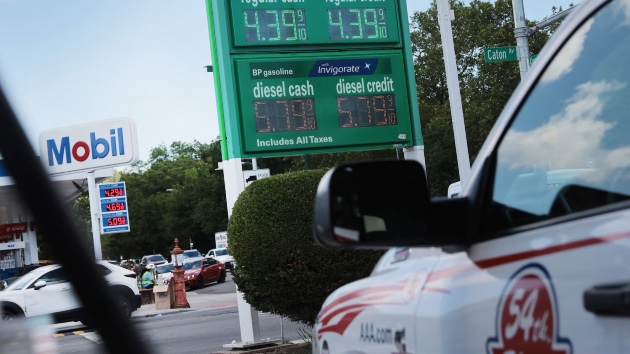
(NEW YORKI) –Drivers stung by high gas prices have enjoyed some welcome relief over the last couple of weeks, even as the impact of the Iran war continues to choke off oil supply.
The national average price of a gallon of gas stood at $4.26 on Wednesday, marking a decline of 30 cents, or 6.5%, since a recent peak on May 21.
Still, prices remain well above where they clocked in before a historic oil shock set off by the war. In late February, the average gallon of gas ran less than $3.
The dropoff in gas prices owes to a decline in oil costs over the latter part of last month, which coincided with a slump in demand following Memorial Day weekend, some analysts said.
Still, they cautioned, gas prices may rise again as oil prices jump and the war shows little sign of an imminent resolution. If the war continues, some analysts said, gas price could top $5 a gallon by next month.
“It’s so volatile,” Patrick Penfield, a professor of supply chain practice at Syracuse University, told ABC News. “If the war ended, prices would likely go down. But if it continues, you’ll see prices go up.”
In Georgia, the state with the lowest average gas prices, a gallon costs about $3.79, AAA data shows. In all, the AAA data says six states currently sell gas at or below an average price of $4 per gallon.
By contrast, the cost of a gallon of gas in California stands at $5.99, making it the state with the highest prices, AAA data shows. Even in California, however, the average price has fallen about 10 cents over the past week.
At the outset of the war, gasoline prices surged in response to Iran’s effective closure of the Strait of Hormuz, a maritime trading route that facilitates the transport of about one-fifth of global crude supply.
Oil prices began to fall in mid-May, however, as Iran and the U.S. appeared willing to strike an agreement that would reopen the strait. Crude oil is the main ingredient in auto fuel, accounting for more than half of the price paid at the pump, according to the federal U.S. Energy Information Administration.
On Friday, U.S. oil prices fell as low as about $86 a barrel, marking a drop of about 20% over a 10-day stretch.
“Gas prices have seen a big push because crude prices have dropped. Crude prices have dropped largely because the president has been indicating that we’re close to an agreement with Iran,” Ramanan Krishnamoorti, a professor of petroleum engineering at the University of Houston, told ABC News.
The U.S. is a net exporter of petroleum, meaning the country produces more oil than it consumes. But since oil prices are set on a global market, U.S. prices move in response to swings in worldwide supply and demand.
Oil prices have ticked up in recent days, but they remain below $100 a barrel. As long as oil prices remain under that benchmark, gas prices may continue to hold steady or even decline, Denton Cinquegrana, chief oil analyst at Dow Jones Energy, told ABC News.
A near-term drop in gas prices appears possible because gas sellers are holding onto unusually large profit margins, meaning they could reduce retail prices even if their input costs maintain current levels, Cinquegrana said. Over the past two years, the average margin for sellers came in at about 34 cents per gallon, he added, but it currently stands at 50 cents per gallon.
“There’s still some room for gas prices to move down,” Cinquegrana said.
Looking weeks or months into the future, however, analysts cautioned about a rise in oil and gasoline prices unless normal tariff resumes in the Strait of Hormuz.
“It’s still possible later this summer, even ahead of July 4, we could see the national average pass $5 a gallon,” Patrick De Haan, a petroleum analyst at GasBuddy, told ABC News Live on Monday.
“We could be seeing much higher gas prices in very short order if the strait doesn’t reopen,” he added.
Copyright © 2026, ABC Audio. All rights reserved.