
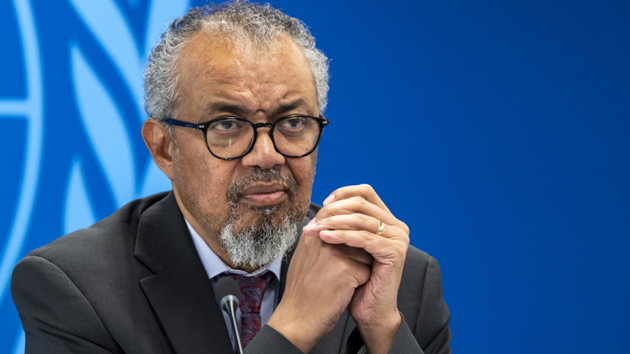
(GENEVA, Switzerland) — The head of the World Health Organization warned on Monday that a rapidly growing Ebola outbreak in the Democratic Republic of Congo and Uganda “will get worse before it gets better.”
More than 900 cases and more than 220 deaths have been reported in the DRC, WHO Director-General Dr. Tedros Adhanom Ghebreyesus said during a virtual briefing. Of those totals, 101 cases and 10 deaths have been confirmed.
Additionally, there have been five travel-related cases and a death in Uganda, according to the WHO and the Uganda Ministry of Health.
“We are facing an extremely serious and difficult outbreak. It will get worse before it gets better,” Tedros said on Monday. “But we know this virus, and we know how to stop it. We have stopped every previous Ebola outbreak, and we will stop this one, too.”
Tedros said he wanted to echo comments made by South African President Cyril Ramaphosa about overcoming the outbreak with unity.
“The question is just how quickly we can do it, and how many more lives will be lost before we do,” Tedros added.
Tedros’ comments come amid a hospital in northeastern Congo facing growing tension as officials have trouble following safety rules following the death of a well-known religious leader.
Dr. Richard Lokudi, director of the Mongbwalu General Referral Hospital in Ituri province — one of three provinces where the Ebola outbreak is concentrated — told ABC News the facility is under heavy tension after the body of a confirmed Ebola victim, who was also a major religious figure in the region, was brought there.
Lokudi said that family members and groups of young people are demanding the body be returned.
Because the patient was a confirmed Ebola case, authorities are insisting on a “safe and dignified burial” under outbreak protocols, and the body is being temporarily kept at the hospital until burial on Monday.
Lokudi said police and military forces have been securing the hospital and firing warning shots to disperse protesters gathered outside.
He added that the gunfire around the hospital has left him exhausted and stressed.
Last week, Tedros classified the Ebola outbreak as a public health emergency of international concern — one level below a pandemic in the United Nations agency’s alert system.
The WHO continues to consider the national risk assessment as “very high” while the regional level risk remains “high” and the global risk level remains “low,” Tedros said on Monday.
The outbreak has led to multiple countries, including the U.S., India, the U.K. and Australia, putting travel restrictions in place.
Entry to the U.S. is restricted to foreign travelers who have recently been in the DRC, Uganda and South Sudan.
Meanwhile, U.S. passport holders and U.S. nationals returning to the U.S. from the three countries will be funneled to Dulles Airport in Virginia to be screened for symptoms and interviewed about possible exposure.
Enhanced screening efforts have also begun at Hartsfield-Jackson Atlanta International Airport as of Saturday morning and efforts at George Bush Intercontinental Airport in Houston will begin late Tuesday.
Lawful permanent residents (green card holders) who have been in any of the three countries over the last 21 days are barred from entering the U.S. temporarily.
Tedros said on Monday that WHO teams are on the ground in the outbreak zones assisting with response including contact tracing, establishing treatment centers and infection prevention and control. Tedros added that he will be traveling to the DRC on Tuesday.
The WHO chief said that several aspects of this outbreak make it “especially challenging,” including the delays in detecting the outbreak.
“[It] means that we are now playing catch-up with a very fast-moving epidemic,” he said on Monday.
US doctor infected with Ebola critically ill but says he is ‘cautiously optimistic’
He said that due to recent fighting in the provinces facing the brunt of the outbreak, it means tens of thousands of people are displaced and there is “significant distrust of outside authorities among the local population.”
An additional challenge is that there are no approved vaccines or treatments for the strain of Ebola responsible for the outbreak: Bundibugyo virus.
Tedros said the WHO has recommended prioritizing two monoclonal antibodies to advance in clinical trials and recommended evaluating the antiviral obeldesivir in a clinical trial as post-exposure prophylaxis for those who are high-risk contacts.
ABC News’ Eric M. Strauss contributed to this report.
Copyright © 2026, ABC Audio. All rights reserved.