
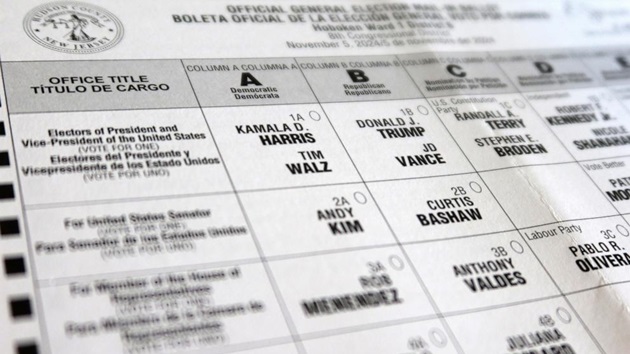
(WASHINGTON) — In a case with potentially major ramifications for the 2026 midterm elections and all federal elections going forward, the U.S. Supreme Court on Monday is considering a Republican Party bid to prevent states from counting mail-in ballots received after Election Day even if they were postmarked on or before.
Thirty states plus D.C. and several U.S. territories have laws allowing tabulation of some late-arriving ballots provided that they were timely cast and received within a specified post-election timeframe, according to the National Conference of State Legislatures.
The case before the justices centers on Mississippi’s acceptance of absentee ballots up to five days after Election Day so long as they were received by the Postal Service on or before.
The Republican National Committee, which brought the lawsuit, alleges the policy violates federal law establishing the Tuesday after the first Monday in November as the day for election of members of the House, Senate, and presidential electors, in specified years.
Republicans argue that the term “election” means both “ballot submission and receipt” and that Congress intended that it be completed on a single day.
“Allowing states to count large numbers of mail-in ballots that are received after Election Day undermines trust and confidence in our elections,” said RNC chair Joe Gruters in a statement on the case. “Elections must end on Election Day.”
Mississippi and several voter advocacy groups defending the state law insist “election” has historically meant when voters make their “choice” by marking and submitting their ballots — not necessarily when they are received and counted.
“The weight of the law and the weight of the precedent is on our side,” said Marc Elias, a prominent Democratic election law attorney representing some of the parties defending the Mississippi law.
A Supreme Court decision in favor of the RNC could upend voting policies and procedures in dozens of states five months before voters head to the polls for the midterm elections.
Voting rights advocates also warn that an abrupt change in policy could lead to widespread rejection of ballots that were properly cast by well-intended voters but experienced unintended delivery delays by the Postal Service or other circumstances.
Hundreds of thousands of mail-in ballots in the 2024 general election arrived after Election Day but were still legally counted that year across 22 states and territories with a post-election grace period, according to the U.S. Election Assistance Commission.
Many states that accept late-arriving absentee ballots implemented their policies during the COVID-19 pandemic when vote by mail surged in popularity and Postal Service delays raised concerns about inadvertent disenfranchisement.
Extended ballot receipt deadlines have also been aimed at helping active duty military service members and other Americans living overseas who cast their ballots from afar.
Elias said he believes the RNC suit — against a Republican-led state with minimal absentee voting — was part of a broader effort on the part of President Donald Trump and his allies to make it more difficult to vote by mail under the belief the practice favors Democrats.
“I don’t suspect that spending millions of dollars to affect the handful of ballots in the state of Mississippi that only allows excuse absentee voting anyway to be counted after Election Day is what the RNC is really after,” said Elias. “This is just a partisan effort to undermine mail-in voting.”
In March 2025, Trump signed an executive order that attempted to cut federal election funding to states that have mail ballot receipt grace periods, but it has largely been blocked by federal courts for now.
The president later said on social media that he is leading a “movement to get rid of MAIL-IN BALLOTS,” claiming, without providing evidence, that they lead to voter fraud.
Trump has also been pushing Republicans in Congress to approve the Safeguard American Voter Eligibility (SAVE America) Act, which would — in part — outlaw voting by mail for anyone without a legitimate excuse, such as military service, illness, or disability, making it impossible to vote in person.
Data on which party would potentially benefit from changes to mail ballot rules is not clear.
Most Americans, 58%, support allowing any voter to cast a ballot by mail, according to a Pew Research Center survey late last year. But there is sharp division among parties, with 83% of Democrats and Democratic-leaning voters favoring mail-voting with 68% of Republicans and Republican-leaning voters opposed.
The Trump administration, which is not a party to the case, told the court in an amicus brief that it strongly supports a decision striking down Mississippi’s law and others like it.
“Ensuring all ballot boxes close on the same day eliminates incentives and opportunities for fraudulent abuse,” wrote Solicitor General John Sauer. “Leaving them open conflicts not only with the ordinary meaning of ‘election day,’ but also with the very integrity of the election.”
Mississippi Attorney General Lynn Fitch, a Republican, dismissed that claim in a filing with the court, arguing that neither ballot receipt nor ballot counting is part of the “election” and that both have historically extended beyond Election Day.
“Counting votes is not part of the election,” Fitch told the court. “That is why counting votes lawfully can and does occur after Election Day. So, too, with ballot receipt: it is vital — but it is not part of the election itself. So, states may do what the Mississippi legislature has done: make a ‘policy choice’ to require only that absentee ballots be mailed by election day.”
A decision is expected in the case by the end of June.
Copyright © 2026, ABC Audio. All rights reserved.