
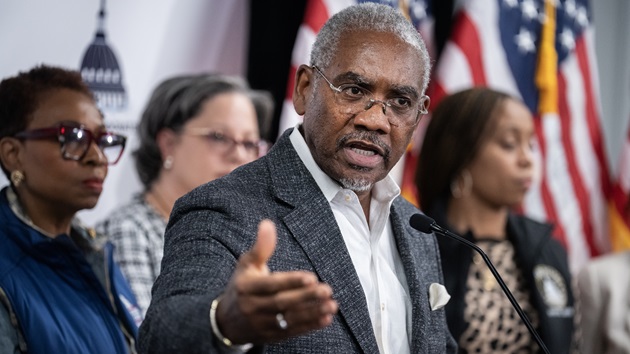
(WASHINGTON) — Rep. Gregory Meeks knows the pivotal role Black men can play in a young person’s life.
“In high school, my [Black] male teacher was Mr. Ozzie and he guided me, you know, through some difficult times and through good times,” Meeks, D-N.Y., told ABC News.
He praised Ozzie for giving him life advice and will never forget how his former teacher inspired him to pursue politics.
“He got me involved in student government at the time,” Meeks said, adding “Without the foundation, I would never be here.”
In interviews with ABC News over the last year, lawmakers across a broad spectrum discussed their relationship with the Black male figures who taught them during their formative years. Having a Black male — and a diverse group of educators — benefits “everyone,” not just Black students, according to House Minority Leader Hakeem Jeffries and education experts who spoke with ABC News.
However, less than 2% of all U.S. public school teachers are Black men, according to recent government data. It stems from the U.S. Supreme Court’s 1954 ruling in Brown v. Board of Education, which ended racial segregation in America’s public schools and prompted a massive white resistance to the new law of the land.
Leslie T. Fenwick, author of “Jim Crow’s Pink Slip: The Untold Story of Black Principal and Teacher Leadership,” told ABC News that the resistance — by mostly white Southern politicians — helped cause the shortage of Black male educators, and Black educators as a whole were forced out in droves.
House Speaker Mike Johnson, R-La., said the latest data on Black male teachers are a “concerning statistic.” Still, the Louisiana native told ABC News that he had “many” Black male teachers over the years.
“One of my favorites was Mr. Tilmer Keels,” Johnson recalled. “He was our band director in middle school. He was such a great inspirational leader,” Johnson added.
Johnson, Meeks and their colleagues overwhelmingly described Black male teachers as supportive, encouraging, and provided positive images for young people.
“They [Black male educators] were very significant for me, and we need more than just one,” Meeks said. “I should be able to talk about three, four, five, six, seven, eight of them,” he added.
Bipartisan appreciation
There’s bipartisan support throughout Congress for these impactful teachers.
Rep. Troy Carter, D-La., said teaching is one of the “most important” careers one can choose. Illinois Democratic Rep. Danny K. Davis, one of the oldest lawmakers on Capitol Hill, said his roles in public service include teaching.
Jonathan L. Jackson’s father, civil rights leader Rev. Jesse Jackson who passed away last week, served as a role model for Black youth across the nation. In the classroom, Jackson said he had at least two Black male teachers throughout high school who he said impacted his worldview.
“People need someone to look up to,” Jackson told ABC News. “That’s why we should be pushing specifically for more African American males in science, education, humanities, histories and all the other good things.”
Sen. Raphael Warnock, D-Ga., is also pushing to increase representation in the classroom.
“I’m an advocate for having more male teachers in general, but certainly Black male teachers,” he said, adding, “I think you need a picture of what you want to become in the world.”
Recruitment and retention
Over years of reporting, several Black male educators at public, charter and private pre-K-12 schools have told ABC News that they feel underappreciated and overstretched — with their numbers in the profession already small and appearing to dwindle, according to experts.
Today, 100 years after the first observance of what would become Black History Month, roughly three dozen Black males are serving in Congress. The ones who spoke to ABC News believe Black men deserve a space in the classroom.
Bobby Scott, the top Democrat on the House Education & Workforce Committee who grew up in the segregated South, doesn’t remember ever having a Black male teacher — from elementary school all the way through to when he earned his law degree from Boston College. He noted that teachers and coaches hold an important place in a child’s upbringing, stressing that there should be more Black male educators in schools.
Eric Duncan, the director for preschool-12th grade policy at the nonprofit organization The Education Trust, argued Congress holds the power to bolster the Black male educator through a multitude of levers that would incentivize them to stay in the profession, including scholarships, mortgage assistance, and teacher tax credits.
Duncan, a former social studies teacher, said Black male educators need to feel empowered. Their dismal numbers would improve if the legislative branch keeps level funding for teacher pipeline programs, he said.
“Congress has a role, I think, in continuing to appropriate those funds and continues to keep those programs for the teacher prep programs in the districts that are doing the hard work of trying to recruit and retain Black male educators in their schools,” he said.
“Artificial barriers” impeding progress
The Supreme Court’s Brown v. Board of Education ruling had a crippling impact on the retention of Black male teachers.
More than 70 years after the resistance to the Brown vs. Board of Education ruling, some lawmakers say they feel different factors of the teaching profession keep men out of the classroom, including credentialing and salaries.
Rep. John James, R-Mich., said he wishes there were more avenues for Black men to become teachers but “artificial barriers” are impeding their progress.
“The licensing and certification, the time and the money required, this erects artificial barriers to create mentors and role models, particularly for young Black men who don’t necessarily have that in their life,” James told ABC News.
Last session, multiple teacher salary bills introduced in the House and Senate never received a vote. Freshman Rep. Shomari Figures, D-Ala. said Congress has a collective obligation to address the problem.
“The salary piece of it is certainly a big thing, but we also got to get real about, you know, conditions in schools,” Figures said.
“How are we making the environment the best suitable for teachers to want to stay and remain in the classroom long term?”
Copyright © 2026, ABC Audio. All rights reserved.