
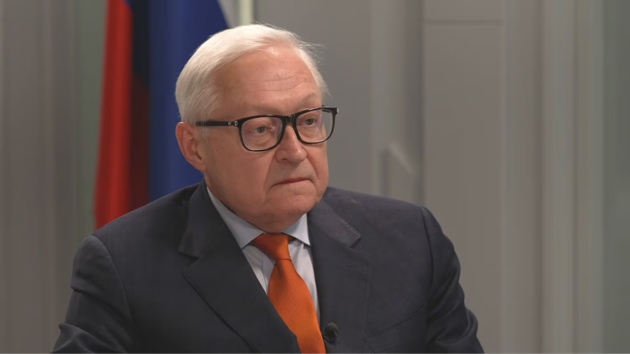
(MOSCOW and LONDON) — Russian Deputy Foreign Minister Sergey Ryabkov told ABC News during an exclusive interview on Monday that he believes the warring parties are “on the verge” of a diplomatic solution to end Moscow’s war.
“We are prepared to have a deal,” Ryabkov said of Russian President Vladimir Putin’s government. The deputy foreign minister added that he hoped an agreement would be reached “sooner rather than later.”
U.S. administration officials signaled on Monday that a peace deal between Russia and Ukraine may be closer than ever, telling reporters on the condition of anonymity that “literally 90%” of the issues between the two warring countries had been solved.
But Ryabkov also reiterated long-held demands from Moscow that Kyiv says it cannot accept as part of any peace deal. Among those is Russian control of Crimea, which was occupied in 2014, and four other partially-occupied territories — Donetsk, Luhansk, Zaporizhzhia and Kherson — in the south and east of Ukraine.
Ukrainian President Volodymyr Zelenskyy has repeatedly ruled out territorial concessions to Russia.
“We have five altogether and we are not able, in any form, to compromise on this,” Ryabkov said of Russia’s control of the territories.
Ryabkov spoke to ABC News as both Moscow and Kyiv work with American representatives on the White House’s latest peace push, intended to secure an end to Russia’s full-scale invasion of its neighbor which began in February 2022.
Another sticking point for Moscow has been the possible deployment of troops from NATO nations to Ukraine after the war.
He said Russia would not agree to a deal that included their presence on Ukrainian soil, even if they were there as part of a security guarantee or as members of the so-called “Coalition of the Willing,” as a group of mostly European leaders refer to themselves.
“We definitely will not at any moment subscribe to, agree to, or even be content with, any presence of NATO troops on the Ukrainian territory,” Ryabkov said.
Ryabkov — a high-profile figure within Russia’s Foreign Ministry who regularly speaks with international media outlets — has served as the deputy foreign minister in Moscow since 2008, working under Foreign Minister Sergey Lavrov, who has been in his post since 2004.
Ryabkov was among those Russian officials downplaying the threat looming over Ukraine in the lead up to Moscow’s full-scale invasion of its neighbor. As Russian troops massed along Ukraine’s borders in January 2022, Ryabkov said Moscow had “no intention of attacking, staging an offensive on or invading Ukraine.”
Speaking with ABC News on Monday, the deputy foreign minister refused to refer to Russia’s ongoing invasion as a war, instead using the Kremlin’s preferred phrase of a “special military operation.”
“We do what we do, we want to stop it and whether it would be stopped depends much on how people who support authorities in Kyiv recognize the inevitable outcome of our success,” Ryabkov said.
Russian officials have framed their invasion as a necessary measure to protect ethnic Russians living in Ukraine. When asked about the suffering and deaths of members of that community as a result of Moscow’s war, Ryabkov said he had sympathy for those affected.
“The whole purpose of what is being done by us there is to ensure that at least some of those people, majority of those people, find it better and find it, I would say, more appropriate to be where they belong, which is Russia.”
Ryabkov has regularly commented on various aspects of U.S.-Russian relations during the ongoing war. He has, for example, repeatedly called for renewed focus on bilateral nuclear and arms control treaties.
However, Ryabkov said this month that progress on that and topics “will only become possible for us after we become convinced of substantive and irreversible improvements in Washington’s policy toward Russia.”
Ryabkov last month told the state-owned International Affairs magazine that a new meeting between Trump and Putin was possible as Ukraine peace talks continued. “I wouldn’t rule anything out,” he said.
ABC News’ Mariam Khan and Hannah Demissie contributed to this report.
Copyright © 2025, ABC Audio. All rights reserved.